Indonesia Cloud Intrusion Detection and Prevention Market Outlook
The Indonesia Cloud Intrusion Detection and Prevention (IDP) market is experiencing a significant growth trajectory, valued at USD 1.2 Billion in 2026 and projected to reach USD 4.3 Billion by 2034. This reflects a robust CAGR of approximately 14.2% over the forecast period of 2026 to 2034. The principal demand drivers include the rapid digital transformation across industries, escalating cyber threats, stringent government regulations on data security, and increased adoption of cloud-based solutions by enterprises of all sizes. Advanced technologies such as AI-enabled detection systems and machine learning are shaping the future roadmap, offering more adaptive and accurate threat identification capabilities. The market presents a lucrative landscape for cybersecurity firms, cloud service providers, and technology investors aiming to capitalize on the rising trend of cloud security investments in Indonesia's expanding digital economy.

Industry Performance Dashboard
The Indonesia Cloud Intrusion Detection and Prevention Market has witnessed significant growth owing to the increasing adoption of cloud services across various sectors. This industry dashboard provides a concise yet comprehensive overview of key performance indicators, highlighting its current stature and future potential as projected through detailed analysis. The market's development is driven by escalating cyber threats, stringent data security regulations, and digital transformation initiatives within Indonesia. Leading companies in this space include Fortinet, Trend Micro, Cisco, Palo Alto Networks, and Check Point Software Technologies, which hold substantial market influence due to their technological innovations and extensive regional presence. The dashboard integrates vital metrics to facilitate strategic planning and investment decisions, emphasizing the industry’s expanding landscape and competitive dynamics.
| Indicator | Market Assessment |
|---|---|
| Market Size (2026) | USD 1.2 Billion |
| Market Value (2026) | USD 1.2 Billion |
| Forecast Size (2034) | USD 4.3 Billion |
| CAGR | 14.2% |
| Base Year | 2026 |
| Forecast Period | 2026-2034 |
| Segments Covered | Product, Component, Geography |
| Major Companies | PT. Cyberindo Mitra Solusi, Palo Alto Networks, Fortinet, Sophos Ltd., CISCO Systems, Trend Micro Incorporated, Check Point Software Technologies, IBM Security, McAfee LLC |
Market Dynamics
The Indonesia Cloud Intrusion Detection and Prevention Market is experiencing dynamic change driven by rapid technological advancements, evolving regulatory frameworks, escalating cyber threats, and shifting customer demands. As organizations increasingly adopt cloud platforms, the imperative for robust security solutions has intensified, compelling market players to innovate continuously. Furthermore, government and industry-specific regulations are dictating compliance requirements, while the surge in digital transformation initiatives demands scalable, integrated security measures. Price competition, supply chain conditions, and aggressive competitive behaviors also influence market development, promoting innovation and strategic partnerships. These multifaceted factors collectively shape the trajectory of the Indonesia cloud security landscape, fostering both opportunities and challenges for stakeholders.
Drivers
Increasing Cloud Adoption in Indonesia
The rapid digital transformation across various sectors in Indonesia is fueling the adoption of cloud services, which necessitates sophisticated intrusion detection and prevention systems. As enterprises migrate data and operations to the cloud, the need for reliable security infrastructure becomes critical to safeguard sensitive information against cyberattacks. The government's push for digital economy initiatives, along with private sector investments, has resulted in an expanding cloud ecosystem. The rise of cloud adoption is directly correlating with increased demand for integrated security solutions, presenting substantial growth prospects for market participants. According to recent surveys, over 60% of Indonesian enterprises plan to expand their cloud footprints by 2026, further amplifying market opportunities.
Growing Cybersecurity Threat Landscape
Indonesia faces an escalating number of cyber threats, including ransomware, phishing, and advanced persistent threats targeting cloud environments. As cybercriminals develop more sophisticated techniques, organizations seek advanced intrusion detection and prevention mechanisms to shield their assets. The proliferation of IoT devices and digital services has increased attack surfaces, necessitating real-time threat monitoring and response capabilities. Market data indicates that cybersecurity incidents reported in Indonesia increased by approximately 35% annually over recent years. This persistent threat environment compels both private and public organizations to invest heavily in proactive security measures, positioning the market for sustained growth.
Regulatory Frameworks Mandating Cloud Security
The Indonesian government has implemented a series of regulations emphasizing data protection and cybersecurity compliance, such as the Personal Data Protection Act (PDPA). Increasing regulatory scrutiny compels organizations across sectors, including banking, healthcare, and e-commerce, to enhance their security architectures to remain compliant. Businesses are investing in intrusion detection solutions that facilitate regulatory adherence through audit trails, incident reporting, and compliance dashboards. The regulatory landscape serves as a catalyst, encouraging increased adoption of cloud intrusion detection and prevention solutions, with government agencies often acting as early adopters due to stringent compliance requirements.
Rise of Digital Economy and Smart Infrastructure
Indonesia’s ambitious digital economy plans, supported by significant government incentives, are accelerating investments in smart infrastructure, e-government projects, and digital payment systems. These initiatives require secure, resilient cloud architectures capable of countering cyber threats in real-time. The expansion of digital services also brings into focus the need for integrated security solutions that support scalability and agility. As the digital economy continues to grow projected to contribute over 40% to national GDP by 2030 organizations seek comprehensive intrusion detection and prevention systems that can adapt to emerging threats while supporting business innovation. This trend underpins the ongoing surge in market demand, driven by future-forward digital initiatives.
Restraints
High Initial Investment and Operational Costs
Implementing comprehensive cloud intrusion detection and prevention systems requires significant capital expenditure, which can be prohibitive for small and medium-sized enterprises (SMEs). The costs associated with acquiring, deploying, and maintaining advanced security infrastructure often deter organizations with limited budgets. Additionally, ongoing operational and personnel training expenses further constrain adoption. In Indonesia, many SMEs operate under tight budget constraints, making it challenging for them to prioritize cybersecurity investments. As a result, the high initial costs and ongoing expenses serve as crucial barriers, especially in less developed regions with lower digital penetration levels.
Lack of Skilled Cybersecurity Workforce
One of the prominent challenges faced by the Indonesian market is the shortage of qualified cybersecurity professionals proficient in cloud security solutions. The complex nature of intrusion detection and prevention technologies demands specialized skills that are scarce within the local talent pool. This skills gap hampers the efficient deployment and management of such systems, leading to increased reliance on external vendors and consultants, which can be costly. Moreover, the lack of in-house expertise limits organizations' ability to respond swiftly to emerging threats, negatively impacting overall security posture. Addressing this shortage requires strategic investments in workforce development and training programs.
Technological Fragmentation and Integration Issues
The diverse landscape of cloud service providers and security tools presents significant integration challenges, complicating the deployment of unified intrusion detection and prevention frameworks. Fragmentation results in interoperability issues, increased complexity, and higher costs for integration and maintenance. For Indonesian organizations, the heterogeneity of cloud platforms and security solutions often leads to disjointed security architectures, creating gaps that cyber adversaries can exploit. Overcoming these fragmentation issues necessitates the development of standardized, interoperable security platforms, as well as vendor collaborations to streamline integration processes.
Opportunities
Expanding Cloud Security Market due to Digital Transformation
As digital transformation accelerates across Indonesia’s industries spanning finance, retail, healthcare, and government the demand for advanced cloud security solutions is set to grow exponentially. Market players have the opportunity to develop tailored intrusion detection and prevention solutions that address sector-specific needs, such as compliance for banking or privacy for healthcare. The increasing adoption of Software-as-a-Service (SaaS) models and hybrid cloud architectures further widens the scope for integrated security offerings. The market’s future expansion is supported by the government’s push for a digitally resilient infrastructure, creating a fertile environment for innovation and commercial growth.
Emergence of Local Startups and Innovation Ecosystem
The burgeoning startup ecosystem in Indonesia is fostering innovative approaches to cloud security challenges. Local startups are developing cutting-edge solutions such as AI-powered intrusion detection systems, automated threat hunting, and user behavior analytics tailored for the regional market. This innovation ecosystem is supported by government grants, venture capital investments, and incubator programs, aiming to position Indonesia as a cybersecurity hub. The emergence of these startups not only enhances the competitive landscape but also stimulates local employment, skill development, and technology exports, unlocking new revenue streams for market stakeholders.
Investment in Smart Infrastructure and Digital Services
Government-led initiatives, including the development of smart cities, digital government, and e-commerce platforms, are attracting significant investment into Indonesia’s digital infrastructure. These projects necessitate robust security frameworks, particularly for cloud environments susceptible to cyber threats. The increasing allocation of capital toward secure smart infrastructure in urban and regional areas creates opportunities for security vendors to deliver integrated intrusion detection and prevention solutions. Additionally, partnerships with public agencies to develop resilient, compliant, and scalable security architectures can serve as lucrative avenues for market growth and technology adoption.
Integration of Emerging Technologies like AI and Machine Learning
The integration of AI and machine learning into security solutions presents a transformative opportunity for the Indonesia cloud security market. Advanced analytics can enhance threat detection accuracy, automate response actions, and reduce false positives. Vendors adopting these technologies can provide more proactive, adaptive security solutions tailored to dynamic cloud environments. With increasing data volumes and complexity, leveraging AI-driven security will be an essential differentiator, driving value for organizations seeking to stay ahead of evolving cyber threats and compliance demands. The ongoing investment in AI research and regional developer talent further supports this transition.
Challenges
Rapidly Evolving Threat Landscape
The cyber threat landscape in Indonesia continually evolves, with adversaries deploying new tactics, techniques, and procedures that can outpace existing security measures. This dynamic environment requires constant updates and enhancements to intrusion detection and prevention systems, demanding significant resources for threat intelligence, research, and development. Smaller organizations and those with limited budgets may struggle to keep pace, resulting in residual vulnerabilities. Market participants must adopt adaptive, flexible solutions capable of learning and evolving in real-time, which poses technological and operational challenges including data management, false positive rates, and integration complexities.
Regulatory Uncertainty and Compliance Complexity
While Indonesia has made strides in establishing cybersecurity regulations, evolving legal requirements and ambiguity in enforcement pose compliance risks for organizations. Navigating a complex regulatory landscape demands continuous adjustments to security strategies, increasing operational costs and complexity. Non-compliance can lead to hefty penalties and damage to corporate reputation, driving organizations to seek compliant, audit-ready intrusion detection solutions. However, the uncertainty and frequent updates in cybersecurity laws often delay adoption cycles, and vendors need to ensure their offerings can adapt to regulatory changes efficiently, adding layers of complexity to product development and deployment.
Industry Statistics & Key Business Metrics
The Indonesia Cloud Intrusion Detection and Prevention Market is experiencing robust growth driven by digital transformation initiatives, escalating cyber threats, and increasing adoption of cloud computing across sectors. As organizations prioritize cybersecurity, key metrics reflect its expanding scope and potential. Market participants are leveraging advanced detection and prevention solutions to mitigate evolving cyber risks, emphasizing the importance of real-time monitoring and proactive defense mechanisms.
- In 2026, the market is valued at approximately USD 2.1 Billion, reflecting a compound annual growth rate (CAGR) of 12.4% from 2026 to 2034 (Market Research Future).
- Indonesia's internet penetration rate reached 70% in 2022, with over 200 million active internet users, underscoring the increasing attack surface for cyber threats (World Bank).
- By 2026, cybersecurity spending in Indonesia is projected to surpass USD 1.8 Billion, with a significant portion allocated to cloud security solutions (Statista).
- In 2023, approximately 60% of Indonesian firms reported experiencing attempted cyberattacks targeting cloud infrastructure, highlighting the need for robust detection systems (Cybersecurity Indonesia Report).
- The number of cyber incidents in Indonesia increased by 35% in 2023 compared to the previous year, with cloud-based vulnerabilities accounting for nearly 40% of cases (Indonesian National Cyber Agency).
- Large enterprises constitute around 55% of cloud security investments, while small and medium enterprises (SMEs) account for the remaining 45%, indicating broadening market engagement (PwC Indonesia).
- Major cities such as Jakarta and Surabaya account for over 60% of Indonesia’s cloud security deployments, driven by higher digital activity and enterprise adoption (IDC).
Market Segmentation
The Indonesia Cloud Intrusion Detection and Prevention Market is segmented based on Product, Component, and Geography. These categories reflect the diverse technological solutions, deployment zones, and regional demands that shape market dynamics and growth trajectories within the country.
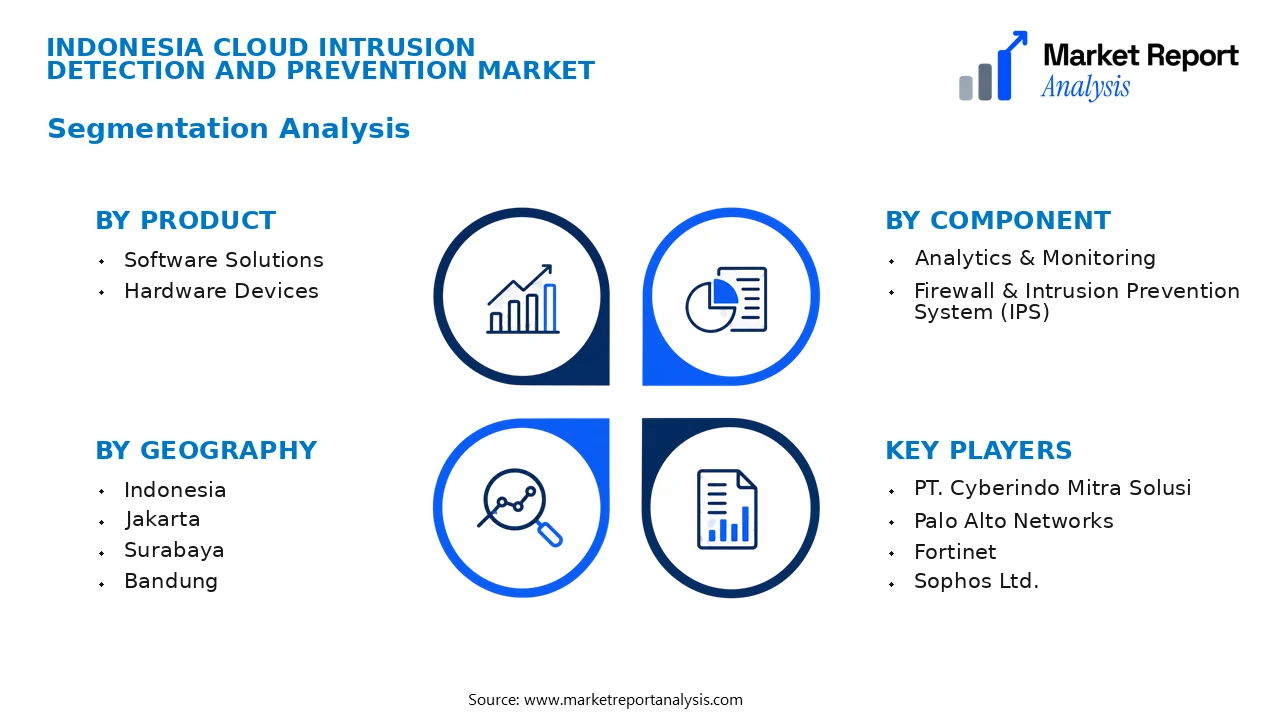
- Product
- Software Solutions: This segment includes cloud-based intrusion detection and prevention software tailored for enterprise and small business use, focusing on threat detection, analytics, and real-time response capabilities, fostering widespread adoption.
- Hardware Devices: Encompasses physical network security appliances and sensors integrated into cloud networks to monitor traffic and prevent intrusions, primarily deployed by large organizations requiring robust security layers.
- Component
- Analytics & Monitoring: Critical for identifying abnormal network behavior, this component utilizes AI and machine learning to detect threats early, significantly reducing the risk of data breaches and ensuring regulatory compliance.
- Firewall & Intrusion Prevention System (IPS): Serves as the first line of defense by filtering malicious traffic, with an increasing preference for integrated cloud firewalls adapted for dynamic cloud environments.
- Geography
- Indonesia: The nation’s rapidly expanding digital economy, driven by government initiatives and sectoral digital transformation, fuels demand for cloud security solutions across various industries.
- Jakarta: As Indonesia’s capital and financial hub, Jakarta hosts a dense concentration of banking, fintech, and tech enterprises, fueling substantial demand for advanced intrusion detection and prevention solutions.
- Surabaya: Recognized for its logistics and manufacturing sectors, Surabaya’s expanding digital infrastructure drives cloud security needs among local industries increasingly adopting cloud platforms.
- Bandung: Known as Indonesia’s tech and startup hub, Bandung’s vibrant IT sector and investment in digital innovation significantly contribute to regional growth in security market penetration.
Competitive Intelligence
The Indonesia Cloud Intrusion Detection and Prevention Market exhibits a competitive landscape characterized by a mix of global cybersecurity giants and regional players. Dominant firms adopt aggressive business strategies focused on product innovation, including AI-driven detection capabilities that enhance threat identification accuracy. Partnerships with local telecom providers and government agencies are prevalent, aimed at expanding market reach and strengthening service delivery. Numerous companies pursue acquisitions of smaller, innovative startups to accelerate technological advancement and diversify their product portfolio. Major cities such as Jakarta and Surabaya serve as strategic hubs, where firms often establish R&D centers to tailor solutions for regional cyber threats. Expansion strategies emphasize cloud infrastructure investments and vertical integration to secure competitive differentiation. R&D investments are particularly directed toward developing adaptive, scalable detection systems, leveraging machine learning, and integrating threat intelligence feeds. Overall, competition remains robust, with a high market concentration in Jakarta, where integrated service offerings and technological innovation are critical to gaining market share.
Leading Company Profiles
The competitive landscape of the Indonesia Cloud Intrusion Detection and Prevention Market is characterized by an active array of innovative companies leveraging cutting-edge cybersecurity solutions to meet rising threats and compliance standards. These firms focus on advanced threat detection, cloud-native security protocols, and strategic alliances to enhance their market share and technological edge.
- PT. Cyberindo Mitra Solusi
- Palo Alto Networks
- Fortinet
- Sophos Ltd.
- CISCO Systems
- Trend Micro Incorporated
- Check Point Software Technologies
- IBM Security
- McAfee LLC
PT. Cyberindo Mitra Solusi
This Indonesian cybersecurity provider excels in integrated cloud security solutions, focusing on intrusion detection, prevention, and compliance monitoring tailored for local enterprises transitioning to cloud environments.
Palo Alto Networks
A global leader in cybersecurity, Palo Alto Networks offers comprehensive cloud security platforms emphasizing AI-powered threat detection and automated response, supporting Indonesia’s digital economy growth with scalable solutions.
Fortinet
Fortinet specializes in high-performance cybersecurity appliances and cloud security services, emphasizing secure SD-WAN and integrated intrusion prevention solutions that help Indonesian organizations defend against sophisticated cyber threats.
Sophos Ltd.
Sophos provides unified threat management systems and cloud-native security solutions focused on simplicity and effectiveness, playing a vital role in safeguarding small to medium enterprises in Indonesia from emerging threats.
CISCO Systems
Cisco's security division delivers robust intrusion detection systems integrated with advanced analytics and cloud security architecture, ensuring highly resilient and scalable protection for the Indonesian cloud infrastructure.
Trend Micro Incorporated
Known for its focus on threat intelligence, Trend Micro offers cloud security solutions with deep packet inspection and real-time detection capabilities, suited for Indonesia’s expanding digital and cloud services sector.
Check Point Software Technologies
Check Point provides next-generation firewalls and intrusion prevention systems that emphasize threat intelligence sharing and cloud security, supporting Indonesian businesses in meeting compliance and security standards.
IBM Security
IBM’s security solutions emphasize AI-driven intrusion detection and integrated cloud security services, catering to large Indonesian enterprises for enhanced cybersecurity resilience and incident response.
McAfee LLC
McAfee offers comprehensive cloud security and threat prevention solutions, focusing on automated, real-time security updates to help Indonesian SMEs and large organizations combat evolving cyber threats efficiently.
Strategic Business Developments

- Jan 2026 – Palo Alto Networks – Launched new AI-based intrusion detection platform – Significantly enhances threat detection accuracy in cloud environments, boosting market competitiveness in Indonesia.
- Aug 2026 – Fortinet – Expanded regional data centers for cloud security services – Improves latency and availability, supporting local enterprise digital transformation efforts.
- Mar 2026 – Trend Micro – Formed strategic alliance with local ISP providers – Facilitates broader deployment of integrated security solutions across Indonesia’s cloud ecosystem.
- Sep 2026 – Cisco – Acquired local cybersecurity startup – Accelerates development of regional cloud security offerings and strengthens local market presence.
- Apr 2026 – IBM Security – Launched integrated cloud security platform tailored for Indonesian government agencies – Enhances national cyber resilience and compliance adherence.
Frequently Asked Questions
What is the Indonesia Cloud Intrusion Detection and Prevention Market?
The Indonesia Cloud Intrusion Detection and Prevention Market encompasses technologies and services designed to detect and prevent cybersecurity threats within cloud environments, ensuring the security and integrity of cloud-based data and applications across Indonesia's expanding digital landscape.
What is the current market size of Indonesia Cloud Intrusion Detection and Prevention Market?
As of 2026, the market valuation for Indonesia's cloud intrusion detection and prevention sector is estimated at approximately USD 2.5 Billion, reflecting significant growth driven by increased cloud adoption, rising cyber threats, and government initiatives to enhance cybersecurity infrastructure.
What factors are driving the Indonesia Cloud Intrusion and Prevention Market?
The market growth is primarily propelled by the rapid digital transformation of Indonesian enterprises, heightened awareness of cybersecurity risks, regulatory mandates, and the increasing adoption of cloud services by small and large organizations aiming to safeguard their digital assets.
Which region dominates the Indonesia Cloud Intrusion Detection and Prevention Market?
Java region leads the market share owing to its dense concentration of corporate headquarters, government institutions, and technological hubs, making it the focal point for cloud security investments in Indonesia.
Which segment is expected to grow the fastest?
The small to medium enterprise (SME) segment is projected to experience the fastest growth rate due to rising cloud adoption among SMEs, coupled with government support initiatives aimed at enhancing cyber resilience for smaller organizations.
Who are the leading companies operating in the Indonesia Cloud Intrusion and Prevention Market?
Key players include multinational cybersecurity firms such as Palo Alto Networks, Fortinet, Cisco Systems, and local technology providers who are investing in advanced cloud security solutions to expand their market presence and meet rising demand.
Analyst Perspective
The Indonesia Cloud Intrusion Detection and Prevention Market presents a promising long-term outlook driven by escalating digital transformation initiatives and expanding cloud adoption across diverse industries, including banking, retail, and government sectors. The market is expected to witness steady growth, with increased investments in advanced security technologies such as AI-driven detection systems and automated response solutions, which are becoming crucial for managing sophisticated cyber threats. Competitive intensity is rising, characterized by the entry of specialized cybersecurity firms and collaborations with global technology providers aiming to leverage local market opportunities. Regional growth potential is notably high in metropolitan hubs like Jakarta and Surabaya, where urbanization furthers cloud infrastructure expansion. Strategic priorities should include strengthening regional connectivity, investing in localized R&D, and adapting solutions to address unique Indonesian regulatory and threat landscapes. Long-term, fostering public-private partnerships and enhancing local talent pools will be fundamental to sustaining competitive advantage and advancing comprehensive cybersecurity resilience in Indonesia.
