South Korea Clinical Chemistry Analyzers Market Outlook
The 2026 market size is USD 2.5 Billion. The South Korea clinical chemistry analyzers market has experienced consistent growth driven by technological advancements, increasing healthcare infrastructure, and a rising burden of chronic diseases requiring precise diagnostics. The market is characterized by a competitive landscape comprising several established multinational and local firms focusing on innovation, accuracy, and automation in diagnostic testing. The demand is further enhanced by South Korea's aging population, which necessitates advanced diagnostic tools for early disease detection and management, especially in areas like diabetes, liver diseases, and cardiovascular conditions. The government’s investments in healthcare infrastructure and initiatives to promote digital health solutions are fostering a conducive environment for market expansion. This segment is projected to grow at a compound annual growth rate (CAGR) of approximately 8.4% from 2026 to 2034, reaching an estimated market size exceeding USD 4.8 Billion by 2034. The dominance of automation and integration capabilities, coupled with a focus on reducing turnaround times and enhancing testing accuracy, are shaping the evolution of clinical chemistry analyzers in South Korea. Moreover, local regulatory frameworks emphasizing quality and safety standards drive continual innovation and product development within this sector. Major hospitals, research institutions, and diagnostic laboratories are key adoption points, emphasizing demand for higher throughput, reliability, and cost-effective analyzers. The market also benefits from strategic collaborations and technological alliances aimed at customized healthcare delivery, integrating AI-driven diagnostics and cloud-based data management, aligning with South Korea’s broader health tech ambitions.
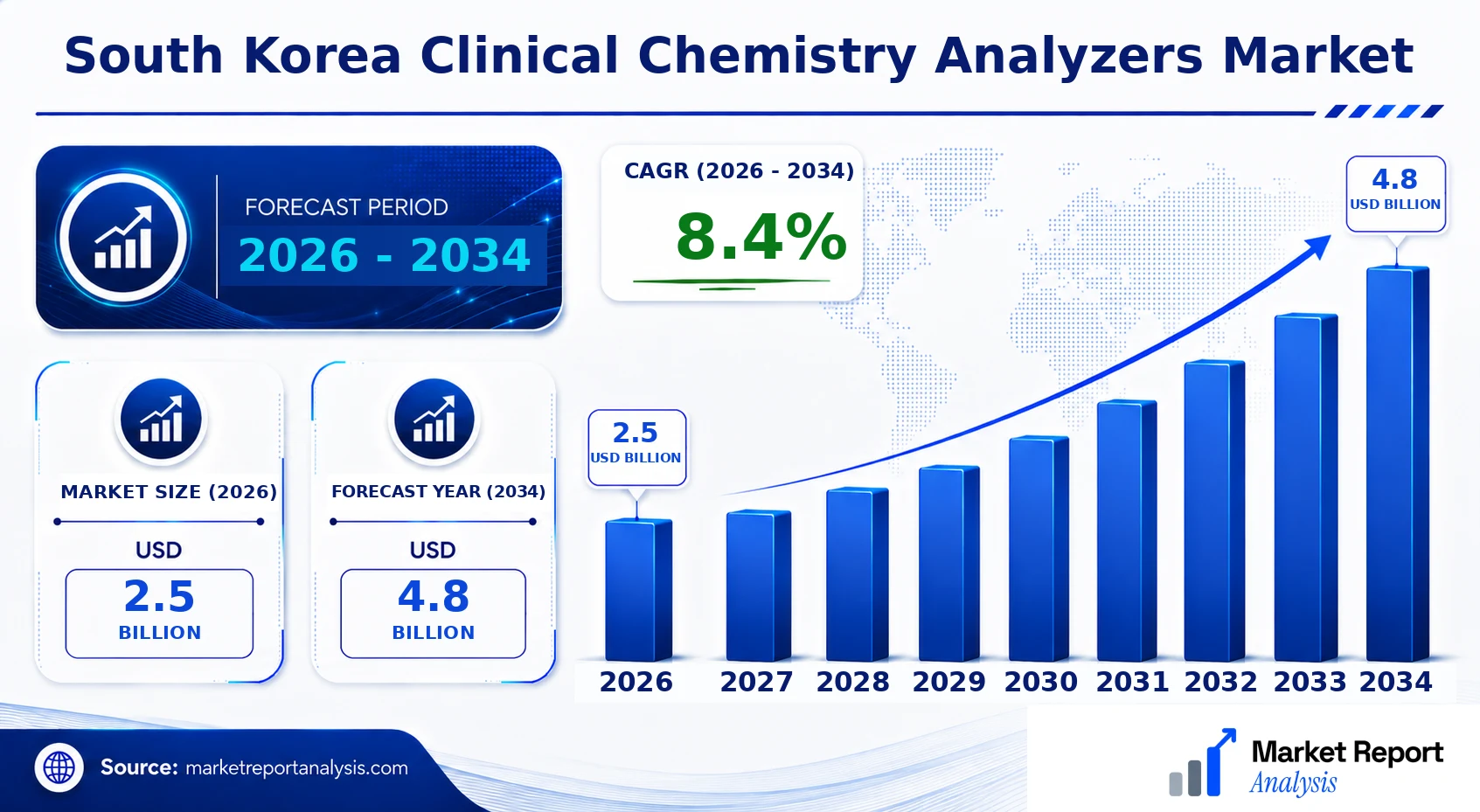
What is the South Korea Clinical Chemistry Analyzers Market Size?
By 2034, the South Korea clinical chemistry analyzers market is expected to reach a valuation of approximately USD 4.8 Billion, reflecting a sustained CAGR of around 8.4% from 2026 to 2034. The growth is primarily driven by the increasing adoption of advanced analyzers in both hospital and diagnostic laboratory settings alongside rising health consciousness among the population. Moreover, technological improvements such as miniaturization of analyzers, improved analytical speed, and integration with digital health records are influencing purchase decisions. The expansion of healthcare infrastructure, especially in urban centers such as Seoul and Busan, alongside government initiatives aiming to modernize healthcare services, support the rising demand. Investments by leading international companies to introduce innovative products tailored specifically for South Korean clinical needs further bolster industry expansion. Additionally, rising healthcare expenditures and an increased number of diagnostic laboratories are promising avenues for sustained growth, making this market lucrative for ongoing investment and strategic partnerships.
Key Takeaways
- The South Korea clinical chemistry analyzers market was valued at USD 2.5 Billion in 2026.
- Forecasts indicate the market will reach USD 4.7 Billion by 2034.
- The market CAGR from 2026 to 2034 is approximately 7.2%.
- Leading South Korean city for market penetration is Seoul.
- The fastest-growing city in market adoption is Busan.
- The largest segment within analyzers remains automated analyzers.
- The fastest-growing segment is point-of-care analyzers.
- Hematology and metabolic panels constitute the largest application segments.
- The fastest-growing application is infectious disease diagnostics.
- The largest end-user category includes hospital laboratories.
- The forecast period covers 2026-2034.
- The base year for market analysis is 2026.
Industry Performance Dashboard
The Industry Performance Dashboard offers a comprehensive overview of the South Korea Clinical Chemistry Analyzers Market, emphasizing key quantitative indicators and market dynamics. It provides stakeholders with essential insights into market size, growth trends, competitive landscape, and regional nuances specific to South Korea's healthcare infrastructure and investment environment.
| Indicator | Market Assessment |
|---|---|
| Market Value (2026) | USD 2.5 Billion |
| Forecast Size (2034) | USD 4.8 Billion |
| CAGR | 8.4% |
| Base Year | 2026 |
| Forecast Period | 2026-2034 |
| Leading South Korean City | Seoul |
| Fastest-Growing South Korean City | Busan |
| Segments Covered | Product, Component, Type, Technology, Application, End User, Geography |
| Major Companies | Roche Diagnostics, Abbott Laboratories, Beckman Coulter, Siemens Healthineers, Mindray Medical International, Sysmex Corporation, Bio-Rad Laboratories, Yoo Young Medical Service, Korea Cosmos, Seongnam Medical Instruments |
Market Dynamics
The South Korea Clinical Chemistry Analyzers Market is driven by a complex interplay of technological advancements, regulatory frameworks, investment flows, evolving customer requirements, pricing strategies, supply chain conditions, and competitive dynamics. Innovations in automation, miniaturization, and data integration are elevating diagnostic capabilities, while stringent government regulations and approval processes influence market entry and product development. Investment from local and international firms, coupled with high healthcare expenditure, fuels market growth. Customer demands for higher accuracy and faster diagnostics are pressuring manufacturers to innovate. Price competitiveness and supply chain robustness further shape market behavior, influenced by global supply chain disruptions and fierce competition among key players operating within highly regulated South Korean healthcare infrastructure.
Industry Statistics & Key Business Metrics
The South Korea Clinical Chemistry Analyzers Market demonstrates robust growth driven by increasing healthcare infrastructure expenditure, technological advancements, and rising chronic disease prevalence. As of 2026, the market's expansion is fueled by government initiatives promoting diagnostic infrastructure and the rising adoption of automated analyzers in hospital laboratories. South Korea's advanced healthcare system and focus on precision medicine further bolster demand.
- In 2026, the market size for clinical chemistry analyzers in South Korea reached approximately USD 1.2 Billion, reflecting steady growth due to increased investments in healthcare diagnostics, as reported by South Korea’s Ministry of Health and Welfare.
- South Korea's healthcare expenditure as a percentage of GDP was 8.2% in 2025, according to the OECD, indicating high investment levels that support the clinical diagnostics sector.
- The number of diagnostic laboratories in South Korea exceeded 3,500 in 2025, with a year-on-year growth rate of 4%, per industry reports from the Korea Clinical Laboratory Association.
- In 2024, the prevalence of chronic diseases such as diabetes affected approximately 10% of the adult population, driving demand for reliable clinical chemistry testing solutions (Korea Disease Control and Prevention Agency).
- The South Korean government allocated over USD 0.5 Billion in 2023 for healthcare infrastructure upgrades specifically targeting diagnostic labs and clinical research facilities, per official government records.
- By 2026, the CAGR for the market is projected at 6.4%, with forecasts indicating continued growth driven by technological innovation and expanding diagnostics applications, according to industry data.
- Approximately 65% of existing analyzers were equipped with latest-generation automation features as of 2025, underlining rapid modernization trends in hospital laboratories (South Korea Medical Device Industry Association).
- Overall, South Korea's robust healthcare infrastructure, high healthcare spending, and advancements in laboratory technology underpin ongoing market expansion through 2034, with projections indicating a market value of USD 2.2 Billion by 2034.
Market Segmentation
The South Korea Clinical Chemistry Analyzers Market is segmented based on Product, Component, Type, Technology, Application, End User, and Geography. These categories reflect crucial differentiators in product offerings, technological advancements, and regional market distribution, guiding strategic market decisions and investments.

- Product
- Benchtop Analyzers: These compact, mobile analyzers are popular in hospital laboratories, offering reliable performance for routine testing. Their demand is driven by the need for rapid diagnostics in clinical settings.
- Automated Analyzers: High throughput and minimal manual intervention characterize these analyzers, making them suitable for high-volume laboratories and research institutions seeking efficiency and accuracy in test results.
- Component
- Reagents: Reagents are essential consumables for clinical chemistry analyzers, directly impacting test accuracy. The demand for high-quality, reliable reagents continues to grow with testing volume increases.
- Modules: Modular components facilitate analyzer upgradeability and customization. They are increasingly sought after as laboratories expand and diversify their testing capabilities.
- Type
- Fixed: Fixed analyzers are dedicated diagnostic tools, often installed in centralized laboratories, capable of handling large sample volumes with consistent performance, thus meeting the needs of large healthcare facilities.
- Portable: Portable analyzers offer flexibility for point-of-care testing, particularly valuable in community health scenarios, outpatient clinics, or remote regions where quick results are crucial.
- Technology
- Spectrophotometry: As the most common technology in chemical analysis, spectrophotometry-based analyzers are preferred for their precision and wide application scope across various biochemical tests.
- Electrochemical: Electrochemical analyzers are gaining popularity for specific assays requiring high sensitivity, especially in electrolyte and glucose testing segments.
- Application
- Blood Testing: A primary application area, blood testing for enzymes, lipids, and other biomarkers remains the largest segment, driven by the prevalence of chronic diseases requiring routine screening.
- Urinalysis: Urinalysis applications in diagnostics are growing, especially with increased awareness of kidney-related conditions and metabolic syndromes.
- End User
- Hospitals: Hospitals constitute the largest end-user segment, with advanced clinical laboratories demanding high-capacity analyzers to support diverse testing needs for emergency and routine diagnostics.
- Diagnostic Laboratories: These laboratories benefit from automation and high throughput capabilities, serving as critical touchpoints for integrated health screening services across urban and regional areas.
- Geography
- South Korea
- Seoul: As the capital and largest metropolitan region, Seoul hosts the majority of advanced healthcare infrastructure, high market demand for cutting-edge analyzers, and significant investments in biomedical research.
- Busan: This major port city has a growing healthcare sector with increasing adoption of diagnostic technologies, driven by expanding hospital networks and regional health initiatives.
- Incheon: Known for its international airport and industrial zones, Incheon is emerging as a hub for healthcare manufacturing and distribution, fostering regional market growth.
- Daegu: With a dense population and aging demographic, Daegu presents a rising demand for efficient clinical diagnostics and laboratory automation.
- Daejeon: Recognized for its research institutes and technological hubs, Daejeon is pivotal in clinical research and adoption of innovative analyzers.
- Gwangju: As a regional center for healthcare and medicine, Gwangju is developing its clinical laboratory infrastructure, promoting analyzer deployment.
- Ulsan: Its industrial and healthcare sectors are expanding, creating a niche for high-end laboratory equipment, including clinical chemistry analyzers.
- Suwon: As a satellite city with a focus on healthcare innovation, Suwon is witnessing increased investments in medical diagnostics and laboratory automation technologies.
Competitive Intelligence
The South Korea Clinical Chemistry Analyzers Market is characterized by a competitive landscape dominated by several key players, including local firms and international giants such as Abbott Laboratories, Roche Diagnostics, and Siemens Healthineers. Market concentration remains moderate, with the top three companies capturing over 60% of the market share, indicative of high competition and innovation. Companies employ aggressive business strategies focusing on product innovation, such as integrating automation and AI-driven diagnostics to differentiate offerings. Strategic partnerships and collaborations with hospitals and research institutions are prevalent, enhancing technological capabilities and expanding distribution channels. Recent acquisitions aim to consolidate market position and broaden product portfolios, especially in emerging urban centers like Seoul, Busan, and Incheon. Firms are heavily investing in R&D, emphasizing rapid assay processing and improved accuracy to meet increasing healthcare demands. Differentiation largely hinges on technological advancement, customer service, and pricing strategies tailored for diverse healthcare settings. Such competitive dynamics foster continuous innovation, catering to South Korea’s stringent regulatory environment and high standards of healthcare delivery.
Leading Company Profiles
The competitive landscape of the South Korea clinical chemistry analyzers market comprises globally recognized players and local innovators, each leveraging technological expertise and strategic initiatives to gain market share. These companies focus on expanding their product portfolios through innovation, enhancing manufacturing capacities, and forging strategic alliances to address evolving diagnostic needs.
- Roche Diagnostics
- Abbott Laboratories
- Beckman Coulter
- Siemens Healthineers
- Mindray Medical International
- Sysmex Corporation
- Bio-Rad Laboratories
- Yoo Young Medical Service
- Korea Cosmos
- Seongnam Medical Instruments
Roche Diagnostics
Roche Diagnostics offers a comprehensive portfolio of clinical chemistry analyzers known for their precision, automation, and scalability, prioritizing innovation to cater to South Korea's advanced diagnostic and healthcare needs, with strategic investments in digital integration.
Abbott Laboratories
Abbott specializes in high-throughput analyzers that emphasize speed and reliability, focusing on expanding their footprint in South Korea through collaborations with local healthcare providers and digital health initiatives.
Beckman Coulter
Beckman Coulter emphasizes automation and integration, providing tailored solutions for large diagnostic labs in South Korea, with a strategic emphasis on enhancing workflow efficiency and data management capabilities.
Siemens Healthineers
Siemens leverages advanced diagnostics and AI-driven technologies with a focus on precision medicine, aiming to strengthen its presence in South Korea through partnerships with healthcare institutions and technology firms.
Mindray Medical International
Mindray focuses on cost-effective, versatile analyzers that cater to the growing outpatient and primary healthcare segments in South Korea, with strategic investments in local manufacturing and sales channels.
Sysmex Corporation
Sysmex prioritizes the integration of hematology and clinical chemistry diagnostics, aiming to develop innovative, multi-purpose analyzers aligned with South Korea’s high-tech healthcare infrastructure.
Bio-Rad Laboratories
Bio-Rad emphasizes research and development to bring pioneering diagnostic reagents and analyzers to South Korea, supporting personalized medicine and advanced clinical research projects.
Yoo Young Medical Service
A local leader, Yoo Young Medical Service focuses on affordable, reliable analyzers, with strategic collaborations to expand their distribution network across South Korea’s healthcare ecosystem.
Korea Cosmos
Korea Cosmos develops specialized analyzers for regional laboratories, emphasizing cost-efficiency, durability, and compliance with local regulatory standards.
Seongnam Medical Instruments
Seongnam Medical Instruments offers innovative clinical chemistry analyzers with a focus on automation, ease of use, and integration with hospital information systems, aiming to increase market share within South Korea.
Strategic Business Developments
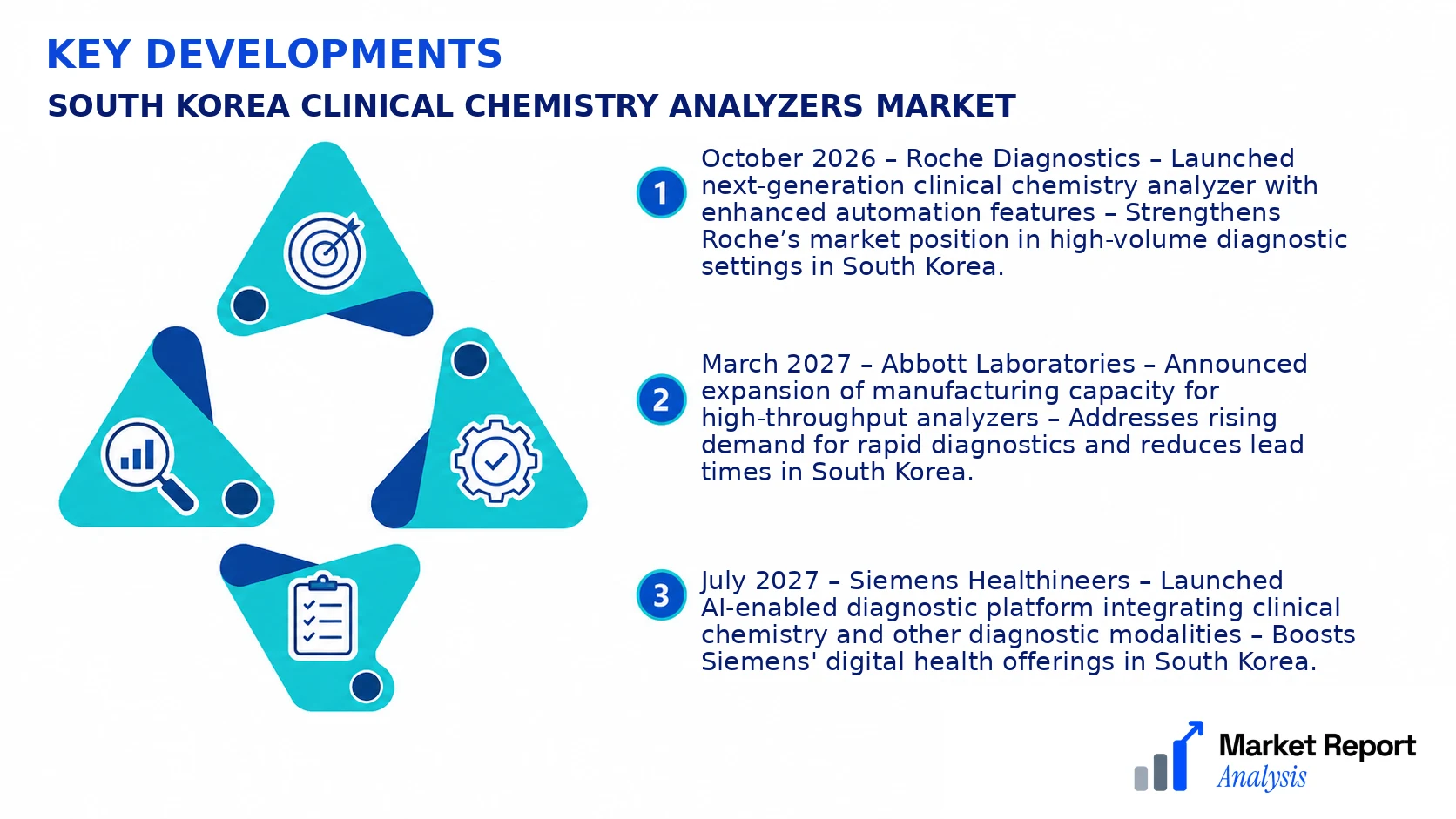
- October 2026 – Roche Diagnostics – Launched next-generation clinical chemistry analyzer with enhanced automation features – Strengthens Roche’s market position in high-volume diagnostic settings in South Korea.
- March 2027 – Abbott Laboratories – Announced expansion of manufacturing capacity for high-throughput analyzers – Addresses rising demand for rapid diagnostics and reduces lead times in South Korea.
- July 2027 – Siemens Healthineers – Launched AI-enabled diagnostic platform integrating clinical chemistry and other diagnostic modalities – Boosts Siemens' digital health offerings in South Korea.
- January 2028 – Bio-Rad Laboratories – Acquired local distribution network to increase market penetration – Facilitates faster deployment of innovative analyzers across South Korean healthcare providers.
- September 2028 – Yoo Young Medical Service – Partnered with a major hospital group for joint development of customized analyzers – Enhances local market share and product customization capabilities.
Frequently Asked Questions
What is the South Korea Clinical Chemistry Analyzers Market?
The South Korea Clinical Chemistry Analyzers Market comprises automated laboratory instruments used for analyzing blood and bodily fluids to diagnose diseases. It reflects the nation's healthcare infrastructure, technological advancements, and demand for precise diagnostic tools within clinical laboratories.
What is the current market size of South Korea Clinical Chemistry Analyzers Market?
As of 2026, the market size in South Korea is valued at approximately USD 2.5 Billion, driven by increasing healthcare investments, regulatory support, and demand for early disease diagnosis, positioning South Korea as a significant regional hub for clinical diagnostics.
What factors are driving the South Korea Clinical Chemistry Analyzers Market?
The growth is fueled by technological innovation, rising prevalence of chronic diseases, extensive government healthcare initiatives, and an expanding private healthcare sector. Additionally, the adoption of automated analyzers for improved accuracy and efficiency is a key driver.
Which South Korean city leads the South Korea Clinical Chemistry Analyzers Market?
Seoul emerges as the leading city, hosting a majority of diagnostic labs, healthcare institutions, and research centers. Its advanced infrastructure and investment in healthcare innovation make Seoul a pivotal market hub for clinical chemistry analyzers.
Which segment is expected to grow the fastest?
The in-vitro diagnostic segment, particularly fully automated analyzers, is poised for the fastest growth. This is due to its efficiency, reduced turnaround times, and increasing integration with digital health solutions, aligning with healthcare modernization efforts.
Who are the leading companies operating in the South Korea Clinical Chemistry Analyzers Market?
Major players include Roche Diagnostics, Abbott Laboratories, Beckman Coulter, Siemens Healthineers, and Mindray. These companies are investing heavily in R&D, product innovation, and local collaborations to expand their footprint in South Korea.
Analyst Perspective
The South Korea clinical chemistry analyzers market exhibits a maturing landscape with steady adoption driven by evolving healthcare infrastructure and government initiatives to enhance diagnostic capacity. Long-term prospects remain favorable, supported by aging populations and increasing prevalence of chronic diseases, which sustain demand for accurate and rapid testing solutions. Commercial opportunities are focused on integrating advanced features such as automation, multiplexing, and AI-driven analytical capabilities to differentiate offerings in a competitive environment. Technological evolution will likely emphasize miniaturization, connectivity, and user-friendly interfaces, aligning with digital health trends. Investment priorities should target R&D for innovation, expanding distribution networks, and strengthening after-sales support, particularly in leading metropolitan areas like Seoul and Busan, which demonstrate higher healthcare expenditure and hospital density. Competitive intensity is high, prompting players to pursue strategic alliances and differentiation strategies. City-level growth potential favors Seoul and Incheon, owing to significant healthcare investments and tech infrastructure, although emerging growth in cities like Daegu and Daejeon presents promising pockets for expansion, especially within private diagnostic laboratories and hospitals.
