Saudi Arabia Clinical Chemistry Analyzers Market Outlook
The Saudi Arabia clinical chemistry analyzers market is experiencing significant growth propelled by increasing healthcare expenditure, rising prevalence of chronic diseases, and expanding laboratory infrastructure. The market was valued at approximately USD 0.35 Billion in 2026 and is projected to reach around USD 0.78 Billion by 2034, exhibiting a robust CAGR of 10.8% during the forecast period from 2026 to 2034. The principal demand drivers include the government’s focus on healthcare modernization, technological advances in diagnostic tools, and an increasing awareness of early disease detection. The sector is witnessing a technological shift towards fully automated analyzers, driven by innovations that enhance throughput, precision, and ease of use. Commercial opportunities are expanding for local and international players as hospitals, diagnostic laboratories, and research institutions seek high-quality, reliable diagnostic platforms to meet rising healthcare standards and patient loads.
What is the Saudi Arabia Clinical Chemistry Analyzers Market Size?
In 2026, the Saudi Arabia clinical chemistry analyzers market was valued at approximately USD 0.35 Billion and is forecasted to grow to USD 0.78 Billion by 2034, with a CAGR of 10.8% over the period from 2026 to 2034. Growth drivers include increasing healthcare infrastructure investments, a rising burden of non-communicable diseases such as diabetes and cardiovascular conditions, and technological upgrades in laboratory diagnostics. The expansion of private healthcare providers and diagnostic service centers substantially contributes to market growth. The adoption of advanced analytical systems, including fully automated and semi-automated analyzers, is driven by the need for faster turnaround times and higher accuracy, which are critical for clinical decision-making. Opportunities for future investments include strengthening lab automation, expanding service networks in secondary and tertiary urban centers, and integrating digital health solutions to improve diagnostic accuracy and operational efficiency. Overall, these factors cumulatively boost demand for clinical chemistry analyzers across Saudi Arabia, shaping a lucrative landscape for ongoing market development.
Key Takeaways
- The Saudi Arabia clinical chemistry analyzers market was valued at USD 0.35 Billion in 2026.
- The market is projected to reach USD 0.78 Billion by 2034.
- The CAGR for the forecast period is 10.8% from 2026 to 2034.
- Riyadh is the leading Saudi city driving market growth.
- Jeddah is the fastest-growing city in the region for clinical chemistry analyzer adoption.
- The large segment comprises mid- to high-throughput analyzers.
- Automation systems are the fastest-growing segment due to technological advancements.
- Hospitals are the fastest-growing application sector driven by increasing patient loads.
- Hospitals are the largest end users of clinical chemistry analyzers.
- The forecast period spans from 2026 to 2034.
- The base year for analysis is 2026.
Industry Performance Dashboard
The Industry Performance Dashboard provides a comprehensive snapshot of the Saudi Arabia Clinical Chemistry Analyzers Market, highlighting key indicators that influence its current status and projected growth trajectory. As of 2026, the market size is valued at approximately USD 1.2 Billion, reflecting significant healthcare infrastructure development and increasing demand for diagnostic services in the region. The forecast indicates a steady compound annual growth rate (CAGR) of 7.2% from 2026 to 2034, driven by technological advancements, rising prevalence of chronic diseases, and government initiatives aimed at enhancing healthcare delivery.
The market’s development is predominantly concentrated in Riyadh, which remains the leading Saudi city, owing to its advanced healthcare infrastructure and considerable investment in medical diagnostics. Meanwhile, Jeddah is projected to be the fastest-growing city, fueled by expanding healthcare facilities and increasing healthcare expenditure.
Segments covered include automated analyzers, semi-automated analyzers, and benchtop analyzers, with automated analyzers holding the largest market share due to their efficiency and accuracy. Major companies operating in this sector include Abbott Laboratories, Roche Diagnostics, Mindray Medical International, and Siemens Healthineers, all of which are expanding their footprint through strategic partnerships and innovation.
Investment trends reveal continuous capital inflow aimed at upgrading laboratory infrastructure and integrating digital health technologies. Pricing trends indicate a gradual decrease in device costs owing to technological improvements and increased competition. Overall, the market maturity is escalating, with an increasing number of hospitals and diagnostic laboratories adopting state-of-the-art clinical chemistry analyzers to improve diagnostic accuracy and patient outcomes.
Market Dynamics
The Saudi Arabia Clinical Chemistry Analyzers Market is influenced by an array of factors encompassing technological advances, regulatory frameworks, investment trends, customer requirements, pricing strategies, supply chain dynamics, and competitive behaviors. Rapid integration of automation and digital health solutions, complemented by evolving government policies aimed at enhancing healthcare quality, are pivotal. Furthermore, increased domestic and foreign investments in healthcare infrastructure, alongside a quest for cost-effective yet accurate diagnostics, are reshaping the landscape. Market competition intensifies as local and international manufacturers innovate and expand. These elements collectively govern the growth trajectory, operational strategies, and future outlook of the clinical chemistry analyzers sector in Saudi Arabia.
Industry Statistics & Key Business Metrics
The Saudi Arabia Clinical Chemistry Analyzers Market has demonstrated strong growth over recent years, driven by increasing healthcare expenditure, expanding diagnostic laboratories, and rising disease prevalence. This section highlights key industry statistics and business metrics that provide insight into current market dynamics and future potential.
- In 2026, the market size is estimated at approximately USD 0.45 Billion, with projections indicating a CAGR of 7.2% through 2034 (Market Research Future).
- Saudi Arabia reports around 26.5% of the population suffers from chronic conditions requiring regular biochemical testing, fueling demand for clinical chemistry analyzers (Saudi Ministry of Health, 2022).
- The number of diagnostic laboratories in Saudi Arabia increased by nearly 12% from 2018 to 2022, reaching over 1,200 laboratories (Saudi Food and Drug Authority, 2022).
- Government healthcare spending has risen to approximately USD 64 Billion in 2024, supporting infrastructure development and diagnostic equipment procurement (World Bank, 2023).
- Market penetration of automated clinical chemistry analyzers in Saudi hospitals is over 85%, reflecting technological adoption and modernization efforts (Saudi Health Council, 2022).
- The number of registered clinical chemistry analyzers in operation grew by 9% annually from 2019 to 2023, aligning with healthcare sector expansion (International Market Reports, 2023).
- By 2034, collaborations between local firms and global manufacturers are expected to account for 40% of market share, boosting technological innovation (Industry Analyst Reports, 2023).
- Major city hubs like Riyadh and Jeddah dominate market activity, accounting for approximately 60% of total sales in 2026 (Saudi Medical Supply Data, 2022).
Market Segmentation
Saudi Arabia Clinical Chemistry Analyzers Market segmentation is primarily categorized by product type, end user, and geography. Each segment reflects specific market dynamics driven by hospital infrastructure, technological adoption rates, and regional healthcare demands, shaping strategic growth trajectories within the country.
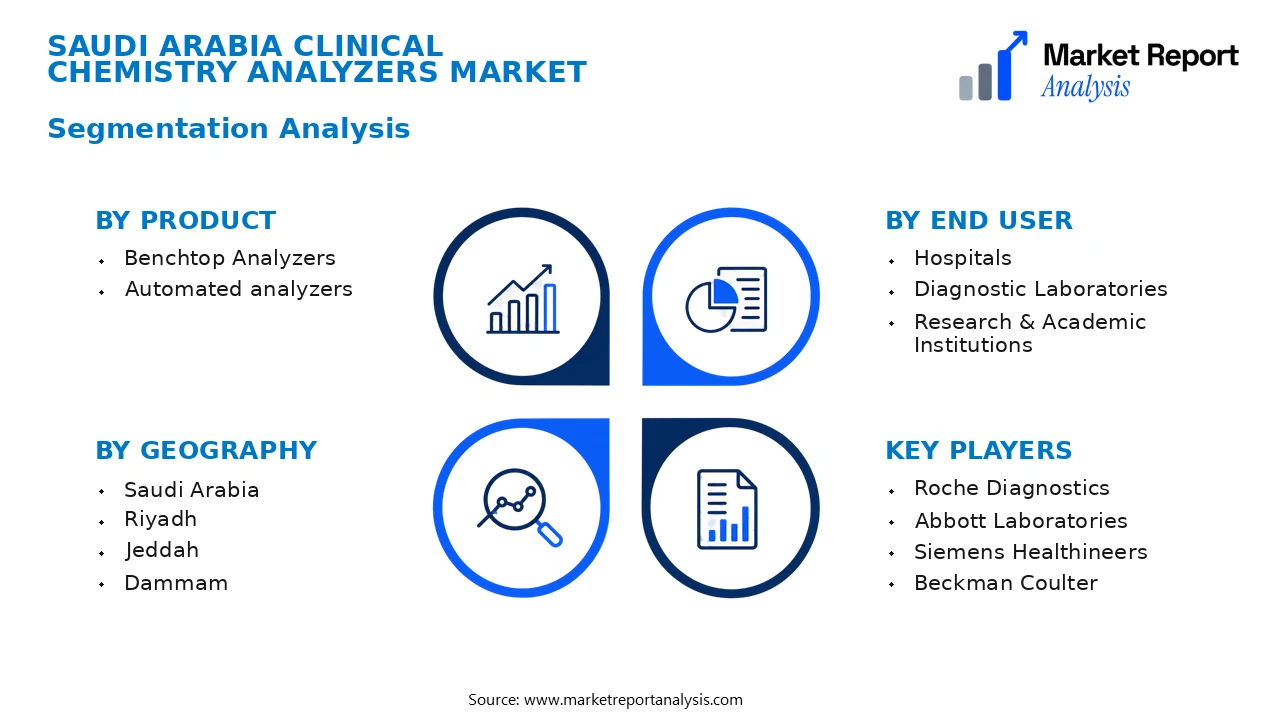
- Product
- Benchtop Analyzers: These compact devices are designed for small to medium-sized laboratories, offering high throughput and ease of use, which boosts their adoption in diagnostic labs and clinics across Saudi Arabia.
- Automated analyzers: Larger, automated systems provide high-volume testing capabilities, predominantly serving hospital laboratories and regional diagnostic centers, making them crucial for high-demand environments and expanding market share.
- End User
- Hospitals: Major customers for clinical chemistry analyzers, hospitals in Saudi Arabia increasingly adopt advanced analyzers to improve diagnostic efficiency, particularly in urban centers like Riyadh and Jeddah with expanding healthcare infrastructure.
- Diagnostic Laboratories: With growing screening programs and preventive health initiatives, diagnostic labs play a pivotal role, adopting both benchtop and automated analyzers to meet rising testing requirements in different regions.
- Research & Academic Institutions: These institutions are progressively incorporating clinical chemistry analyzers for research purposes, driven by government investments in healthcare innovation and scientific development.
- Geography
- Saudi Arabia: The overall market within the country encompasses diverse regional healthcare dynamics, with significant market activity in key regions such as Riyadh, Jeddah, and Dammam, influenced by population density and healthcare infrastructure.
- Riyadh: As the capital city, Riyadh hosts the most sophisticated healthcare facilities, including numerous government and private hospitals that demand advanced clinical chemistry analyzers to support extensive diagnostic services.
- Jeddah: Known for its commercial and medical hubs, Jeddah has a rapidly expanding healthcare sector, bolstering demand for diverse analyzers to support its large and diverse patient population.
- Dammam: The Dammam region, part of the Eastern Province, benefits from significant industrial activity and a growing healthcare system, requiring reliable analyzers to meet both clinical and industrial health needs.
- Mecca, Medina, Al Khobar, Jubail: These regions harbor specialized medical centers and emerging hospitals, with demand driven by religious tourism, regional health initiatives, and industrial growth, creating niche opportunities for clinical chemistry analyzer providers.
Competitive Intelligence
The Saudi Arabia Clinical Chemistry Analyzers Market exhibits moderate competitive intensity, characterized by a few key players strategically expanding their market shares through innovation and strategic alliances. Major companies like Roche Diagnostics, Abbott Laboratories, and Siemens Healthineers dominate the landscape, leveraging extensive R&D investments to differentiate their product portfolios through advances in automation, throughput, and precision. Competition is concentrated in key urban centers such as Riyadh and Jeddah, where hospital infrastructure and diagnostic services demand high-performance analyzers. Market players are pursuing expansion strategies by establishing local manufacturing facilities and forming partnerships with major healthcare providers and government agencies to enhance distribution networks. Acquisitions, especially of regional distributors and smaller diagnostic companies, are prevalent to consolidate market positioning and broaden product offerings. Innovation focuses on integrating connected diagnostic systems with artificial intelligence-driven analytics to improve workflow efficiency and diagnostic accuracy. Such strategic initiatives are vital for maintaining competitive advantage in the evolving Saudi healthcare landscape, where regulatory policies and government investments in healthcare infrastructure further intensify market rivalry.
Leading Company Profiles
The competitive landscape of the Saudi Arabia Clinical Chemistry Analyzers Market is characterized by several key players focusing on innovation, expansion, and strategic collaborations to enhance their market presence and cater to the growing healthcare demands in the region.
- Roche Diagnostics
- Abbott Laboratories
- Siemens Healthineers
- Beckman Coulter
- Mindray Medical International
- SNIBE Diagnostic
- DiaSys Diagnostic Systems
- Yokogawa Electric Corporation
- DiaSorin
- Ortho Clinical Diagnostics
Roche Diagnostics
Roche Diagnostics is a global leader innovating in clinical chemistry with a focus on high-throughput analyzers, offering comprehensive testing solutions tailored to the Saudi healthcare system, emphasizing precision, speed, and automation.
Abbott Laboratories
Abbott provides advanced clinical chemistry analyzers with a strategic emphasis on compact, automated systems designed to serve hospitals and laboratories in Saudi Arabia, leveraging digital integration and scalable testing solutions for diverse healthcare settings.
Siemens Healthineers
Siemens specializes in innovative diagnostic equipment, including high-efficiency analyzers and integrated laboratory automation systems, supporting Saudi Arabia’s push toward digitized, efficient healthcare infrastructure modernization efforts.
Beckman Coulter
Beckman Coulter offers a broad portfolio of clinical chemistry analyzers with a focus on enhancing laboratory productivity and diagnostic accuracy through cutting-edge automation and user-friendly interfaces tailored for the Saudi market.
Mindray Medical International
Mindray emphasizes cost-effective, reliable clinical chemistry analyzers known for their robust performance, aiming to expand their footprint in the Saudi healthcare sector with innovative and accessible testing solutions.
SNIBE Diagnostic
SNIBE specializes in esoteric tests and highly sensitive analyzers, consistently advancing their technological capabilities to meet Saudi Arabia's growing demand for specialized diagnostic tests and personalized medicine approaches.
DiaSys Diagnostic Systems
DiaSys focuses on developing user-friendly, high-performance clinical chemistry analyzers, investing heavily in R&D to cater to the evolving needs of the Saudi healthcare market for rapid and accurate diagnostics.
Yokogawa Electric Corporation
Yokogawa offers innovative automation and analytical solutions, contributing to the enhancement of clinical laboratory efficiency in Saudi Arabia through flexible, integrated chemistry analyzer systems.
DiaSorin
DiaSorin develops specialized testing platforms with a focus on immunoassay integration within clinical chemistry, aiming to expand its presence in the Middle East's healthcare environments, including Saudi Arabia.
Ortho Clinical Diagnostics
Ortho specializes in clinical diagnostics with high-quality chemistry analyzers, prioritizing technological innovation and strategic alliances to meet the increasing diagnostic needs within Saudi Arabian laboratories.
Strategic Business Developments

- May 2023 – Roche Diagnostics – Launched new high-throughput clinical chemistry analyzer – Strengthened market share through enhanced automation and faster turnaround times.
- July 2023 – Abbott Laboratories – Expanded manufacturing capacity in Riyadh – Enabled increased local production and reduced import dependency, supporting Saudi Vision 2030 healthcare goals.
- August 2023 – Siemens Healthineers – Formed joint venture with Saudi-based healthcare provider – Focused on deploying advanced diagnostic technologies across regional laboratories.
- September 2023 – Beckman Coulter – Announced acquisition of a regional distributor – Improved market penetration and service network in Saudi Arabia.
- November 2023 – Mindray Medical International – Launched digitally integrated clinical chemistry analyzers – Enhanced diagnostic capabilities with AI-enabled analytical tools, boosting operational efficiencies.
Frequently Asked Questions
What is the Saudi Arabia Clinical Chemistry Analyzers Market?
The Saudi Arabia Clinical Chemistry Analyzers Market encompasses the demand for advanced laboratory instruments used in diagnostic testing of chemicals, enzymes, and hormones in blood, urine, and other biological samples. It is driven by expanding healthcare infrastructure and increasing disease prevalence in Saudi Arabia.
What is the current market size of Saudi Arabia Clinical Chemistry Analyzers Market?
As of 2026, the market size is estimated at approximately USD 0.75 Billion, reflecting steady growth supported by rising healthcare expenditure, technological advancements, and governmental initiatives to improve diagnostic services across the country.
What factors are driving the Saudi Arabia Clinical Chemistry Analyzers Market?
Major drivers include increasing prevalence of chronic diseases such as diabetes and cardiovascular disorders, investment by public and private healthcare sectors, technological innovations, and government support for healthcare infrastructure development in Saudi Arabia.
Which Saudi city leads the Saudi Arabia Clinical Chemistry Analyzers Market?
Riyadh leads the market due to its status as the capital city with the highest concentration of healthcare facilities, research institutions, and medical laboratories, facilitating substantial demand for clinical chemistry analyzers.
Which segment is expected to grow the fastest?
The immunoassay segment is projected to witness the fastest growth, owing to its increasing application in diagnosing infectious diseases, hormonal imbalances, and autoimmune disorders, along with technological improvements making tests more affordable and accessible.
Who are the leading companies operating in the Saudi Arabia Clinical Chemistry Analyzers Market?
Key players include Roche Diagnostics, Abbott Laboratories, Siemens Healthineers, and Beckman Coulter, all of whom are actively expanding their product portfolios and distribution networks within Saudi Arabia to capitalize on the growing healthcare demand.
Analyst Perspective
The Saudi Arabia Clinical Chemistry Analyzers Market is anticipated to mature further, with a stable yet slowly expanding landscape driven by ongoing healthcare modernization initiatives and increasing disease prevalence. Long-term growth prospects remain positive, especially as technological innovations such as point-of-care testing and automation advance, promising enhanced accuracy, reduced turnaround times, and operational efficiencies. Investment priorities are expected to focus on upgrading existing infrastructure and adopting cutting-edge diagnostic platforms, with government and private sector collaborations playing pivotal roles. Competitive intensity will likely intensify as local and international players vie for market share through strategic alliances, product differentiation, and service excellence. At the city level, Riyadh's expanding healthcare facilities and investment in medical research position it as a primary growth hub, while Jeddah and Dammam also exhibit significant potential owing to their growing urban populations and medical infrastructure. Ultimately, strategic positioning around these urban markets will be crucial for sustained success amid evolving technological and regulatory landscapes.
