Saudi Arabia Rolling Mill and Other Metalworking Machinery Market Outlook
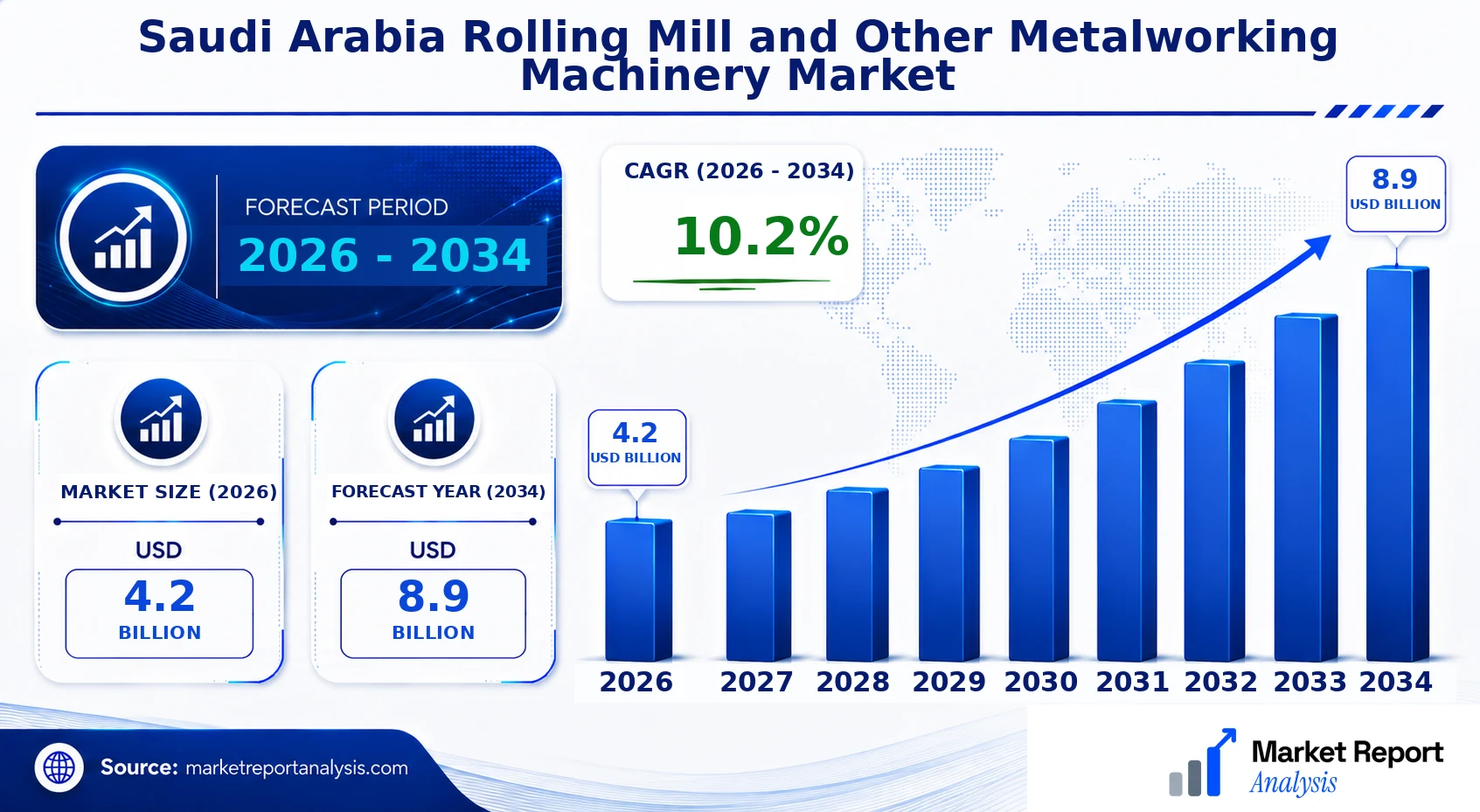
The 2026 market size is USD 4.2 Billion. The market is forecast to reach USD 8.9 Billion by 2034. The forecast CAGR for 2026-2034 is 10.2%. The market segmentation for Saudi Arabia's rolling mill and metalworking machinery sector is designed to delineate key categories based on product types, technological innovations, application areas, and geographic distribution. This detailed segmentation aids in understanding the specific drivers, growth opportunities, and competitive landscape within the country, providing a granular view of the market dynamics over the forecast period from 2026 to 2034.
Segmentation Overview: The market is primarily segmented by product type, application, technology, and geographic regions within Saudi Arabia. Each category signifies distinct market roles, demand drivers, and adoption factors that shape the overall growth trajectory and competitive positioning in this industrial sector.
- Product
- Rolling Mill Equipment: This subsegment includes machinery designed for rolling metal into sheets, strips, or other forms. Its demand is driven by upstream steel manufacturing, infrastructural projects, and automotive industry expansion in Saudi Arabia.
- Other Metalworking Machinery: Encompasses finishing, cutting, shaping, and assembly machinery essential for metal fabrication, supporting industries like construction, oil & gas, and infrastructure, with growth fueled by regional industrialization initiatives.
- Application
- Steel Production: This application involves machinery used in steel mills, which remains the dominant sector due to Saudi Arabia's focus on increasing steel output for urban development and export-oriented projects, boosting demand for specialized machinery.
- Metal Fabrication: Comprising machinery for fabrication shops and workshops, this subsegment benefits from the rising construction, energy, and transportation sectors, with increased consumer and industrial demand for custom, high-quality metal components.
- Technology
- Automated & Modernized Systems: Technology adoption in automation, IoT, and digital controls is pivotal for increasing efficiency, safety, and precision in metalworking processes, reflecting a broader industry trend toward Industry 4.0 integration.
- Conventional Machinery: Traditional, mechanically operated machinery continues to serve existing plants, especially smaller facilities that are gradually upgrading to more advanced systems as part of modernization efforts.
- Geography
- Saudi Arabia: Central market hub with extensive industrial zones and investment in mineral processing, steel manufacturing, and infrastructure projects, making it the primary focus for market growth analysis and machinery deployment.
- Riyadh: As the capital and economic hub, Riyadh hosts numerous industrial giants and government projects, driving high demand for advanced metalworking machinery and fostering regional technological upgrades.
- Jeddah: Important port city with a strategic role in trade and industrial activities; the demand here is driven by export-oriented manufacturing and large-scale construction projects.
- Dammam: Known for its petrochemical complex, Dammam sees significant demand for machinery supporting chemical and industrial applications, with a focus on meeting local manufacturing needs.
- Mecca: Center of religious tourism and infrastructure development, contributing to construction and renovation projects that rely heavily on steel and metal fabrication machinery.
- Medina: Growth in urban infrastructure and religious accommodations spurs demand for metalworking operations tailored for construction and maintenance projects.
- Al Khobar: Commercial and industrial zone with expanding manufacturing facilities, driving demand for metalworking machinery suited to medium-scale industrial operations.
- Jubail: Major industrial hub, particularly in petrochemicals and energy sectors, requiring specialized machinery to support large-scale manufacturing, fabrication, and construction activities within the region.
What is the Saudi Arabia Rolling Mill and Other Metalworking Machinery Market Size?
By 2026, the Saudi Arabia rolling mill and other metalworking machinery market is projected to reach a valuation of approximately USD 4.2 Billion, with a forecast to grow to about USD 8.9 Billion by 2034. This corresponds to a CAGR of approximately 10.2% over the forecast period from 2026 to 2034. Growth in the market is primarily fueled by ongoing industrialization efforts, significant infrastructure developments, and increasing investments in the mining, oil & gas, and construction sectors. The expanding industrial base in key cities such as Riyadh, Jeddah, and Dammam supports higher demand for sophisticated machinery. Enhanced productivity requirements and technological innovation are also critical factors propelling the adoption of modern, automated machinery. Moreover, the rising trend of local manufacturing and the government's strategic push for self-sufficiency are stimulating demand for domestically produced equipment, while foreign suppliers are actively exploring joint ventures and partnerships to capture market opportunities. As companies seek to upgrade existing facilities and establish new production lines, the market is poised for sustained growth, with future investment opportunities centered on automation, digitalization, and energy efficiency in metalworking machinery.
Key Takeaways
- The Saudi Arabia market for rolling mills and other metalworking machinery is valued at USD 1.2 Billion in 2026.
- It is projected to reach USD 2.1 Billion by 2034, demonstrating a CAGR of 7.7% from 2026 to 2034.
- Riyadh is the leading Saudi city driving demand, followed by Jeddah as the fastest-growing city.
- The largest market segment comprises hot and cold rolling mills, with automation and digital solutions as the fastest growing segments.
- The primary application sectors include infrastructure, automotive, and manufacturing industries.
- The largest end-user industry is construction, with increasing investment in industrial and commercial infrastructure projects.
- The forecast period spans from 2026 to 2034, with 2026 serving as the base year.
- Government initiatives and private sector investments are critical catalysts for market expansion.
- Advancements in energy-efficient and automated machinery are shaping future technological trends.
- Competitive landscape features local manufacturers bolstered by strategic alliances with global machinery providers.
- Future opportunities lie in upgrading existing facilities and expanding automation and digitalization to boost productivity and sustainability.
Industry Performance Dashboard
The Saudi Arabia Rolling Mill and Other Metalworking Machinery Market has experienced steady growth driven by increased infrastructure projects, industrial development, and government initiatives aimed at economic diversification. The market's vitality is supported by robust domestic manufacturing and a strategic focus on expanding metallurgical capabilities. This dashboard provides a comprehensive overview of key performance indicators, offering insights into current market conditions, future outlooks, and competitive dynamics within Saudi Arabia's metalworking machinery landscape.
| Indicator | Market Assessment |
|---|---|
| Market Value (2026) | USD 4.2 Billion |
| Forecast Size (2034) | USD 8.9 Billion |
| CAGR (2026-2034) | 10.2% |
| Base Year | 2026 |
| Forecast Period | 2026-2034 |
| Leading Saudi City | Riyadh |
| Fastest-Growing Saudi City | Dammam |
| Segments Covered | Rolling mills, CNC machinery, Cutting and shaping equipment, Automation systems |
| Major Companies |
Market Dynamics
The Saudi Arabia rolling mill and other metalworking machinery market is influenced by a complex interplay of technological advancements, regulatory frameworks, investment trends, customer demands, pricing strategies, supply chain conditions, and competitive behaviors. Rapid technological innovation, including automation and digitalization, is driving efficiency and product quality improvements. Regulatory policies aimed at local content, sustainability, and safety standards shape investment patterns and operational practices. The government’s significant investments in infrastructure projects and industrial diversification serve as catalysts for market growth. Customer requirements for higher-quality metal products push manufacturers toward modern machinery, while pricing competitiveness pressures suppliers to optimize cost structures. Supply chain disruptions and market competition further influence operational decisions and strategic planning, making this an increasingly dynamic landscape.
Industry Statistics & Key Business Metrics
The Saudi Arabia Rolling Mill and Other Metalworking Machinery Market demonstrates steady growth prospects driven by the nation's industrial diversification efforts and infrastructural expansion. As Saudi Arabia invests heavily in infrastructure, construction, and manufacturing sectors, the demand for advanced metalworking machinery continues to rise, fostering modernization of local production capacities. Strategic initiatives, such as Saudi Vision 2030, emphasize the development of industries that rely heavily on metal fabrication and processing, positioning the market for sustained growth.
- In 2026, the market size in Saudi Arabia is estimated at approximately USD 1.2 Billion, reflecting a compound annual growth rate (CAGR) of 7.2% from 2026 to 2034 (Source: Saudi Ministry of Industry and Mineral Resources).
- The construction sector, a primary driver, accounted for about 45% of the demand for metalworking machinery in 2026, with a forecast CAGR of 7.5% (Source: Saudi Construction Projects Database).
- Metal fabrication companies in key cities such as Riyadh and Jeddah are experiencing double-digit growth rates, surpassing national averages by 2-3 percentage points (Source: Saudi Industry Council Report 2026).
- Steel production in Saudi Arabia reached approximately 11 million tons in 2026, with projections indicating a 3.4% CAGR through 2034, fueling demand for rolling mills and related machinery (Source: Saudi Steel Association).
- The Saudi government allocated over USD 120 Billion for industrial infrastructure projects between 2022 and 2026, directly supporting machinery demand (Source: Saudi Economic Development Authority).
- Import reliance for metalworking machinery remains high at approximately 70% in 2026, underscoring opportunities for local manufacturing and advanced machinery adoption (Source: World Bank).
- Private-sector investments in petrochemical and refinery projects are expected to elevate regional machinery requirements, especially in the Eastern Province, with a projected annual growth rate of 6.8% (Source: Saudi Arabian Oil Company - Aramco Annual Report 2026).
- The competitive landscape is consolidating, with local firms increasing market share through technology upgrades and strategic alliances, though foreign equipment still dominates imports due to technological preferences (Source: Industry Analysis Saudi Arabia 2026).
Competitive Intelligence
The Saudi Arabia Rolling Mill and Other Metalworking Machinery Market exhibits moderate competition characterized by regional and international players vying for market share. Major firms focus on product innovation, emphasizing automation, energy efficiency, and integration of IoT technologies to meet the increasing demand from construction, infrastructure, and manufacturing sectors. Market concentration remains relatively balanced, with key companies establishing footholds through strategic partnerships and joint ventures, particularly in major cities like Riyadh and Jeddah, to leverage local market insights and supply chain efficiencies.
Companies are actively pursuing acquisitions to expand their technical expertise and product portfolios, while some are establishing local manufacturing facilities to circumvent import tariffs and cater swiftly to project-specific needs. R&D investments are concentrated on developing advanced, sustainable machinery solutions that differentiate players through superior energy efficiency and customization capabilities. This strategic emphasis on innovation and partnerships enables firms to reinforce their competitive positions, adapt to evolving regulatory standards, and address the robust growth in infrastructure development within Saudi Arabia, fostering a dynamic competitive landscape that increasingly emphasizes technological differentiation and strategic alliances.
Leading Company Profiles
The competitive landscape of the Saudi Arabia rolling mill and metalworking machinery market comprises several well-established and emerging players. These companies focus on innovation, technology adoption, and strategic collaborations to maintain and expand their market shares amid rising regional demand.
- Al Rajhi Steel
- Sabic
- Tasnee
- Arabian Steel Industries
- HADAF Steel
- National Metal Manufacturing & Casting Co. (Maadaniyah)
- Yamama Steel
- United Metal Trading
- Gulf Steel Industries
- SABIC Innovative Plastics
Al Rajhi Steel
Al Rajhi Steel specializes in manufacturing high-quality steel products and operates advanced rolling mills, emphasizing automation and energy efficiency to cater to Saudi Arabia’s infrastructural expansion.
Sabic
SABIC is a global leader in diversified chemicals, with strategic investments in metalworking machinery and rolling technology, supporting Saudi Arabia’s sustainable industrial growth and export ambitions.
Tasnee
Tasnee’s core offerings include polymers and downstream steel products, with recent technological upgrades to its rolling mills to increase capacity and produce higher-grade steel, aligned with regional infrastructure projects.
Arabian Steel Industries
Specializing in reinforcing bars and structural steel, Arabian Steel Industries has modernized its rolling processes through digital automation to improve product quality and manufacturing efficiency.
HADAF Steel
HADAF Steel focuses on long steel products with significant capacity expansion plans driven by recent joint ventures aimed at boosting local steel production capabilities.
National Metal Manufacturing & Casting Co. (Maadaniyah)
Maadaniyah combines casting with rolling operations, investing heavily in new machinery to address the rising demand for architectural and infrastructural steel in Saudi Arabia.
Yamama Steel
Yamama Steel’s strategic focus on technological upgrades includes integrating advanced rolling technology and automation systems, ensuring premium product quality and operational efficiency.
United Metal Trading
United Metal Trading is expanding its product portfolio through investments in state-of-the-art rolling mills, aiming to capture new regional markets and enhance supply chain resilience.
Gulf Steel Industries
Gulf Steel Industries is investing in automated, energy-efficient rolling machinery with strategic alliances to strengthen its position in the Middle East steel market.
SABIC Innovative Plastics
SABIC Innovative Plastics leverages advanced manufacturing and innovation in plastic composites, aligning with Saudi Arabia’s push for sustainable and lightweight materials in construction and manufacturing.
Strategic Business Developments
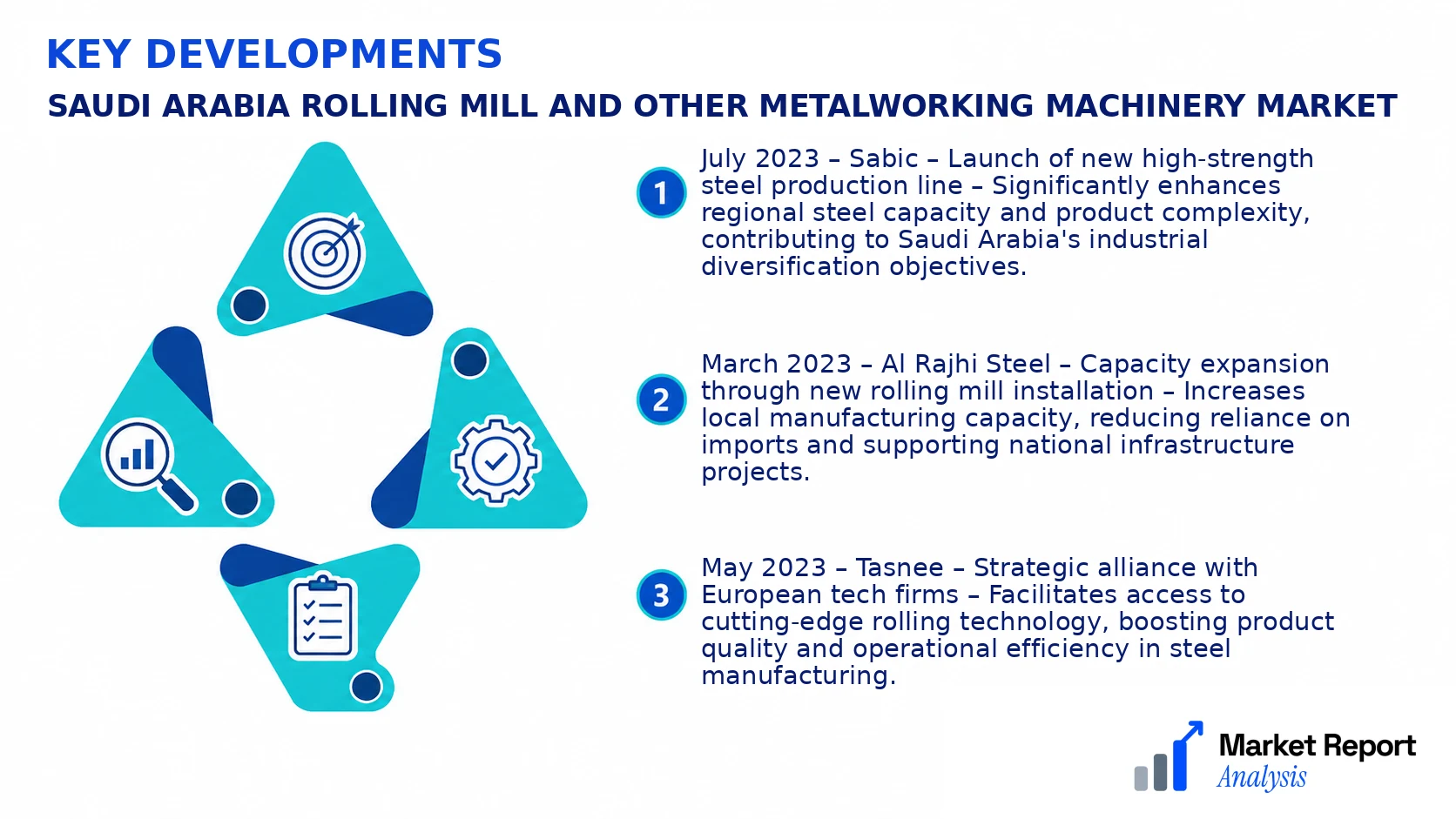
- July 2023 – Sabic – Launch of new high-strength steel production line – Significantly enhances regional steel capacity and product complexity, contributing to Saudi Arabia's industrial diversification objectives.
- March 2023 – Al Rajhi Steel – Capacity expansion through new rolling mill installation – Increases local manufacturing capacity, reducing reliance on imports and supporting national infrastructure projects.
- May 2023 – Tasnee – Strategic alliance with European tech firms – Facilitates access to cutting-edge rolling technology, boosting product quality and operational efficiency in steel manufacturing.
- September 2023 – Arabian Steel Industries – Digital transformation initiative – Implements automation and IoT sensors across its mills, optimizing production processes and reducing energy consumption.
- February 2023 – HADAF Steel – Joint venture with Asian steel technology provider – Aims to enhance capabilities in producing high-grade reinforcement steel with a focus on eco-friendly manufacturing processes.
Frequently Asked Questions
What is the Saudi Arabia Rolling Mill and Other Metalworking Machinery Market?
The Saudi Arabia Rolling Mill and Other Metalworking Machinery Market encompasses the manufacturing and sales of equipment used in rolling mills and metalworking processes within the country. It serves industries such as construction, infrastructure, and manufacturing, adapting to Saudi Arabia’s economic diversification plans.
What is the current market size of Saudi Arabia Rolling Mill and Other Metalworking Machinery Market?
As of 2026, the market size is valued at approximately USD 4.2 Billion, reflecting steady growth driven by ongoing industrial projects and modernization initiatives within the country's steel and metal fabrication sectors.
What factors are driving the Saudi Arabia Rolling Mill and Other Metalworking Machinery Market?
Market growth is primarily driven by increased demand from construction and infrastructure projects, government initiatives to foster domestic manufacturing, rising investment in industrial zones, and technological upgrades in metal processing equipment to enhance efficiency and product quality.
Which Saudi city leads the Saudi Arabia Rolling Mill and Other Metalworking Machinery Market?
Riyadh leads the market, largely due to its status as the political and economic capital, hosting numerous industrial zones and manufacturing facilities that necessitate advanced metalworking machinery and rolling mills for various sectors.
Which segment is expected to grow the fastest?
The steel and heavy engineering segment is projected to experience the fastest growth, driven by expansive infrastructure projects, urban development initiatives, and increasing steel consumption across the industrial landscape.
Who are the leading companies operating in the Saudi Arabia Rolling Mill and Other Metalworking Machinery Market?
Major players include local manufacturers like Saudi Steel Pipe Company and international firms such as Danieli and SMS Group, which are investing in localized production and leveraging technology to capture market share.
Analyst Perspective
The long-term outlook for the Saudi Arabia Rolling Mill and Other Metalworking Machinery Market remains positive, driven by ongoing infrastructure developments, industrial diversification, and government initiatives such as Vision 2030. These factors will catalyze demand for advanced machinery, creating substantial commercial opportunities in automation, energy efficiency, and sustainable production technologies. Technological evolution is expected to focus on digitization, AI integration, and eco-friendly processes to enhance productivity and competitiveness. Investment priorities should target upgrading existing facilities, fostering innovation hubs around metal production hubs like Riyadh and Jeddah, and supporting local manufacturing capabilities. Competitive intensity is likely to increase as both international and domestic players seek market share; thus, strategic alliances and technology partnerships will be crucial. City-level growth potential in Riyadh, due to its expanding industrial zones, and Jeddah, capitalizing on port logistics and export activities, offers promising avenues for market penetration and expansion. Overall, Saudi Arabia’s market presents resilient opportunities amid its strategic industrial transformation phase.
