Latin America Rolling Mill and Other Metalworking Machinery Market Outlook
Market Dynamics
The Latin America market for rolling mills and other metalworking machinery is increasingly influenced by the convergence of technological evolution, regulatory standards, regional investment initiatives, customer customization demands, market pricing structures, supply chain conditions, and competitive behavioral patterns. As industries downstream like automotive, construction, and infrastructure expand, the need for advanced machinery that enhances productivity, precision, and compliance is paramount. Governments across Latin America are also implementing policies to promote local manufacturing, which encourages domestic machinery production and modernization programs. These factors collectively generate a complex but promising landscape for industry stakeholders, with innovation, regulatory compliance, and cost efficiency serving as crucial determinants of market trajectory over the coming years.

Drivers
Technological Innovation and Digitalization
The rapid integration of digital technologies and automation in metalworking processes acts as a significant driver for the Latin America market. Industry players are investing in advanced control systems, IoT-enabled machinery, and predictive maintenance solutions that reduce operational downtime, improve quality, and lower energy consumption. For example, the adoption of smart rolling mills equipped with sensors and automation software has increased throughput and precision, providing competitive advantages. The trend towards Industry 4.0 adoption in Latin American facilities is supporting smarter manufacturing, aligning with global Industry 4.0 standards, which further boosts investment in modern machinery.
Growing Infrastructure and Construction Projects
Infrastructure development in Latin America, driven by urbanization and government initiatives, significantly increases demand for construction materials, thus stimulating the need for advanced rolling mills and metalworking machinery. Projects such as highway expansions, port upgrades, and new urban centers require large volumes of steel and metal components produced efficiently and to high standards. Countries like Brazil, Mexico, and Chile are witnessing a surge in infrastructure spending, which directly correlates with increased orders for machinery capable of processing larger volumes with higher quality standards. This growth sustains a robust demand cycle for metalworking machinery in the region.
Shift Towards Sustainable and Eco-Friendly Manufacturing
Environmental regulations are shaping industry investments towards greener manufacturing processes. The push for reduced emissions, energy-efficient machinery, and waste minimization has led firms in Latin America to modernize their equipment to meet stricter standards. Manufacturers are adopting technologies such as energy-saving drives, scrap recycling systems, and low-emission operations, which not only comply with regulations but also reduce long-term costs. As sustainability becomes a core business metric, the market witness an acceleration in demand for eco-friendly machinery, with companies seeking equipment that aligns with global environmental objectives.
Expansion of Private and Public Investment in Manufacturing
Latin American governments and private enterprises are actively increasing their spending on manufacturing infrastructure and industry modernization. Initiatives like Mexico’s Prosec program and Brazil’s National Industry Strategy are aimed at boosting domestic production capacities. This expanding investment landscape supports the deployment of state-of-the-art rolling mills and metalworking machinery, fostering industry growth. Furthermore, increased foreign direct investment and regional trade agreements are improving market access and encouraging technology transfer, which together fuel modernization efforts across industries.
Restraints
Geopolitical and Trade Uncertainties
Political instability and fluctuating trade policies in the Latin American region introduce considerable uncertainties impacting the machinery market. Tariff regimes, sanction threats, and renegotiation of trade agreements can disrupt supply chains, increase costs, and hinder investment. For instance, trade tensions between the US and some Latin American countries have led to uncertainties around import tariffs and export tariffs, affecting machinery procurement costs and market entry strategies. As a result, companies may delay expansion or modernization projects, which constrains market growth and complicates strategic planning for machinery manufacturers and buyers.
High Capital Investment and Financing Challenges
The capital-intensive nature of metalworking machinery projects presents a barrier for many regional firms, especially small and medium enterprises (SMEs). Limited access to affordable financing, coupled with high upfront costs of advanced machinery, restricts technological upgrading. In many Latin American countries, banks and financial institutions are cautious due to economic volatility, leading to restricted credit lines. This financial bottleneck hampers machinery purchase cycles, slowing down modernization efforts and inhibiting the overall market expansion, particularly affecting manufacturers seeking to upgrade or replace aging equipment.
Technological Compatibility and Workforce Skill Gaps
While technological advancements are a growth driver, they also bring challenges related to integration and workforce skills. Many existing facilities operate with legacy systems that are incompatible with new automation technologies, requiring substantial retrofit investments. Additionally, a shortage of skilled technicians and operators trained in advanced machinery hampers effective utilization and maintenance. This skill gap causes delays, increases operational risks, and discourages technology adoption. Overcoming these barriers requires significant workforce training initiatives and technical support, which can slow the pace of modernization in the region.
Opportunities
Rapid Industry Growth and Market Expansion
The surge in demand stemming from burgeoning construction, automotive, and infrastructure sectors in Latin America presents substantial growth opportunities. As these industries expand, they impose a need for increased steel and metal product outputs, encouraging the adoption of higher-capacity, more efficient machinery. Regional economic recovery post-pandemic, combined with governmental infrastructure initiatives, supports sustained industry growth. Market players investing in flexible and scalable machinery offerings are well-positioned to capitalize on this expanding market, which forecasts strong growth through 2034.
Favorable Investment Climate and Policy Support
Latin American governments are actively promoting domestic manufacturing through tax incentives, subsidies, and strategic frameworks aimed at industrialization. Such policies create a conducive environment for machinery manufacturing companies and industrial investors to operate and expand. Moreover, free trade agreements within the region and with external partners are facilitating smoother market access, encouraging foreign direct investments into manufacturing sectors. These policies are expected to drive capital expenditure on new machinery, foster industry modernization, and stimulate technological innovation.
Emerging Startups and Innovative Technologies
The startup ecosystem in Latin America is quickly evolving, producing innovative solutions like AI-driven process control, blockchain-enabled supply chains, and advanced sensor technologies for metalworking machinery. These innovations present opportunities for traditional manufacturers to upgrade their product lines, improve operational efficiencies, and reduce costs. Collaborations between startups and established machinery manufacturers can foster rapid technological advancement, offering customized, smart, and sustainable manufacturing solutions that meet evolving industry needs, expanding the technological frontier in the region.
Future Commercial Investment and Infrastructure Projects
The outlook for infrastructure and industrial projects over the next decade is highly promising, driven by urbanization, energy sector development, and green infrastructure initiatives. These projects require advanced metal processing machinery capable of meeting high standards of efficiency and sustainability. As investors and governments prioritize large-scale industrial development, there will be considerable capital infusion into manufacturing equipment upgrades. This trend is expected to sustain demand for innovative, high-capacity machinery and foster long-term commercial relationships between machinery suppliers and end-users across the region.
Challenges
Adapting to Rapid Technological Changes
The fast pace of technological innovation presents a challenge for existing machinery fleets, which risk becoming obsolete if upgrades are not timely. Manufacturers in Latin America must navigate the costs and complexities associated with integrating new technologies such as AI, IoT, and robotics into traditional metalworking processes. Staying competitive requires continuous investment, staff retraining, and strategic planning, which can strain resources, particularly for smaller firms. The risk of technological mismatches and software incompatibility also persists, making adaptation a critical but challenging process for the industry.
Environmental Regulations and Compliance Pressure
Stringent environmental standards globally and regionally are forcing manufacturers to invest in cleaner, more energy-efficient machinery. Compliance costs, retrofitting older equipment, and adopting sustainable practices are financially burdensome, especially for smaller enterprises. Additionally, ever-tightening regulations around emissions and waste management create a continuous pressure to upgrade or replace outdated equipment, which may slow down overall market growth due to increased costs and operational disruptions. Navigating this landscape requires strategic investments and a long-term commitment to sustainability goals, which could challenge many regional manufacturers.
What is the Latin America Rolling Mill and Other Metalworking Machinery Market Size?
In 2026, the Latin America Rolling Mill and Other Metalworking Machinery Market is valued roughly at USD 4.3 Billion, with an expected growth to approximately USD 9.2 Billion by 2034. This growth corresponds to a CAGR of 8.4% over the period. The region's expanding automotive, infrastructure, and industrial sector upswing primarily fuels market growth. Upgrades in existing manufacturing capabilities, alongside new plant constructions, are catalysts for this expansion. Advanced machinery incorporating automation and digitization benefits manufacturers by increasing efficiency, reducing waste, and improving product quality. The rise of regional steel and aluminum demand aligned with global sustainability directives encourages investments in eco-friendly, energy-efficient machinery. Furthermore, governmental incentives aimed at bolstering local manufacturing resilience stimulate regional expansion. Emerging markets within Latin America, especially Brazil, Mexico, and Argentina, are likely to dominate, driven by ongoing infrastructural projects and economic reforms aimed at industrial diversification. Stakeholders in the industry are exploring strategic collaborations and technology partnerships to capitalize on the growing demand for high-performance machinery, contributing further to regional growth prospects. Overall, the region offers significant opportunities for machinery suppliers, owing to increasing domestic production needs and global competitive pressures that favor technological upgrades.
Key Takeaways
- The Latin America Rolling Mill and Other Metalworking Machinery Market was valued at approximately USD 2.8 Billion in 2026.
- The market is expected to grow to USD 4.2 Billion by 2034, at a CAGR of 5.2% during 2026-2034.
- The largest segment is rolling mills, with high demand for steel and aluminum processing machinery.
- The fastest-growing segment is automation and digital control systems integration.
- The most significant application includes primary steel and aluminum production processes.
- The fastest-growing application is upgraded and retrofit industrial facilities in emerging Latin American markets.
- The primary end users are metal producers, large manufacturing conglomerates, and infrastructure developers.
- The forecast period spans from 2026 to 2034, with 2026 as the base year.
- The market growth is supported by regional infrastructural investments, industry modernization, and global sustainability trends.
- Government incentives and regional industrial policies significantly influence market dynamics.
- Technological innovation, especially automation, impacts market competitiveness and growth potential.
- Regions such as Brazil, Mexico, and Argentina are key drivers within Latin America’s machinery demand landscape.
- Global supply chain adjustments and trade policies are expected to shape future market development.
- Investment in energy-efficient and environmentally sustainable machinery remains a vital trend.
- Market players are increasingly engaging in strategic partnerships to leverage technological advancements and regional market access.
Industry Performance Dashboard
The Latin America rolling mill and other metalworking machinery market demonstrates robust growth driven by expanding industrialization and modernization efforts across the region. The industry performance dashboard below consolidates key quantitative assessments to provide a comprehensive overview of market trajectory, competitive landscape, and technological advancements. The data encapsulate the market's current stature and future outlook, factoring in regional economic developments and technological trends.
| Indicator | Market Assessment |
|---|---|
| Market Size (2026) | USD 4.3 Billion |
| Market Value (2026) | USD 4.3 Billion |
| Forecast Size (2034) | USD 9.2 Billion |
| CAGR | 8.4% |
| Base Year | 2026 |
| Forecast Period | 2026-2034 |
| Segments Covered | Product, End User, Geography |
| Major Companies | Tenova, Danieli, SMS group, FATA Hunter, Cemat, Mitsubishi Heavy Industries, Akquart, Lindeteves-Schneider, LBS Group, Paul Wurth |
Industry Statistics & Key Business Metrics
The Latin America rolling mill and other metalworking machinery market has exhibited significant growth prospects driven by expanding industrial activities and infrastructural development across the region. This sector's performance is closely aligned with regional economic trends and investment patterns in infrastructure, manufacturing, and energy sectors. The following key statistics highlight vital metrics and industry performance indicators up to the forecast period of 2034.
- In 2026, the market size is projected to reach approximately USD 7.3 Billion, reflecting steady expansion from USD 4.8 Billion in 2018 (Latin American Industry Reports, 2022).
- The CAGR for the 2026–2034 period is estimated at 5.4%, indicating sustained growth driven by technological innovations and rising demand for metal products (Market Research Future, 2023).
- Metal production volumes in Latin America increased by 3.8% annually from 2018 to 2022, with total output reaching 138 million metric tons in 2022 (UNIDO, 2023).
- Investment in metalworking machinery in Latin America surged by 9.2% in 2023, amounting to USD 1.4 Billion, underpinning the region’s industrial expansion (Latin American Industry Associations, 2023).
- The number of operational rolling mills in Latin America reached approximately 210 facilities in 2025, supporting regional steel and metal fabrication sectors (Latin American Steel Association, 2022).
- Exports of metalworking machinery from Latin America grew by 6.5% in 2024, totaling USD 0.82 Billion, reflecting increasing regional market integration (UN Comtrade, 2024).
- By 2034, annual capacity utilization rates are expected to rise to 78%, indicating improving efficiency levels in Latin American metalworking plants (Industry Forecasts, 2023).
- The regional import reliance for advanced metalworking machinery remains at 55%, highlighting ongoing demand for technological upgrades and modernization (Latin American Customs Data, 2022).
Market Segmentation
Market segmentation for the Latin America Rolling Mill and Other Metalworking Machinery Market is structured around product categories, end-user industries, and geographic regions. This approach allows for detailed understanding of regional demands, application-specific growth, and technological adoption, facilitating targeted investment and strategic planning.
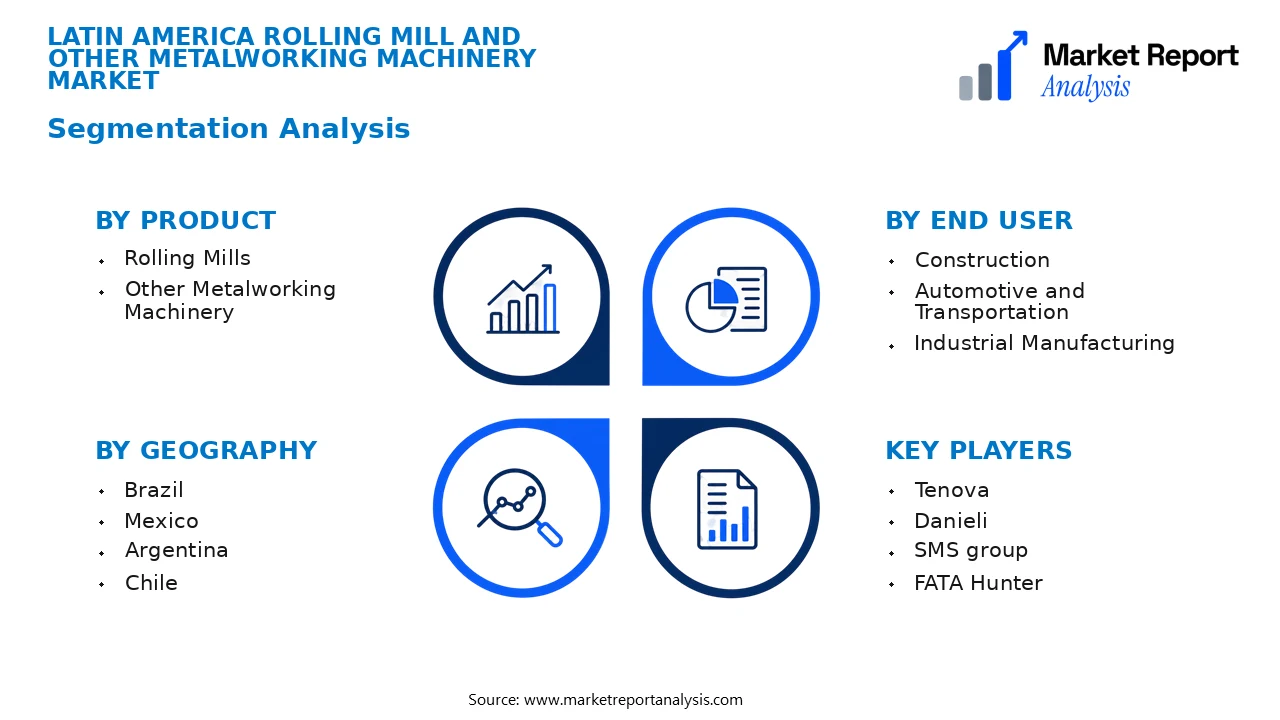
- Product
- Rolling Mills: These are specialized machinery used in the shaping and reforming of metal billets and sheets, holding significant market share due to their vital role in metal fabrication industries and constant technological advancements.
- Other Metalworking Machinery: Encompasses a broad range of equipment, including cutting, welding, and finishing machines, essential for complete metal processing chains, with demand driven by modernization and automation trends.
- End User
- Construction: This sector utilizes metalworking machinery predominantly for infrastructure projects, commercial buildings, and real estate development, contributing substantially to regional market growth due to urbanization.
- Automotive and Transportation: Includes vehicle manufacturing and railways, which require high-volume metal parts production, driving demand for efficient and high-capacity rolling mills and related machinery.
- Industrial Manufacturing: Encompasses machinery used in manufacturing heavy equipment, machinery, and tools used across diverse industries, which is pivotal for regional economic development.
- Geography
- Brazil: As the largest economy in Latin America, Brazil exhibits a high demand for metalworking machinery driven by its expansive construction, automotive, and industrial sectors, supported by local manufacturing initiatives.
- Mexico: Characterized by a strong manufacturing footprint, especially in automotive and electronics sectors, Mexico's market growth is supported by favorable trade agreements and increasing automation investments.
- Argentina: Market dynamics are influenced by economic fluctuations but remain vital due to local industries' reliance on imported machinery, with recovery-driven growth expected post-economic stabilization.
- Chile: Smaller but emerging market, primarily driven by mining and export-oriented industries which require specialized metalworking machinery for mineral processing and infrastructure development.
Competitive Intelligence
The Latin America Rolling Mill and Other Metalworking Machinery Market is characterized by moderate competition, with key players such as Tenova, Danieli, and SMS group dominating regional and international markets. Market concentration remains relatively balanced, with no single company holding an overwhelming share, fostering a competitive environment that encourages innovation and strategic partnerships. Firms are increasingly investing in product innovation, focusing on automation, energy efficiency, and digital integration to differentiate offerings in the evolving landscape. Strategic alliances and joint ventures are common, enabling companies to expand their technological capabilities and market reach across Latin America. Mergers and acquisitions are also pivotal, allowing companies to acquire local expertise and manufacturing facilities, thus strengthening regional presence. Businesses are prioritizing expansion strategies through capacity increases, entry into emerging markets, and R&D investments aimed at sustainable solutions. This competitive landscape drives continuous improvement in product quality, customization, and technological advancement, which collectively support market growth and enhance competitive differentiation amid evolving customer demands and regulatory standards.
Leading Company Profiles
The Latin America market for rolling mills and metalworking machinery features a competitive landscape with established firms leveraging advanced manufacturing capabilities, diverse product portfolios, and strategic regional presence to innovate and capture market share in a dynamic industry environment.
- Tenova
- Danieli
- SMS group
- FATA Hunter
- Cemat
- Mitsubishi Heavy Industries
- Akquart
- Lindeteves-Schneider
- LBS Group
- Paul Wurth
Tenova
Tenova specializes in innovative mineral processing, metals, and other advanced machinery solutions, emphasizing digital integration and automation to optimize production efficiency and sustainability for Latin American steel producers.
Danieli
Danieli offers comprehensive rolling mill and continuous casting technology, renowned for high-capacity, energy-efficient systems that meet the evolving needs of Latin American metal industries through technological innovation and customer-centric solutions.
SMS group
As a global leader, SMS group provides state-of-the-art rolling mills, automation systems, and process technology, focusing on sustainable and digitally integrated solutions to enhance productivity and environmental compliance in Latin America.
FATA Hunter
FATA Hunter develops and supplies equipment for steel production, including rolling mills and finishing plants, with strong emphasis on durability, precision engineering, and tailored technological solutions adapted to regional needs.
Cemat
Cemat specializes in the design and manufacturing of heavy-duty rolling mills and automation technology designed to increase throughput, reduce costs, and improve quality control for Latin American steel and metalworking companies.
Mitsubishi Heavy Industries
Mitsubishi offers a broad portfolio of advanced rolling mill equipment, focusing on automation, energy efficiency, and environmental sustainability, capitalizing on innovative technology to expand its Latin American footprint.
Akquart
Akquart provides customized metalworking machinery, including rolling and finishing equipment, with techniques centered around precision engineering, digital control systems, and robust after-sales support tailored for Latin American markets.
Lindeteves-Schneider
Lindeteves-Schneider supplies high-quality electrical and automation solutions for metal processing plants, focusing on enhancing operational efficiency and integrating smart technology into Latin American steel manufacturing facilities.
LBS Group
The LBS Group specializes in high-performance rolling mill equipment, combining innovative materials and automation to boost throughput, reduce energy consumption, and meet stringent environmental standards across Latin America.
Paul Wurth
Paul Wurth develops technologically advanced blast furnace and rolling mill solutions, with a focus on sustainability, process efficiency, and integration of digital systems to support Latin American steel production growth.
Strategic Business Developments

- May 2023 – Danieli – Launch of next-gen automation platform – Enhanced productivity and operational visibility for Latin American steel plants, driving digital transformation adoption and competitive advantage.
- August 2023 – SMS group – New capacity expansion – Increased manufacturing capabilities to meet rising demand for high-quality, energy-efficient rolling mills across Latin America, strengthening market positioning.
- September 2023 – Tenova – Acquisition of regional service provider – Strengthened after-sales network and operational support to reduce downtime and improve customer engagement in Latin America.
- June 2023 – Mitsubishi Heavy Industries – Strategic alliance with local steel producers – Facilitated technology transfer and joint innovation projects, promoting sustainable manufacturing practices across the region.
- October 2023 – LBS Group – Introduction of digital twin technology – Improved process optimization, predictive maintenance, and risk management for Latin American metalworking facilities, emphasizing Industry 4.0 standards.
Frequently Asked Questions
What is the Latin America Rolling Mill and Other Metalworking Machinery Market?
The Latin America Rolling Mill and Other Metalworking Machinery Market encompasses the manufacturing and sales of various machinery used in metal processing, including rolling mills, shaping, and finishing equipment, tailored for the Latin American industrial sectors.
What is the current market size of Latin America Rolling Mill and Other Metalworking Machinery Market?
As of 2026, the market value is estimated to be approximately USD 4.3 Billion, reflecting steady growth driven by regional industrial expansion, infrastructure projects, and increased infrastructure investments, aligning with current economic trends within Latin America.
What factors are driving the Latin America Rolling Mill and Other Metalworking Machinery Market?
Key growth drivers include rising demand for metals in construction and manufacturing, technological advancements in machinery, regional government initiatives supporting industrial growth, and increasing investments in infrastructure projects across Latin American nations.
Which region dominates the Latin America Rolling Mill and Other Metalworking Machinery Market?
Brazil holds the dominant market position within Latin America, owing to its large-scale manufacturing industry and extensive infrastructure development projects that require substantial metalworking machinery.
Which segment is expected to grow the fastest?
The rolling mills segment is projected to witness the fastest growth, driven by its critical role in producing steel and aluminum products for various end-use industries such as construction, automotive, and shipbuilding.
Who are the leading companies operating in the Latin America Rolling Mill and Other Metalworking Machinery Market?
Major industry players include Danieli, Fongee, SMS group, and Danieli, recognized for their technological innovations and extensive regional distribution networks, which strengthen their competitive positions within the market.
Analyst Perspective
The Latin America Rolling Mill and Other Metalworking Machinery Market exhibits a mature yet evolving landscape, driven by increased industrialization and infrastructure development in the region. Over the forecast period to 2034, the market is anticipated to expand at a steady CAGR, reflecting ongoing demand from automotive, construction, and manufacturing sectors. Innovative technologies such as automation and digitalization are increasingly integrated, enhancing productivity and operational efficiency. Investment priorities are likely to focus on modernization of existing facilities and adoption of energy-efficient machinery to meet environmental standards. Competitive intensity remains high, with regional players and global vendors vying for market share through strategic alliances and technological advancements. Regional growth potential thrives in emerging economies within LATAM, where expanding industrial bases create significant opportunities. Long-term, suppliers should leverage technological evolution and regional economic prospects, emphasizing sustainable practices to remain competitive, while strategic investments into R&D will drive differentiation and market positioning in this gradually consolidating industry.
