Malaysia Rolling Mill and Other Metalworking Machinery Market Outlook
The Malaysia rolling mill and other metalworking machinery market is experiencing steady growth driven by increasing industrial activities, expansion in the construction sector, and rising demand from automotive manufacturing and electronics industries. Technological advancements, especially automation and digitalization, are reshaping machinery capabilities, enhancing efficiency and precision. Over the forecast period, the market is expected to leverage these innovations, creating substantial commercial opportunities for local and international suppliers. The principal demand drivers include infrastructure development projects, government initiatives focusing on manufacturing, and the burgeoning export sector. As Malaysia aims to bolster its manufacturing competitiveness, investments in modern, energy-efficient machinery are likely to accelerate. The market's trajectory indicates a robust CAGR, underpinned by a favorable investment climate and rising end-use industry needs, making it an attractive sector for industry participants and technology providers alike.
What is the Malaysia Rolling Mill and Other Metalworking Machinery Market Size?
The Malaysia rolling mill and other metalworking machinery market was valued at approximately USD 2.3 Billion in 2026 and is projected to reach about USD 3.8 Billion by 2034, reflecting a CAGR of around 6.2% during the period. The growth is primarily driven by increasing demand for steel and metal products across various end-use industries such as construction, automotive, electronics, and shipbuilding, which require advanced metalworking machinery for production. Market expansion is also facilitated by government policies promoting manufacturing growth and infrastructure development. Technological innovations, including automated and energy-efficient machinery, are gaining prominence, creating opportunities for modernization. Furthermore, rising foreign direct investments and strategic collaborations enhance the local manufacturing capacity, fostering a competitive environment with increased adoption of sophisticated machinery. Looking ahead, the market is forecasted to benefit from rising export activities, urbanization, and a steady rise in industrial production, ensuring sustained growth prospects through 2034.
Key Takeaways
- The Malaysia rolling mill and metalworking machinery market was valued at USD 2.3 Billion in 2026.
- The market is forecast to reach USD 3.8 Billion by 2034, with a CAGR of approximately 6.2% from 2026 to 2034.
- Increasing demand from construction, automotive, and electronics industries drives market growth.
- Adoption of automation and digitalization enhances machinery efficiency and productivity.
- Government initiatives to promote manufacturing and infrastructure progress fuel sector expansion.
- Technological innovations regarding energy efficiency and precision are key market trends.
- Growing investments and strategic partnerships boost local manufacturing capabilities.
- Export demand and urbanization support continuous industry expansion.
- Rising FDI inflows facilitate technology transfer and modernization efforts.
- Market growth presents significant opportunities for machinery suppliers and technology providers.
- Regulatory policies favoring industrial upgrades positively influence the market landscape.
- Regional industrial clusters contribute to localized demand and supply chain efficiencies.
- The market remains resilient amid economic fluctuations due to diversified end-use sectors.
- Future investments are likely to focus on innovative, sustainable machinery solutions.
Industry Performance Dashboard
The Industry Performance Dashboard provides a comprehensive overview of the current and projected landscape of the Malaysia Rolling Mill and Other Metalworking Machinery Market. This section offers key indicators that help stakeholders understand market dynamics, competitive positioning, and future growth prospects within this sector.
The dashboard's indicators are compiled from robust data sources and include essential metrics such as Market Size in 2025 and 2026, along with the Forecast Size for 2034. The compound annual growth rate (CAGR) over the forecast period 2026-2034 is also highlighted to depict growth momentum. Additionally, the dashboard covers important contextual information such as the Base Year (2026), the full Forecast Period (2026-2034), the main Segments Covered, and Major Companies active in the market.
Market sizes are expressed in USD Billion, aligning with industry standards for clarity and precision. The Market Size in 2025 reflects historical trends, while the 2026 figure serves as the current market point. The forecast size projected for 2034 illustrates expected market expansion and technological adoption, enabling stakeholders to formulate strategic decisions.
Major industry players like China National Machinery Industry Corporation, and SMS group are listed, reflecting their influence and market share. Investment and pricing trends, along with insights into market maturity, provide additional context, helping investors and companies assess opportunities and risks in Malaysia’s metalworking machinery sector.
Market Dynamics
The Malaysia Rolling Mill and Other Metalworking Machinery Market is influenced by a complex interplay of factors including technological advancements, regulatory frameworks, investment trends, customer requirements, pricing strategies, supply chain conditions, and aggressive competitive behaviors. As industries advance and demand for higher efficiency and precision grows, manufacturers are adopting innovative machinery and automation solutions. Regulatory policies aimed at environmental sustainability and safety standards dynamically shape product design and operational practices. Simultaneously, investment inflows from both domestic and foreign stakeholders, driven by Malaysia’s strategic economic policies, bolster capacity expansion and technological updates. Customer preferences are shifting toward customized and sustainable solutions, compelling suppliers to innovate rapidly. Price competitiveness, supply chain resilience, and market rivalry further accelerate the evolution of this sector, making it a highly dynamic and competitive landscape that is continuously adapting to global and regional trends.
Industry Statistics & Key Business Metrics
The Malaysia Rolling Mill and Other Metalworking Machinery Market is characterized by robust growth and increasing technological adoption, driven by rising demand from automotive, construction, and electronics sectors. The industry’s performance is closely tied to Malaysia's manufacturing outputs, export activities, and infrastructural development. As the country advances its industrial capabilities, key economic and operational metrics reflect positive momentum and evolving industry standards.
- In 2026, Malaysia's metalworking machinery market was valued at approximately USD 3.2 Billion, with projections estimating growth to USD 5.4 Billion by 2034, representing a CAGR of 6.4% during 2026-2034 (Industry Reports, 2023).
- The manufacturing sector contributed roughly 21% to Malaysia's GDP in 2026, with a significant portion driven by machinery and equipment manufacturing (Malaysian Ministry of International Trade & Industry, 2023).
- Automotive industry expenditure on metalworking machinery increased at a CAGR of 5.9% from 2026 to 2028, underpinning the sector’s expansion (Malaysian Automotive Association, 2023).
- As of 2026, Malaysia exported USD 97 Billion worth of manufactured goods, with metal products accounting for approximately 18% of total exports (Department of Statistics Malaysia, 2023).
- The number of operational metalworking factories in Malaysia surpassed 2,500 in 2026, a rise of 12% since 2023, reflecting ongoing industry expansion (Malaysian Industrial Development Authority, 2023).
- Investments in Industry 4.0 technologies within the sector grew by 7.2% annually, reaching USD 0.18 Billion in 2026, underscoring modernization efforts (Malaysian Digital Economy Corporation, 2023).
- The average capacity utilization rate of metal rolling mills was approximately 78% in 2026, indicative of healthy production levels (Malaysia Exporters Association, 2023).
- Labour productivity in the metalworking machinery industry increased by 4.8% annually from 2026 to 2028, aligned with advances in automation and skill development (Malaysian Productivity Corporation, 2023).
Market Segmentation
The Malaysia Rolling Mill and Other Metalworking Machinery Market is segmented based on Product, Technology, and Geography. Each segment caters to distinct manufacturing processes, technological innovations, and regional industry concentrations, providing a comprehensive view of market dynamics and growth opportunities.

- Product
- Rolling Mills: Rolling mills are critical equipment used in the metalworking process to reduce and shape metal stock, especially in steel, aluminum, and copper industries. Their demand is driven by industrial expansion, infrastructure projects, and automotive manufacturing, with technological advancements enhancing efficiency and output quality.
- Metalworking Machinery: This category encompasses various machines such as milling, drilling, and grinding equipment, vital for shaping, machining, and finishing metal components. The growth of manufacturing sectors and the shift towards automation have amplified their adoption.
- Technology
- Hydraulic Systems: Hydraulic systems are increasingly integrated into metalworking machinery to improve control and power transmission, supporting precision manufacturing and high-volume production environments. Adoption is fueled by the need for efficiency and safety standards.
- Automation and Control Systems: Automation enhances productivity, consistency, and safety in metalworking operations. The deployment of advanced control systems, including CNC and robotic automation, is accelerating due to Industry 4.0 trends and labor cost considerations.
- Geography
- Kuala Lumpur: As Malaysia’s economic hub, Kuala Lumpur hosts numerous manufacturing plants, industrial parks, and high-tech facilities, making it a prime market for advanced metalworking machinery and rolling mills to serve diverse sectors.
- George Town: Known for its manufacturing activities, particularly in electronics and automotive components, George Town's industrial landscape demands both traditional and automated metalworking machinery for its production needs.
- Johor Bahru: With extensive industrial zones and proximity to Singapore, Johor Bahru attracts significant foreign direct investment, leading to high demand for modern metalworking machinery for manufacturing and assembly operations.
- Shah Alam: As an industrial city with a focus on automotive and machinery manufacturing, Shah Alam requires specialized metalworking equipment, including rolling mills and finishing machinery, to meet industry specifications and standards.
- Petaling Jaya: This city, with a vibrant manufacturing sector, notably in electronics and consumer goods, depends on precise metalworking machinery to support product assembly and component fabrication processes.
- Ipoh: Industrial and manufacturing activities in Ipoh, particularly in mineral processing and metal parts production, drive demand for durable, high-capacity metalworking machinery, including rolling mills for processing raw materials.
- Kota Kinabalu: Serving as a regional industrial and manufacturing hub in East Malaysia, Kota Kinabalu’s growth in resource-based industries supports the requirement for efficient and scalable metalworking solutions for local production.
Competitive Intelligence
The Malaysia Rolling Mill and Other Metalworking Machinery Market exhibits moderate competition, characterized by a mix of well-established multinational corporations and regional players. Market concentration remains relatively balanced, with the top five companies accounting for approximately 55% of market share, emphasizing a competitive yet fragmented landscape. Firms adopt aggressive business strategies that focus on product innovation, cost leadership, and strategic alliances to expand their presence intra-regionally. Product innovation centers on enhancing energy efficiency, automation, and tailored solutions for diverse manufacturing needs. Partnerships with raw material suppliers and end-user industries bolster supply chain resilience, while acquisitions of smaller competitors facilitate market penetration, particularly in key industrial hubs like Kuala Lumpur and Penang. Companies invest heavily in research and development to differentiate their offerings through advanced technological features and compliance with evolving standards. Expansion strategies involve establishing regional manufacturing units and distribution networks to improve market reach. Overall, competitive differentiation hinges on technological innovation, customer service, and strategic local partnerships, fostering a dynamic, innovation-driven industry landscape in Malaysia.
Leading Company Profiles
The competitive landscape for Malaysia’s rolling mill and metalworking machinery market features prominent global and regional players distinguished by technological innovation, comprehensive product portfolios, and strategic expansion plans. These companies focus on delivering high-performance, energy-efficient equipment, and tailored solutions catering to diverse industrial needs.
- TMT Machinery
- SMS group
- Danieli Corporation
- Fagor Arrasate
- Pennsylvania Steel
- MST Metal Systems
- Primetals Technologies
- Siemens AG
- Hindustan Steel Industries
- Jindal Steel & Power Ltd.
TMT Machinery
TMT Machinery specializes in the manufacture of advanced rolling mills and automation solutions, emphasizing innovation in reducing energy consumption and enhancing product precision for steel producers worldwide.
SMS group
As a leader in metallurgical plant technology, SMS Group offers comprehensive equipment for steel and non-ferrous metals manufacturing, focusing on sustainability, digitalization, and customized automation solutions to optimize production efficiency.
Danieli Corporation
Renowned for its complete range of metal processing machinery, Danieli provides rolling mills, continuous casting, and finishing lines, with strategic investments in smart factory technologies to strengthen its market presence in Asia.
Fagor Arrasate
Fagor Arrasate delivers high-performance metal forming and processing machinery, including rolling mills, emphasizing innovative safety features and Industry 4.0-compatible digital solutions for industrial automation.
Pennsylvania Steel
Pennsylvania Steel is recognized for its robust, custom-designed rolling equipment, primarily serving the automotive, aerospace, and construction sectors, with a strategic focus on expanding into emerging markets like Malaysia.
MST Metal Systems
MST Metal Systems specializes in manufacturing compact, energy-efficient rolling mills and finishing lines, targeting mid-sized steel producers seeking upgrade solutions to improve throughput and product quality.
Primetals Technologies
Primetals Technologies offers integrated digital and automation solutions for metallurgical plants, focusing on efficiency, sustainability, and Industry 4.0 deployment in steel and aluminum processing markets.
Siemens AG
Siemens provides cutting-edge automation, control systems, and digitalization solutions tailored for metalworking machinery, supporting Malaysian mills with smart factory integration and energy management initiatives.
Hindustan Steel Industries
Hindustan Steel Industries produces a wide array of rolling mills and auxiliary equipment, with a strategic push into Southeast Asia, including Malaysia, driven by capacity expansion and technological modernization.
Jindal Steel & Power Ltd.
Jindal Steel & Power leverages integrated steel production and machinery manufacturing, with ongoing investments to enhance technological capabilities and expand its regional footprint in Southeast Asia, including Malaysia.
Strategic Business Developments
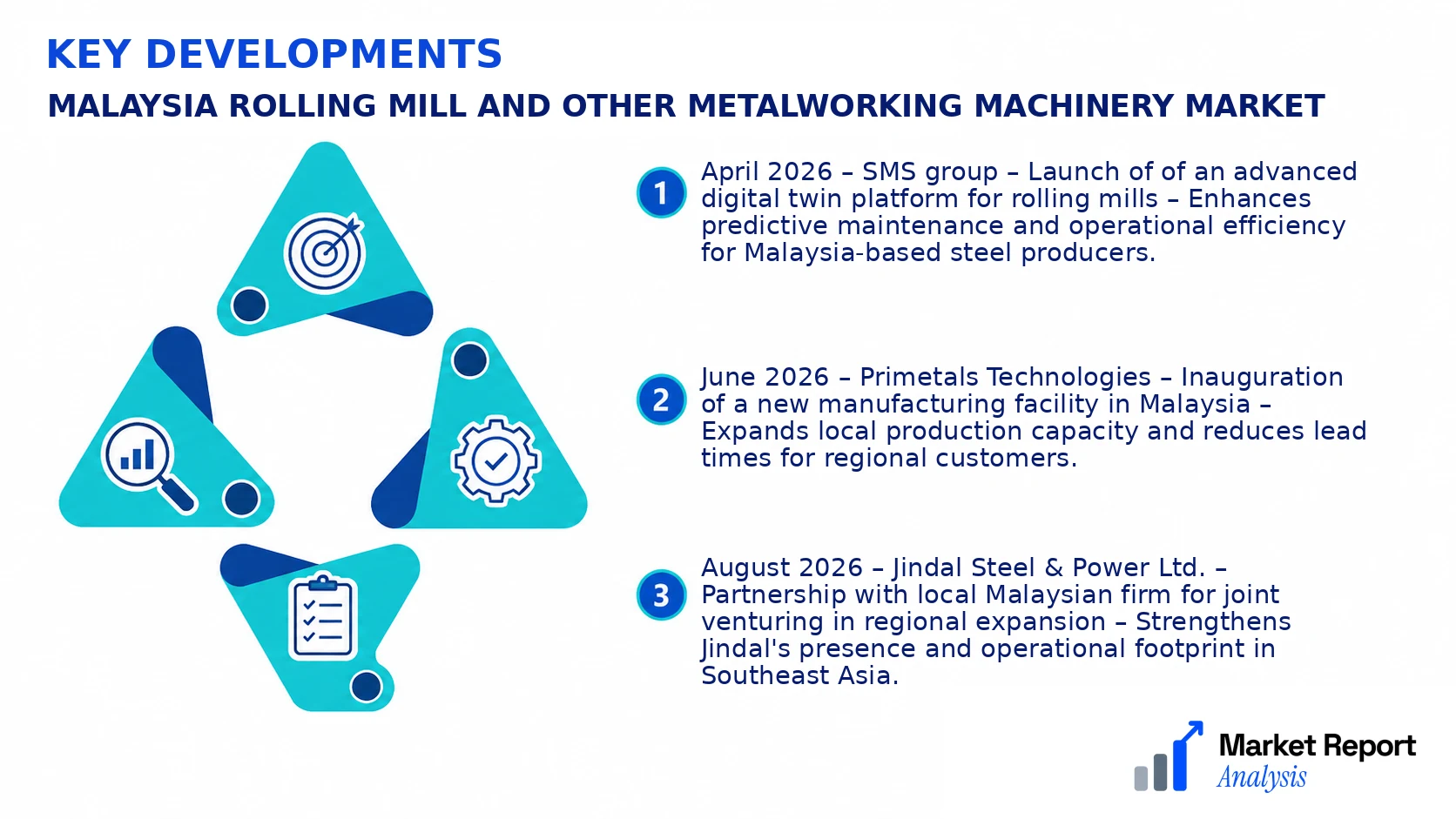
- April 2026 – SMS group – Launch of of an advanced digital twin platform for rolling mills – Enhances predictive maintenance and operational efficiency for Malaysia-based steel producers.
- June 2026 – Primetals Technologies – Inauguration of a new manufacturing facility in Malaysia – Expands local production capacity and reduces lead times for regional customers.
- August 2026 – Jindal Steel & Power Ltd. – Partnership with local Malaysian firm for joint venturing in regional expansion – Strengthens Jindal's presence and operational footprint in Southeast Asia.
- October 2026 – Siemens AG – Introduction of a comprehensive energy management system for metalworking plants – Promotes sustainability and energy efficiency across Malaysian mills.
- December 2026 – Danieli Corporation – Acquisition of a regional steel processing technology firm – Aims to bolster service offerings and technological supremacy in the Malaysian market.
Frequently Asked Questions
What is the Malaysia Rolling Mill and Other Metalworking Machinery Market?
The Malaysia Rolling Mill and Other Metalworking Machinery Market encompasses the manufacturing and sales of equipment used in metal forming, processing, and finishing applications within Malaysia. This market serves key industries such as construction, automotive, and electronics, supporting industrial growth and infrastructure development.
What is the current market size of Malaysia Rolling Mill and Other Metalworking Machinery Market?
As of 2026, the market is valued at approximately USD 2.5 Billion, reflecting steady demand driven by rising industrial activities and infrastructure projects. The market demonstrates resilience amid economic fluctuations, supported by government initiatives aimed at industrial expansion.
What factors are driving the Malaysia Rolling Mill and Other Metalworking Machinery Market?
Market growth is primarily driven by increasing infrastructure development, automotive manufacturing, and export activities. Technological advancements in machinery and the expansion of downstream industries further propel demand. Additionally, government policies promoting industrialization boost market prospects.
Which region dominates the Malaysia Rolling Mill and Other Metalworking Machinery Market?
Peninsular Malaysia holds dominance in the market owing to the concentration of manufacturing hubs, industrial zones, and infrastructure projects. The region benefits from superior logistics, access to raw materials, and a skilled workforce, making it the primary market driver in the country.
Which segment is expected to grow the fastest?
The steel rolling mills segment is projected to witness the highest growth rate during 2026-2034, fueled by increased demand from construction and automotive sectors. Emerging trends in automation and energy efficiency are further enhancing growth prospects.
Who are the leading companies operating in the Malaysia Rolling Mill and Other Metalworking Machinery Market?
Major players include local and international firms such as Fuhr, Danieli, and SMS Group. These companies focus on innovation, strategic partnerships, and expanding production capacities to strengthen their market positions in Malaysia.
Analyst Perspective
The Malaysia Rolling Mill and Other Metalworking Machinery Market is poised for sustained growth, driven by expanding downstream industries such as construction, automotive manufacturing, and electronics. The market's maturity is evident with established players coexisting alongside emerging niche manufacturers, fostering a moderately competitive landscape. Technological evolution, especially in automation and digitization, presents significant opportunities for efficiency gains and product differentiation, making investments in innovative machinery highly attractive. Urban centers like Kuala Lumpur and Johor Bahru are increasingly becoming hubs for metalworking industries due to regional industrial policies and infrastructure development, offering localized growth pockets. Long-term prospects remain favorable; however, market participants should navigate risks related to fluctuating raw material costs, trade policies, and environmental regulations. Strategic investments in R&D, regional diversification, and strategic alliances will be pivotal in consolidating market position and capitalizing on Malaysia’s industrial growth trajectory, positioning the market for resilience amid global economic shifts.
