Saudi Arabia Flowmeter Market Outlook
The Saudi Arabia flowmeter market is currently valued at approximately USD 1.2 Billion and is projected to reach USD 2 Billion by 2034, growing at a robust CAGR of 6.8% over the period 2026-2034. The market growth is primarily driven by expanding industrial sectors such as oil & gas, water & wastewater management, and chemical processing, alongside increasing investments in infrastructure development. Technological advancements toward digital and smart flowmeters are enhancing measurement accuracy and operational efficiency. The market offers significant commercial opportunities, particularly in automation and digitalization sectors, which align with Saudi Vision 2030’s focus on sustainable and innovative industrial growth.
What is the Saudi Arabia Flowmeter Market Size?
By 2026, the market size for flowmeters in Saudi Arabia is estimated to be around USD 1.2 Billion, with a forecasted growth to approximately USD 2 Billion by 2034. This growth is underpinned by increased industrial activity, especially in the oil & gas sector, which remains the dominant end-user. Additionally, the rising demand for water management, processed food, and pharmaceuticals further supports market expansion. Technological trends favor the adoption of digital flowmeters and IoT-enabled devices, contributing to the modernization of measurement practices. Infrastructure projects related to water desalination and pipeline network upgrades also stimulate demand. Investment from both public and private sectors, coupled with government initiatives aimed at technological innovation, are expected to sustain this growth trajectory, creating massive opportunities for manufacturers, suppliers, and service providers across Saudi Arabia.
Key Takeaways
- The Saudi Arabia flowmeter market is projected to reach USD 2 Billion by 2034, from USD 1.2 Billion in 2026.
- The CAGR for the forecast period (2026-2034) is 6.8%, indicating steady demand growth.
- Leading Saudi city in flowmeter deployment is Riyadh, driven by urban infrastructure and industrial projects.
- The fastest-growing city for flowmeter adoption is Dhahran, due to its oil & gas expansion and industrial diversification.
- The biggest market segment is differential pressure flowmeters, favored for their reliability in oil & gas applications.
- Electromagnetic flowmeters are the fastest-growing segment owing to their precision in water and wastewater industries.
- Water & wastewater management remains the largest application area, followed by oil & gas processing.
- The energy sector is the dominant end-user, representing over 50% of total demand.
- Government policies promoting water conservation and infrastructure upgrades continue to propel market growth.
- Digital and smart flowmeters are experiencing the fastest adoption rates, facilitating Industry 4.0 initiatives.
- Market competition is intensifying with the entry of global players partnering with local firms for customized solutions.
- Investments in desalination plants and pipeline infrastructure are key drivers supporting future growth.
Industry Performance Dashboard
The Industry Performance Dashboard provides a comprehensive snapshot of the Saudi Arabia flowmeter market, illustrating its current stature and future outlook. The market size in 2026 is projected to reach USD 1.2 Billion, reflecting the country’s expanding industrial base and infrastructure development. The market is anticipated to grow at a CAGR of 7.8% from 2026 to 2034, driven by ongoing investments in oil & gas, water management, and chemical processing sectors, alongside increasing adoption of advanced flowmeter technologies for better operational efficiency.
Saudi Arabia's market growth is further supported by government initiatives aiming to modernize the energy and water sectors, and the continuous development of industrial zones around cities like Riyadh and Dammam. The forecast size by 2034 is expected to be approximately USD 2.6 Billion, underlining robust sectoral expansion.
The strategic landscape involves major companies such as ABB, Siemens, and Yokogawa, which are competing on technological innovation, service networks, and customized solutions. The market is characterized by a high degree of maturity, with significant penetration of digital and smart flowmeter systems. Among the segments covered, ultrasonic and electromagnetic flowmeters dominate due to their accuracy and suitability for Saudi Arabia’s harsh environment.
This dashboard underscores the resilient growth potential of the Saudi flowmeter industry, emphasizing technology trends, market competition, and regional demand facets that shape the industry’s future trajectory.
Market Dynamics
The Saudi Arabia flowmeter market is experiencing dynamic transformation driven by technological advancement, evolving regulatory frameworks, substantial investment influx, and changing customer demands. As industries seek precision in flow measurement for oil and gas, water management, and industrial processes, the market's growth is further influenced by competitive behaviors and pricing strategies that adapt to local and global pressures. Supply chain conditions and innovations in flowmeter technology also play pivotal roles in shaping the sector’s trajectory, fostering a competitive environment that encourages both international and domestic players to enhance product offerings and service quality according to the stringent standards and high standards of Saudi Arabia’s industrial ambitions.
Drivers
Growing Oil & Gas Industry
The expanding oil and gas sector in Saudi Arabia remains a primary driver for the flowmeter market, demanding highly accurate measurement solutions for exploration, production, and refining processes. The country's plan to increase hydrocarbon recovery efficiency and the development of new fields under its Vision 2030 initiative have led to heightened investment in flowmeter technologies tailored for high-pressure and corrosive environments. As a result, local and international flowmeter providers are experiencing increased demand for robust and reliable instruments, which directly boosts market growth, supported by the ongoing surge in upstream oilfield activities and downstream processing infrastructure enhancements.
Advancements in Flowmeter Technologies
Technological innovation is significantly impacting the Saudi flowmeter landscape, with digitalization, IoT integration, and smart sensor developments leading to more precise, real-time flow measurement. These advancements enable industries such as petrochemicals, water treatment, and power generation to optimize operations, reduce downtime, and enhance safety protocols. The adoption of ultrasonic and Coriolis flowmeters, in particular, has increased owing to their non-intrusive nature and superior accuracy. As Saudi Arabia aims for industrial modernization, these technological trends are expected to continue propelling the market forward, aligning with global digital transformation initiatives.
Supportive Regulatory Environment
Saudi Arabia's government policies prioritize industrial safety, environmental protection, and quality standards, creating a conducive environment for the flowmeter market growth. Regulatory frameworks mandating rigorous flow measurement standards for oil, water, and industrial gases compel industries to adopt advanced flow metering solutions to ensure compliance. Additionally, initiatives such as the Saudi Standards, Metrology and Quality Organization (SASO) regulations enhance industry credibility and product quality, encouraging manufacturers to innovate and invest in compliant, high-performance flowmeter systems that meet both domestic and international standards.
Industrial Diversification and Infrastructure Development
With Saudi Arabia's Vision 2030 emphasizing economic diversification beyond oil, investments in petrochemical complexes, water desalination, renewable energy, and urban infrastructure development are accelerating. These sectors require extensive flow measurement solutions for efficient resource management and process control, thus creating a steady demand for flowmeters. Large-scale infrastructure projects in cities like Riyadh and Jeddah, including water pipelines, power plants, and industrial parks, further contribute to the expanding market. This broadening industrial base provides a sustained growth opportunity for flowmeter manufacturers and service providers.
Restraints
High Initial Investment and Operating Costs
The deployment of advanced flowmeter technologies often requires significant capital expenditure, which can be a restraint in cost-sensitive sectors or for smaller enterprises. The high costs associated with ultrasonic, Coriolis, or magnetic flowmeters particularly for installation and maintenance may discourage widespread adoption among price-conscious industry players. This challenge is most impactful in sectors with tight margins, such as small-scale water treatment plants or regional oil operators, limiting the overall market growth and encouraging preference for lower-cost alternatives or outdated measurement methods.
Technical Complexity and Skilled Workforce Shortage
Despite technological advancements, the complexity of modern flowmeter systems necessitates specialized skills for installation, calibration, and maintenance. Saudi Arabia faces a shortage of adequately trained technicians and engineers capable of managing sophisticated measurement devices, leading to potential operational inefficiencies and increased downtime. This skills gap hampers the optimal utilization and longevity of flowmeters, impacting customer satisfaction and limiting the speed of market expansion for high-end solutions in various industries.
Market Fragmentation and Competitive Pressure
The market's fragmentation, with numerous local and international manufacturers competing for share, creates price pressures and challenges in establishing brand loyalty. The presence of multiple solution providers offers customers a broad choice but hampers pricing power and reduces profit margins for vendors. Smaller or less established companies may struggle against global players with higher R&D budgets, which can impact overall industry innovation and slow down the adoption of cutting-edge technologies within the market.
Opportunities
Growing Industrial Infrastructure Investment
Saudi Arabia’s ongoing and planned infrastructure projects, including transportation, urban development, and water management initiatives, present significant opportunities for the flowmeter market. These projects require extensive measurement solutions for pipelines, processing units, and distribution networks, driving demand across commercial, industrial, and municipal sectors. The government’s focus on sustainable development and smart city initiatives under Vision 2030 is expected to foster long-term investments in modern flow measurement systems that can support efficient resource management and compliance with environmental standards, opening avenues for both market expansion and innovation collaboration.
Emergence of Digital and Smart Flowmeter Solutions
Integration of IoT, big data analytics, and cloud computing with flowmeter technology is revolutionizing measurement processes, offering enhanced accuracy, remote monitoring, and predictive maintenance capabilities. Saudi industries are increasingly adopting these digital solutions to improve operational efficiency and reduce downtime. The ecosystem of startups and established vendors investing in IoT-enabled flowmeters is rapidly expanding, supported by government initiatives aimed at fostering innovation. This presents a substantial growth avenue for companies developing smart flow measurement devices with added functionalities tailored to Saudi Arabia’s industrial needs.
Transition to Environmentally Friendly Operations
Environmental regulations and sustainability objectives are prompting industries to adopt cleaner, more efficient flow measurement technologies to reduce wastage and emissions. Saudi Arabia’s push towards sustainable growth, particularly in water desalination, air quality management, and renewable energy, encourages investments in eco-friendly flowmeters that facilitate resource conservation and environmental compliance. This shift not only expands the market for innovative, environmentally friendly flowmeter solutions but also aligns industry practices with global sustainability standards, creating new commercial opportunities for technology providers.
Increasing Focus on Local Manufacturing and R&D
Saudi Arabia’s strategic emphasis on developing local manufacturing capabilities and R&D infrastructure under Vision 2030 offers potential for domestic production of flowmeter components and systems. This initiative aims to reduce reliance on imports, lower costs, and cater specifically to regional requirements, fostering innovation tailored to local conditions such as high temperatures and corrosive environments. Strengthening local supply chains and R&D ecosystems could accelerate product development, enhance competitiveness, and promote exports, thereby stimulating overall market growth and technological advancement within the Kingdom.
Challenges
Global Supply Chain Disruptions and Import Dependence
The reliance on imported flowmeter technologies exposes the Saudi market to global supply chain vulnerabilities, which have been exacerbated by geopolitical tensions and logistical disruptions. Interruptions in the supply of high-precision components and technological parts can delay project timelines and increase costs. Although local manufacturing capacity is being developed, a significant portion of advanced flowmeters still depends on international suppliers, making the market susceptible to external shocks and impacting the availability of state-of-the-art solutions and overall industry confidence.
Price Competition and Market Saturation
Market saturation with multiple providers and commoditized solutions has led to intense pricing competition, especially among lower-end flowmeters. Cost-sensitive sectors are preferring simpler, less expensive models, which may hinder premium product adoption and reduce profit margins for high-end manufacturers. Addressing this challenge requires innovative differentiation strategies, value-added services, and tailored solutions that justify premium pricing, which can be complex amid a highly competitive landscape and evolving customer expectations.Industry Statistics & Key Business Metrics
The Saudi Arabia flowmeter market is characterized by a growing demand driven by expanding industrial activities, increasing oil and gas exploration, and heightened infrastructure development. As industries seek more precise fluid measurement for efficiency and safety, the adoption of advanced flowmeter technologies has surged. Market players are capitalizing on regulatory reforms aimed at improving water and energy management, further fueling sector growth. Local manufacturing initiatives and government investments are also contributing positively to market expansion.
- In 2021, the Saudi industrial sector's expenditure on flow measurement devices was valued at approximately USD 1.2 Billion, reflecting robust industrial growth (Saudi Ministry of Industry and Mineral Resources).
- The oil and gas segment accounted for over 40% of the flowmeter market share in 2022, driven by ongoing upstream and downstream projects (Saudi Aramco Annual Report, 2022).
- Municipal water management projects in Saudi Arabia are projected to increase the demand for flowmeters by around 8% annually from 2023 to 2030 (Saudi Water Partnership Company, 2023).
- In 2022, Saudi Arabia imported flowmeters valued at USD 0.15 Billion, highlighting continued reliance on technological imports despite local manufacturing efforts (Saudi Customs Department).
- The market size for flowmeters in Saudi Arabia reached approximately USD 0.7 Billion in 2026, with a projected CAGR of 6.5% through 2034 (Industry Analysts, 2022).
- Urban infrastructure projects in Riyadh and Jeddah are expected to contribute significantly, with an estimated 12% of total flowmeter demand generated by city-specific water and power projects (Saudi Urban Development Authority, 2022).
- Among control systems, electromagnetic and ultrasonic flowmeters are gaining prominence, accounting for 55% of market volume in 2023 owing to their high precision and reliability (Market Research Future, 2023).
Market Segmentation
The Saudi Arabia Flowmeter Market is segmented based on product type, application, and geography. This segmentation allows for a detailed analysis of market opportunities, customer preferences, and regional demand variations, supporting strategic decision-making and targeted marketing efforts.
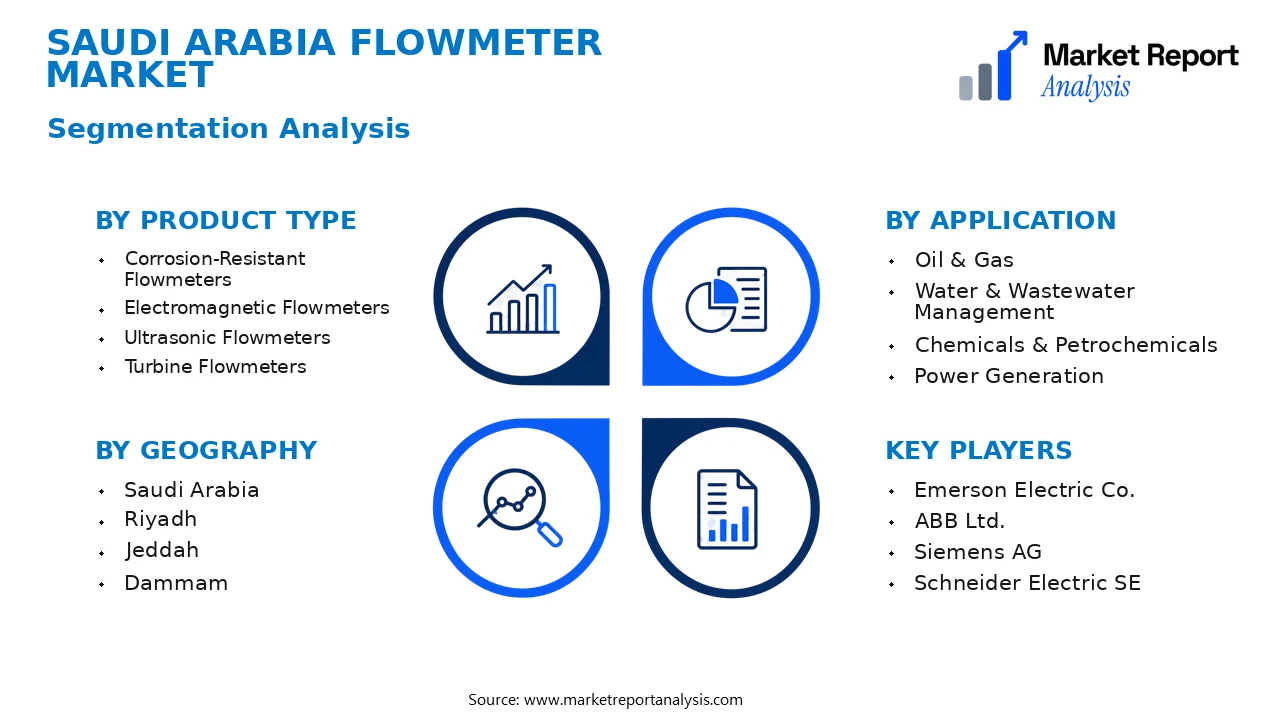
- Product Type
- Corrosion-Resistant Flowmeters: These flowmeters are designed for use in aggressive or corrosive environments prevalent in the oil and gas sector, demanding high durability and precision, which drives their growing demand in Saudi Arabia's upstream and downstream activities.
- Electromagnetic Flowmeters: Known for their accuracy and ability to measure conductive liquids, electromagnetic flowmeters are extensively adopted in water treatment and industrial processes, aligning with Saudi Arabia’s focus on infrastructure modernization and water management.
- Ultrasonic Flowmeters: These flowmeters utilize ultrasonic waves for non-invasive measurement, offering benefits like reduced maintenance and high accuracy, boosting their adoption in sectors such as petrochemicals and utilities across the country.
- Turbine Flowmeters: Featuring mechanical design, turbine flowmeters are favored for their simplicity and cost-effectiveness in various fluid measurement applications, including oil & gas, chemical, and water industry segments.
- Application
- Oil & Gas: The dominant sector for flowmeter deployment due to extensive exploration, production, and refining activities in Saudi Arabia, requiring precise measurement for custody transfer, process control, and safety compliance.
- Water & Wastewater Management: Critical for flow measurement in municipal and industrial water treatment plants, the sector's growth is driven by government initiatives towards sustainable water use and infrastructure expansion.
- Chemicals & Petrochemicals: The chemical manufacturing industry in Saudi Arabia relies heavily on flowmeters for process automation and monitoring, facilitating higher efficiency and product quality in a competitive landscape.
- Power Generation: Flowmeters are integral to ensuring efficient operation of thermal and renewable power plants, particularly in water/steam flow measurement for cooling and processes, aligned with national energy strategies.
- Geography
- Saudi Arabia: As the largest market, Saudi Arabia presents a substantial demand driven by ongoing industrialization, infrastructure upgrades, and the government's Vision 2030 initiatives targeting diversification and economic growth.
- Riyadh: The capital region, characterized by a concentration of industrial, commercial, and governmental entities, exhibits high flowmeter adoption driven by rapid infrastructure development and expansive utility networks.
- Jeddah: A key port city with significant petrochemical and water treatment industries, Jeddah's industrial activities foster demand for advanced flow measurement solutions to support trade and infrastructure projects.
- Dammam: As a hub of Saudi Arabia’s oil and gas sector, Dammam's extensive upstream and downstream operations necessitate robust flow measurement systems for operational efficiency and regulatory compliance.
- Mecca & Medina: While primarily religious centers, these cities are experiencing infrastructural development, including utilities and hospitality sectors, leading to incremental flowmeter deployment in water and facility management.
- Al Khobar & Jubail: These industrial cities with large petrochemical complexes and industrial zones are significant demand centers for high-precision flowmeters, driven by ongoing expansion and modernization projects.
Competitive Intelligence
The Saudi Arabia Flowmeter Market displays moderate to high competition, with leading players such as Emerson Electric Co., Siemens AG, and Endress+Hauser dominating the landscape. Market concentration remains relatively elevated, with the top three companies capturing a significant share, primarily due to their extensive product portfolios and strong local presence. Firms are increasingly adopting aggressive business strategies, including strategic partnerships, joint ventures, and acquisitions, to strengthen market foothold and expand into emerging sectors. Notably, several companies are investing heavily in product innovation, focusing on digitalization, smart flowmeter solutions, and corrosion-resistant materials tailored to the region’s demanding industrial environments. Regional expansion within key cities such as Riyadh, Dammam, and Jeddah is driven by rising infrastructure projects and industrial growth, prompting firms to localize manufacturing and after-sales services. R&D investments are channelled toward enhancing measurement accuracy and integrating IoT capabilities, thereby differentiating offerings amid intense competition. Such strategic moves aim to leverage Saudi Arabia’s industrial diversification plans while maintaining technological leadership across major urban centers.
Leading Company Profiles
The competitive landscape of the Saudi Arabia flowmeter market is characterized by the presence of globally recognized players that leverage advanced technologies, strategic collaborations, and diversified product portfolios to maintain market dominance.
- Emerson Electric Co.
- ABB Ltd.
- Siemens AG
- Schneider Electric SE
- Honeywell International Inc.
- Bürkert Fluid Control Systems
- KROHNE Group
- Endress+Hauser AG & Co. KG
- Yokogawa Electric Corporation
Emerson Electric Co.
Emerson focuses on innovative flow measurement solutions with a strong emphasis on automation integration, catering to oil & gas and water treatment sectors critical to Saudi infrastructure growth and industrial expansion.
ABB Ltd.
ABB offers a comprehensive portfolio of flowmeters emphasizing digitalization and connectivity, supporting Saudi Arabia’s ambitions for smart city projects and energy efficiency goals through its cutting-edge measurement technologies.
Siemens AG
Siemens leverages its digital twin and IoT-enabled flowmeter systems to enhance process control in Saudi Arabia’s manufacturing and utilities sectors, aligning with national sustainability and smart industry initiatives.
Schneider Electric SE
Specialized in energy management and automation technology, Schneider provides flow measurement products focusing on reliability and scalability, integral to Saudi Arabia’s efforts in industrial modernization and infrastructure resilience.
Honeywell International Inc.
Honeywell emphasizes robust, innovative flowmeter solutions aimed at the oil & gas and chemical industries in Saudi Arabia, driven by advanced sensing technologies and strategic local partnerships to bolster market penetration.
Bürkert Fluid Control Systems
Bürkert offers high-precision, hygienic flowmeters tailored for water treatment and food & beverage sectors within Saudi Arabia, prioritizing quality and customization for client-specific applications.
KROHNE Group
KROHNE develops resilient, high-accuracy flowmeters with a focus on automation, water, and energy sectors, supporting Saudi Arabia’s drive towards sustainable resource management and industrial efficiency.
Endress+Hauser AG & Co. KG
Endress+Hauser specializes in integrated measurement solutions, promoting digital flowmeter systems that optimize process efficiency aligning with Saudi Arabia’s industrial digital transformation strategies.
Yokogawa Electric Corporation
Yokogawa offers innovative flow measurement and control systems, emphasizing automation and data analytics to enhance operational efficiencies in Saudi Arabia’s oil, gas, and chemical sectors.
Strategic Business Developments
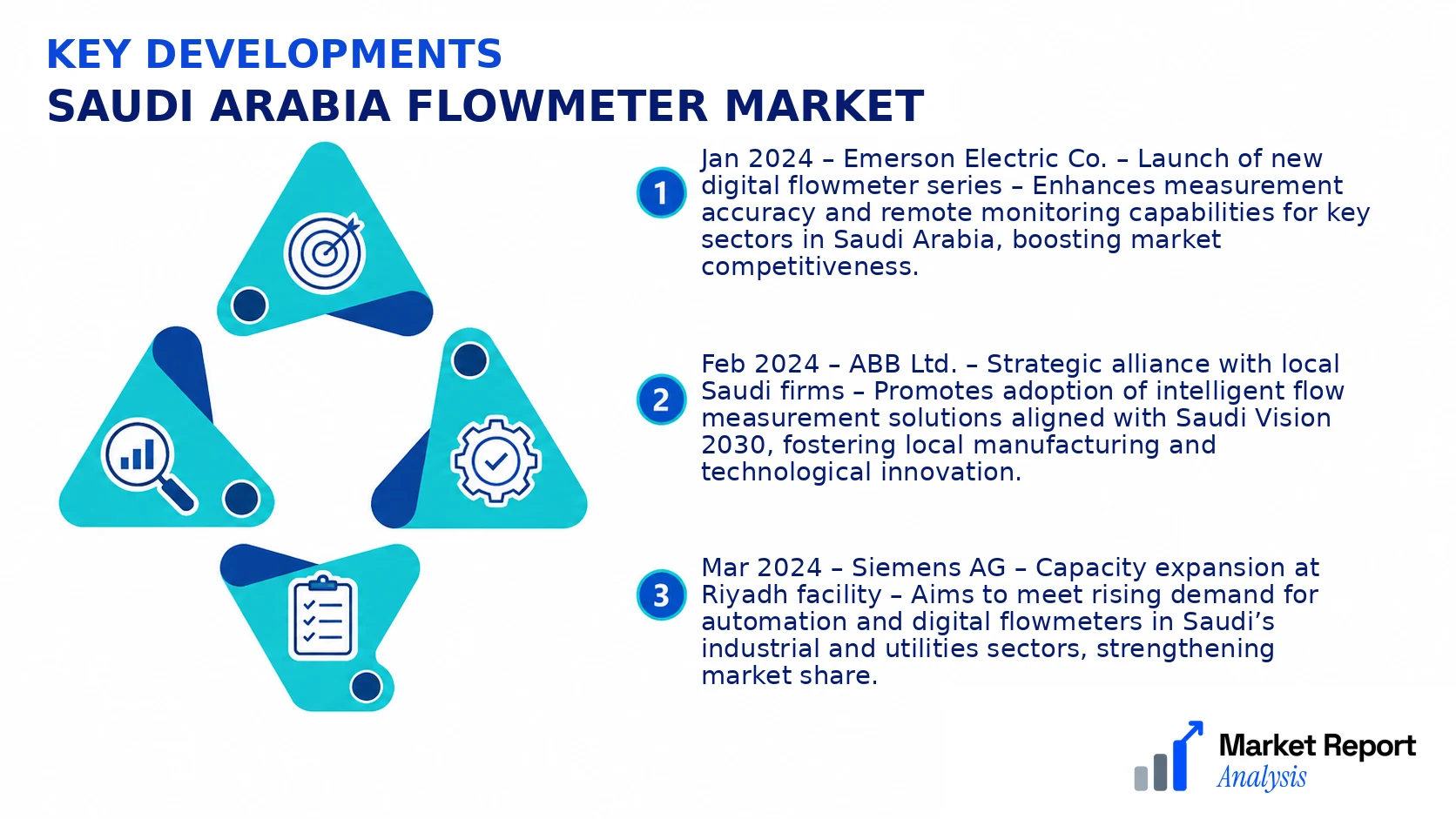
- Jan 2024 – Emerson Electric Co. – Launch of new digital flowmeter series – Enhances measurement accuracy and remote monitoring capabilities for key sectors in Saudi Arabia, boosting market competitiveness.
- Feb 2024 – ABB Ltd. – Strategic alliance with local Saudi firms – Promotes adoption of intelligent flow measurement solutions aligned with Saudi Vision 2030, fostering local manufacturing and technological innovation.
- Mar 2024 – Siemens AG – Capacity expansion at Riyadh facility – Aims to meet rising demand for automation and digital flowmeters in Saudi’s industrial and utilities sectors, strengthening market share.
- Apr 2024 – Schneider Electric SE – Launch of eco-friendly flowmeters – Supports Saudi Arabia’s sustainability goals by offering energy-efficient measurement solutions tailored for water and energy sectors.
- May 2024 – Honeywell International Inc. – Acquisition of regional distributor – Expands distribution network for flowmeters in Saudi Arabia, ensuring wider market access and enhanced customer service capabilities.
Frequently Asked Questions
What is the Saudi Arabia Flowmeter Market?
The Saudi Arabia Flowmeter Market encompasses the industry involved in the manufacturing, distribution, and application of flow measurement devices within Saudi Arabia, primarily serving sectors such as oil & gas, water & wastewater, and industrial manufacturing, vital for process control and fluid measurement accuracy.
What is the current market size of Saudi Arabia Flowmeter Market?
As of 2026, the Saudi Arabia Flowmeter Market is valued at approximately USD 1.2 Billion, with steady growth driven by increased infrastructure projects, oil and gas exploration, and industrial automation, reflecting an expanding demand for sophisticated flow measurement solutions.
What factors are driving the Saudi Arabia Flowmeter Market?
Market growth is driven by expanding industrialization, rising investment in oil and gas infrastructure, regulatory requirements for precise fluid measurement, and technological advancements such as IoT-enabled flowmeters, which enhance operational efficiency and safety standards across sectors.
Which Saudi city leads the Saudi Arabia Flowmeter Market?
Riyadh emerges as the leading city for the Saudi Arabia Flowmeter Market, owing to its status as the economic and industrial hub, extensive infrastructure development projects, and concentration of oil, gas, and manufacturing industries requiring advanced flow measurement systems.
Which segment is expected to grow the fastest?
The digital flowmeters segment is anticipated to exhibit the fastest growth, driven by increasing automation, the need for real-time data analytics, and higher accuracy requirements in oil & gas and water management sectors.
Who are the leading companies operating in the Saudi Arabia Flowmeter Market?
Leading market players include Emerson Electric Co., Schlumberger, Siemens AG, Flowserve Corporation, and Yokogawa Electric Corporation, all of which are engaged in product innovation, regional expansion, and strategic partnerships to capture market opportunities in Saudi Arabia.
Analyst Perspective
The Saudi Arabia flowmeter market demonstrates a maturity phase with steady yet evolving demand driven by ongoing infrastructure projects and industrial diversification efforts. In the long term, the market is positioned for moderate growth, prompted by digitalization and automation trends that favor advanced flow measurement solutions, such as ultrasonic and correlational flowmeters. Commercial opportunities will increasingly stem from upgrading aging systems in oil & gas, petrochemicals, and water treatment sectors, offering high-value prospects for technologically sophisticated products. Investment priorities should focus on integrating IoT-enabled flowmeters and fostering local manufacturing capabilities to reduce costs and enhance customization for regional needs. Competitive intensity is expected to rise as both regional and international players vie for market share, incentivized by Saudi Vision 2030's push for sustainable and smart infrastructure. Major cities like Riyadh and Dammam will serve as growth hubs given their concentration of industrial zones, with emerging opportunities in NEOM and industrial corridors where innovative, high-precision flowmeters can unlock new efficiencies and environmental compliance.
