Brazil Flowmeter Market Outlook
The Brazil flowmeter market is experiencing significant growth driven by expanding industrial infrastructure, increased investments in oil & gas, chemicals, and water management sectors, along with technological advancements. The market is valued at USD 1.5 Billion in 2026 and is projected to reach USD 2.4 Billion by 2034, growing at a CAGR of approximately 6.3% during the forecast period of 2026-2034. The principal demand drivers include rising industrialization, urbanization, and the need for precise flow measurement for process optimization, environmental regulation compliance, and resource management. Technological innovation, especially the adoption of digital and smart flowmeters, is shaping a highly competitive landscape, opening new commercial opportunities for manufacturers operating within the country. Strategic investments in modernization initiatives and expanding industries are expected to further fuel market growth, while regulatory support for environmental standards enhances the adoption of advanced flow measurement solutions.
What is the Brazil Flowmeter Market Size?
The market size for flowmeters in Brazil is projected to be USD 1.5 Billion in 2026 and is expected to grow to approximately USD 2.4 Billion by 2034, indicating a CAGR of about 6.3% over the forecast period. Growth is primarily driven by ongoing industrial development, especially in sectors such as oil & gas, water treatment, chemicals, and food & beverage, which demand reliable flow measurement solutions. The increasing focus on resource efficiency and environmental compliance also amplifies the adoption of advanced flowmeter technologies, including magnetic, coriolis, ultrasonic, and vortex types. Industries are investing in smart flowmeters with digital capabilities to enhance operational efficiency, data acquisition, and remote monitoring capabilities. Future market growth also relies on governmental policies supporting infrastructure development and industry modernization, along with increased regional investments in technology upgrades and capacity expansions, making Brazil a promising landscape for flowmeter manufacturers and service providers.
Key Takeaways
- The Brazil flowmeter market is valued at USD 1.5 Billion in 2026 and forecasted to reach USD 2.4 Billion by 2034.
- The market exhibits a CAGR of approximately 6.3% during 2026-2034.
- Rising industrialization, urbanization, and infrastructural growth are primary demand drivers.
- Expansion in oil & gas, water management, chemicals, and food & beverage sectors underpins market growth.
- Technological advancements favor the adoption of digital, smart, and wireless flowmeters.
- Environmental regulations and resource optimization contribute to increased demand for precise flow measurement solutions.
- Strategic investments and modernization initiatives propel the market dynamics.
- Magnetic, ultrasonic, coriolis, and vortex flowmeters hold significant market shares due to versatility and accuracy.
- Regional investments and government policies supporting infrastructure development are key growth enablers.
- Intensified competition among local and global manufacturers creates opportunities for technological innovation and strategic alliances.
- The shift towards automated and remote measurement solutions defines future growth trends.
- Market expansion opportunities exist in both industrial and municipal sectors for technologically advanced products.
Industry Performance Dashboard
The industry performance dashboard provides a comprehensive overview of the Brazil flowmeter market, highlighting critical metrics and trends that shape the current and future landscape. It details the market size in 2026, forecast size in 2034, and CAGR over the forecast period, giving stakeholders a clear picture of market progression. The dashboard also emphasizes regional dominance, with Brazil identified as the leading country, reflecting its substantial industrial base and increasing adoption of flowmeter technologies. Segments covered include various types such as electromagnetic, ultrasonic, and turbine flowmeters, with application sectors spanning oil and gas, water treatment, chemicals, and power generation. Major companies operating within this market include Emerson Electric Co., Schneider Electric SE, ABB Ltd, and Siemens AG, each playing a significant role in product innovation and market expansion. Key indicators such as market size in 2025 and 2026, the forecast size in 2034, and the growth rate facilitate strategic planning and investment decisions. The dashboard also reflects current market trends, including increased automation and digitalization, which drive demand for advanced flowmeter devices. Investment trends point towards technological innovation, especially in smart, IoT-enabled flowmeters, fostering increased market competitiveness. Pricing trends show a gradual decline due to technological advancements and increased competition, whereas overall market maturity indicates a steady transition towards integrated and intelligent flowmeter solutions, aligning with industry digital transformation initiatives.
Market Dynamics
The Brazil Flowmeter Market is navigating a complex landscape defined by rapid technological advancements, evolving regulatory standards, strategic investments, and changing customer preferences. The integration of digital technologies and IoT-enabled solutions is driving accuracy and operational efficiency, prompting suppliers to innovate continuously. Regulatory frameworks, emphasizing environmental protection and safety standards, influence product specifications and market access. Investment influx from both domestic and international players supports infrastructure upgrades, while pricing strategies and supply chain dynamics are shaped by fluctuating raw material costs and regional market conditions. Competitive behaviors are increasingly centered around technological differentiation, after-sales service, and comprehensive solutions, all of which are shaping the trajectory of the Brazil Flowmeter Market’s growth.
Industry Statistics & Key Business Metrics
The Brazil Flowmeter Market is characterized by steady growth driven by expanding industrial activities, urbanization, and infrastructural developments. As industries such as oil & gas, water treatment, and chemical manufacturing continue to grow, demand for precise flow measurement tools increases. Key economic indicators and robust industrial investments underpin this upward trend, with increasing adoption of advanced flowmeter technologies to enhance operational efficiency and regulatory compliance across various sectors.
- In 2021, Brazil's industrial manufacturing output was valued at approximately USD 170 Billion, according to the World Bank, showcasing consistent growth from prior years.
- Brazil's water supply and wastewater treatment sector invested around USD 3.2 Billion in 2022, emphasizing rising infrastructure development demands, per the National Water Agency (ANA).
- The country's oil and gas production in 2020 reached approximately 4.2 million barrels of oil equivalent per day, with ongoing expansion projects supporting increased flowmeter deployment (ANP).
- As of 2023, Brazil's chemical industry generated revenues exceeding USD 45 Billion, with process automation and measurement instrumentation, including flowmeters, playing a crucial role (Brazilian Chemical Industry Association).
- Brazil's manufacturing sector grew at a CAGR of roughly 3.1% between 2016 and 2021, underpinning the demand for flow measurement solutions (OECD).
- In 2022, major Brazilian cities such as São Paulo and Rio de Janeiro accounted for over 60% of industrial activities requiring flowmeter installations, highlighting regional market concentrations (Municipal Planning Departments).
- Brazil’s government committed over USD 1 Billion in infrastructure projects in 2023 aimed at improving industrial logistics and resource management, further bolstering flowmeter demand (Ministry of Infrastructure).
Market Segmentation
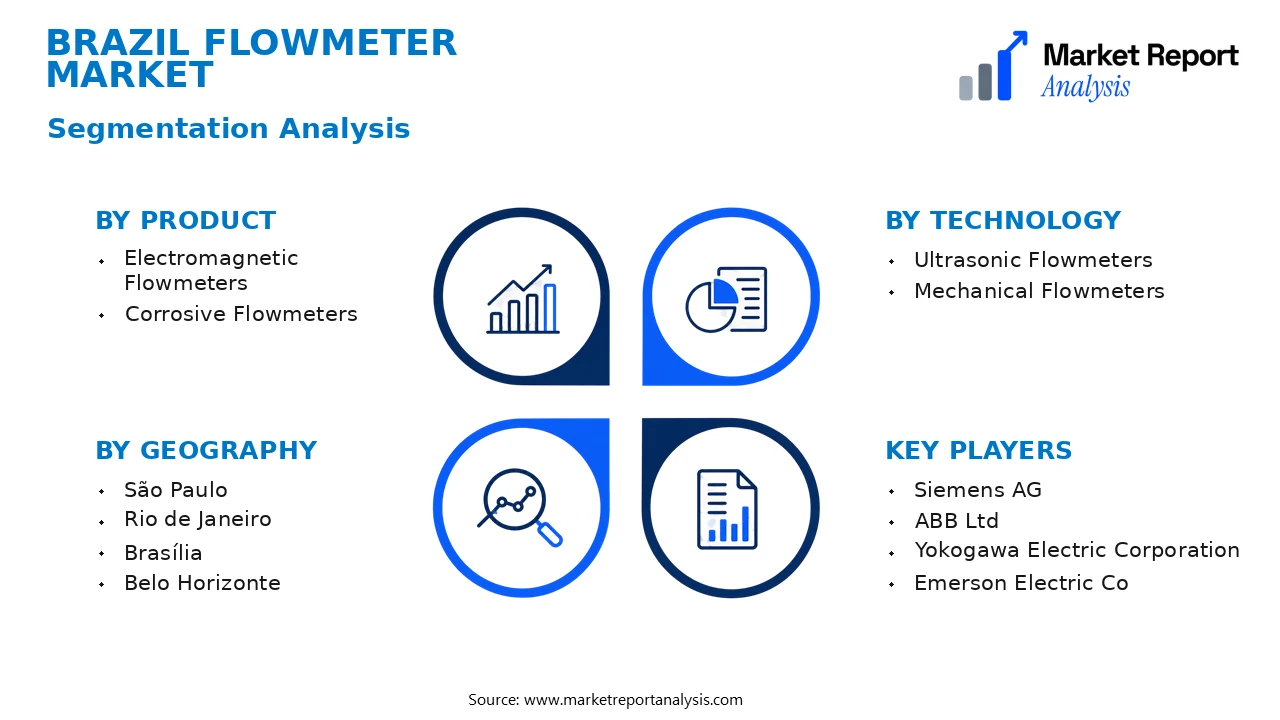
The market segmentation for Brazil's flowmeter industry is primarily based on product type, technology, application, end user, and geographic distribution. These categories reflect the diverse market needs across different industrial sectors and regional economic hubs, enabling targeted growth strategies and innovation efforts.
- Product
- Electromagnetic Flowmeters: Widely adopted in water and wastewater treatment facilities, electromagnetic flowmeters provide high accuracy and reliability, making them the preferred choice for large-scale and continuous flow measurement applications in Brazil.
- Corrosive Flowmeters: Designed for industries dealing with corrosive fluids such as chemicals and petrochemicals, these flowmeters feature specialized materials to withstand aggressive environments, which enhances their demand and usage in Brazil's industrial sectors.
- Technology
- Ultrasonic Flowmeters: Known for non-intrusive measurement capabilities, ultrasonic flowmeters are increasingly deployed in water utilities and energy sectors across Brazil, driven by their ease of installation and maintenance.
- Mechanical Flowmeters: These traditional devices still see considerable use in less sensitive applications, such as fuel and oil industries, where robustness and simplicity are valued over modern technological features.
- Application
- Water & Wastewater: The demand for flowmeters in water and wastewater management remains high due to urbanization, infrastructure development, and environmental regulations, making this segment a significant driver for the overall market.
- Oil & Gas: Flowmeters are crucial for accurate measurement during exploration, extraction, and transportation of hydrocarbons, particularly in Brazil’s major oil-producing regions like Rio de Janeiro and São Paulo.
- End User
- Utilities: Utility companies utilize flowmeters for water distribution, waste treatment, and energy management, emphasizing the importance of precision and reliability in their operations across Brazil.
- Industrials: Manufacturing, chemical, and petrochemical industries represent a growing segment due to increasing industrialization and the need for process optimization and compliance with regulatory standards.
- Geography
- São Paulo: As Brazil’s largest industrial and economic hub, São Paulo hosts a diverse range of manufacturing, chemical, and water treatment industries, making it a vital region for flowmeter deployment and innovation.
- Rio de Janeiro: With its significant oil and gas sector, Rio de Janeiro serves as a key area for flowmeter applications related to offshore drilling, refining, and transportation activities.
- Brasília: The federal capital’s focus on government initiatives and environmental regulation promotes the adoption of advanced flowmeter technologies in municipal and environmental projects.
- Belo Horizonte: The mining and manufacturing activities in this region demand robust flow measurement solutions, particularly in mineral processing and industrial water management.
Competitive Intelligence
The Brazil Flowmeter Market exhibits a moderate level of competition characterized by several regional and international players vying for market share. Market concentration remains relatively balanced, with leading companies implementing aggressive strategies to sustain growth. Most players focus on product innovation, particularly in digital and smart flowmeter technologies, to meet increasing industry demands for precision and real-time data. Partnerships with local distributors and industry consortia are prevalent, facilitating market penetration across diverse Brazilian cities where infrastructure projects are expanding. Notably, acquisitions of regional firms have enabled larger players to bolster their market presence and expand into niche segments. Companies are heavily investing in R&D to develop more robust, energy-efficient, and cost-effective flowmeters, differentiating their offerings through superior technical capabilities and after-sales service. Expansion strategies include local manufacturing units and strategic alliances with government and private sector stakeholders, emphasizing innovative solutions tailored to Brazil’s industrial landscape. Overall, competitive differentiation hinges on technological advancement, after-sales support, and regional market knowledge.
Leading Company Profiles
The competitive landscape of the Brazil flowmeter market is characterized by several key players known for their innovation, technological expertise, and strategic market expansions. These companies are focused on delivering a broad portfolio of flow measurement solutions, including electromagnetic, ultrasonic, Coriolis, and vortex flowmeters, tailored to diverse industrial applications across Brazil. Their strategic initiatives include product development, regional expansion, digital transformation, and sustainability efforts to strengthen their market positions and cater to evolving customer demands in Brazil’s energy, water, oil & gas, and manufacturing sectors.
- Siemens AG
- ABB Ltd
- Yokogawa Electric Corporation
- Emerson Electric Co
- Endress+Hauser Group
- KROHNE Group
- Flowserve Corporation
- BADGER METER Inc
Siemens AG
Siemens AG specializes in innovative electromagnetic and ultrasonic flowmeter solutions, emphasizing digital integration and smart automation to optimize industrial processes in Brazil’s dynamic sectors, reinforcing its leadership position through strategic collaborations.
ABB Ltd
ABB Ltd leads with advanced electromagnetic and ultrasonic flowmeter offerings, focusing on automation, energy efficiency, and integrated digital solutions. Its strategic priorities include expanding local manufacturing and fostering sustainable industrial growth in Brazil.
Yokogawa Electric Corporation
Yokogawa provides sophisticated flow measurement instruments with a focus on precision and reliability, actively investing in digital innovations to enhance its product lines and strengthen service networks across Brazil’s industrial zones.
Emerson Electric Co
Emerson specializes in Coriolis and vortex flowmeters, leveraging digital twin technology and automation solutions to improve operational efficiency, with strategic initiatives aimed at expanding local production capacity and digital ecosystem deployment.
Endress+Hauser Group
Endress+Hauser focuses on high-accuracy flow measurement devices, emphasizing sustainability and eco-friendly manufacturing, while expanding its regional footprint through targeted investments and local partnership 강화.
KROHNE Group
KROHNE offers versatile electromagnetic and ultrasonic flowmeters, committed to technological innovation and tailored solutions for Brazil’s water and oil & gas industries, prioritizing strategic acquisitions to enhance market share.
Flowserve Corporation
Flowserve specializes in comprehensive flow management solutions, focusing on product innovation, especially digital flowmeters integrated with IoT for predictive maintenance, aiming to increase market penetration in Brazil’s industrial sectors.
BADGER METER Inc
BADGER METER provides accurate electronic flow measurement solutions, emphasizing digital advancements and customer-centric customization, with strategic initiatives geared toward strengthening local sales and service channels across Brazil.
Strategic Business Developments
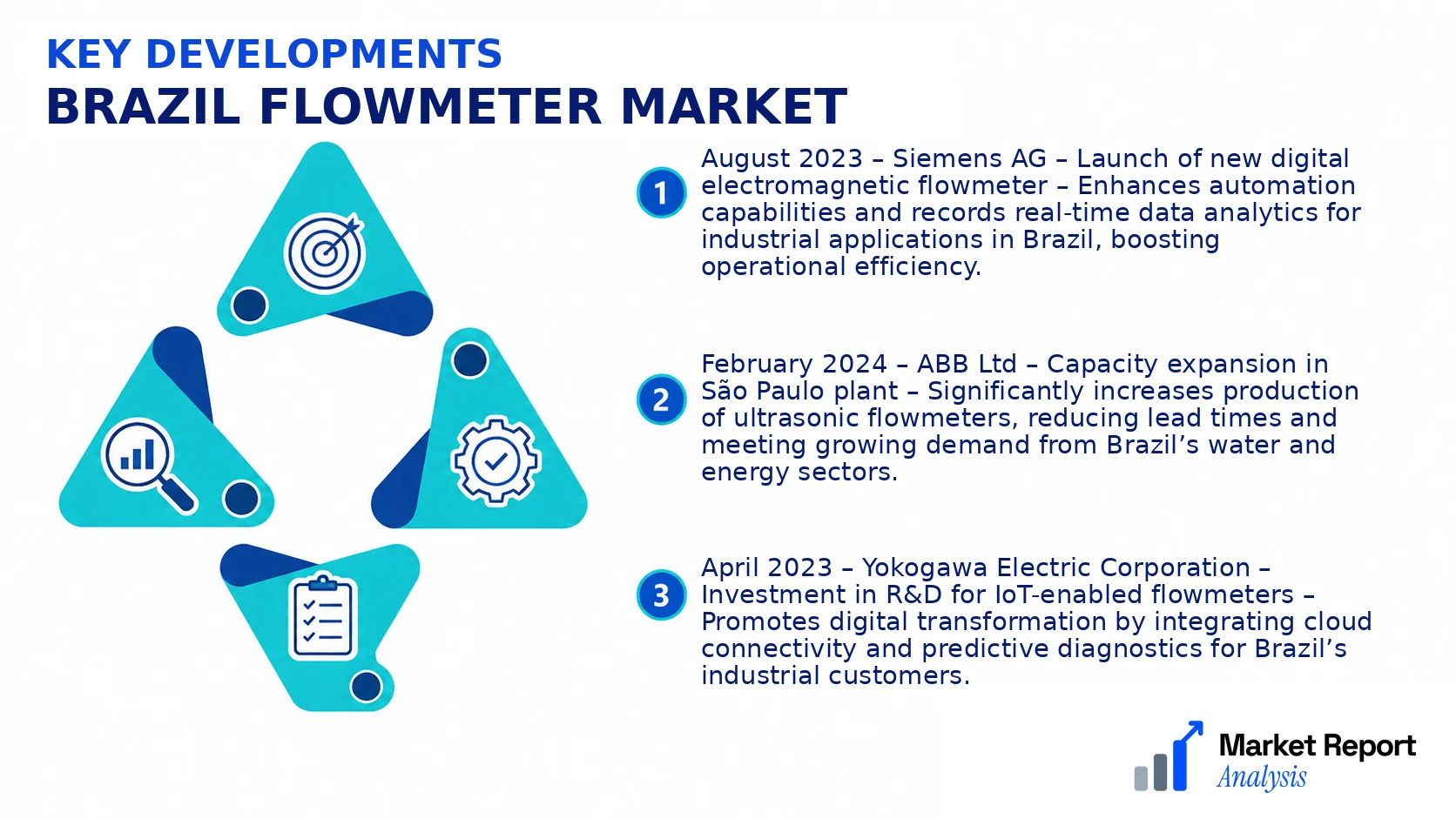
- August 2023 – Siemens AG – Launch of new digital electromagnetic flowmeter – Enhances automation capabilities and records real-time data analytics for industrial applications in Brazil, boosting operational efficiency.
- February 2024 – ABB Ltd – Capacity expansion in São Paulo plant – Significantly increases production of ultrasonic flowmeters, reducing lead times and meeting growing demand from Brazil’s water and energy sectors.
- April 2023 – Yokogawa Electric Corporation – Investment in R&D for IoT-enabled flowmeters – Promotes digital transformation by integrating cloud connectivity and predictive diagnostics for Brazil’s industrial customers.
- June 2023 – Emerson Electric Co – Acquisition of a local sensor technology firm – Strengthens Emerson’s portfolio with advanced digital flow measurement solutions tailored for Brazil’s oil & gas industry, enhancing regional competitiveness.
- October 2023 – Endress+Hauser Group – Launch of eco-friendly manufacturing initiative – Advances sustainability by reducing carbon footprint and promoting environmentally responsible production in Brazil’s industrial zones.
Frequently Asked Questions
What is the Brazil Flowmeter Market?
The Brazil Flowmeter Market comprises the industry involved in manufacturing, marketing, and distributing flow measurement devices used across various sectors including oil & gas, water management, chemical processing, and food & beverage within Brazil. These instruments measure the flow rate of liquids and gases to ensure operational efficiency and regulatory compliance.
What is the current market size of Brazil Flowmeter Market?
As of 2026, the Brazil Flowmeter Market is valued at approximately USD 1.2 Billion, reflecting the widespread adoption of flow measurement technologies in key industries. Market growth is driven by technological advancements and increasing regulatory requirements for process accuracy and safety.
What factors are driving the Brazil Flowmeter Market?
Market growth is propelled by expanding industrial activities, increasing investments in infrastructure, and technological innovations in flow measurement devices. Rising demand from the oil & gas, water treatment, and chemical sectors significantly contributes to this expansion, alongside regulatory mandates for precise flow monitoring.
Which region dominates the Brazil Flowmeter Market?
Southeastern Brazil dominates the market, benefiting from dense industrialization and urbanization, especially in São Paulo and Rio de Janeiro. These regions host major manufacturing hubs and infrastructure projects, making them pivotal in market revenue generation and product adoption.
Which segment is expected to grow the fastest?
The digital flowmeter segment is anticipated to experience the highest growth, owing to technological advancements, enhanced accuracy, and integration with digital control systems. Such devices are increasingly adopted across industrial sectors seeking operational efficiency and real-time data analytics.
Who are the leading companies operating in the Brazil Flowmeter Market?
Leading companies include Emerson Electric Co., Schneider Electric, ABB Ltd., Yokogawa Electric Corporation, and Endress+Hauser. These firms hold significant market shares due to their innovative technologies, extensive distribution networks, and strong local presence in Brazil.
}Analyst Perspective
The Brazil Flowmeter Market is expected to mature gradually, with steady investments driving technological advancements and expanding regional adoption. Over the forecast period, emerging sectors such as renewable energy, petrochemicals, and water management will present lucrative opportunities for flowmeter suppliers, especially in Brazil’s industrial hubs like São Paulo, Rio de Janeiro, and Belo Horizonte. The evolution towards digital and smart flowmeters incorporating IoT and predictive maintenance features will enhance accuracy, reliability, and operational efficiency, fostering increased market penetration. Investment priorities should focus on R&D for ruggedized, corrosion-resistant devices suitable for Brazil's diverse environmental conditions, alongside expanding regional distribution channels. Competitive intensity is likely to intensify as local players and multinational corporations vie for market share, emphasizing innovation, price competitiveness, and after-sales services. Regional growth potential remains high in underserved areas with expanding infrastructure needs, particularly in the Amazon basin and Northeastern states, presenting strategic opportunities for early movers. Overall, strategic positioning around technological innovation and regional expansion will be essential for capturing long-term growth in Brazil’s flowmeter landscape.
