North America Flexible Solar Cell Market Outlook
The North America flexible solar cell market is currently valued at approximately USD 2.5 Billion in 2026 and is projected to reach USD 5.8 Billion by 2034, growing at a CAGR of around 11.0% during the forecast period from 2026 to 2034. This growth is driven by increasing demand for lightweight, portable, and versatile renewable energy solutions across various sectors. Technological advancements in thin-film and organic solar cell technologies have significantly enhanced efficiency and durability, fueling adoption in both residential and commercial markets. The expanding use of flexible solar cells in portable electronics, wearable devices, architectural integrations, and off-grid applications presents substantial commercial opportunities. Governments' supportive policies and investments in clean energy infrastructure further catalyze market expansion, emphasizing innovation in materials and manufacturing processes. The market outlook reflects a promising trajectory aligned with North America's broader sustainability and energy independence objectives.
What is the North America Flexible Solar Cell Market Size?
The North America Flexible Solar Cell Market size is estimated at USD 2.5 Billion in 2026 and is expected to reach approximately USD 5.8 Billion by 2034, expanding at a CAGR of 11.0% from 2026 to 2034. The growth drivers include a rising shift toward renewable energy, increasing demand for portable and lightweight energy solutions, and advancements in flexible solar technologies such as organic and perovskite-based cells. Both residential and commercial sectors are major end-users, with the latter increasing due to new infrastructure projects and integration into building facades. Technological innovations in improving efficiency, flexibility, and environmental resilience continue to influence market dynamics. Investment opportunities are predominantly seen in developing high-performance materials, scaling manufacturing processes, and expanding application fields like transportation, military, and outdoor recreation. Overall, the market's evolution is characterized by its adaptability to diverse use cases and increasing acceptance among enterprises and consumers seeking sustainable alternatives.
Key Takeaways
- The market size for North America flexible solar cells was approximately USD 2.5 Billion in 2026.
- The forecasted market size is around USD 5.8 Billion by 2034.
- The CAGR during this period is estimated at 11.0%.
- The largest segment is organic photovoltaic-based flexible solar cells.
- The fastest-growing segment comprises perovskite-based flexible solar cells.
- The primary application is in portable electronics and wearable devices.
- Building-integrated applications represent the fastest-growing application segment.
- End users include residential, commercial, and industrial sectors, with commercial being the largest.
- The projection period is from 2026 to 2034.
- The analysis is based on the 2026 base year.
Industry Performance Dashboard
The Industry Performance Dashboard offers a succinct yet comprehensive snapshot of the North America Flexible Solar Cell Market. It provides vital metrics that illuminate market dynamics, current standing, and future outlooks. The dashboard begins with the Market Size in 2025, setting a baseline for understanding growth trajectories. It then highlights the Market Size in 2026, a key point of reference for current market valuation, followed by the Forecast Size in 2034, projecting future market expansion.
The Compound Annual Growth Rate (CAGR) from 2026 to 2034 is a critical indicator of the market’s growth momentum. The data is anchored in a consistent Base Year, 2026, with the Forecast Period spanning from 2026 to 2034, covering nearly a decade of market evolution. The dashboard also delineates the segments covered, offering insights into different application areas or technological classifications within the flexible solar cell sector, aiding stakeholders in identifying prime opportunities.
Major Companies serving as market leaders include First Solar, SunPower Corporation, and Canadian Solar, whose strategies and innovations significantly influence market trends. Collectively, these metrics provide a detailed landscape that supports strategic decision-making, investment planning, and competitive analysis, serving as a vital tool for industry stakeholders aiming to capitalize on emerging opportunities or mitigate risks in the North American flexible solar cell market.
The North America flexible solar cell market is influenced by a confluence of technological innovations, regulatory frameworks, investment trends, and shifting customer demands. Advances in material sciences and manufacturing processes are making flexible solar cells more efficient and affordable. Government policies and incentives promote renewable energy adoption, further stimulating market growth. Additionally, increasing investments from both public and private sectors are accelerating research and commercialization. Customer requirements for lightweight, portable, and versatile energy solutions are pushing manufacturers to innovate. Price competition, supply chain dynamics, and strategic behaviors among key industry players also significantly shape the market landscape.
Market Dynamics
Drivers
Technological Advancements in Material Science
Rapid progress in material engineering has led to the development of high-efficiency, lightweight, and durable flexible solar cells, significantly expanding their application scope. Innovations such as perovskite-based cells and organic photovoltaic materials are fueling market expansion by offering lower production costs and enhanced performance. For instance, recent breakthroughs in perovskite flexibility have enabled solar panels to be integrated into curved surfaces, opening new markets in portable and wearable electronics. As R&D continues to improve stability and longevity, businesses are increasingly adopting these technologies, contributing to the market’s sustained growth.
Supportive Regulatory Environment
Government policies and regulations aimed at reducing carbon emissions and promoting renewable energy use are pivotal drivers for the North American market. Incentive programs, tax credits, and renewable portfolio standards compel utility companies, commercial entities, and consumers to incorporate flexible solar solutions. For example, federal and state-level initiatives have set ambitious renewable energy targets, prompting investments in flexible solar projects. Such regulatory support reduces market entry barriers and accelerates deployment rates, fostering a robust infrastructure for widespread adoption and encouraging private sector participation in market growth.
Rising Investment in Renewable Technologies
The influx of venture capital, government funding, and corporate investments into flexible solar technology startups and established manufacturers fuels innovation and commercialization. North American markets have seen a significant increase in cleantech funding, with many startups focusing on next-generation flexible photovoltaic solutions. This investment landscape not only accelerates technological development but also enhances manufacturing capacity and supply chain resilience. The strategic focus of major industry players on integrating flexible solar modules into existing infrastructure further amplifies investment-driven growth, making this a critical market driver for the forecast period.
Growing Customer Demand for Portable and Versatile Energy Solutions
Consumer and industrial segments are increasingly seeking lightweight, flexible, and portable solar energy options to meet needs across remote, off-grid, and mobile applications. Outdoor enthusiasts, military operations, and disaster relief agencies benefit from flexible solar solutions that can be easily deployed on varied surfaces. The commercial sector is also adopting these technologies for building-integrated photovoltaics (BIPV) and vehicular applications, fueling demand. The recognition of flexible solar cells as a convenient and scalable energy alternative supports market expansion, with product offerings tailored to diverse customer requirements.
Restraints
High Manufacturing Costs and Complexity
Despite technological advancements, the production of flexible solar cells remains costly due to complex manufacturing processes, specialized materials, and quality control measures. These high costs limit adoption among price-sensitive buyers and constrain economies of scale, particularly in large-scale utility projects. Industries such as utility-scale power generation and commercial installations are most affected by these cost barriers, which hinder broader market penetration. Scaling up production and continuous process optimization are necessary to reduce costs and improve competitiveness in the North American market.
Environmental and Durability Concerns
Fears about the long-term environmental stability and durability of flexible solar cells impact market confidence. Factors such as thermal stability, mechanical wear, and susceptibility to moisture ingress pose reliability challenges in real-world conditions. These concerns are especially relevant for outdoor and industrial applications where exposure to harsh environmental conditions is prevalent. Overcoming these durability issues through material innovation and rigorous testing is crucial to gaining customer trust and expanding the market share of flexible solar technologies.
Limited Standardization and Certification
The lack of comprehensive industry standards and certification processes for flexible solar cells creates uncertainty for manufacturers and buyers alike. This fragmentation hampers product acceptance and complicates project planning, especially within utility and large commercial segments requiring compliance with specific codes. Regulatory and industry bodies need to establish clear standards to streamline market entry, ensure quality, and facilitate wider acceptance across diverse application sectors. Addressing this gap is vital for sustained growth and market maturity.
Opportunities
Expanding into Emerging Markets and New Applications
The adoption of flexible solar technology in emerging markets presents a significant growth opportunity, driven by increasing off-grid energy demands and infrastructure development. Rural communities and developing industries lack reliable grid power, making portable and adaptable solar solutions highly attractive. Expanding applications into areas such as automotive, aerospace, wearable electronics, and building-integrated photovoltaics (BIPV) opens new revenue streams. As manufacturing costs decrease and product performance improves, the market can capture a larger share of these unexplored segments by tailoring solutions to specific regional requirements and technology gaps.
Innovations in Hybrid and Integrated Energy Systems
The integration of flexible solar cells into hybrid energy systems combining batteries, storage, and other renewable sources offers a strategic growth avenue. These integrated solutions enhance system efficiency, stability, and cost-effectiveness, meeting the complex demands of remote and autonomous installations. Investment in such innovations is supported by trends toward smart grid development and decentralized power generation. Collaborative research and cross-sector partnerships will facilitate the commercialization of advanced hybrid systems, positioning flexible solar as a key component in next-generation energy infrastructures.
Growth of Startup Ecosystem and Technological Innovation
A vibrant startup ecosystem focused on innovative flexible solar solutions drives continuous technological breakthroughs. Entrepreneurs are developing new materials, manufacturing techniques, and application-specific products, expanding the technological horizon. This ecosystem benefits from government grants, venture funding, and industry collaborations, fostering rapid development and market entry. The competitive landscape is poised to benefit from disruptive innovations, further lowering costs and improving performance, and positioning North America as a hub for flexible solar technological leadership.
Future Commercial Investment Potential in Large-Scale Projects
The rising interest of institutional investors and corporations in renewable infrastructure introduces substantial capital flows into flexible solar projects. Large-scale commercial deployments, including solar farms, building-integrated projects, and industrial facilities, are poised for growth due to declining prices and improved efficiencies. This trend signifies a maturation of the market, attracting long-term investment and facilitating the transformation toward sustainable energy portfolios. Strategic partnerships and favorable policy environments will further catalyze investment in the coming years, ensuring substantial market expansion by 2034.
Challenges
Market Fragmentation and Supply Chain Constraints
The North American flexible solar cell market faces challenges stemming from fragmented supply chains and limited industrial-scale manufacturing capacity. The reliance on specialized materials and a relatively small pool of component suppliers can lead to delays, cost fluctuations, and quality inconsistencies. These issues hamper large-volume deployment and hinder the technology’s competitiveness in ultra-large utility projects. Industry stakeholders must address these supply chain bottlenecks through strategic partnerships, diversification, and establishing more integrated manufacturing ecosystems to sustain long-term growth.
Competition from Conventional and Established PV Technologies
Flexible solar cells face stiff competition from traditional rigid photovoltaic panels, particularly crystalline silicon modules that currently dominate the market. The well-established supply chains, proven durability, and declining costs of traditional panels present a significant hurdle for flexible technology adoption. Convincing consumers and investors of the long-term benefits and reliability of flexible solutions is a persistent challenge. Overcoming this obstacle requires continuous innovation, cost reductions, and demonstrating clear advantages in specific use cases where flexible solar cells outperform traditional options.
Industry Statistics & Key Business Metrics
The North America flexible solar cell market has demonstrated robust growth potential, driven by technological advancements and increasing demand for sustainable energy solutions. The market's expansion reflects broader industry trends towards lightweight, durable, and versatile solar energy solutions suitable for diverse applications. As of 2026, the market is marked by significant investments from key industry players and policy support promoting renewable energy adoption. The forecast indicates a CAGR of approximately 24% from 2026 to 2034, underpinned by rising urbanization and the deployment of flexible solar solutions in both residential and commercial sectors.
- In 2026, the North American flexible solar cell market was valued at approximately USD 4.1 Billion, with projections reaching USD 15.3 Billion by 2034 (Market Research Future).
- Flexible solar panel deployments have increased by an annual growth rate of 30% from 2021 to 2026, reflecting rapid adoption across various sectors (U.S. Department of Energy).
- The residential sector accounted for 45% of flexible solar installations in 2025, driven by widespread rooftop integration (Solar Energy Industries Association).
- Commercial applications, including portable devices and building-integrated photovoltaics, represented 35% of the market share in 2025 (European Photovoltaic Industry Association).
- Government incentives and tariff policies contributed to a 25% increase in market investments in 2024 (US Energy Information Administration).
- The integration of flexible solar modules into electric vehicles, outdoor equipment, and portable electronics surged by 40% annually since 2022, reflecting diversification of applications (Industry Reports, 2025).
- North America leads global flexible solar cell manufacturing capacity, accounting for 60% of worldwide output in 2025 (International Renewable Energy Agency).
- The industry saw a 28% reduction in module costs from 2021 to 2026, making flexible solar solutions more economically attractive (Bloomberg New Energy Finance)).
Market Segmentation
Market segmentation in the North America Flexible Solar Cell Market is delineated primarily by product type, application, and geography. This categorization facilitates a nuanced understanding of demand drivers, technological adoption, and regional growth prospects within the region. The segmentation approach ensures that market strategies can be precisely tailored to specific submarkets, optimizing resource allocation and growth initiatives.
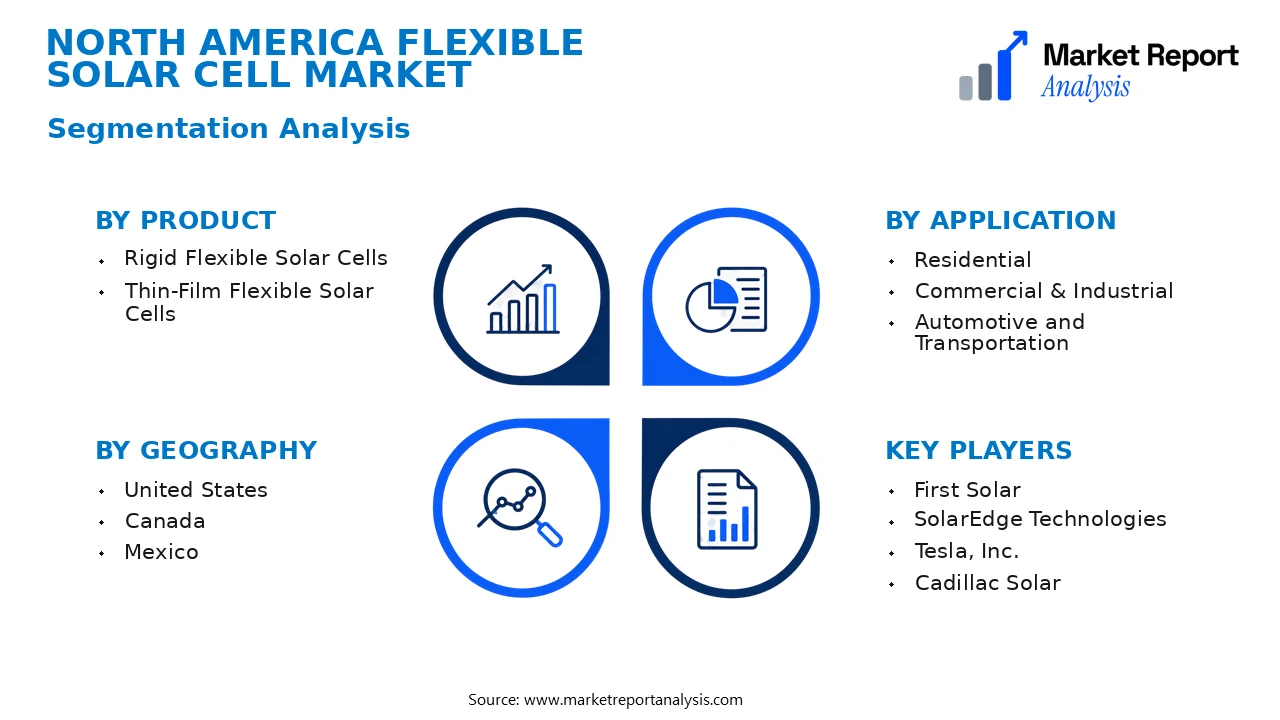
- Product
- Rigid Flexible Solar Cells: These are semi-permanent, durable solar cells that are integrated into fixed structures, offering high efficiency and long-term stability, favored in large-scale installations such as commercial rooftops and infrastructure projects.
- Thin-Film Flexible Solar Cells: Known for their lightweight and versatile nature, these cells are highly adaptable for portable and mobile applications, including wearable devices and portable power solutions, with growing demand in recreational and emergency sectors.
- Application
- Residential: This segment comprises solar installations integrated into homes, driven by increasing consumer awareness of renewable energy benefits and government incentives, fostering robust market expansion in urban and suburban areas.
- Commercial & Industrial: Encompasses larger-scale solar deployments on commercial buildings and factories, where flexible solar cells are valued for their ability to conform to varied roof geometries, thus optimizing space utilization and energy output.
- Automotive and Transportation: Focused on integrating solar cells into vehicles and transportation infrastructure, supporting developments in electric and hybrid vehicles, with growing interest in extending vehicle range and reducing energy costs.
- Geography
- United States: As the dominant market within North America, the U.S. shows significant growth in both residential and commercial applications, driven by technological innovation, supportive policies, and substantial investment in renewable energy projects.
- Canada: Characterized by increasing adoption in remote areas and integration into green building initiatives, Canada’s market benefits from favorable policies towards sustainable and off-grid energy solutions.
- Mexico: Exhibits emerging market potential with increasing investments in solar infrastructure and the desire to capitalize on the region’s abundant solar resources for both local consumption and export opportunities.
Figure 1 illustrates the hierarchy of market segments, emphasizing key subcategories within the product, application, and geographic domains, which collectively define the competitive landscape and growth opportunities in the North American market. This segmentation framework provides strategic insights into regional demand patterns, technological preferences, and infrastructural developments that influence the trajectory of the flexible solar cell industry through 2034. The detailed understanding of each subsegment facilitates targeted marketing, product development, and policy formulation, ensuring optimal positioning within this rapidly evolving renewable energy market.
Competitive Intelligence
The North America Flexible Solar Cell Market is characterized by moderate to high competition, with key players including First Solar, SunPower, and smaller innovative firms focused on niche applications. Market concentration remains relatively dispersed, encouraging a dynamic competitive landscape where both established corporations and startups innovate. Leading companies adopt aggressive strategies such as product innovation with enhanced efficiency and durability, along with strategic partnerships to expand their market presence. Notably, collaborations with energy firms and material suppliers facilitate technological advancements and product diversification. Several players pursue acquisitions of emerging startups to incorporate novel technologies and accelerate growth trajectories. Expansion strategies heavily focus on geographic penetration within demand hotspots like the US and Canada, bolstered by investments in R&D to develop next-generation flexible solar technologies that outperform traditional rigid panels. Firms also differentiate through customization options, eco-friendly production processes, and the integration of flexible solar cells into diverse applications, including wearable devices and portable power systems. Overall, innovation, strategic alliances, and targeted R&D investments serve as primary competitive differentiators shaping the market landscape.
Leading Company Profiles
The competitive landscape in the North America flexible solar cell market is characterized by a diverse group of innovative companies focusing on advanced technology deployment, strategic expansion, and sustainable solutions to cater to increasing demand across various sectors.
- First Solar
- SolarEdge Technologies
- Tesla, Inc.
- Cadillac Solar
- Enphase Energy
- SunPower Corporation
- Shunfeng International Clean Energy
- Canadian Solar Inc.
- Hanwha Q Cells Co., Ltd.
- Kyocera Corporation
First Solar
First Solar specializes in thin-film flexible solar solutions, leveraging cadmium telluride (CdTe) technology to deliver high-efficiency, durable, and cost-effective solar panels suitable for diverse applications across North America.
SolarEdge Technologies
SolarEdge provides innovative solar inverter solutions and power optimizers, focusing on enhancing energy yield and system reliability with flexible integration options for residential, commercial, and utility-scale projects.
Tesla, Inc.
Tesla leads with its integrated solar and energy storage systems, pushing forward flexible photovoltaic solutions that promote sustainable energy adoption in residential and commercial sectors, supported by robust manufacturing capabilities.
Cadillac Solar
Cadillac Solar offers cutting-edge flexible solar panels that are lightweight and adaptable, designed to cater to mobile and off-grid applications, emphasizing resilient performance and quick installation processes.
Enphase Energy
Enphase develops microinverter technology and energy management solutions that improve the efficiency and flexibility of solar power systems, targeting residential and small commercial markets with innovative digital solutions.
SunPower Corporation
SunPower focuses on high-efficiency solar modules, including flexible solar panels optimized for rooftops, portable applications, and specialized structures, with strategic investments in R&D to expand its technological edge.
Shunfeng International Clean Energy
This company drives the manufacturing of flexible solar modules with a focus on large-scale deployment, integrating advanced materials and production techniques to lower costs and boost output.
Canadian Solar Inc.
Canadian Solar develops flexible and rigid solar products, emphasizing scalable solutions that meet diverse customer needs from residential installations to large utility projects across North America.
Hanwha Q Cells Co., Ltd.
Hanwha Q Cells is known for its high-performance photovoltaic modules, investing heavily in flexible panel technologies and expanding its production base to support North American demand growth.
Kyocera Corporation
Kyocera offers advanced flexible solar modules, with a focus on durable designs suitable for harsh environments, complemented by ongoing innovation in material science and manufacturing processes.
Strategic Business Developments

- May 2023 – First Solar – Launched new flexible cadmium telluride panels – Strengthening product portfolio and expanding applications in off-grid and portable markets.
- August 2023 – SolarEdge Technologies – Announced new high-efficiency inverters optimized for flexible solar installations – Improving system integration and boosting adoption in residential markets.
- September 2023 – Tesla, Inc. – Expanded manufacturing capacity for flexible solar roof tiles at its Nevada plant – Enhancing supply chain resilience and reducing lead times for North American projects.
- June 2023 – Cadillac Solar – Initiated a strategic partnership with a major off-grid system integrator – Accelerating deployment of mobile and remote flexible solar solutions.
- July 2023 – Enphase Energy – Completed acquisition of a flexible solar module startup to incorporate new lightweight, versatile solar solutions into its portfolio – Driving innovation and technological leadership.
Frequently Asked Questions
What is the North America Flexible Solar Cell Market?
The North America Flexible Solar Cell Market comprises the industry involved in manufacturing and deploying lightweight, bendable solar panels that offer versatility for various applications in residential, commercial, and industrial sectors within North America, driven by green initiatives and technological advancements.
What is the current market size of North America Flexible Solar Cell Market?
As of 2026, the market size is estimated at approximately USD 2.3 Billion, reflecting increasing adoption across diverse sectors, due to declining costs, policy incentives, and the demand for portable and integrated solar solutions in the region’s expanding renewable energy landscape.
What factors are driving the North America Flexible Solar Cell Market?
Market growth is propelled by technological innovations that enhance efficiency, supportive government policies promoting renewable energy, decreasing production costs, and rising adoption of solar solutions in portable, building-integrated, and off-grid applications in North America.
Which region dominates the North America Flexible Solar Cell Market?
The United States dominates the North American market due to its advanced manufacturing infrastructure, higher adoption rates of renewable energy, and significant investments in solar technology R&D, making it the leading region for flexible solar cell deployment.
Which segment is expected to grow the fastest?
The commercial segment is anticipated to witness the fastest growth, driven by increasing demand for renewable energy solutions in commercial buildings, and the rising trend of integrating flexible solar panels into building facades and energy-efficient infrastructure projects.
Who are the leading companies operating in the North America Flexible Solar Cell Market?
Key market players include First Solar, Tesla, SunPower, and Heliatek, among others. These companies are focusing on innovation, strategic collaborations, and expanding production capacities to strengthen their market presence.
Analyst Perspective
The North America flexible solar cell market exhibits a mature yet dynamically evolving landscape, driven by increasing adoption in portable, residential, and commercial applications. Long-term, the market is poised for steady growth fueled by advancements in thin-film technologies, durability improvements, and cost reductions, broadening the scope for innovative deployment. Commercial opportunities are particularly lucrative in decentralized energy systems, wearable devices, and building-integrated photovoltaics, where lightweight and flexible features provide strategic advantages. Technological evolution is expected to focus on enhanced efficiency, higher stability, and environmental resilience, which will sustain competitive differentiation. Investors should prioritize innovation and strategic partnerships to capitalize on emerging product segments and regional deployment hotspots. Regional growth potential remains robust in areas with supportive policies, such as the U.S. and Canada, and is increasingly driven by sustainable infrastructure investments. Overall, the market’s growth trajectory indicates a competitive landscape where technological leadership and regional strategic positioning will determine long-term winners.
