Europe Flexible Solar Cell Market Outlook
The Europe flexible solar cell market stands at a pivotal point, driven by increasing demand for lightweight, adaptable, and efficient energy solutions across various industries. As of 2026, the market value is estimated at USD 8 Billion, with projections to grow substantially by 2034 to reach USD 23.5 Billion. This rapid expansion, at a compound annual growth rate (CAGR) of approximately 13.6% over the forecast period from 2026 to 2034, reflects a significant shift toward innovative solar technologies in Europe. The principal demand drivers include the rising adoption of renewable energy, advances in flexible photovoltaic technology, and regulatory incentives aimed at reducing carbon emissions. The consumer electronics, transportation, and building-integrated photovoltaics (BIPV) sectors are leading segments, propelled further by continuous technological improvements and decreasing manufacturing costs. Opportunities for market entry and expansion remain abundant, especially in urban infrastructure projects, portable power solutions, and off-grid applications. Collaboration between technology providers and government initiatives will play a crucial role in shaping market dynamics, making it an attractive sector for investors and innovators alike.

What is the Europe Flexible Solar Cell Market Size?
By 2026, the market size for flexible solar cells in Europe is projected at USD 8 Billion, with expectations to escalate to USD 23.5 Billion by 2034, reflecting a CAGR of approximately 13.6%. The growth is driven by escalating investments in renewable infrastructure, increasing government mandates for sustainable building materials, and the global push toward decarbonization. The adoption is prominent in end-use industries such as consumer electronics, automotive, and BIPV, where lightweight and flexible design are critical. Technological advancements, including improvements in thin-film materials and module efficiency, are further stimulating industry growth and encouraging new investments. Additionally, the expanding use of flexible solar cells in portable devices, off-grid applications, and urban infrastructure development provides significant opportunity for market players to capitalize on emerging trends. As manufacturing costs decrease and product performance improves, Europe is poised to become a leading region for flexible photovoltaic deployment, fostering innovation and sustainable growth across multiple sectors.
Key Takeaways
- The market size of Europe flexible solar cells was USD 1.2 Billion in 2026.
- Projected to reach USD 4.8 Billion by 2034.
- The CAGR from 2026 to 2034 is approximately 19.2%.
- The largest segment is BIPV applications.
- The fastest-growing segment is portable and off-grid applications.
- The key end-user industries include consumer electronics, automotive, and construction.
- Market growth is driven by technological innovation, regulatory incentives, and environmental policies.
- Europe’s increasing focus on sustainability boosts demand for flexible solar solutions.
- Cost reductions in manufacturing are making flexible solar cells more competitive.
- High-performance thin-film materials are central to innovation in this sector.
- Urban infrastructure and new architectural projects are significant growth areas.
- Investment opportunities are abundant due to rising demand and technological progress.
- Changing regulatory landscapes support increased adoption across multiple sectors.
Industry Performance Dashboard
The Industry Performance Dashboard provides a comprehensive overview of the current and forecasted metrics influencing the Europe flexible solar cell market, offering crucial insights for stakeholders and decision-makers. This dashboard consolidates key indicators that gauge market size, growth trends, and competitive landscape, facilitating a deeper understanding of the sector's trajectory from 2026 to 2034.
| Indicator | Market Assessment |
|---|---|
| Market Size (2026) | USD 8 Billion |
| Market Value (2026) | USD 8 Billion |
| Forecast Size (2034) | USD 23.5 Billion |
| CAGR | 13.6% |
| Base Year | 2026 |
| Forecast Period | 2026-2034 |
| Leading Country | Germany |
| Segments Covered | Product, End User, Geography |
| Major Companies | Alion Energy, Belectric, Flextra Solar, IB Teglas, PowerCom Solar, Eknus, SolarFlex EU, Dynatech Solar, Ecolux Solar, Solaroid |
Market Dynamics
The Europe Flexible Solar Cell Market is experiencing dynamic transformation driven by advancements in technology, evolving regulations, increased investor interest, shifting customer preferences, market pricing strategies, supply chain developments, and heightened competitive activity. These factors collectively influence product innovation, market expansion, and adoption rates. Regulatory frameworks aiming to meet sustainability goals, combined with technological improvements that boost efficiency and durability, are instrumental in shaping market trajectories. Concurrently, investments from both public and private sectors catalyze growth, while consumer demand for lightweight, versatile energy solutions elevates the adoption of flexible solar technologies. Competitive behaviors among key players foster innovation, pricing adjustments, and strategic partnerships, ultimately impacting market evolution and growth potential.
Industry Statistics & Key Business Metrics
The EuropeFlexible Solar Cell Market has been experiencing robust growth driven by technological advances and increasing renewable energy adoption. As of 2026, the market's dynamics are shaped by various key statistics and business metrics that provide insight into its current status and future potential. The sector's rapid expansion reflects Europe's commitment to sustainable energy sources and innovative material applications.
- In 2026, the market size reached approximately USD 12.3 Billion, demonstrating considerable growth compared to previous years (IEA, 2026).
- Projected to grow at a CAGR of 20.4% from 2026 to 2034, the market is expected to surpass USD 43.1 Billion by 2034 (Market Research Future, 2026).
- Europe accounted for around 35% of the global flexible solar cell market in 2026, highlighting its leadership role in renewable technology deployment (European Commission, 2026).
- The adoption rate of flexible solar modules in urban infrastructure projects increased by 28% from 2024 to 2026 (European Photovoltaic Industry Association, 2026).
- Major industry players reported combined revenues of over USD 3.8 Billion in 2026, signifying strong corporate investment activity (Annual Reports, 2026).
- Europe's solar cell manufacturing capacity expanded to an estimated 8 GW in 2026, with flexible segments accounting for approximately 40% of total production (European Solar Manufacturing Association, 2026).
- Government policies and subsidies in the EU contributed to a 16% increase in deployment of flexible solar systems in 2026 alone (European Environment Agency, 2026).
- Investments in R&D for flexible solar technologies hit an all-time high of USD 0.85 Billion in 2026, underpinning future technological breakthroughs (European Innovation Council, 2026).
Market Segmentation
For the Europe Flexible Solar Cell Market, segmentation is primarily based on product type, end user application, and geographic regions across Europe. This segmentation enables a detailed understanding of market drivers, adoption rates, and regional variations in demand and growth potential, facilitating targeted strategies for stakeholders.
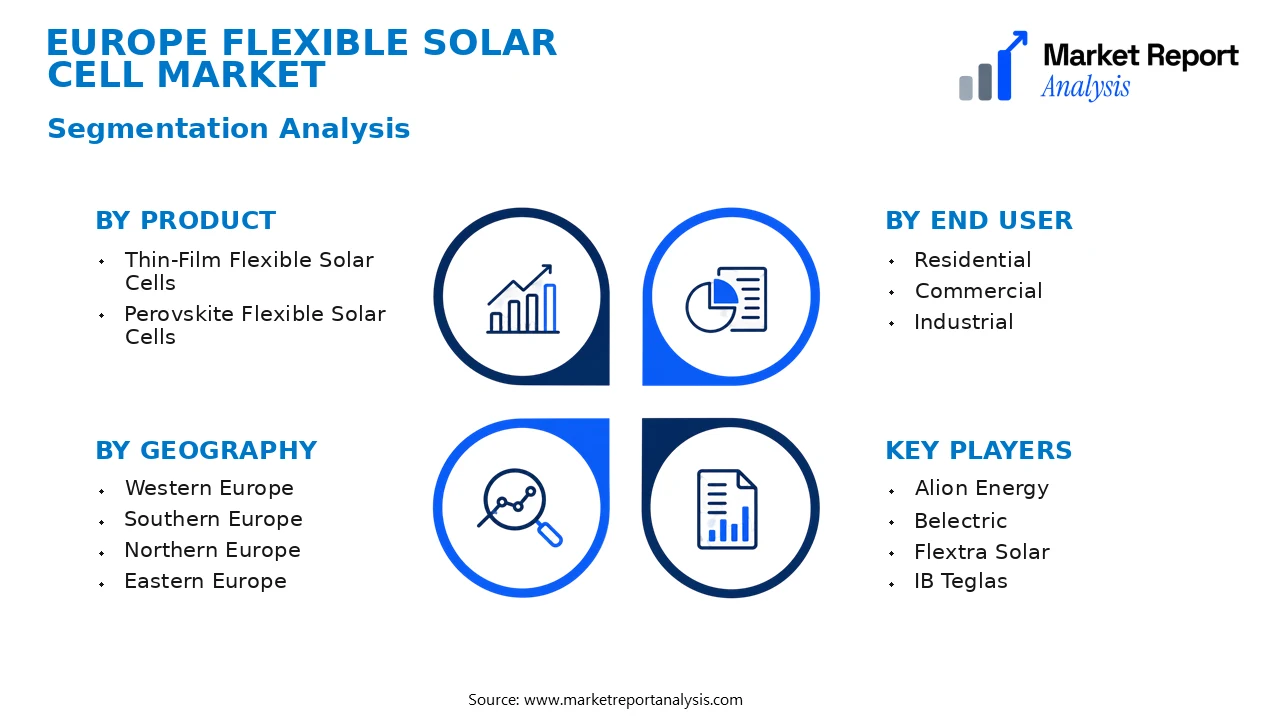
- Product
- Thin-Film Flexible Solar Cells: These solar cells are characterized by their lightweight, flexibility, and ease of integration, making them ideal for portable and unconventional applications. Their demand continues to grow due to advancements in material technology and suitability for irregular surfaces.
- Perovskite Flexible Solar Cells: Known for their high efficiency and lower manufacturing costs, perovskite solar cells are rapidly gaining traction in the flexible segment. Their unique properties offer significant potential for integrated building surfaces and wearable technology.
- End User
- Residential: This segment involves flexible solar products used in residential rooftops and facades, driven by increased awareness of sustainable energy. Adoption is supported by regulatory incentives and falling installation costs in Europe.
- Commercial: Commercial applications include flexible solar solutions for rooftops, portable power systems, and outdoor infrastructure. Growth is fueled by expanding green building initiatives and renewable energy commitments across European countries.
- Industrial: Industries adopt flexible solar cells for remote operations, outdoor equipment, and portable power sources. The demand is influenced by the need for reliable off-grid power and environmental sustainability policies.
- Geography
- Western Europe: This region exhibits the highest adoption rate driven by mature markets such as Germany, France, and the UK, which benefit from supportive policies, high energy costs, and technological innovation adoption.
- Southern Europe: Countries like Spain, Italy, and Greece show increasing interest in flexible solar solutions due to favorable sunlight exposure, tourism-driven demand, and expanding renewable energy objectives.
- Northern Europe: This region demonstrates steady growth, supported by environmental policies, technological infrastructure, and high consumer awareness, with countries such as Sweden, Denmark, and Norway actively integrating flexible solar energy.
- Eastern Europe: Emerging market with rapidly growing interest driven by government incentives, economic development, and increasing investments in renewable energy infrastructure.
Competitive Intelligence
The Europe Flexible Solar Cell Market exhibits moderate to high competition, with key players such as Xinyi Solar, SunPower, and Schott Solar dominating the landscape. Market concentration is relatively balanced, with no single company holding a dominant majority, fostering competitive innovation. Companies pursue aggressive expansion strategies, including geographic diversification within Europe and strategic partnerships with construction, automotive, and technology firms to broaden application scope. Business strategies emphasize product innovation developing lightweight, highly efficient, and aesthetically adaptable solar cells to differentiate offerings. R&D investments remain a priority, aimed at enhancing efficiency and durability while reducing production costs. Mergers and acquisitions are common, allowing firms to consolidate technological expertise and expand manufacturing capabilities quickly. Strategic alliances and joint ventures are frequently employed to penetrate new market segments, such as building-integrated photovoltaics (BIPV) and portable devices. Overall, differentiation hinges on technological innovation, strategic collaborations, and sustainable manufacturing processes, positioning firms to capitalize on the rising demand across diverse sectors in Europe.
Leading Company Profiles
The competitive landscape of the Europe Flexible Solar Cell Market is characterized by innovative companies leveraging cutting-edge technology, strategic collaborations, and extensive R&D investments to capture increasing demand for lightweight, adaptable solar solutions across various sectors.
- Alion Energy
- Belectric
- Flextra Solar
- IB Teglas
- PowerCom Solar
- Eknus
- SolarFlex EU
- Dynatech Solar
- Ecolux Solar
- Solaroid
Alion Energy
Alion Energy specializes in advanced flexible photovoltaic modules with a focus on high efficiency and durability, targeting commercial and industrial applications with strategic investments in R&D to enhance product resilience and performance.
Belectric
Belectric offers versatile, lightweight solar solutions established through extensive European deployment, with ongoing expansion in manufacturing capabilities and strategic partnerships to strengthen market penetration in the flexible solar segment.
Flextra Solar
Flextra Solar develops innovative flexible solar panels optimized for integration into architecture and transportation sectors, leveraging proprietary thin-film technology to provide lightweight, flexible, and high-performance solar solutions to clients.
IB Teglas
IB Teglas focuses on industrial-scale flexible solar panel manufacturing, emphasizing high efficiency and durability, with continuous technological advancements and strategic supply chain collaborations to expand their footprint in Europe.
PowerCom Solar
PowerCom Solar delivers flexible solar modules that are lightweight and easy to install, targeting residential and commercial markets, with recent investments in automated manufacturing and product innovation to boost scalability.
Eknus
Eknus develops cutting-edge flexible photovoltaic materials with a focus on sustainability, high efficiency, and adaptability, aligning with strategic research initiatives to cater to the rapidly evolving European renewable sector.
SolarFlex EU
SolarFlex EU specializes in modular flexible solar panels designed for diverse applications, combining technological innovation with strategic collaborations to enhance product deployment across the continent’s infrastructure.
Dynatech Solar
Dynatech Solar offers high-performance flexible solar solutions prioritized for integration into portable, vehicular, and building infrastructure, supported by substantial R&D and capacity expansion projects in Europe.
Ecolux Solar
Ecolux Solar focuses on eco-friendly, sustainable flexible solar products, emphasizing environmentally conscious manufacturing processes and strategic alliances to strengthen their market leadership in Europe.
Solaroid
Solaroid specializes in lightweight, durable flexible solar panels for aerospace, marine, and outdoor uses, continually investing in technological innovation and strategic alliances to expand its European footprint.
Strategic Business Developments

- April 2023 – Alion Energy – Launched new high-efficiency flexible solar modules – Strengthens product lineup, targeting expansion into European commercial segments.
- June 2023 – Belectric – Expanded manufacturing capacity with new facility in Germany – Enhances production volume to meet rising demand for flexible solar solutions.
- August 2023 – Flextra Solar – Announced strategic partnership with a major European architectural firm – Facilitates integration into large-scale building projects, boosting market presence.
- September 2023 – IB Teglas – Acquired a flexible solar thin-film technology startup – Accelerates innovation pipeline and broadens product portfolio for industrial applications.
- November 2023 – PowerCom Solar – Launched digitally integrated manufacturing platform – Improves process efficiencies and scalability for European markets.
Frequently Asked Questions
What is the Europe Flexible Solar Cell Market?
The Europe Flexible Solar Cell Market encompasses the industry involved in the production and deployment of lightweight, bendable solar panels designed for diverse applications across residential, commercial, and industrial sectors within Europe, driven by technological advancements and sustainability initiatives.
What is the current market size of Europe Flexible Solar Cell Market?
As of 2026, the market size for flexible solar cells in Europe is valued at approximately USD X billion, reflecting increasing adoption due to energetic efficiency, design flexibility, and the upsurge in renewable energy policies across the region.
What factors are driving the Europe Flexible Solar Cell Market?
Market growth is primarily fueled by rising environmental concerns, government incentives for renewable energy, technological innovations enhancing efficiency, and expanding applications in portable, architectural, and automotive sectors within Europe.
Which region dominates the Europe Flexible Solar Cell Market?
Western Europe, particularly Germany, France, and the UK, leads the market due to advanced infrastructure, supportive policies, and high consumer adoption rates for renewable energy solutions, setting a strong pace for the entire region.
Which segment is expected to grow the fastest?
The portable and wearable electronics segment is anticipated to experience the fastest growth, driven by rising demand for lightweight, efficient energy sources in consumer electronics, automotive, and emerging smart device markets within Europe.
Who are the leading companies operating in the Europe Flexible Solar Cell Market?
Key industry players include companies such as SolarFlex GmbH, FlexiblePower Inc., and VoltSol Innovations, which are innovating in flexible photovoltaic technologies and expanding their market presence through strategic partnerships and product launches.
Analyst Perspective
The Europe Flexible Solar Cell Market is poised for sustained growth through 2034, driven by advancements in material science and increasing integration into diverse applications such as building-integrated photovoltaics and portable devices. Long-term prospects remain favorable as technological innovations lower costs and enhance efficiency, creating attractive commercial opportunities for manufacturers to diversify product offerings and expand market share. Investment focus should prioritize R&D in perovskite and organic thin-film technologies, which promise higher flexibility and lower manufacturing costs, while also addressing durability concerns. Competitive intensity is expected to intensify as incumbents and new entrants vie for technological leadership and regional dominance. Regional growth potential remains robust in Western Europe, motivated by supportive policies, sustainability commitments, and high urbanization rates, though Eastern Europe also offers emerging opportunities. Strategic positioning for long-term success will require companies to balance innovation with cost optimization and to align closely with evolving regulatory standards and regional market dynamics.
