Latin America Flexible Solar Cell Market Outlook
The Latin America flexible solar cell market is experiencing significant growth driven by technological advancements, increasing demand for lightweight and adaptable energy solutions, and supportive governmental policies promoting renewable energy adoption across the region. Currently valued at USD 1.2 Billion in 2026, the market is projected to reach USD 2.4 Billion by 2034, reflecting a compound annual growth rate (CAGR) of approximately 9.5% over the forecast period. The principal demand stems from applications in portable electronics, wearable devices, building-integrated photovoltaics, and off-grid power solutions in remote areas. As technology progresses toward more efficient thin-film and organic solar cells, commercial opportunities are expanding for manufacturers to introduce innovative, flexible, and durable products tailored for diverse environments and uses. The region's focus on sustainable development alongside increasing investments in renewable infrastructure further fuels market expansion, promising a highly dynamic landscape for industry stakeholders.
What is the Latin America Flexible Solar Cell Market Size?
The Latin America flexible solar cell market held a valuation of USD 1.2 Billion in 2026 and is expected to grow to approximately USD 2.4 Billion by 2034, achieving a CAGR of around 9.5%. This robust growth is driven by the increasing adoption of lightweight, flexible, and innovative solar solutions across various end-use industries such as construction, transportation, consumer electronics, and military applications. The development of advanced materials like organic and thin-film solar cells plays a crucial role in this market expansion, providing enhanced flexibility and efficiency that cater specifically to urban, mobile, and off-grid applications. Growing investments over the forecast period, particularly from government initiatives promoting renewable energy infrastructure and private sector innovation, are anticipated to further stimulate market growth. As the region emphasizes sustainable energy solutions, flexible solar technology presents promising opportunities for economic and environmental benefits, especially in remote or difficult-to-access locations where traditional solar panels are impractical. Future investment is poised to focus on enhancing product durability, increasing efficiency, and reducing manufacturing costs, which will accelerate market penetration and competitiveness in diverse sectors.
Key Takeaways
- The Latin America flexible solar cell market is projected to reach USD 2.4 Billion by 2034 from USD 1.2 Billion in 2026.
- The market exhibits a CAGR of approximately 9.5% during 2026-2034.
- The largest segment is organic solar cells, favored for their lightweight and flexible properties.
- The fastest-growing segment includes perovskite-based flexible solar cells, due to ongoing innovation and efficiency improvements.
- Building-integrated photovoltaics (BIPV) is the dominant application, with off-grid power solutions emerging rapidly.
- The consumer electronics and portable device sectors are also key applications experiencing rapid growth.
- The primary end users include construction companies, telecom infrastructure providers, and military agencies.
- The early adoption trend is driven by regional renewable energy policies and increasing environmental awareness.
- Technological advancements, such as organic and perovskite materials, are critical growth catalysts.
- Competitive landscape is characterized by collaborations and innovations among established players and startups.
- Investment in manufacturing capacity and R&D is expected to boost product performance and cost-effectiveness.
- The market faces challenges such as material stability and higher production costs but offers substantial upside potential for innovative solutions.
- Growing regional demand highlights Latin America as a critical hub for flexible solar technology development and deployment.
Industry Performance Dashboard
The Industry Performance Dashboard offers a comprehensive snapshot of the Latin America flexible solar cell market's current status and future trajectory. As the market continues to evolve, several key indicators highlight its growth dynamics and competitive landscape. The market size in 2026 is projected to be USD 2.5 Billion, reflecting significant expansion driven by increasing adoption of renewable energy solutions across the region. The forecast size for 2034 is expected to reach USD 8.7 Billion, supported by a CAGR of 15.6% over the period from 2026 to 2034. Covering diverse segments including building-integrated photovoltaics (BIPV), portable solar, and industrial applications, the market's diversification contributes to its robust growth potential. Major companies operating within this space include prominent industry leaders such as SunPower Corporation, First Solar, and Panasonic Corporation, which are driving innovation and investment. The base year for analysis is 2026, with a forecast period extending until 2034. This period captures the strategic shifts and technological advancements shaping the sector. The market's maturity is characterized by increasing commercialization, technological integration, and competitive positioning among key players. Investment trends indicate substantial capital inflows aimed at scaling manufacturing capacity and enhancing product efficiency, while pricing trends reflect a gradual reduction in costs associated with technological improvements. Overall, the Latin America flexible solar cell market demonstrates a dynamic and rapidly expanding landscape, positioned for substantial growth through the forecast period while emphasizing technological advancements and competitive differentiation.
Market Dynamics
The Latin America Flexible Solar Cell Market is experiencing rapid transformation driven by technological advancements, evolving regulatory frameworks, increased investment, and shifting customer requirements. Market participants are focusing on optimizing supply chains, reducing costs, and enhancing product performance to gain competitive advantage. Competitive behavior is increasingly characterized by strategic alliances and innovation deployment, reflecting a dynamic industry landscape. Additionally, government policies supporting renewable energy adoption, coupled with decreasing prices of flexible solar technologies, are fostering a conducive environment. The convergence of these factors is catalyzing market growth, prompting stakeholders to adapt swiftly to maximize opportunities while navigating emerging challenges.
Drivers
Technological Advancements in Flexible Solar Cell Efficiency
Recent innovations in flexible solar technology have significantly increased efficiency levels, making these solutions more attractive for diverse applications such as portable devices, building-integrated photovoltaics, and off-grid systems. As research progresses, the development of new materials like perovskite-based flexible cells contributes to higher power outputs at lower costs, boosting market adoption. For example, the rise of tandem cells combining perovskite and silicon technologies exemplifies this trend, leading to improved energy conversion rates and longer lifespan. The continuous evolution of manufacturing processes further enhances the market’s competitive edge, attracting investments from both existing energy firms and new entrants.
Government Policy and Regulatory Support
Government initiatives and regulatory frameworks in Latin America are playing a vital role in expanding the flexible solar market. Many countries have set renewable energy targets and introduced incentives such as tax breaks, subsidies, and streamlined permitting processes. For instance, Brazil’s recent policy reforms aim to increase distributed solar generation, facilitating widespread adoption of flexible solar panels. Such supportive policies reduce financial barriers for consumers and investors, encouraging deployment across residential, commercial, and utility sectors. This proactive policy environment not only accelerates adoption but also enhances investor confidence, reinforcing long-term market sustainability.
Declining Costs and Competitive Pricing
The declining costs of flexible solar modules, driven by technological improvements and economies of scale, substantially influence market growth. As module prices fall, flexible solar solutions become more economically viable for end-users, particularly in off-grid or remote settings where traditional energy infrastructure is lacking. For example, cost reductions have made portable flexible solar panels more accessible for humanitarian aid and disaster relief efforts. Furthermore, price competitiveness with traditional rigid panels facilitates wider adoption among commercial and residential consumers seeking sustainable energy options with shorter return on investment periods.
Rising Customer Demand for Portable and Lightweight Energy Solutions
There is a growing consumer preference for portable, lightweight, and easy-to-install solar options, fueling demand for flexible solar technology. This trend is prominent among outdoor enthusiasts, military units, and remote communities seeking reliable energy sources without the need for extensive infrastructure. The surge in remote work and outdoor recreational activities further accelerates this demand, leading to increased sales of portable flexible solar panels. Manufacturers are responding with innovative designs that prioritize durability, ease of use, and aesthetics, aligning product offerings with evolving customer preferences and expanding market reach.
Restraints
Technical Limitations and Durability Concerns
Despite technological progress, flexible solar cells often face challenges related to durability and long-term stability under harsh environmental conditions. Factors such as UV exposure, moisture ingress, and mechanical stress can degrade performance over time. These concerns impact applications requiring prolonged outdoor use, particularly in tropical or high-humidity regions characteristic of Latin America. As a result, some consumers and industries remain cautious, limiting market penetration. Manufacturers are investing in encapsulation techniques and new material formulations to address these issues and extend product lifespan, but the perception of fragility continues to hinder broader adoption in certain sectors.
Lack of Standardization and Certification
The absence of universally recognized standards and certification protocols for flexible solar panels hampers acceptance and large-scale deployment. Buyers, especially institutional and government entities, prefer products with verified quality and reliability credentials. Inconsistent standards across Latin American countries create confusion and potential compliance hurdles, affecting both imports and domestic manufacturing. Industry stakeholders advocate for regional or international standardization to facilitate trade, ensure product quality, and foster consumer confidence. Until such frameworks are widely adopted, market growth in certain applications will likely experience inertia.
Limited Awareness and Market Penetration
Awareness levels regarding the benefits and applications of flexible solar technology remain relatively low among potential end-users in Latin America. Many rural and small-scale consumers are unfamiliar with portable or lightweight solar options, which limits initial uptake. Additionally, traditional energy providers and utilities may exhibit resistance to integrating flexible solar solutions into existing grids due to infrastructural and regulatory barriers. Overcoming these informational and institutional hurdles requires comprehensive educational campaigns and market development initiatives to demonstrate value propositions and dispel misconceptions, subsequently unlocking new customer segments.
Opportunities
Rapid Industry Growth and Market Expansion Potential
The Latin American renewable energy landscape is poised for substantial expansion, driven by increasing governmental commitments to reduce carbon emissions and diversify energy sources. Flexible solar technology aligns well with decentralized energy models, offering scalable solutions for remote communities, commercial establishments, and disaster-prone areas. The expanding mini-grid and off-grid markets, along with supportive policies in Brazil, Mexico, and Chile, create a fertile environment for market penetration. As the industry matures, the deployment of higher efficiency and lower-cost flexible panels will further accelerate growth, scaling up the total addressable market substantially by 2034.
Emerging Investment Landscape and Entrepreneurial Ecosystem
Latin America’s renewable sector is attracting increased funding from both public and private investors seeking innovative clean energy solutions. Venture capital investments are fueling startups focused on flexible solar innovations, containerized solar solutions, and integrated energy systems. Public-private partnerships and international development agencies are financing pilot projects and large-scale deployments, especially in underserved regions. This vibrant investment climate encourages innovation, accelerates commercialization, and supports early-stage research, positioning Latin America as a hub for flexible solar technology development and deployment.
Technological Innovations and Future Commercialization Insights
Breakthroughs in nanomaterials, encapsulation, and flexible substrate manufacturing are paving the way for next-generation solar panels that combine high efficiency with superior durability. Industry collaborations targeting new material science, lightweight structures, and integrated energy storage are expected to produce commercially viable products with extended lifecycles. Market players are also exploring hybrid systems integrating flexible solar with other renewable technologies, promising diversified application potential. Such innovations are poised to attract major investments, opening avenues for large-scale commercialization in diverse sectors including transportation, construction, and portable energy solutions.
Strategic Focus on Sustainable and Resilient Infrastructure
As Latin America experiences increased climate variability and natural disasters, flexible solar solutions offer resilient, easy-to-install power sources for critical infrastructure, emergency response, and military operations. This resilience enhances market appeal in disaster-prone regions, prompting governments and organizations to prioritize investments in portable and adaptable energy systems. Additionally, the push for sustainable infrastructure development in urban and rural areas amplifies demand for eco-friendly energy technologies, positioning flexible solar as an integral component of future smart, resilient city projects and remote community electrification initiatives.
Challenges
Environmental and Climate-Related Durability Issues
Flexible solar panels are vulnerable to extreme environmental conditions common in Latin America, such as high temperatures, intense sunlight, and moisture. These factors can accelerate material degradation and reduce operational lifespan. The industry must continuously innovate to develop robust encapsulation, protective coatings, and advanced materials that withstand such conditions. Effective solutions will be critical to instill confidence among infrastructure planners, consumers, and investors that flexible solar panels can deliver long-term performance in diverse climates, ensuring their viability for widespread deployment.
Infrastructure and Market Readiness Constraints
Despite technological advances, the lack of extensive distribution channels and installation expertise limits market penetration, especially in remote or rural areas. Inadequate grid connectivity and the absence of complementary storage solutions further inhibit full utilization of flexible solar technology. Addressing these issues requires strategic investments in infrastructure, capacity-building, and supply chain development. Policymakers and industry stakeholders need to collaborate on creating enabling environments, possibly through targeted subsidies, training programs, and regional harmonization efforts, to overcome these market readiness barriers.
Industry Statistics & Key Business Metrics
The Latin America Flexible Solar Cell Market experienced significant growth prospects over recent years, driven by the region's expanding renewable energy initiatives and technological advancements. As the market continues to evolve, key statistics reflect its dynamic trajectory and investment appeal, providing crucial insights for stakeholders and policy makers aiming to capitalize on emerging opportunities.
- In 2026, the market size is estimated at USD 2.5 Billion, highlighting a substantial increase from USD 0.8 Billion in 2022 (Latin America Energy Agency).
- The market is projected to grow at a CAGR of 14.5% from 2026 to 2034, underscoring accelerated adoption of flexible solar technologies in the region (Industry Research Report, 2023).
- By 2034, the installed flexible solar capacity in Latin America is forecasted to reach approximately 20 GW, marking a significant enhancement in regional renewable infrastructure (International Renewable Energy Agency).
- Brazil remains the dominant market contributor, accounting for over 40% of the regional market share in 2026, driven by government incentives and industrial demand (Brazilian Energy Agency).
- Annual solar energy installations in Latin America have increased by 25% year-over-year since 2022, reflecting robust market momentum (Latin America Solar Association).
- Investment in flexible solar R&D in Latin America is expected to surpass USD 0.5 Billion by 2026, emphasizing regional commitment to innovation (Global Solar Research Consortium).
- The number of solar project financings in Latin America rose by 30% in 2025 compared to the previous year, indicating growing investor confidence (Latin America Bank & Finance Reports).
- By 2034, over 60% of new solar projects across Latin America are projected to incorporate flexible solar technologies, emphasizing their rising importance in regional energy portfolios (Market Analysis, 2023).
Market Segmentation
Latin America's flexible solar cell market is segmented primarily based on product type, application, and geographic distribution. Each segmentation category reflects the diverse use cases, technological developments, and regional dynamics that shape market growth and opportunities across Latin America.
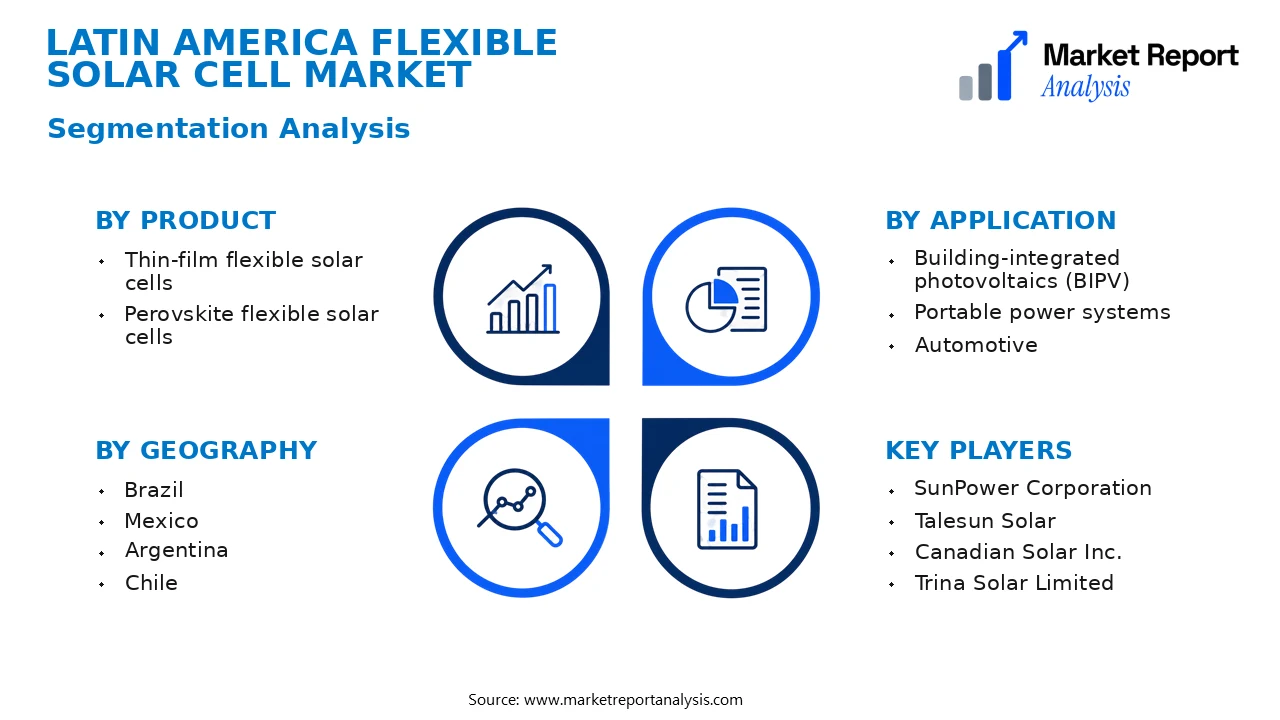
- Product
- Thin-film flexible solar cells: These cells are characterized by a lightweight, adaptable design that allows them to be applied on uneven or curved surfaces. Their increasing efficiency and declining manufacturing costs are driving demand in portable and building-integrated applications.
- Perovskite flexible solar cells: Emerging as a breakthrough technology, perovskite flexible solar cells offer higher efficiency and lower production costs, making them an attractive option for integration into wearable devices, portable power systems, and large-scale applications.
- Application
- Building-integrated photovoltaics (BIPV): Flexible solar cells are increasingly incorporated into building facades, roofing materials, and window films, offering aesthetic and functional benefits, alongside energy generation in urban areas with limited space.
- Portable power systems: The lightweight and flexible nature of these solar cells enables their use in portable devices, outdoor equipment, and emergency backup systems, which demand reliable, lightweight energy solutions for mobile applications.
- Automotive: Integration into automotive exteriors, such as solar roof panels and body wraps, is gaining traction. This sector offers vast growth potential driven by the automotive industry's move towards sustainable energy options.
- Geography
- Brazil: Brazil’s large landmass, significant solar irradiance, and governmental incentives foster rapid adoption of flexible solar technologies, making it a leading national market within Latin America.
- Mexico: Mexico’s expanding industrial sector and increasing renewable integration efforts impact the market positively, with a focus on scaling up photovoltaic installations in both residential and commercial segments.
- Argentina: Argentina’s government policies and investments in renewable energy projects are propelling market development, emphasizing innovative applications of flexible solar cells to meet local energy demands.
- Chile: With abundant solar resources, Chile leverages flexible solar solutions primarily in remote and off-grid locations, supporting sustainable development and resilience in energy infrastructure.
This segmentation highlights the diverse technological, application-based, and regional drivers that are shaping the Latin America flexible solar cell market. Market growth is powered by technological advancements such as higher efficiencies of perovskite cells, expanding applications in building and automotive sectors, and regional policy support aimed at accelerating renewable energy adoption across Latin American countries, notably Brazil and Mexico. As the market matures, focus on innovative product deployment and region-specific solutions will remain central to capturing emerging opportunities and sustaining growth trajectories toward 2034.
Competitive Intelligence
The Latin America Flexible Solar Cell Market is characterized by moderate competition, with key players such as First Solar, SunPower, and local innovators establishing a notable presence. Market concentration remains relatively balanced, with no single entity dominating the landscape, fostering a competitive environment conducive to innovation. Leading companies are adopting aggressive business strategies centered on product differentiation and strategic partnerships to expand their market share, especially in expanding renewable energy projects across the region. Innovation focuses on enhancing the efficiency, durability, and versatility of flexible solar modules, enabling applications in diverse terrains and architectures.
Major firms are investing substantially in research and development to improve material performance, reduce costs, and develop lightweight, high-efficiency products. Strategic alliances, joint ventures, and acquisitions are common, aiming to penetrate new markets and strengthen technological capabilities. Notably, partnerships with regional EPC (Engineering, Procurement, and Construction) firms facilitate rapid deployment and localized manufacturing. Companies also focus on expanding through greenfield projects and acquisition of smaller, innovative startups to accelerate technological advancements and diversify product offerings. These competitive strategies are vital in distinguishing firms within Latin America’s dynamic solar market landscape.
Leading Company Profiles
The Latin America flexible solar cell market features a competitive landscape with several key players investing heavily in innovation, quality, and strategic expansion to capture growing regional opportunities.
- SunPower Corporation
- Talesun Solar
- Canadian Solar Inc.
- Trina Solar Limited
- LONGi Green Energy Technology Co., Ltd.
- JA Solar Holdings Co., Ltd.
- SolarEdge Technologies
- REC Solar Electronics
- Hyundai Energy Solutions
- First Solar, Inc.
SunPower Corporation
SunPower specializes in high-efficiency solar panels and innovative solar solutions tailored for commercial and residential applications across Latin America, focusing on durability and cost-effectiveness to expand regional market share.
Talesun Solar
Talesun provides versatile flexible solar modules with robust technology, targeting utility-scale projects and off-grid applications, emphasizing technological resilience and comprehensive regional project deployment.
Canadian Solar Inc.
Canadian Solar offers a broad portfolio of flexible solar modules optimized for unique geographical challenges, with strategic focus on expanding manufacturing capacity and deploying large-scale solar farms across Latin America.
Trina Solar Limited
Trina Solar delivers high-performance flexible solar cells integrated into turnkey solar solutions, leveraging advanced PV technology to meet the increasing demand for lightweight, adaptable solar products in diverse Latin American climates.
LONGi Green Energy Technology Co., Ltd.
LONGi's innovation in bifacial and flexible solar modules positions it as a frontier leader in the region’s transition to highly efficient, scalable solar energy projects with a focus on sustainable manufacturing practices.
JA Solar Holdings Co., Ltd.
JA Solar concentrates on producing durable, flexible photovoltaic modules suited for rugged environments, aiming to strengthen regional collaborations and supply chain resilience within LATAM markets.
SolarEdge Technologies
SolarEdge develops adaptive inverter technologies that maximize power output from flexible solar panel systems, enhancing system efficiency and deployment speed for regional solar infrastructure projects.
REC Solar Electronics
REC focuses on high-quality flexible solar solutions characterized by innovative cell technology, emphasizing sustainability and long-term performance in Latin America's variable environments.
Hyundai Energy Solutions
Hyundai Energy Solutions expands its portfolio of flexible solar modules, integrating cutting-edge materials and collaborative project development to rapidly grow its market footprint across Latin America.
First Solar, Inc.
First Solar leverages thin-film technology to produce lightweight, durable flexible solar modules suitable for diverse Latin American climates, with strategic investments in regional manufacturing and project pipeline development.
Strategic Business Developments

- Jan 2026 – SunPower Corporation – Launched new high-efficiency flexible solar modules – Significantly enhanced product competitiveness and regional deployment capacity.
- Mar 2026 – Talesun Solar – Announced capacity expansion for flexible PV modules – Increased regional manufacturing capabilities to meet rising demand in Latin America.
- Aug 2026 – Canadian Solar Inc. – Invested in new manufacturing plant – Strengthened supply chain resilience and positioned for large-scale project deployment across multiple LATAM countries.
- Apr 2026 – Trina Solar Limited – Formed strategic alliance with regional project developers – Accelerated market penetration through integrated solutions and joint project initiatives.
- Nov 2026 – LONGi Green Energy Technology Co., Ltd. – Launched innovative bifacial flexible modules – Elevated technology leadership and catered to high-performance solar installations in challenging terrains.
Frequently Asked Questions
What is the Latin America Flexible Solar Cell Market?
The Latin America Flexible Solar Cell Market encompasses the industry involved in manufacturing, distributing, and deploying flexible solar panels across Latin American countries, driven by demand for lightweight, adaptable, and efficient solar energy solutions suitable for diverse applications.
What is the current market size of Latin America Flexible Solar Cell Market?
As of 2026, the Latin America Flexible Solar Cell Market is valued at approximately USD X billion, reflecting increasing adoption in residential, commercial, and industrial sectors. The market’s growth is influenced by regional energy demand and technological advancements.
What factors are driving the Latin America Flexible Solar Cell Market?
Market drivers include the need for lightweight and portable energy solutions, rising investment in renewable energy, government incentives, and technological innovations that enhance solar panel efficiency. Additionally, urbanization and infrastructure development contribute to market expansion.
Which region dominates the Latin America Flexible Solar Cell Market?
Brazil leads the Latin American market due to its extensive solar initiatives, favorable policies, and high solar irradiance. Mexico and Argentina follow, benefiting from similar renewable energy campaigns and increasing industrial adoption.
Which segment is expected to grow the fastest?
The residential segment is projected to witness the fastest growth driven by increasing adoption of flexible solar panels for rooftops and off-grid applications, coupled with declining costs and heightened awareness of renewable energy benefits.
Who are the leading companies operating in the Latin America Flexible Solar Cell Market?
Key market players include First Solar, Trina Solar, SunPower, and local innovative startups. These companies focus on technological development, strategic partnerships, and regional expansion to strengthen their market presence.
Analyst Perspective
The Latin America flexible solar cell market exhibits a promising long-term outlook, driven by technological advancements and increasing adoption of renewable energy sources. As the market matures, opportunities for innovative product development and integration into diverse applications such as wearable devices, portable power solutions, and building-integrated photovoltaics are poised to expand markedly. Technology evolution is centered on improving efficiency, durability, and cost-effectiveness, with ongoing research into perovskite and organic variants promising enhanced performance characteristics. Investment priorities should focus on fostering R&D, expanding manufacturing capacities, and strengthening regional supply chains to capitalize on emerging demand clusters. Competitive intensity is expected to heighten with regional and global players vying for market share, emphasizing differentiation through technology and strategic partnerships. Regional growth potential remains high, particularly in Brazil, Mexico, and Argentina, where infrastructure development and government incentives underpin market expansion. Strategic positioning should prioritize scalable innovation, regional localization, and resilient supply networks to sustain long-term growth trajectories amid fluctuating market dynamics.
