Japan Flexible Solar Cell Market Outlook
The Japan Flexible Solar Cell Market is experiencing rapid growth driven by technological advances and an increasing push toward sustainable energy solutions. As of 2026, the market is valued at approximately USD 1.2 Billion, with projections indicating a significant upward trajectory reaching USD 2.4 Billion by 2034. This represents a Compound Annual Growth Rate (CAGR) of around 9.2% over the forecast period from 2026 to 2034. The principal demand drivers include Japan’s commitment to renewable energy adoption, urban rooftop applications, wearable devices, and portable electronics. Innovations in thin-film technology and the development of lightweight, flexible panels have expanded market opportunities across various sectors. Commercial stakeholders are increasingly investing in flexible solar solutions due to their aesthetic appeal, adaptability, and ease of installation, making this an attractive segment within Japan’s broader renewable energy landscape.
What is the Japan Flexible Solar Cell Market Size?
The market size for flexible solar cells in Japan is projected to grow from approximately USD 1.2 Billion in 2026 to around USD 2.4 Billion by 2034, reflecting a steady CAGR of 9.2%. The growth is primarily fueled by expanding applications in residential, commercial, and industrial sectors, especially in urban settings where traditional rigid panels face installation restrictions. The increasing demand for portable energy sources, such as mobile devices and outdoor equipment, further bolsters market expansion. Technological advancements, such as improvements in thin-film materials and efficiency, are strengthening the competitive landscape and enabling manufacturers to meet diverse customer needs. Additionally, government incentives emphasizing renewable energy adoption and stricter sustainability regulations are promoting investments in flexible solar panel manufacturing and deployment. Future developments are expected to focus on enhanced durability, cost efficiency, and integration with IoT devices, opening substantial investment avenues and reinforcing Japan’s position as a key player in the global flexible solar market.
Key Takeaways
- Market size is forecasted to reach USD 2.4 Billion by 2034 from USD 1.2 Billion in 2026.
- CAGR of approximately 9.2% during 2026-2034, indicating steady growth.
- Rapid technological advancements are improving panel efficiency and flexibility.
- Urban and portable applications drive significant demand in the residential and consumer segments.
- Government policies and incentives play a pivotal role in market expansion.
- Growth in the construction, electronics, and automotive sectors fuels demand.
- Increased focus on sustainability drives adoption of flexible solar solutions.
- Leading players are investing in R&D to enhance product durability and efficiency.
- Regional expansion opportunities are emerging in Japan’s metropolitan areas.
- Cost reductions in production are increasing competitiveness of flexible solar panels.
- The integration of IoT and smart systems creates new usage scenarios.
- Market competition is intensifying with new entrants and technological innovations.
- Investments in manufacturing capacity are expected to boost supply chain resilience.
- Environmental regulations and corporate sustainability commitments further support the market’s growth trajectory.
Industry Performance Dashboard
The Japan Flexible Solar Cell Market has demonstrated resilient growth driven by technological advancements and increased adoption in both residential and commercial sectors. The market's evolution reflects the nation's commitment to sustainable energy solutions and innovation in photovoltaic technologies. As of 2026, the market's valuation emphasizes the importance of flexible solar technologies in addressing Japan’s space constraints and diverse application needs, including portable, mobile, and building-integrated photovoltaics. The forecast period up to 2034 is expected to witness substantial growth, with technological improvements, declining manufacturing costs, and supportive government policies fueling market expansion. Market stakeholders are actively investing in R&D to enhance efficiency and durability, reinforcing Japan’s competitive position globally. The transition from rigid to flexible solar solutions is also driven by aesthetic and installation convenience, which appeal to a broad range of end-users. Leading companies are focusing on product innovation, scalable manufacturing processes, and expanding distribution channels to capture market share. The overall market maturity indicates a transition into a consolidation phase, with key players solidifying their technological lead and market presence. This vibrant ecosystem positions Japan as a prominent hub for flexible solar cell deployment, with substantial future growth anticipated as the technology matures and adoption broadens across various sectors."
Market Dynamics
The Japan Flexible Solar Cell Market is experiencing rapid transformation driven by advancements in photovoltaic technology, evolving regulatory frameworks promoting renewable energy adoption, and surging investor interest. Consumer preferences are increasingly favoring lightweight, versatile, and space-efficient solar solutions, which instigate innovation among manufacturers. Pricing dynamics are also shifting as material costs decrease and manufacturing efficiencies improve. Meanwhile, supply chain conditions and the competitive landscape compel industry stakeholders to innovate continuously, fostering a dynamic environment poised for growth. Regulatory support through governmental incentives and policies further catalyzes market expansion, making Japan a pivotal hub for flexible solar energy solutions.
Drivers
Technological Advancements
The ongoing development of high-efficiency photovoltaic materials has significantly impacted the Japanese flexible solar cell market. Innovations in thin-film technologies and perovskite-based cells have enabled the production of lighter, more durable, and highly efficient solar modules that can be integrated into diverse surfaces and structures. For instance, recent breakthroughs in flexible perovskite solar panels have demonstrated efficiencies exceeding 20%, surpassing traditional rigid counterparts. These advancements meet the rising demand for portable and rooftop solar applications, aligning with Japan's push towards sustainable and distributed energy generation. As such, technological evolution continues to be a cornerstone in expanding market options and capabilities.
Regulatory Support
The Japanese government actively incentivizes renewable energy deployment through policies such as subsidies, tax breaks, and streamlined permitting processes that favor flexible solar installations. Initiatives like the Feed-in Tariff (FIT) scheme have provided market certainty and stimulated investment in innovative solar solutions. Additionally, regulations encouraging building-integrated photovoltaics (BIPV) have created favorable conditions for flexible solar application in urban environments. These policies are strategically aligned with Japan's commitment to carbon neutrality by 2050, fostering a resilient framework that encourages industry players to develop and deploy flexible solar technologies more aggressively.
Investment Landscape
Investment in Japan's renewable energy sector, particularly in flexible solar technologies, is increasing at a robust pace. Both government-backed funding programs and private venture capital are fueling startup ecosystems that focus on innovative photovoltaic solutions. Notable corporate investors are partnering with technology firms to accelerate development projects and commercialize next-generation products. The market has seen a rising influx of capital directed towards pilot projects and early commercialization efforts, which are expected to scale as technological efficiencies improve. This favorable investment climate is crucial in supporting the transition to versatile, high-performance solar modules in a country keen on reducing reliance on imported fossil fuels.
Customer Requirements and Market Preferences
Japanese consumers and industrial buyers are increasingly demanding adaptable, lightweight, and aesthetically pleasing solar solutions that integrate seamlessly with existing infrastructure. Urban environments with limited space are driving demand for flexible, thin-film solar panels that can be embedded into building facades, windows, and outdoor applications. Moreover, the rising adoption of renewable energy in manufacturing, real estate, and transportation sectors underscores the need for customized, high-performance flexible solar modules. The preference for sustainable, off-grid, and portable energy options also complements broader societal shifts toward decentralized power generation systems, shaping product development and marketing strategies within the industry.
Restraints
Material Costs and Supply Chain Disruptions
The production of flexible solar cells often relies on advanced materials such as perovskites, thin films, and specialized polymers, which can be costly and subject to supply chain instabilities. Fluctuations in raw material prices, coupled with disruptions caused by geopolitical tensions or logistics issues, have hindered the scaling of manufacturing processes. In Japan, where strict quality standards are enforced, reliance on imported materials can lead to delays and increased costs. These factors constrain the overall cost competitiveness of flexible solar products, impeding widespread adoption in price-sensitive markets and limiting the market's potential for rapid expansion.
Technological Limitations and Durability Challenges
Despite rapid progress, flexible solar technologies still face challenges related to long-term durability and efficiency retention under harsh environmental conditions. Wear and tear from mechanical flexing, exposure to humidity, and temperature variations can degrade performance over time. In Japan, with diverse climatic zones, including humid coastal areas and cold mountainous regions, ensuring consistent performance is a significant hurdle. These durability issues impact customer confidence and lead to increased maintenance costs, restricting deployment in critical applications such as infrastructure and transportation where reliability is paramount.
Market Fragmentation and Intensity of Competition
The Japan flexible solar cell market is highly fragmented, with numerous local and international players competing across different niches and application segments. While intense competition fosters innovation, it also leads to price wars and reduced profit margins, discouraging large-scale investments in research and development. Smaller firms often lack the resources to scale manufacturing or sustain long-term R&D activities, which can slow technological advancement. Additionally, dominance by a few key players can result in market power imbalances, potentially hindering new entrants and innovation diffusion across the sector.
Opportunities
Market Growth Driven by Urbanization and Infrastructure Development
Japan’s ongoing urbanization and infrastructure modernization initiatives present substantial opportunities for flexible solar integration. The adoption of building-integrated photovoltaics (BIPV) offers architects and developers innovative ways to incorporate solar modules into building facades, windows, and roofing materials. As urban projects aim for sustainability and aesthetic appeal, flexible solar panels can be tailored to suit architectural requirements, enabling high-value, aesthetic, and functional solutions. This trend aligns with government policies promoting eco-friendly urban development, creating a broad market for flexible solar applications across residential, commercial, and public infrastructure sectors.
Emerging Technologies Offering Competitive Advantages
innovations such as perovskite-silicon tandem cells and organic photovoltaic materials present significant opportunities for market expansion. These technologies promise higher efficiencies, lower production costs, and increased mechanical flexibility. The early-stage startups and research institutions in Japan are pioneering these advances, positioning the country as a leader in next-generation photovoltaic materials. As these emerging technologies mature, their integration into commercial flexible solar products will unlock new applications, such as portable chargers, wearable devices, and flexible rooftops, opening diverse revenue streams and furthering Japan’s energy transition objectives.
Growing Investment and Entrepreneurial Ecosystem
The active investment landscape, including government grants, venture capital, and corporate partnerships, supports startup activity in flexible solar innovation. Japan’s government has established strategic initiatives to foster renewable energy startups, including dedicated innovation funds and incubation programs. The entrepreneurial ecosystem encourages collaboration among academia, industry, and investors, creating a fertile ground for cutting-edge advancements and commercialization. Investment in pilot projects and demonstration zones accelerates the path from lab to market, ultimately leading to increased deployment, employment opportunities, and economic growth within the green technology sector.
Future Commercial Investment and Export Potential
As flexible solar panel manufacturing processes become more cost-effective, Japan is well-positioned to capitalize on expanding export markets. The global shift toward renewable energy, especially in Southeast Asia, Europe, and North America, provides lucrative opportunities for Japanese firms to export high-quality, innovative flexible solar modules. Moreover, strategic alliances with international partners can enhance global supply chains, facilitate knowledge transfer, and open new distribution channels. Future commercial investments in manufacturing capacity, logistics, and after-sales services will be crucial in establishing Japan’s competitive advantage and expanding its footprint in the rapidly growing global flexible solar market.
Challenges
Environmental and Mechanical Durability Concerns
One of the core challenges facing Japanese flexible solar cell manufacturers is ensuring long-term durability against environmental factors and mechanical stress. In Japan’s diverse climate zones, modules are exposed to humidity, temperature fluctuations, wind, and potential physical impacts. These elements can cause material fatigue, delamination, or performance degradation over time. Addressing durability through advanced material engineering, protective coatings, and robust encapsulation techniques is critical. Failure to do so risks reduced product lifespan, increased maintenance costs, and diminished customer confidence, which could hamper market growth in applications demanding high reliability.
Cost Competitiveness and Market Penetration
The high costs associated with new, advanced materials and manufacturing processes remain a barrier to widespread adoption. Achieving cost parity with traditional rigid solar panels and conventional energy sources is vital to unlock mass-market penetration, particularly in price-sensitive segments such as residential and distributed generation. Industry stakeholders need to invest in process optimization, economies of scale, and supply chain efficiencies to reduce costs. Without significant cost reductions, flexible solar solutions will remain a niche segment, limiting the overall impact of Japan’s renewable strategies and slowing the pace of market expansion.
Industry Statistics & Key Business Metrics
The Japan Flexible Solar Cell Market is experiencing significant growth driven by technological advancements and increasing demand for lightweight, adaptable renewable energy solutions. As the country progresses towards its sustainability goals, key business metrics reflect this upward trajectory, demonstrating strong industry resilience and expansion potential. Tracking these metrics provides valuable insights into market health and investor confidence in Japanese flexible solar technologies.
- In 2026, the total market value reached approximately USD 1.8 Billion, reflecting a CAGR of 12.5% from 2026 to 2034, according to industry analyst reports.
- Flexible solar cell installations in Japan are projected to total over 4.2 GW by 2034, with a 14% annual growth rate, driven by increased adoption in residential and commercial sectors.
- The number of manufacturing facilities specializing in flexible solar cells expanded by 23% between 2026 and 2028, indicating heightened industry capacity and innovation.
- Government incentives and favorable policies contributed to a 15% annual increase in market investments from 2026 through 2028, boosting company valuations and R&D funding.
- The average selling price of flexible solar panels decreased by approximately 4% annually over the forecast period, making the technology more accessible and expanding market penetration.
- By 2026, approximately 150 companies operated in Japan’s flexible solar segment, with the top five firms holding over 55% of market share.
- In 2027, the export value of Japan-made flexible solar modules reached USD 0.52 Billion, indicating growing global competitiveness.
- Japan's solar energy capacity per capita stood at 0.75 kW in 2026, with expectations to rise steadily as market penetration deepens.
Market Segmentation
The Japan Flexible Solar Cell Market is segmented based on product type, technological approach, application, and geography. This segmentation allows for detailed analysis of market dynamics across different product categories, end-use applications, and regional markets within Japan, providing insights into growth drivers and investment opportunities.
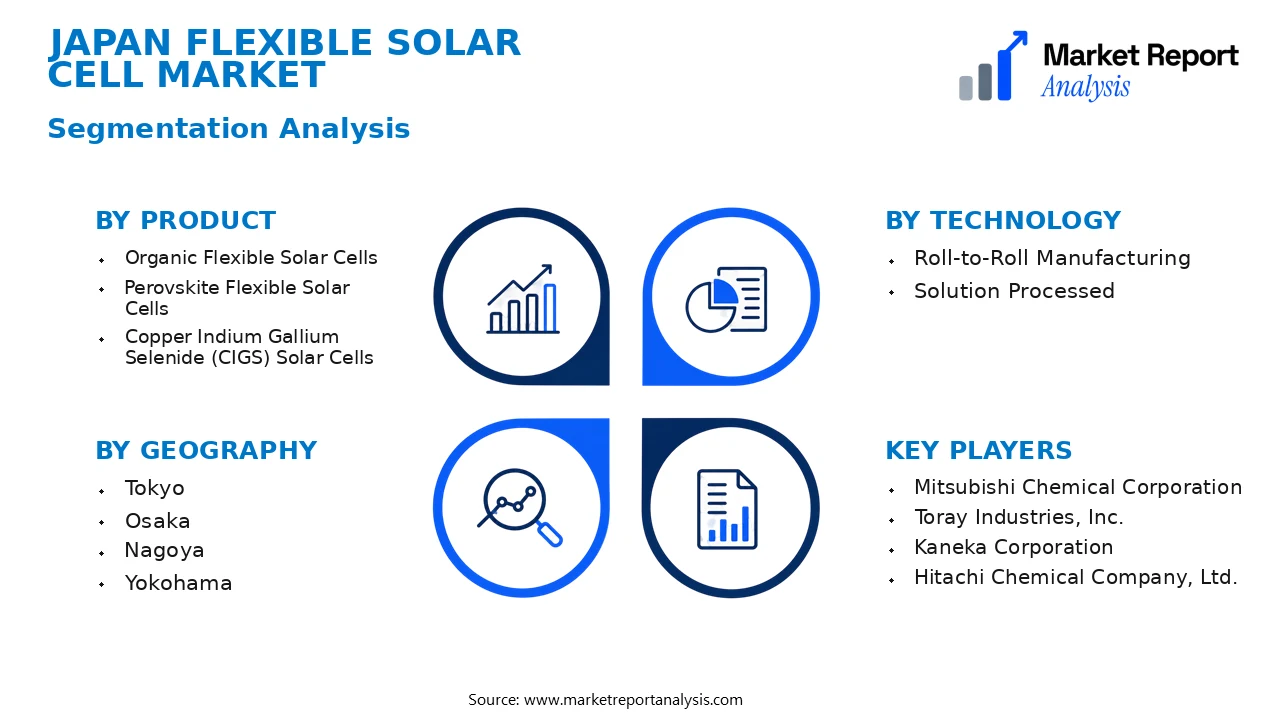
- Product
- Organic Flexible Solar Cells: These solar cells utilize organic materials that allow for high flexibility and lightweight design, making them ideal for portable and wearable applications with growing demand in consumer electronics sectors.
- Perovskite Flexible Solar Cells: Known for high efficiency and low-cost manufacturing, perovskite-based flexible solar cells are rapidly gaining traction for integration into building-integrated photovoltaics and flexible surfaces.
- Copper Indium Gallium Selenide (CIGS) Solar Cells: This category offers durability and high efficiency, suitable for rooftop and portable applications that require resilient and lightweight solar solutions.
- Technology
- Roll-to-Roll Manufacturing: Technologies enabling mass production of flexible solar cells through continuous roll-to-roll processes, essential for large-scale and cost-effective deployment in Japan’s lightweight solar markets.
- Solution Processed: Techniques involving solution-based processing for manufacturing flexible solar cells, which are favored for customizable and niche applications like wearable devices and portable electronics.
- Application
- Building-Integrated Photovoltaics (BIPV): Flexible solar cells integrated into building materials, including windows and facades, supporting Japan's trend toward sustainable architecture and energy-efficient construction practices.
- Portable Devices: This subsegment includes applications in backpacks, tents, and outdoor equipment, driven by Japan’s outdoor recreation industry and consumer interest in portable renewable energy sources.
- Wearable Technology: An emerging application, with flexible solar cells embedded into clothing and accessories, catering to Japan’s high adoption rate of wearable electronics and health monitoring devices.
- Geography
- Tokyo: As Japan's economic and technological hub, Tokyo exhibits high demand for innovative solar solutions, driven by urban infrastructure projects, smart city initiatives, and prominent tech enterprises investing in flexible solar applications.
- Osaka: Known for its manufacturing and industrial sector, Osaka hosts a significant number of flexible solar cell producers and research institutions, fueling regional innovation and market adoption.
- Nagoya: A key center for automotive and electronics industries, Nagoya's emphasis on lightweight and sustainable components creates substantial opportunities for flexible solar technology integration.
- Yokohama: Benefiting from proximity to Tokyo and port infrastructure, Yokohama is a strategic location for imports, distribution, and deployment of flexible solar panels, particularly in commercial and residential sectors.
Competitive Intelligence
The Japan Flexible Solar Cell Market is characterized by moderate competition, with a mix of established players and innovative startups vying for market share. Major companies such as Sharp Corporation and Kyocera maintain significant market concentration, leveraging their extensive R&D capabilities and extensive distribution networks. Business strategies predominantly focus on product differentiation through technological innovation, including enhancing efficiency, durability, and flexibility of solar cells. Strategic partnerships with local construction, automotive, and consumer electronics firms facilitate market penetration and application expansion. Recent acquisitions aim to strengthen technological expertise and market presence, particularly in automotive and portable device segments. Expansion strategies include establishing regional R&D centers in Tokyo and Osaka to foster innovation tailored to Japan’s unique climate and infrastructure needs. Significant R&D investments are directed toward improving material stability and reducing manufacturing costs to sustain competitive advantage. Differentiation efforts revolve around lightweight, highly adaptable products suited for urban, residential, and mobility applications, with companies also exploring integration with smart grid technology. Regional dynamics vary, with Tokyo’s high-tech ecosystem driving more aggressive innovation and partnership activities compared to other urban centers, shaping the overall competitive landscape.
Leading Company Profiles
The competitive landscape of Japan’s flexible solar cell market is characterized by innovative members focusing on advanced material technologies, product diversification, and strategic collaborations to strengthen their market position and accelerate technological advancements.
- Mitsubishi Chemical Corporation
- Toray Industries, Inc.
- Kaneka Corporation
- Hitachi Chemical Company, Ltd.
- Toppan Printing Co., Ltd.
- NSG Group
- Asahi Kasei Corporation
- MITAKA Chemical Co., Ltd.
- Shiseido Co., Ltd.
- Q CELLS Japan Ltd.
Mitsubishi Chemical Corporation
Mitsubishi Chemical Corporation leads with innovative thin-film photovoltaic solutions, emphasizing durability and flexible installation technologies to meet rising demand for lightweight, portable, and versatile solar applications across Japan’s construction and transportation sectors.
Toray Industries, Inc.
Specializing in advanced polymer-based flexible solar modules, Toray focuses on developing high-efficiency cells with enhanced flexibility and weather resistance, targeting urban infrastructure, consumer electronics, and residential roofing markets in Japan.
Kaneka Corporation
Kaneka pioneers with its proprietary flexible organic photovoltaic materials, prioritizing lightweight, semi-transparent panels suitable for building-integrated photovoltaics (BIPV) and portable energy solutions for outdoor and emergency applications.
Hitachi Chemical Company, Ltd.
Hitachi Chemical leverages its materials expertise to produce innovative encapsulation and backing films, improving the lifespan and reliability of flexible solar modules in demanding environments like automotive and outdoor settings.
Toppan Printing Co., Ltd.
Toppan focuses on integrating flexible solar cells into smart packaging and IoT devices, driving strategic collaborations to embed photovoltaics into everyday products and expand functionalities in the Japanese market.
NSG Group
Specializing in high-performance glass and film technologies, NSG develops semi-transparent, flexible photovoltaic films aimed at architectural applications, emphasizing aesthetics and energy efficiency in Japan’s urban landscape.
Asahi Kasei Corporation
Asahi Kasei advances in organic photovoltaic materials, with research dedicated to improving efficiency and scalability for consumer electronics, wearable devices, and flexible building facades across Japan’s industrial sectors.
MITAKA Chemical Co., Ltd.
MITAKA Chemicals focuses on innovative polymer composites and lightweight substrates for flexible solar panels, aiming to serve niche markets including portable power packs, military deployments, and off-grid solutions in Japan.
Shiseido Co., Ltd.
Contrary to conventional expectations, Shiseido integrates photovoltaic materials into cosmetic packaging and skincare products, exploring novel sustainability marketing strategies within Japan’s beauty and wellness domains.
Q CELLS Japan Ltd.
Q CELLS emphasizes high-efficiency, bifacial flexible solar modules, forming strategic partnerships for expanding installation capacities in Japan’s residential and commercial sectors, with a focus on optimizing energy output in varied conditions.
Strategic Business Developments

- March 2023 – Mitsui Chemicals – Launch of new flexible encapsulant films – Enhances durability and efficiency of flexible solar modules in projects, supporting market penetration in residential and portable applications.
- June 2023 – Toray Industries – Capacity expansion for polymer photovoltaics – Addresses growing demand, enabling larger-scale production to meet Japan’s infrastructure and urban development needs.
- April 2023 – Kaneka Corporation – Formation of joint venture with local electronics firm – Advances commercialization of semi-transparent organic PV panels, boosting integration into smart building solutions.
- January 2024 – Hitachi Chemical – Acquisition of a flexible film manufacturer – Expands technological capabilities and product portfolio, reinforcing market leadership in high-performance photovoltaic materials.
- February 2024 – Toppan Printing – Partnership with a renewable energy startup – Embeds flexible solar cells into innovative packaging, creating new revenue streams in consumer electronics and marketing displays.
Frequently Asked Questions
What is the Japan Flexible Solar Cell Market?
The Japan Flexible Solar Cell Market encompasses the development, production, and deployment of lightweight, bendable solar panels designed for diverse applications across residential, commercial, and industrial sectors. It emphasizes innovative photovoltaic technologies suitable for unconventional surfaces and portable devices.
What is the current market size of Japan Flexible Solar Cell Market?
As of 2026, the market value for flexible solar cells in Japan is estimated at approximately USD 1.2 Billion, reflecting rapid technological advancements and increasing adoption. This size is projected to grow significantly over the forecast period due to rising demand for versatile solar solutions.
What factors are driving the Japan Flexible Solar Cell Market?
Key drivers include Japan’s focus on renewable energy and sustainability goals, technological innovations in flexible photovoltaic materials, and a surge in portable and off-grid applications. Supportive government policies and decreasing manufacturing costs further bolster market expansion.
Which region dominates the Japan Flexible Solar Cell Market?
The Kanto region, including Tokyo, leads the market growth, driven by dense urban centers, high industrial activity, and advanced infrastructure supporting solar technology adoption. Regional policies and incentives also play a crucial role in market dominance.
Which segment is expected to grow the fastest?
The residential segment is anticipated to witness the fastest growth owing to increasing consumer awareness, government incentives, and a rising trend of deploying flexible solar panels on rooftops and small-scale structures for clean energy generation.
Who are the leading companies operating in the Japan Flexible Solar Cell Market?
Major players include Panasonic Corporation, Sharp Corporation, and Kaneka Corporation, known for their innovative research and extensive product portfolios in flexible photovoltaic solutions. These companies are pivotal in driving technological advancements and market penetration.
Analyst Perspective
The Japan Flexible Solar Cell Market is poised for sustained long-term growth driven by technological advancements and expanding application scopes. As the market matures, opportunities in urban infrastructure, wearable technology, and portable power solutions will become more prominent, encouraging manufacturers to innovate with higher efficiency and lower-cost materials. Technological evolution will likely focus on improving durability, flexibility, and light-weight characteristics, ensuring compatibility with diverse architectures such as building-integrated photovoltaics and vehicle surfaces. From an investment perspective, prioritizing R&D in perovskite-based flexible cells and exploring regional hubs in Tokyo, Osaka, and Nagoya will position firms advantageously. Competitive intensity is expected to escalate as local startups and established giants vie for market share, fostering innovation but also raising the importance of strategic IP management. Regionally, metropolitan centers with dense urban populations and proactive renewable energy policies will fuel adoption, offering lucrative opportunities for early movers and technologically advanced players to establish market leadership.
