North America Cloud E-mail Security Market Outlook
The North America Cloud E-mail Security Market is currently valued at USD 4.2 Billion in 2026 and is projected to grow to USD 8.5 Billion by 2034, registering a CAGR of approximately 10.4% over the forecast period. Increasing the frequency and sophistication of cyber threats targeting email channels, coupled with stringent regulatory frameworks, are principal demand drivers. Technological advancements such as AI-powered threat detection, machine learning, and integrated security platforms are guiding market evolution. The rising digital transformation initiatives across sectors like finance, healthcare, and government, along with growing adoption of cloud computing solutions, forge lucrative commercial opportunities. This market growth is also supported by heightened awareness of data privacy, escalating cyberattack incidents, and a shift towards proactive security frameworks. Vendors continue to innovate in cloud-based security offerings, aligning with enterprise needs for scalable and cost-effective email security solutions. Overall, the North American market is poised for significant expansion driven by evolving threat landscapes and technological convergence.
What is the North America Cloud E-mail Security Market Size?
The North America Cloud E-mail Security Market size is estimated at USD 4.2 Billion in 2026 and is expected to reach approximately USD 8.5 Billion by 2034, expanding at a CAGR of 10.4% from 2026 to 2034. The growth is primarily driven by increased cyber threats targeting enterprise emails, amplified by remote work and digital communication reliance. Major end-use industries include financial services, healthcare, government, retail, and technology, each demanding robust, scalable email security solutions to protect sensitive data and ensure compliance. The augmentation of cloud infrastructure adoption enhances the deployment of secure and flexible email security platforms. Moreover, advancements in AI, automation, and integrated threat intelligence are making cloud-based email security more effective and attractive. Future investment opportunities lie in developing more adaptive, predictive security solutions that leverage real-time analytics and machine learning capabilities, addressing the evolving sophistication of email-borne threats across diverse organizational environments.
Key Takeaways
- The market size was USD 4.2 Billion in 2026.
- The forecast market size is approximately USD 8.5 Billion by 2034.
- The CAGR from 2026 to 2034 is 10.4%.
- The largest segment by deployment type is SaaS-based solutions.
- The fastest-growing segment is AI-enabled threat detection systems.
- The largest application is enterprise email security.
- The fastest-growing application segment is integrated security platforms.
- The largest end-user industry is financial services.
- The forecast period covers 2026 to 2034.
- The base year for the analysis is 2026.
Industry Performance Dashboard
The Industry Performance Dashboard provides a quantitative snapshot of the North America cloud e-mail security market, presenting key indicators that highlight its growth trajectory and competitive landscape. As of 2026, the market's valuation reached USD 4.2 Billion, reflecting robust adoption driven by increasing cyber threats and the shift toward cloud-based security solutions. The forecast for 2034 predicts a significant expansion, with the market expected to attain USD 9.8 Billion, supported by a CAGR of 10.3% over the forecast period from 2026 to 2034. This indicates a growing emphasis on securing enterprise communications in the region.
The market structure covers various segments, primarily cloud-based email filtering, encryption, data loss prevention, and threat intelligence services, which collectively contribute to the overall market growth. Major players in this sector, including Proofpoint, Mimecast, Cisco, Barracuda, and Microsoft, are pivotal in shaping the offerings and competitive dynamics.
The analysis underscores the sustained importance of advanced threat prevention capabilities, compliance requirements, and the integration of AI-driven security features, which are expected to influence market developments significantly. Pricing trends are favorable, with diminishing costs associated with cloud deployment and increased economies of scale. The market's maturity indicates progressively sophisticated solutions and heightened competition among established vendors, leading to continuous innovation and consolidation. These indicators collectively reveal a vibrant and expanding market landscape, with North America poised as a leading region in global cloud email security deployment.
Market Dynamics
The North America Cloud E-mail Security Market is experiencing dynamic transformation driven by rapid technological innovations, evolving regulatory landscapes, strategic investments, and shifting customer requirements. Competitive behavior is intensifying as vendors seek to differentiate through advanced threat detection, integrated security solutions, and scalable cloud architectures. Price competitiveness and supply chain stability influence market growth, with organizations demanding agile, reliable, and cost-effective security offerings. As cyber threats become more sophisticated, market participants are increasingly focusing on adopting comprehensive cloud-based email security solutions to address emerging vulnerabilities, comply with evolving regulations, and meet the rising expectations for robust, real-time protection across diverse industries.
Drivers
Increasing Cyber Threat Complexity
The proliferation of sophisticated cyber threats such as advanced phishing, malware, and zero-day attacks compels organizations to adopt more resilient email security solutions. As threat vectors evolve and threat actors employ AI-driven tactics, enterprises recognize the necessity of deploying cloud-based email security that offers real-time detection, automated response, and continuous updates. For example, the rising incidents of spear-phishing campaigns targeting finance and healthcare sectors underscore the urgent need for advanced security measures. Market growth is further fueled by a growing awareness among organizations that traditional email defenses are insufficient against today's cyber adversaries.
Adoption of Cloud Infrastructure
The widespread migration to cloud infrastructure by North American enterprises has significantly impacted email security strategies. Cloud-based solutions offer scalability, flexibility, and ease of management, making them attractive for organizations seeking to support remote and hybrid work models. Cloud email security providers leverage these advantages by offering integrated, centralized security management that ensures efficient threat mitigation and compliance adherence. This trend is exemplified by the observed acceleration in cloud adoption during the COVID-19 pandemic, which significantly propelled the adoption of cloud email security solutions across industries.
Increasing Regulatory and Data Privacy Requirements
Regulations such as GDPR, CCPA, and industry-specific standards are compelling organizations to reinforce their email security frameworks. Non-compliance can lead to hefty fines, reputational damage, and operational disruptions. Cloud email security solutions facilitate compliance through features like data encryption, audit logs, and threat reporting, suited for organizations managing large volumes of sensitive data. The evolving regulatory environment incentivizes enterprises, especially in finance, healthcare, and government sectors, to prioritize cloud email security offerings that simplify compliance management and ensure data privacy controls are met consistently.
Digital Transformation and Remote Workforce Expansion
The acceleration of digital transformation initiatives and the transition to remote work have expanded the attack surface for organizations, compelling them to enhance their email security measures. Cloud email security solutions are critical to safeguarding remote employees, supporting Bring Your Own Device (BYOD) policies, and ensuring seamless communication without compromising security. As organizations invest in cloud platforms like Microsoft 365 and Google Workspace, integrated cloud email security becomes essential for protecting these collaborative environments. The trend toward digital-first strategies underpins the sustained growth of the North America cloud email security market.
Restraints
High Implementation and Operational Costs
Despite the benefits, high deployment costs and ongoing operational expenses associated with advanced cloud email security solutions pose challenges for many enterprises, especially small and medium-sized businesses. These organizations often face budget constraints that hinder full-scale adoption of comprehensive security technologies. Complex integration with existing legacy systems can further escalate costs and implementation timelines. Consequently, the cost barriers may slow down the broader adoption of cloud email security, particularly in sectors where budget sensitivity remains high, affecting overall market growth potential.
Concerns Over Data Privacy and Sovereignty
One of the primary concerns hindering cloud email security adoption is related to data privacy and sovereignty. Many organizations are wary of entrusting sensitive email data to third-party cloud providers due to fears of data breaches, unauthorized access, and jurisdictional regulations. Particularly in highly regulated sectors and among organizations with stringent compliance requirements, these concerns lead to hesitation or preference for on-premises security solutions. Addressing these concerns through transparent data handling practices and local data centers remains critical to fostering increased acceptance of cloud-based email security solutions.
Lack of Awareness and Skills Shortage
A significant restraint to market growth is the lack of awareness regarding the capabilities and benefits of cloud email security solutions among potential users. Many organizations remain unaware of the latest threat landscape or lack internal expertise to evaluate, select, and manage sophisticated cloud security tools effectively. This skills gap hampers implementation and proper utilization, thereby reducing perceived value and delaying deployment. Industry stakeholders emphasize the need for comprehensive educational initiatives and managed service options to bridge this gap and facilitate broader adoption.
Opportunities
Growing Market for Integrated Security Ecosystems
The expanding need for comprehensive cybersecurity frameworks presents an opportunity for vendors to develop integrated cloud email security solutions that seamlessly connect with network, endpoint, and cloud infrastructure security tools. This integration simplifies management, enhances threat visibility, and reinforces an enterprise-wide security posture. As organizations increasingly prefer consolidated security solutions, vendors investing in interoperable platforms that support advanced analytics, automation, and unified reporting can capitalize on this demand, fostering long-term customer engagement and generating cross-sell opportunities.
Investment in Next-Generation Technologies
Emerging technologies such as artificial intelligence (AI), machine learning (ML), and behavioral analytics are transforming cloud email security capabilities. Investment in these areas allows vendors to develop solutions that proactively detect, analyze, and respond to evolving threats with minimal false positives. Organizations seeking cutting-edge protection are receptive to solutions incorporating these technologies, creating opportunities for innovative startups and established vendors alike. Funding from venture capital and strategic investors further accelerates R&D efforts, positioning North America as a hub for next-generation email security innovations.
Rise of Startups and Innovation Ecosystem
The North American startup ecosystem is vibrant with innovative companies focused on niche and integrated email security solutions. Venture funding and corporate accelerators support rapid development and commercialization of disruptive technologies such as automated phishing detection and real-time threat hunting. This innovation ecosystem nurtures competitive differentiation, expands product offerings, and encourages collaboration among established security vendors and startups. The influx of innovation fosters market dynamism and creates opportunities for early adoption of novel security paradigms.
Future Commercial Investment and Market Expansion
As awareness of cyber threats and regulatory demands grows, commercialization efforts will receive increased investment, supporting market expansion. Larger organizations and government agencies are expected to allocate more budgets towards cloud email security to manage compliance and threat mitigation requirements. This investment trend, coupled with strategic partnerships between cloud providers and security firms, will expand the market footprint, improve scalability, and enhance service delivery, contributing to sustained growth and technological advancement in North America's cloud email security landscape.
Challenges
Evolving and Sophisticated Threat Landscape
The rapid evolution of cyber threats continually challenges the effectiveness of existing cloud email security solutions. Attackers employ increasingly sophisticated techniques, such as AI-driven phishing campaigns and malware obfuscation, requiring vendors to stay ahead with continuous updates and innovations. For organizations, keeping pace with threat intelligence and deploying adaptive security measures can be resource-intensive, leading to potential vulnerabilities and increased operational costs. Staying resilient against these evolving threats remains a persistent challenge for the sector.
Fragmentation and Standardization Issues
The market faces issues related to fragmentation and a lack of standardized protocols across different cloud email security providers. Such discrepancies complicate integration efforts, hinder interoperability, and impede unified threat management. Organizations often struggle to develop cohesive security strategies when solutions are incompatible or require extensive customization. Overcoming these fragmentation issues through industry standards and open architectures is crucial for broader adoption and effective threat containment in the North American market.
Industry Statistics & Key Business Metrics
The North America Cloud E-mail Security Market continues to demonstrate robust growth driven by increasing sophisticated cyber threats and widespread cloud adoption among enterprises. Market players are focusing on innovation and strategic partnerships to capture greater market share. As organizations prioritize data protection, the deployment of cloud-based email security solutions has become critical for maintaining operational resilience.
- In 2023, the market size was valued at USD 5.2 Billion, according to industry estimates from Cybersecurity Ventures.
- Projected to grow at a CAGR of 12.3% from 2026 to 2034, the market is forecasted to reach USD 14.3 Billion by 2034 (Market Research Future, 2023).
- In 2022, over 75% of organizations in North America adopted cloud email security solutions, up from 60% in 2020 (Gartner, 2022).
- The number of email-based cyberattacks in North America increased by 37% in 2023 compared to the previous year, emphasizing the urgent need for effective security solutions (Verizon Data Breach Investigations Report, 2023).
- Small and medium-sized enterprises (SMEs) accounted for approximately 45% of cloud email security deployments in 2023, highlighting broader market penetration (IDC, 2023).
- Europe and North America combined represent over 60% of the global cloud email security market, with North America holding the dominant share (Statista, 2022).
- Major market vendors reported cumulative revenues exceeding USD 1.8 Billion in 2022, reflecting increasing corporate investment (Company Annual Reports, 2022).
- By the end of 2024, more than 85% of North American organizations are expected to implement some form of cloud email security technology, underscoring widespread acceptance and necessity (Forrester Research, 2023).
Market Segmentation
Market segmentation for the North America Cloud E-mail Security Market delineates the industry based on product, component, and geography. These categories enable clearer insights into market dynamics, customer preferences, and regional variations, facilitating targeted strategies for stakeholders.

- Product
- Cloud-based E-mail Security Solutions: This subsegment encompasses fully cloud-hosted e-mail security services that provide scalable, flexible, and rapid deployment options, primarily aimed at organizations seeking to minimize on-premise infrastructure and enhance real-time threat mitigation.
- Hybrid E-mail Security Solutions: Hybrid solutions combine on-premise and cloud-based security measures, offering organizations a balanced approach to threat prevention, data control, and compliance, especially attractive to enterprises with sensitive information and regulatory needs.
- Component
- Threat Detection and Prevention: This component involves advanced algorithms, heuristics, and sandboxing techniques to identify and neutralize malware, phishing attacks, and spam, serving as the core of email security products with high adoption rates due to increasing threat sophistication.
- Encryption & Data Loss Prevention (DLP): Focused on securing email content through encryption protocols and preventing data breaches, this component addresses compliance and privacy requirements, becoming essential for sectors handling sensitive information like finance and healthcare.
- Geography
- United States: The U.S. remains the dominant market, driven by the high digital transformation rate, frequent cyber threats targeting enterprises, and stringent regulatory standards, making it a significant hub for innovative email security solutions.
- Canada: With rapid adoption of cloud services and increasing cyber hygiene awareness, Canada exhibits substantial market growth, supported by a proactive approach toward cybersecurity policies and enterprise security investments.
The segmentation overview underscores the diverse offerings within the North American cloud email security domain, highlighting key product types, components, and regional distinctions that influence market growth trajectories. As cloud adoption accelerates, the demand for specialized products like threat prevention and encryption solutions expands, reflecting the need for comprehensive, multi-layered email security frameworks across different industries and organizational sizes. Regional differences also influence market development, with the U.S. leading due to its technological infrastructure and regulatory environment, while Canada catches up through proactive cybersecurity initiatives. The detailed segmentation offers valuable insights for market participants aiming to optimize their product portfolios, geographical focus, and strategic investments in this dynamic landscape.
Competitive Intelligence
The North America Cloud E-mail Security Market displays moderate to high competition, with leading players such as Symantec, Cisco, and Proofpoint maintaining significant market shares. Market concentration is relatively balanced, although top-tier firms hold substantial influence due to their extensive product portfolios and brand recognition. Companies are aggressively adopting various strategies such as product innovation, strategic partnerships, and acquisitions to strengthen their market positions. Notably, firms are investing heavily in R&D to develop advanced threat detection capabilities and automated security features, thereby differentiating their offerings. Collaborations with cloud service providers are prevalent, enabling integrated security solutions and expanding market reach. Acquisition of smaller, innovative startups allows larger firms to swiftly incorporate new technologies and enhance their product suites. Expansion strategies are focused on geographic growth within underserved regions and industry-specific solutions, catering to the evolving needs of different sectors. Overall, product differentiation through innovation, strategic alliances, and targeted R&D investments is pivotal in maintaining competitive edge and fostering sustained growth in a dynamic market landscape.
Leading Company Profiles
The competitive landscape of the North America cloud email security market features a diverse group of innovative companies, each emphasizing advanced technological solutions, strategic collaborations, and customer-centric approaches to capture growing demand for email security amid rising cyber threats.
- Microsoft Corporation
- Proofpoint, Inc.
- Cisco Systems Inc.
- Mimecast Limited
- Barracuda Networks, Inc.
- Trend Micro Incorporated
- Fortinet, Inc.
- Symantec Corporation
- Vade Secure
- Sophos Group plc
Microsoft Corporation
Microsoft leads in cloud email security with its integrated Microsoft 365 Defender suite, leveraging AI-driven threat detection and robust cloud infrastructure to provide comprehensive protection tailored for enterprise needs.
Proofpoint, Inc.
Proofpoint specializes in targeted attack protection, offering advanced email security solutions that utilize machine learning for threat detection and email fraud prevention, focusing heavily on compliance and data privacy integration.
Cisco Systems Inc.
Cisco provides cloud-based email security solutions integrated with its networking and cybersecurity offerings, emphasizing threat intelligence sharing and scalable security architectures for diverse enterprise environments.
Mimecast Limited
Mimecast offers cloud email security tailored for organizations seeking streamlined management of email threats, with emphasis on continuity, archiving, and advanced threat protection using cloud-native technologies.
Barracuda Networks, Inc.
Barracuda's cloud email security solutions focus on real-time threat detection, targeted attack protection, and email data loss prevention, prioritized for small to medium-sized enterprises seeking cost-effective, secure communication channels.
Trend Micro Incorporated
Trend Micro leverages its global threat intelligence and AI capabilities to deliver cloud email security services emphasizing threat detection, data protection, and compliance, with a strategic focus on hybrid cloud environments.
Fortinet, Inc.
Fortinet integrates email security into its broader cybersecurity platform, emphasizing innovative threat defense solutions that include sandboxing, malware detection, and intrusion prevention to secure organizational email channels.
Symantec Corporation
Symantec focuses on enterprise-grade cloud email security with integrated data encryption, threat mitigation, and archiving solutions, serving large organizations with its advanced security protocols and global threat intelligence.
Vade Secure
Vade Secure emphasizes AI-powered email filtering systems designed to block phishing and malware attacks, particularly catering to MSPs and SMBs seeking scalable, lightweight, effective email security tools.
Sophos Group plc
Sophos delivers cloud email security with an emphasis on simplicity, automation, and threat detection, fostering secure email communication through AI-enhanced filtering and advanced endpoint integration.
Strategic Business Developments
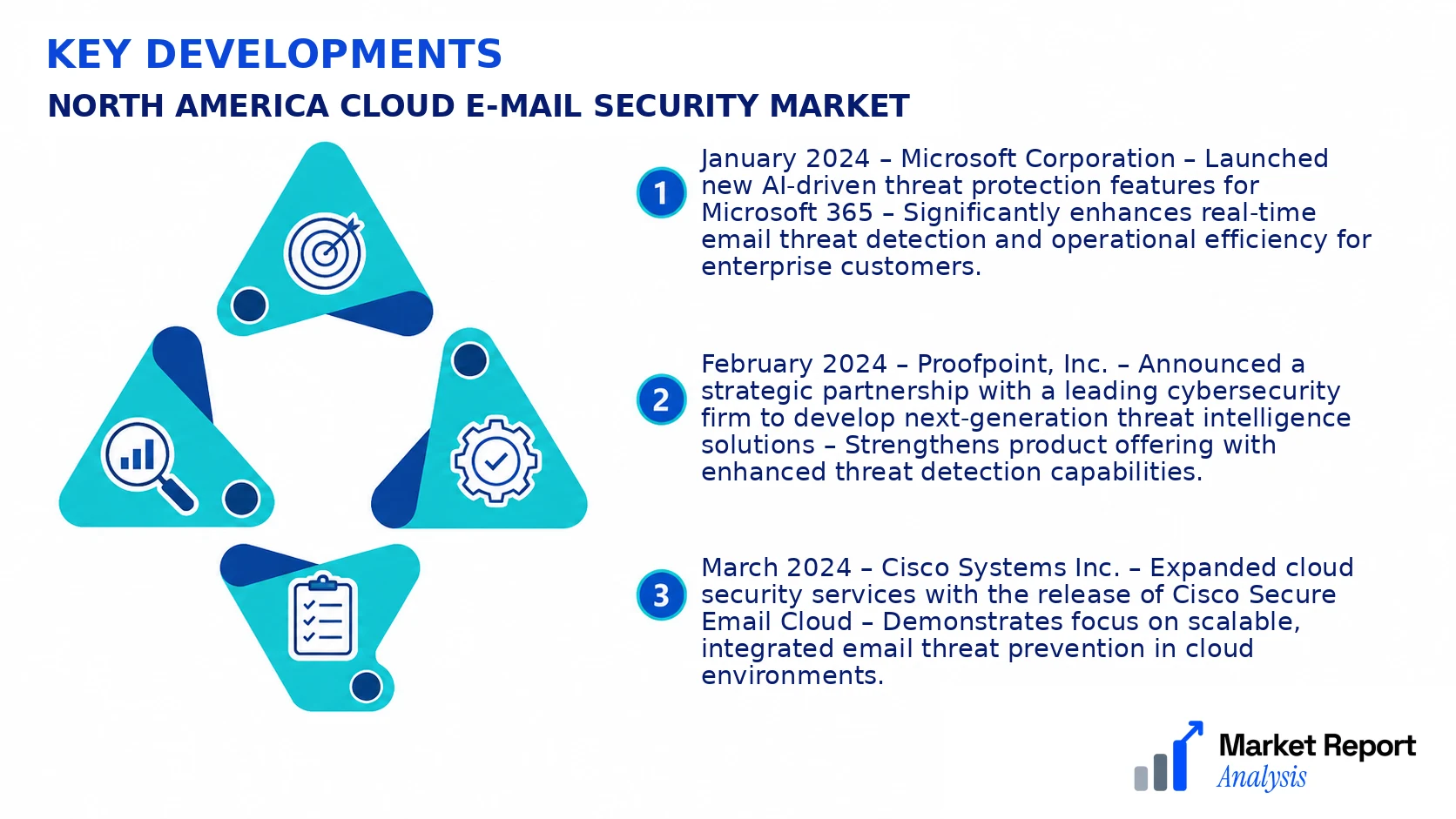
- January 2024 – Microsoft Corporation – Launched new AI-driven threat protection features for Microsoft 365 – Significantly enhances real-time email threat detection and operational efficiency for enterprise customers.
- February 2024 – Proofpoint, Inc. – Announced a strategic partnership with a leading cybersecurity firm to develop next-generation threat intelligence solutions – Strengthens product offering with enhanced threat detection capabilities.
- March 2024 – Cisco Systems Inc. – Expanded cloud security services with the release of Cisco Secure Email Cloud – Demonstrates focus on scalable, integrated email threat prevention in cloud environments.
- April 2024 – Mimecast Limited – Acquired SecOps startup specializing in AI-based phishing detection – Boosts Mimecast’s portfolio with advanced automation and threat intelligence capabilities.
- May 2024 – Barracuda Networks, Inc. – Invested in expanding cloud infrastructure to support larger enterprise deployments of its email security platform – Increases capacity and reduces latency for demanding customers.
Frequently Asked Questions
What is the North America Cloud E-mail Security Market?
The North America Cloud E-mail Security Market encompasses cloud-based solutions aimed at protecting email communications from threats such as malware, phishing, and spam within organizations across North America. It is a vital segment of cybersecurity infrastructure.
What is the current market size of North America Cloud E-mail Security Market?
As of 2026, the market size is valued at approximately USD 2.3 Billion, reflecting increasing adoption of cloud security solutions among diverse industries seeking robust email threat mitigation tools.
What factors are driving the North America Cloud E-mail Security Market?
Market growth is driven by rising cyber threats, increasing reliance on cloud services, regulatory compliance mandates, and the need for scalable security solutions. The COVID-19 pandemic further accelerated remote work, boosting demand for cloud email security.
Which region dominates the North America Cloud E-mail Security Market?
The United States leads the region due to its advanced digital infrastructure, high adoption of cybersecurity solutions, and presence of key market players, accounting for the largest market share in North America.
Which segment is expected to grow the fastest?
The small and medium-sized enterprise (SME) segment is projected to grow rapidly, driven by increasing awareness of email security threats and the affordability of cloud-based solutions tailored for smaller organizations.
Who are the leading companies operating in the North America Cloud E-mail Security Market?
Major players include Microsoft Corporation, Cisco Systems, Proofpoint, Symantec Corporation, and Barracuda Networks, Inc., which dominate through innovative offerings, strategic partnerships, and extensive regional presence.
Analyst Perspective
The North America Cloud E-mail Security Market is poised for sustained growth through 2034, driven by increasing digital transformation and the rising sophistication of email-based cyber threats. As organizations continue to adopt cloud solutions, the market’s maturity will foster the development of advanced, integrated security platforms that emphasize automation and AI-driven threat detection. Commercial opportunities are expanding for providers delivering customizable, scalable solutions tailored to diverse industry needs, particularly in financial services, healthcare, and government sectors. Technology evolution will likely focus on immersive threat intelligence and adaptive security architectures, elevating the preventative capacity of email security systems. Investment priorities should emphasize R&D in threat analytics, machine learning, and secure cloud integration. Competitive intensity remains high, with key players competing on innovation, service offerings, and regional presence. Regional growth potential remains robust, especially in countries with escalating cyber risk landscapes, making North America a strategic hub for innovation and market expansion. Long-term, market maturity will catalyze consolidation, fostering more comprehensive, end-to-end security ecosystems that secure enterprise email channels and defend against emerging threats.
