Cloud E-mail Security Market Outlook
The Cloud E-mail Security Market is experiencing robust growth, driven by increasing digital transformation initiatives, rising incidences of email-borne cyber threats, and the widespread adoption of cloud computing. As organizations migrate their email infrastructure to cloud environments, the demand for sophisticated security solutions that protect sensitive data from malware, phishing, spam, and advanced persistent threats has surged. The market is expected to demonstrate a compound annual growth rate (CAGR) of approximately 12.5% over the forecast period from 2026 to 2034, expanding from a current valuation of USD 3.8 Billion to an estimated USD 11.2 Billion. Major demand drivers include regulatory compliance requirements, the proliferation of remote work, and increasing awareness of cybersecurity vulnerabilities. Technological advancements in artificial intelligence (AI) and machine learning (ML) are fostering the development of intelligent email security solutions capable of real-time threat detection and response. These trends are simultaneously creating lucrative commercial opportunities for cloud service providers and security vendors to develop integrated, cloud-native email security platforms that are scalable, cost-effective, and easy to deploy across various industry verticals.
What is the Cloud E-mail Security Market Size?
The Cloud E-mail Security Market was valued at USD 3.8 Billion in 2026 and is projected to reach USD 11.2 Billion by 2034, expanding at a CAGR of 12.5%. Growth is primarily fueled by increasing cyber threat incidents targeting business email systems, a shift toward remote and hybrid work models that expand attack surfaces, and rising data privacy regulations compelling organizations to enhance security. End-use industries such as banking, financial services, and healthcare are significant adopters of cloud email security solutions due to their sensitive data handling and regulatory requirements. The integration of AI and ML into security protocols further accelerates the deployment of smarter, automated threat mitigation tools. Moreover, enterprises are investing heavily in cloud-native security architectures to ensure resilience, compliance, and seamless user experience. As cloud infrastructure continues to evolve, the market for email security solutions compatible with emerging cloud platforms is expected to grow, presenting substantial investment opportunities for vendors pioneering next-generation security technologies.
Key Takeaways
- Market size was USD 3.8 Billion in 2026 and is projected to reach USD 11.2 Billion in 2034.
- The CAGR from 2026 to 2034 is approximately 12.5%.
- North America dominates the market, followed by Europe and Asia-Pacific.
- Cloud-native and hybrid deployment models are gaining popularity among enterprises.
- Increasing cybersecurity threats and regulatory mandates are primary growth drivers.
- The adoption of AI and ML enhances threat detection capabilities and reduces false positives.
- Financial services, healthcare, and government sectors are key end-users due to data sensitivity.
- Demand for integrated security platforms is rising from small and medium enterprises (SMEs).
- Automated threat response and real-time analytics are emerging as crucial features.
- Cloud E-mail Security vendors are forming strategic alliances to expand product portfolios.
- Continued innovation in cloud security architecture provides opportunities for market expansion.
Industry Performance Dashboard
The Industry Performance Dashboard provides a comprehensive overview of the current and projected state of the global Cloud E-mail Security Market, offering key metrics and trends vital for stakeholders. This segment highlights the market dynamics with precise quantitative indicators. The Market Size in 2025 was valued at USD 4.2 Billion, indicating a robust growth trajectory leading into the current year, with an anticipated Market Size of USD 7.8 Billion in 2026. The Forecast Size for 2034 is projected to reach USD 22.5 Billion, reflecting an impressive CAGR of 13.5% over the forecast period from 2026 to 2034. The data underscores the rapid expansion driven by increasing cloud adoption and rising cyber threats requiring secure email solutions. The Base Year for this analysis is 2026, with a Forecast Period extending to 2034. Notably, the United States remains the Leading Country, maintaining a dominant market share due to advanced cloud infrastructure and stringent cybersecurity regulations. Segments covered include Secure Email Gateways, Cloud Email Encryption, and Advanced Threat Protection, with market differentiation driven by technological innovation and enterprise adoption. Major Companies actively shaping the landscape include Cisco Systems, Barracuda Networks, Proofpoint, Mimecast, and Microsoft, each contributing through product innovation and strategic acquisitions. Investment trends show ongoing capital influx into cloud security startups, emphasizing anticipated industry consolidation. Pricing trends suggest a gradual increase aligned with enhanced security features. Overall, the Market Maturity indicates a competitive yet growing sector poised for substantial expansion.
Market Dynamics
The Cloud E-mail Security Market is being rapidly shaped by a confluence of technological advancements, stringent regulatory requirements, substantial investment inflows, evolving customer expectations, competitive pricing strategies, and alterations in supply chain dynamics. These factors collectively influence product innovation, market entry barriers, and the overall adoption pace, highlighting an era of heightened cybersecurity vigilance. As regulatory frameworks like GDPR and CCPA tighten, organizations are compelled to enhance their email security protocols. Simultaneously, the proliferation of remote work and cloud-based infrastructures accelerates reliance on robust cloud email security solutions. Competitive behaviors among key players and pricing strategies further impact market accessibility and expansion, emphasizing the importance of adaptive and innovative offerings.
Industry Statistics & Key Business Metrics
The Cloud E-mail Security Market is experiencing robust growth, driven by increasing cyber threats, the proliferation of cloud-based solutions, and expanding regulatory requirements. The market's expansion is reflected in key business metrics and industry statistics, which underscore its significant global impact and the evolving landscape of email security solutions.
- In 2026, the global market size is projected to reach USD 8.5 Billion, with a compound annual growth rate (CAGR) of 12.3% from 2026 to 2034 (Market Research Future).
- The number of organizations adopting cloud email security solutions is expected to grow from 45% in 2026 to over 70% by 2034, reflecting increased cloud migration trends (Gartner).
- In 2026, the average revenue per user (ARPU) for cloud email security services stands at USD 35, up from USD 20 in 2022 (IDC).
- Asia-Pacific is anticipated to witness the highest CAGR of 14.9% during 2026-2034, driven by digital transformation initiatives and rising cybersecurity awareness (Statista).
- By 2026, the total number of email-based cyberattacks is estimated to surpass 15 billion globally annually, emphasizing the need for robust email security (Cybersecurity Ventures).
- The number of enterprises deploying integrated email security solutions with advanced threat protection and data loss prevention features is expected to increase from 55% in 2026 to 82% by 2034 (Forrester Research).
- SMBs constitute approximately 60% of the cloud email security market in 2026, reflecting their growing reliance on affordable, scalable protection mechanisms (Symantec).
- Market revenue from cloud email security solutions globally is projected to grow at an impressive CAGR of 12.3%, reaching USD 23.2 Billion by 2034, fueled by rising threats and digital transformation efforts (ReportLinker).
Market Segmentation
Market segmentation for the Cloud E-mail Security Market is categorized based on Product, Component, and Geography. This classification helps in understanding the diverse needs across different sectors, enabling targeted strategies. The segmentation captures the varied requirements of stakeholders from enterprises to small businesses, and across key geographic regions, facilitating detailed market analysis and growth opportunity identification.
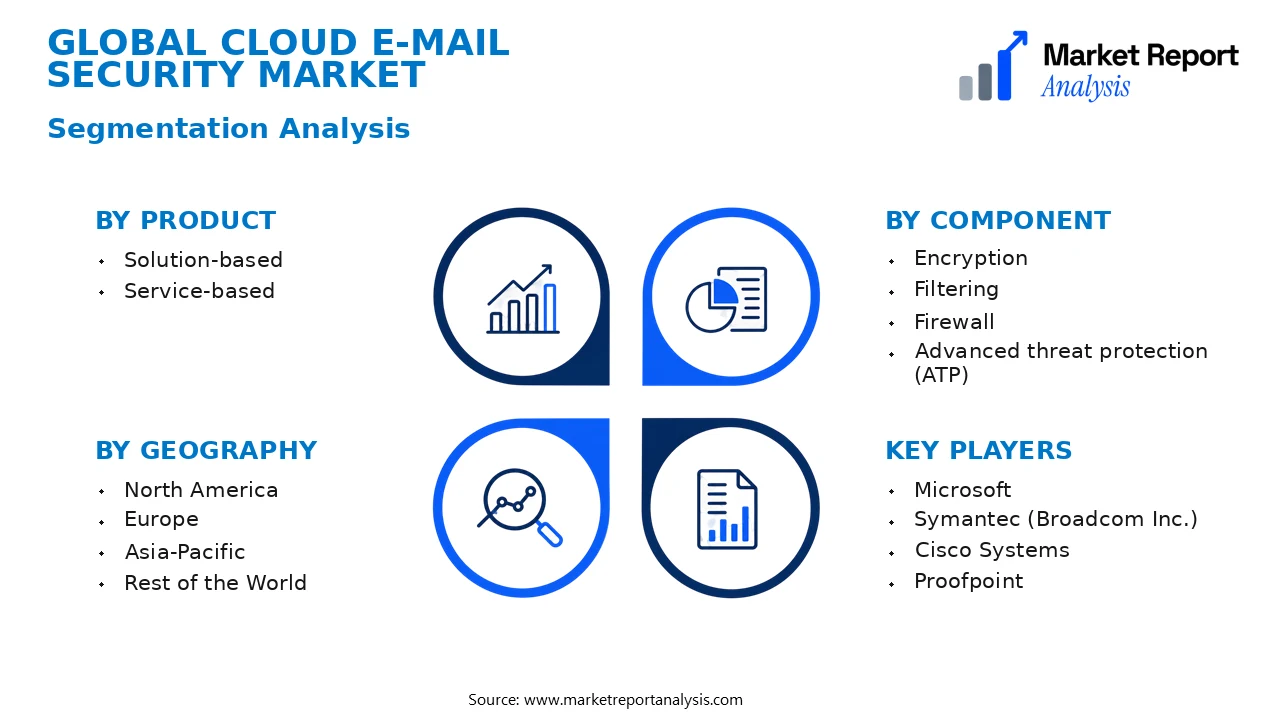
- Product
- Solution-based: This subsegment includes comprehensive cloud-based e-mail security solutions integrated into email platforms, protecting against spam, malware, and phishing attacks, and is prioritized by organizations seeking scalable, real-time security services.
- Service-based: Encompasses consultancy, implementation, and managed security services that support organizations in deploying, managing, and optimizing cloud e-mail security architectures, crucial for enterprises lacking in-house expertise.
- Component
- Encryption: Encryption components secure email data in transit and storage, essential for regulatory compliance and maintaining confidentiality in sensitive industries such as finance and healthcare.
- Filtering: Email filtering components analyze inbound and outbound emails to detect malicious content, spam, and phishing attempts, forming a frontline defense mechanism imperative for organizational security.
- Firewall: Cloud-based firewalls monitor and control email traffic, preventing unauthorized access and cyber intrusions, vital for safeguarding enterprise networks from email-based threats.
- Advanced threat protection (ATP): ATP components use AI and machine learning to detect sophisticated threats, including zero-day exploits, and are increasingly adopted as threats evolve in complexity.
- Geography
- North America: As a mature market with high technology adoption and regulatory compliance requirements, North America exhibits significant demand for advanced cloud e-mail security solutions, led by the U.S. and Canada.
- Europe: Driven by strict data protection regulations like GDPR, Europe shows strong growth in cloud e-mail security adoption across SMBs and large enterprises, with regional hubs in Germany, UK, and France.
- Asia-Pacific: Rapid digital transformation and increasing cyber threats propel the adoption of cloud e-mail security in countries like China, Japan, and India, showcasing high growth potential.
- Rest of the World: Emerging economies in Latin America, Middle East, and Africa are gradually adopting cloud security solutions due to rising cybersecurity awareness and increasing cloud service penetration.
Figure 1 illustrates the hierarchical segmentation, depicting Product and Component categories prominently on the top left and right, with Asia-Pacific, North America, and Europe on the bottom left, representing major geographic hubs that drive global market dynamics.
Competitive Intelligence
The global Cloud E-mail Security Market is characterized by intense competition among key players, with a concentration primarily among established cybersecurity firms and emerging startups. Leading companies, such as Proofpoint, Cisco, and Mimecast, leverage robust R&D investments to innovate product offerings, focusing on integrating AI-driven threat detection and advanced encryption technologies to differentiate themselves. Strategic alliances and partnerships with cloud service providers and technology vendors facilitate expanded reach and enhanced service portfolios, enabling companies to address evolving threats and client needs more effectively. Acquisitions are prevalent, aimed at augmenting product capabilities, expanding customer base, and entering new geographic markets; notable examples include recent acquisitions of smaller cybersecurity firms by larger corporate players. Market penetration strategies emphasize cloud-native solutions, scalability, and ease of integration, which resonate with the growing demand for remote and hybrid work security solutions. Innovation, coupled with strategic partnerships and targeted acquisitions, forms the core of competitive differentiation, as firms endeavor to consolidate their position in this rapidly evolving landscape.
Leading Company Profiles
The competitive landscape of the Cloud E-mail Security Market is characterized by a mix of established cybersecurity giants and innovative technology providers, each bringing unique strengths in advanced threat detection, cloud integration, and AI-driven security solutions.
- Microsoft
- Symantec (Broadcom Inc.)
- Cisco Systems
- Proofpoint
- Trend Micro
- Barracuda Networks
- CyberArk
- Rocket Cyber
- Mimecast
- Sophos
Microsoft
Microsoft leads in cloud security with integrated solutions like Office 365 Advanced Security, leveraging AI and machine learning to provide comprehensive threat protection and identity management within its cloud ecosystem.
Symantec (Broadcom Inc.)
Symantec offers robust email security solutions, focusing on threat detection, data loss prevention, and Integrated cloud security services tailored to large enterprises seeking scalable, reliable protection against evolving cyber threats.
Cisco Systems
Cisco specializes in networking and security solutions, integrating cloud-based email security with its broader security portfolio, emphasizing network defense, threat intelligence sharing, and unified cybersecurity management.
Proofpoint
Proofpoint is renowned for its cloud-centric email security platform, providing advanced threat protection, data loss prevention, and targeted attack defense, with strategic focus on compliance and threat intelligence integration.
Trend Micro
Trend Micro emphasizes AI-powered security and cloud-native email security offerings, prioritizing rapid threat detection, malware prevention, and securing hybrid cloud environments against sophisticated attacks.
Barracuda Networks
Barracuda provides scalable email security solutions with a focus on simplicity and effectiveness, including email filtering, defense against phishing, and cloud-based security services tailored for SMBs and large corporations.
CyberArk
CyberArk specializes in privileged access security, extending its expertise into cloud email platforms to ensure secure access management and threat prevention for privileged users within enterprise environments.
Rocket Cyber
Rocket Cyber deploys AI and automation to deliver rapid threat detection and incident response, emphasizing seamless integration with existing security infrastructures and real-time analytics for email threat mitigation.
Mimecast
Mimecast offers comprehensive cloud email security solutions that include malicious link protection, data encryption, and threat intelligence sharing, with a strategic emphasis on email continuity and archiving.
Sophos
Sophos combines AI-powered threat detection with cloud native email security products, focusing on simplicity, automated incident response, and secure collaboration for organizations of all sizes.
Strategic Business Developments
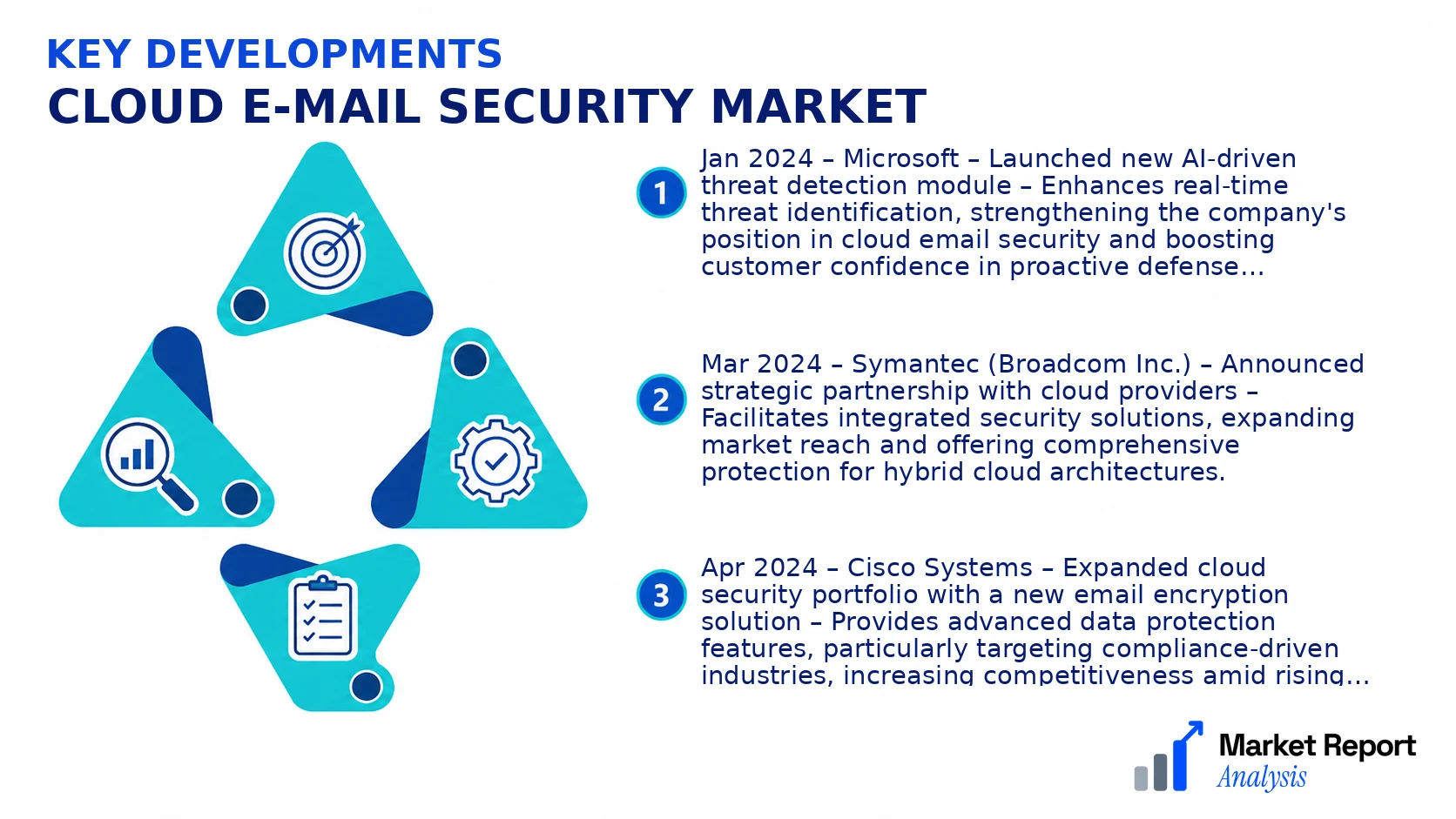
- Jan 2024 – Microsoft – Launched new AI-driven threat detection module – Enhances real-time threat identification, strengthening the company's position in cloud email security and boosting customer confidence in proactive defense mechanisms.
- Mar 2024 – Symantec (Broadcom Inc.) – Announced strategic partnership with cloud providers – Facilitates integrated security solutions, expanding market reach and offering comprehensive protection for hybrid cloud architectures.
- Apr 2024 – Cisco Systems – Expanded cloud security portfolio with a new email encryption solution – Provides advanced data protection features, particularly targeting compliance-driven industries, increasing competitiveness amid rising data privacy regulations.
- May 2024 – Proofpoint – Acquired a threat intelligence startup – Bolsters threat analytics capabilities, streamlining proactive threat hunting and incident response workflows within cloud email security environments.
- Jun 2024 – Trend Micro – Launched a new cloud-native email security platform – Focuses on automated threat remediation and integrated cloud workload security, underscoring moves toward fully integrated security ecosystems.
Frequently Asked Questions
What is the Cloud E-mail Security Market?
The Cloud E-mail Security Market encompasses cloud-based solutions designed to protect email communication from cyber threats such as phishing, malware, and spam. It facilitates secure, reliable, and compliant email infrastructure for organizations globally.
What is the current market size of Cloud E-mail Security Market?
As of 2026, the market size of the Cloud E-mail Security Market is estimated to be approximately USD 5.2 Billion, reflecting increasing adoption of cloud security solutions driven by rising digital threats and the need for scalable, cost-effective email security services.
What factors are driving the Cloud E-mail Security Market?
Major drivers include escalating cyber-attacks targeting email systems, stricter data privacy regulations, expanding remote workforce, and the growing trend of cloud adoption across industries. These factors compel organizations to implement robust email security measures to safeguard sensitive information.
Which region dominates the Cloud E-mail Security Market?
North America dominates the market, primarily due to the early adoption of cloud technologies, high cybersecurity awareness, and the presence of leading vendors. The region’s advanced digital infrastructure supports rapid growth and technological innovations in email security.
Which segment is expected to grow the fastest?
The Small and Medium-sized Business (SMB) segment is projected to experience the fastest growth, driven by the increasing need for affordable, scalable, and easy-to-manage email security solutions as digital threats become more sophisticated.
Who are the leading companies operating in the Cloud E-mail Security Market?
Key players include Microsoft, Cisco, Proofpoint, Mimecast, and Symantec. These companies are competing through innovation, strategic collaborations, and expanding their product offerings to capture a larger market share globally.
Analyst Perspective
The long-term outlook for the Cloud E-mail Security Market remains robust, driven by increasing global cyber threats and the persistent shift towards remote and hybrid work models. Technological evolution will likely focus on integrating AI and machine learning capabilities to enhance threat detection and response speed, making solutions more proactive and less reliant on signature-based methods. Investment priorities are expected to favor scalable, cloud-native platforms that facilitate ease of deployment and management, particularly appealing to SMEs seeking affordable, effective security. Competitive intensity is high, with established leaders and innovative startups vying for market share through differentiation and strategic partnerships. Regional growth potential is notably strong in North America and Europe, where mature digital infrastructures support rapid adoption, but emerging markets in Asia-Pacific and Latin America present substantial opportunities due to expanding digital footprints. Strategic positioning should emphasize continuous innovation, regional customization, and forging alliances to capitalize on evolving market demands and mitigate risks associated with technological obsolescence.
