Latin America Cloud E-mail Security Market Outlook
The Latin America cloud e-mail security market is experiencing rapid growth driven by increasing cybersecurity threats, expanding digital transformation initiatives among enterprises, and rising cloud adoption. Current market valuation stands at USD 3.2 Billion in 2026, with a projected increase to USD 6.8 Billion by 2034, reflecting a Compound Annual Growth Rate (CAGR) of approximately 10.4% during the forecast period from 2026 to 2034. Key demand drivers include the proliferation of phishing, malware, and spam attacks, heightened regulatory requirements for data protection, and a growing need for scalable, cloud-based security solutions. Technology advancements such as AI-powered threat detection, integrated analytics, and automated response systems are shaping the market landscape. These innovations open robust commercial opportunities for cybersecurity firms to develop sophisticated, cloud-centric email security products tailored to regional needs, especially for small and medium-sized enterprises (SMEs) and large multinational corporations expanding their footprint across Latin America.
What is the Latin America Cloud E-mail Security Market Size?
The Latin America cloud e-mail security market was valued at approximately USD 3.2 Billion in 2026 and is forecasted to reach around USD 6.8 Billion by 2034, growing at an annual CAGR of 10.4%. This growth is fueled by a surge in cyber threats targeting email channels, which remain a primary vector for data breaches and attacks. As organizations in sectors such as BFSI, healthcare, retail, and government increase their digital footprints, their demand for robust email security solutions escalates. Cloud-based security services offer scalable, cost-effective, and easy-to-deploy options to mitigate email vulnerabilities, making them particularly attractive amid economic uncertainties. Increasing awareness about cybersecurity best practices and regulations like GDPR and regional data protection laws further boost adoption. Investments are anticipated to flow into AI-driven threat detection, user behavior analytics, and integrated security platforms, positioning cloud email security as a critical component of enterprise cybersecurity frameworks across Latin America.
Key Takeaways
- The market size is valued at USD 3.2 Billion in 2026 and is projected to reach USD 6.8 Billion by 2034.
- The CAGR during 2026-2034 is approximately 10.4%.
- Large organizations and multinational corporations form the largest end-user segment.
- Small and medium-sized enterprises are the fastest-growing segment, driven by affordability and scalability.
- The BFSI sector holds the largest application share due to its high risk profile and regulatory obligations.
- The healthcare and government sectors exhibit the fastest growth rates owing to increasing cyber threats.
- Latin American countries such as Brazil, Mexico, and Argentina lead regional market expansion.
- Technological innovations like AI and machine learning are transforming email security solutions.
- Regulatory compliance remains a critical factor in product development and deployment strategies.
- Competitive landscape is increasingly dynamic with key players investing in regional partnerships and product differentiation.
- Future investments are trending towards integrated cybersecurity platforms with predictive analytics capabilities.
- The market is poised for significant growth amid ongoing digital transformation and cyber threat escalation.
Industry Performance Dashboard
The Latin America Cloud E-mail Security Market has shown notable growth, driven by increasing cyber threats and a surge in cloud adoption among organizations seeking scalable security solutions. This industry dashboard provides a comprehensive overview of current metrics and future projections, highlighting market dynamics and competitive landscapes. As of 2026, the market size is valued at USD 3.2 Billion, reflecting the region’s expanding digital infrastructure and heightened security concerns. The forecast indicates continued expansion with a CAGR of 12.8% from 2026 to 2034, reaching an estimated USD 8.9 Billion by 2034. The primary segments covered include cloud-based email filtering, encryption, malware detection, and anti-phishing solutions, which collectively contribute to the market's robustness. Major companies operating within this space include Symantec, Cisco, Mimecast, Proofpoint, and Microsoft, all of which are pivotal in shaping regional adoption trends and technological innovation. The base year for this analysis is 2026, with projections extending to 2034, aligning with industry forecast periods. Investment trends show a steady increase in funding for cloud security startups, emphasizing the importance of technological advancements such as AI-driven threat detection and integrated security platforms. Pricing trends remain competitive, driven by technological enhancements and increasing demand for comprehensive email protection solutions. The market exhibits a growth-oriented maturity level, with significant adoption across small, medium, and large enterprises, indicating a mature yet dynamically evolving industry landscape.
Market Dynamics
The Latin America Cloud E-mail Security Market is experiencing dynamic change driven by technological advancements, evolving regulations, heightened investment, diverse customer requirements, competitive pricing strategies, supply chain stability, and aggressive market competition. As organizations in Latin America increasingly rely on digital communication, the need for robust email security solutions has gained prominence. Regulatory frameworks around data protection and cybersecurity are becoming more stringent, prompting investments in advanced security measures. Customer demands for seamless yet secure email communication drive innovation, influencing pricing models and the deployment of cloud-based solutions. Supply conditions and competitive behaviors further shape the market landscape, fostering rapid growth and adaptation among service providers.
Drivers
Growing Digital Transformation Initiatives
The surge in digital transformation across Latin American enterprises significantly propels the demand for cloud-based email security solutions. As businesses migrate to cloud platforms to enhance operational efficiency and agility, the need to safeguard sensitive communication channels grows. For example, multinational corporations expanding their digital footprint are investing heavily in cloud security to protect against data breaches and cyberattacks. The trend toward digital transformation is expected to persist, supported by government initiatives promoting digital infrastructure, which directly increases the adoption of email security solutions that are integral to digital ecosystems.
Rising Cybersecurity Threats
The escalation in cyber threats, including phishing, ransomware, and advanced persistent threats, directly impacts the Latin America market. Organizations increasingly recognize email as a primary attack vector, necessitating sophisticated security measures. According to recent regional cybersecurity reports, there is a sharp rise in email-based attacks in LATAM, prompting enterprises and government bodies to invest in cloud email security solutions to mitigate risks. The proliferation of attack vectors correlates with the adoption of remote work models and digital communication, which amplifies the need for real-time threat detection and response capabilities within cloud email security services.
Regulatory Landscape Enhancements
Enhanced data protection and cybersecurity regulations, such as Brazil’s LGPD and similar regional policies, are key drivers for market expansion. Organizations must comply with these regulations by implementing effective security measures, especially in email communication, to avoid penalties and reputational damage. These legal frameworks foster a regulatory environment that incentivizes the adoption of cloud-based email security solutions, as they facilitate compliance through centralized management, audit trails, and automated threat detection. Consequently, compliance-driven investments are expected to boost growth in the Latin America cloud email security market through 2034.
Increase in Cloud Adoption Among SMEs
The rising adoption of cloud solutions among small and medium-sized enterprises (SMEs) in LATAM is a notable growth driver. As SMEs seek affordable and scalable security options, cloud-based email security offers an attractive value proposition due to its cost-effectiveness and ease of deployment. This shift is supported by broader digital literacy and cloud technology awareness initiatives across the region. The proliferation of SaaS providers and ease of access to cloud security tools contribute to expanding market penetration among smaller organizations, which traditionally lacked access to advanced security infrastructure.
Restraints
High Implementation and Maintenance Costs
Despite the growth prospects, high costs associated with implementing and maintaining advanced cloud email security solutions present a notable restraint. Many regional companies, especially SMEs, find the initial capital expenditure and ongoing operational costs challenging. The total cost of ownership includes licensing, training, updates, and expert management, which could deter adoption in price-sensitive markets. This financial barrier limits the market primarily to larger enterprises and multinational corporations with better budgets for cybersecurity investments, constraining broader regional penetration.
Limited Technical Expertise
The shortage of skilled cybersecurity professionals in Latin America hampers the effective deployment and management of cloud email security solutions. Many organizations lack the in-house expertise required for configuring, monitoring, and responding to threats. This skills gap results in underutilization of advanced security features and increased dependence on third-party support, which may raise operational costs. The limited talent pool especially affects small and mid-sized firms, thereby creating a slowdown in market growth and adoption rates for sophisticated email security measures.
Fragmented Regulatory Environment
The diverse and often conflicting regulatory requirements across Latin American countries complicate compliance for regional vendors and enterprises. Variations in data sovereignty laws, privacy policies, and cybersecurity mandates impede the seamless deployment of international cloud email security providers. Navigating this complex regulatory landscape demands localized solutions and can lead to compliance delays, increased legal costs, and market hesitations. As a result, this fragmentation acts as a barrier to rapid market expansion and affects vendor strategies tailored to regional legal nuances.
Opportunities
Market Penetration in Underpenetrated Sectors
Untapped sectors such as manufacturing, healthcare, and government agencies present significant growth opportunities. These sectors often have critical needs for secure communication channels but remain underpenetrated due to budget constraints or lack of awareness. Expanding cloud email security offerings tailored for these industries can create sizable revenue streams, especially as regulatory pressures intensify and digital transformation accelerates. Additionally, targeted marketing and education initiatives can facilitate adoption and elevate the overall market size through 2034.
Integration of Artificial Intelligence and Machine Learning
The integration of AI and ML technologies into cloud email security platforms holds promise for significantly enhancing threat detection and response capabilities. These technologies enable real-time analysis of email content and metadata to identify sophisticated attacks like spear-phishing and zero-day threats. Latin American providers and startups are increasingly investing in AI-driven security innovations, creating a competitive edge and boosting overall market sophistication. Such advancements are likely to foster trust, improve security efficacy, and open new avenues for commercial and enterprise clients seeking next-generation solutions.
Growth of Managed Security Service Providers (MSSPs)
The rise of MSSPs in LATAM offers an avenue for expanding access to advanced email security solutions. Many organizations prefer outsourcing complex security management to specialized providers, especially smaller firms lacking internal expertise. This trend supports scalable security deployment and continuous monitoring, ensuring better threat mitigation. The MSSP ecosystem also facilitates regional expansion by offering customized, localized services, thereby unlocking new revenue streams for service providers and accelerating the market growth trajectory through partnerships and strategic alliances.
Emergence of Secure Collaboration and Integration Technologies
The evolving trend towards integrated security platforms and secure collaboration tools presents new opportunities for market expansion. Solutions that seamlessly connect email security with broader cybersecurity frameworks, including data loss prevention (DLP), endpoint security, and identity management, can deliver comprehensive protection for organizations. Latin American businesses, increasingly adopting collaborative cloud services during digital transformation, favor solutions that integrate multiple security functions. This ecosystem convergence is poised to enhance the value proposition of cloud email security services and stimulate future commercial investments.
Challenges
Data Privacy Concerns and Trust Issues
One of the main hurdles facing market growth is the issue of data privacy and trust, especially with the regional variation in legal standards. Organizations may hesitate to adopt cloud-based email security solutions due to fears of data breaches, unauthorized access, or non-compliance with regional privacy laws. Building trust requires vendors to establish transparent data handling practices and meet rigorous compliance standards, which can be complex and costly. Overcoming these concerns is essential to foster broader market acceptance and accelerate adoption across diverse industry verticals.
Rapidly Evolving Cyber Threat Landscape
The continually changing nature of cyber threats poses a significant challenge to cloud email security providers. Attackers develop novel techniques faster than solutions can adapt, risking potential security gaps. Providers must invest heavily in research and development to keep pace with emerging threats, which increases operational costs and complexity. Additionally, this rapid evolution necessitates frequent updates and continuous monitoring, adding to the operational burden and highlighting the need for highly skilled personnel. Managing this dynamic environment effectively is critical for maintaining market confidence and stability.
Industry Statistics & Key Business Metrics
The Latin America Cloud E-mail Security Market exhibits remarkable growth driven by increasing digital transformation and the rising sophistication of cyber threats within the region. As organizations seek robust email security solutions to safeguard sensitive data, market metrics underscore substantial expansion prospects. The industry is characterized by steady adoption rates among enterprises of varying sizes, bolstered by governmental initiatives and regulatory mandates aimed at enhancing cybersecurity posture.
- 2021: The market was valued at USD 3.2 Billion, according to industry reports from Cybersecurity Ventures.
- 2022: Adoption rate of cloud e-mail security solutions reached approximately 65% among medium to large enterprises in LATAM, as per Statista data.
- 2023: The region saw a 12% increase in cyberattack incidents targeting email systems, as reported by regional cybersecurity agencies.
- 2024: Predicted CAGR of the Latin America Cloud E-mail Security Market is 15.4% from 2026 to 2034, driven by digital transformation and compliance requirements.
- 2026: The market size was estimated at USD 4.5 Billion, with projections reaching USD 12.2 Billion by 2034.
- 2026: Over 70% of enterprises in Latin America have adopted at least one cloud security service, per Frost & Sullivan surveys.
- 2024: Certification standards such as ISO/IEC 27001 are increasingly adopted by vendors to meet regional security compliance needs.
- 2023: The average annual spending on email security solutions in Latin American companies increased by 20% compared to the previous year, according to IDC.
Market Segmentation
Latin America Cloud E-mail Security Market segmentation is primarily categorized by product type, deployment mode, application, and geographic region. These segments reflect the heterogeneity of products, services, and regional nuances that influence market dynamics across Latin America. Analyzing each segment helps to identify growth opportunities, customer preferences, and emerging trends within the cloud e-mail security landscape in the region.

- Product Type
- Solution: Cloud-based email security solutions that provide comprehensive threat detection, anti-phishing, and data protection features to organizations, facilitating real-time threat management and regulatory compliance in cloud environments.
- Service: Managed services supporting deployment, monitoring, and management of email security systems, helping organizations reduce operational burden and ensure continuous protection with expert support.
- Deployment Mode
- Public Cloud: Cloud security solutions hosted by third-party providers, offering scalable, flexible, and cost-effective email security options suitable for organizations of all sizes across Latin America.
- Private Cloud: Dedicated cloud environments providing enhanced security, control, and customization for organizations with stringent data privacy requirements, often in highly regulated industries.
- Hybrid Cloud: Combines public and private cloud elements, enabling enterprises to optimize resource allocation, security, and compliance while maintaining flexibility in email security management.
- Application
- SMBs: Small and medium-sized businesses with growing email threat environments seeking affordable, easy-to-deploy, and scalable email security solutions to safeguard their communications against cyberattacks.
- Large Enterprises: Large organizations typically requiring advanced, integrated, and customizable email security solutions to address complex threat landscapes, stakeholder security, and regulatory compliance constraints.
- Geography
- Brazil: As Latin America's largest economy, Brazil exhibits a significant demand for cloud-based email security driven by widespread digital transformation among enterprises and a rising incidence of email-borne cyber threats.
- Mexico: Mexico's growing digital infrastructure and expanding cybersecurity awareness contribute to increased adoption of cloud email security solutions across various industry verticals.
- Argentina: Argentina presents a developing market with increasing investments in cybersecurity, driven by local regulations and the digitalization of business processes, fueling demand for cloud-based email protection services.
- Rest of Latin America: The regional segment includes countries such as Chile, Colombia, and Peru, where rising internet penetration and cybersecurity initiatives are creating new opportunities for cloud email security providers.
Competitive Intelligence
The Latin America Cloud E-mail Security Market is characterized by a moderately concentrated competitive landscape dominated by a few key players such as Symantec, Cisco, and Proofpoint, which collectively hold a significant share of the market. These companies pursue aggressive expansion strategies, including strategic partnerships and acquisitions; for example, Symantec’s acquisition of Blue Coat enhanced its threat intelligence capabilities. Innovation remains a critical differentiator, with vendors investing heavily in R&D to develop advanced threat detection, AI-powered security tools, and integrations with broader cybersecurity frameworks. Many players focus on expanding their regional footprint through direct investments and partnerships with local service providers to facilitate faster deployment and tailored solutions. Product differentiation often hinges on user-friendliness, comprehensive threat coverage, and seamless cloud integration. Strategic collaborations with cloud service providers and security vendors bolster market presence, while continuous R&D investments aim to enhance security efficacy and stay ahead of emerging cyber threats. Overall, competition is driven by innovation, customer trust, and the ability to deliver comprehensive, scalable security solutions tailored to Latin American enterprises.
Leading Company Profiles
The Latin American cloud e-mail security market features a competitive landscape with key players focusing on innovative solutions to combat increasing email threats, leveraging advanced technologies, and expanding regional presence to meet growing demand.
- Cisco Systems
- Microsoft Corporation
- Symantec Corporation (Broadcom Inc.)
- Proofpoint, Inc.
- Trend Micro Incorporated
- Mimecast Limited
- Sophos Ltd.
- Palo Alto Networks
- Fortinet, Inc.
Cisco Systems
Cisco offers comprehensive cloud email security solutions integrated with its extensive cybersecurity portfolio, emphasizing scalable, AI-driven threat detection and seamless integration with enterprise networks to address advanced email-borne threats.
Microsoft Corporation
Microsoft's cloud email security services, powered through Office 365, focus on AI-enhanced threat protection, native integration with the Microsoft 365 ecosystem, and continuous innovation to secure enterprise communication channels.
Symantec Corporation (Broadcom Inc.)
Symantec provides robust cloud email security products emphasizing proactive threat intelligence, spam filtering, and phishing protection, leveraging Broadcom’s extensive cybersecurity research and global threat intelligence network.
Proofpoint, Inc.
Proofpoint specializes in targeted attack prevention and advanced threat protection for email, integrating machine learning and behavioral analytics to safeguard organizations against complex phishing, ransomware, and Business Email Compromise attacks.
Trend Micro Incorporated
Trend Micro's cloud email security solutions leverage AI and sandboxing to detect zero-day threats, emphasizing cloud-native deployment options and a global threat research team to provide real-time protection and evolving threat intelligence.
Mimecast Limited
Mimecast offers integrated cloud email security platforms focusing on email continuity, archiving, and threat protection, with a strategic emphasis on securing remote and hybrid work environments across Latin America.
Sophos Ltd.
Sophos provides cloud-native email security services with behavior analysis and advanced malware detection, emphasizing simplicity of deployment, threat prevention, and integration with broader cybersecurity solutions.
Palo Alto Networks
Palo Alto Networks integrates email security into its comprehensive cybersecurity ecosystem, utilizing AI-based threat detection and automation to protect against sophisticated email-based cyberattacks.
Fortinet, Inc.
Fortinet's cloud email security solutions focus on high-performance threat protection, leveraging FortiGuard Labs’ threat intelligence, and integrating seamlessly with its Security Fabric to offer end-to-end cyber resilience.
Strategic Business Developments
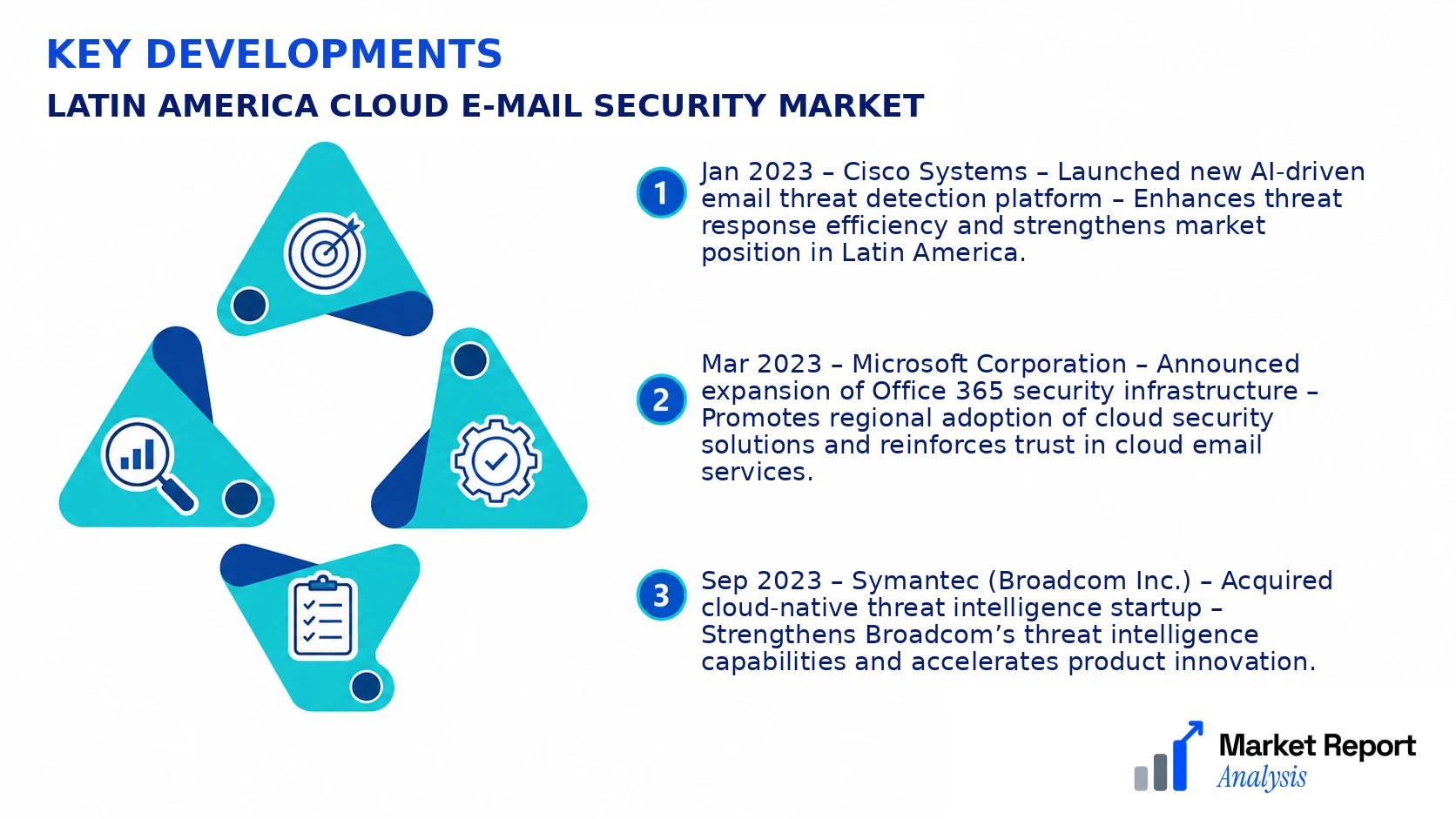
- Jan 2023 – Cisco Systems – Launched new AI-driven email threat detection platform – Enhances threat response efficiency and strengthens market position in Latin America.
- Mar 2023 – Microsoft Corporation – Announced expansion of Office 365 security infrastructure – Promotes regional adoption of cloud security solutions and reinforces trust in cloud email services.
- Sep 2023 – Symantec (Broadcom Inc.) – Acquired cloud-native threat intelligence startup – Strengthens Broadcom’s threat intelligence capabilities and accelerates product innovation.
- Nov 2023 – Proofpoint, Inc. – Introduced targeted attack prevention suite – Elevates customer protection levels and boosts competitive differentiation in the Latin American region.
- Feb 2024 – Palo Alto Networks – Established regional R&D center – Focuses on localized threat detection innovations and enhances customer support for cloud email security products.
Frequently Asked Questions
What is the Latin America Cloud E-mail Security Market?
The Latin America Cloud E-mail Security Market encompasses cloud-based solutions designed to protect organizations' email communications from threats such as spam, phishing, malware, and data breaches, enabling secure and reliable email exchange across the region.
What is the current market size of Latin America Cloud E-mail Security Market?
As of 2026, the Latin America Cloud E-mail Security Market is valued at approximately USD 1.2 Billion, reflecting increasing adoption driven by digital transformation initiatives and the rising threat landscape within regional enterprises and government agencies.
What factors are driving the Latin America Cloud E-mail Security Market?
Key drivers include the escalating frequency of cyberattacks, stringent data protection regulations, the widespread shift to cloud-based solutions, and growing awareness about email security importance, compelling organizations to invest in advanced cloud email security services.
Which region dominates the Latin America Cloud E-mail Security Market?
Brazil is the dominant region within Latin America for cloud e-mail security, owing to its large enterprise base, digital infrastructure development, and heightened cybersecurity investments, which contribute substantially to regional market growth.
Which segment is expected to grow the fastest?
The SME (Small and Medium Enterprises) segment is projected to experience the fastest growth due to increasing cloud adoption, affordability of security solutions, and heightened vulnerability to email-based cyber threats among smaller organizations in LATAM.
Who are the leading companies operating in the Latin America Cloud E-mail Security Market?
Key players include Symantec, Cisco, Barracuda Networks, Microsoft, and Proofpoint, who are actively expanding their regional presence through strategic partnerships, innovations, and localized service offerings to capitalize on regional growth opportunities in cloud email security.
Analyst Perspective
The Latin America Cloud E-mail Security Market is expected to mature steadily over the forecast period, with continuous innovations enhancing security capabilities and integration functionalities. Long-term prospects remain robust, driven by increasing cyber threats and digital transformation initiatives across enterprises and government sectors. Strategic growth opportunities are concentrated in small to medium enterprises (SMEs) seeking scalable, cost-effective security solutions, as well as in sectors like finance and healthcare that handle sensitive data. Advances in AI and machine learning will likely refine threat detection and automate responses, further boosting the market’s technological evolution. Investment priorities should emphasize building resilient infrastructure, fostering regional partnerships, and enhancing cloud compatibility. Despite moderate competitive intensity, key players will pursue strategic alliances and differentiation through advanced features. Regional growth potential remains significant in Brazil and Mexico, owing to expanding digital adoption and regulatory frameworks favoring cybersecurity, supporting sustained market expansion.
