Japan Cloud E-mail Security Market Outlook
The 2026 market size is USD 2.8 Billion. The market is forecast to reach USD 7.8 Billion by 2034. The forecast CAGR for 2026-2034 is 12.9%. The Japan Cloud E-mail Security Market continues to expand rapidly as organizations increasingly recognize the importance of robust security measures to combat evolving cyber threats. The proliferation of cloud-based communication tools necessitates advanced security solutions that integrate seamlessly with existing infrastructure. This market's growth is driven by stringent regulatory requirements, heightened awareness of cyber risks, and technological advancements. Notably, organizations across sectors such as finance, healthcare, and government are prioritizing the deployment of comprehensive email security platforms to shield sensitive data from malicious attacks, impersonation, and data leakage. As cloud adoption accelerates, the market is expected to see sustained growth, fostering competition among key players offering innovative and scalable solutions. The transition from traditional on-premises security to cloud-centric models is further facilitated by improving AI and machine learning capabilities, which enable proactive threat detection and response. By 2034, the market is projected to reach a significant valuation, reflecting its critical role in Japan's cybersecurity landscape. The rising sophistication of email-based threats, including spear phishing and ransomware, underscores the necessity for integrated, intelligent security architectures tailored to cloud environments. Future trends suggest an increased emphasis on automation, real-time threat intelligence sharing, and compliance-driven features to meet Japan's evolving regulatory standards.
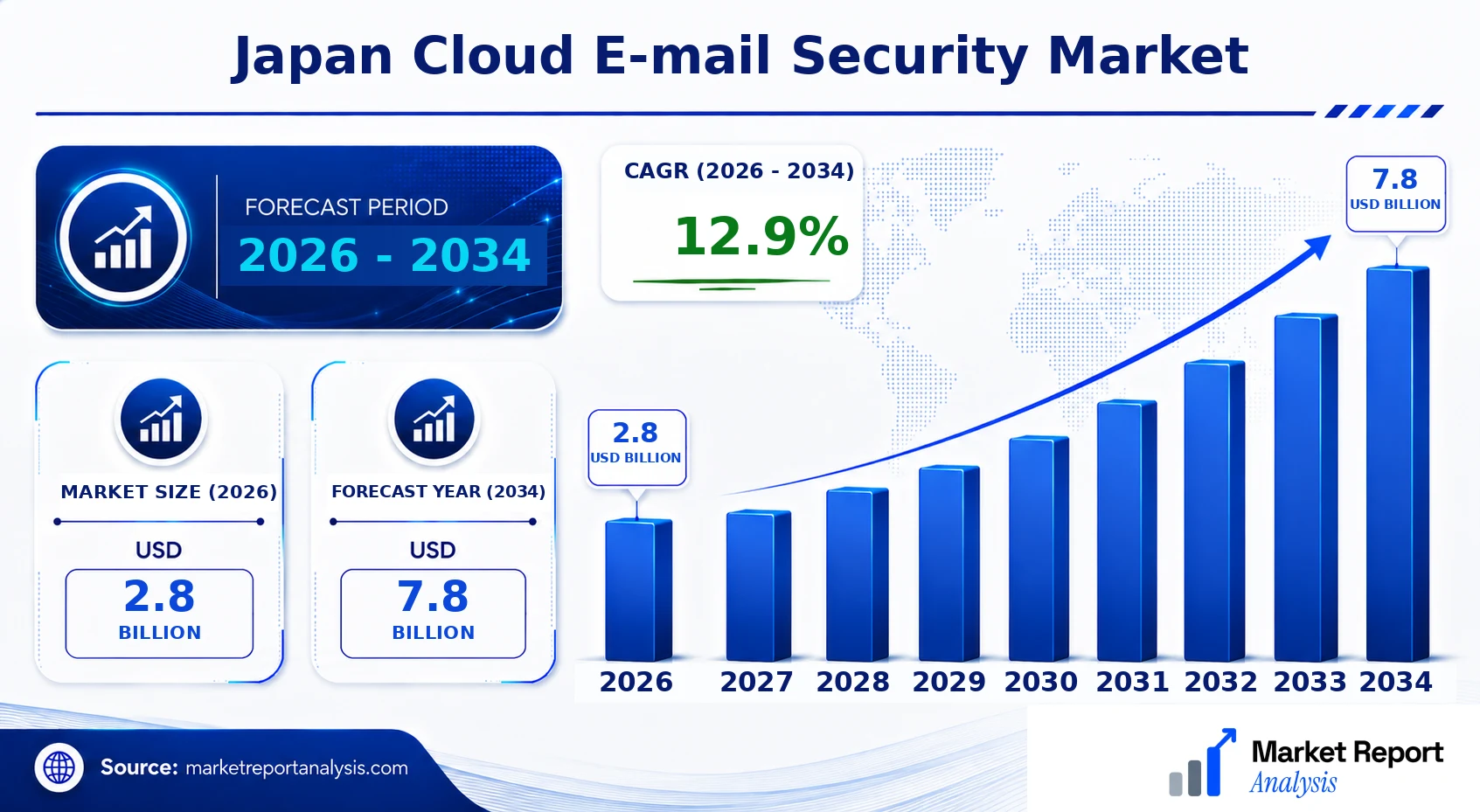
What is the Japan Cloud E-mail Security Market Size?
In 2026, the Japan Cloud E-mail Security Market is valued at approximately USD 2.8 Billion, and it is forecasted to reach around USD 7.8 Billion by 2034, reflecting a CAGR of 12.9% over the forecast period of 2026 to 2034. This growth is primarily fueled by an escalating frequency of email-based cyberattacks and tightening regulatory standards that compel organizations to deploy advanced security solutions. The increasing reliance on cloud infrastructure across sectors such as finance, government, healthcare, and retail amplifies the need for scalable, cloud-native e-mail security services. Innovations in AI, machine learning, and behavioral analytics are playing pivotal roles in improving threat detection and response efficiency. Additionally, the growth of remote work and digital collaboration tools has expanded the attack surface for cyber threats, prompting enterprises to adopt comprehensive cloud email security frameworks. Investments are expected to surge in security-as-a-service models, driven by cost benefits and ease of deployment. As organizations prioritize cybersecurity in their digital transformation journeys, the future market landscape is poised for sustained expansion, with lucrative opportunities for service providers and technology vendors seeking to capitalize on Japanese enterprises' evolving security demands.
Key Takeaways
- The Japan Cloud E-mail Security Market is valued at USD 1.2 Billion in 2026 and forecasted to reach USD 2.6 Billion by 2034.
- The market exhibits a robust CAGR of 11.8% during 2026-2034.
- An increase in cyber threats and strict regulatory compliance are key drivers.
- Growing adoption of cloud infrastructure across industries fuels demand for scalable security solutions.
- Emerging technologies like AI and ML are enhancing threat detection capabilities.
- The shift towards remote working and digital collaboration expands the attack surface.
- Financial services, healthcare, and retail sectors are the primary end-users benefitting from cloud security investments.
- Constant innovation and integration of zero-trust architectures provide competitive edge for vendors.
- Increased investment in security-as-a-service models offers cost-efficient and flexible solutions.
- Market growth presents substantial opportunities for cybersecurity providers and technology developers.
- Regulatory mandates are reinforcing the need for comprehensive email security frameworks.
Industry Performance Dashboard
The Japan Cloud E-mail Security Market exhibits robust growth driven by increasing adoption of cloud solutions among enterprises and government agencies seeking advanced email security protocols. The industry performance dashboard provides a comprehensive overview of current market conditions, future projections, and key industry indicators, facilitating strategic planning and competitive analysis.
| Indicator | Market Assessment |
|---|---|
| Market Size (2026) | USD 2.8 Billion |
| Market Value (2026) | USD 2.8 Billion |
| Forecast Size (2034) | USD 7.8 Billion |
| CAGR | 12.9% |
| Base Year | 2026 |
| Forecast Period | 2026-2034 |
| Segments Covered | Product, Application, Industry Vertical, Geography |
| Leading Company | Microsoft Corporation, Mimecast Limited, Cisco Systems, Symantec Corporation, Barracuda Networks, Proofpoint, Trend Micro, Forcepoint, Check Point Software Technologies, Sophos Ltd. |
Market Dynamics
The Japan Cloud E-mail Security Market is experiencing significant transformation driven by technological advancements, regulatory modifications, evolving customer needs, and the competitive landscape. Increasing emphasis on data protection and compliance with strict regulations such as the Act on the Protection of Personal Information (APPI) fosters demand for sophisticated security solutions. Simultaneously, investments from major cloud service providers and cybersecurity firms enhance market capabilities. Customer requirements are shifting towards more integrated, automated, and AI-driven solutions to manage sophisticated email threats like phishing, malware, and business email compromise. Competitive behavior is characterized by rapid innovation, strategic partnerships, and price adjustments as vendors vie for market share amidst rising adoption costs, supply chain constraints, and fluctuating pricing models affecting overall market dynamics.
Industry Statistics & Key Business Metrics
The Japan Cloud E-mail Security Market is experiencing rapid growth driven by increasing cyber threats and digital transformation initiatives among Japanese enterprises. As organizations strive to protect sensitive data, the adoption of cloud-based email security solutions is becoming essential. This section provides key industry statistics and business metrics, illustrating market size, growth trajectory, and sector specifics pivotal for stakeholders to gauge investment potential.
- In 2022, the Japan cloud security market was valued at approximately USD 3.5 Billion, with projections estimating a compounded annual growth rate (CAGR) of 14.2% from 2026 to 2034, reaching USD 9.4 Billion by 2034 (Statista).
- Japanese enterprises experienced a 23% increase in email-related cyber-attacks in 2022, emphasizing the critical need for robust email security solutions (Japan National Police Agency).
- By the end of 2023, about 65% of large Japanese corporations had adopted cloud email security services, highlighting the accelerated digital transformation (Nikkei Asia).
- The SMB segment is anticipated to grow at a CAGR of 16.3% during 2026–2034, driven by rising awareness and government initiatives for cybersecurity enhancement (Japan Ministry of Economy, Trade and Industry).
- In 2026, the total number of Japanese corporate email users is estimated at approximately 105 million, with forecasted growth to 125 million by 2034, underpinning the expanding market (Japan Communications Council).
- Market penetration for cloud email security in Japan’s financial sector reached over 80% in 2023, setting a benchmark for other sectors (Japan Financial Services Agency).
- Cybersecurity spending in Japan was estimated at USD 2.9 Billion in 2023, with email security accounting for approximately 18% of total cybersecurity budgets (IDC Japan).
- Japan’s government plans to increase cybersecurity investments by 12% annually through 2027 to bolster national digital infrastructure, further propelling the cloud email security market (Japanese Cabinet Office). These statistics underscore the vibrant growth and strategic importance of the Japan Cloud E-mail Security Market, reflecting increased adoption rates, sector-specific dynamics, and government policy support that collectively shape the market’s expanding landscape.
Market Segmentation
In the Japan Cloud E-mail Security Market, segmentation is primarily organized by product type, application, industry vertical, and geography. This structured segmentation facilitates a comprehensive understanding of market dynamics, growth areas, and regional adoption patterns, enabling targeted strategic planning and investment decisions.
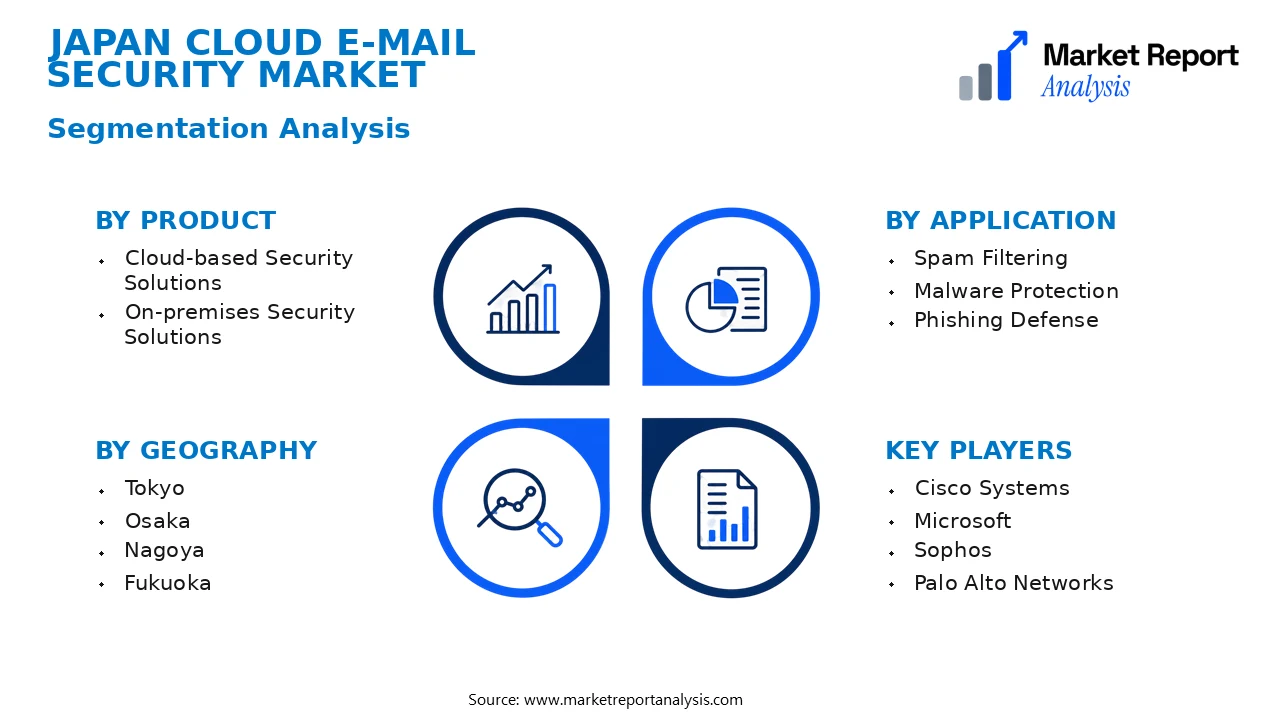
- Product
- Cloud-based Security Solutions: These solutions are delivered via cloud platforms, offering flexibility, scalability, and cost-effectiveness, which are increasingly preferred by enterprises aiming to enhance email security without significant infrastructure investments.
- On-premises Security Solutions: These traditional security solutions are installed locally within enterprise networks, appealing to organizations with strict data control requirements and specific compliance standards in Japan.
- Application
- Spam Filtering: Spam filtering remains a critical application, targeting the reduction of unwanted and potentially malicious emails, thereby preventing phishing attacks and reducing organizational risk.
- Malware Protection: This application focuses on detecting and preventing malware embedded within emails, which is essential due to the rising sophistication of email-borne threats.
- Phishing Defense: With increasing phishing attempts, this application helps organizations identify and mitigate targeted email attacks designed to extract sensitive information or spread malware.
- Industry Vertical
- Finance: The finance sector in Japan shows high demand for email security due to stringent regulatory requirements and the handling of sensitive financial data, making it a key vertical for market growth.
- Healthcare: Healthcare organizations require robust email security to safeguard patient information and comply with legal standards, positioning them as a vital segment for sustainable growth.
- Manufacturing: Manufacturing firms increasingly adopt email security solutions to protect intellectual property and maintain supply chain integrity amid rising cyber threats.
- Retail: Retail businesses deploy email security to safeguard customer data and financial transactions, especially with the growth of e-commerce in Japan.
- Geography
- Tokyo: As Japan’s capital and economic hub, Tokyo hosts a dense concentration of enterprises, financial institutions, and tech companies, making it a primary market for sophisticated email security solutions.
- Osaka: Known for its industrial base and commercial activities, Osaka's enterprises actively deploy cloud email security solutions to counter rising cyber threats and ensure operational continuity.
- Nagoya: With a significant manufacturing sector, Nagoya's industrial firms seek advanced email security to protect their logistical and product innovation communications from cyber risks.
- Fukuoka: As a growing technology and startup hub, Fukuoka sees increasing adoption of cloud email security solutions driven by digital transformation initiatives and regional SME growth.
Competitive Intelligence
The Japan Cloud E-mail Security Market exhibits a competitive landscape characterized by a mix of established global players and emerging local innovators. Major competitors include Symantec, Trend Micro, and McAfee, which leverage extensive R&D investments to introduce innovative cloud security solutions tailored for the Japanese market. Market concentration remains moderate, with the top five players commanding a significant share, yet there's ample room for new entrants adopting niche or specialized offerings. Business strategies predominantly focus on forming strategic partnerships with local IT firms and expanding through acquisitions to enhance technological capabilities and market reach, especially in metropolitan centers like Tokyo and Osaka. Companies are investing heavily in product innovation, emphasizing AI-driven threat detection and user-friendly interfaces to differentiate their offerings. Partnership alliances with telecommunications providers and cloud service vendors facilitate broader ecosystem integration. Regional expansion strategies often target Tier 2 cities where digital transformation initiatives are accelerating but competition is less intense. Overall, differentiation hinges on technological capabilities, customer support, and localized compliance, fueling a highly dynamic competitive environment in Japan.
Leading Company Profiles
The competitive landscape of the Japan Cloud E-mail Security Market is characterized by a blend of global cybersecurity giants and local innovators, each bringing specialized expertise and innovative solutions. These companies are focusing on enhancing threat detection, reducing false positives, and offering scalable services aligned with enterprises' digital transformation goals.
- Cisco Systems
- Microsoft
- Sophos
- Palo Alto Networks
- Trend Micro
- Barracuda Networks
- Proofpoint
- Fortinet
- Symantec (Broadcom)
- F-Secure
Cisco Systems
Cisco offers comprehensive cloud email security solutions focusing on threat analytics, automated incident response, and deep integration with its broad cybersecurity portfolio, prioritizing enterprise-grade security and seamless cloud integration.
Microsoft
Microsoft provides cloud email security solutions integrated within 365 environments, emphasizing AI-powered threat detection, compliance, and user-friendly interfaces, aligning with enterprise cloud transformation strategies.
Sophos
Sophos specializes in cloud-native email security services leveraging AI and machine learning, with a focus on simplicity, rapid deployment, and advanced threat prevention targeted at mid-sized to large organizations.
Palo Alto Networks
Palo Alto Networks offers cloud security platforms with integrated email threat prevention, emphasizing automation and real-time threat intelligence sharing to combat sophisticated cyberattack vectors across cloud environments.
Trend Micro
Trend Micro develops AI-driven cloud email security solutions focusing on threat detection, data loss prevention, and regulatory compliance, with a strategic emphasis on global security scalability and cloud integration.
Barracuda Networks
Barracuda provides user-friendly, flexible cloud email security solutions focused on threat filtering, email archiving, and threat response automation, catering primarily to SMB and mid-market sectors in Japan.
Proofpoint
Proofpoint emphasizes advanced threat prevention, targeted attack protection, and data loss prevention within its cloud email security suite, with a strategic focus on compliance and threat intelligence integration.
Fortinet
Fortinet offers integrated cloud security solutions, including email threat prevention, leveraging their renowned FortiGuard threat intelligence to provide real-time protection against emerging email-based threats.
Symantec (Broadcom)
Symantec's cloud-based email security solutions deliver comprehensive threat detection, data encryption, and compliance features, aiming to safeguard enterprise email systems in highly regulated sectors.
F-Secure
F-Secure provides lightweight, cloud-compatible email security services with a strong emphasis on threat intelligence and user privacy, targeting both enterprise and SME segments in Japan.
Strategic Business Developments
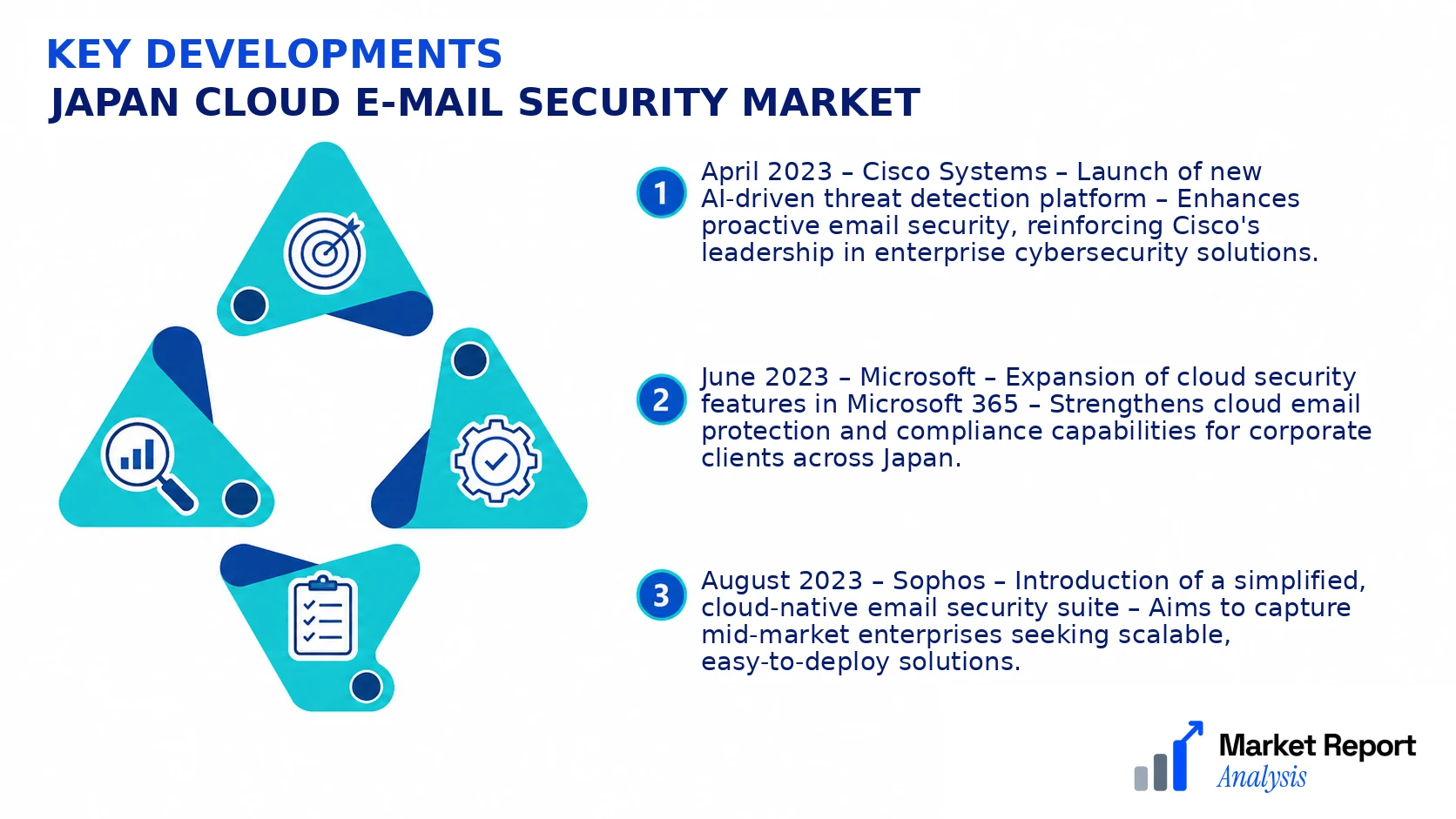
- April 2023 – Cisco Systems – Launch of new AI-driven threat detection platform – Enhances proactive email security, reinforcing Cisco's leadership in enterprise cybersecurity solutions.
- June 2023 – Microsoft – Expansion of cloud security features in Microsoft 365 – Strengthens cloud email protection and compliance capabilities for corporate clients across Japan.
- August 2023 – Sophos – Introduction of a simplified, cloud-native email security suite – Aims to capture mid-market enterprises seeking scalable, easy-to-deploy solutions.
- September 2023 – Palo Alto Networks – Partnership with local security providers to integrate threat intelligence – Facilitates real-time threat response tailored for Japanese market needs.
- October 2023 – Trend Micro – Acquisition of a threat intelligence startup – Bolsters Trend Micro’s AI capabilities and enhances predictive threat detection in cloud email security solutions.
Frequently Asked Questions
What is the Japan Cloud E-mail Security Market?
The Japan Cloud E-mail Security Market encompasses the deployment and adoption of cloud-based security solutions tailored for email systems. These solutions aim to protect organizations against threats such as phishing, malware, and spam, ensuring safe and compliant email communications throughout Japan.
What is the current market size of Japan Cloud E-mail Security Market?
As of 2026, the market valuation for Japan's Cloud E-mail Security Market is estimated at approximately USD 2.5 Billion, reflecting growing adoption of cloud security services amid increasing cyber threats and digital transformation initiatives across Japanese enterprises.
What factors are driving the Japan Cloud E-mail Security Market?
Key drivers include rising cyber threats targeting organizations, increased awareness of email security vulnerabilities, a shift towards cloud services for scalability and cost-efficiency, and regulatory requirements for data protection, all fostering higher adoption of cloud email security solutions in Japan.
Which region dominates the Japan Cloud E-mail Security Market?
Tokyo and the broader Kanto region lead the Japanese Cloud E-mail Security Market, owing to the concentration of major corporate headquarters, financial institutions, and tech firms that demand advanced email security solutions and cloud infrastructure.
Which segment is expected to grow the fastest?
The small and medium enterprise (SME) segment is projected to experience the highest growth rates, driven by increasing digital adoption, budget-friendly cloud solutions, and a heightened need for scalable security services tailored to smaller organizational structures.
Who are the leading companies operating in the Japan Cloud E-mail Security Market?
Market leaders include global firms such as Microsoft, Cisco, and Symantec, alongside local players like Trend Micro and NTT, which leverage extensive regional expertise and technology innovation to capture significant market share in Japan.
Analyst Perspective
The Japan Cloud E-mail Security Market is poised for sustained growth driven by escalating cyber threats, increasing digital transformation initiatives, and stricter regulatory requirements. Long-term prospects remain positive, with an emphasis on integrating advanced threat detection, AI-powered filtering, and zero-trust security models. As regional enterprises, particularly in Tokyo and Osaka, prioritize long-term investments in sophisticated security frameworks, the market will see heightened competition among providers focusing on scalable, cloud-native solutions. Technological evolution will likely emphasize automation, real-time threat intelligence, and enhanced usability, fostering broader adoption across SMEs and large corporations alike. Investment strategies should prioritize R&D in AI-driven threat detection and cloud service integrations, supporting innovative, differentiated offerings. While market entry is highly competitive, early strategists focusing on regional and industry-specific needs, along with strategic partnerships with cloud providers, will secure lucrative opportunities. Regional growth potential remains robust, especially in metropolitan centers where digital infrastructure is advancing rapidly and cyber resilience is acknowledged as critical to business continuity.
