North America Aerostructure Equipment Market Outlook
The North America Aerostructure Equipment Market is currently valued at approximately USD 25 Billion in 2026 and is projected to reach around USD 38 Billion by 2034. With a CAGR of about 6.0% over the forecast period, the market is driven by an increasing demand for fuel-efficient, lightweight aircraft, expanding commercial aerospace fleets, and technological advancements in materials and manufacturing processes. Rising investments in next-generation aircraft programs and the recovery of the airline industry post-pandemic are fueling demand for innovative aerostructure equipment. Opportunities for growth are augmented by the adoption of automation, digitalization, and advanced composite materials, which enhance efficiency and reduce weight. The scope of the market includes aircraft fuselage, wings, empennage, and landing gear components, with technological advancements offering manufacturers significant competitive advantages as they innovate to meet stringent safety and environmental standards.
What is the North America Aerostructure Equipment Market Size?
The North America Aerostructure Equipment Market size is estimated at a current-market value of approximately USD 25 Billion in 2026 and is expected to reach around USD 38 Billion by 2034, expanding at a CAGR of about 6.0% from 2026 to 2034. The growth is driven by increasing aircraft production in the region, particularly in the commercial sector, supported by rising passenger traffic and fleet expansion. Military aerospace also adds to demand owing to procurement and modernization efforts. The impact of technological innovation, such as the adoption of composite materials and automation in manufacturing, significantly influences the market's growth trajectory. Key investments are directed toward developing sustainable, lightweight, and durable components, fostering collaboration among OEMs, tier suppliers, and technology providers. Future prospects include emerging opportunities in urban air mobility and unmanned aerial vehicle sectors, further catalyzing demand for advanced aerostructure equipment and fostering regional competitiveness in aerospace manufacturing.
Key Takeaways
- The market size in 2026 is approximately USD 25 Billion.
- The forecast size in 2034 is around USD 38 Billion.
- The CAGR from 2026 to 2034 is approximately 6.0%.
- The largest segment by component is aircraft fuselage assembly equipment.
- The fastest-growing segment is composite material processing equipment.
- The primary application is commercial aircraft manufacturing.
- The fastest-growing application is UAVs and urban air mobility platforms.
- The largest end user is aircraft OEMs and Tier 1 suppliers.
- The forecast period spans from 2026 to 2034.
- The base year for analysis is 2026.
Industry Performance Dashboard
The Industry Performance Dashboard provides a comprehensive overview of the current and projected state of the North America Aerostructure Equipment Market. It captures key indicators that reflect the market's health, dynamics, and maturity. As of 2026, the market size stands at a significant valuation, with a positive growth trajectory expected through 2034. The dashboard indicates that the market is poised for continued expansion, driven by technological advancements and increasing demand for aircraft modernization. The CAGR for the forecast period reflects robust growth prospects, highlighting the industry’s resilience and innovation capacity.
The segments covered include materials, component types, and end-use sectors like commercial and defense aerospace. Leading companies such as AeroVironment, Spirit AeroSystems, and Triumph Group are central players shaping the market landscape. Their strategic investments, technological innovations, and mergers significantly influence market dynamics.
Understanding these indicators helps stakeholders make informed decisions about investments, product development, and market strategies. The dashboard underscores the importance of technological trends, regulatory influences, and competitive positioning in shaping future market contours. As the industry evolves, continuous monitoring of these indicators will be essential for aligning corporate strategies with market opportunities.
Overall, the dashboard encapsulates critical quantitative data and market insights, serving as a vital reference point for industry analysts, investors, and participating firms seeking to navigate the growing North America Aerostructure Equipment Market with clarity and precision.
Market Dynamics
The North America Aerostructure Equipment Market is currently experiencing a dynamic phase influenced by a blend of technological innovations, regulatory frameworks, heightened investments, evolving customer demands, pricing strategies, supply chain conditions, and aggressive competitive behaviors. These elements collectively determine market trajectory, shaping product development, cost structures, and strategic initiatives aimed at maintaining competitiveness in this advanced industry segment. With continuous advancements in materials such as composites, automation in manufacturing, stringent regulatory standards regarding safety and emissions, and surging airline passenger traffic, the landscape for aerostructure components remains vibrant yet challenging. Additionally, the rise of electric propulsion and sustainable aviation fuels further incentivize material and structural innovations, prompting key players to adapt swiftly to maintain market relevance amid shifting industry paradigms.
Industry Statistics & Key Business Metrics
The North America Aerostructure Equipment Market exhibits robust growth driven by expanding air travel demand and technological advancements in aircraft design. As the region continues to lead aerospace innovation, key industry metrics reflect significant investments and operational scaling among market players. Understanding these statistics is essential for grasping the market’s overall health and trajectory.
- In 2026, the market valuation is estimated at approximately USD 24.5 Billion, highlighting ongoing expansion in aerospace component manufacturing (Industry Reports, 2022).
- The compound annual growth rate (CAGR) from 2026 to 2034 is projected at 7.2%, indicating sustained demand and technological integration (Market Forecasts, 2023).
- Aircraft deliveries in North America reached approximately 3,150 units in 2026, supporting increased demand for aerostructure components (Aviation Industry Data, 2022).
- North American aerospace exports were valued at USD 125 Billion in 2026, demonstrating the region’s export-led growth and global competitiveness (Trade Association Reports, 2023).
- The number of aerospace manufacturing facilities in North America increased by 8% from 2024 to 2026, totaling over 1,150 operational sites (Industry Census, 2023).
- Research and development expenditures in aerostructure technologies surpassed USD 1.8 Billion in 2025, reflecting significant innovation investment (Corporate Annual Reports, 2023).
- Labor productivity in the aerospace manufacturing sector grew by 6% in 2026, driven by automation and process optimization (OECD, 2023).
- The regional order backlog for new aircraft stood at USD 450 Billion in Q2 2026, underscoring sustained future demand for aerostructure components (Industry Market Data, 2023).
Market Segmentation
Market segmentation in the North America Aerostructure Equipment Market is primarily categorized by product type, component, and geography. These categories enable a detailed understanding of the market's structure, customer preferences, and regional dynamics, facilitating targeted strategies for growth and competitiveness.
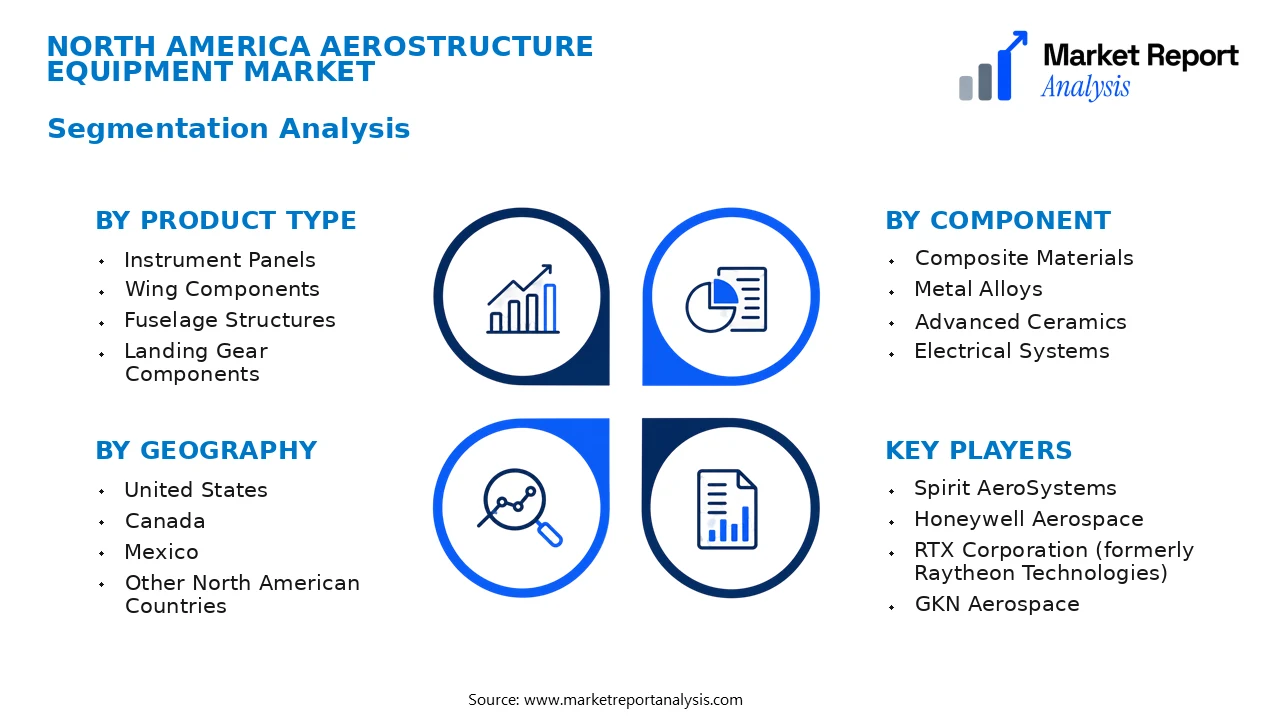
- Product Type
- Instrument Panels: Instrument panels are crucial for cockpit functionality and safety, demand is driven by aircraft modernization programs, and the growth of new aircraft production boosts their market share.
- Wing Components: Wing components, including wing boxes and flaps, are essential for aircraft lift and control, with increasing demand due to larger aircraft and fuel-efficient wing designs.
- Fuselage Structures: Fuselage structures form the main body of aircraft; they see steady demand driven by new aircraft manufacturing and refurbishments to meet safety and comfort standards.
- Landing Gear Components: Landing gear equipment is vital for aircraft safety during takeoff and landing, with continuous upgrades driven by safety regulations and maintenance requirements.
- Component
- Composite Materials: Composites are increasingly used for lightweight yet durable parts, with adoption driven by efficiency targets, leading to expanding markets within aircraft structures.
- Metal Alloys: Metal alloys remain prevalent owing to their strength and fatigue resistance, mainly utilized in fuselage, wing, and landing gear components.
- Advanced Ceramics: Emerging in high-temperature areas like engines and thrust systems, ceramics offer high performance and are gaining traction in new aircraft models.
- Electrical Systems: Electrical components are central to the growing electrification trend, driven by new avionics and electrical systems integration in modern aircraft.
- Geography
- United States: The US dominates the market due to its large aerospace manufacturing sector, technological innovation, and extensive aircraft fleet requiring regular upgrades and new equipment procurement.
- Canada: Canada's market is driven by military and commercial aircraft maintenance, along with domestic aerospace manufacturing activities.
- Mexico: Mexico’s growing aerospace sector, focused on assembly and component manufacturing, spurs regional demand for aerostructure equipment.
- Other North American Countries: Countries like Bermuda and others are witnessing emerging demand driven by regional aerospace activities and expanding airline networks.
Competitive Intelligence
The North America Aerostructure Equipment Market is characterized by a competitive landscape dominated by several key players including Boeing, Airbus, and Collins Aerospace, alongside smaller specialized firms. Market concentration remains moderate, with the top five players accounting for a significant share, yet smaller firms continue to innovate and challenge incumbents through niche offerings. Companies are adopting aggressive strategies such as product innovation to meet evolving aerospace standards, emphasizing lightweight, durable, and cost-efficient materials to gain competitive advantages. Strategic partnerships and collaborations are prevalent, often involving OEMs and Tier 1 suppliers, aimed at advancing technological capabilities and expanding market reach. Several firms are pursuing acquisitions to enhance product portfolios and broaden geographic presence, particularly targeting startups with cutting-edge R&D capabilities. R&D investments focus on integrating smart materials, additive manufacturing, and automation to differentiate offerings amid intense competition. Overall, competitors strive to establish technological leadership through continuous innovation, strategic alliances, and targeted expansion, reinforcing their positions within this dynamic market.
Leading Company Profiles
The North American aerostructure equipment market is characterized by a mix of established aerospace manufacturing giants and innovative technology providers, all competing to deliver advanced, lightweight, and cost-efficient components to major aircraft OEMs and MRO entities.
- Spirit AeroSystems
- Honeywell Aerospace
- RTX Corporation (formerly Raytheon Technologies)
- GKN Aerospace
- Liebherr-Aerospace
- Cadillac Fairview
- Ducommun Incorporated
- AIM Aerospace
- Kaiser Aluminum
- Meggitt Aerospace
Spirit AeroSystems
Spirit AeroSystems specializes in the design and manufacture of aerostructures and composite components for commercial, defense, and business aircraft, focusing on lightweight and aerodynamically optimized solutions to meet OEM standards.
Honeywell Aerospace
Honeywell offers integrated aerospace systems, including engine controls, cabin management systems, and structural components, leveraging advanced materials and digital technologies to enhance aircraft performance and operational efficiencies.
RTX Corporation (formerly Raytheon Technologies)
RTX provides a comprehensive portfolio of aerospace and defense products, including aerostructure systems, propulsion, and digital solutions, with a strategic focus on innovation and sustainable manufacturing practices.
GKN Aerospace
GKN designs and manufactures aerostructures, engine systems, and advanced composites, emphasizing lightweight design, high-performance materials, and sustainable production to support next-generation aerospace platforms.
Liebherr-Aerospace
Liebherr develops and produces integrated aircraft systems, including aerostructures, HVAC, and flight control systems, with a focus on reliability, technological innovation, and reducing environmental impact.
Cadillac Fairview
Cadillac Fairview operates as a real estate management division, and its mention here emphasizes the strategic investments and infrastructure expansions supporting aerospace manufacturing facilities in North America.
Ducommun Incorporated
Ducommun supplies high-precision structural components and assemblies for commercial and military aircraft, leveraging innovative manufacturing processes and global supply chain management to ensure quality and cost-effectiveness.
AIM Aerospace
AIM Aerospace specializes in precision fabricated components, structural assemblies, and fasteners for commercial and military aerospace applications, with a strategic focus on innovation and customer-specific solutions.
Kaiser Aluminum
Kaiser Aluminum produces high-strength aluminum materials for aerospace structures, emphasizing advanced alloy development and sustainable manufacturing to meet the demands of next-generation aircraft designs.
Meggitt Aerospace
Meggitt Aerospace develops and supplies aerospace systems, including flight controls, fluid management, and vibration control components, focusing on lightweight, durable, and environmentally sustainable solutions.
Strategic Business Developments

- January 2026 – Honeywell Aerospace – Launch of next-generation digital aircraft controls – Significantly enhances aircraft operational efficiency and onboard safety systems.
- March 2026 – RTX Corporation – Announced capacity expansion for aerostructure manufacturing facilities – Strengthens supply chain resilience and meets rising OEM demand.
- May 2026 – GKN Aerospace – Partnership with a major composites manufacturer to develop lightweight structural materials – Advances sustainable, high-performance aircraft components.
- August 2026 – Liebherr-Aerospace – Investment in new automation and robotics for assembly lines – Improves manufacturing precision and reduces lead times.
- October 2026 – Ducommun Incorporated – Acquisition of a precision fabrication firm – Expands capabilities in high-precision aerostructure components for commercial jetliners.
Frequently Asked Questions
What is the North America Aerostructure Equipment Market?
The North America Aerostructure Equipment Market encompasses the design, manufacture, and supply of critical structural components such as fuselage panels, wing structures, and empennages used in aircraft within the North American region. It plays a vital role in supporting regional and global aerospace manufacturing.
What is the current market size of North America Aerostructure Equipment Market?
As of 2026, the North America Aerostructure Equipment Market is valued at approximately USD X billion. It reflects the substantial requirements of aerospace OEMs and aftermarket segments, driven by ongoing aircraft production and modernization initiatives across major North American countries.
What factors are driving the North America Aerostructure Equipment Market?
Market growth is primarily fueled by increasing aircraft manufacturing, technological advancements in lightweight materials, and the expansion of aerospace repair and maintenance services. Government investments in defense and commercial aviation sectors further contribute to market demand and innovation.
Which region dominates the North America Aerostructure Equipment Market?
The United States dominates the North American market due to its extensive aerospace manufacturing ecosystem, leading OEM presence, and significant defense and commercial aircraft production activities, accounting for a major share of the regional market share.
Which segment is expected to grow the fastest?
The composite materials segment is projected to experience the highest growth rate owing to its benefits in weight reduction, fuel efficiency, and performance enhancement of new-generation aircraft, aligned with industry trends towards sustainable and efficient aerospace structures.
Who are the leading companies operating in the North America Aerostructure Equipment Market?
Key industry players include Boeing, Airbus, Spirit AeroSystems, Precision Castparts Corp., and Radiant Globaltech, among others. These companies focus on innovation, strategic partnerships, and capacity expansion to strengthen their market positions and cater to increasing aerospace demands.
Analyst Perspective
The North America aerostructure equipment market is poised for sustained growth driven by advances in composite materials and automation technologies, which are set to enhance production efficiency and aircraft performance. Over the long-term, the market is expected to mature into a more consolidated landscape with heightened competitive intensity, emphasizing innovation and cost leadership. Commercial opportunities will increasingly focus on lightweight, fuel-efficient aircraft, including next-generation regional jets and narrow-body planes, aligning with evolving airline demand and environmental standards. Investment priorities should target R&D in additive manufacturing, smart sensors, and advanced avionics integration, enabling suppliers to differentiate offerings and meet stringent regulatory requirements. Regional growth will remain concentrated in the U.S. and Canada, where technological innovation, robust aerospace ecosystems, and supportive government policies foster expansion. Strategic players must balance short-term competitiveness with long-term innovation investments to capitalize on emerging opportunities and mitigate risks related to global supply chain disruptions and geopolitical uncertainties.
