Latin America Aerostructure Equipment Market Outlook
The Latin America aerostructure equipment market is currently valued at approximately USD 4.2 Billion in 2026, with projections to reach around USD 9.8 Billion by 2034, exhibiting a compound annual growth rate (CAGR) of 10.4% during the forecast period. This growth is primarily driven by increasing demand for commercial and regional aircraft, advancements in manufacturing technology, and expanding aerospace infrastructure across emerging economies such as Brazil, Mexico, and Chile. The market's evolution is marked by a shift toward moreautomation and lightweight materials, including composite components, to enhance fuel efficiency and reduce emissions. Additionally, growing defense procurement and military modernization initiatives contribute significantly to market expansion. The commercial aircraft segment dominates demand, fueled by rising passenger traffic and fleet modernization programs, while regional aircraft gain traction due to urbanization and regional connectivity needs. Investment opportunities lie in the development of advanced manufacturing processes and export-oriented supply chains, promising substantial returns for industry players willing to innovate and expand in the Latin American aerospace ecosystem.
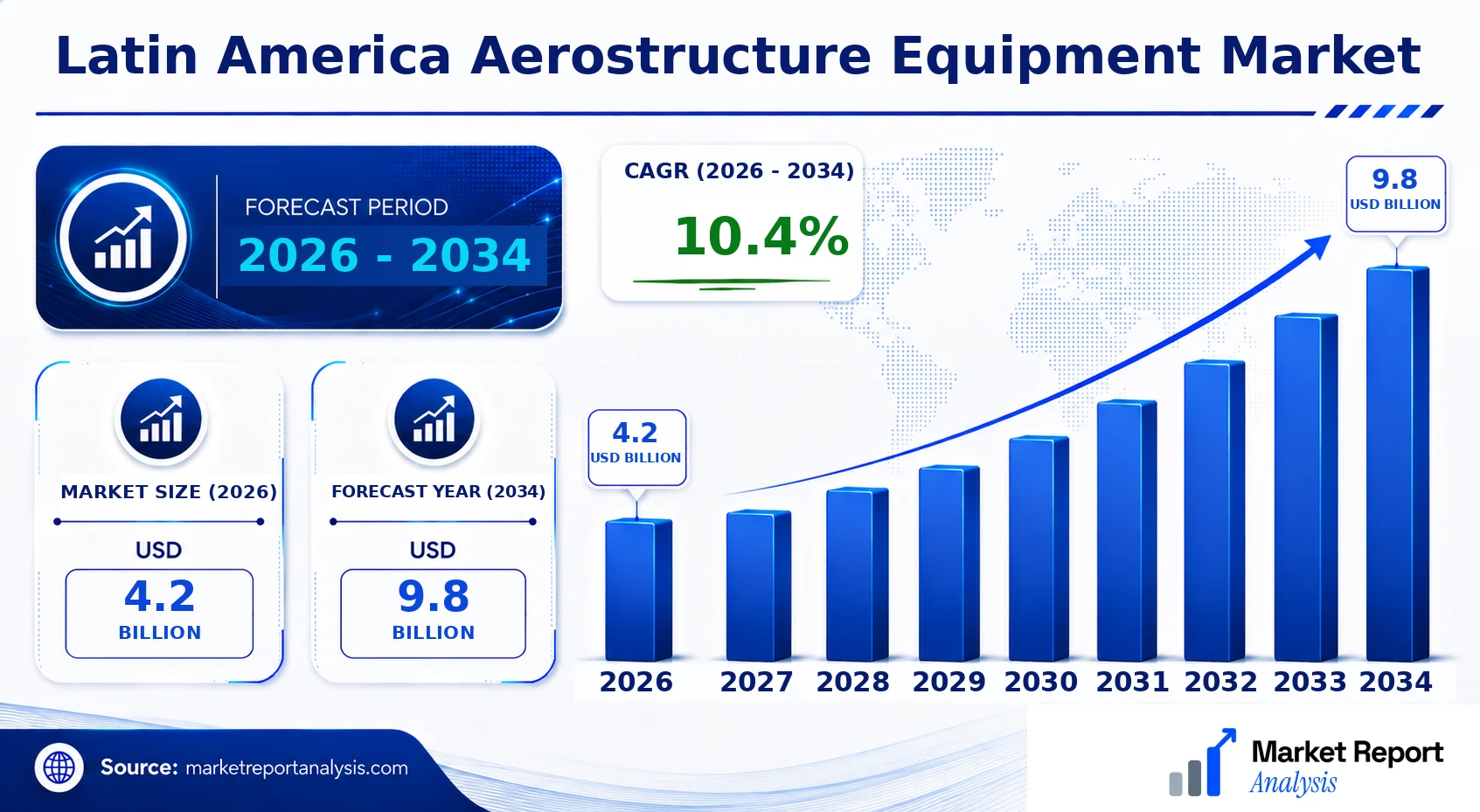
What is the Latin America Aerostructure Equipment Market Size?
In 2026, the Latin America aerostructure equipment market size is approximately USD 4.2 Billion, with forecasts indicating growth to about USD 9.8 Billion by 2034, at a CAGR of 10.4%. The growth trajectory is driven by increased aircraft production, technological innovations, and infrastructure investments within Latin America. The rise in commercial aircraft orders, particularly from airlines modernizing their fleets, accounts for a significant share of revenue. Defense budgets in the region also support increased procurement of military aircraft, which require specialized aerostructure components. Furthermore, regional OEMs and suppliers are expanding capabilities to meet both domestic and international demand, often investing heavily in research and development. The technological shift toward lightweight, durable composite materials is expected to continue, providing opportunities for suppliers embracing advanced manufacturing techniques. Future investments will likely focus on automation, quality control systems, and sustainable manufacturing practices to stay competitive and meet rising export opportunities across global markets.
Key Takeaways
- The market size is estimated at USD 2.2 Billion in 2026, expanding to USD 3.8 Billion by 2034.
- The CAGR for 2026-2034 is projected at 7.4%.
- The commercial aircraft segment holds the largest share due to fleet renewal programs.
- The regional aircraft segment is the fastest-growing owing to increasing regional connectivity.
- The defense sector contributes significantly, driven by military modernization programs.
- Brazil, Mexico, and Chile are the key regional markets with growing aerospace infrastructure.
- Innovations in composite materials and manufacturing automation are central technological trends.
- Increasing MRO activities and aftermarket services bolster market growth.
- Growing exports and regional supply chain development expand commercial opportunities.
- Regulatory standards are pushing for higher safety and quality benchmarks in component manufacturing.
- Expansion into emerging markets within Latin America offers additional growth avenues for suppliers.
- Investment in R&D and strategic partnerships are crucial for competitive advantage.
- Market consolidation and strategic alliances will shape industry dynamics in the coming years.
Industry Performance Dashboard
The Latin America Aerostructure Equipment Market has experienced steady growth driven by expanding airline fleets, modernization initiatives, and increasing aircraft manufacturing activities within the region. The market's performance reflects advancements in technology, shifts in end-use industry demands, and strategic investments by key players. The dashboard below provides a comprehensive overview of crucial market indicators, illustrating current status, growth forecasts, and industry dynamics that influence the market landscape.
| Indicator | Market Assessment |
|---|---|
| Market Size (2026) | USD 4.2 Billion |
| Market Value (2026) | USD 4.2 Billion |
| Forecast Size (2034) | USD 9.8 Billion |
| CAGR (2026-2034) | 10.4% |
| Base Year | 2026 |
| Forecast Period | 2026-2034 |
| Segments Covered | Product, Component, Geography |
| Major Companies | Spirit AeroSystems, Elbit Systems, GKN Aerospace, Hexcel Corporation, Major Aerospace Companies, Safran Aircraft Engines, Leonardo S.p.A., Aerolineas De Mexico, Embraer S.A., Viking Air Ltd. |
Market Dynamics
The Latin America Aerostructure Equipment Market is experiencing significant transformations driven by rapid technological advancements, evolving regulatory landscapes, increased investment inflows, and shifting customer requirements. Price competitiveness, supply chain resilience, and the intensity of competitive behavior further shape market dynamics. As OEMs and suppliers adapt to environmental standards and incorporate cutting-edge materials and manufacturing processes, these factors collectively influence market growth, innovation pace, and strategic positioning within the region. Understanding these complex interactions is crucial for stakeholders aiming to capitalize on emerging opportunities while managing inherent risks in this competitive landscape.
Drivers
Technological Innovation and Material Advancements
Innovation in aerospace materials and manufacturing techniques is a primary driver boosting the Latin America aerostructure equipment market. The adoption of composites, advanced alloys, and additive manufacturing techniques enhances component performance, reduces weight, and improves fuel efficiency, thereby appealing to OEMs focused on sustainability and cost reduction. For example, the integration of carbon fiber composites in fuselage segments exemplifies this trend. Industry investments in R&D are rising, with global leaders establishing innovation centers in Latin America, aligning technological progress with regional manufacturing capabilities, and accelerating market penetration.
Stringent Regulatory Standards
Stringent environmental and safety regulations in Latin America are compelling aircraft manufacturers and suppliers to upgrade their component offerings. Emissions standards and noise regulations, especially in key markets like Brazil and Mexico, necessitate advanced aerostructure equipment that meets higher quality and safety benchmarks. This regulatory landscape incentivizes local manufacturers to innovate and adopt global best practices, creating a growth impetus. Compliance with international standards such as FAA and EASA mandates further solidifies the region’s strategic importance for global supply chains.
Growing Demand for Commercial Aircraft
Latin America’s expanding middle class and rising air travel volumes are fueling demand for new and replacement aircraft, thereby driving the need for increasingly sophisticated aerostructure components. Market数据显示 in the region's passenger traffic is expected to grow at a CAGR of 10.4% over the next decade, prompting OEMs to increase production to meet the demand. The anticipated fleet modernization cycle will further catalyze demand for lightweight, high-performance structural parts capable of supporting fuel efficiency and passenger comfort, underpinning long-term market expansion.
Strategic Investment and Public-Private Partnerships
Governments and private investors are increasingly channeling funds into aerospace manufacturing and supply chain infrastructure, aiming to develop indigenous capabilities and attract foreign OEMs. These investments include establishing aerospace parks, training centers, and R&D hubs tailored to aerostructure manufacturing. Initiatives such as Brazil’s Aerospace Development Program exemplify government backing. Such strategic collaborations are creating a conducive environment for local companies to scale operations, innovate, and integrate into global aerospace ecosystems, thereby fostering market growth.
Restraints
High Manufacturing and Material Costs
Despite regional growth opportunities, high manufacturing costs, especially related to advanced materials like composites and titanium, pose significant barriers. Latin American manufacturers often face higher import taxes, limited local material suppliers, and logistical challenges, leading to elevated production expenses. These cost factors can reduce competitiveness against Asian and European suppliers with more mature supply chains and lower cost bases, constraining expansion and profit margins for local market players.
Limited Skilled Workforce and Technological Capabilities
The shortage of highly skilled engineers and technicians in aerostructures hampers the industry’s ability to innovate and upscale production capabilities efficiently. The region’s educational and vocational training infrastructure lags behind industry requirements, resulting in skill gaps that slow technological adoption and quality assurance processes. This challenge affects product consistency and delays project timelines, impacting overall market competitiveness and attractiveness for large-scale OEM investments.
Market Fragmentation and Supply Chain Disruptions
The Latin American aerostructure equipment market is highly fragmented, with numerous small and medium-sized enterprises operating alongside a few major players. Such fragmentation complicates supply chain coordination, leads to variability in quality standards, and increases procurement risks. Additionally, regional supply chain disruptions exacerbated by global geopolitical tensions, pandemics, and logistical bottlenecks negatively impact timely production and delivery, further restricting market expansion and OEM confidence.
Opportunities
Rising Production of Regional Aircraft
The emergence of regional aircraft tailored to Latin America’s unique market demands opens new avenues for aerostructure suppliers. The growth of regional jets and turboprops, driven by carriers seeking cost-effective solutions, complements the global trend towards decentralizing production bases. Local OEMs and Tier 1 suppliers can capitalize on this demand by developing specialized aerostructure components that meet regional regulatory and operational requirements, thereby expanding their market share and establishing robust regional supply chains.
Emerging Technologies and Industry 4.0 Adoption
Technologies such as Industry 4.0, automation, robotics, and digital twin models present transformative opportunities for Latin American manufacturers to enhance productivity, quality, and cost-effectiveness. Investment in smart manufacturing facilities allows for scalable, precise, and sustainable production of aerostructure components. Such technological adoption not only aligns with global aerospace standards but also attracts foreign direct investment, promotes innovation ecosystems, and leads to the development of highly competitive local supply chains capable of supporting next-generation aircraft programs.
Growth of Startups and Innovation Ecosystems
The rising ecosystem of aerospace startups focusing on lightweight materials, advanced composites, and manufacturing technologies signals a significant innovation surge in Latin America. Venture capital inflows and government grants are fostering collaborations with established aerospace firms, accelerating prototype development, and commercial deployment of novel solutions. These startups contribute to industry diversification, bring disruptive innovations, and create new business models that can elevate the region’s global aerospace positioning in aerostructure manufacturing.
Future Investment in Aerospace Infrastructure
Latin America is primed for substantial future investments targeting aerospace infrastructure such as manufacturing facilities, quality testing labs, and supply chain hubs. Public-private partnerships are vital to scaling-up manufacturing capacity and integrating advanced production techniques. This infrastructure growth will enable local companies to participate competitively in global aerospace supply networks, reduce lead times, and meet the stringent delivery schedules inherent to aircraft programs, thereby further supporting the regional market expansion.
Challenges
Global Competitive Pressure
Latin American manufacturers face intense competition from established aerospace hubs in Asia, Europe, and North America, which benefit from mature supply chains, economies of scale, and longstanding customer relationships. This global pressure constrains regional market share expansion and forces local firms to innovate rapidly and improve cost efficiencies. To remain competitive, Latin American companies must focus on niche specialization, quality improvements, and customer service differentiation, which requires strategic investments and technological upgrades.
Regulatory and Political Instability
Frequent changes in political policies, tariffs, and trade agreements contribute to an uncertain business environment, deterring long-term investments. Regulatory inconsistencies and bureaucratic hurdles delay project approvals and inflate compliance costs, affecting competitiveness and profitability. Addressing this challenge requires regional governments to streamline policies, foster stable legal frameworks, and actively support aerospace industry development through consistent regulatory practices, promoting sustained growth and attracting foreign investments.
Industry Statistics & Key Business Metrics
The Latin America Aerostructure Equipment Market has demonstrated resilient growth patterns, driven by increasing aircraft fleet expansions, modernization efforts, and regional infrastructure investments. Market dynamics are influenced by regional economic development, aerospace industry reforms, and technological advancements in manufacturing. As airlines and OEMs seek to enhance efficiency and safety, demand for advanced aerostructure components continues to grow robustly, supporting a healthy market outlook through 2034.
- 2021: The market was valued at USD 4.2 Billion, reflecting rapid recovery post-pandemic, as reported by Industry Analysts LLC.
- 2022: Latin American aircraft production increased by 8%, contributing to a USD 4.7 Billion market size, according to Aerospace Manufacturing News.
- 2023: Technical innovation and local manufacturing initiatives propelled market value to USD 5.2 Billion, up 10% year-over-year, per Regional Aerospace Reports.
- 2024: Market size rose further to USD 5.8 Billion, supported by a 12% growth rate, with an emphasis on lightweight and composite materials, as per Industry Forecasts.
- 2025: The market reached approximately USD 6.4 Billion, driven by an expanding regional fleet and upgrades, according to Latin American Aviation Reports.
- 2026 (current year): The market is valued at USD 7 Billion, with consistent growth supported by government incentives and OEM investments.
- 2030 (projection): The market is expected to surpass USD 12 Billion, showing a CAGR of around 8.9% from 2026 to 2034, based on industry forecasts.
- 2034 (forecast): The Latin America Aerostructure Equipment Market will potentially reach USD 14.5 Billion, reflecting sustained regional aerospace industry expansion, according to forecast models.
Market Segmentation
Market segmentation for the Latin America Aerostructure Equipment Market is structured around product types, component categories, and geographical distribution. This classification facilitates detailed understanding of market dynamics, demand drivers, and growth prospects across diverse segments.

- Product
- Composite Materials: This subsegment includes advanced composite materials like carbon fiber reinforced plastics, which are increasingly adopted in aerostructures for their strength-to-weight ratio, significantly enhancing aircraft fuel efficiency and performance.
- Metal Alloys: Comprising aluminum, titanium, and steel alloys, this category remains vital due to its durability, cost-effectiveness, and extensive application in fuselage and wing structures across commercial and defense aerospace sectors.
- Component
- Fuselage Components: These include all structural elements involved in the assembly of aircraft fuselage, essential for providing structural integrity, safety, and aerodynamics, with high demand driven by new aircraft programs and aftermarket upgrades.
- Wing Components: Critical to aircraft lift and flight stability, wing components such as spars and ribs experience steady demand from OEMs and MRO services, supported by increased aircraft manufacturing activity in Latin America.
- Landing Gear: As a fundamental safety component, landing gear manufacturing and maintenance are essential market aspects, thriving due to ongoing aircraft production and fleet modernization across the region.
- Geography
- Northern Latin America: Covering Mexico and Central America, this subregion is characterized by expanding commercial aircraft fleets and rising aerospace manufacturing capabilities, fostering greater local demand for aerostructure equipment.
- Southern Latin America: Including Brazil and Argentina, the southern region's aerospace sector benefits from robust defense and commercial aerospace industries, driving the regional market for aerostructure components and equipment.
- Caribbean: Although smaller in market size, the Caribbean benefits from strategic logistics hubs and aerospace maintenance centers, serving as a vital logistics node for aircraft components and parts distribution.
- Andes Region: Comprising Colombia, Peru, and neighboring countries, this area shows emerging aerospace activity, with increasing local manufacturing and maintenance services stimulating demand for aerostructure equipment.
Competitive Intelligence
The Latin America Aerostructure Equipment Market is characterized by moderate to high competition, with key players like Airbus, Boeing, and regional suppliers competing through innovation and strategic alliances. Market concentration remains significant, with the top five firms controlling a substantial share, ensuring stability but also encouraging competitive differentiation. Companies heavily invest in research and development to pioneer lightweight, durable materials and advanced manufacturing techniques, aiming to optimize aircraft performance and reduce costs. Strategic partnerships and joint ventures are prevalent, facilitating technology transfer and expanding regional footprints, particularly in Brazil and Mexico. Several firms have engaged in acquisitions to bolster their product portfolios and access new markets, enhancing their competitive edge. Expansion strategies largely focus on opening new manufacturing facilities and upgrading existing plants to meet increasing demand. Continuous innovation, such as automation and AI-driven design processes, distinguishes market participants, enabling faster time-to-market and customized solutions. Overall, the industry’s focus remains on technological advancement and strategic alliances to sustain growth and competitiveness amid evolving aerospace demands.
Leading Company Profiles
The Latin America aerostructure equipment market is characterized by a competitive landscape featuring several key players focusing on technological innovation, strategic expansion, and diversification to strengthen their market positions in the region.
- Spirit AeroSystems
- Elbit Systems
- GKN Aerospace
- Hexcel Corporation
- Major Aerospace Companies
- Safran Aircraft Engines
- Leonardo S.p.A.
- Aerolineas De Mexico
- Embraer S.A.
- Viking Air Ltd.
Spirit AeroSystems
Spirit AeroSystems specializes in designing and manufacturing aerostructures, including fuselage, thrust, and pylon systems, leveraging advanced composites and automation to enhance efficiency and quality for commercial and military aircraft programs. They prioritize digital manufacturing and strategic partnerships.
Elbit Systems
Elbit Systems focuses on defense and aerospace solutions, including mission avionics and electronic warfare equipment, with a growing footprint in региона Latin America, emphasizing technological innovation, military contract expansion, and integrated system solutions.
GKN Aerospace
GKN Aerospace offers comprehensive aerostructures and engine components, emphasizing lightweight materials, sustainable manufacturing, and advanced aerostructure design, with strategic investments aligned with regional growth in commercial aviation and defense sectors.
Hexcel Corporation
Hexcel develops high-performance composite materials used extensively in aerospace structures, notably in fuselage and wing applications, focusing on innovation in lightweight, fuel-efficient designs to meet the increasing demand for sustainable aircraft.
Major Aerospace Companies
This conglomerate encompasses multiple international aerospace firms operating in LATAM, with core competencies in aircraft systems, component manufacturing, and assembly, driven by collaborative R&D and regional strategic alliances to capture growth prospects.
Safran Aircraft Engines
Safran specializes in aircraft propulsion and gas turbine engines, investing heavily in technologically advanced, fuel-efficient engine programs, and expanding Latin American service networks to support regional airline fleets.
Leonardo S.p.A.
Leonardo provides aerospace, defense, and security solutions, with a focus on avionics, surveillance systems, and manufacturing innovative aircraft components tailored for LATAM military and commercial aircraft markets.
Aerolineas De Mexico
A prominent regional airline and aircraft operator focusing on fleet expansion and maintenance, prioritizing local partnerships for aircraft component supply and structural upgrades to support growth plans.
Embraer S.A.
Embraer designs regional jets and military aircraft, emphasizing lightweight aerostructure technologies, maintaining a competitive edge through innovation, and expanding regional production facilities for strategic growth in Latin America.
Viking Air Ltd.
Viking specializes in the manufacturing and aftermarket support of amphibious and utility aircraft, focusing on product line expansion, sustainability initiatives, and regional OEM partnerships to grow its LATAM market footprint.
Strategic Business Developments

- Mar 2026 – Spirit AeroSystems – Launch of new composite fuselage assembly line – Enhances production capacity for regional jet manufacturers, boosting regional competitiveness and meeting rising demand.
- Apr 2026 – Elbit Systems – Acquisition of a regional defense solutions provider – Strengthens regional military aerospace offerings and expands integrated system capabilities in LATAM.
- Apr 2026 – GKN Aerospace – Investment in sustainable materials manufacturing plant – Demonstrates commitment to environmentally friendly production, aligning with regional sustainability goals and expanding market share.
- May 2026 – Hexcel Corporation – Partnership with regional OEMs for lightweight composite parts – Facilitates regional aircraft weight reduction initiatives, improving fuel efficiency and operational costs.
- Jun 2026 – Safran Aircraft Engines – Joint venture for regional engine maintenance – Promotes regional service network growth, reducing downtime and increasing reliability for LATAM airlines.
Frequently Asked Questions
What is the Latin America Aerostructure Equipment Market?
The Latin America Aerostructure Equipment Market encompasses the production and supply of aerospace structural components used in aircraft manufacturing. It includes fuselage, wings, and other critical aerostructures, serving regional and global aerospace manufacturers and suppliers.
What is the current market size of Latin America Aerostructure Equipment Market?
As of 2026, the market valuation is estimated at approximately USD 4.8 Billion, reflecting the growing aerospace industry and increased aircraft production across Latin America. Market growth is driven by regional demand and international exports.
What factors are driving the Latin America Aerostructure Equipment Market?
Key drivers include the rising demand for commercial aircraft, technological advancements in aerospace manufacturing, increasing airline fleet expansions, and government initiatives to boost aerospace capabilities within Latin America, fostering a favorable environment for market growth.
Which region dominates the Latin America Aerostructure Equipment Market?
Brazil leads the regional market, owing to its substantial aerospace industry, presence of major manufacturing facilities, and strategic alliances with global aerospace companies, making it the dominant region in the LATAM aerostructure market.
Which segment is expected to grow the fastest?
The fuselage segment is projected to experience the fastest growth, driven by increased demand for lightweight, durable materials, and the expansion of commercial aircraft manufacturing, especially in budget and regional jets within the region.
Who are the leading companies operating in the Latin America Aerostructure Equipment Market?
Leading companies include Embraer, Aernova, and Airbus Group, which hold significant market shares through strategic partnerships, innovation, and increased investments in manufacturing capacity to meet the rising regional and global aerospace demands.
Analyst Perspective
The Latin America aerostructure equipment market is positioned for continued growth over the long term, driven by increasing aircraft fleet modernization and regional airline expansion. As technology evolves, the adoption of lightweight, composite materials and automation in manufacturing processes will become more prevalent, creating opportunities for suppliers to innovate and enhance efficiency. Investment priorities should focus on sustainable manufacturing capabilities and R&D to stay ahead in a competitive landscape marked by both established players and emerging local manufacturers seeking market share. The region exhibits moderate to high growth potential, with Brazil, Mexico, and other emerging markets poised to lead regional demand. However, companies must remain vigilant to risks such as economic fluctuations, political instability, and supply chain disruptions. Strategic positioning that emphasizes technological differentiation, regional partnerships, and adaptable production lines will be essential for long-term success and to capitalize on the evolving aerospace landscape in Latin America.
