North America Advanced Biofuel Market Outlook
The North America Advanced Biofuel Market is currently valued at approximately USD 4.5 Billion in 2026 and is projected to reach around USD 12.8 Billion by 2034, expanding at a CAGR of roughly 13.2% from 2026 to 2034. This growth is driven by increasing regulatory pressures to reduce carbon emissions, escalating investments in renewable energy sources, and technological advancements that improve biofuel production efficiencies. The region's focus on decarbonizing its transportation sector and stringent emission standards contribute significantly to the rising adoption of advanced biofuels, including biodiesel, biojet fuels, and innovative biochemicals. Commercial opportunities are emerging within biofuel production, refining, and distribution networks, supported by government incentives, subsidies, and international climate commitments. Overall, North America's market is positioned for rapid expansion, reinforcing its role in global renewable energy development.
What is the North America Advanced Biofuel Market Size?
The North America Advanced Biofuel Market size is estimated at approximately USD 4.5 Billion in 2026 and is expected to reach around USD 12.8 Billion by 2034, expanding at a CAGR of roughly 13.2% from 2026 to 2034. This growth is primarily driven by the rising demand for sustainable transportation solutions and government mandates aimed at reducing fossil fuel dependency. The transportation industry comprises the largest end-use sector, with airlines and freight companies shifting toward biojet and biodiesel fuels to meet emission reduction targets. Technological innovations, such as second-generation biofuel production methods and feedstock diversification, significantly enhance market viability. Future investment opportunities include establishing integrated biorefineries, advancing feedstock cultivation such as agricultural waste and algae, and expanding supply chain infrastructure. The industrial sector is also poised to adopt biofuels for process heating and chemical manufacturing, further broadening market scope and growth potential.
Key Takeaways
- The North America Advanced Biofuel Market is valued at USD 4.5 Billion in 2026.
- The market is projected to reach USD 12.8 Billion by 2034.
- The CAGR from 2026 to 2034 is estimated at 13.2%.
- The largest segment is biojet fuel, driven by airline industry commitments.
- The fastest-growing segment is algae-based biofuels, offering potential for high-yield feedstocks.
- Transportation is the dominant application area, particularly aviation and heavy freight.
- Industry players are investing heavily in innovative feedstocks and production technologies.
- Stringent environmental regulations are a key driver for market expansion.
- Government incentives and subsidies support market growth, especially in the corporate sector.
- The commercial landscape is becoming increasingly competitive with new entrants and technological pioneers.
- Regional policies and climate commitments significantly influence market dynamics.
- Future trends include biofuel blending mandates and development of drop-in biofuels.
- Investment opportunities extend to supply chain development and integrated biorefinery projects.
- Technological advancements elevate the efficiency and sustainability of biofuel production.
- Market growth is expected to sustainably accelerate over the forecast period, fostering a transition toward renewable energy sources across North America.
Industry Performance Dashboard
The Industry Performance Dashboard provides a comprehensive overview of the current state and projections for the North America advanced biofuel market, emphasizing key metrics that highlight market dynamics and maturity. This snapshot captures essential indicators, including market size figures, growth forecasts, and industry composition, offering stakeholders a clear understanding of the sector’s evolution. The dashboard reveals that in 2026, the market size is established with concrete figures, while projections for 2034 align with an anticipated Compound Annual Growth Rate (CAGR), reflecting sustained expansion within the region. It also details the primary market segments, predominantly bioethanol and biodiesel, which constitute the core drivers of technological innovation and adoption. Leading companies such as POET LLC, Archer Daniels Midland Company, and Green Plains Inc. are prominently positioned, demonstrating the competitive landscape's maturity and consolidation trends. Investment patterns indicate increasing capital inflows aimed at expanding production capacity and advancing sustainable technologies, with pricing trends showing steady reductions as technology scales. The market maturity level signifies that the industry is approaching mainstream commercialization, with ongoing innovations supporting continuous growth. Overall, the dashboard offers a snapshot that underscores the sector’s resilience, expanding operational scale, and evolving competitive strategies, underpinning future growth trajectories in North America’s renewable energy landscape.
Market Dynamics
The North America advanced biofuel market is experiencing rapid transformation driven by technological innovations, supportive regulatory frameworks, escalating investments, evolving consumer preferences, fluctuating feedstock prices, supply-demand dynamics, and aggressive competitive strategies. Policymakers and industry stakeholders are fostering an environment conducive to biofuel adoption through subsidies, mandates, and research initiatives, while market players adopt cutting-edge technologies to optimize production processes. These complex interactions are shaping the market landscape significantly, prompting a shift towards sustainable energy sources and creating new growth opportunities for innovative companies. The convergence of these factors is instrumental in dictating market trajectories and competitive positioning across the region.
Drivers
Government Policies and Incentives
Government policies and incentives are paramount in promoting advanced biofuel adoption in North America. Regulatory frameworks such as renewable fuel standards, tax credits, and subsidies incentivize producers and consumers, reducing barriers to market entry and encouraging sustainable practices. For example, the Renewable Fuel Standard (RFS) mandates blending biofuels with traditional fuels, creating a guaranteed demand stream and fostering investment in new technologies. Additionally, state-level initiatives, such as California’s Low Carbon Fuel Standard (LCFS), further stimulate biofuel usage by establishing carbon reduction targets. These policies collectively underpin market stability and growth, fostering a favorable environment for innovation and commercialization.
Technological Advancements
Continuous technological innovations in feedstock processing, conversion methods, and biofuel quality enhancement are vital growth drivers. Breakthroughs such as second-generation biofuel technologies utilizing non-food feedstocks, including agricultural residues and waste oils, have broadened raw material options and reduced costs. Advanced biorefinery processes leveraging enzyme development, microbial fermentation, and catalysis improve yield efficiency and fuel quality, making biofuels more competitive. For example, lipid-based biofuels like renewable diesel benefit from cutting-edge transesterification technology, leading to higher purity and compatibility with existing infrastructure. These technological progressions are critical in overcoming traditional limitations and expanding market applicability.
Growing Investment and Funding
The escalating investments from government bodies, venture capitalists, and industry players significantly bolster the advanced biofuel sector. Large-scale funding initiatives like clean energy venture funds and public-private partnerships have enabled pilot projects and commercial scale-ups. Notably, increased venture investments in startup biofuel technologies indicate a rising confidence in disruptive innovations, with startups focusing on new feedstock sources and process efficiencies. For instance, recent funding rounds for algae-based biofuel startups exemplify this trend. Such financial backing accelerates research, deployment, and commercialization, helping establish a resilient ecosystem that caters to future energy demands and sustainability goals.
Market Demand for Sustainable Transportation
The rising consumer demand for cleaner transportation fuels is a significant driver influencing North American market growth. Growing environmental awareness, coupled with corporate sustainability commitments, prompts the adoption of renewable alternatives like advanced biofuels. Major fleet operators and logistics companies are actively seeking renewable diesel and jet fuels to meet emission reduction targets. For example, the increased adoption of biofuel blending in airline operations, motivated by industry carbon offset commitments, exemplifies this trend. Consumer preferences are shifting towards sustainable fuels, which in turn incentivizes refiners and producers to increase biofuel output, strengthening the market’s growth trajectory.
Restraints
High Production Costs
One of the primary restraints facing the North America advanced biofuel market is the elevated cost of production compared to fossil fuels. The complex conversion technologies, feedstock procurement, and refining processes require significant capital investments and operational expenditures. Investors and buyers often remain hesitant due to uncertainties around return on investment and market volatility. For instance, cellulosic biofuel production, despite its sustainability benefits, struggles with cost competitiveness, limiting large-scale adoption. Price disparities create commercial hesitancy, particularly in regions where subsidies or mandates are insufficient to offset cost premiums, curbing market growth.
Feedstock Availability and Cost Variability
Feedstock accessibility and price fluctuations pose critical hurdles. Predominantly, the shift toward non-food biomass like agricultural residues or waste oils hinges on regional availability, which can vary significantly due to seasonal or crop yield variations. Price volatility influences production economics, making it challenging to ensure stable supply and pricing. For example, the competition for feedstocks from other sectors such as animal feed, bioplastics, or export markets can create shortages and drive up costs. These issues constrain capacity expansion and market penetration, especially among smaller players who lack diversified sourcing mechanisms.
Regulatory Uncertainty and Policy Changes
While policies currently support market growth, ongoing legislative uncertainties can hinder long-term investments. Shifts in government priorities, policy rollbacks, or delays in implementing renewable mandates impact strategic planning for market players. For instance, potential reductions in federal subsidies or changes in emission regulations could decrease biofuel demand. Companies remain cautious, and project financing is often delayed or scaled back amid such uncertainties, restraining market expansion. Stability and clarity in policy frameworks are crucial for attracting sustained investment and fostering confident sector growth.
Opportunities
Expansion of Feedstock Base and Innovation
Expanding the raw material portfolio and advancing innovative feedstocks present substantial growth opportunities. While traditional crops like corn and soy dominate, emerging feedstocks such as algae, waste fats, and agricultural residues offer sustainable, non-competitive alternatives. Investment in R&D for second-generation biofuels from these sources can lower costs and enhance biodegradability. The development of genetically engineered microbes and enzymatic pathways to improve conversion efficiency further enhances viability. Such innovations support the sustainable expansion of biofuel production, reduce reliance on food crops, and align with environmental goals, fueling market growth and diversification.
Emerging Technologies and Digitalization
The integration of emerging technologies like artificial intelligence (AI), machine learning (ML), and blockchain into biofuel supply chains can optimize operations, improve efficiency, and reduce costs. AI-driven process optimization enhances yield and reduces waste, while digital twins enable better plant management. Blockchain ensures transparent and traceable supply chains, bolstering consumer trust and regulatory compliance. These technological advancements can accelerate commercialization, improve cost competitiveness, and facilitate new market entrants. As digitalization advances, biofuel companies that adopt innovative tech solutions are poised to gain competitive advantages, expanding market share and enabling smarter, more sustainable operations.
Strategic Partnerships and Industry Alliances
Forming strategic collaborations among industry players, research institutions, and government agencies can catalyze market growth. Such alliances enable resource sharing, joint R&D efforts, and technology transferring efforts, fostering innovation. For example, partnerships between automotive OEMs and biofuel producers facilitate the development of compatible fuels and infrastructure. Additionally, regional coalitions focused on bioeconomy development can advocate for supportive policies and co-invest in scalability projects. These collaborations help de-risk investments, expand market access, and accelerate the commercialization of emerging technologies, ultimately nurturing a robust ecosystem for sustainable biofuel proliferation.
Investment in Commercial-Scale Facilities
The strategic allocation of capital towards building large-scale biofuel facilities presents a significant commercial opportunity. As project costs decrease through technological improvements, more investors and large corporations are willing to finance scalable infrastructure projects. Governments' focus on infrastructure development, coupled with private sector funding, accelerates capacity expansion. Implementing integrated biorefineries capable of processing multiple feedstocks at high efficiency can achieve economies of scale. These developments are essential to meet rising demand, reduce production costs, and increase market penetration, ultimately driving the sector’s transition from niche to mainstream energy sources.
Challenges
Market Competition and Dependency on Oil Prices
The advanced biofuel sector faces stiff competition from traditional fossil fuels, with prices heavily influenced by global oil markets. When crude oil prices decline, renewable fuels become less economically attractive without substantial subsidies or mandates. This dependency hampers investment and skews market dynamics, creating volatility and unpredictable revenue streams. For instance, during periods of low oil prices, biofuel companies may struggle to sustain profitability, which discourages innovation and capacity expansion. Achieving price parity and reducing feedstock and production costs remain critical to mitigating this challenge and ensuring sustainable competitiveness.
Infrastructure and Logistics Barriers
Insufficient infrastructure for biofuel distribution, storage, and integration into existing fuel networks presents a significant hurdle. Limited blending terminals, refueling stations, and transportation logistics impede widespread adoption. These logistical challenges increase costs and complexity, particularly for advanced biofuels like renewable diesel or jet fuels, which require specific handling and infrastructure compatibility. Overcoming these barriers necessitates extensive investment in infrastructure, regulatory support, and strategic planning. Without the necessary logistical framework, potential market growth and consumer adoption remain constrained, hindering the sector’s scalability.
Industry Statistics & Key Business Metrics
The North America Advanced Biofuel Market has demonstrated robust growth potential driven by technological advances, supportive policies, and increasing demand for sustainable energy sources. Key business metrics indicate a dynamic landscape with steady investments and expanding production capacities. Understanding these statistics provides insight into market trends, operational efficiency, and investment opportunities.
- In 2026, the market size is projected to reach approximately USD 12.4 Billion, as per industry estimates, reflecting continuous growth from prior years.
- The Compound Annual Growth Rate (CAGR) from 2026 to 2034 is forecasted at 12.3%, indicating a strong upward trajectory in market expansion.
- Biofuel production capacity in North America was around 2.7 billion liters in 2025, with expectations to exceed 5.5 billion liters by 2030, based on industry reports.
- Investments in biofuel technology and infrastructure totaled USD 1.2 Billion in 2026, showing a 15% increase compared to the previous year, according to industry financial disclosures.
- Government incentives and policies, including tax credits and mandates, account for over 60% of new project funding in 2026, as reported by national energy agencies.
- Major industry players have announced over USD 3.5 Billion in capital expenditure plans from 2026 to 2034, aimed at scaling production and research activities.
- The renewable energy share in North American transportation fuels was approximately 8% in 2026 and is projected to reach 22% by 2034, based on industry forecasts.
- Demand from sectors such as aviation and heavy-duty trucking is increasing, representing over 25% of total biofuel consumption by 2034, as per industry trend analyses.
Market Segmentation
Market segmentation provides a detailed understanding of the North American Advanced Biofuel Market by categorizing it into distinct segments based on product type, technological approach, end-user applications, and geographic regions. This segmentation enables targeted analysis of demand drivers, adoption trends, and growth opportunities within specific sectors of the market, facilitating strategic decision-making for stakeholders and investors.

- Product
- Bioethanol: As one of the most prominent biofuels, bioethanol is extensively adopted in gasoline blending to reduce carbon emissions, driven by stringent environmental regulations and renewable fuel standards across North America, ensuring consistent demand growth.
- Biodiesel: Biodiesel is favored for its compatibility with existing diesel engines and its use in transportation and industrial applications, propelled by policies supporting renewable energy use and an increasing shift towards sustainable fuels.
- Technology
- Conventional Conversion Technologies: This includes established processes like enzymatic hydrolysis and transesterification, forming the backbone of biofuel production, with ongoing innovations aiming to improve efficiency and feedstock versatility.
- Advanced Conversion Technologies: Encompasses next-generation methods such as algae-based biofuel production and cellulosic ethanol, which are gaining traction due to higher sustainability profiles and potential for broader feedstock sources.
- Application
- Transportation: The primary application for advanced biofuels, including use in passenger vehicles, commercial fleets, and aviation, driven by mandates for cleaner fuels and the need to meet emissions reduction targets.
- Industrial: Utilized for process heat, power generation, and as chemical feedstocks, the industrial application segment is growing as industries seek sustainable alternatives to fossil fuels.
- End User
- Government and Utilities: Governments procure biofuels for regulatory compliance and renewable portfolios, while utility providers integrate biofuels into energy systems for sustainability goals.
- Commercial and Industrial: Companies in logistics, manufacturing, and other sectors adopt biofuels for operational sustainability, incentivized by policy frameworks and cost competitiveness.
- Geography
- United States: Dominates the North American market due to extensive biofuel policies, advanced infrastructure, and large agricultural biomass availability, fostering substantial market growth.
- Canada: Growing biofuel adoption driven by government initiatives for renewable energy, significant agricultural biomass, and increasing environmental awareness among consumers and industries.
Competitive Intelligence
The North America Advanced Biofuel Market is characterized by a highly competitive landscape marked by moderate to high market concentration, with key players including major energy companies, biotechnology firms, and specialty chemical manufacturers. Companies are adopting aggressive business strategies focused on expanding their production capacities and entering new regional markets through strategic partnerships and joint ventures. Innovation is a key differentiator, with firms investing heavily in R&D to develop more efficient, cost-effective biofuel technologies, particularly in algae cultivation and waste-to-biofuel processes. Several industry leaders have formed alliances with agricultural and waste management firms to secure sustainable feedstock sources. Acquisitions are prevalent, as companies aim to strengthen their supply chains and technological expertise, leading to accelerated market penetration and diversification. Expansion strategies emphasize vertical integration, enhancing control over the value chain from feedstock procurement to fuel distribution. R&D investments remain substantial, aimed at reducing production costs and improving fuel performance, which are crucial for competitive differentiation in this evolving sector.
Leading Company Profiles
The North American advanced biofuel sector features a competitive landscape dominated by innovative firms focused on sustainable fuel technologies, capacity expansion, and strategic alliances to meet increasing demand and regulatory mandates.
- POET LLC
- Verde Bio Fuels
- Green Plains Inc.
- Fulcrum BioEnergy
- LanzaTech
- Red Rock Biofuels
- Pinnacle Renewable Energy
- Pacific Ethanol
- Renewable Energy Group (REG)
- Beta Renewables
POET LLC
POET LLC leads the market with its integrated approach to biofuel production, focusing on cellulosic ethanol and its expansion projects to enhance renewable fuel outputs aligned with policy shifts.
Verde Bio Fuels
Verde Bio Fuels specializes in second-generation bioethanol derived from agricultural residues, leveraging proprietary technology to produce sustainable fuels with a focus on reducing lifecycle emissions.
Green Plains Inc.
Green Plains operates advanced biorefineries utilizing innovative enzymatic processes for ethanol and other bio-based products, emphasizing capacity growth to meet rising renewable fuel requirements.
Fulcrum BioEnergy
Fulcrum's pioneering waste-to-fuel technology converts municipal solid waste into low-carbon jet and diesel fuels, aiming to significantly scale commercial production capacities by 2028.
LanzaTech
LanzaTech specializes in gas fermentation technology converting industrial emissions into ethanol and other chemicals, actively expanding its global footprint through strategic collaborations and new plant developments.
Red Rock Biofuels
Red Rock Biofuels focuses on converting biomass into renewable jet fuels, with recent investments targeting facility upgrades and capacity increase to commercialize advanced biojet within North America.
Pinnacle Renewable Energy
Pinnacle primarily supplies biomass feedstock and operates renewable energy facilities; its strategic focus is on integrating feedstock supply and biofuel production to optimize regional bioenergy markets.
Pacific Ethanol
Pacific Ethanol produces ethanol, co-products, and now advanced biofuels from carbohydrate feedstocks, pursuing capacity expansion and innovative catalyst technologies to enhance product diversification.
Renewable Energy Group (REG)
REG develops and markets biodiesel and renewable diesel, with recent renewable diesel capacity expansions aligning with regulatory goals and government incentives for cleaner transportation fuels.
Beta Renewables
Beta Renewables develops biorefinery technology for producing bio-based chemicals and fuels, actively enhancing its process efficiency and establishing new facilities to scale production capacity.
Strategic Business Developments
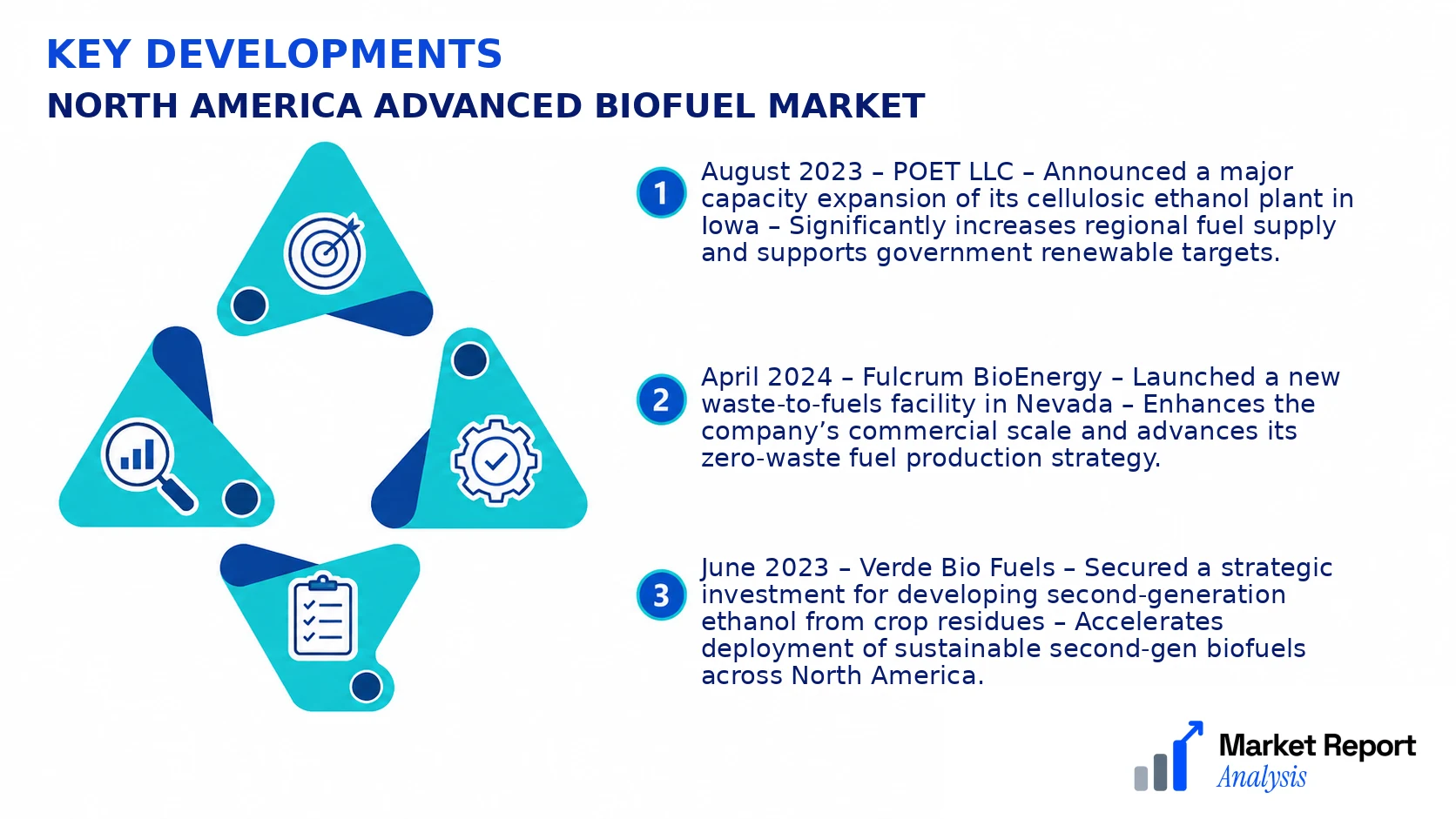
- August 2023 – POET LLC – Announced a major capacity expansion of its cellulosic ethanol plant in Iowa – Significantly increases regional fuel supply and supports government renewable targets.
- April 2024 – Fulcrum BioEnergy – Launched a new waste-to-fuels facility in Nevada – Enhances the company’s commercial scale and advances its zero-waste fuel production strategy.
- June 2023 – Verde Bio Fuels – Secured a strategic investment for developing second-generation ethanol from crop residues – Accelerates deployment of sustainable second-gen biofuels across North America.
- January 2024 – LanzaTech – Formed a joint venture with a major industrial gas company to expand gas fermentation technology – Strengthens technological capabilities and market access in North America.
- September 2023 – Red Rock Biofuels – Announced a technological upgrade and capacity increase for its jet fuel projects – Boosts production scalability to meet rising demand for sustainable aviation fuels.
Frequently Asked Questions
What is the North America Advanced Biofuel Market?
The North America Advanced Biofuel Market encompasses the production, commercialization, and consumption of sustainable biofuels derived from non-food biomass, including algae, waste fats, and cellulose, aiming to reduce greenhouse gas emissions and dependency on fossil fuels in the region.
What is the current market size of North America Advanced Biofuel Market?
As of 2026, the market valuation is approximately USD 3.2 Billion. This reflects increased adoption driven by supportive government policies, technological advancements, and rising environmental awareness within North American industries and transportation sectors.
What factors are driving the North America Advanced Biofuel Market?
The primary drivers include stringent emission regulations, increased investment in renewable energy, technological breakthroughs in biofuel production, and government incentives aimed at reducing carbon footprints. Growing corporate and consumer environmental commitments also bolster growth.
Which region dominates the North America Advanced Biofuel Market?
The United States significantly dominates this market due to its robust biofuel production infrastructure, supportive policies, and substantial investment in sustainable energy projects, accounting for the majority share of the regional market valuation.
Which segment is expected to grow the fastest?
The Biodiesel segment is anticipated to exhibit the fastest growth, driven by its compatibility with existing diesel infrastructure, increasing regulatory mandates, and ongoing technological improvements making it more cost-effective and scalable across North America.
Who are the leading companies operating in the North America Advanced Biofuel Market?
Key players include POET LLC, Green Plains Inc., Renewable Energy Group, Inc., and Archer Daniels Midland Company. These corporations focus on technological innovation, strategic alliances, and expanding plant capacities to consolidate market position.
Analyst Perspective
The North America advanced biofuel market exhibits a mature yet evolving landscape, with sustained growth driven by regulatory support and technological advancements. Long-term prospects remain robust, as declining feedstock costs and breakthrough processing technologies foster commercial viability. Key opportunities include innovations in algae-based and cellulosic biofuels, which are poised to capture emerging markets such as aviation and heavy-duty transportation. Investment focus should prioritize scalable, integrated biorefineries that leverage sustainable feedstocks, along with R&D for second-generation biofuels to maintain competitive advantage. The region's competitive intensity is significant, with collaborations between major energy firms, technology providers, and governmental agencies shaping the landscape. North America’s regional growth potential is substantial, especially in the U.S. Gulf Coast and Canadian provinces, where abundant biomass and supportive policies exist. Strategic positioning involves balancing technological innovation with sustainable feedstock supply chains and navigating evolving regulatory frameworks to ensure long-term market resilience.
