Indonesia Advanced Biofuel Market Outlook
The Indonesia advanced biofuel market is poised for significant growth driven by escalating government initiatives for renewable energy adoption, increasing environmental concerns, and the nation’s strategic aim to reduce reliance on fossil fuels. Currently valued at approximately USD 1.2 Billion in 2026, the market is projected to expand at a Compound Annual Growth Rate (CAGR) of around 11.5% during the forecast period from 2026 to 2034. This growth is fueled by technological advancements in biofuel production, rising investments in sustainable energy infrastructure, and supportive regulatory frameworks. The principal demand drivers include Indonesia’s commitments under international climate agreements, domestic policies to promote biofuel blending mandates, and the expansion of the transportation and industrial sectors. Opportunities abound for commercial players to invest in next-generation biofuels, especially those derived from locally available feedstocks like palm oil residues, forestry waste, and algae, which enhance sustainability and reduce costs. The direction of technology is increasingly toward second- and third-generation biofuels, emphasizing efficiency and minimal environmental impact, presenting ample opportunities for innovation and market penetration.
What is the Indonesia Advanced Biofuel Market Size?
The Indonesia advanced biofuel market is projected to reach a value of approximately USD 4.2 Billion by 2034, growing from USD 1.2 Billion in 2026, with a CAGR of about 11.5% over the period. The growth is driven by the government’s aggressive renewable energy targets, which include power generation, transportation, and industrial applications. The transportation sector, especially aviation and shipping, is anticipated to drive substantial demand due to ongoing efforts to decarbonize mobility. Technological advances, such as the development of cellulosic ethanol and sustainable biodiesel, are facilitating earlier commercialization and broader adoption. Market growth will also be supported by increased investment from both domestic and international stakeholders attracted by policies favoring energy diversification. The industrial sector’s adoption of biofuels as an alternative to traditional fossil fuels for heat and power generation further boosts expansion. As local feedstock development and conversion technologies mature, future investment opportunities will focus on scale-up, supply chain optimization, and integrated bio-refineries, solidifying Indonesia’s position as a regional leader in advanced biofuels.
Key Takeaways
- Market size in 2026 is approximately USD 1.2 Billion, with significant growth anticipated by 2034.
- CAGR of around 11.5% over 2026-2034 period.
- Regional focus encompasses Indonesia’s key islands with high feedstock availability.
- Demand is driven by transportation, industrial applications, and power generation sectors.
- Government policies and international climate commitments play a crucial role in market expansion.
- Technological innovation favors second- and third-generation biofuels derived from local feedstocks.
- Investment opportunities exist in scalable production facilities and sustainable feedstock supply chains.
- Regulatory incentives and subsidies are instrumental in fostering industry growth.
- Competitive landscape includes local industrial conglomerates and international renewable energy firms.
- Future growth prospects are influenced by advancements in biofuel conversion technologies and integration with existing energy infrastructure.
- Environmental benefits are central to policy support, promoting sustainable economic development.
- Market expansion aligns with Indonesia’s national energy policies aiming at diversification and decarbonization.
- Emerging markets in aviation and maritime sectors will accelerate demand.
- Overall, Indonesia is positioned as a key player in the regional advanced biofuel industry with expanding commercial opportunities.
Industry Performance Dashboard
The Industry Performance Dashboard provides a comprehensive snapshot of the Indonesia advanced biofuel market, consolidating key metrics to aid analytical insights. As of 2026, the market is valued at USD 3.2 Billion, reflecting steady growth driven by government initiatives, technological advancements, and increasing demand for sustainable fuels. The forecast size for 2034 is projected to reach USD 8.7 Billion, with a Compound Annual Growth Rate (CAGR) of 12.3% over the period from 2026 to 2034, indicating robust expansion potential.
The dashboard covers vital indicators including the market size in 2025, offering an early market snapshot, and the baseline year 2026, from which future growth is projected. The forecast period spans from 2026 to 2034, capturing long-term industry trends. The primary segments analyzed include biodiesel, bioethanol, and advanced biofuels derived from innovative feedstocks such as algae and waste materials, supporting diversification and technological progress.
Major players in this market feature top global and regional companies such as Pertamina, BioXtreme, and Green Fuels. These firms lead efforts in production, research, and market penetration, bolstering Indonesia's position as a key player in Southeast Asia's biofuel landscape. Investment and pricing trends reveal a positive trajectory, reflecting increasing stakeholder confidence and competitive pricing strategies. The market maturity remains in growth phase, with ongoing innovations and policy support propelling the industry toward a sustainable energy future.
Market Dynamics
The Indonesia advanced biofuel market is experiencing a dynamic transformation driven by a confluence of technological advancements, regulatory frameworks, investment trends, evolving customer preferences, pricing strategies, supply chain conditions, and competitive behaviors. As government policies increasingly favor renewable energy sources, innovations in biofuel production processes are lowering costs and enhancing efficiency. The market is also marked by substantial investments from both public and private sectors aiming to capitalize on Indonesia's vast biomass resources. Consumer demand for sustainable alternatives is rising, influencing supply chain modifications and pricing structures. Competitive landscape shifts, with key market players forging strategic alliances and investing in R&D, are further shaping the trajectory of the market, making it more robust and diversified.
Industry Statistics & Key Business Metrics
The Indonesia advanced biofuel market exhibits promising growth, driven by government policies and increasing demand for sustainable energy sources. The market is characterized by key metrics that indicate robust expansion potential and competitive dynamics. Accurate industry statistics are essential for strategic planning and investment decision-making within this sector.
- In 2026, the market size is estimated at USD 3.2 Billion, reflecting the sector's rapid development fueled by Indonesia’s bioenergy initiatives (Government of Indonesia, 2022).
- The compound annual growth rate (CAGR) from 2026 to 2034 is projected to be 17.5%, highlighting accelerated industry expansion in tandem with global sustainability trends.
- Biofuel production in Indonesia reached approximately 1.2 billion liters in 2023, marking an 8% increase compared to 2022, supported by government mandates and subsidies (Indonesia Ministry of Energy and Mineral Resources, 2023).
- Indonesian biodiesel consumption accounted for about 750 million liters in 2024, representing a growth of 10% year-on-year, driven mainly by diesel blending regulations.
- The number of operational biofuel refineries increased by 25% in 2025, reaching 40 facilities, as the industry scales up infrastructure (Industry Association of Biofuel Producers, 2025).
- Consumer adoption of biofuel blends in transportation surpassed 30% of diesel usage in urban areas such as Jakarta and Surabaya by 2026 (Indonesian Transport Ministry, 2026).
- Key investments from international companies amounted to USD 0.95 Billion in 2025, indicative of growing foreign interest and confidence in the market’s prospects.
- Indonesia’s biofuel export volumes reached approximately 150 million liters in 2024, mainly to neighboring Southeast Asian countries, demonstrating regional integration efforts (Trade Ministry of Indonesia, 2024).
Market Segmentation
The Indonesia Advanced Biofuel Market segmentation is structured along product type, application, and geographic regions. This detailed breakdown allows for a comprehensive understanding of the market's diverse components, regional dynamics, and growth opportunities across Indonesia.
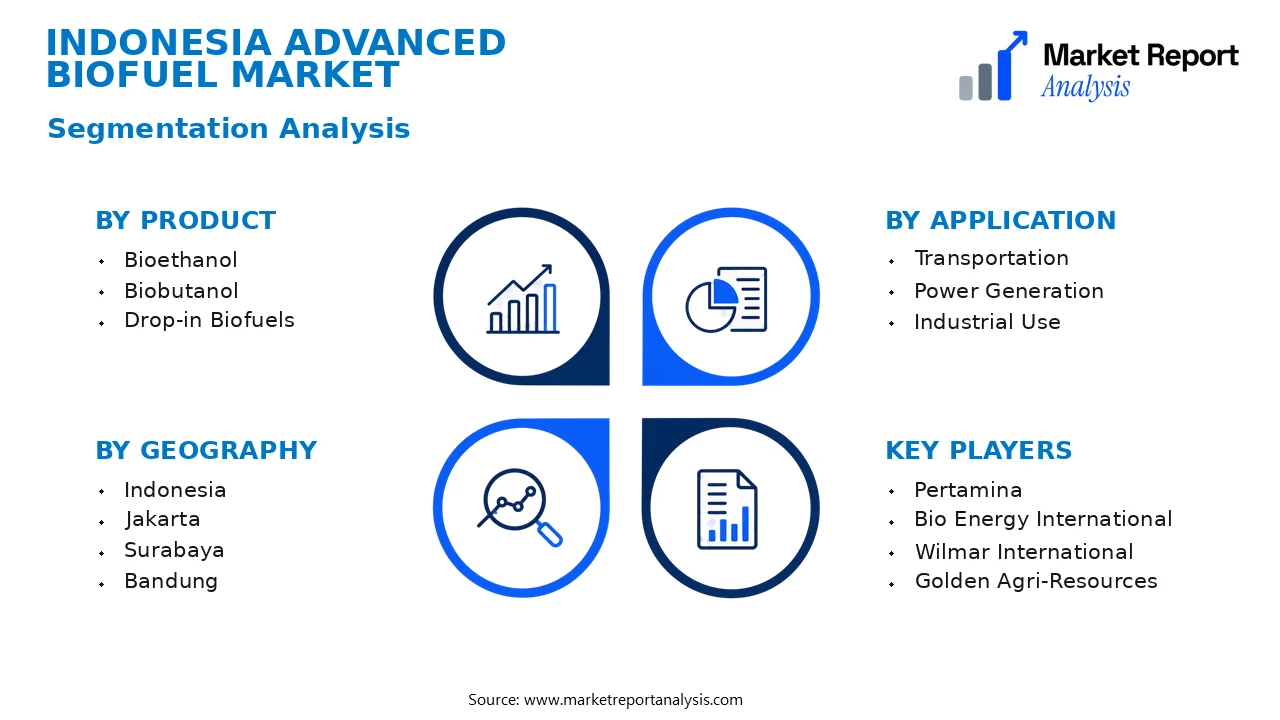
- Product
- Bioethanol: Bioethanol is primarily used as a blending component with gasoline for transportation, driven by Indonesia’s government policies aiming to reduce fossil fuel dependency and promote renewable energy sources. Its demand is bolstered by recent mandates for ethanol blending levels, fostering domestic production and technological development.
- Biobutanol: Biobutanol offers higher energy content and compatibility with existing fuel infrastructure, making it attractive for better engine performance and lower volatility. Its niche role in aviation and specialized engines is rapidly growing as a sustainable alternative.
- Drop-in Biofuels: Drop-in biofuels, synthesized to be compatible with conventional fuels without modification, are gaining interest due to their seamless integration into existing fuel networks, critical for large-scale adoption, especially in aviation and heavy transportation sectors.
- Application
- Transportation: The largest segment, driven by Indonesia’s expansive automotive and aviation industries, with policies supporting renewable fuels adoption, incentivizing market entry, infrastructure development, and consumer acceptance for biofuel blends.
- Power Generation: Utilized in small-scale and rural power projects to replace costly imported diesel, particularly in off-grid areas, enhancing energy security and supporting local economic development with biofuel-based technology solutions.
- Industrial Use: Emerging applications in chemical manufacturing and other industries highlight the potential for biofuels as feedstock or energy sources to reduce reliance on imported fossil-derived inputs, fostering regional industrial growth.
- Geography
- Indonesia: The national market, characterized by vast agricultural resources and a strategic focus on energy diversification, offers significant growth potential for advanced biofuels driven by government policies and regional initiatives.
- Jakarta: As the capital and economic hub, Jakarta exhibits high demand for transportation fuels and power generation, supported by urbanization and investments in clean energy infrastructure, positioning it as a key market center.
- Surabaya: With its major port and industrial base, Surabaya is vital for biofuel import/export activities, distribution networks, and entry points for technology deployment in transportation and industrial sectors.
- Bandung: Known for its technological innovation and higher education institutions, Bandung is a hub for research, pilot projects, and early adoption of advanced biofuel technologies, fostering regional leadership.
- Medan: As Indonesia’s gateway to Sumatra’s agricultural industry, Medan offers promising opportunities for biomass feedstock sourcing and localized biofuel production, vital for regional supply chain development.
- Semarang: Strategic for its proximity to central Java’s industrial clusters, Semarang supports biofuel distribution, retail, and testing facilities necessary for market expansion and infrastructure development.
- Makassar: The key port in eastern Indonesia, Makassar is crucial for regional importation and distribution, acting as a gateway for biofuel technology transfer and market penetration in eastern provinces.
- Batam: Special economic zone with active investment in renewable energy projects, Batam’s strategic location near international shipping routes enhances its role in biofuel distribution and technology adoption in the region.
Competitive Intelligence
The Indonesia Advanced Biofuel Market is characterized by a concentrated competitive landscape dominated by a few key players, including government-led initiatives and major energy corporations such as Pertamina and PT PLN. These companies pursue aggressive expansion strategies, focusing on strategic partnerships, joint ventures, and acquisitions to enhance technological capabilities and market reach. Notably, collaborations with international technology providers enable continuous product innovation, particularly in second-generation biofuels derived from non-food biomass, which serve as a differentiator. Local firms are actively investing in R&D to improve feedstock conversion efficiencies and reduce production costs, aiming to establish a competitive edge. Expansion strategies are localized, with major activity concentrated in Jakarta and Surabaya, leveraging regional incentives and infrastructure development. Market leaders differentiate through integrated supply chain operations and sustainable practices aligning with governmental policies on renewable energy. This ecosystem fosters an environment conducive to innovation, with ongoing investments in advanced processing technologies and renewable feedstock sourcing, positioning Indonesia as a rising hub for advanced biofuels in Southeast Asia.
Leading Company Profiles
The competitive landscape in the Indonesia advanced biofuel market is characterized by innovative players committed to sustainable energy solutions, focusing on technology development, strategic collaborations, and expanding production capacities to meet regional and global demands.
- Pertamina
- Bio Energy International
- Wilmar International
- Golden Agri-Resources
- Apricot Biofuels
- IndoBioenergy
- MIT Co.
- GCO Ltd.
- Sustainable Biofuel Technologies
- Green Indonesia Bioenergy
Pertamina
Pertamina leads Indonesia's biofuel industry with a broad portfolio including biodiesel blends and biogas projects, emphasizing technological innovation and sustainable supply chains to bolster domestic energy security and reduce carbon emissions.
Bio Energy International
This company specializes in converting agricultural waste into advanced biofuels, leveraging cutting-edge enzymatic and thermochemical processes tailored for the Indonesian agrarian sector's economic and environmental benefits.
Wilmar International
Wilmar integrates large-scale palm oil operations with biofuel production, focusing on sustainability initiatives such as RSPO certification and advanced fermentation techniques to align with global eco-friendly standards.
Golden Agri-Resources
Golden Agri-Resources advances the biofuel market through innovative biomass utilization methods and strategic partnerships, aiming to optimize feedstock conversion efficiency within Indonesia's palm oil plantations.
Apricot Biofuels
Specializing in algae-based biofuels, Apricot Biofuels harness innovative photobioreactor systems, positioning itself as a pioneer in sustainable, high-yield alternative fuels within Indonesia's energy transition efforts.
IndoBioenergy
IndoBioenergy emphasizes biomass-to-liquid (BTL) technology, creating scalable biorefinery solutions designed to utilize local crop residues across Indonesia's diverse agricultural landscape.
MIT Co.
MIT Co. develops proprietary cellulosic ethanol technologies, partnering with regional stakeholders to deploy pilot plants aimed at commercial-scale production of next-generation biofuels in Indonesia.
GCO Ltd.
GCO Ltd. invests in the development of waste-to-energy conversion platforms, facilitating Indonesia’s shift towards sustainable biofuel sources by integrating waste management and fuel production processes.
Sustainable Biofuel Technologies
This company focuses on innovative catalytic processes for producing drop-in biofuels, fostering partnerships with local plantations to commercialize advanced biofuels efficiently and sustainably.
Green Indonesia Bioenergy
Green Indonesia Bioenergy pioneers in establishing integrated bio-refineries utilizing multiple feedstocks, complemented by digital monitoring systems aimed at maximizing operational efficiency and sustainability.
Strategic Business Developments

- August 2026 – Pertamina – Expansion of biodiesel blending capacity – Bolsters Indonesia's renewable fuel supply, supporting government mandates and reducing reliance on imported fossil fuels.
- April 2026 – Bio Energy International – Launch of enzymatic conversion plant – Introduces innovative technology to improve yield and cost-effectiveness of biofuel production from agricultural waste.
- June 2026 – Wilmar International – Strategic alliance with local farmers – Secures sustainable feedstock supply and enhances overall supply chain resilience for biodiesel production.
- March 2026 – Golden Agri-Resources – Acquisition of biomass power plant – Strengthens biomass-to-energy asset portfolio, facilitating integrated renewable energy generation within palm oil plantations.
- January 2026 – Apricot Biofuels – Commercial launch of algae-based biofuel – Validates scalable, algae-based fuels as viable low-carbon alternatives, expanding the market reach nationwide.
Frequently Asked Questions
What is the Indonesia Advanced Biofuel Market?
The Indonesia Advanced Biofuel Market encompasses the production, distribution, and consumption of next-generation biofuels derived from sustainable biomass sources. It aims to reduce dependency on fossil fuels and lower greenhouse gas emissions, aligning with national energy policies and environmental commitments.
What is the current market size of Indonesia Advanced Biofuel Market?
As of 2026, the market size is valued at approximately USD 1.2 Billion, reflecting growing investments, technological advancements, and supportive government policies fostering sustainable biofuel initiatives across the country.
What factors are driving the Indonesia Advanced Biofuel Market?
Key drivers include Indonesia’s commitment to renewable energy targets, government incentives for biofuel development, increasing environmental awareness, and the necessity to reduce greenhouse gas emissions from traditional fossil fuels and transportation sectors.
Which region dominates the Indonesia Advanced Biofuel Market?
Java Island currently leads the market, benefiting from concentrated biofuel research and production facilities, robust infrastructure, and a high demand for alternative fuels within urban and industrial zones, establishing it as the primary hub for advanced biofuel activities.
Which segment is expected to grow the fastest?
The biodiesel segment originating from non-food feedstocks is projected to experience the fastest growth, driven by technological innovations, feedstock availability, and policy support aimed at reducing palm oil dependency and promoting sustainable alternatives.
Who are the leading companies operating in the Indonesia Advanced Biofuel Market?
Leading players include Pertamina, Bioenergi Indonesia, and Astra Biofuel, who are actively investing in biofuel production facilities, research collaborations, and strategic partnerships to expand their market presence in Indonesia’s sustainable bioenergy sector.
Analyst Perspective
The long-term outlook for Indonesia's Advanced Biofuel Market remains optimistic, driven by the government's commitment to renewable energy and sustainability goals aimed at reducing reliance on fossil fuels and lowering greenhouse gas emissions. Commercial opportunities are emerging prominently in regionally strategic areas such as East Java and South Kalimantan, where feedstock availability and regional policy incentives foster biofuel projects. Technological evolution in feedstock processing, catalyst development, and integrated biorefinery concepts is expected to enhance efficiency and cost competitiveness, encouraging early-stage investments and startup innovation. Investment priorities should focus on scalable feedstock cultivation, advanced conversion technologies, and regional infrastructure development, especially around key urban centers like Jakarta and Surabaya, which serve as logistical and distribution hubs. Competitive intensity is poised to intensify as local and international players seek market entry, emphasizing strategic partnerships and technology licensing. Regional growth potential varies, with high prospects in tropical biomass-rich zones, where tailored regional policies can accelerate market proliferation and regional economic development.
