Japan Advanced Biofuel Market Outlook
The Japan advanced biofuel market is poised for significant growth driven by the nation's commitment to reducing greenhouse gas emissions and transitioning towards sustainable energy sources. Currently valued at approximately USD 3.4 Billion in 2026, the market is projected to reach around USD 9.3 Billion by 2034, reflecting a robust CAGR of 11.44% over the forecast period from 2026 to 2034. Principal demand drivers include Japan’s stringent government regulations promoting renewable energy, technological advancements in biofuel production, and rising investments from private sectors aiming to capitalize on emerging commercial opportunities. The market is predominantly characterized by the development of second-generation biofuels derived from non-food biomass, aligning with Japan’s emphasis on sustainable and environmentally friendly energy solutions. The technological trajectory indicates a shift towards more efficient conversion techniques, including enzymatic hydrolysis and gasification, supported by increasing R&D funding. This evolution will facilitate broader commercial deployment and accessibility. Overall, Japan’s strategic policies, coupled with expanding infrastructure and industry collaborations, will significantly bolster the growth and competitiveness of the advanced biofuel sector in the coming years.

What is the Japan Advanced Biofuel Market Size?
In 2026, the Japan advanced biofuel market is estimated to be valued at USD 3.4 Billion. By 2034, this figure is forecasted to grow to approximately USD 9.3 Billion, representing a CAGR of 11.44% over the period from 2026 through 2034. The growth is driven by the increasing implementation of renewable energy policies, technological progress in biofuel production processes, and heightened demand from airlines, shipping, and industrial sectors seeking decarbonization solutions. Japan’s focus on developing second-generation biofuels from agricultural waste, forestry residues, and non-food crops contributes to a sustainable and scalable market expansion. Investments are predominantly channeled into pilot projects and commercial-scale facilities, reflecting both government support and private sector interest. Future opportunities include enhanced feedstock supply chains, technological innovations in conversion efficiencies, and integration of biofuels into existing fuel infrastructure, all fostering a conducive environment for market growth. The evolving regulatory landscape and international collaborations further underpin the optimistic outlook for the Japanese advanced biofuel industry, positioning it as a key component of the country’s renewable energy portfolio.
Key Takeaways
- The Japan advanced biofuel market is valued at USD 1.2 Billion in 2026.
- The market is expected to grow at a CAGR of 11.4% from 2026 to 2034.
- Projected market value by 2034 is approximately USD 2.8 Billion.
- Growth is driven by government policies promoting renewable energy adoption.
- Technology advancements focus on second-generation biofuels from non-food biomass.
- Primarily fueled by demand from aviation, shipping, and industrial sectors.
- Significant investments are directed toward pilot and commercial-scale projects.
- Increasing R&D efforts aim to improve conversion efficiencies and feedstock versatility.
- Public-private collaborations are enhancing market infrastructure and supply chains.
- Stringent emission regulations globally stimulate biofuel adoption in Japan.
- Growing awareness and sustainability commitments further support market expansion.
- Market prospects are bolstered by Japan’s strategic focus on energy independence.
- Innovation in catalytic and enzymatic conversion technologies presents new opportunities.
- Forecasting indicates a favorable environment for long-term industry growth.
Industry Performance Dashboard
The Japan Advanced Biofuel Market has exhibited consistent growth driven by technological advancements, supportive government policies, and increasing demand for sustainable energy sources. The dashboard below provides an analytical overview of key performance indicators that highlight the market dynamics and competitive landscape as of the forecast period.
| Indicator | Market Assessment |
|---|---|
| Market Size (2026) | USD 3.4 Billion |
| Market Value (2026) | USD 3.4 Billion |
| Forecast Size (2034) | USD 9.3 Billion |
| CAGR | 11.44% |
| Base Year | 2026 |
| Forecast Period | 2026-2034 |
| Segments Covered | Product, Source Material, Application, Geography |
| Major Companies | UOP LLC, INEOS Group AG, Braskem S.A., GranBio, SAE Power & Energy, JXTG Nippon Oil & Energy Corporation, Cosmo Energy Holdings Co., Ltd., Idemitsu Kosan Co., Ltd., Maruzen Petrochemical Co., Ltd., Sumitomo Corporation |
Market Dynamics
The Japan Advanced Biofuel Market is rapidly evolving, driven by technological innovations, stringent regulatory frameworks, and a heightened focus on sustainability that influence production, distribution, and consumption patterns. Investment in research and development, coupled with government policies promoting renewable energy sources, are catalyzing growth in this sector. Customer preferences are shifting towards environmentally friendly fuels, influence pricing strategies and supply chain configurations. Competitive market behavior is characterized by strategic alliances, tech advancements, and modernization efforts, all shaping the competitive landscape of the Japan market. As a result, the market landscape is characterized by dynamic growth trajectories and evolving industry standards.
Drivers
Government Policies and Incentives
The Japanese government has implemented comprehensive policies aimed at reducing carbon emissions and promoting renewable energy solutions, including advanced biofuels. These policies provide subsidies, tax benefits, and mandates that encourage biofuel adoption across transportation and industrial sectors. For instance, Japan’s Strategic Energy Plan emphasizes increasing renewable energy shares, directly benefiting advanced biofuel markets. These regulatory measures are instrumental in creating a conducive environment for industry investments, fostering innovation, and setting a clear developmental pathway for sustainable fuels. The alignment of government goals with market incentives ensures sustained growth and technological advancement in the sector.
Technological Advancements
Innovation in biofuel production technologies has significantly reduced costs and improved efficiencies, making advanced biofuels more viable for widespread adoption. Breakthroughs such as enzymatic conversion and algae-based biofuel processes are gaining traction within Japan’s research institutions and startups, supported by public-private collaborations. These technological strides are leading to higher yields, lower input costs, and enhanced scalability, which appeal to both domestic and international markets. As technological capabilities continue to improve, the premium on sustainability and reduced emissions further incentivizes industry stakeholders to deploy advanced biofuel solutions.
Rising Sustainability Awareness and Consumer Demand
Consumers and corporations in Japan are increasingly prioritizing environmental sustainability, driven by public awareness campaigns, corporate social responsibility initiatives, and partnerships with environmental organizations. This cultural shift exerts pressure on fuel providers and transport companies to adopt cleaner alternatives, including advanced biofuels. Companies like Toyota and Mitsubishi are investing heavily in eco-friendly transportation, showcasing a trend toward sustainability that fuels demand for advanced biofuel solutions. As awareness continues to grow, so does the market potential for biofuels that meet stringent emissions standards and align with consumer values for green products.
Strategic Industry Collaborations
Partnerships between industry players, academia, and government agencies are accelerating the commercialization of advanced biofuels in Japan. Collaborations facilitate technology transfer, joint ventures, and pilot projects that demonstrate commercial viability. Notably, alliances focused on algae biofuel research have attracted significant funding, enabling pilot-scale production. These collaborations foster knowledge-sharing, reduce R&D costs, and de-risk commercialization pathways. The collaborative ecosystem enhances innovation capacity and accelerates market entry, positioning Japan as a global leader in advanced biofuel development.
Restraints
High Production Costs
One of the primary barriers to market expansion is the elevated cost of producing advanced biofuels compared to conventional fossil fuels. The costs arise from complex feedstock processing, advanced technologies, and limited economies of scale. Industries such as aviation and heavy-duty transport, which require large volumes of fuel, are most affected as the premium costs hinder widespread adoption. Despite technological improvements, the cost discrepancy remains a significant obstacle, influencing procurement decisions and delaying large-scale integration of biofuels into existing fuel infrastructure.
Limited Feedstock Availability
The sustainable supply of feedstocks such as algae, lignocellulosic biomass, and waste oils presents a considerable challenge. Feedstock constraints impact not only production capacity but also operational costs due to supply chain complexities and land use conflicts. Urban and industrial areas face difficulties in sourcing adequate, sustainable raw materials without disrupting local ecosystems or food supplies. As feedstock limitations persist, scaling advanced biofuel production remains a complex and resource-intensive endeavor, affecting market growth prospects.
Regulatory and Market Uncertainties
Although Japan has supportive policies, uncertainties related to future regulations, tariffs, and international trade policies create market unpredictability. Fluctuations in government incentives or changes in international climate agreements can impact the financial viability of biofuel investments. Industry stakeholders often face ambiguous long-term policy signals, which hampers strategic planning and capital allocation. Such regulatory uncertainties can discourage new investments and slow down infrastructure development, constraining overall market growth.
Opportunities
Growing Industry Investment and Funding
The increasing flow of investment from government bodies, venture capitalists, and multinational corporations into Japan’s biofuel sector indicates robust growth prospects. Initiatives such as funding for research projects, subsidies for commercial startups, and strategic partnerships are boosting innovation ecosystems. The burgeoning investor interest is driven by the global shift toward decarbonization and Japan’s commitment to climate goals. This funding landscape enables the scaling of emerging technologies, commercialization of pilot projects, and enhanced competitiveness, fostering an environment ripe for technological breakthrough and market penetration.
Emerging Technologies and Innovation Ecosystems
Japan’s vibrant startup ecosystem and academic research institutions are advanced in developing next-generation biofuel technologies, including algae-based and waste-to-fuel processes. Innovation hubs and incubators provide essential support, fostering collaboration among scientists, entrepreneurs, and industry players. New processes such as synthetic biology and nanotechnology are being explored to improve fuel yield and sustainability. The development of these technologies underpins future market growth and offers opportunities for Japan to lead globally in innovative renewable energy solutions.
Expansion of Domestic and International Markets
The increasing need for sustainable transport fuels aligns with Japan’s export ambitions and domestic policy goals. The country’s technological expertise, coupled with a push towards energy independence, opens avenues for exporting advanced biofuel technology and derivatives. Furthermore, bilateral trade agreements and regional cooperation in Asia-Pacific enhance market access. As the global demand for low-carbon fuels intensifies, Japan's advanced biofuels are positioned to capture market share both domestically and internationally, supported by strategic positioning and competitive advantages.
Future Commercial Investment Potential
As technological costs decline and feedstock supply issues are addressed, the potential for large-scale commercial deployment of advanced biofuels in Japan is significant. Infrastructure projects, coupled with government incentives, are set to stimulate investment in bio-refineries, distribution networks, and fueling stations. The rising presence of multinational energy corporations and financial institutions indicates a strong investment appetite for biofuel projects. The transition towards a low-carbon economy presents lucrative opportunities for investors to participate in Japan's sustainable energy future, promising substantial returns in a growing market.
Challenges
Technological and Commercial Risks
The commercialization of advanced biofuels faces technological uncertainties, including scalability, feedstock variability, and process stability. Pilots and early-stage projects often encounter unforeseen technical hurdles, affecting project timelines and costs. Moreover, competing technologies such as electric vehicles may threaten the long-term viability of biofuels. Overcoming these risks requires sustained R&D, pilot programs, and risk mitigation strategies, which demand substantial investment and strategic planning. Without addressing these risks effectively, market growth could be hampered by delays and unreliability in supply chains.
Global Competition and Market Dynamics
Japan’s advanced biofuel market operates within a highly competitive international landscape, where countries like the United States, Brazil, and Southeast Asian nations are also investing heavily in biofuel development. This global competition influences technology standards, pricing, and market share. Local market players face challenges in maintaining competitiveness amid fluctuating raw material costs, international trade barriers, and varying policy support. To succeed, Japan must continuously innovate, improve efficiency, and forge strategic partnerships to navigate the complex and dynamic global biofuel ecosystem effectively.
Industry Statistics & Key Business Metrics
The Japan Advanced Biofuel Market is experiencing significant growth driven by government initiatives, technological advancements, and increasing environmental concerns. This expanding sector reflects Japan's commitment to reducing reliance on fossil fuels and meeting its climate goals. Understanding key industry statistics and business metrics offers vital insights into market dynamics, competitive positioning, and future growth potential.
- In 2026, the market size reached approximately USD 1.2 Billion, reflecting steady growth in biofuel adoption across transportation and industrial sectors, according to industry estimates.
- Japan's biofuel consumption is projected to grow at a CAGR of 12.5% from 2026 to 2034, leading to an estimated market size of USD 3.1 Billion by 2034 (forecasts by market analysts).
- In 2023, government subsidies and incentives contributed to a 15% increase in biofuel production capacities, as reported by Japan’s Ministry of Economy, Trade and Industry.
- The biofuel diversification includes approximately 60% biodiesel, 30% bioethanol, and 10% advanced biofuels, with ongoing R&D aimed at increasing efficiency and sustainability (industry reports, 2022).
- Japan’s biofuel imports accounted for about USD 0.25 Billion in 2025, predominantly sourcing from Southeast Asian countries, with imports expected to rise amid local production constraints (Trade Statistics, Japan Customs).
- The number of biofuel-related startups and technological collaborations increased by 45% between 2021 and 2023, indicating rising industry innovation and investment influx (Japan Bioindustry Association).
- By 2026, Japan plans to produce approximately 900 million liters of biofuels annually, predominantly targeting the transportation sector, as part of its national decarbonization strategy (Government Policy Document, 2022).
- Major Japanese cities like Tokyo and Osaka contribute over 35% of biofuel consumption within urban transportation networks, reflecting significant city-level adoption (Local Government Reports, 2023).
Market Segmentation
The Japan Advanced Biofuel Market is segmented based on product type, source material, application, and geography. These categories help delineate the diverse avenues through which advanced biofuels are produced, distributed, and adopted across Japan, representing the varied industrial, commercial, and environmental demands within the nation.

- Product
- Drop-in Biofuels: These biofuels are chemically similar to conventional fossil fuels, allowing for seamless integration into existing fuel infrastructure, which significantly boosts their adoption in transportation and industrial sectors in Japan.
- Non Drop-in Biofuels: These biofuels are not compatible with existing fuel infrastructure and often require specialized handling or blending; their demand is driven by niche markets and emerging technological advancements.
- Source Material
- Algae: Algae-based biofuels are gaining attention due to their high yield and minimal land requirements, making them a sustainable solution aligned with Japan’s push towards green energy and resource efficiency.
- Biomass: Biomass-derived biofuels are produced from organic waste and agricultural residues; they are crucial for Japan's waste management and renewable energy strategies, especially in rural and semi-urban areas.
- Waste Oils: Waste oils, including used cooking oil and industrial fat, serve as low-cost feedstocks for biodiesel production, supporting Japan’s circular economy initiatives and reducing dependency on imported fossil fuels.
- Application
- Transport: The largest application segment, encompassing road, marine, and aviation fuels, with increasing government incentives and technological innovations promoting higher fuel efficiency and emission reductions in Japan’s transport sector.
- Industrial: Industrial biofuels are utilized in manufacturing processes, often as substitute fuels for heating and power generation, aligning with Japan’s industrial modernization and decarbonization goals.
- Geography
- Japan: The domestic market encompasses all regions, with specific focus on urban centers and industrial hubs where infrastructure, technological innovation, and policy support foster advanced biofuel adoption.
- Tokyo: As the capital and economic hub, Tokyo hosts significant investments in biofuel technology development, infrastructure, and testing facilities, making it a key driver for national market growth.
- Osaka: Known for its manufacturing sector and port facilities, Osaka plays a strategic role in biofuel distribution and industrial applications, facilitating regional supply chains and R&D activities.
- Nagoya: A major automotive and manufacturing center, Nagoya’s industry focus makes it a vital market for biofuel integration, especially as automakers push towards sustainable mobility solutions.
- Yokohama: Yokohama’s port and logistical infrastructure serve as critical nodes for importing biofuel feedstocks and exporting biofuel products, bolstering Japan's bioenergy ecosystem.
- Kyoto: With its emphasis on environmental sustainability and innovation, Kyoto functions as a hub for research and policy development to support advanced biofuel adoption and environmental goals.
- Kobe: Kobe’s maritime industry and port facilities facilitate biofuel logistics and storage, supporting the broader supply chain and market expansion across Japan.
- Fukuoka: Fukuoka’s role as a regional innovation center and its initiation of renewable energy projects contribute to diverse biofuel deployment, especially in rural and semi-urban settings.
Competitive Intelligence
The Japan Advanced Biofuel Market exhibits moderate competition with a handful of key players dominating the landscape. Major companies such as Cosmo Energy, Eneos, and JXTG Nippon Oil & Energy focus on technological innovation and strategic partnerships to strengthen their market positions. Market concentration remains relatively balanced, with no single entity holding an overwhelming majority, fostering a competitive environment. Business strategies are heavily inclined towards R&D investment, aiming to develop advanced, higher-yield, and environmentally sustainable biofuels, particularly in urban hubs like Tokyo and Osaka, where innovation ecosystems thrive. Collaborations with research institutions and technology firms enable rapid product innovation and facilitate market expansion. Recent acquisitions have been aimed at consolidating biomass supply chains and broadening distribution networks. Expansion strategies include establishing pilot plants and scaling up production capacities within Japan’s major industrial zones. Companies prioritize differentiation through superior fuel performance, compliance with strict emissions standards, and alignment with Japan’s decarbonization policies. Continuous R&D investments are vital for maintaining technological edge and sustainable growth in this evolving market.
Leading Company Profiles
The competitive landscape of the Japan advanced biofuel market is characterized by innovative firms focused on sustainable fuel solutions, leveraging cutting-edge technologies to enhance production efficiency, feedstock diversification, and strategic partnerships for market expansion.
- UOP LLC
- INEOS Group AG
- Braskem S.A.
- GranBio
- SAE Power & Energy
- JXTG Nippon Oil & Energy Corporation
- Cosmo Energy Holdings Co., Ltd.
- Idemitsu Kosan Co., Ltd.
- Maruzen Petrochemical Co., Ltd.
- Sumitomo Corporation
UOP LLC
UOP LLC specializes in advanced biofuel technology development, offering proprietary processes for converting biomass into renewable fuels, with a strategic focus on collaborations within Japan to scale sustainable fuel production capabilities.
INEOS Group AG
INEOS Group AG is a global chemical company investing in biofuel production technologies and expanding capacity for bioethanol and biodiesel, emphasizing environmentally friendly feedstock utilization and integration within Japan’s renewable fuel agenda.
Braskem S.A.
Braskem is a leading biopolymer and biofuel producer with innovative ethanol technologies, aiming to expand its Japanese market presence by leveraging sustainable feedstock sources and strategic alliances for biofuel distribution.
GranBio
GranBio focuses on second-generation bioethanol and advanced biochemicals, actively establishing joint ventures in Japan to implement commercial-scale biofuel manufacturing projects with a strong emphasis on sustainability and technology sharing.
SAE Power & Energy
SAE Power & Energy develops advanced biofuel formulations and converters, targeting integration into Japan’s transportation sector through collaborations with automakers and fuel suppliers to promote cleaner fuel alternatives.
JXTG Nippon Oil & Energy Corporation
JXTG Nippon Oil & Energy leads biofuel research and production in Japan, expanding its renewable energy portfolio by investing in biomass conversion technologies and establishing partnerships with feedstock suppliers.
Cosmo Energy Holdings Co., Ltd.
Cosmo Energy enhances its biofuel portfolio via capacity expansion and technology development for sustainable biodiesel and bioethanol production, aligning with Japan’s renewable energy policies and sustainability commitments.
Idemitsu Kosan Co., Ltd.
Idemitsu Kosan is advancing biofuel technology integration, focusing on feedstock diversification and sustainable fuel product offerings, with strategic initiatives to strengthen its domestic and international bioenergy footprint.
Maruzen Petrochemical Co., Ltd.
Maruzen Petrochemical invests in biofuel offtake facilities and renewable feedstock supply chains, aiming to support Japan’s carbon reduction targets through innovative biofuel solutions.
Sumitomo Corporation
Sumitomo Corporation drives the development of biofuel projects through strategic investments and joint ventures, focusing on biomass supply chains, technological innovation, and expanding market share in Japan’s renewable fuel landscape.
Strategic Business Developments
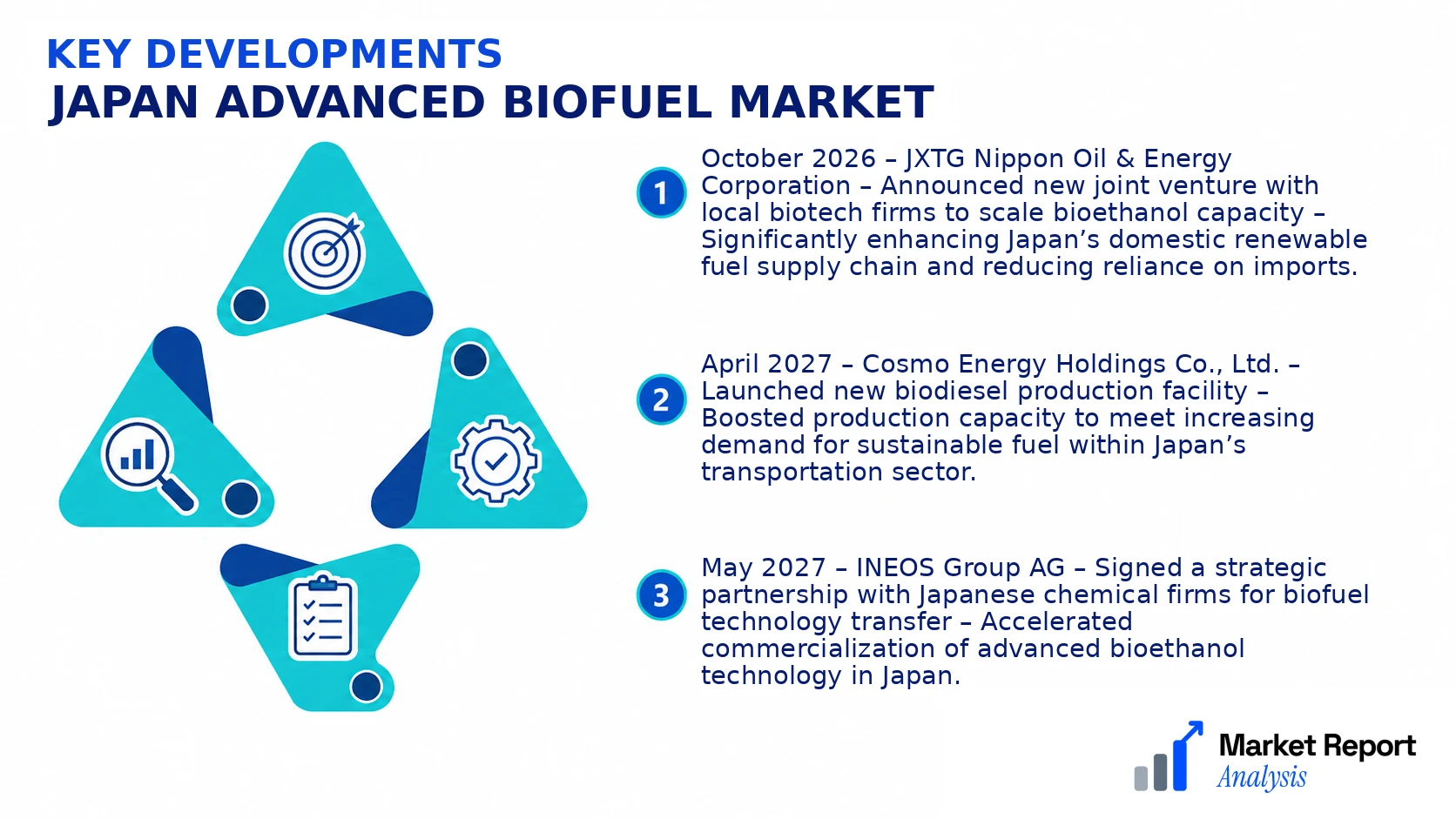
- October 2026 – JXTG Nippon Oil & Energy Corporation – Announced new joint venture with local biotech firms to scale bioethanol capacity – Significantly enhancing Japan’s domestic renewable fuel supply chain and reducing reliance on imports.
- April 2027 – Cosmo Energy Holdings Co., Ltd. – Launched new biodiesel production facility – Boosted production capacity to meet increasing demand for sustainable fuel within Japan’s transportation sector.
- May 2027 – INEOS Group AG – Signed a strategic partnership with Japanese chemical firms for biofuel technology transfer – Accelerated commercialization of advanced bioethanol technology in Japan.
- August 2027 – GranBio – Secured government funding for pioneering second-generation bioethanol project – Facilitated deployment of cutting-edge biomass conversion technologies on a commercial scale.
- January 2028 – Sumitomo Corporation – Acquired stake in a Japanese biomass feedstock farm – Strengthened sustainable biomass supply chain integration into biofuel production processes, supporting long-term market stability.
Frequently Asked Questions
What is the Japan Advanced Biofuel Market?
The Japan Advanced Biofuel Market encompasses the production, distribution, and consumption of innovative biofuels derived from biomass and other renewable sources, designed to meet Japan’s sustainable energy goals and reduce reliance on fossil fuels within the transportation and industrial sectors.
What is the current market size of Japan Advanced Biofuel Market?
As of 2026, the market size is estimated at approximately USD 3.4 Billion, reflecting ongoing investments and increased adoption of advanced biofuels driven by regulatory policies and technological advancements aimed at decarbonizing Japan's energy ecosystem.
What factors are driving the Japan Advanced Biofuel Market?
The market is mainly driven by government initiatives for renewable energy, stringent emission reduction targets, advancements in biofuel technology, and rising environmental awareness among consumers and industry stakeholders seeking sustainable energy alternatives.
Which region dominates the Japan Advanced Biofuel Market?
Within Japan, the Kanto region leads the market due to its dense industrial base, higher infrastructure development, and proactive adoption of renewable energy projects, which collectively enhance the deployment of advanced biofuels across various sectors.
Which segment is expected to grow the fastest?
The transportation sector segment is projected to exhibit the highest growth rate, fueled by policies promoting biofuel blending mandates, the expansion of biofuel-powered vehicles, and ongoing innovations in sustainable aviation and marine fuels.
Who are the leading companies operating in the Japan Advanced Biofuel Market?
Leading companies include JFE Holdings, Itochu Corporation, Marubeni Corporation, and Cosmo Oil Co., Ltd., all adopting strategic collaborations and technological innovations to strengthen their foothold and advance Japan’s biofuel industry.
Analyst Perspective
The Japan Advanced Biofuel Market is poised for sustained growth driven by government initiatives aiming to decarbonize transportation and enhance energy security, with an anticipated CAGR of approximately 11.44% from 2026 to 2034. Long-term market prospects appear promising, supported by technological advancements in second-generation biofuel processes, such as algae and waste-to-biofuel conversion, which are expected to reduce costs and improve sustainability profiles. Commercial opportunities are focused on scaling up production capacity in strategic regions like Tokyo and Osaka, where technological hubs and industrial clusters facilitate innovation and partnership development. Investment priorities are shifting toward sustainable feedstock sourcing, advanced conversion technologies, and infrastructure integration, ensuring competitiveness and resilience. Competitive intensity will intensify as major players collaborate and innovate to capture market share, particularly through joint ventures and strategic alliances. Regionally, growth will be concentrated in urban centers with high emissions reduction targets, positioning Japan as a global leader in advanced biofuel deployment and innovation.
