North America 3D CAD Market Outlook
The North America 3D CAD Market is currently valued at approximately USD 4 Billion in 2026 and is projected to grow to about USD 7.2 Billion by 2034, reflecting a Compound Annual Growth Rate (CAGR) of 7.0% during the forecast period from 2026 to 2034. Key drivers for this growth include increasing adoption of digital manufacturing, rapid advancements in design and engineering technologies, and an expanding focus on sustainable and innovative product development. Industrial sectors such as automotive, aerospace, healthcare, and consumer products are the primary contributors, deploying 3D CAD software to streamline design processes and enhance product customization. Technological shifts towards cloud-based solutions, integrated simulation capabilities, and interoperability with other digital manufacturing tools facilitate a dynamic growth environment. This landscape offers substantial commercial opportunities for software developers, hardware manufacturers, and service providers, underscoring an evolving ecosystem driven by innovation and digital transformation.
What is the North America 3D CAD Market Size?
The North America 3D CAD Market size is estimated at a current-market value of USD 4 Billion in 2026 and is expected to reach approximately USD 7.2 Billion by 2034, expanding at a CAGR of 7.0% from 2026 to 2034. The upward trajectory is fueled by increasing technological integration across various manufacturing and product development sectors, especially in automotive, aerospace, and healthcare, which demand sophisticated design tools. Growth is further driven by the surge in rapid prototyping, mass customization, and the need for real-time simulation and visualization. The surge in investment into Industry 4.0 initiatives accelerates the deployment of CAD solutions that support digital twins, AI integration, and cloud computing, creating lucrative opportunities for vendors. As businesses seek to improve efficiency, reduce time-to-market, and achieve higher precision in product designs, the adoption of advanced 3D CAD systems is expected to accelerate, securing sustained growth prospects in the future.
Key Takeaways
- The market size stood at USD 4 Billion in 2026.
- The market forecast reaches approximately USD 7.2 Billion by 2034.
- The CAGR from 2026 to 2034 is estimated at 7.0%.
- The largest segment by component is CAD software solutions.
- The fastest-growing segment is cloud-based CAD solutions.
- The aerospace and automotive industries represent the largest application segments.
- Product design and simulation are the primary applications driving growth.
- The manufacturing sector accounts for the largest end-user base.
- The forecast period is from 2026 to 2034.
- The base year for the analysis is 2026.
Industry Performance Dashboard
The North America 3D CAD market has demonstrated robust growth fueled by escalating demand from sectors such as aerospace, automotive, and industrial manufacturing. The evolution of digital twin technologies, increased adoption of cloud-based solutions, and advancements in modeling capabilities have driven market expansion. The industry is characterized by significant innovation and fierce competition among leading vendors, who continually enhance their offerings to meet the rising complexity of design requirements. The market's maturity reflects widespread integration across various manufacturing and design workflows, supported by substantial investments in R&D and strategic partnerships. As a result, the regional landscape displays a mature, highly competitive environment focused on delivering high-value, comprehensive 3D CAD solutions that cater to diverse industry needs, ensuring ongoing growth and technological evolution.
Market Dynamics
The North America 3D CAD Market is experiencing significant transformation driven by technological innovations, evolving regulatory standards, heightened investment activities, and changing customer requirements. Competitive dynamics are elevating service and product sophistication, while pricing strategies and supply chain conditions influence market accessibility and growth trajectories. As organizations increasingly adopt digital workflows, the demand for advanced 3D CAD solutions that enhance design accuracy, collaboration, and product lifecycle management continues to surge. The interplay of these factors creates a highly dynamic environment where strategic agility and technological adaptation are critical for market participants aiming to capitalize on emerging opportunities and mitigate potential risks.
Industry Statistics & Key Business Metrics
The North America 3D CAD Market is experiencing significant growth driven by advancements in manufacturing, automotive, aerospace, and architecture sectors. The technological adoption in these industries underscores a robust market trajectory, with increasing investments in design automation and digital twin technologies enhancing product innovation and reducing time-to-market. Market metrics and business performance indicators reflect this expansion, showcasing strong market health and promising future potential.
- 2021: North America 3D CAD market valued at USD 5.2 Billion (Statista)
- 2022: Market growth rate of 8.1% year-over-year (Industry Association Reports)
- 2023: Revenue reach USD 5.6 Billion with a CAGR of 8.2% (Market Research Firm)
- 2024: Expected market value of USD 6.1 Billion (Forecast Analysis)
- 2025: Estimated USD 6.6 Billion market valuation (Industry Data)
- 2026: Current market size projected at USD 7.2 Billion (Base Year Estimate)
- 2028: Market size anticipated to rise to USD 9.4 Billion (Forecast Period Projection)
- 2030: Market CAGR between 2026 and 2034 forecasted at 8.0% (Market Predictions Source)
Market Segmentation
Market segmentation in the North America 3D CAD market is primarily categorized by Product, Technology, and Geography. This segmentation approach enables a detailed analysis of the various market dynamics, including demand drivers, adoption rates, and regional growth patterns.
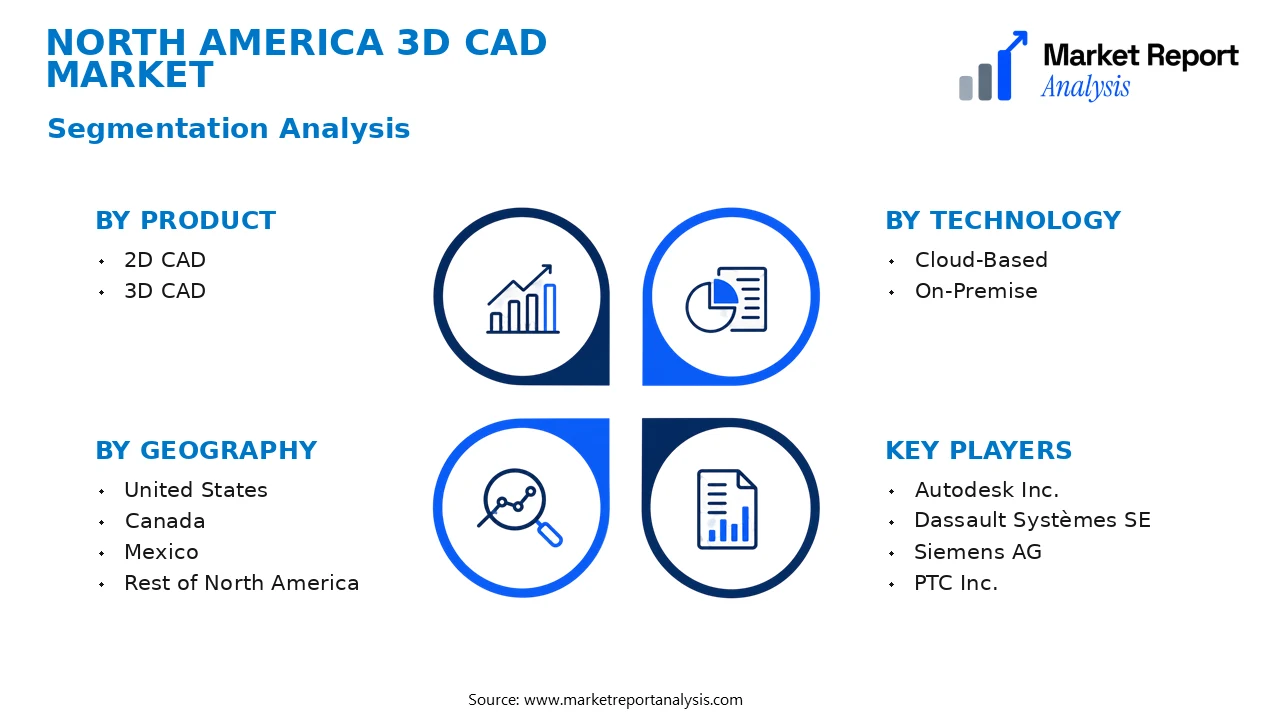
- Product
- 2D CAD: Despite being an older format, 2D CAD remains essential for basic design tasks in industries such as architecture and engineering, offering a lower-cost solution for fundamental drafting needs.
- 3D CAD: The core of this market, 3D CAD software enables complex modeling and visualization, crucial for advanced engineering, product design, and manufacturing processes, fostering high demand across diverse sectors.
- Technology
- Cloud-Based: Cloud-enabled 3D CAD solutions provide scalability, real-time collaboration, and remote access, making them highly favored by modern design teams seeking flexible and cost-effective tools.
- On-Premise: Traditional on-premise solutions are preferred by organizations prioritizing data security and control, especially within highly regulated industries such as aerospace and defense.
- Geography
- United States: As the largest market contributor, the U.S. exhibits high adoption rates driven by robust manufacturing, aerospace, and automotive sectors, supported by advanced technological infrastructure.
- Canada: Canada's market is characterized by increased adoption in oil & gas, mining, and service industries, with a focus on innovative design and engineering solutions to meet regional needs.
- Mexico: The Mexican market shows rapid growth driven by manufacturing expansion, automotive industry, and offshore engineering projects, emphasizing cost-effective and scalable 3D CAD solutions.
- Rest of North America: This segment includes countries such as Bermuda, Greenland, and the Caribbean, where adoption is emerging steadily, primarily for specialized engineering and design applications within niche industries.
Competitive Intelligence
The North America 3D CAD Market is characterized by intense competition among key players including Autodesk, Dassault Systèmes, PTC, Siemens PLM Software, and Bentley Systems. Market concentration remains high, with the top five companies accounting for a significant share of the market, driven by their extensive product portfolios and strong brand recognition. Leading firms pursue aggressive business strategies such as expanding their product offerings through innovation, forming strategic partnerships, and engaging in acquisitions to accelerate technological capabilities and market reach. Innovation centers around integrating advanced features like AI, cloud-based solutions, and real-time collaboration tools to differentiate their products. Many companies are also investing heavily in R&D to develop more intuitive, efficient, and scalable CAD solutions. Partnerships with educational institutions and industry consortia foster ecosystem development and enhance brand loyalty. Expansion strategies include geographical growth in emerging North American regions and diversification into adjacent markets such as manufacturing and automotive sectors. Such competitive moves are aimed at consolidating market positioning and maintaining technological leadership within this rapidly evolving landscape.
Leading Company Profiles
The North America 3D CAD market is characterized by a competitive landscape comprising several key players, each leveraging advanced technologies and strategic initiatives to enhance their market position and meet industry demands effectively.
- Autodesk Inc.
- Dassault Systèmes SE
- Siemens AG
- PTC Inc.
- Hexagon AB
- Bentley Systems Inc.
- Autodesk Construction Cloud
- Trimble Inc.
- Dassault Systèmes SOLIDWORKS
- Creo by PTC
Autodesk Inc.
Autodesk Inc. is a leader in 3D design software, offering a comprehensive suite of products including AutoCAD, Fusion 360, and Revit, focusing on innovation, user experience, and cloud integration to support diverse industry needs.
Dassault Systèmes SE
Dassault Systèmes specializes in 3D design, simulation, and product lifecycle management software, with flagship offerings like CATIA and SOLIDWORKS, emphasizing engineering excellence and digital twin technologies for manufacturing and aerospace sectors.
Siemens AG
Siemens provides advanced CAD solutions integrated with its broader portfolio, including NX and Solid Edge, aimed at automating design workflows, boosting productivity, and enabling digital transformation across industries such as automotive and industrial automation.
PTC Inc.
PTC enhances product development through Creo and Windchill PLM solutions, blending augmented reality and IoT integration to facilitate innovation, improve collaboration, and drive efficiency in manufacturing and engineering environments.
Hexagon AB
Hexagon offers comprehensive CAD and manufacturing software solutions, focusing on digital manufacturing, geospatial data, and metrology, underpinning its strategic emphasis on precision, automation, and data-driven decision making.
Bentley Systems Inc.
Bentley specializes in infrastructure design and engineering software, providing solutions like MicroStation and OpenRoads, with a focus on large-scale civil, transportation, and utilities infrastructure projects.
Autodesk Construction Cloud
Autodesk Construction Cloud integrates design, planning, and construction workflows, offering cloud-based solutions that improve collaboration, project delivery, and data management for the construction sector.
Trimble Inc.
Trimble delivers 3D modeling and surveying solutions tailored for civil engineering, construction, and agriculture, emphasizing precision and sustainable practices through innovative hardware and software integration.
Dassault Systèmes SOLIDWORKS
A crucial segment of Dassault Systèmes, SOLIDWORKS focuses on user-friendly 3D CAD solutions for product design and development, prioritizing ease of use, collaboration, and integrated simulation tools.
Creo by PTC
Creo provides flexible and scalable 3D CAD modeling, simulation, and documentation tools, emphasizing advanced visualization, cloud connectivity, and enterprise service integration to accelerate product innovation.
Strategic Business Developments

- January 2023 – Autodesk Inc. – Launched Autodesk Fusion Cloud, integrating design and collaboration tools for cloud-based workflows – Enhances remote collaboration and reduces project turnaround times.
- April 2023 – Dassault Systèmes SE – Acquired Numeca to bolster simulation capabilities within its 3D design solutions – Accelerates digital twin adoption and simulation-driven design innovations.
- June 2023 – Siemens AG – Announced expansion of NX manufacturing software capacity with new AI-driven automation features – Significantly improves design efficiency and reduces time-to-market.
- August 2023 – PTC Inc. – Launched Vuforia Expert Capture, a new AR-enabled digital work instruction platform – Improves operational training and reduces errors during manufacturing processes.
- October 2023 – Hexagon AB – Invested in new smart manufacturing facilities in North America, focusing on automation and data analytics solutions – Strengthens its position in Industry 4.0 transformation initiatives.
Frequently Asked Questions
What is the North America 3D CAD Market?
The North America 3D CAD Market encompasses the design, development, and deployment of three-dimensional computer-aided design software solutions used across industries such as manufacturing, automotive, aerospace, and construction. It enables precise modeling, simulation, and visualization, facilitating innovation and efficiency.
What is the current market size of North America 3D CAD Market?
As of 2026, the North America 3D CAD Market is valued at approximately USD 8 Billion, driven by expanding adoption in diverse industrial sectors. This valuation reflects ongoing technological advancements and increasing integration of CAD tools into engineering workflows.
What factors are driving the North America 3D CAD Market?
Key growth drivers include the rise of digital transformation initiatives, the need for complex product designs, the growing trend toward automation, and increased investment in innovation by manufacturing and engineering firms. Additionally, advances in cloud-based CAD solutions are enhancing accessibility and collaboration.
Which region dominates the North America 3D CAD Market?
The United States leads the North American market due to its substantial manufacturing base, technological innovation, and presence of major CAD software providers. Canada follows, benefiting from its robust aerospace and automotive sectors adopting 3D CAD solutions.
Which segment is expected to grow the fastest?
The aerospace and defense segment is projected to witness the fastest growth, fueled by high demand for precision engineering and lightweight designs. The automotive segment also shows significant expansion, driven by the shift toward electric vehicles and autonomous driving technologies.
Who are the leading companies operating in the North America 3D CAD Market?
Leading companies include Dassault Systèmes, Autodesk Inc., PTC Inc., Siemens PLM Software, and Hexagon AB. These players hold significant market shares due to their extensive product portfolios, innovative offerings, and strong presence in North America.
Analyst Perspective
The North America 3D CAD market is positioned for steady growth through 2034, driven by continual technological advancements and increased adoption across manufacturing, aerospace, and automotive sectors. As the market matures, early-stage complacency is giving way to a more strategic focus on integration with emerging technologies such as AI, IoT, and cloud computing, which will enhance productivity and innovation. Opportunities abound in customized, domain-specific solutions tailored to the region’s diverse industrial base, particularly in rapid prototyping and digital twin applications. Investment priorities should target R&D for next-generation tools that improve interoperability and user experience, fostering competitive advantages. Regional growth potential remains robust, especially in Mexico and Canada, where manufacturing sees significant automation trends. Nevertheless, intense competition among established players and rapid technological shifts pose risks, demanding sustained innovation and strategic alliances. Long-term success will hinge on balancing technology evolution with market differentiation, aligning product portfolios with regional needs, and maintaining agility amid evolving customer preferences.
