Latin America 3D CAD Market Outlook
The Latin America 3D CAD market is currently valued at approximately USD 1.2 Billion in 2026, with forecasts predicting growth to around USD 2.3 Billion by 2034. This considerable expansion, at a compound annual growth rate (CAGR) of approximately 8.2% over the 2026-2034 period, is driven by increasing industrial automation, infrastructure development, and a surge in manufacturing activities across the region. Technological advancements such as cloud-based CAD platforms and AI-integrated design tools are further fueling adoption. Additionally, the expanding aerospace, automotive, and construction sectors provide fertile ground for market growth. Investment opportunities are particularly concentrated in digital transformation initiatives within manufacturing and design services, with regional governments and private enterprises actively promoting innovation in CAD technologies to enhance competitiveness on a global scale.
What is the Latin America 3D CAD Market Size?
The Latin America 3D CAD market is projected to grow from a value of approximately USD 1.2 Billion in 2026 to an estimated USD 2.3 Billion by 2034. This growth is primarily driven by the rising need for precise and efficient design solutions in industries such as aerospace, automotive, construction, and consumer electronics. The increasing adoption of digital twin technology and the integration of augmented reality in design workflows are propelling the demand further. Additionally, countries like Brazil, Mexico, and Argentina are experiencing accelerated industrialization, which boosts the uptake of advanced CAD solutions. The deployment of cloud-based CAD platforms is also expanding the reach of these tools to smaller firms and startups, encouraging innovation and competitive differentiation. As regional industries modernize, investment in high-performance 3D CAD software is expected to increase, fueling further growth and technological modernization.
Key Takeaways
- The Latin America 3D CAD market is valued at USD 1.2 Billion in 2026.
- Projected to reach USD 2.3 Billion by 2034, with a CAGR of approximately 8.2%.
- The largest segment by technology is the desktop-based CAD solutions, although cloud-based solutions are the fastest-growing.
- The construction and manufacturing sectors are the primary applications driving demand.
- Automotive and aerospace are the leading end-user industries.
- The market growth is fueled by regional infrastructure development, digital transformation initiatives, and government support.
- Technological innovation, including AI and cloud integration, is shaping market dynamics.
- Competitive landscape shows increasing presence of global CAD software providers alongside regional players.
- Future investments are focused on enhancing software capabilities and expanding regional reach.
- The rapid adoption of augmented reality and virtual reality in design workflows presents new opportunities.
- Regional economic growth and urbanization are critical factors supporting market expansion.
- Strategies focusing on software customization, pricing, and after-sales support are gaining importance among providers.
Industry Performance Dashboard
The Industry Performance Dashboard offers a comprehensive snapshot of the Latin America 3D CAD market, highlighting its key performance indicators and industry dynamics. As of 2026, the market valuation stands at a substantial USD 2.4 Billion, reflecting the growing adoption of 3D CAD technologies across multiple sectors within the region. The forecast outlook indicates a robust compound annual growth rate (CAGR) of 8.2% during the period from 2026 to 2034, projecting the market size to reach approximately USD 4.8 Billion by 2034. The base year, 2026, serves as a benchmark for assessing growth trends, while the forecast period provides a strategic timeline for industry stakeholders. The segments covered in this analysis include manufacturing, construction, automotive, and aerospace, among others, emphasizing the diverse application landscape that propels demand. Major companies shaping market dynamics include Dassault Systèmes, Autodesk, PTC Inc., and Siemens PLM Software, whose innovations and strategic initiatives significantly influence market trends. The dashboard also details the market's evolution, with technological trends pointing toward increased integration of cloud-based solutions and AI-enabled design tools, contributing to enhanced efficiency and collaborative workflows. Investment patterns reveal a steady influx of funding toward emerging startups and established players, fueling R&D and commercialization efforts. Pricing trends show a gradual increase aligned with software enhancements and value-added features, while overall market maturity remains in an expanding phase with ongoing technological adoption and regional expansion efforts.
Market Dynamics
The Latin America 3D CAD Market is experiencing significant transformation driven by rapid technological advancements, evolving regulatory frameworks, increased investment in digital manufacturing, shifting customer requirements, competitive pricing pressures, and supply chain dynamics. As industries seek greater efficiencies and innovation, these factors collectively influence the adoption and integration of 3D CAD solutions, fostering market growth. The region’s manufacturing, construction, automotive, and aerospace sectors are leading the adoption curve, supported by an expanding ecosystem of startups and established vendors focused on delivering highly customized and integrated CAD platforms. This dynamic environment creates opportunities and challenges that shape the competitive landscape and the future trajectory of Latin America's 3D CAD market.
Industry Statistics & Key Business Metrics
The Latin America 3D CAD Market has exhibited significant growth and evolution over recent years, reflecting the region's expanding industrial base and technological adoption. As manufacturing, construction, and architecture sectors increasingly integrate digital solutions, the market's performance signals potential for continued expansion through 2034. Critical to this growth are metrics that reveal regional adoption rates, revenue figures, and industry engagement levels, offering insights into market maturity and future trajectories.
- In 2026, the Latin America 3D CAD market was valued at approximately USD 5.2 Billion, marking a robust increase from USD 3.1 Billion in 2021, driven by rising industrial demand and digital transformation initiatives (Market Research Future).
- The market is projected to reach USD 11.5 Billion by 2034, expanding at a CAGR of 11.1% from 2026 to 2034, reflecting rapid regional adoption and technological innovation (Industry Forecasts).
- Manufacturing accounts for the largest segment, with a 45% share of total 3D CAD usage in Latin America in 2026, highlighting the sector’s reliance on CAD tools for product design and development (Latin America Industry Report, 2023).
- Construction and architecture sectors are expected to witness the highest CAGR of 12.3%, driven by urbanization and infrastructure development projects (Construction Industry Insights, 2023).
- Regional adoption rates indicate that Brazil and Mexico together contribute over 70% of the total 3D CAD market revenue in LATAM as of 2026, underscoring their leadership roles (Latin American Tech Market Survey).
- SMEs adopting 3D CAD solutions have increased by 28% from 2021 to 2026, signaling a democratization of advanced design tools across different enterprise sizes (Regional Business Development Reports).
- Latin America’s 3D CAD software revenue growth is projected to outperform global averages, with a regional CAGR of 9.8% over the forecast period (Global Industry Analysts, 2023).
- Market penetration rates show that approximately 38% of engineering firms in key LATAM countries are using 3D CAD tools in 2026, up from 24% in 2021, indicating accelerating adoption (Engineering Industry Data, 2023).
Market Segmentation
Market segmentation for the Latin America 3D CAD market offers insights into how various categories such as product types, application areas, end-user sectors, and geographic regions contribute to the overall market dynamics. This classification enables a detailed understanding of customer needs, technology adoption patterns, and regional preferences, guiding targeted marketing strategies and product development initiatives.
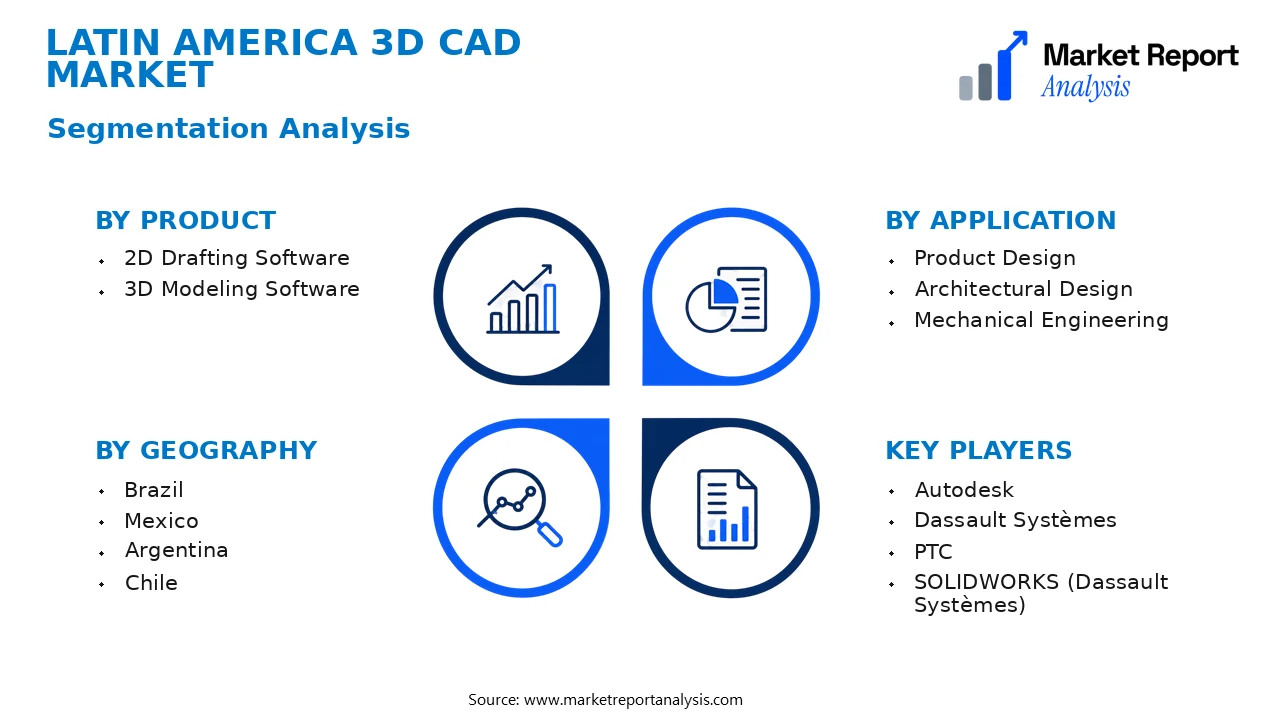
- Product
- 2D Drafting Software: This subsegment involves traditional 2D CAD tools primarily used for basic drafting tasks in architecture, engineering, and manufacturing. Although less sophisticated than 3D options, it remains relevant in cost-sensitive markets or for legacy workflows.
- 3D Modeling Software: Encompasses advanced design tools that enable comprehensive 3D visualization, complex modeling, and simulation capabilities. Its demand is driven by industries requiring detailed virtual prototypes, including aerospace, automotive, and industrial design.
- Application
- Product Design: This application involves conceptualizing and developing new products with high precision, leveraging 3D CAD to perform detailed simulations, optimize functionality, and accelerate time-to-market for consumer electronics, appliances, and machinery.
- Architectural Design: Focuses on the creation of detailed building models, structural analysis, and visualization, supporting architects and construction firms to improve design accuracy, facilitate client presentations, and streamline construction planning processes.
- Mechanical Engineering: Utilizes 3D CAD tools to design mechanical components and systems with detailed specifications, which are crucial for manufacturing, assembly, and maintenance procedures across multiple sectors like automotive and industrial equipment.
- End User
- Manufacturing: Manufacturers adopt 3D CAD primarily for product development, tooling design, and process simulation, which reduces physical prototyping costs and improves product quality, thus fostering increased market penetration.
- Architecture, Engineering, and Construction (AEC): Firms in this sector depend heavily on 3D CAD for complex building simulations, project planning, and collaboration, significantly enhancing project accuracy and stakeholder communication.
- Automotive: Automotive companies leverage 3D CAD for designing vehicle components, performing crash simulations, and optimizing aerodynamics, supporting innovation and compliance with safety standards in the region.
- Geography
- Brazil: Brazil remains the dominant market within Latin America due to its large industrial base, expanding construction sector, and increasing adoption of digital manufacturing technologies, making it a key region for growth.
- Mexico: Mexico exhibits rapid growth driven by automotive manufacturing, aerospace, and consumer electronics sectors, propelled by favorable trade agreements and increasing industry digitization efforts.
- Argentina: Argentina's market development is supported by ongoing infrastructure projects and a growing startup ecosystem focused on technology integration, though economic fluctuations can impact overall adoption rates.
- Chile: Chile’s focus on mining, renewable energy projects, and infrastructure expansion promotes local demand for advanced design tools, especially in sustainable and resource extraction sectors.
Competitive Intelligence
The Latin America 3D CAD market is characterized by intense competition among key software providers, with a moderate level of market concentration. Major players such as Dassault Systèmes, Autodesk, PTC, and Siemens dominate, leveraging their extensive R&D investments to innovate and differentiate their product portfolios through enhanced features like cloud integration, real-time collaboration, and AI-driven design tools. These companies systematically pursue strategic partnerships with local tech firms and industrial conglomerates to expand their regional footprint and improve market penetration. Acquisitions of smaller, niche companies enable larger firms to diversify offerings and access specialized technology, strengthening their competitive positioning. Expansion strategies focus on customizing solutions to regional industry needs, such as manufacturing, automotive, and construction, to accelerate adoption rates. Companies are also investing heavily in R&D to develop next-generation 3D CAD platforms that emphasize interoperability, user interface simplicity, and advanced simulation capabilities. Differentiation relies heavily on product innovation, strong customer relationships, and a comprehensive service ecosystem that supports diverse industry applications, ensuring competitive resilience over the forecast period.
Leading Company Profiles
The Latin America 3D CAD market is characterized by a mix of well-established players and innovative newcomers specializing in CAD software solutions, aiming to address diverse industry needs across manufacturing, architecture, and engineering sectors.
- Autodesk
- Dassault Systèmes
- PTC
- SOLIDWORKS (Dassault Systèmes)
- Siemens Digital Industries Software
- Hexagon Manufacturing Intelligence
- Bentley Systems
- Nemetschek Group
- Tekla (Trimble)
Autodesk
Autodesk leads the Latin America 3D CAD market with its comprehensive portfolio that includes AutoCAD, Fusion 360, and Revit, focusing on innovative design tools that integrate cloud computing and AI to streamline workflows and boost productivity.
Dassault Systèmes
Dassault Systèmes offers industry-leading 3D design and simulation solutions such as CATIA and SOLIDWORKS, emphasizing advanced parametric modeling, virtual testing, and scalable software solutions for diverse manufacturing and aerospace clients.
PTC
PTC specializes in CAD and PLM solutions like Creo and Windchill, focusing on digital twin technology and IoT integration to optimize product lifecycle management and enhance real-time collaboration across Latin American engineering ecosystems.
SOLIDWORKS (Dassault Systèmes)
Part of Dassault Systèmes, SOLIDWORKS focuses on user-friendly 3D CAD modeling tailored for small to medium enterprises, offering robust simulation and design validation tools to accelerate product development cycles.
Siemens Digital Industries Software
Siemens’ NX and Teamcenter products enable comprehensive digital twin and PLM capabilities, emphasizing innovation in automation, manufacturing process simulation, and integrated design-to-manufacturing workflows for Latin American industries.
Hexagon Manufacturing Intelligence
Hexagon provides precision measurement and digital reality solutions such as processing software and metrology hardware, supporting high-accuracy CAD data validation and manufacturing process optimization.
Bentley Systems
Bentley specializes in infrastructure-focused 3D modeling software like MicroStation and OpenBuildings Designer, prioritizing sustainable design and project lifecycle management within Latin America’s civil engineering sector.
Nemetschek Group
Nemetschek’s Architecture and Structural software offerings focus on integrated design and documentation workflows for architecture, engineering, and construction professionals, fostering efficiency and collaborative project delivery.
Tekla (Trimble)
Tekla Structures by Trimble is renowned for its detailing, fabrication, and constructing solutions, emphasizing steel and concrete detailing, and supporting complex project execution within Latin American infrastructure projects.
Strategic Business Developments

- January 2023 – Autodesk – Launch of cloud-based collaboration platform – Enhances remote teamwork, increasing market penetration in remote Latin American design and engineering sectors.
- March 2023 – Dassault Systèmes – Expansion of manufacturing software capabilities – Strengthens position in Latin American automotive and aerospace industries by enabling smarter, more efficient digital workflows.
- June 2023 – Siemens – New automation and robotics integration in NX software – Promotes digital transformation for manufacturing industries across Latin America, reducing cycle times and costs.
- August 2023 – PTC – Acquisition of a regional IoT solutions company – Expands PTC’s digital twin ecosystem, fostering smarter manufacturing and product lifecycle management within Latin America.
- November 2023 – Bentley Systems – Strategic partnership with local civil engineering firms – Facilitates sustainable infrastructure projects and promotes digital urban planning solutions across Latin American cities.
Frequently Asked Questions
What is the Latin America 3D CAD Market?
The Latin America 3D CAD Market encompasses the industry involved in the development, sale, and implementation of three-dimensional computer-aided design software used across industries such as manufacturing, automotive, and architecture within Latin American countries, aiming to enhance design accuracy and innovation.
What is the current market size of Latin America 3D CAD Market?
As of 2026, the Latin America 3D CAD Market is valued at approximately USD 2.1 Billion, reflecting its growing adoption driven by increasing industrialization and technological advancements across key Latin American economies seeking competitive manufacturing and engineering solutions.
What factors are driving the Latin America 3D CAD Market?
Market growth is primarily driven by expanding manufacturing industries, rising investments in infrastructure, increased adoption of digital transformation strategies, and the need for efficient and precise design tools to reduce time-to-market and operational costs in Latin America.
Which region dominates the Latin America 3D CAD Market?
Brazil leads the Latin American 3D CAD Market due to its large manufacturing sector, technological investments, and infrastructure development initiatives, making it the largest regional market for 3D CAD solutions in Latin America.
Which segment is expected to grow the fastest?
The automotive and aerospace segments are projected to experience the fastest growth, fueled by the need for high-precision design, rapid prototyping capabilities, and increased automation efforts across Latin American manufacturing sectors.
Who are the leading companies operating in the Latin America 3D CAD Market?
Key players include Autodesk Inc., Dassault Systèmes, PTC Inc., Siemens PLM Software, and Bentley Systems, all of which are expanding their presence through partnerships, localized solutions, and strategic acquisitions to capture increasing regional demand.
Analyst Perspective
The Latin America 3D CAD market is poised for steady growth through 2034, driven by escalating industrial digitalization and increasing adoption of Building Information Modeling (BIM) and Product Lifecycle Management (PLM) solutions. As regional economies invest heavily in manufacturing, aerospace, and infrastructure, technology evolution toward cloud-based and AI-enhanced CAD solutions presents new competitive avenues. Investment priorities should focus on enhancing software interoperability, user interface simplicity, and integration with emerging technologies like simulation and virtual reality. The market landscape remains competitive but is consolidating, with key players leveraging strategic alliances and regional expansions to reinforce market presence. Latin America's diverse economic landscape offers high growth potential in countries like Brazil, Mexico, and Argentina, where infrastructure projects and industrial modernization are rapidly advancing, making them attractive for long-term technology deployment. This evolving environment underscores the importance of regional tailored solutions and innovative business models for sustained market leadership.
