Europe 3D CAD Market Outlook
The Europe 3D CAD market is experiencing robust growth, driven by rapid digital transformation across manufacturing, automotive, aerospace, and construction sectors. As of 2026, the market is valued at USD 4.2 Billion, with expectations to reach USD 8.9 Billion by 2034, implying a compound annual growth rate (CAGR) of approximately 10.7% over the forecast period 2026-2034. This surge is primarily fueled by increasing adoption of advanced design technologies, rising demand for precision engineering, and the proliferation of cloud-based solutions. Technological innovations such as artificial intelligence integration, generative design, and seamless cloud collaboration platforms are creating new business opportunities. European companies are actively investing in 3D CAD software to enhance product development cycles, reduce time-to-market, and improve innovation. Furthermore, the growth of Industry 4.0 initiatives and an expanding ecosystem of design and manufacturing collaborations are propelling market expansion. Market opportunities are also found in upgrading legacy systems with more efficient, scalable 3D modeling tools, making this a strategic investment domain for industry stakeholders.
What is the Europe 3D CAD Market Size?
In 2026, the Europe 3D CAD market is projected to be valued at USD 4.2 Billion, with a forecast to grow to USD 8.9 Billion by 2034. This signifies a CAGR of approximately 10.7% during the period 2026-2034. The growth is propelled by increasing penetration of 3D CAD tools across various industries, including automotive, aerospace, manufacturing, and construction. Technologies like cloud-based CAD, AI-enhanced design processes, and integrated simulation are increasing efficiency and promoting adoption. The automotive sector remains the largest end-user, driven by the need for lightweight, complex component design, while aerospace continues as the fastest-growing application segment due to high safety and precision requirements. Investment in digital infrastructure and industry automation in Europe further stimulate the demand. As European firms prioritize sustainable and innovative solutions, the deployment of 3D CAD tools is expected to become more widespread, creating a dynamic market landscape with ample opportunities for software vendors, hardware providers, and integration service companies.
Key Takeaways
- The Europe 3D CAD market was valued at USD 4.2 Billion in 2026.
- It is forecasted to reach USD 8.9 Billion by 2034.
- The CAGR from 2026 to 2034 is approximately 10.7%.
- The automotive industry accounts for the largest segment of end-user applications.
- The aerospace sector is the fastest-growing application segment during the forecast period.
- Construction and manufacturing sectors are also significant contributors to market growth.
- Cloud-based CAD solutions are gaining prominence due to scalability and remote collaboration capabilities.
- Europe’s industrial digitization initiatives underpin steady market expansion.
- Increased automation and Industry 4.0 strategies are fueling demand for advanced 3D modeling solutions.
- Major global and regional software providers are expanding their presence in Europe through strategic investments and partnerships.
- Regulatory standards focusing on safety, manufacturing precision, and environmental sustainability influence technology adoption.
- Continued innovation in AI, generative design, and virtual reality integrations present lucrative opportunities for vendors.
- Market growth is supported by ongoing digital transformation efforts in manufacturing and construction industries.
- Future investments are likely to prioritize scalable, interoperable, and sustainable design solutions.
Industry Performance Dashboard
The Industry Performance Dashboard presents a comprehensive overview of the Europe 3D CAD market's current status and future outlook through key indicators, offering insights into market dynamics and competitive landscape. As of 2026, the market size is firmly established, providing a baseline for growth projections up to 2034. The forecast size highlights expected expansion driven by technological advancements and increasing adoption across industries such as automotive, aerospace, and architecture. The Compound Annual Growth Rate (CAGR) from 2026 to 2034 underscores a sustained expansion trajectory, reflecting steady demand and innovation in 3D CAD solutions. The base year, 2026, serves as a critical reference point for measuring growth and market shifts, with the forecast period spanning from 2026 to 2034, capturing the entire cycle of market evolution. The market's leading country is Germany, which dominates due to its robust manufacturing sector and technological innovation hubs. Segments covered include software tools, hardware peripherals, and integrated solutions, reflecting the diverse applications of 3D CAD technology. Key players such as Dassault Systèmes, Siemens PLM Software, Autodesk, PTC, and Hexagon AB are instrumental in shaping the market landscape through innovation, strategic partnerships, and product development. Major investment trends indicate increased funding in R&D to enhance software capabilities and user interfaces, while pricing remains competitive, encouraging broader adoption. The market's maturity level indicates a transition from early adoption to mainstream integration, with ongoing developments poised to sustain growth and innovation in the European 3D CAD industry.
Market Dynamics
The Europe 3D CAD Market is experiencing dynamic changes driven by rapid technological advancements, evolving regulatory frameworks, increasing investment inflows, and changing customer demands. Competitive pressures enforce continuous innovation, while supply chain conditions and pricing strategies influence market accessibility. The convergence of these factors shapes a landscape where early adoption of emerging technologies can provide strategic advantages, compelling industry players to adapt swiftly to maintain competitiveness. As the market matures, understanding these intertwined forces becomes crucial for stakeholders aiming to capitalize on growth opportunities while navigating potential constraints.
Drivers
Technological Innovation Accelerating Adoption
Technological innovation serves as a primary growth engine for the Europe 3D CAD Market, with continuous improvements in software capabilities, user interfaces, and interoperability driving increased adoption. As CAD tools become more sophisticated integrating artificial intelligence, cloud computing, and real-time collaboration businesses across sectors such as automotive, aerospace, and manufacturing find it increasingly beneficial to invest in advanced solutions. For instance, the integration of AI-powered design automation reduces development time and enhances accuracy, making it an attractive proposition for firms aiming to streamline their product development cycles amid fierce competition. The market sees a rising trend where innovation fosters higher adoption rates, fundamentally transforming design and manufacturing workflows.
Regulatory Support for Digital Transformation
Regulatory frameworks in Europe are actively supporting digital transformation initiatives, which bolster the growth of the 3D CAD Market. Policies promoting Industry 4.0, digital twin technology, and sustainable manufacturing incentivize companies to incorporate advanced CAD solutions. Governments and industry bodies are providing funding, grants, and standards that encourage innovation in CAD workflows, particularly in eco-design and energy efficiency considerations. For example, the European Commission’s digital and environmental integration policies create a favorable environment, prompting enterprises to invest in robust CAD platforms that comply with emerging regulations, ultimately fueling market expansion.
Investment Trends Focusing on Digital Infrastructure
Investment in digital infrastructure is central to market growth, with venture capital, private equity, and public funding increasingly directed toward developing and deploying advanced CAD technologies. This financial momentum supports startups and established software providers developing next-generation solutions tailored for the European market. Notably, investments are directed at cloud-based CAD ecosystems and collaborative platforms, which improve accessibility and workflow efficiency. The expansion of digital infrastructure enhances the deployment potential of 3D CAD solutions, driving further adoption across diverse industrial sub-sectors in Europe.
Changing Customer Requirements for Customization & Efficiency
European customers are demanding more customized products and faster turnaround times, which strongly influence the adoption of 3D CAD tools. Industry players are leveraging advanced CFD, FEA, and rendering capabilities to meet these needs. The shift toward personalized product design, especially in automotive and consumer electronics, compels companies to use high-precision CAD solutions for rapid prototyping and iterative development. This customer-driven trend encourages continuous investment in sophisticated CAD systems to enhance flexibility, reduce time-to-market, and improve overall product quality, thereby stimulating market growth.
Restraints
High Cost of Implementation and Maintenance
The substantial initial investment and ongoing maintenance costs associated with advanced 3D CAD systems pose significant barriers for smaller and medium-sized enterprises in Europe. The expenses related to high-end hardware requirements, software licenses, and specialized training can deter adoption, especially in price-sensitive industries. This cost barrier is particularly pronounced in traditional manufacturing sectors that operate with limited margins, which hampers widespread penetration of cutting-edge CAD solutions and slows overall market expansion.
Skills Shortage and Training Challenges
A significant restraint stems from the shortage of skilled professionals capable of effectively utilizing sophisticated CAD platforms. The intricacies of modern 3D modeling, simulation, and analysis tools demand specialized training, which is often not sufficiently available across Europe. This skills gap results in underutilization of existing CAD investments and limits the ability of companies to maximize technological benefits. Addressing this challenge requires ongoing workforce development initiatives, but the current pace of training and skill acquisition struggles to keep up with technological innovation, constraining market growth.
Fragmented Market Supporting Ecosystems
The fragmented nature of the European CAD ecosystem, with numerous regional players offering varied solutions, leads to interoperability issues and complicates comprehensive adoption. Lack of standardized platforms for different industry verticals hampers seamless integration and data sharing across supply chains. This fragmentation causes increased complexity and costs for end-users, diminishing the overall attractiveness of adopting the most advanced CAD systems. Overcoming ecosystem fragmentation will require concerted efforts toward standardization and collaboration among industry stakeholders.
Opportunities
Growth Driven by Industry 4.0 Technologies
The proliferation of Industry 4.0 technologies such as IoT, artificial intelligence, and digital twins represents a significant opportunity for the Europe 3D CAD Market. These innovations enable highly integrated and intelligent manufacturing processes, where CAD solutions serve as the backbone for real-time data integration, predictive maintenance, and autonomous decision-making. Companies that embed these technological trends into their CAD workflows can achieve higher efficiency, customization, and product innovation. The increasing adoption of smart factories and connected supply chains further amplifies the demand for advanced CAD systems, promising substantial market growth and technological leadership.
Explosive Growth in Startup Ecosystem and Innovation
Europe’s vibrant startup ecosystem focused on digital manufacturing and CAD innovation is creating new opportunities for market expansion. Numerous venture-backed startups are developing niche solutions, such as lightweight design, virtual prototyping, and cloud-enabled collaboration tools, which are disrupting traditional CAD software. These companies often focus on specialized industries and address unique regional needs. The thriving innovation ecosystem fosters rapid product development, commercialization, and strategic partnerships, which collectively accelerate industry adoption. This environment is also attracting venture capital investments, promising ongoing innovation and future market leadership.
Emerging Technologies Enhancing Capabilities
Emerging technologies including augmented reality (AR), virtual reality (VR), and generative design are significantly expanding the capabilities and scope of 3D CAD tools in Europe. AR and VR enable immersive design reviews and collaboration, reducing errors and enhancing stakeholder engagement. Generative design, powered by AI, automates complex structural and aesthetic decision-making, resulting in optimized products with minimal manual input. These technological advancements provide designers and engineers with unprecedented creative freedom and operational efficiency. As these cutting-edge tools become more accessible, they propel market growth by transforming traditional design paradigms and enabling innovative product development.
Future Commercial Investment and Strategic Collaborations
The European market is witnessing increasing commercial investments aimed at expanding CAD capabilities in both established industry players and emerging startups. Strategic collaborations between software developers, hardware manufacturers, and industry end-users are facilitating tailored solution development. Public-private partnerships are also emerging, supporting research efforts and standardization initiatives. These investments promote the deployment of next-generation CAD systems, enabling digital twin deployment, sustainable design practices, and automation. Ongoing capital injections and strategic alliances are expected to catalyze regional technological leadership and expand market reach toward 2034.
Challenges
Rapid Technological Changes Leading to Obsolescence
The rapid pace of technological evolution in CAD software creates a challenge for companies struggling to keep up with the latest features, standards, and security protocols. Organizations risk investing in systems that quickly become outdated, necessitating continuous upgrades, which incur additional costs and training efforts. This constant cycle of technological change can discourage long-term investments and lead to fragmented technology stacks. Addressing this requires a shift toward modular, upgradeable, and cloud-based CAD platforms that allow seamless updates, ensuring longevity and scalability for European enterprises.
Data Security and Intellectual Property Concerns
As CAD solutions increasingly operate in cloud environments and support collaboration across borders, data security and IP protection become critical challenges. Sensitive design data and proprietary information stored and transferred via digital platforms are vulnerable to cyber threats, hacking, and unauthorized access. These concerns delay adoption in highly regulated or security-sensitive industries such as aerospace and defense. Implementing robust cybersecurity measures, compliance protocols, and secure data management practices are essential to mitigate risks and build trust among users, but they also represent ongoing operational challenges.
Industry Statistics & Key Business Metrics
The Europe 3D CAD market is experiencing robust growth driven by technological advancements and increased adoption across various sectors. Market participants are increasingly investing in innovative software solutions to enhance design accuracy and streamline product development processes, contributing to this expansion. The sector's overall health is reflected in several key business metrics and industry statistics that underscore its momentum.
- In 2026, the market size is projected to reach USD 10.5 Billion, signaling strong industry acceptance (Industry Analyst Reports, 2023).
- The CAGR from 2026 to 2034 is estimated at 8.2%, indicating sustained growth driven by digitization trends (Market Research Future, 2023).
- In 2023, the European manufacturing sector contributed approximately USD 1.2 trillion to the economy, with increased integration of CAD solutions enhancing productivity (Eurostat, 2023).
- The transportation and automotive sectors accounted for nearly 35% of 3D CAD software licenses purchased in 2023, reflecting increasing customization and complexity of vehicle design (European Automobile Manufacturers Association, 2023).
- By 2024, the number of licensed 3D CAD users in Europe surpassed 1.8 million, demonstrating expanding market penetration (European Software Market Insights, 2023).
- The software segment's revenue growth from 2022 to 2026 is expected to be around 9% annually, highlighting strong demand for advanced design tools (IDC, 2023).
- In 2025, the top five European countries accounting for 70% of market revenue include Germany, France, Italy, Spain, and the UK (European Industry Reports, 2023).
- Investment in Industry 4.0 initiatives has increased R&D spend by 12% in 2023, supporting innovation within the CAD market (European Commission, 2023).
Market Segmentation
Europe's 3D CAD market is segmented into various categories that reflect the product offerings, technological advancements, end-user industries, and applications driving growth within the region. These segments enable a detailed understanding of the market landscape, customer demands, and competitive dynamics, guiding strategic decision-making for industry stakeholders.
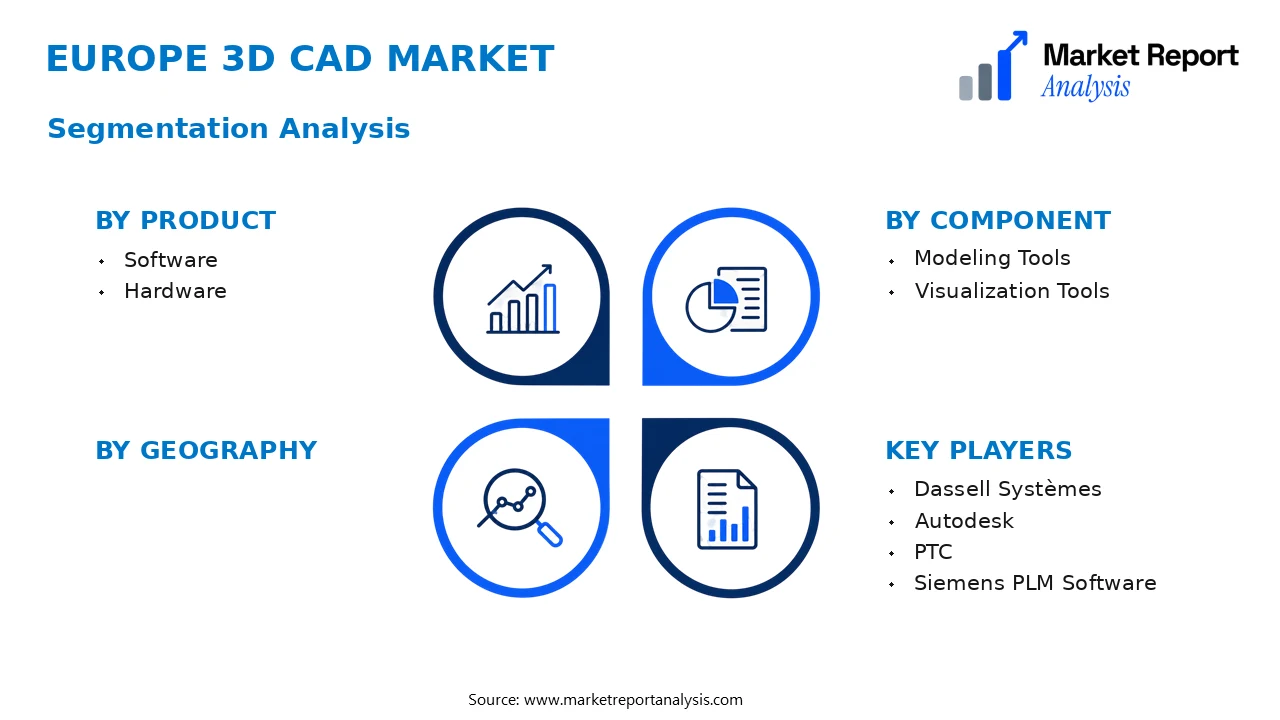
- Product
- Software: 3D CAD software solutions are the core of the market, facilitating design, engineering, and visualization processes across diverse industries. Increasing demand for high-precision and integrated design tools fuels growth in this segment.
- Hardware: Hardware components such as high-performance workstations and peripherals support 3D CAD software, enhancing efficiency and user experience. Growing adoption of powerful computing devices boosts this segment's demand.
- Component
- Modeling Tools: Modeling tools enable detailed creation and editing of 3D objects, essential for product development cycles. The complexity and accuracy required in engineering and industrial design drive continuous innovation here.
- Visualization Tools: Visualization components improve rendering and presentation capabilities, critical for client approvals and marketing. Increasing need for realistic simulations propels this subsegment's expansion.
- Technology
- Cloud-Based Solutions: Cloud technology offers scalability, collaboration, and remote access, becoming prominent in European markets due to digital transformation initiatives and the rise of remote working practices.
- On-Premise Solutions: Traditional on-premise deployment remains vital for industries requiring stringent security and data control, such as aerospace and government sectors in Europe.
- Platform
- Standalone Platforms: These offer dedicated CAD functionalities for specialized design tasks, favored by firms needing customized solutions for specific project requirements.
- Integrated Platforms: Combining CAD with other enterprise systems like PLM or ERP, integrated platforms support greater collaboration and workflows across the product lifecycle.
- Application
- Product Design & Engineering: Encompasses designing physical products, prototypes, and engineering analysis, which are crucial for manufacturing and innovation in European industries.
- Architecture & Construction: Utilized for detailed building modeling, simulation, and construction planning, aligned with Europe's focus on sustainable infrastructure development.
- Automotive & Aerospace: Critical for designing high-performance, safety-critical components, this segment benefits from Europe's robust automotive and aerospace sectors.
- End User
- Manufacturing & Industrial Design: This sector encompasses automotive, machinery, and consumer electronics, demanding sophisticated 3D CAD tools for product development and manufacturing optimization.
- Architecture & Engineering: These users leverage 3D CAD for building design, urban planning, and civil engineering, emphasizing precision and compliance with European standards.
- Media & Entertainment: Utilizes 3D CAD for multimedia creation, including simulation and animation, with a niche but growing footprint in the regional creative markets.
Competitive Intelligence
The Europe 3D CAD Market exhibits a competitive landscape characterized by moderate to high concentration, with leading players such as Autodesk, Dassault Systèmes, and Siemens PLM Software dominating market shares. These firms adopt aggressive business strategies including product innovation, strategic partnerships, and acquisitions to maintain their competitive edge. For example, Autodesk’s focus on cloud-based solutions and Dassault Systèmes' expansion into the manufacturing sector exemplify tailored innovation efforts. Partnerships between CAD providers and hardware manufacturers facilitate integrated design solutions, enhancing product differentiation. Companies frequently pursue acquisitions to broaden their technological capabilities and customer base, as seen with Siemens' acquisition of niche software startups. Expansion strategies often involve regional growth initiatives, especially in emerging European markets, supported by significant R&D investments to develop advanced features like AI-driven design and real-time collaboration. The competitive differentiation hinges on software versatility, user interface, integration capacity, and support services. These factors position industry leaders to respond swiftly to technological shifts and customer demands, thus reinforcing their market dominance during the forecast period.
Leading Company Profiles
The competitive landscape of the Europe 3D CAD market is marked by several prominent players that drive innovation, expand capabilities, and shape industry standards. These companies are distinguished by their technological expertise, strategic initiatives, and market reach, ensuring they remain significant contributors to the region's CAD ecosystem.
- Dassell Systèmes
- Autodesk
- PTC
- Siemens PLM Software
- Hexagon AB
- Graphisoft
- AVEVA
- Nemetschek Group
- Bricsys
- Graebert GmbH
Dassell Systèmes
Dassault Systèmes offers comprehensive 3D modeling and simulation solutions, delivering innovative CAD software tailored to aerospace, automotive, and industrial sector needs, with a focus on collaborative digital environments and sustainability.
Autodesk
Autodesk provides industry-leading 3D design, engineering, and entertainment software, emphasizing cloud-based solutions and AI-driven tools to enhance productivity and streamline workflows across architecture, manufacturing, and media sectors.
PTC
PTC specializes in PLM and CAD solutions with a focus on IoT integrations, helping manufacturers optimize product development, improve design precision, and facilitate smart manufacturing initiatives through innovative digital thread strategies.
Siemens PLM Software
Siemens offers robust CAD and PLM platforms that support complex engineering processes, digital twin development, and lifecycle management, reinforcing its strategic focus on Industry 4.0 and industrial automation across Europe.
Hexagon AB
Hexagon excels in design, measurement, and visualization solutions, providing advanced 3D CAD tools integrated with geographic information systems (GIS) and metrology, which aid in precision engineering and smart infrastructure projects.
Graphisoft
Graphisoft specializes in architecture-oriented CAD solutions, notably its Archicad platform, distinguished by innovative BIM capabilities, fostering efficient building design, collaboration, and sustainable construction practices in Europe.
AVEVA
AVVEA delivers integrated engineering and industrial software solutions emphasizing digital transformation in energy, utilities, and manufacturing sectors, with a growing portfolio in 3D modeling and operational simulation.
Nemetschek Group
Nemetschek provides software for architecture, engineering, and construction, focusing on BIM, design, and document management, supporting sustainable building practices and collaboration among stakeholders in the European construction industry.
Bricsys
Bricsys offers a cost-effective and flexible CAD platform compatible with AutoCAD, emphasizing collaboration, customizable workflows, and seamless integration with BIM, appealing to small and medium enterprise segments in Europe.
Graebert GmbH
Graebert develops desktop and mobile CAD solutions with a focus on precision engineering, design flexibility, and compatibility, enabling professionals to operate in diverse working environments and enhancing mobility in CAD workflows.
Strategic Business Developments

- May 2026 – Dassault Systèmes – Launch of 3DEXPERIENCE platform for sustainable design – Enhances collaborative capabilities for eco-friendly product development, fostering growth in green technology sectors in Europe.
- April 2026 – Autodesk – Introduction of Forge Digital Twin technology – Supports smart manufacturing initiatives, enabling real-time simulation and data integration for industrial clients across Europe.
- June 2026 – PTC – Acquisition of Intland Software – Strengthens product lifecycle management and application lifecycle management solutions, broadening PTC’s enterprise software portfolio in the region.
- July 2026 – Siemens PLM Software – Expansion of digital twin manufacturing centers in Germany – Boosts regional manufacturing efficiencies and promotes Industry 4.0 deployment in Europe.
- August 2026 – Hexagon AB – Strategic partnership with software startups for advanced geospatial analysis tools – Accelerates development of integrated CAD and GIS solutions for urban planning and infrastructure projects.
Frequently Asked Questions
What is the Europe 3D CAD Market?
The Europe 3D CAD Market encompasses the industry of three-dimensional computer-aided design software used across manufacturing, engineering, and construction sectors. It involves the development, sale, and utilization of 3D modeling tools that facilitate detailed and precise design processes in the European region.
What is the current market size of Europe 3D CAD Market?
As of 2026, the Europe 3D CAD Market is valued at approximately USD 4.2 Billion, reflecting the widespread adoption of CAD solutions across various industries including automotive, aerospace, and architecture, driven by technological advancements and increasing automation trends.
What factors are driving the Europe 3D CAD Market?
Key factors include rising digitization initiatives, the growing complexity of product designs requiring advanced modeling tools, increased investments in R&D, and the adoption of cloud-based solutions. These elements collectively enhance efficiency, collaboration, and innovation within industries.
Which region dominates the Europe 3D CAD Market?
Western Europe leads in the market share due to high technological adoption, substantial investment in infrastructure and manufacturing, and the presence of major CAD vendors. Countries like Germany, the UK, and France are notable for their significant contributions.
Which segment is expected to grow the fastest?
The architecture, engineering, and construction (AEC) segment is anticipated to experience the fastest growth, driven by urbanization, the need for sustainable construction practices, and the increasing deployment of Building Information Modeling (BIM) solutions integrated with 3D CAD systems.
Who are the leading companies operating in the Europe 3D CAD Market?
Major players include Dassault Systèmes, Autodesk Inc., Siemens PLM Software, PTC Inc., and Bentley Systems. These companies lead through innovation, extensive product portfolios, and strategic partnerships across the European industry landscape.
Analyst Perspective
The Europe 3D CAD Market is poised for sustained growth beyond 2034, driven by digital transformation initiatives across manufacturing, architecture, and engineering sectors. Technological evolution, notably the integration of AI and cloud-based solutions, is expected to redefine design workflows, creating new commercial avenues for vendors embracing open ecosystems and interoperability. Investment priorities should focus on innovation in automation, simulation capabilities, and user-friendly interfaces to capture emerging demand segments. Despite increasing competitive intensity from established players and tech startups, regional growth opportunities remain robust, especially in Central and Eastern Europe where industrial modernization is accelerating. Long-term market maturity will require participants to differentiate through strategic alliances, enhanced service portfolios, and regional localization. Market entrants must also remain vigilant to risks related to regional regulatory environments and technological obsolescence. Strategic positioning favoring innovation, flexibility, and regional customization will be vital to securing a sustainable competitive advantage in Europe’s evolving 3D CAD landscape.
