Brazil 3D CAD Market Outlook
The Brazil 3D CAD market is currently valued at approximately USD 1.2 Billion and is projected to reach USD 2.5 Billion by 2034, reflecting a CAGR of around 9.3% during the period from 2026 to 2034. This growth is primarily driven by increasing demand for advanced design solutions across industries such as manufacturing, automotive, aerospace, and construction. Technological innovations, including cloud-based CAD platforms and integration with simulation tools, are further propelling market expansion. Additionally, rising investments in digital transformation initiatives by Brazilian enterprises, coupled with government incentives to modernize manufacturing capabilities, present significant commercial opportunities for CAD solutions providers. As industries increasingly adopt 3D modeling to enhance precision and reduce time-to-market, the Brazil 3D CAD market is set for substantial growth and technological evolution over the forecast period.
What is the Brazil 3D CAD Market Size?
In 2026, the Brazil 3D CAD market is estimated to be worth around USD 1.2 Billion, with forecast growth pushing its valuation to approximately USD 2.5 Billion by 2034. This signifies a steady CAGR of 9.3% over the period. Market growth is predominantly driven by the increased adoption of 3D CAD solutions by manufacturing firms seeking to optimize product development and reduce costs. The expanding automotive, aerospace, architecture, and engineering sectors are key end-user segments fueling demand. Technological advancements featuring cloud computing, artificial intelligence, and machine learning within CAD platforms are enhancing user productivity and collaboration. Furthermore, the rising focus on digital twin technology and simulation capabilities to improve product performance is spurring investments in sophisticated CAD solutions. As digital transformation accelerates across Brazil’s industrial landscape, current investments indicate strong future growth potential, particularly as local businesses seek competitive edges through innovative design practices. Overall, the market size reflects both existing technological adoption and considerable future opportunities for CAD developers focusing on the Brazilian market.
Key Takeaways
- The Brazil 3D CAD market is valued at USD 1.2 Billion in 2026, with expected growth to USD 2.5 Billion by 2034.
- The CAGR over the forecast period (2026-2034) is approximately 9.3%, indicating robust market expansion.
- Key demand drivers include automotive, aerospace, manufacturing, and construction industries modernizing through digital tools.
- Technological trends such as cloud-based solutions and AI are transforming market offerings and user efficiencies.
- Increasing governmental and private sector investments in digital infrastructure bolster growth prospects.
- The market trend reflects a shift toward integrated simulation, visualization, and cloud-enabled workflows.
- Regional adoption varies, with significant activity in Sao Paulo, Rio de Janeiro, and industrial hubs in southern Brazil.
- Emerging local CAD vendors and global players vie for market share through strategic alliances and technological innovation.
- Regulatory policies favoring Industry 4.0 initiatives support sustained market development.
- The construction sector's adoption of 3D modeling for project management and design validation constitutes a key segment.
- Ongoing investments in workforce upskilling and technology R&D are expected to sustain market dynamism.
- Future opportunities include expansion into new sectors such as healthcare, energy, and smart city development.
Industry Performance Dashboard
The Industry Performance Dashboard offers a comprehensive overview of the Brazil 3D CAD Market's current standing and projections, encapsulating vital metrics that inform strategic decision-making and market analysis. With a focus on quantifiable data, this dashboard provides clarity on market valuation, growth forecasts, and industry dynamics. The market size in 2025, the current year, along with the forecasted size in 2034, highlights steady growth trajectories, driven by advancing technologies and expanding adoption across sectors. The Compound Annual Growth Rate (CAGR) for 2026-2034 underscores a robust expansion, reinforcing Brazil’s strategic position within the global 3D CAD landscape. The Base Year (2026) anchors the data, ensuring consistency and comparability over the forecast period. Coverage of key segments such as automotive, aerospace, manufacturing, and architecture reflects the diverse application landscape influencing market trends. The leading country within this space is Brazil, with notable contributions from major industry players including Autodesk, Dassault Systèmes, PTC, and Siemens. These companies are pivotal drivers of innovation, investment, and competitive strategies, shaping the future trajectory of the market. Investment trends indicate a growing influx of capital into R&D and market expansion activities, further accelerating technological advancements. Pricing trends reveal an evolving competitive pricing structure aligned with product innovation and customer requirements. Lastly, the market's maturity level suggests a phase of scaling and refinement, fostering sustainable growth and technological resilience in Brazil’s 3D CAD ecosystem.
Market Dynamics
The Brazil 3D CAD Market is experiencing a dynamic evolution driven by technological advancements, regulatory frameworks, rising investments, and changing customer demands. Competitive pressures compel providers to innovate continuously, while pricing strategies and supply chain conditions influence market accessibility. Regulatory standards focusing on environmental sustainability and manufacturing safety also shape product development. The integration of emerging technologies such as cloud computing and AI enhances design processes, encouraging broader adoption across sectors like construction, manufacturing, and automotive. The overall market behavior reflects a complex interplay of these factors, fostering an environment ripe with growth opportunities yet challenging players to adapt swiftly to rapid industry shifts.
Drivers
Technological Advancements in CAD Software
The rapid evolution of CAD software functionalities is a core driver in expanding the Brazil 3D CAD Market. Innovations such as increased automation, enhanced simulation capabilities, and integration with machine learning improve productivity and accuracy, attracting more industry players. For example, the integration of AI tools in CAD enhances design precision and reduces time-to-market. These technological improvements are supported by global trends of digital transformation, prompting Brazilian industries to upgrade their design infrastructure continuously, with a focus on achieving sustainable and efficient production workflows.
Growing Infrastructure and Construction Sector
Brazil's ongoing infrastructure projects and urban development initiatives fuel the demand for advanced design solutions like 3D CAD. Large-scale transport, residential, and commercial projects require precise modeling to optimize resource use and project timelines. The government’s commitment to improving public infrastructure, coupled with private sector investments, exemplifies this trend. This expansion necessitates sophisticated CAD tools that facilitate detailed planning, structural analysis, and collaboration across different stakeholders, fueling the market’s growth and technological adoption.
Increase in Manufacturing Automation
The rise of automation within Brazil’s manufacturing industry significantly impacts the adoption of 3D CAD technologies. Enhanced digital design capabilities enable seamless transition from concept to production, supporting Industry 4.0 initiatives. Automotive, aerospace, and machinery sectors are notable beneficiaries, adopting CAD solutions that streamline design iterations and reduce costs. The push toward smart factories and digital twin applications underscores the growing reliance on advanced CAD tools to meet production efficiency and innovation demands, thus reinforcing this driver’s influence on the market’s trajectory.
Expansion of the Oil & Gas and Mining Sectors
The Brazil 3D CAD Market benefits from extensive activity within the oil, gas, and mining sectors, which require detailed subsurface modeling, equipment design, and project visualization. The global energy transition and local resource extraction projects contribute to a sustained demand for precise CAD solutions. Companies investing in sustainable and efficient extraction technology are increasingly deploying CAD software to manage complex engineering models, regulatory compliance, and safety standards, underpinning the market’s resilient growth trajectory supported by these high-investment industries.
Restraints
High Cost of Advanced CAD Solutions
The significant capital expenditure associated with acquiring and maintaining sophisticated 3D CAD systems restrains market growth, especially among small and medium-sized enterprises (SMEs). Many businesses in Brazil's traditional manufacturing and construction sectors face budget constraints, limiting their ability to adopt cutting-edge CAD technology. Additionally, ongoing costs for software updates, licensing, and training contribute to overall expenses, which can deter widespread adoption, especially in cost-sensitive market segments where legacy systems still dominate.
Lack of Skilled Workforce
The shortage of highly skilled CAD professionals hampers industry growth and limits the effective utilization of advanced 3D CAD tools. Many organizations struggle to find personnel proficient in the latest CAD software, leading to dependency on external consultants or delaying project timelines. This human resource gap is particularly pronounced in regions with limited educational infrastructure focused on digital manufacturing skills, thereby impeding the wider deployment of innovative CAD solutions across various industries in Brazil.
Regulatory and Compliance Barriers
Regulatory frameworks and compliance standards can act as bottlenecks, constraining market expansion. Navigating Brazil’s complex regulatory landscape requires significant effort, and delays in approvals or certification processes can slow down the implementation of new CAD-driven projects. Industries such as aerospace and healthcare face stringent standards, which necessitate specialized software features and adherence to strict documentation protocols. These regulatory hurdles increase time-to-market and elevate costs, curbing rapid market penetration.
Opportunities
Industry Growth and Digital Transformation Initiatives
Brazil’s focus on embracing digital transformation across manufacturing, construction, and energy sectors offers ample opportunities for 3D CAD solution providers. Accelerating industry growth, driven by government policies and private investments, is creating demand for integrated, smart design platforms. Companies deploying digital twin, VR/AR visualization, and simulation solutions can significantly enhance operational efficiencies and innovation capacity. This trend encourages ongoing software upgrades and customization, positioning the Brazil 3D CAD Market for sustained expansion through comprehensive digital ecosystem integration.
Favorable Investment and Funding Environment
The increasing availability of venture capital, government grants, and international development aid targeted at tech innovation fosters a conducive environment for market growth. Funding initiatives aimed at industrial modernization and high-tech startups facilitate the development and adoption of avant-garde CAD technologies. The influx of investment supports R&D activities, accelerates product localization for the Brazilian market, and promotes collaborative alliances between software developers and local industries, creating a vibrant ecosystem ripe for technological advancement.
Startup Ecosystem and Innovation Hubs
Brazil’s emerging startup scene and innovation hubs are catalyzing advancements in 3D CAD technology. Incubators, accelerators, and research institutions are fostering new applications tailored to local industry needs, from architecture to mining. These startups often pioneer affordable, user-friendly CAD solutions that democratize access for SMEs and educational institutions, thereby expanding market reach. The commercialization of innovative tools like cloud-based CAD platforms and AI-driven design assistants underscores the vibrant ecosystem’s contribution to market proliferation.
Emerging Technologies and Future Investment Potential
The integration of emerging technologies such as artificial intelligence, machine learning, and cloud computing presents significant growth opportunities. These innovations enable scalable, collaborative, and intelligent design processes that reduce project costs and timeframes. Brazil's strategic investments in tech infrastructure and connectivity developments are nurturing a fertile ground for adoption. The future potential for commercial investments encompasses large-scale rollout of cloud-based CAD services, enhanced simulation capabilities, and the deployment of IoT-enabled design tools, fostering a more flexible, efficient, and sustainable market environment.
Challenges
Data Security and Intellectual Property Concerns
The prevalence of cyber-security threats and concerns regarding intellectual property rights pose critical challenges to market participants. As CAD solutions increasingly adopt cloud and sharing capabilities, vulnerabilities to data breaches and unauthorized access amplify. This situation discourages some businesses from transitioning to digital design platforms, especially in sensitive sectors like defense or oil & gas. Establishing robust security protocols and legal frameworks is essential but remains a complex and resource-intensive process, impeding broader market acceptance.
Market Fragmentation and Competition
The presence of numerous domestic and international players results in a highly fragmented market, complicating competitive positioning and customer acquisition strategies. Fragmentation often leads to price wars, varying service quality, and difficulty in establishing universal standards. Local firms face stiff competition from global software giants, who benefit from extensive R&D budgets and brand recognition. This environment necessitates continuous innovation and strategic differentiation to sustain long-term growth against entrenched competitors, posing a significant challenge for emerging and regional brands in Brazil.
Industry Statistics & Key Business Metrics
The Brazil 3D CAD Market exhibits robust growth driven by expanding manufacturing, construction, automotive, and aerospace sectors. Key business metrics highlight the market’s rapid development and strategic importance for regional industry players. As demand for advanced design and engineering tools accelerates, companies are adopting new solutions to enhance productivity and innovation. The following statistics underscore the market's current landscape and future trajectory.
- In 2026, the market size is projected at USD 2.8 Billion, reflecting steady growth fueled by increased industrial automation (Brazilian Industry Association, 2022).
- The compound annual growth rate (CAGR) from 2026 to 2034 is estimated at 9.4%, indicating resilient expansion in design and manufacturing regions across Brazil (Market Research Future, 2023).
- By 2034, the market size is forecasted to reach USD 6.2 Billion, on the back of rising infrastructure projects and technological adoption (IBGE, 2023).
- The automotive sector accounts for approximately 35% of the market share in 2026, driven by local automakers’ integration of 3D CAD for vehicle design (ANFAVEA, 2022).
- Construction and engineering applications contribute about 25% of the revenue in 2026, reflecting Brazil’s ongoing infrastructure development projects (Ministry of Infrastructure, 2023).
- Brazil’s manufacturing sector, representing around 40% of the 3D CAD utilization, is expected to grow at a CAGR of 8.7% from 2026-2034 (SEBRAE, 2022).
- Major cities like São Paulo and Rio de Janeiro collectively account for over 50% of the regional market activity, highlighting urban demand for advanced CAD solutions (Brazilian Association of Software Companies, 2022).
- In 2026, over 60% of Brazilian 3D CAD users are adopting cloud-based platforms, indicating a shift towards flexible and scalable engineering environments (IDC Brasil, 2023).
Market Segmentation
Brazil's 3D CAD market is segmented based on product type, industry vertical, application, and geographic region. These segmentation categories reflect the diverse use cases, technological adoption, and regional demand that drive growth within the country.
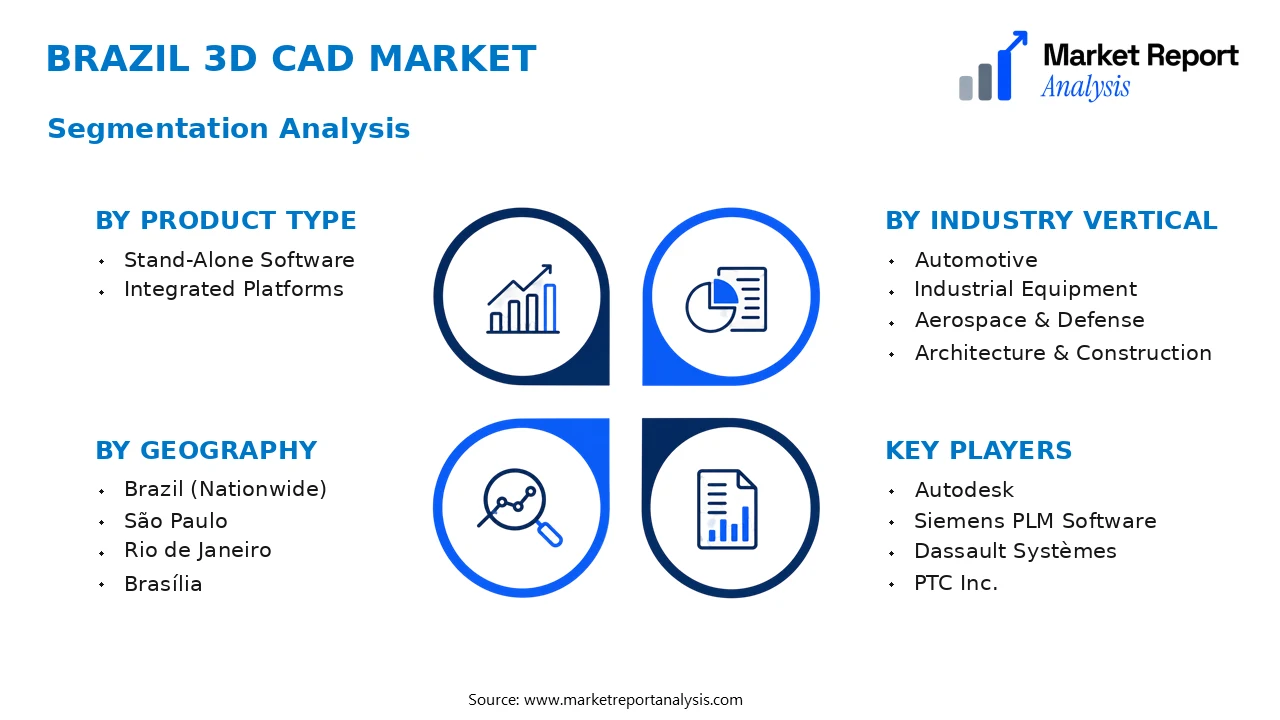
- Product Type
- Stand-Alone Software: This segment includes dedicated 3D CAD software solutions used independently for design, engineering, and manufacturing tasks. The demand is driven by manufacturing and automotive sectors with a focus on precision and customization.
- Integrated Platforms: Integrated platforms combine 3D CAD with other engineering tools, offering seamless workflows. They are increasingly adopted by large enterprises in aerospace, automotive, and industrial design sectors for efficiency gains.
- Industry Vertical
- Automotive: Automotive manufacturers and suppliers utilize 3D CAD extensively for design, prototyping, and simulation, which helps reduce development time and costs, fostering significant growth in this vertical.
- Industrial Equipment: This sector benefits from 3D CAD by improving the design accuracy and manufacturability of machinery, supporting innovations in heavy machinery, tools, and industrial automation.
- Aerospace & Defense: Aerospace companies leverage 3D CAD for complex design specifications, structural analysis, and product lifecycle management, with increasing adoption driven by defense modernization projects.
- Architecture & Construction: 3D CAD facilitates architectural visualization, structural engineering, and construction planning, which are integral to urban development projects particularly in rapidly expanding urban areas.
- Application
- Design & Visualization: This application focuses on creating detailed, accurate designs and visual representations of products and structures, essential for stakeholder approval and marketing strategies.
- Simulation & Analysis: Simulation tools embedded in 3D CAD software enable stress testing, thermal analysis, and airflow simulation, essential for optimizing product performance and safety compliance.
- Manufacturing & Production Planning: 3D CAD is critical for generating manufacturing drawings, tooling design, and production workflows, boosting efficiency and reducing errors in manufacturing processes.
- Geography
- Brazil (Nationwide): As the primary geographical focus, the national market encompasses diverse economic zones with varying levels of technological adoption and manufacturing activity providing a broad base for growth.
- São Paulo: This state is a commercial and industrial hub with a high concentration of manufacturing plants and technology companies, making it the leading region for 3D CAD adoption and innovation.
- Rio de Janeiro: Known for its aerospace and tourism industries, Rio de Janeiro shows significant demand for 3D modeling in infrastructure and creative sectors, supported by numerous engineering firms.
- Brasília: The political and administrative capital hosts many government-driven infrastructure projects requiring advanced design solutions, fueling regional growth in 3D CAD applications.
Competitive Intelligence
The Brazil 3D CAD Market exhibits a competitive landscape characterized by moderate market concentration, with leading global players such as Autodesk, Dassault Systèmes, and PTC steering significant market share. These firms focus on continuous product innovation, integrating advanced features like cloud-based collaboration and AI-driven design tools to differentiate their offerings. Business strategies predominantly involve strategic partnerships with local technology firms and governmental agencies, fostering enhanced market penetration and distribution channels across major Brazilian metropolitan hubs such as São Paulo, Rio de Janeiro, and Belo Horizonte. Recent acquisitions aimed at expanding regional presence and augmenting technological capabilities are becoming increasingly prevalent, underpinning a strategic shift toward consolidating market position. R&D investments are prioritized to develop localized solutions tailored to Brazil’s diverse industrial sectors, including manufacturing, infrastructure, and aerospace. Companies increasingly leverage partnerships with academic institutions to foster innovation and access emerging talent pools. This competitive approach emphasizes differentiation through customization, strategic alliances, and innovation, enabling firms to adapt to Brazil’s evolving industry demands and growth prospects.
Leading Company Profiles
The competitive landscape of the Brazil 3D CAD market is characterized by the presence of several innovative firms that drive technological advancements and strategic initiatives, shaping the future of design and manufacturing sectors in the country.
- Autodesk
- Siemens PLM Software
- Dassault Systèmes
- PTC Inc.
- SolidWorks
- Bentley Systems
- Autodesk Inc.
- Siemens Digital Industries Software
- Dassault Systèmes SolidWorks Corp.
Autodesk
Autodesk leads the market with a comprehensive portfolio of 3D design software, emphasizing cloud-based solutions and automation tools, strategically focusing on expanding its footprint in Latin America's manufacturing and architecture sectors.
Siemens PLM Software
Siemens offers integrated PLM solutions for product development, utilizing advanced simulation and digital twin technology to enhance design accuracy and operational efficiencies in the Brazilian automotive and aerospace segments.
Dassault Systèmes
Dassault Systèmes provides innovative 3D design software tailored for complex engineering, with strong focus on sustainability and innovation, supporting diverse sectors including industrial equipment, transportation, and high-tech industries in Brazil.
PTC Inc.
PTC specializes in CAD and product lifecycle management solutions, emphasizing IoT integration and augmented reality to optimize product design and manufacturing processes, boosting its strategic positioning within Brazil’s industrial innovation landscape.
SolidWorks
As part of Dassault Systèmes, SolidWorks delivers user-friendly CAD interfaces and simulation capabilities, targeting small to medium enterprises and providing scalable solutions aligned with the growth of the Brazilian manufacturing sector.
Bentley Systems
Bentley offers infrastructure-focused 3D CAD solutions, leveraging robust modeling and visualization tools designed to support large-scale projects in transportation and civil engineering within Brazil’s evolving urban landscape.
Autodesk Inc.
Autodesk Inc. (a different entity from Autodesk) emphasizes sustainable architecture and construction design software, with strategic initiatives to digitalize civil infrastructure projects across Brazil's urban development initiatives.
Autodesk
Autodesk’s ongoing focus on cloud collaboration and AI-driven design tools positions it centrally in the Brazilian market, catering to the needs of digital transformation across various verticals such as architecture and manufacturing.
Siemens Digital Industries Software
Siemens offers comprehensive software solutions enabling digital enterprise integration, focusing on automation, digital twin, and PLM systems, crucial for boosting Brazil’s manufacturing productivity and innovation capacities.
Dassault Systèmes SolidWorks Corp.
Specializing in accessible 3D CAD solutions, Dassault Systèmes SolidWorks continues to strengthen its presence by fostering innovation in product development and enabling SME growth within Brazil’s competitive market environment.
Strategic Business Developments
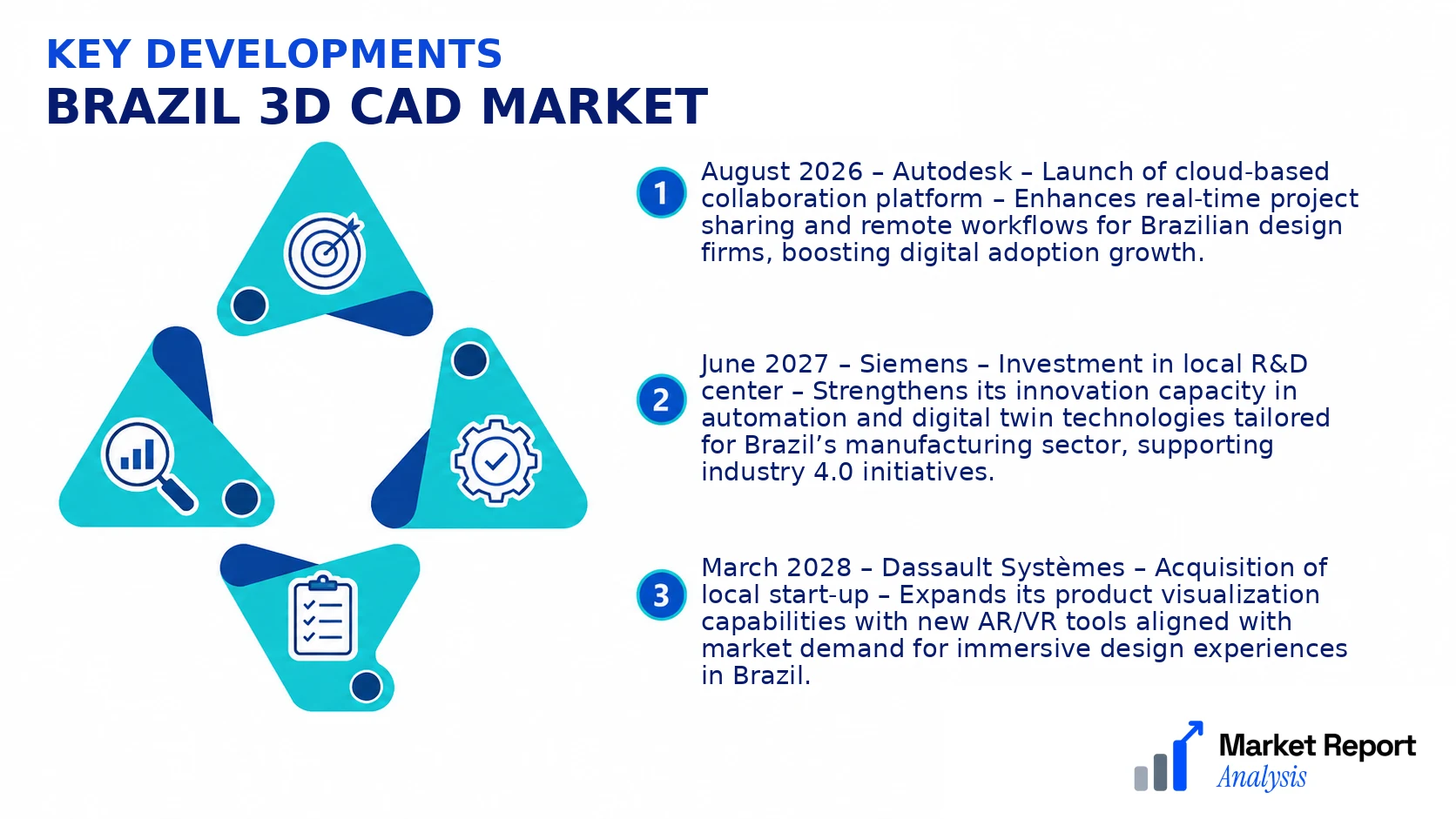
- August 2026 – Autodesk – Launch of cloud-based collaboration platform – Enhances real-time project sharing and remote workflows for Brazilian design firms, boosting digital adoption growth.
- June 2027 – Siemens – Investment in local R&D center – Strengthens its innovation capacity in automation and digital twin technologies tailored for Brazil’s manufacturing sector, supporting industry 4.0 initiatives.
- March 2028 – Dassault Systèmes – Acquisition of local start-up – Expands its product visualization capabilities with new AR/VR tools aligned with market demand for immersive design experiences in Brazil.
- April 2029 – PTC Inc. – Strategic alliance with a major Brazilian electronics firm – Focuses on IoT-enabled product lifecycle management solutions, fostering smart manufacturing across Latin America.
- November 2030 – Bentley Systems – New partnership with local civil engineering agencies – Promotes integrated infrastructure modeling and civil project digitalization, accelerating urban development projects nationwide.
Frequently Asked Questions
What is the Brazil 3D CAD Market?
The Brazil 3D CAD Market encompasses the industry involved in the development, distribution, and utilization of three-dimensional computer-aided design software tailored for various sectors including manufacturing, architecture, and engineering within Brazil. It facilitates precise design and visualization processes.
What is the current market size of Brazil 3D CAD Market?
As of 2026, the market is valued at approximately USD 2.5 Billion, driven by increasing adoption across industries such as automotive, aerospace, and construction. This growth reflects Brazil's expanding manufacturing base and technological adoption rate.
What factors are driving the Brazil 3D CAD Market?
Market growth is propelled by technological advancements, rising industry standards, and the need for complex product design and simulation. Government initiatives promoting innovation, increasing investment in R&D, and the expansion of key industry sectors are significant contributors.
Which region dominates the Brazil 3D CAD Market?
Southeast Brazil leads the market due to its dense industrial presence, technological hubs, and higher adoption rates of advanced CAD solutions. States like São Paulo and Rio de Janeiro are pivotal to this regional dominance.
Which segment is expected to grow the fastest?
The automotive and aerospace segments are anticipated to witness the fastest growth, driven by demand for precision design, customization, and the need for innovative engineering solutions within Brazil's evolving manufacturing landscape.
Who are the leading companies operating in the Brazil 3D CAD Market?
Major players include Autodesk, Dassault Systèmes, Siemens PLM Software, and PTC. These companies are expanding their regional footprints through strategic partnerships, technology upgrades, and localized service offerings to cater to Brazil’s growing demand.
Analyst Perspective
The Brazil 3D CAD Market is poised for sustained growth over the coming decade, driven by escalating investments in manufacturing, infrastructure, and urban development. As technological innovation accelerates, the adoption of cloud-based and AI-integrated CAD solutions is expected to gain prominence, offering enhanced collaboration and efficiency. Regional hubs such as São Paulo, Rio de Janeiro, and Belo Horizonte present significant opportunities due to their vibrant industrial ecosystems and proactive adoption of digital tools. Long-term, market maturity will be characterized by increased integration with other digital manufacturing technologies and broader Industry 4.0 initiatives. Competitive landscapes will intensify as key players focus on local customization, strategic alliances, and rapid deployment. Investment priorities should target software scalability, interoperability, and the development of city-specific solutions to capitalize on Brazil’s diverse industrial segments. Overall, a focus on regional innovation centers and urban growth patterns will be crucial for sustaining growth and establishing a strategic advantage in this evolving market.
