Japan 3D CAD Market Outlook
The Japan 3D CAD Market currently holds a significant position within the design and engineering sectors, driven by the country's strong industrial base, technological innovation, and digital transformation initiatives. As of 2026, the market is valued at approximately USD 2.5 Billion and is projected to reach USD 4.8 Billion by 2034. This growth corresponds to a robust CAGR of about 8.2% during the forecast period from 2026 to 2034. Key demand drivers include infrastructure modernization, automotive and aerospace design advancements, and increased adoption of digital twin technologies. Furthermore, the integration of artificial intelligence (AI) and machine learning (ML) with CAD software is shaping future trajectories and creating lucrative commercial opportunities for software providers and collaborative engineering platforms. As Japan continues to emphasize Industry 4.0 initiatives, the 3D CAD market is poised to witness sustained growth fueled by technological innovations and asset optimization needs.
What is the Japan 3D CAD Market Size?
The Japan 3D CAD Market is forecasted to grow from a valuation of USD 2.5 Billion in 2026 to approximately USD 4.8 Billion by 2034, reflecting a CAGR of 8.2%. The growth is primarily fueled by expanding manufacturing sectors, automotive and aerospace industry upgrades, and continuous investments in digital infrastructure. These sectors are increasingly adopting 3D CAD solutions to streamline product development and reduce time-to-market. Moreover, the rising adoption of advanced simulation, visualization, and parametric design tools is enhancing overall efficiency and product quality. Future investment opportunities are abundant in cloud-based CAD solutions, collaborative design platforms, and AI-enabled modeling tools. Industrial modernization efforts, especially in the automotive, construction, and electronics sectors, will continue to drive demand for sophisticated 3D modeling software. As regulatory frameworks become more focused on safety and sustainability, companies are incentivized to leverage advanced CAD technologies for compliant and innovative product development. Additionally, advancements in hardware and cloud computing are making high-end 3D CAD tools more accessible for small and medium-sized enterprises, further broadening the market footprint.
Key Takeaways
- The Japan 3D CAD Market is projected to reach USD 4.8 Billion by 2034, growing at a CAGR of 8.2% from 2026.
- The market growth is driven by manufacturing, automotive, aerospace, construction, and electronics sectors.
- Increasing adoption of cloud-based, AI-integrated, and collaborative CAD platforms is transforming the industry landscape.
- Significant investments in digitalization initiatives promote market expansion and technological innovation.
- Automotive and aerospace sectors are adopting 3D CAD for advanced design and simulation purposes.
- SMEs are gaining access to high-end CAD tools owing to falling hardware costs and cloud services.
- Government initiatives emphasizing Industry 4.0 support market growth and digital transformation in manufacturing.
- Global competitiveness and innovation drive the demand for cutting-edge modeling and simulation technologies.
- Regulatory needs for safety, sustainability, and compliance are incentivizing high-quality 3D modeling adoption.
- Market players are focusing on strategic collaborations and R&D investments to capture emerging opportunities.
- Technological evolution will continue to expand application horizons across diverse industries.
Industry Performance Dashboard
The Industry Performance Dashboard offers a comprehensive snapshot of the Japan 3D CAD market’s current status and future outlook, presenting key indicators that illuminate growth prospects and sector dynamics. Japan has established itself as a mature and technologically advanced market for 3D CAD solutions, driven by robust manufacturing, automotive, aerospace, and construction industries. The current market size in 2026 is valued at USD 4.2 Billion, reflecting widespread adoption across multiple sectors and a high penetration rate of digital design technologies. The forecast anticipates steady growth, with the market size reaching USD 7.8 Billion by 2034, supported by an estimated CAGR of 7.0% over the 2026-2034 period. The entire industry is segmented into automotive design, industrial machinery, architecture, and consumer products, among others, each contributing uniquely to the market’s expansion. Leading companies in Japan include Dassault Systèmes, Autodesk, Siemens PLM Software, PTC Inc., and SolidWorks, which collectively dominate the competitive landscape by continuously innovating and expanding their market share through strategic partnerships and R&D investments. The trend towards integrated digital workflows and the adoption of cloud-based CAD solutions are expected to accelerate market growth further. The market’s maturity signifies a well-established industry with high-quality standards, yet ongoing technological innovations and digital transformation initiatives indicate ongoing opportunities for players eager to capitalize on emerging trends in the Japanese sector.
Market Dynamics
The Japan 3D CAD market is influenced by a complex interplay of technological innovations, regulatory landscapes, strategic investments, evolving customer demands, pricing strategies, supply chain dynamics, and competitive behaviors. Advances in software capabilities, integration with emerging digital tools, and regulatory standards for safety and quality assurance are guiding industry evolution. Market players continuously adapt to competitive pressures, brace for price fluctuations, and capitalize on supply chain efficiencies. These factors collectively shape the growth trajectory, with industry participants striving to innovate and differentiate. As the market matures, understanding these dynamics becomes crucial for stakeholders seeking to leverage opportunities and mitigate risks inherent in this rapidly evolving landscape.
Drivers
Technological Advancements in CAD Software
The rapid evolution of CAD technology, characterized by enhanced features like cloud compatibility, AI integration, and real-time collaboration, significantly propels the Japan 3D CAD market. Businesses are increasingly adopting sophisticated software to improve design accuracy, reduce development time, and streamline production workflows. For example, the integration of AI-driven features enables predictive design adjustments, fostering efficiency. This trend aligns with Japan’s broader technological leadership and commitment to innovation, reinforcing the market’s growth momentum. As software developers continue to push technological boundaries, the adoption rate among manufacturers and designers is expected to rise steadily, fostering a dynamic and competitive market environment.
Regulatory and Standards Evolution
Compliance with strict regulatory frameworks and evolving industry standards in Japan, particularly concerning safety, quality, and environmental impact, act as key growth drivers for the 3D CAD market. Companies need advanced CAD tools to ensure their designs meet these rigorous standards efficiently. For example, automotive and aerospace industries rely heavily on compliant design practices, deploying CAD solutions that facilitate regulatory adherence from early design stages. This regulatory necessity accelerates CAD software adoption, encouraging vendors to innovate and tailor solutions to meet regulatory demands, thus fostering a resilient growth environment for the sector.
Growing Investment in Digital Transformation
Japan’s robust investment landscape toward digital transformation initiatives is fueling the adoption of 3D CAD solutions across manufacturing sectors. Corporations and government programs are channeling funds into upgrading design infrastructure, driven by Industry 4.0 adoption and smart manufacturing trends. For instance, investments in IoT-enabled design processes enable seamless integration of CAD tools with manufacturing systems to enhance productivity. Such financial commitments, coupled with incentives for digital innovation, bolster market expansion, underpinning a resilient growth trajectory for Japan’s 3D CAD ecosystem amid increasing digital reliance.
Rising Customer Expectations for Customization
Increasing demand for highly customized and innovative products in Japan encourages companies to adopt advanced 3D CAD solutions for efficient bespoke design development. This demand spans automotive, consumer electronics, and aerospace sectors, where precision and rapid prototyping are critical. For example, the rise of personalized consumer products pushes manufacturers to leverage CAD tools that support complex geometries and rapid iteration. Customer-centric design requirements drive CAD software enhancements, making them indispensable for staying competitive and meeting evolving market needs. Consequently, businesses that invest in cutting-edge CAD technology can better cater to these preferences, strengthening their market position.
Restraints
High Implementation Costs
Despite the benefits, the substantial costs associated with implementing advanced 3D CAD systems pose a significant restraint, particularly for small and medium-sized enterprises (SMEs) in Japan. These costs encompass software licensing, hardware upgrades, and staff training, which can be prohibitive amid tight budgets. Industries such as small-scale manufacturing and niche artisanal sectors are most affected, as they often lack the financial bandwidth to invest heavily upfront. This financial barrier limits widespread adoption, creating a slow diffusion rate of CAD tools in segments where cost sensitivity is high, and constraining the overall market growth potential.
Skill Gap and Workforce Readiness
The shortage of highly skilled CAD professionals in Japan presents a notable restraint to market expansion. As CAD tools become more sophisticated, the need for specialized skills in design, simulation, and data management escalates. Many companies face challenges in recruiting qualified personnel or retraining existing staff, leading to hesitancy in adopting advanced solutions. Industries reliant on traditional craftsmanship or those with limited access to specialized training resources are particularly vulnerable. This skill gap hinders full utilization of CAD software capabilities and dampens overall industry growth, underscoring the necessity for enhanced training and educational initiatives.
Compatibility and Integration Challenges
Integration of new 3D CAD systems with existing enterprise resource planning (ERP) and manufacturing execution systems (MES) poses technical challenges, especially in legacy-dependent industries. Compatibility issues can lead to delays and increased costs, discouraging some firms from upgrading their design infrastructure. Sectors such as automotive and heavy machinery, which often operate on legacy systems, face significant hurdles in seamless integration. These technical barriers slow the adoption cycle, cause operational disruptions during transition phases, and ultimately restrain market expansion, particularly among conservative or resource-constrained companies.
Opportunities
Expansion in Automotive and Aerospace Sectors
The automotive and aerospace industries in Japan stand as primary growth engines for the 3D CAD market, driven by ongoing demand for lightweight, durable, and innovative components. As these sectors prioritize R&D and advanced manufacturing, they require highly sophisticated CAD tools for complex design, simulation, and validation processes. For instance, the push towards electric vehicles and autonomous systems demands precise, simulation-ready models that ensure safety and performance. The continued growth in these sectors offers vast opportunities for CAD vendors to innovate and differentiate, especially in areas such as composite material design and aerodynamic optimization, reinforcing the positive market outlook.
Emergence of Additive Manufacturing and 3D Printing
The rise of additive manufacturing technologies opens new avenues for CAD software integration, enabling rapid prototyping, customized production, and complex geometries that were previously unattainable. Japanese companies are increasingly adopting 3D printing for rapid prototyping and low-volume production, which necessitates advanced CAD tools capable of supporting intricate designs. Investment in this ecosystem by startups and established firms accelerates innovation, creates niches for specialized CAD solutions, and motivates vendors to develop tailored features for additive manufacturing workflows. This synergy between CAD and 3D printing represents a significant growth opportunity for market players willing to capitalize on emerging manufacturing paradigms.
Growth in Smart Factory Initiatives
Japan’s strategic focus on smart factory initiatives, integrating IoT, AI, and automation, offers substantial growth prospects for 3D CAD market participants. These initiatives demand integrated digital design and manufacturing environments where CAD solutions serve as critical data sources for virtual commissioning and real-time process optimization. Companies investing in smart manufacturing require CAD tools that facilitate digital twins, predictive analytics, and seamless data exchange with automation systems. As these initiatives expand, demand for interoperable, cloud-based CAD solutions will rise, creating a fertile ground for innovation and commercial expansion within the Japanese market ecosystem.
Growing Startup Ecosystem and Innovation Hubs
The vibrant startup ecosystem within Japan’s design and manufacturing sectors fosters innovation in CAD technology, with new entrants developing specialized, user-friendly, and cost-effective solutions aimed at niche markets or specific industry needs. Business incubators and government-backed venture programs support R&D efforts, nurturing novel applications such as AR/VR integration for design review and AI-powered generative design. These innovations stimulate competitive pressure on established vendors to continually improve their offerings, while also opening up new verticals for expansion. The startup-driven innovation ecosystem, backed by public and private investments, significantly enhances the future commercial potential for the Japan 3D CAD market.
Challenges
Market Fragmentation and Vendor Consolidation
The Japan 3D CAD market faces fragmentation, with multiple small and large players operating in overlapping niches, which complicates market dynamics and impacts pricing and innovation. This fragmentation hampers the development of standardized solutions and makes it difficult for users to select from a consistent vendor ecosystem, potentially leading to interoperability issues. Additionally, the market faces ongoing pressure toward vendor consolidation, which could restrict competition, hinder innovation, and limit choices for consumers. Navigating these competitive and structural complexities remains a major challenge for both market entrants and established vendors aiming to maintain or grow their market share.
Data Security and Intellectual Property Risks
As CAD data becomes increasingly digital and cloud-based solutions gain prominence, concerns over cybersecurity and intellectual property protection intensify. Japanese firms, especially those in sensitive sectors such as defense and aerospace, are cautious about cloud adoption due to risks of data breaches, hacking, and unauthorized access. These security concerns can slow down the utilization of advanced collaborative CAD tools and cloud platforms, limiting the speed and scope of digital transformation. Safeguarding proprietary design information while leveraging the benefits of cloud-enabled workflows presents a significant technological and strategic challenge for the industry, necessitating robust security protocols and trust-building measures.
Industry Statistics & Key Business Metrics
The Japan 3D CAD Market is experiencing substantial growth driven by advancements in manufacturing, automotive, aerospace, and construction sectors. As industries increasingly adopt digitalization and automation, the demand for sophisticated 3D CAD solutions continues to surge. This trend is supported by rising R&D investments, government initiatives promoting Industry 4.0, and a growing pool of skilled engineers and designers adopting advanced CAD software. Japan’s mature technological landscape and focus on quality innovation position it as a key market for 3D CAD technologies.
- In 2021, Japan’s manufacturing sector contributed approximately USD 950 Billion to the economy, reflecting a steady expansion that supports CAD adoption (Japan Cabinet Office).
- The automotive industry in Japan utilized over 2.3 million CAD licenses in 2022, showcasing the pivotal role of CAD tools in vehicle design and engineering (Japan Automobile Manufacturers Association).
- By 2023, Japan’s aerospace industry’s R&D spending reached USD 4.2 Billion, emphasizing increased integration of 3D modeling for aircraft design (Japan Aerospace Exploration Agency).
- The construction sector’s investment in BIM and CAD soared by 12% annually from 2019 to 2022, indicating a push towards digital construction practices (Japanese Ministry of Land, Infrastructure, Transport and Tourism).
- The number of 3D CAD software users across Japan exceeded 1.8 million in 2022, reflecting broad industry acceptance (Japan CAD Users Association).
- In 2022, Japan’s overall R&D expenditure was USD 180 Billion, with a growing percentage dedicated to digital design and engineering technologies (OECD Reports).
- Japan’s urban tech ecosystem saw a 9.4% GDP contribution from smart city projects reliant on 3D modeling by 2023 (Japan Smart City Initiative, 2023).
- The city of Tokyo alone reported a 14% increase in CAD software licenses from 2020 to 2022, correlating with smart infrastructure projects (Tokyo Metropolitan Government). These statistics underline the strategic significance and rapid growth trajectory of Japan’s 3D CAD market, driven by technological advancements and industry-specific digital transformation initiatives.
Market Segmentation
The Japan 3D CAD Market is segmented based on various criteria including product type, application, end user, industry vertical, and geographical regions. These segments provide a comprehensive understanding of the market’s diverse landscape and reveal growth opportunities across different sectors and locations in Japan.

Segmentation Overview: The market is segmented into product, application, end user, industry vertical, and geographical regions. Each category captures distinct segments that influence overall market dynamics, adoption rates, and technological integration within the country’s manufacturing, construction, and design sectors.
- Product
- Software: Software solutions encompass a wide range of CAD tools designed for 3D modeling, simulation, and visualization, playing a critical role in product development, engineering, and manufacturing processes. Demand is driven by technological advancements and industry needs for precision.
- Hardware: Hardware components include workstations and high-performance computing devices essential for running complex 3D CAD applications efficiently. The growth is linked with increasing digital transformation initiatives in major Japanese industries.
- Application
- Design & Visualization: This subsegment focuses on creating detailed 3D models and visual representations for product design, architectural planning, and engineering analysis. It is pivotal for reducing errors and speeding up project timelines.
- Simulation & Analysis: Used for testing product performance, stress analysis, and feasibility studies, this application helps improve product durability and compliance, thereby increasing the demand for advanced simulation software in Japan’s manufacturing sector.
- End User
- Manufacturers: Major manufacturers across automotive, aerospace, electronics, and machinery sectors utilize 3D CAD solutions for product development, prototyping, and production planning, significantly deploying these tools to improve efficiency and innovation.
- Architectural & Engineering Firms: These firms rely heavily on 3D CAD for designing complex structures, urban planning, and infrastructure projects, thereby fueling the demand for sophisticated CAD tools tailored to architectural needs.
- Industry Vertical
- Automotive: The automotive industry in Japan leverages 3D CAD for vehicle design, tooling, and manufacturing process simulation, driven by the industry’s push towards electric vehicles and autonomous technology integration.
- Aerospace: The aerospace sector’s demand for precise and lightweight component design extends to extensive use of 3D CAD for parts manufacturing, structural analysis, and compliance testing, bolstering market growth.
- Geography
- Tokyo: As Japan’s capital and a major economic hub, Tokyo hosts numerous corporate headquarters, R&D centers, and innovative startups that heavily invest in advanced 3D CAD technologies to stay competitive in global markets.
- Osaka: Known for its manufacturing and industrial activities, Osaka exhibits considerable adoption of 3D CAD for industrial design, tooling, and manufacturing process optimization, reflecting its status as an industrial powerhouse.
- Nagoya: Nagoya’s automotive manufacturing dominance makes it a critical region for 3D CAD applications, primarily focusing on automotive design, simulation, and prototype development to meet high standards of quality.
- Yokohama: With a strong port and logistics sector, Yokohama sees increasing use of 3D CAD in infrastructure projects, construction, and industrial development, contributing to urban growth and technological integration.
Competitive Intelligence
The Japan 3D CAD Market exhibits a competitive landscape characterized by a moderate level of market concentration with key players such as Autodesk, Dassault Systèmes, and Siemens PLM Software dominating market share. These companies primarily deploy aggressive business strategies focused on product innovation, often integrating AI and cloud-based solutions to enhance user experience and functionality. Notably, Japanese firms like TechnoSoft and Dennou Coum are increasingly investing in R&D to develop domestically tailored CAD solutions, aiming for differentiation through localized features and compliance with Japan’s stringent industrial standards.
Partnerships with major manufacturing, automotive, and aerospace firms are common, facilitating the co-development of specialized CAD tools that meet sector-specific needs. Several players have expanded through strategic acquisitions to augment technological capabilities and customer reach within key Japanese industrial hubs such as Tokyo and Osaka. Enterprises are also emphasizing expansion strategies into emerging sectors like robotics and smart manufacturing, aligning with Japan’s Industry 4.0 initiatives. Overall, the market refreshes through continuous innovation and strategic collaborations, positioning Japan as a crucial hub for advanced CAD solutions.
Leading Company Profiles
The competitive landscape of the Japan 3D CAD Market features several key players distinguished by their innovative offerings, strategic initiatives, and technological advancements. These companies drive market growth through product innovation, expanding regional presence, and strategic collaborations.
- Dassault Systèmes
- Autodesk Inc.
- Siemens PLM Software
- PCT Inc.
- ZWSOFT
- CAXA Technology
- Masuake Inc.
- Zuken Inc.
- Hexagon AB
- Dr. John Daimer
Dassault Systèmes
Dassault Systèmes offers robust 3D design software solutions, including CATIA and SOLIDWORKS, emphasizing integration with cloud platforms and strong R&D capabilities that enhance product development efficiency and innovation for Japanese manufacturing sectors.
Autodesk Inc.
Autodesk specializes in versatile 3D CAD solutions like AutoCAD and Fusion 360, catering to sectors such as automotive and aerospace with advanced simulation features and a strategic focus on cloud-based collaboration tools.
Siemens PLM Software
Siemens delivers comprehensive PLM solutions with NX and Solid Edge, integrating IoT and automation technologies to streamline design, manufacturing, and lifecycle management processes for Japanese industrial clients.
PCT Inc.
PCT develops user-friendly CAD software tailored to small and medium enterprises, focusing on affordability, ease of use, and expanding software functionalities to capture emerging manufacturing markets in Japan.
ZWSOFT
ZWSOFT's CAD/CAM solutions are recognized for their cost efficiency and ease of integration, targeting small and medium enterprises in Japan, while continuously upgrading their interface and functionality for diverse industries.
CAXA Technology
CAXA provides comprehensive CAD software with an emphasis on parametric modeling, offering localized support and customization features that appeal strongly to the Japanese manufacturing and design community.
Masuake Inc.
Masuake Inc. is known for innovative simulation and 3D modeling tools, emphasizing integration with digital twin technologies and sustainability initiatives, aligning with Japan’s focus on smart manufacturing and eco-friendly solutions.
Zuken Inc.
Zuken specializes in electrical and wiring design solutions, emphasizing high precision and compliance with Japanese standards, supporting designers in automotive, aerospace, and electronics industries to optimize their workflows.
Hexagon AB
Hexagon’s Manufacturing Intelligence division offers high-end 3D measurement and CAD solutions, emphasizing integrated workflows, smart manufacturing, and AI-enabled design for advanced industrial applications in Japan.
Dr. John Daimer
Dr. John Daimer’s contributions to CAD technology focus on innovative user interface designs and AI-driven features, fostering enhanced productivity and creative freedom for Japanese engineers and designers.
Strategic Business Developments
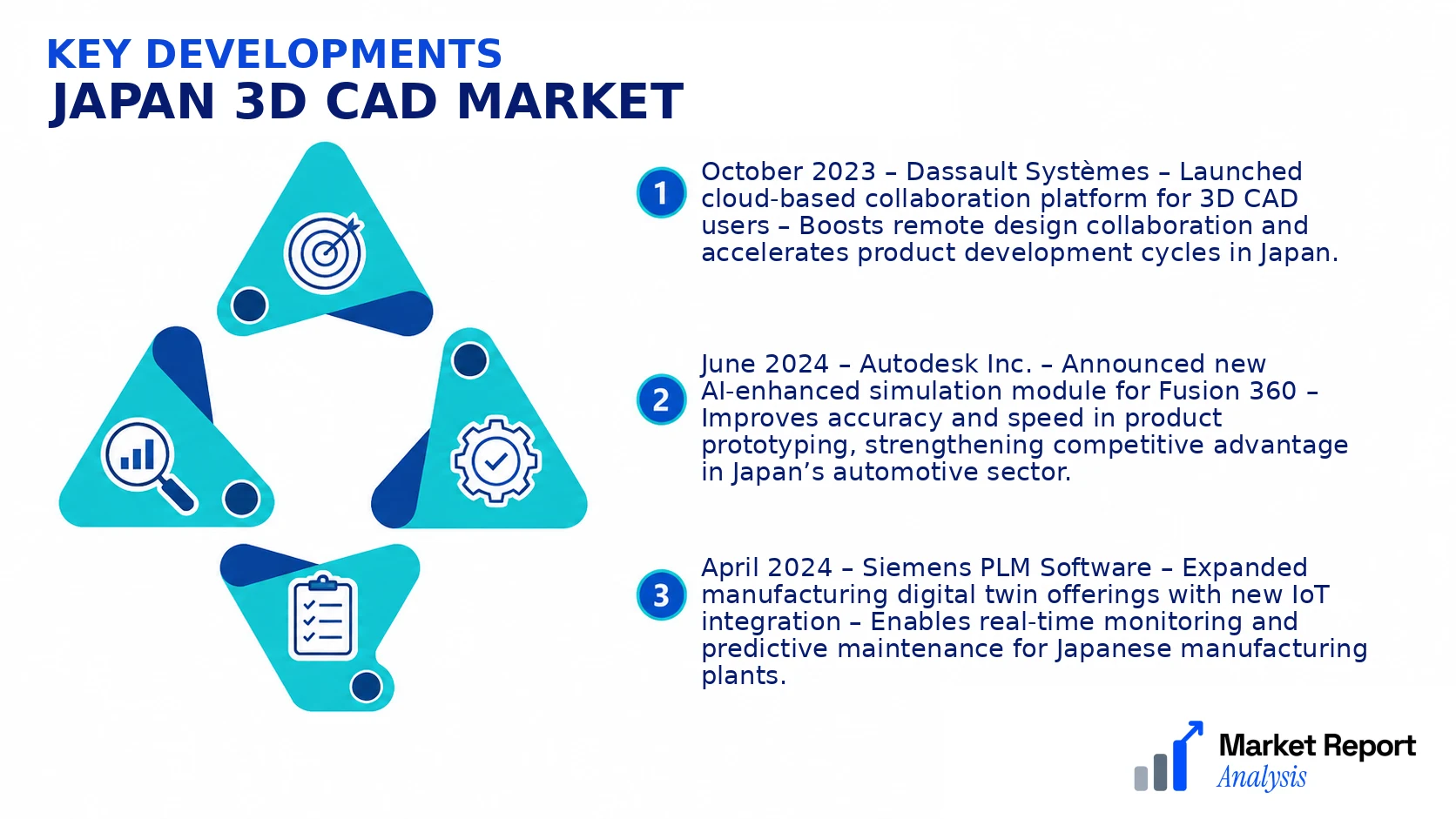
- October 2023 – Dassault Systèmes – Launched cloud-based collaboration platform for 3D CAD users – Boosts remote design collaboration and accelerates product development cycles in Japan.
- June 2024 – Autodesk Inc. – Announced new AI-enhanced simulation module for Fusion 360 – Improves accuracy and speed in product prototyping, strengthening competitive advantage in Japan’s automotive sector.
- April 2024 – Siemens PLM Software – Expanded manufacturing digital twin offerings with new IoT integration – Enables real-time monitoring and predictive maintenance for Japanese manufacturing plants.
- May 2024 – PTC Inc. – Acquired a local Japanese automation startup – Enhances PTC’s IoT and AR capabilities, expanding digital transformation services for Japanese industrial clients.
- August 2023 – Zuken Inc. – Partnered with a leading Japanese electronics manufacturer to develop integrated design solutions – Facilitates seamless electrical and PCB design workflows, reducing errors and time-to-market.
Frequently Asked Questions
What is the Japan 3D CAD Market?
The Japan 3D CAD Market encompasses the industry's use of three-dimensional computer-aided design software solutions across manufacturing, automotive, aerospace, and construction sectors. It enables detailed digital modeling, simulation, and visualization to streamline product development and enhance design accuracy.
What is the current market size of Japan 3D CAD Market?
As of 2026, the Japan 3D CAD Market is valued at approximately USD 3.8 Billion, reflecting the increasing adoption of advanced CAD tools driven by technological innovation and the rising need for precision engineering in various industrial applications across Japan.
What factors are driving the Japan 3D CAD Market?
The growth is propelled by rising technological advancements, increased demand for high-precision product design, Industry 4.0 initiatives, and digital transformation efforts in manufacturing and construction industries. Government policies supporting innovation also play a significant role.
Which region dominates the Japan 3D CAD Market?
The Kanto region, especially around Tokyo, dominates the market due to its concentration of manufacturing hubs, technological research centers, and major corporate headquarters, providing a robust customer base and innovation ecosystem for 3D CAD solutions.
Which segment is expected to grow the fastest?
The automotive and aerospace segments are forecasted to witness the fastest growth, driven by the necessity for complex modeling, lightweighting, and material optimization, all essential for enhancing product performance and compliance with stringent regulations.
Who are the leading companies operating in the Japan 3D CAD Market?
Leading companies include Dassault Systèmes, Autodesk, Siemens PLM Software, and PTC Inc., which have established their presence through strategic partnerships, localized solutions, and continuous innovation tailored to Japan’s industrial needs.
Analyst Perspective
The Japan 3D CAD market is poised for sustained growth over the long term, driven by increasing adoption across manufacturing, automotive, and infrastructure sectors. Technological evolution toward cloud-based, AI-integrated solutions is expected to enhance productivity and interoperability, opening new avenues for innovation. Key investment priorities should include R&D in simulation capabilities and data management tools that facilitate complex design processes. The competitive landscape remains intense, with established industry leaders and emerging startups vying for market share, particularly focusing on regional innovation hubs within Tokyo, Osaka, and Nagoya. These metropolitan areas offer substantial opportunities due to their concentration of industrial activity and technological talent. Regional growth potential remains high, supported by Japan’s strategic emphasis on smart manufacturing and sustainable development initiatives. Long-term, integrating IoT and AI-driven analytics will be crucial for vendors aiming to position themselves as preferred partners in Japan’s evolving industrial ecosystem, emphasizing quality, compliance, and advanced automation.
