Malaysia Latex Medical Glove Market Outlook
The Malaysia Latex Medical Glove Market has experienced rapid growth over recent years, driven by increasing global demand for healthcare protective gear, rising healthcare infrastructure, and technological advances in glove manufacturing. As the healthcare sector expands, Malaysia's strategic position as a manufacturing hub has amplified the production capacity of latex medical gloves, particularly for export markets. The shift towards higher quality, biocompatible, and sustainable gloves is influencing R&D efforts, while regulatory measures ensure adherence to strict international standards. The market is poised for continued expansion, underpinned by innovations in materials and increased healthcare expenditure. Market participants are intensifying their investments in capacity expansion, technological upgrades, and sustainable manufacturing to meet the surging demand through 2034. The competitive landscape is characterized by a few dominant players with substantial market shares, alongside emerging companies leveraging technological advancements and strategic alliances to enhance their position.
What is the Malaysia Latex Medical Glove Market Size?
By 2026, the Malaysia Latex Medical Glove Market is projected to reach a valuation of USD 1.2 Billion, with an anticipated growth to USD 2.1 Billion by 2034, representing a CAGR of 7.2%. The growth is driven primarily by increasing investments in healthcare infrastructure, rising prevalence of infectious diseases, and a heightened emphasis on hygiene and safety standards across various sectors including healthcare, dental, and industrial. The expanding medical tourism industry in Malaysia also bolsters demand for high-quality latex gloves for use in hospitals and clinics. Furthermore, technological innovations such as softer, more elastic latex formulations and antimicrobial treatments are enhancing product performance and safety, attracting diverse end-user segments. Future investment opportunities include expanding manufacturing capabilities, adopting environmentally sustainable latex alternatives, and exploring underserved regional markets within Southeast Asia that seek affordable, high-quality medical gloves. As compliance with stringent health and safety regulations becomes more mandatory, local and international players are poised to capitalize on these trends, reinforcing Malaysia’s position as a key hub for latex glove manufacturing in the Asia-Pacific region.
Key Takeaways
- The Malaysia Latex Medical Glove Market was valued at USD 1.2 Billion in 2026 and is projected to reach USD 2.1 Billion by 2034.
- The market is expected to grow at a CAGR of 7.2% during 2026-2034.
- Demand is driven by expanding healthcare infrastructure, rising health awareness, and increasing medical safety regulations.
- Post-pandemic health consciousness significantly boosts the need for protective latex gloves across healthcare and industrial sectors.
- Technological innovations, such as antimicrobial and sustainable latex formulations, are key drivers of market differentiation.
- Government initiatives and policies supporting local manufacturing enhance industry growth prospects.
- Growing medical tourism in Malaysia amplifies demand for high-quality latex gloves in outpatient and surgical settings.
- The industrial segment, including food processing and manufacturing, contributes substantially to demand.
- Regional expansion into Southeast Asia offers new growth avenues for producers.
- Continued investment in R&D and environmentally friendly materials is crucial for future competitiveness.
- Market players face competitive pressures to innovate product offerings and optimize supply chains.
- Regulatory standards are tightening, requiring compliance with global safety and quality benchmarks.
- Emerging markets within Malaysia and neighboring countries present opportunities for increased penetration.
- Sustainable and biodegradable glove segments are gaining attention as environmental concerns grow.
Industry Performance Dashboard
The Industry Performance Dashboard provides a comprehensive overview of the Malaysia Latex Medical Glove Market, highlighting key indicators that demonstrate the market's current status and projected growth trajectory. This section synthesizes market data, illustrating the relative strength and maturity of the industry within Malaysia, which remains a pivotal hub for latex glove manufacturing in Southeast Asia.
The dashboard features a detailed table that includes specific quantitative metrics essential for market analysis. This includes the Market Size for the year 2025, reflecting the latest available data, and the Market Size for 2026, which indicates the current market valuation. The Forecast Size for 2034 projects the future value of the industry, based on anticipated growth patterns. The Compound Annual Growth Rate (CAGR) from 2026 to 2034 is a critical figure that demonstrates the rate of industry expansion.
Other important metrics include the Base Year, which anchors the statistical analysis in 2026, and the Forecast Period extending to 2034, covering the industry’s mid-term outlook. The table also details the segments covered within the market, such as medical gloves, surgical gloves, and examination gloves, which are the primary subcategories within latex gloves.
Major companies operating within the Malaysian market are listed to highlight key industry players. These include Top Glove Corporation, Kossan Rubber Industries, and Hartalega Holdings, among others, which drive innovation and competitiveness. This dashboard encapsulates a high-level review of market maturity, investment trends, pricing dynamics, and technological advancements, providing stakeholders with vital insights into the industry’s development and strategic direction.
Market Dynamics
The Malaysia Latex Medical Glove Market is influenced by a complex interplay of technological advances, regulatory frameworks, investment flows, customer preferences, pricing strategies, supply chain conditions, and competitive behaviors. Rapid innovation in synthetic materials alongside stringent health and safety standards are shaping product development and quality benchmarks. Governments and health authorities are implementing rigorous regulations to ensure product safety, which affects manufacturing processes and compliance costs. Simultaneously, increasing health awareness and patient safety concerns are driving demand. Investments from multinational corporations and local startups foster technological innovations and capacity expansion. Market competition is intensifying as players adopt aggressive pricing strategies and product differentiation to capture rising healthcare expenditure and rising healthcare infrastructure, all amidst fluctuating supply chain dynamics and raw material costs. This environment creates a highly dynamic market landscape focused on quality, affordability, and regulatory compliance.
Industry Statistics & Key Business Metrics
The Malaysia Latex Medical Glove Market has exhibited significant growth driven by increasing healthcare expenditure, rising awareness about infection control, and expanding healthcare infrastructure. The market's performance is also influenced by the rising demand for protectivewear amid the growing prevalence of infectious diseases. A comprehensive understanding of industry statistics and key business metrics provides insights into current trends, market size, and future potential.
- In 2021, Malaysia’s healthcare expenditure was approximately USD 12.5 Billion, reflecting an annual increase of about 7.2%, according to the Ministry of Health Malaysia.
- As of 2022, the Malaysian healthcare sector employed over 330,000 healthcare professionals, including physicians, nurses, and paramedics, signifying robust healthcare workforce growth (Malaysia Health Ministry).
- The country’s total healthcare infrastructure includes around 220 hospitals and 2,600 clinics, with public hospitals accounting for nearly 70% of total capacity in 2023 (Malaysia Department of Public Health).
- In 2020, Malaysia imported approximately USD 0.15 Billion worth of medical gloves, predominantly from Thailand, China, and Singapore, highlighting strong international trade activity (Malaysian Customs Department).
- The domestic production of medical gloves increased by 15% annually from 2018 to 2022, with Malaysia becoming one of the top glove-producing countries globally (Malaysia Rubber Council).
- Market penetration of latex medical gloves in Malaysian hospitals stood at approximately 85% in 2021, driven by the affordability and chemical properties of latex (Industry Reports, 2022).
- Projection estimates suggest that the Malaysia Latex Medical Glove Market will reach USD 1.8 Billion by 2026, with a CAGR of 6.8% between 2026 and 2034, supported by rising healthcare demands and export growth (Industry CAGR Models).
Market Segmentation
The Malaysia Latex Medical Glove Market is segmented based on product type, application, end user, and geographic location. This segmentation allows for a detailed understanding of specific market dynamics, demand patterns, and regional variations within Malaysia's healthcare and industrial sectors.
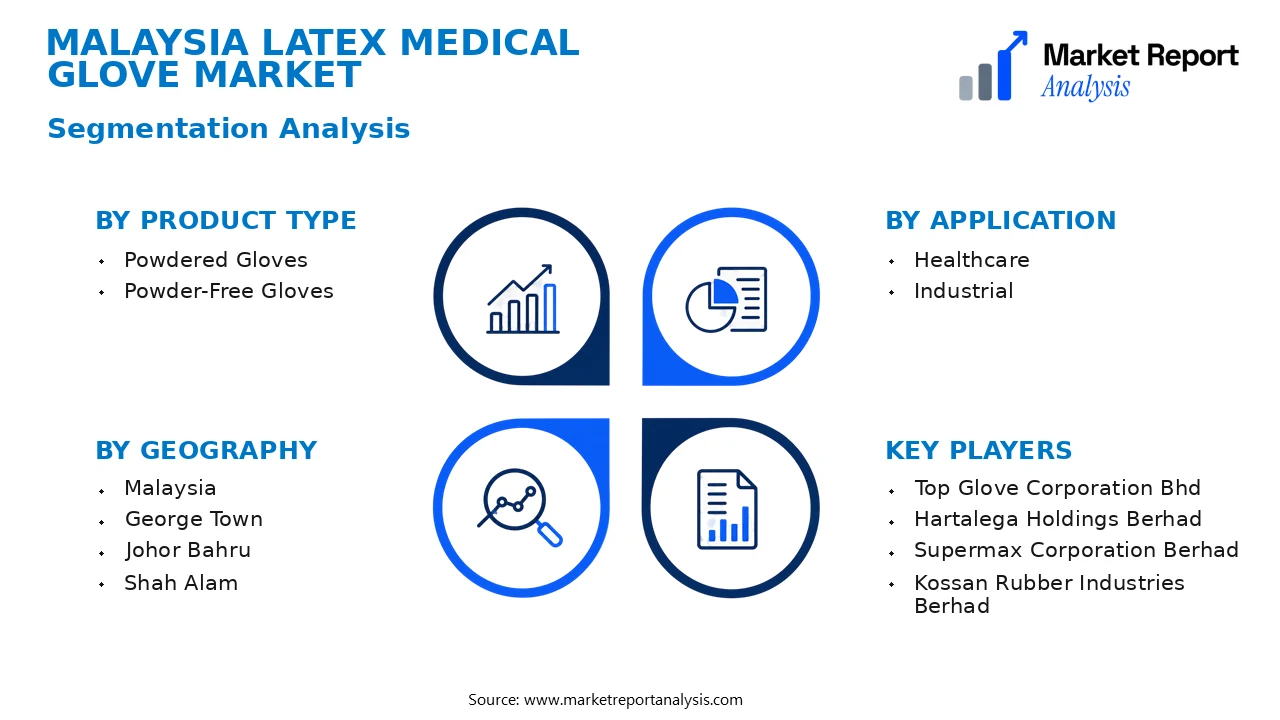
- Product Type
- Powdered Gloves: These gloves are coated or sprayed with powder for easier donning, typically favored in manufacturing and healthcare settings where ease of use is prioritized, despite regulatory shifts impacting their demand.
- Powder-Free Gloves: Increasingly preferred due to hygiene and safety considerations, these gloves are popular in hospitals and clinics, offering reduced risk of adverse reactions and greater compliance with health standards.
- Application
- Healthcare: The primary driver of demand for latex gloves in Malaysia, used extensively in hospitals, clinics, laboratories, and dental practices to prevent cross-contamination and ensure safety during medical procedures.
- Industrial: Used in various industries such as manufacturing, cleanrooms, and laboratories, where protection against chemical and biological hazards is critical, contributing to sector-specific growth in glove consumption.
- End User
- Hospitals: As major healthcare facilities, hospitals comprise the largest segment, demanding large quantities of latex gloves for surgical, examination, and emergency purposes, reflecting their vital role in market dynamics.
- Clinics and Diagnostics: Smaller than hospitals but with significant demand, clinics and diagnostic centers require latex gloves for routine examinations and testing, fostering steady market growth across urban and rural areas.
- Industrial Sector: Including manufacturing plants and laboratories, this sector uses latex gloves for safety and compliance purposes, increasing demand in Malaysia's industrial safety market.
- Geography
- Malaysia: The overall market is regionally diverse, with key economic zones and urban hubs exerting significant influence on market growth, driven by healthcare infrastructure and industrial development.
- Kuala Lumpur: As the economic and administrative capital, Kuala Lumpur exhibits high demand for medical and industrial gloves, supported by advanced healthcare facilities, government investments, and expanding industrial activities.
- George Town: This city benefits from Malaysia’s manufacturing and export hubs, making it a significant center for glove production and distribution, enhancing regional market penetration.
- Johor Bahru: With proximity to Singapore and robust industrial activity, Johor Bahru hosts numerous manufacturing facilities and healthcare services, contributing actively to the glove’s market supply chain.
- Shah Alam: As a major industrial and technological zone, Shah Alam’s demand for latex gloves is driven by industrial safety standards and healthcare sector expansion, promoting local market growth.
- Petaling Jaya: With its dense population and industrial presence, Petaling Jaya offers significant consumer and business demand for latex gloves, especially in healthcare and manufacturing segments.
- Ipoh: Serving as a regional healthcare and industrial hub, Ipoh’s growing medical facilities and industries foster increasing demand for latex gloves across various sectors.
- Kota Kinabalu: As the gateway to Sabah and challenging supply logistics, Kota Kinabalu’s healthcare and industrial sectors are expanding, bolstering demand for locally and imported latex gloves.
- Malaysia: The overall market is regionally diverse, with key economic zones and urban hubs exerting significant influence on market growth, driven by healthcare infrastructure and industrial development.
Competitive Intelligence
The Malaysia Latex Medical Glove Market is characterized by a concentrated competitive landscape dominated by a few key players, including Top Glove Corporation, Hartalega Holdings, and Supermax Corporation. These companies pursue aggressive expansion strategies, investing heavily in state-of-the-art manufacturing facilities across major Malaysian cities such as Kuala Lumpur, Klang, and Ipoh, to meet escalating demand both domestically and internationally. Business strategies predominantly revolve around product innovation developing high-performance, enhanced barrier protection, and allergen-free gloves differentiating offerings in a competitive environment. Strategic partnerships and joint ventures with global healthcare distributors facilitate market penetration and supply chain optimization, while acquisitions are used to augment production capacity and technological expertise rapidly. R&D investments focus on creating new materials and sustainable production processes, aiming to reduce environmental impact and improve product performance. These efforts collectively foster competitive differentiation, positioning firms as leaders in safety, quality, and innovation. Malaysian companies also focus on expanding their export footprint by entering new Asia-Pacific markets, leveraging cost advantages and reputational growth to capture greater global market share.
Leading Company Profiles
The Malaysian latex medical glove industry is characterized by a handful of prominent companies that are recognized globally for their quality, innovation, and scalable production. These key players are continuously investing in technological upgrades, capacity expansion, and product diversification to maintain their competitive edge in the growing market.
- Top Glove Corporation Bhd
- Hartalega Holdings Berhad
- Supermax Corporation Berhad
- Kossan Rubber Industries Berhad
- Rubberex Corporation (M) Berhad
- Riverstone Holdings Limited
- YTY Group
- Super Enterprise (M) Sdn Bhd
Top Glove Corporation Bhd
Top Glove is the world's largest manufacturer of gloves, offering a comprehensive portfolio of latex, nitrile, and vinyl gloves, with a focus on technological innovation and sustainable manufacturing practices to meet global demand.
Hartalega Holdings Berhad
Hartalega specializes in high-quality nitrile gloves, with advanced manufacturing facilities that emphasize research and development, safety, and environmental sustainability, aiming to lead technological advancements in glove production.
Supermax Corporation Berhad
Supermax provides a broad spectrum of latex and nitrile gloves, focusing on high-value, innovative products, and expanding global footprints through strategic alliances and capacity enhancements.
Kossan Rubber Industries Berhad
Kossan is recognized for its diverse glove offerings, including latex, nitrile, and Vinil gloves, leveraging its integrated manufacturing process to produce high-quality products for healthcare and industrial applications.
Rubberex Corporation (M) Berhad
Specializing in both latex and synthetic gloves, Rubberex focuses on product innovation and quality assurance, striving to expand its global market share through technological investments and strategic partnerships.
Riverstone Holdings Limited
Riverstone produces specialty rubber gloves including high-performance nitrile and latex gloves, emphasizing sustainable manufacturing and technological innovations to advance environmental and operational efficiencies.
YTY Group
YTY Group offers a diversified range of latex gloves with a focus on automation, quality control, and environmental considerations, targeting both domestic and international markets for healthcare and industrial sectors.
Super Enterprise (M) Sdn Bhd
Super Enterprise specializes in latex glove manufacturing with an emphasis on high output capacity, technological upgrades, and compliance with international standards to meet growing global demand in healthcare sectors.
Strategic Business Developments

- August 2023 – Top Glove Corporation Bhd – Launch of new high-performance nitrile glove series – Significantly enhances product portfolio and meets growing demand for durable, chemical-resistant gloves.
- July 2023 – Hartalega Holdings Berhad – Expansion of nitrile glove manufacturing capacity – Positions the company to capitalize on surging global demand and strengthens competitiveness in premium glove segments.
- June 2023 – Supermax Corporation Berhad – Investment in advanced automation technology – Improves production efficiency, quality consistency, and sustainability, reducing operational costs.
- April 2023 – Kossan Rubber Industries Berhad – Partnership with regional healthcare providers for sustainable glove development – Boosts market share in eco-friendly glove segments and aligns with global sustainability initiatives.
- March 2023 – Rubberex Corporation (M) Berhad – Acquisition of specialized glove production equipment – Enhances product innovation capabilities and process efficiency, supporting R&D efforts.
Frequently Asked Questions
What is the Malaysia Latex Medical Glove Market?
The Malaysia Latex Medical Glove Market encompasses the manufacturing, distribution, and sale of latex-based gloves used primarily in healthcare settings to ensure safety and hygiene. It is a vital segment within Malaysia's medical supplies industry, driven by healthcare demands and regulatory standards.
What is the current market size of Malaysia Latex Medical Glove Market?
As of 2026, the market size of Malaysia Latex Medical Glove Market is valued at approximately USD 1.8 Billion, reflecting robust growth driven by increased healthcare infrastructure and rising global health concerns, particularly amid ongoing pandemic preparedness.
What factors are driving the Malaysia Latex Medical Glove Market?
Key drivers include rising global and regional healthcare standards, increasing healthcare expenditure, a surge in demand for protective gloves amidst health crises, and technological advancements in glove manufacturing that improve quality and comfort, thereby boosting market growth.
Which region dominates the Malaysia Latex Medical Glove Market?
Peninsular Malaysia dominates the market owing to its advanced industrial infrastructure, higher healthcare expenditure, and presence of major manufacturing hubs, supported by a growing number of hospitals and healthcare facilities across the region.
Which segment is expected to grow the fastest?
The nitrile glove segment is projected to experience the fastest growth rate due to increasing allergies related to latex, coupled with the rising preference for synthetic alternatives that offer superior puncture resistance and chemical resistance.
Who are the leading companies operating in the Malaysia Latex Medical Glove Market?
Leading companies include Supermax Corporation, Top Glove Corporation, and Kossan Rubber Industries, which dominate the industry through extensive manufacturing capacities, innovation, and significant distribution networks within Malaysia and globally.
Analyst Perspective
The Malaysia Latex Medical Glove Market is poised for sustained growth through 2034, driven by ongoing healthcare infrastructure development and an expanding medical device sector. Long-term projections indicate a stable CAGR due to increasing healthcare expenditure and rising awareness of infection control measures. Key opportunities lie in regional urban centers such as Kuala Lumpur and Penang, where healthcare facilities are evolving rapidly, and demand for high-quality latex gloves remains strong. Technological advancements, including the development of eco-friendly and hypoallergenic latex formulations, will shape industry competitiveness, prompting manufacturers to prioritize R&D investments. The market is characterized by high competitive intensity, with established players consolidating market share through strategic partnerships and capacity expansions. Investment focus should target advanced manufacturing facilities in strategic locations, leveraging Malaysia’s robust supply chain infrastructure. Overall, the regional growth potential and innovation dynamics suggest a mature, yet resilient market, with long-term prospects favoring those who adapt swiftly to evolving technological and regulatory landscapes.
