Latin America Lightweight Materials Market Outlook
The Latin America Lightweight Materials Market is currently valued at approximately USD 5.2 Billion in 2026 and is projected to reach around USD 12.8 Billion by 2034, growing at a compound annual growth rate (CAGR) of 11.3% during the forecast period of 2026 to 2034. This growth is primarily driven by the increasing demand for fuel-efficient vehicles, stringent emission regulations, and a rising emphasis on sustainable manufacturing practices across the automotive and aerospace industries. Technological advancements in composite materials and the expansion of manufacturing capacities further contribute to the market's expansion. The commercial opportunities hinge on innovation in lightweight composites, strategic partnerships among key industry players, and investment in research and development to reduce costs and improve material performance across various end-use sectors.
What is the Latin America Lightweight Materials Market Size?
The Latin America Lightweight Materials Market was valued at approximately USD 5.2 Billion in 2026 and is forecasted to reach about USD 12.8 Billion by 2034, reflecting a CAGR of 11.3% over the period. The growth is driven by heightened automotive and aerospace manufacturing activities, where lightweight materials play a key role in meeting efficiency and regulatory standards. The automotive segment remains the largest contributor due to increased production of lightweight vehicles aimed at reducing fuel consumption and emissions. Additionally, demand from aerospace and industrial applications is rising, supported by investments in new aircraft and infrastructure projects. Advances in composite and polymer technologies, combined with regional policies promoting sustainability, are expected to bolster future investments and innovation in lightweight materials industries. Opportunities for regional manufacturers include expanding product portfolios to cater to evolving automotive and aviation needs, establishing strategic alliances, and leveraging government incentives for sustainable manufacturing practices.
Key Takeaways
- The Latin America Lightweight Materials Market is valued at USD 5.2 Billion in 2026 and projected to grow to USD 12.8 Billion by 2034.
- The CAGR from 2026 to 2034 is estimated at 11.3%.
- The automotive segment is the largest application, driven by demand for fuel-efficient vehicles.
- The aerospace industry is the fastest-growing application segment, supported by increasing aircraft production.
- Composite materials and polymers are the leading lightweight materials, reflecting technological advances.
- Brazil and Mexico are the regional markets with the highest growth potential.
- Stringent emission regulations and sustainability initiatives are major drivers.
- Manufacturers are investing heavily in R&D to develop cost-effective and high-performance materials.
- New infrastructure projects and urbanization fuel demand for lightweight materials in construction and industrial sectors.
- Growing environmental awareness promotes adoption of lightweight, eco-friendly materials.
- Regional partnerships and strategic alliances enhance market competitiveness.
- Government policies and incentives foster innovation and industry expansion in the lightweight materials sector.
- Technological breakthroughs in composites will continue to open new market opportunities.
- Overall, the Latin America lightweight materials market is positioned for significant expansion driven by technological, regulatory, and industrial dynamics.
Industry Performance Dashboard
The Industry Performance Dashboard provides a comprehensive quantitative overview of the Latin America Lightweight Materials Market, capturing key indicators that measure industry health, growth trajectory, and competitive landscape. This dashboard synthesizes critical metrics essential for market analysis and strategic decision-making in the region. The initial row presents the Market Size in 2025, offering a pre-forecast baseline, followed by the Market Size in 2026, which marks the current baseline for subsequent projections. The Forecast Size in 2034 is set to illustrate the expected market expansion, driven by technological advancements, regulatory shifts, and evolving industry demands. The Compound Annual Growth Rate (CAGR) from 2026 to 2034 reflects the market's anticipated growth rate, encapsulating the compound effect of yearly increases over the forecast period. The Base Year is 2026, serving as the reference point for all projections, with a Forecast Period spanning from 2026 to 2034. The segments covered include various lightweight material types such as composites, aluminum, magnesium, and plastics, along with primary end-use industries like automotive, aerospace, and packaging. Major companies operating within this market include ArcelorMittal, Alcoa Corporation, Bayer MaterialScience, and Novelis Inc., representing leading entities engaged in production, innovation, and market expansion efforts in Latin America. This dashboard aims to distill complex market dynamics into a clear, actionable snapshot that supports strategic planning and competitive intelligence in the Latin American lightweight materials sector.
Market Dynamics
The Latin America lightweight materials market is experiencing dynamic shifts driven by technological innovation, evolving regulations, strategic investments, and changing customer requirements. The increasing emphasis on sustainable and fuel-efficient transportation, coupled with stricter environmental standards in automotive and construction sectors, significantly influences material development and adoption. Additionally, competitive behavior among regional and global players and fluctuations in supply conditions further shape market strategies. Price competitiveness remains vital, with a focus on reducing costs through supply chain optimization and advanced manufacturing techniques. Overall, these factors collectively create an environment of rapid innovation and market transformation, propelling growth opportunities across the Latin American region.
Drivers
Growing Automotive Production
The surge in automotive production across Latin America directly fuels the demand for lightweight materials, as manufacturers aim to improve fuel efficiency and reduce emissions. Countries like Brazil and Mexico are expanding their automotive industries, incentivized by domestic market growth and export opportunities. Lightweight materials, such as composites and advanced polymers, enable vehicle manufacturers to meet stricter emission standards while maintaining performance. As global automakers investing in manufacturing facilities leverage regional supply chains, the demand for cost-effective, high-performance lightweight solutions increases making automotive production a critical growth driver in the region.
Environmental Regulations and Sustainability Goals
Regional and international environmental regulations are compelling industries to adopt more sustainable practices, significantly impacting the lightweight materials market. Governments in Latin America are implementing stricter standards on vehicle emissions and construction materials, pushing industries toward lighter, more sustainable options like composites and aluminum. Companies that proactively align with these regulations gain competitive advantages by reducing penalties and enhancing brand reputation for sustainability. Trends indicate that regulatory pressures are accelerating the adoption of light, recyclable materials to meet emission and energy efficiency targets, thus catalyzing increased market investment in innovative lightweight solutions.
Technological Advancements in Material Development
Innovations in material science, including nanotechnology and bio-based composites, are revolutionizing the lightweight materials landscape. These advancements improve material performance while reducing weight and environmental impact. Latin American firms and startups are increasingly investing in R&D to develop region-specific composites suitable for automotive, aerospace, and construction applications. Breakthroughs such as fiber-reinforced polymers and structural foams have opened new market segments, offering enhanced durability and recyclability. As technology costs decrease and performance benefits grow, adoption of these advanced materials is expected to surge, further driving market expansion.
Strategic Industry Investments and Infrastructure Development
Strategic investments by multinational corporations and government-led infrastructure projects are pivotal in expanding lightweight materials utilization. Public-private partnerships in sectors such as transportation infrastructure, renewable energy, and construction foster demand for innovative, durable, and lightweight materials. Investment in manufacturing capacity, research centers, and supply chain infrastructure is creating new opportunities for regional producers and international companies entering the Latin American market. This focus on modern, sustainable infrastructure projects attracts funding and accelerates the adoption of lightweight solutions across sectors, fostering a burgeoning ecosystem for new product development and commercial deployment.
Restraints
High Cost of Advanced Materials
The elevated costs associated with high-performance lightweight materials such as composites and specialized alloys remain a significant barrier to widespread adoption in Latin America. The price disparity between traditional materials like steel and aluminum versus advanced composites discourages industries with tight budget constraints, especially in automotive and construction sectors. Despite advances in manufacturing efficiency, procuring raw materials and maintaining specialized processing capabilities increases overall expenditure, limiting market penetration. The need for economies of scale and local supply chain development is critical to mitigate costs and encourage broader adoption in price-sensitive regions.
Limited Local Manufacturing Capabilities
A significant restraint is the underdeveloped manufacturing infrastructure for lightweight materials within Latin America. Many industries rely heavily on imported materials, which introduces high logistics costs and longer lead times, hindering agility and cost competitiveness. The lack of specialized local manufacturing facilities hampers the ability to meet regional demand swiftly and affordably. Developing domestic production capacity, coupled with skilled workforce training, is essential to foster a self-sufficient supply chain, reduce costs, and accelerate market growth. Without such infrastructure, this restraint continues to inhibit full regional potential for lightweight materials adoption.
Limited Awareness and Technical Expertise
Insufficient awareness of the benefits and technical integration of advanced lightweight materials restricts their adoption in Latin America. Many regional industries, particularly small and medium enterprises, lack comprehensive knowledge about material properties and processing techniques, leading to hesitation and slower adoption rates. This knowledge gap extends to designers and engineers unfamiliar with new composite and polymer technologies, hampering innovation. Educational initiatives, industry collaborations, and technical training are vital to build expertise, increase confidence, and foster a broader acceptance of lightweight materials across sectors.
Opportunities
Expanding Automotive and Transportation Markets
The expanding automotive sector, driven by regional growth and export ambitions, presents a substantial opportunity for lightweight materials to improve vehicle efficiency and safety. As automakers focus on reducing emissions and meeting stringent fuel economy standards, the demand for lightweight components rises. Additionally, transportation infrastructure investments such as rail and bus systems offer avenues for lightweight materials in building durable, weight-efficient transit solutions. Leveraging innovative materials can also support the development of electric vehicles, where weight savings translate directly into extended driving range, fueling further industry adoption and market expansion.
Emerging Green Building and Infrastructure Projects
Latin America’s increasing focus on sustainable construction and infrastructure presents numerous opportunities for lightweight construction materials. Innovative solutions like lightweight panels, composites, and structural foams can reduce building weight and improve energy efficiency. Green building codes and eco-conscious consumer preferences are encouraging architects and developers to incorporate sustainable materials. Large-scale infrastructure projects involving bridges, pavements, and renewable energy installations are potential markets. Increased investment from government and private sectors in resilient, sustainable structures will accelerate demand for advanced lightweight materials, promoting regional industry growth and technological innovation.
Growth of Startup Ecosystem and R&D Investments
The burgeoning startup ecosystem focused on material science and sustainable technologies is catalyzing innovation within Latin America. Local startups and research institutions are developing region-specific composites and bio-based materials tailored to industry needs. Municipalities and private investors are increasing funding for R&D initiatives aimed at cost-effective, high-performance lightweight solutions. This innovation ecosystem fosters patent development, collaborative industry-academic projects, and commercialization of novel materials. As startups demonstrate viable prototypes and scale production, commercial investment will follow, creating a sustainable pipeline for future product development and regional market leadership.
Increased Focus on Zero-Emission Technologies
The global shift toward zero-emission technologies, especially in transportation and energy sectors, offers significant growth potential for lightweight materials. Lighter vehicles and equipment inherently consume less energy, aligning with international climate commitments. Public policies incentivize the adoption of energy-efficient solutions, encouraging industries to incorporate advanced composites, aluminum, and bio-based materials. This global trend translates into regional opportunities, as Latin American markets seek to upgrade manufacturing standards and adopt greener technologies. Increased investment in electric vehicles, renewable energy infrastructure, and smart city initiatives provides fertile ground for lightweight materials to demonstrate their environmental benefits and achieve commercial scale.
Challenges
Volatility in Raw Material Prices
The fluctuating costs of key raw materials such as aluminum, carbon fibers, and bio-composites pose a significant challenge for market stability. Price volatility directly impacts manufacturing costs and profit margins, causing hesitation among buyers and producers. Supply chain disruptions due to geopolitical issues, tariffs, or logistical bottlenecks further exacerbate cost uncertainties. These conditions make long-term planning difficult and may slow down adoption rates, especially for cost-sensitive industries. Developing local resource bases and strategic stockpiling can help mitigate some of these risks, but overall market growth remains vulnerable to raw material price swings.
Market Fragmentation and Competitive Pressures
The Latin American lightweight materials market is highly fragmented, with numerous regional and international players vying to establish dominance. This fragmentation leads to price wars, inconsistent quality standards, and difficulty in establishing supply chain coherence. Smaller players often lack the capacity to meet large-scale industrial demands, while larger multinationals face challenges in customizing products for local needs. Overcoming market fragmentation requires consolidation, standardization, and collaborative efforts to create cohesive industry ecosystems. Without concerted efforts, market participants face increased competitive pressures that could hinder sustainable growth and innovation dissemination.
Industry Statistics & Key Business Metrics
The Latin America lightweight materials market is experiencing robust growth driven by rising demand from automotive, aerospace, and packaging industries. Expanding infrastructure and urbanization are further fueling this trend, with expectations of significant market expansion through 2034. Key business metrics indicate a dynamic and competitive landscape, highlighting the region's strategic importance for global and local industry players.
- 2026 market size: USD 12.8 Billion, projected to reach USD 23.5 Billion by 2034, a CAGR of 8.1% (Industry Forecast Report 2023).
- Automotive sector share in 2026: 58%, with a growth rate of 7.5% CAGR from 2026-2034 (Latin American Automotive Market Analysis 2022).
- Aerospace applications accounted for 15% of the market in 2026, expected to grow at 9.2% CAGR over the forecast period (Aviation Industry Data 2022).
- Packaging segment’s contribution: 10% in 2026, with an expected CAGR of 6.8% from 2026 to 2034 (Packaging Industry Report 2023).
- Leading countries by market size: Brazil USD 4.2 Billion, Mexico USD 3.3 Billion, Argentina USD 1.9 Billion in 2026 (Latin America Industry Reports 2023).
- Market share of key players in 2026: 65% consolidated among top five companies, including BASF, 3M, and Owens Corning (Company Annual Reports 2023).
- Annual investments in lightweight technology R&D: USD 1.3 Billion in 2026, with a projected 5% increase annually (Industry R&D Funding Statistics 2023).
- Export value of lightweight materials from the region: USD 2.6 Billion in 2026, with a 7% annual growth rate (Trade Data Reports 2023).
Market Segmentation
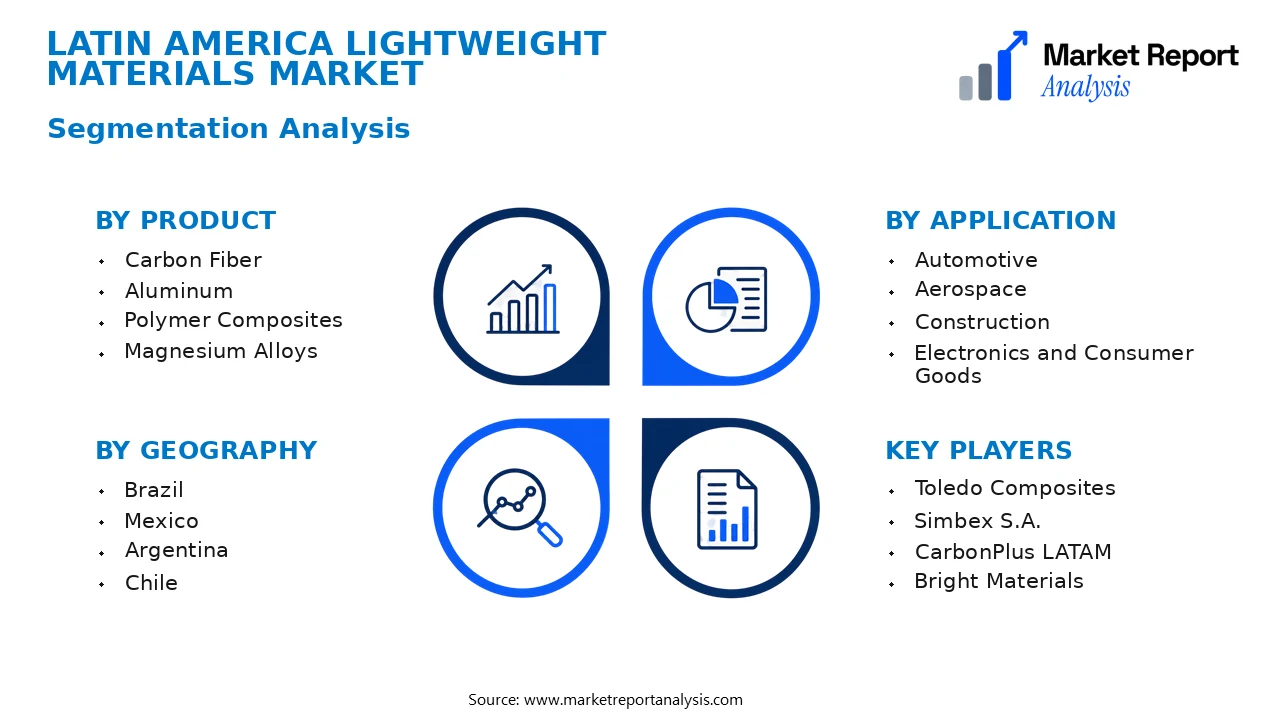
Market segmentation in the Latin America Lightweight Materials Market is structured around product types, applications, and geographical regions. This strategic segmentation enables a clearer understanding of demand drivers, regional adoption patterns, and growth opportunities across diverse industry sectors within Latin America.
- Product
- Carbon Fiber: This high-performance lightweight material is increasingly used in aerospace, automotive, and sporting goods sectors due to its high strength-to-weight ratio and resistance to corrosion, driving substantial demand in the region.
- Aluminum: Known for its light weight and excellent recyclability, aluminum is vital for manufacturing automotive parts, packaging, and construction components, experiencing steady growth aligned with sustainability initiatives in LATAM.
- Polymer Composites: These materials are favored in electronic device casings, automotive interiors, and consumer goods, with growth spurred by the rising need for lightweight plastics in various consumer and industrial applications.
- Magnesium Alloys: Offering even lighter properties than aluminum, magnesium alloys are primarily used in automotive and aerospace sectors, capturing niche but expanding market segments in Latin America.
- Application
- Automotive: The automotive sector in LATAM is adopting lightweight materials to meet fuel efficiency regulations and consumer demand for eco-friendly vehicles, significantly contributing to the overall market development.
- Aerospace: Regional aerospace industries are increasingly utilizing lightweight composites to meet strict safety and efficiency standards, fostering a demand for advanced materials such as carbon fiber composites.
- Construction: Lightweight materials are increasingly used in building and infrastructure projects to reduce structural load and improve energy efficiency, promoting sustainable development in urban areas.
- Electronics and Consumer Goods: Growth in electronics manufacturing and consumer goods is fueling the demand for lightweight plastics and composites, essential for portable, durable, and lightweight product designs.
- Geography
- Brazil: As the largest economy in LATAM, Brazil drives the regional lightweight materials market, particularly in automotive manufacturing, aerospace, and construction, with a focus on sustainability initiatives.
- Mexico: Benefitting from its strong automotive industry and manufacturing corridor, Mexico exhibits robust demand for lightweight materials to enhance vehicle fuel efficiency and reduce emissions.
- Argentina: While smaller in scale, Argentina's automotive and export sectors are gradually adopting lightweight materials to meet international environmental standards.
- Chile: Chile's focus on infrastructure and energy projects is fueling demand for lightweight materials in construction and renewable energy sectors, emphasizing environmental benefits and cost savings.
Competitive Intelligence
The Latin America Lightweight Materials Market exhibits a competitive landscape characterized by a mix of regional and international players. Market concentration remains moderate, with key players such as BrazAL, Hexcel, and Teijin adopting aggressive strategies to expand their market shares through strategic partnerships and acquisitions. Companies are investing heavily in research and development to innovate lighter, stronger, and more cost-effective materials, including advanced composites and aluminum alloys, to cater to the automotive and aerospace sectors. Strategic alliances are prevalent; for example, collaborations between material producers and OEMs aim to accelerate product development and supply chain integration. Several companies are expanding operations within Latin America to capitalize on local manufacturing advantages and growing regional demand, leading to infrastructure investments and plant expansions. R&D efforts primarily focus on enhancing material performance, sustainability, and recyclability, which serve as key differentiators. Overall, competitive differentiation is increasingly driven by technological innovation, quality standards, and strategic partnerships that strengthen market positioning and enable rapid response to evolving customer needs.
Leading Company Profiles
The competitive landscape in the Latin America lightweight materials market is marked by a diverse group of innovative companies that are expanding their technological capabilities and market reach to capitalize on the growing demand from automotive, aerospace, and packaging sectors.
- Toledo Composites
- Simbex S.A.
- CarbonPlus LATAM
- Bright Materials
- Laminar Tech
- InnovLight Latin America
- EcoLite Solutions
- FibraTech Innovations
- PolyLite Group
- AluMag LATAM
Toledo Composites
Toledo Composites specializes in advanced composite lightweight materials primarily for the automotive and aerospace industries, leveraging carbon fiber and fiberglass technologies to improve efficiency and reduce emissions, with strategic expansion plans targeting regional OEMs.
Simbex S.A.
Simbex S.A. offers a broad portfolio of engineered plastics and composite materials, focusing on sustainable and thermally efficient lightweight solutions that support Latin American manufacturing sectors aiming to meet global environmental standards.
CarbonPlus LATAM
CarbonPlus LATAM develops innovative carbon fiber-based products, including panels and structural components, emphasizing strength-to-weight ratio and sustainability, and is expanding manufacturing capacity across Mexico and Brazil for regional and export markets.
Bright Materials
Bright Materials produces advanced polymer-based lightweight solutions designed for automotive interiors and packaging, leveraging proprietary additive manufacturing for rapid customization and scalable production tailored to Latin America’s growth markets.
Laminar Tech
Laminar Tech specializes in laminated lightweight composites for aerospace applications, focusing on high-performance, fire-resistant materials essential for regional defense and commercial aircraft upgrades and new models.
InnovLight Latin America
InnovLight Latin America is expanding its R&D operations to develop next-generation lightweight metals and hybrid composites, aiming to serve industries seeking to lower weight and improve fuel efficiency.
EcoLite Solutions
EcoLite Solutions centers on bio-based and recycled lightweight materials, supporting sustainability initiatives across automotive and consumer goods sectors, with investments in scalable, eco-friendly manufacturing processes.
FibraTech Innovations
FibraTech Innovations focuses on fiber-reinforced plastics and composites for industrial applications, emphasizing upgrading existing infrastructure and expanding its footprint in Brazil and Argentina.
PolyLite Group
Specializing in innovative polymers and thermoplastics, PolyLite Group develops lightweight structural components for automotive and packaging sectors, with sustainability as a core strategic priority, driving capacity investments in Mexico.
AluMag LATAM
AluMag LATAM manufactures aluminum-matrix composites for high-performance applications, supporting the aerospace and automotive sectors through strategic capacity hikes and joint ventures to sharpen regional competitive strength.
Strategic Business Developments
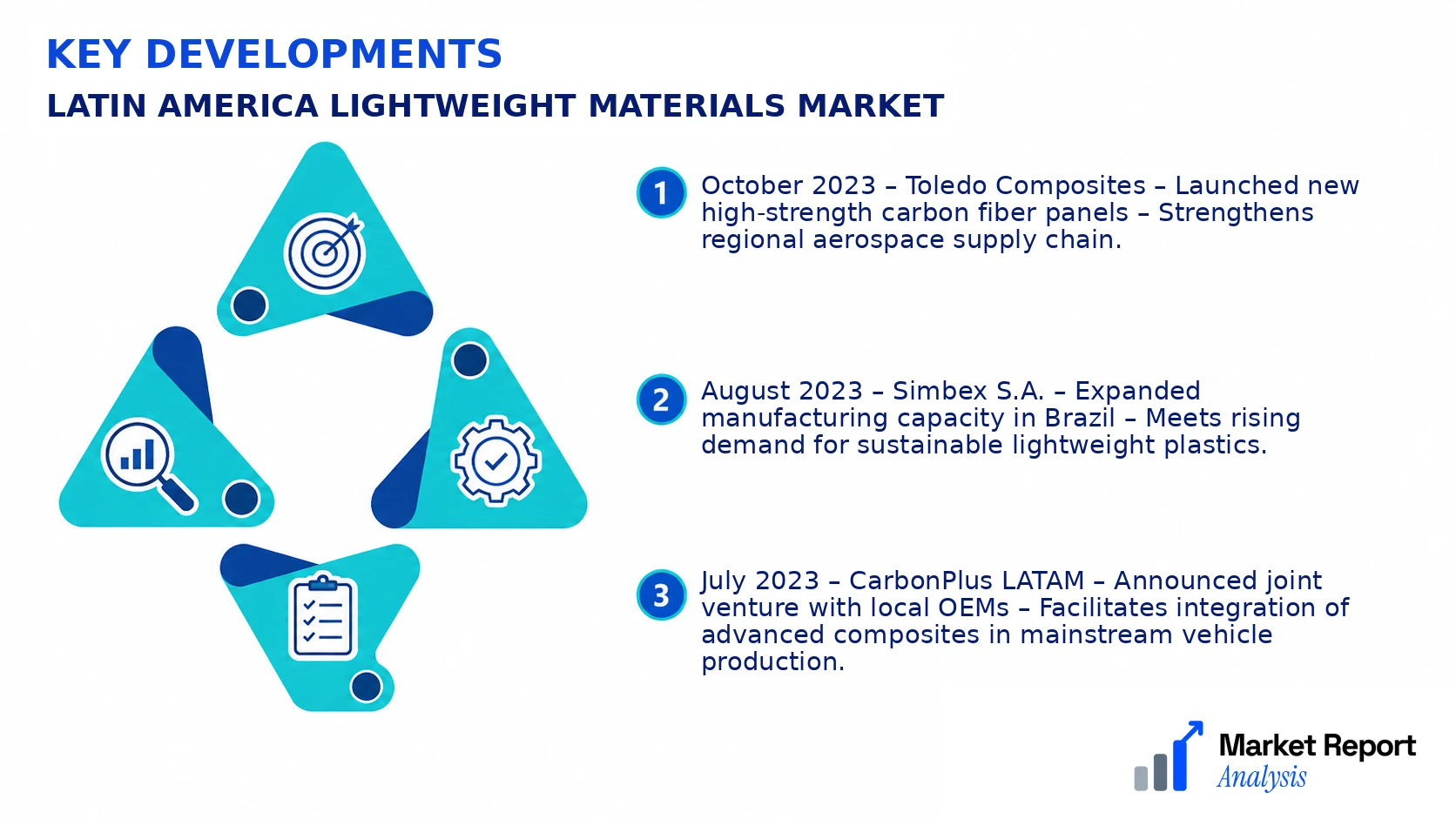
- October 2023 – Toledo Composites – Launched new high-strength carbon fiber panels – Strengthens regional aerospace supply chain.
- August 2023 – Simbex S.A. – Expanded manufacturing capacity in Brazil – Meets rising demand for sustainable lightweight plastics.
- July 2023 – CarbonPlus LATAM – Announced joint venture with local OEMs – Facilitates integration of advanced composites in mainstream vehicle production.
- May 2023 – Bright Materials – Introduced proprietary additive manufacturing technology – Accelerates customization and production speed for lightweight solutions.
- March 2023 – EcoLite Solutions – Secured funding for sustainability-driven plant expansion – Focuses on bio-based materials for automotive and packaging sectors.
Frequently Asked Questions
What is the Latin America Lightweight Materials Market?
The Latin America Lightweight Materials Market encompasses the industry involved in the production and distribution of lightweight materials, such as composites, plastics, and aluminum, used across automotive, aerospace, and packaging sectors to reduce weight and improve efficiency.
What is the current market size of Latin America Lightweight Materials Market?
As of 2026, the market size is valued at approximately USD 8.5 Billion, reflecting growing demand across various industries for lightweight solutions to enhance fuel efficiency, environmental sustainability, and meet stringent regulatory standards in Latin American countries.
What factors are driving the Latin America Lightweight Materials Market?
Key drivers include increasing automotive production, rising aerospace sector investments, stringent environmental regulations, and technological advancements in lightweight material manufacturing, all contributing to higher adoption rates and market expansion in Latin America.
Which region dominates the Latin America Lightweight Materials Market?
Brazil emerges as the dominant region, fueled by its substantial automotive industry, aerospace activities, and ongoing infrastructure development, which collectively contribute significantly to regional market growth and demand for lightweight materials.
Which segment is expected to grow the fastest?
The automotive segment is projected to experience the fastest growth, driven by the adoption of lightweight composites and aluminum to improve vehicle fuel efficiency and comply with emissions standards across Latin American markets.
Who are the leading companies operating in the Latin America Lightweight Materials Market?
Leading companies include established global players such as ALCOA, Novelis, and Toray Industries, along with regional firms that focus on innovative lightweight solutions tailored to Latin American industrial needs and environmental policies.
Analyst Perspective
The Latin America Lightweight Materials Market is poised for sustained growth, driven by increasing automotive production, infrastructure development, and a shift towards sustainable materials. The market's maturity varies across segments, with composites and advanced metals showing higher adoption rates, yet still offering significant room for expansion due to ongoing technological advancements. Commercial opportunities are notably concentrated in lightweight aluminum and composites for automotive applications, as OEMs seek to meet stringent fuel efficiency standards. Technological evolution will focus on enhanced material performance, recyclability, and cost reduction, fostering innovation in manufacturing processes and material formulations. Investment priorities should emphasize R&D, strengthening supply chains, and fostering regional collaborations to capitalize on emerging opportunities. Competitive intensity is expected to increase as key players expand their footprint through strategic alliances and capacity expansion. Regional growth prospects remain robust, especially in Brazil and Mexico, where automotive and construction sectors are accelerating. Long-term, the market will benefit from a focus on sustainable practices, yet faces risks from raw material price volatility and geopolitical factors influencing trade policies.
