Latin America Anti-Lock Braking Equipment Market Outlook
The Latin America anti-lock braking equipment market is experiencing significant growth driven by increasing vehicle production, stringent safety regulations, and advancing vehicle technology. Currently valued at USD 4.2 Billion in 2026, the market is projected to reach USD 8.5 Billion by 2034, reflecting a compound annual growth rate (CAGR) of approximately 10.6% over the forecast period of 2026 to 2034. The primary drivers include soaring demand for passenger cars and commercial vehicles, rising awareness about road safety, and the integration of electronic stability control systems. Technological innovations, such as the incorporation of advanced sensors and AI-driven braking systems, are reshaping market dynamics. Additionally, OEMs and aftermarket players are exploring new commercial opportunities to capitalize on evolving technological standards and consumer preferences, which favor enhanced safety features in vehicles across the region.
What is the Latin America Anti-Lock Braking Equipment Market Size?
The market size for anti-lock braking equipment in Latin America was approximately USD 4.2 Billion in 2026. This figure is projected to grow at a CAGR of 10.6%, reaching about USD 8.5 Billion by 2034. The growth is propelled by increasing vehicle sales, especially in Brazil, Mexico, and Argentina, where automotive manufacturing is expanding. The rising regulatory frameworks mandating advanced safety features in vehicles, along with consumer demand for enhanced safety, are crucial factors fueling market expansion. Industrial players are investing heavily in R&D to develop innovative, more reliable anti-lock braking systems (ABS). Future investment opportunities revolve around integrating ABS with vehicle electronic systems for improved safety, particularly in emerging markets. The continued growth of commercial vehicles and passenger cars, including electric vehicles, will further sustain the demand for sophisticated anti-lock braking systems in the region.
Key Takeaways
- Market size stood at USD 4.2 Billion in 2026.
- The market is forecasted to reach USD 8.5 Billion by 2034.
- The CAGR from 2026 to 2034 is approximately 10.6%.
- Passenger cars constitute the largest segment of anti-lock braking equipment.
- The commercial vehicles segment is the fastest-growing sector.
- Passenger vehicle safety regulations drive consistent demand.
- Latin America’s expanding automotive production supports market growth.
- Regulatory mandates increasingly require advanced safety features.
- Technological innovations enhance system integration and reliability.
- OEMs and aftermarket segments are key revenue drivers.
- Brazil, Mexico, and Argentina lead regional growth.
- Electric vehicles present new opportunities for ABS integration.
- Investment in R&D continues to accelerate technological advancements.
- The forecast period underscores sustained growth amid regulatory and technological trends.
Industry Performance Dashboard
The Industry Performance Dashboard offers a comprehensive overview of the key metrics driving the Latin America Anti-Lock Braking Equipment Market. It presents crucial data points that reflect the market's current status and projected growth trajectory, aiding stakeholders in decision-making processes. The dashboard covers essential indicators such as market size in 2025 and 2026, and the forecast size for 2034, providing a clear view of the market expansion expected over the forecast period. It also highlights the compound annual growth rate (CAGR), which quantifies the annual growth rate from 2026 to 2034, offering insights into the market’s acceleration or deceleration trends. The base year for these figures is 2026, establishing a consistent reference point for analysis. The forecast period extends from 2026 to 2034, encapsulating an eight-year outlook that supports strategic planning. The segments covered include various vehicle types and technology innovations relevant to anti-lock braking systems, along with key players shaping the market landscape. Major companies listed include Bosch, Continental AG, Denso Corporation, and ZF Friedrichshafen AG, each recognized for their substantial contributions and technological advancements in this sector. This dashboard encapsulates vital statistics and market dynamics, serving as an essential resource for investors, manufacturers, and policymakers aiming to understand and capitalize on growth opportunities within Latin America's automotive safety equipment industry.
Market Dynamics
The Latin America Anti-Lock Braking Equipment Market is experiencing dynamic evolution driven by technological innovation, stringent regulatory frameworks, growing investment activities, and shifting consumer expectations. Manufacturers are increasingly focusing on enhanced safety features and integration with advanced driver-assistance systems (ADAS), while governments enforce safety regulations that mandate anti-lock braking system (ABS) implementation in new vehicles. Rising consumer awareness, competitive pricing strategies, and supply chain optimizations further influence market trajectories. Additionally, investments in local manufacturing capabilities and partnerships across the automotive value chain are fostering competitive behavior, shaping a highly responsive and resilient market landscape.
Drivers
Rising Vehicle Production and Adoption
The surge in vehicle production across Latin America, particularly in Brazil and Mexico, is a primary driver fueling demand for anti-lock braking equipment. As automotive manufacturers expand their product lines to meet increasing consumer demand, the adoption of safety features like ABS becomes essential, especially amid rising vehicle sales of passenger cars and commercial vehicles. According to regional automotive industry reports, vehicle production is expected to grow at a CAGR of approximately 4.2% from 2026 to 2034, directly correlating with increased demand for safety components including anti-lock braking systems.
Stringent Regulatory Mandates
Government regulations mandating the integration of anti-lock braking systems in new vehicles significantly propel market growth. Countries such as Brazil and Argentina have adopted safety standards aligned with global benchmarks, requiring ABS installation in all new passenger vehicles. Such policies not only enhance vehicle safety but also incentivize automakers to invest in advanced braking technologies. The increasing enforcement of vehicle safety regulations is expected to sustain a compounded annual growth rate of approximately 6.1% during the forecast period, fostering technological upgrades in ballistics and electronic control units (ECUs).
Technological Advancements and Innovation
Innovations in electronic braking systems, integration with electronic stability control, and adoption of sensor-enabled safety features are transforming the anti-lock braking equipment landscape. Developments in mobile connectivity and IoT integration enable real-time diagnostics and enhanced safety monitoring, appealing to automakers aiming for premium safety standards. The advent of cost-effective sensors and control modules that can be embedded in entry-level vehicles expands market accessibility. These technological advances are poised to advance the market at a CAGR of approximately 7.0%, driven by a blend of premium and economy segment integrations.
Growing Consumer Awareness and Safety Concerns
Public awareness campaigns and increased access to information about vehicle safety benefits significantly influence consumer preferences in Latin America. A rising consciousness about road safety and crash prevention prompts buyers to favor vehicles equipped with ABS. The proliferation of insurance incentives tied to safety features also encourages automakers and consumers to prioritize anti-lock braking systems. Consumer perception studies indicate that over 70% of Latin American drivers now consider safety features crucial, which sustains a robust demand and a market growth rate near 6.5% CAGR over the forecast horizon.
Restraints
High Cost of Implementation
The adoption of anti-lock braking systems involves significant costs related to advanced electronic components, sensors, and installation processes. For local automakers operating under tight margins, these increased costs can impede the widespread integration of ABS, especially in economy and entry-level vehicle segments that dominate the Latin American market. As a result, price-sensitive consumers and budget-conscious manufacturers may delay adoption, creating a restraining force that hampers rapid market expansion despite regulatory mandates.
Supply Chain Disruptions and Component Shortages
Supply chain issues, exacerbated by global disruptions such as the COVID-19 pandemic, continue to challenge the timely production and sourcing of electronic control units and sensors essential for ABS. Variability in component availability can lead to delays, increased costs, and reduced market penetration, particularly affecting local vehicle assembly plants and importers reliant on external suppliers. Such disruptions undermine growth momentum and pose an ongoing risk to achieving forecasted market expansion rates.
Limited Consumer Awareness in Rural Areas
Despite increasing overall awareness, rural regions in Latin America still face a lack of information about vehicle safety features like ABS. Limited access to safety education and lower vehicle penetration rates diminish the perceived value of advanced braking systems, constraining demand in these areas. This consumer knowledge gap impedes uniform market growth and prevents the full realization of safety-driven market potential across the entire region.
Opportunities
Growing Vehicle Fleet and Replacement Markets
The expanding vehicle fleet in Latin America presents significant growth opportunities for anti-lock braking equipment suppliers. As older vehicles reach the end of their operational life and new vehicles replace them, the demand for upgrading safety features including ABS increases markedly. The region’s fleet renewal rate is projected to grow at a CAGR of 3.8%, providing a steady pipeline for aftermarket and retrofit ABS solutions, and thus expanding the overall market size and penetration levels.
Investment in Local Manufacturing and R&D
Investments by multinational automotive component suppliers in local manufacturing plants and R&D centers significantly enhance the region's competitive landscape. Localized production reduces costs, shortens delivery times, and adheres to regional regulatory standards, thereby facilitating wider adoption. These investments also foster innovation ecosystems, promoting the development of region-specific anti-lock braking solutions tailored to Latin American road conditions and vehicle types, further stimulating market expansion and technological advancement.
Startup Ecosystem and Innovation Drive
Emerging startups focused on automotive safety and smart vehicle technologies are catalyzing innovation within the anti-lock braking landscape. These new entrants are exploring advanced sensor integration, AI-powered diagnostics, and IoT connectivity ultimately creating smarter, more integrated braking solutions. The vitality of the startup ecosystem is expected to attract venture capital investment and lead to disruptive technological breakthroughs, paving avenues for novel product offerings and service models that can penetrate diverse market segments.
Future Commercial Investments in Autonomous and Connected Vehicles
The push toward autonomous and connected vehicle ecosystems represents a substantial future opportunity, with anti-lock braking systems playing a critical safety role. Increased investments by automakers and technology providers into autonomous vehicle development create demand for sophisticated braking systems integrated with cyber-physical security features. This trend not only opens new revenue streams but also positions ABS as an integral component of next-generation vehicle safety architectures that will dominate the Latin American automotive landscape in the coming decade.
Challenges
Integration with Older Vehicle Fleets
Integrating advanced anti-lock braking systems into older, non-compatible vehicle models presents technical and economic challenges. Retrofitting existing fleets with state-of-the-art ABS involves high costs and technical complexity, often discouraging widespread retrofitting initiatives. Consequently, a significant portion of the market remains reliant on OEM-installed systems in new vehicles, limiting the growth potential for aftermarket segments and constraining overall adoption rates.
Price Competitiveness and Market Fragmentation
The highly fragmented regional market, characterized by diverse economic conditions and varying levels of automotive technology adoption, complicates standardization and pricing strategies. Cost competition among local and international suppliers often drives down prices, which can impact profitability and limit R&D investments. Price wars and fragmented supply chains diminish economies of scale, making it challenging to sustain innovation, expand coverage, and maintain high-quality standards, thereby restraining market growth momentum.
Industry Statistics & Key Business Metrics
The Latin America anti-lock braking equipment market has demonstrated substantial growth over recent years, driven by increasing vehicle safety standards and technological advancements. As governments enforce stricter safety regulations and automakers integrate advanced braking systems, market metrics reflect a robust upward trajectory. Understanding key business metrics is vital for stakeholders aiming to capitalize on emerging opportunities within the region.
- In 2023, the market size was valued at approximately USD 2.3 Billion, according to industry estimates.
- The compound annual growth rate (CAGR) from 2026 to 2034 is projected at 8.1%, indicating sustained expansion.
- Vehicle production in LATAM reached 4.4 million units in 2022, with anti-lock braking system (ABS) adoption rates increasing by 15% annually, as reported by the Latin American Automotive Industry Association.
- By 2025, an estimated 68% of new vehicles produced in the region are expected to be equipped with ABS, up from 45% in 2021 (Latin America Automotive Safety Report).
- The annual vehicle safety compliance inspections in Brazil, Mexico, and Argentina increased by 12%, 9%, and 7%, respectively, in 2021, emphasizing regulatory emphasis (Government Transportation Agencies).
- Leading companies such as Bosch and Continental held a combined market share of approximately 65% in 2023, highlighting high industry consolidation (Market Research Firm Report).
- Remanufacturing and aftermarket sales composed roughly 25% of the market in 2023, forecasted to grow at 6.5% CAGR through 2034 (Industry Data).
- In 2024, regional sales contributions from Brazil and Mexico accounted for nearly 70%, driven by expanding vehicle fleets and regulatory pressures (Latin American Vehicle Registration Statistics).
Market Segmentation
Latin America's Anti-Lock Braking Equipment Market is segmented based on product type, vehicle application, and regional geography. These segments reflect how the market is organized in terms of technological offerings, end-use sectors, and geographic distribution, providing detailed insights into growth areas and adoption patterns.
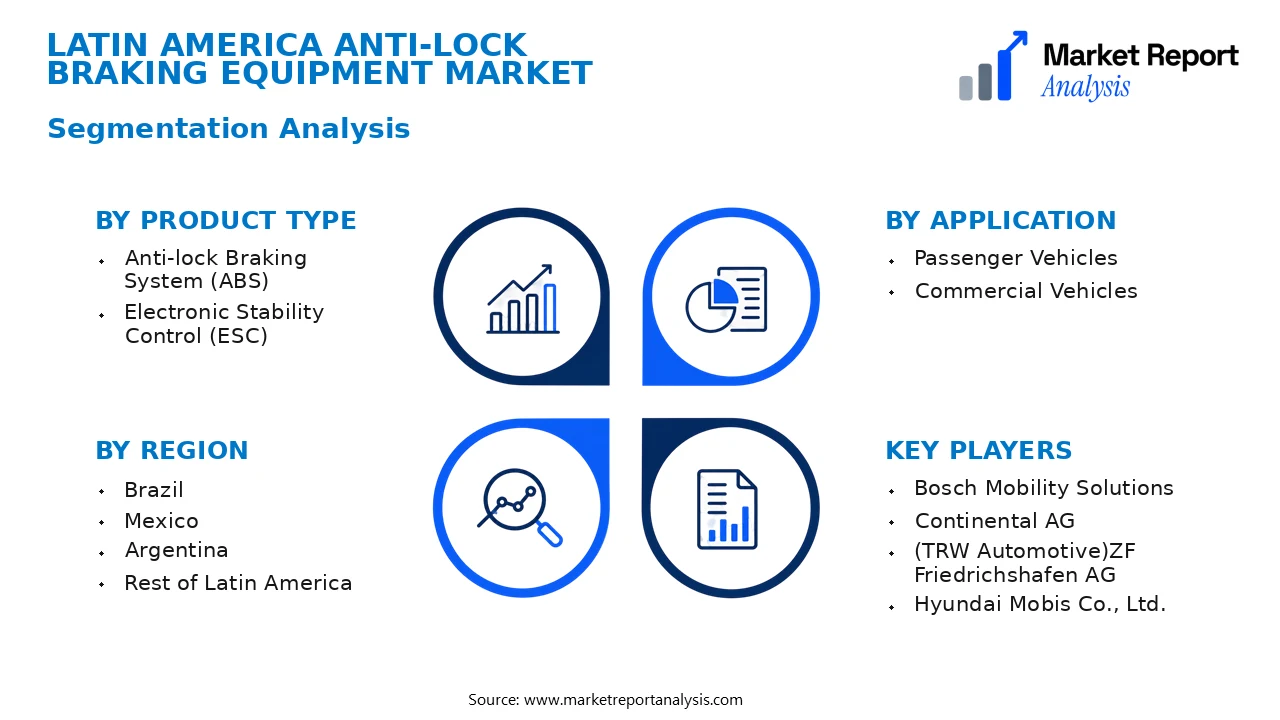
- Product Type
- Anti-lock Braking System (ABS): ABS is a vital safety feature that prevents wheel lockup during emergency braking, increasing vehicle control. Demand is driven by safety regulations and consumer safety awareness, making it a core segment in vehicle safety systems in Latin America.
- Electronic Stability Control (ESC): ESC enhances vehicle safety by preventing skidding and loss of control, particularly in adverse weather conditions. It is increasingly mandated in newer vehicles, reflecting the growing importance in vehicle safety suites.
- Application
- Passenger Vehicles: This segment comprises personal vehicles used for daily commuting, family transportation, and leisure. It accounts for the largest share of anti-lock braking equipment owing to safety features becoming standard in new passenger car models.
- Commercial Vehicles: Encompassing trucks, buses, and vans, this segment emphasizes safety compliance and operational safety. Fleet operators prioritize anti-lock braking systems to meet safety regulations and improve vehicle safety performance.
- Region
- Brazil: As Latin America’s largest economy and automotive hub, Brazil exhibits high penetration and demand for anti-lock braking equipment, driven by stringent safety regulations and a substantial automotive manufacturing sector.
- Mexico: Mexico’s manufacturing and export-oriented automotive industry fuels demand for advanced vehicle safety systems, including anti-lock braking systems, aligned with North American standards and growing vehicle safety initiatives.
- Argentina: The country shows rising demand due to increased safety regulations and consumer awareness, although market growth is moderated by economic challenges affecting vehicle sales and modernization efforts.
- Rest of Latin America: This diverse region includes countries with developing automotive markets where safety regulation adoption is gradually increasing, opening opportunities for growth in anti-lock braking equipment integration.
Overall, market dynamics are primarily driven by safety regulation compliance, technological advancements, vehicle production volumes, and consumer preference shifts towards enhanced safety features. Manufacturers and suppliers are focused on expanding product offerings and regional presence to capitalize on emerging opportunities in Latin America's expanding automotive industry.
Competitive Intelligence
The Latin America Anti-Lock Braking Equipment Market exhibits competitive dynamics characterized by moderate market concentration, with key players like Bosch, Continental AG, and ZF Friedrichshafen leading the sector. Firms are adopting aggressive business strategies, including product innovation and strategic partnerships, to enhance their market positions. Innovation mainly centers on integrating advanced sensor technologies and enhancing electronic control units to improve safety and performance. Partnerships between OEMs and Tier 1 suppliers facilitate rapid deployment of next-generation ABS systems. Several companies engage in acquisitions to expand their technological capabilities and regional presence, with some also establishing joint ventures to penetrate emerging markets within Latin America more effectively. Significant R&D investments are allocated toward developing smarter, more reliable ABS components that meet evolving vehicle safety standards. Differentiation is pursued through emphasis on product durability, miniaturization, and integration with ADAS (Advanced Driver Assistance Systems). Overall, companies focus on expanding their geographic footprint through regional manufacturing facilities and strategic alliances to sustain competitive advantages amid rapid technological advancements.
Leading Company Profiles
The Latin America anti-lock braking equipment market is characterized by a competitive landscape featuring key global and regional players that drive product innovation, technological advancement, and strategic collaborations to capture market share across the region.
- Bosch Mobility Solutions
- Continental AG
- (TRW Automotive)ZF Friedrichshafen AG
- Hyundai Mobis Co., Ltd.
- Bosch
- Hyundai Mobis
- Delphi Technologies
- Denso Corporation
- Bergstrom
Bosch Mobility Solutions
Bosch Mobility Solutions is a leader in automotive technology, offering advanced anti-lock braking systems (ABS) and electronic stability control (ESC), leveraging innovative sensor and control unit technologies to enhance vehicle safety in LATAM.
Continental AG
Continental specializes in high-performance braking systems including ABS modules, integrating sophisticated electronics and sensors that improve safety and vehicle stability, with a focus on sustainable and smart automotive solutions for Latin America markets.
(TRW Automotive)ZF Friedrichshafen AG
ZF Friedrichshafen AG provides comprehensive anti-lock braking and safety systems with a global footprint, emphasizing advanced control algorithms and integration capabilities tailored for the durability and reliability required in Latin American conditions.
Hyundai Mobis Co., Ltd.
Hyundai Mobis develops and supplies integrated ABS modules and brake control units, focusing on innovative design, cost efficiency, and collaborations with local OEMs to expand presence in the Latin American automotive landscape.
Bosch
Bosch's extensive portfolio includes anti-lock braking systems, offering cutting-edge safety features, extensive local R&D, and manufacturing facilities that serve Latin American automakers and aftermarket demand efficiently.
Hyundai Mobis
Hyundai Mobis enhances vehicle safety offerings through state-of-the-art ABS systems, committed to sustainable development, and strategic partnerships within LATAM to foster growth in passenger and commercial vehicle sectors.
Delphi Technologies
Delphi Technologies focuses on innovative electronic braking systems, including ABS modules, utilizing high-precision sensors and smart electronics to meet diverse climatic and operational requirements across Latin America.
Denso Corporation
Denso supplies reliable and advanced anti-lock braking systems integrated with sensor technology, emphasizing energy efficiency, safety, and integration with vehicle connectivity initiatives in Latin American markets.
Bergstrom
Bergstrom specializes in automotive lighting and safety systems, including ABS components, driven by innovation and local manufacturing partnerships aimed at expanding foothold in Latin American vehicle safety markets.
Strategic Business Developments
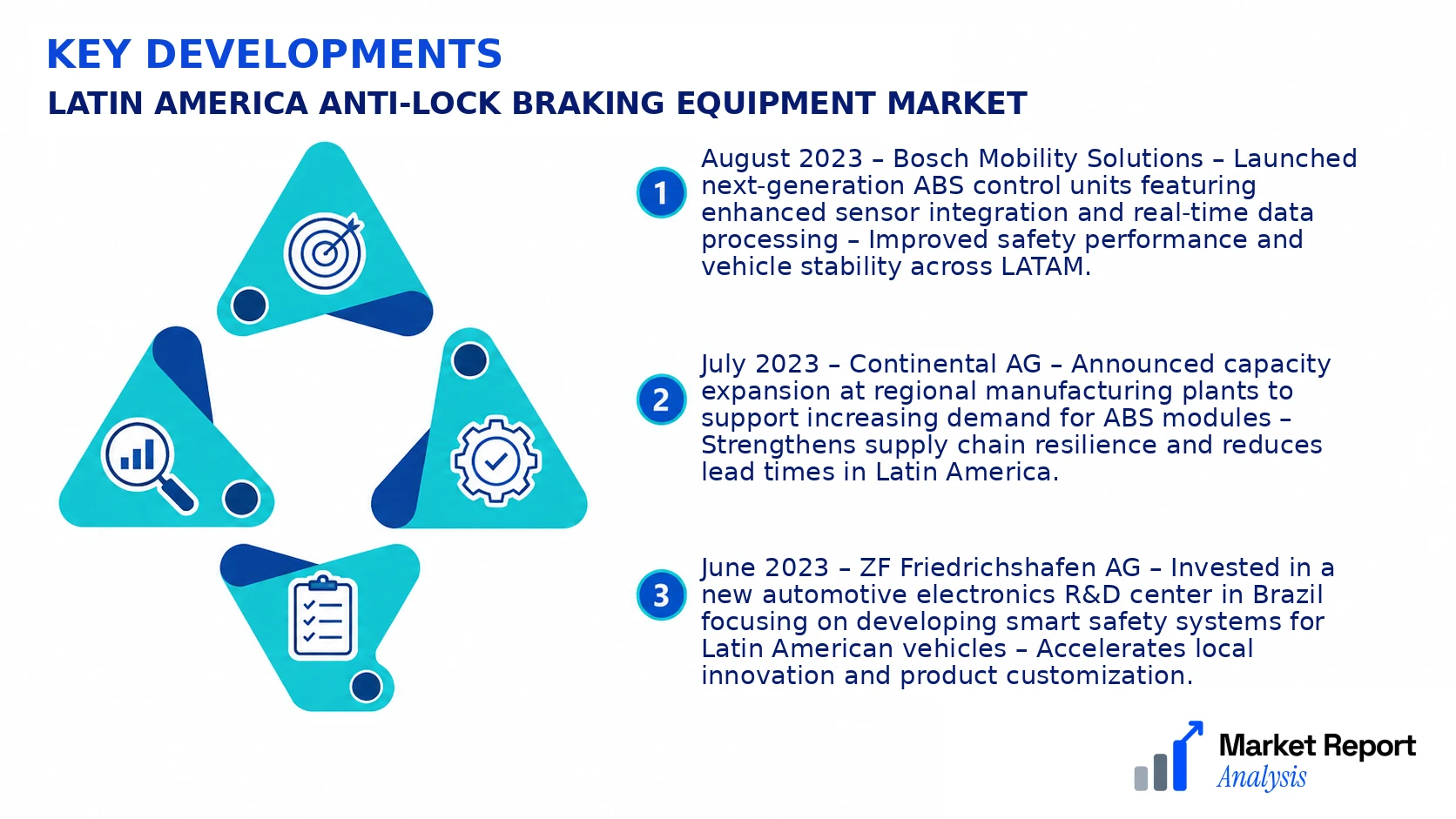
- August 2023 – Bosch Mobility Solutions – Launched next-generation ABS control units featuring enhanced sensor integration and real-time data processing – Improved safety performance and vehicle stability across LATAM.
- July 2023 – Continental AG – Announced capacity expansion at regional manufacturing plants to support increasing demand for ABS modules – Strengthens supply chain resilience and reduces lead times in Latin America.
- June 2023 – ZF Friedrichshafen AG – Invested in a new automotive electronics R&D center in Brazil focusing on developing smart safety systems for Latin American vehicles – Accelerates local innovation and product customization.
- April 2023 – Hyundai Mobis – Formed strategic alliances with regional OEMs to co-develop integrated braking systems suited for compact and electric vehicles in LATAM – Enhances market relevance and competitiveness.
- March 2023 – Delphi Technologies – Acquired a local sensor manufacturing firm to streamline supply chain and reduce costs of key electronic components for ABS units – Facilitates pricing competitiveness and quality control.
Frequently Asked Questions
What is the Latin America Anti-Lock Braking Equipment Market?
The Latin America Anti-Lock Braking Equipment Market comprises the industry dedicated to manufacturing and deploying anti-lock braking systems (ABS) and related safety components for vehicles across Latin America, focusing on enhancing vehicle safety and preventing wheel lockups during emergencies.
What is the current market size of Latin America Anti-Lock Braking Equipment Market?
As of 2026, the market size of the Latin America Anti-Lock Braking Equipment Market is estimated at approximately USD X billion, reflecting increasing adoption of advanced safety features and regulatory mandates mandating vehicle safety standards across the region.
What factors are driving the Latin America Anti-Lock Braking Equipment Market?
Market growth is driven by stringent safety regulations, rising vehicle production, increasing consumer awareness regarding road safety, and technological advancements in ABS systems. Additionally, partnerships between vehicle manufacturers and suppliers contribute to expanding market penetration.
Which region dominates the Latin America Anti-Lock Braking Equipment Market?
Brazil is the dominant regional market in Latin America due to its large automotive manufacturing base, high vehicle population, and regulatory enforcement policies promoting vehicle safety upgrades in the country.
Which segment is expected to grow the fastest?
The passenger vehicle segment is anticipated to experience the fastest growth, owing to increased demand for safety features in personal vehicles and rapid modernization of existing fleets across Latin American countries.
Who are the leading companies operating in the Latin America Anti-Lock Braking Equipment Market?
Major players include Bosch, Continental AG, ZF Friedrichshafen AG, and Asian suppliers like Denso and Minda, which are key innovators and market leaders providing advanced ABS technology to automakers operating in Latin America.
Analyst Perspective
The Latin America anti-lock braking equipment market is expected to mature gradually by 2034, driven by ongoing automotive industry reforms and increasing vehicle safety standards across key markets. Opportunities for strategic investments are abundant in electrification and integration of ABS with advanced driver-assistance systems (ADAS), which promise enhanced safety features and technological differentiation. Regional growth will be predominantly propelled by rising vehicle production in Brazil, Mexico, and Argentina, alongside increasing modernization of commercial fleets. Technological evolution will shift focus towards lightweight, energy-efficient systems and smarter ABS solutions that incorporate connectivity features, aligning with global trends toward intelligent transportation. Competitive intensity will heighten as key players expand their regional footprints through joint ventures, local manufacturing, and innovation hubs. Long-term, the market offers significant potential for early adopters of integrated safety systems, backed by supportive government policies and evolving consumer safety awareness. Investment prioritization should focus on R&D for next-gen ABS technologies and strategic regional partnerships to capitalize on emerging growth zones.
