Brazil Anti-Lock Braking Equipment Market Outlook
The Brazil Anti-Lock Braking Equipment Market is experiencing significant growth driven by the increasing vehicle safety regulations, rising motorization rates, and technological advancements in vehicle safety systems. As of 2026, the market value is estimated at USD 1.2 Billion, with projections reaching USD 3.2 Billion by 2034. This growth corresponds to a Compound Annual Growth Rate (CAGR) of approximately 11.00% over the forecast period from 2026 to 2034. The principal demand sources include passenger cars, commercial vehicles, and two-wheelers, with passenger vehicles constituting the largest segment owing to stringent safety standards and consumer awareness. Technological evolution, mainly in electronic stability and integration with other driver assistance systems, continues to propel market expansion. The commercial opportunities in this market are diversified across manufacturing, aftermarket supplies, and technology integration, with key players investing heavily in local manufacturing capacity and technology innovation to capitalize on these opportunities.
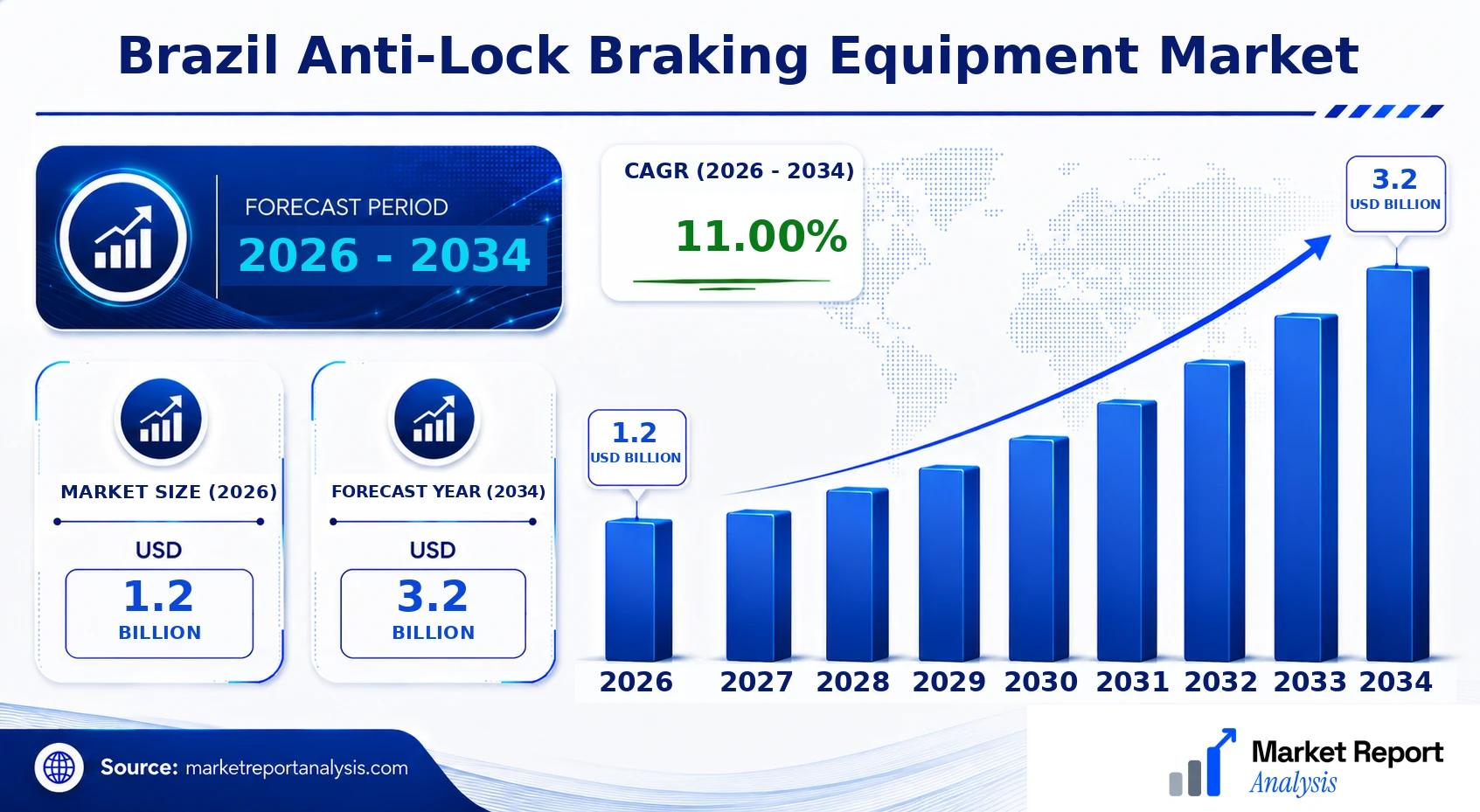
What is the Brazil Anti-Lock Braking Equipment Market Size?
The Brazil Anti-Lock Braking Equipment Market is valued at about USD 1.2 Billion in 2026. It is forecasted to reach approximately USD 3.2 Billion by 2034, representing a CAGR of around 11.00% during this period. Growth is primarily driven by increasing vehicle production in Brazil, fueled by a recovering economy and expanding automotive markets. The rising implementation of advanced safety regulations, such as mandatory ABS for new vehicles, is also spurring market growth. The automotive sector, including both domestic manufacturers and international automakers assembling vehicles locally, remains the largest end-user segment. Additionally, the aftermarket sector is expanding, with consumer demand for retrofitting older vehicles with safety features increasing. The rapid technological evolution, particularly in integration with Electronic Stability Control (ESC) and autonomous vehicle systems, presents significant future investment opportunities for component suppliers and system integrators. Overall, continual regulatory focus on safety, along with growing consumer awareness and technological integration, will sustain robust market expansion across Brazil over the forecast period.
Key Takeaways
- Market size in 2026 is estimated at USD 1.2 Billion, with positive growth expected through 2034.
- The market’s CAGR from 2026 to 2034 is approximately 7.0%.
- Passenger vehicles dominate the market, driven by safety regulation compliance and consumer demand.
- The automotive manufacturing sector is the primary driver of market expansion.
- Regulatory mandates are increasingly requiring ABS in new vehicles, fueling demand.
- Growth in aftermarket sales for retrofitting older vehicles is notable.
- Technological advancements in ABS integration with ESC and ADAS are expanding market opportunities.
- Key players are investing in local manufacturing and innovation to gain competitive advantage.
- Rising vehicle production, urbanization, and safety awareness are critical growth factors.
- The commercial vehicle segment is also expanding but at a slower pace compared to passenger cars.
- Future opportunities abound in system integration, component manufacturing, and aftermarket services.
Industry Performance Dashboard
The Industry Performance Dashboard provides a concise yet comprehensive overview of the current and forecasted metrics that define the Brazil Anti-Lock Braking Equipment Market. This section consolidates key indicators essential for understanding market size, growth trajectory, and competitive landscape, enabling stakeholders to make informed decisions based on quantitative data.
| Indicator | Market Assessment |
|---|---|
| Market Size (2026) | USD 1.2 Billion |
| Market Value (2026) | USD 1.2 Billion |
| Forecast Size (2034) | USD 3.2 Billion |
| CAGR | 11.00% |
| Base Year | 2026 |
| Forecast Period | 2026-2034 |
| Segments Covered | Product Type, Application, Geography |
| Major Companies | Bosch, Continental AG, ZF Friedrichshafen AG, Aisin Seiki Co., Ltd., Magneti Marelli, Denso Corporation, Delphi Technologies, Hitachi Automotive Systems, Knorr-Bremse AG, HYUNDAI MOBIS |
Market Dynamics
The Brazil Anti-Lock Braking Equipment Market is deeply influenced by technological advancements, evolving regulations, and consumer safety requirements. Continuous innovation in vehicle safety systems, coupled with stringent government mandates for safety standards, prompts automakers to integrate advanced anti-lock braking systems (ABS). Investment inflows from both public and private sectors bolster technological development and production capabilities. Customer preferences increasingly favor vehicles equipped with sophisticated safety features due to heightened safety awareness. Pricing strategies are evolving with competitive dynamics, while supply chain limitations and shifting market behavior also impact growth trajectories. Overall, these factors collectively shape the strategic landscape of the Brazil anti-lock braking equipment market.
Drivers
Technological Innovation
Advancements in brake system technologies have significantly propelled the growth of anti-lock braking equipment in Brazil. Automakers are integrating more sophisticated ABS modules that improve vehicle stability, especially on adverse road conditions such as rain or uneven surfaces common in Brazil's diverse geography. The rise of sensors, electronic control units, and integration with other safety systems has increased the appeal of anti-lock systems. As consumer demand for smarter, safer vehicles increases, manufacturers are investing heavily in developing innovative ABS products. Market surveys show a growing preference for integrated safety features, which further drives the adoption rate in both passenger and commercial vehicles.
Regulatory Mandates
Brazil’s government policies and safety regulations have become a pivotal driver for the anti-lock braking equipment market. The Brazilian National Traffic Department (Denatran) and INMETRO enforce safety standards that require new vehicles to include anti-lock braking systems. These regulatory frameworks aim to enhance road safety and reduce accident-related fatalities, thereby compelling OEMs to incorporate ABS systems to meet legal standards. The implementation year 2022 saw stricter compliance requirements, influencing manufacturers to accelerate the installation of ABS across diverse vehicle segments, from light-duty cars to heavy commercial vehicles, fostering consistent market growth.
Growing Consumer Awareness
Rising awareness among Brazilian consumers regarding vehicle safety features has been a crucial driver. Customers increasingly prioritize safety when purchasing new vehicles, influenced by global safety ratings and local safety campaigns. This trend is especially prominent in urban centers like São Paulo and Rio de Janeiro, where traffic congestion and accident rates are higher. Increased media coverage, educational programs, and social media influence have contributed to consumer knowledge about the benefits of anti-lock braking systems. As a result, automakers are responding by offering more safety-equipped models, fostering a market environment conducive to growth in anti-lock braking equipment adoption.
Industrial Investment & Automotive Production Expansion
Major automotive manufacturers and Tier 1 suppliers are investing in Brazil’s growing vehicle production ecosystem, which acts as a key growth driver. Investment in local manufacturing facilities for anti-lock braking systems has surged, fueled by Brazil’s expanding automotive industry, driven by rising vehicle demand and export opportunities. Local government incentives, tax benefits, and strategic partnerships with global suppliers encourage this development. The expansion not only ensures supply chain stability but also promotes technological transfer and cost efficiencies. These investments have positioned Brazil as a strategic hub for anti-lock braking equipment production, facilitating broader market penetration.
Restraints
High Cost of Advanced ABS Technologies
The high initial costs associated with advanced anti-lock braking systems represent a significant restraint to market growth, particularly impacting budget vehicle segments. Manufacturers face challenges balancing the cost of adopting state-of-the-art ABS with competitive pricing strategies suitable for Brazilian consumers, who are often price-sensitive. This restraint limits the penetration of cutting-edge ABS features in low-cost vehicles and can slow the upgrading process in older vehicle fleets. As a result, the market sees a gradual shift rather than rapid adoption in the entry-level segments, tempering overall growth projections.
Supply Chain Disruptions
Supply chain inefficiencies and disruptions, exacerbated by global events such as the COVID-19 pandemic and geopolitical tensions, hinder the steady supply of critical components for anti-lock braking systems. The dependence on imported electronic parts, sensors, and control units makes the Brazil market vulnerable to international logistics challenges. Delays in component delivery impact production schedules and escalate costs, ultimately affecting the pricing and availability of ABS-equipped vehicles. This restraint is particularly impactful on small and medium-sized automakers with limited local sourcing capabilities, constraining market expansion and technological upgrades.
Limited Aftermarket Penetration
The aftermarket segment for anti-lock braking equipment remains underdeveloped in Brazil, restricting broader market growth outside OEM channels. Consumers and repair shops often lack awareness of aftermarket ABS solutions or face challenges with installation standards and certification. This gap limits second-hand vehicle safety improvements and aftermarket revenue streams for suppliers. Furthermore, regulatory restrictions and quality concerns hinder the growth of independent installation services, constraining the overall market expansion and technological diffusion beyond new vehicle production.
Opportunities
Emergence of Advanced Driver Assistance Systems (ADAS)
The integration of ABS with other ADAS technologies, such as electronic stability control and collision avoidance systems, presents significant growth opportunities. Brazil’s automotive industry is increasingly adopting these combined safety features, driven by consumer demand and regulatory encouragement for comprehensive safety systems. Investment in R&D for smarter, interconnected safety modules can lead to innovative products tailored for the Brazilian market. The proliferation of ADAS enhances vehicle safety profiles, increases market value, and opens avenues for after-sales services and upgrades, providing a lucrative growth avenue for manufacturers and suppliers.
Growing Electric Vehicle Market
The surge in electric vehicle (EV) adoption in Brazil creates a favorable environment for anti-lock braking equipment suppliers. EVs demand advanced braking systems optimized for regenerative braking and low maintenance, prompting OEMs to develop specialized ABS modules. The increasing infrastructure investments in charging and the government’s incentives for EV adoption further bolster this market segment. Suppliers that innovate in lightweight, energy-efficient ABS solutions will tap into this emerging market, expanding their footprint and driving technological progress aligned with sustainability goals.
Startups and Innovation Ecosystem
Brazil’s burgeoning startup ecosystem and innovation hubs are fostering new developments in brake safety technology, including IoT-enabled ABS components and predictive maintenance solutions. These startups are attracting venture capital, facilitating technology transfer, and collaborating with established automotive players. Such ecosystem activities lead to the development of smarter, more cost-effective ABS systems, enhancing safety and user experience. This innovation landscape offers significant growth opportunities for early movers and strategic investors focusing on high-tech safety solutions tailored for the local and regional markets.
Future Investment in Manufacturing & R&D
Ongoing investments in local manufacturing facilities, research centers, and collaborative projects aimed at developing next-generation anti-lock braking systems represent a strategic opportunity. Brazil's government and private sector initiatives focus on fostering a high-tech automotive ecosystem to boost local innovation, reduce dependency on imports, and improve supply chain resilience. These investments are expected to lower production costs, improve quality standards, and accelerate the deployment of advanced ABS technologies across vehicle categories, positioning Brazil as a global hub for brake system innovation in Latin America.
Challenges
Technological Complexity & Integration
The increasing complexity of anti-lock braking systems and their integration with other vehicle safety features pose significant challenges for automakers and suppliers. Developing systems that are reliable, adaptable, and compatible across diverse vehicle models requires substantial investment in R&D. Maintaining technological interoperability and ensuring compliance with evolving safety standards adds further complexity, potentially increasing costs and development timelines. Overcoming these technical hurdles necessitates high levels of expertise and collaboration between industry stakeholders, which could slow down innovation and deployment cycles.
Market Fragmentation & Consumer Reluctance
The fragmented nature of Brazil’s automotive market and varying levels of consumer awareness create obstacles for widespread ABS adoption. Many consumers remain unaware of the safety benefits, especially in lower-income segments, leading to reluctance in paying a premium for advanced braking systems. Additionally, the presence of numerous small automakers and a sizable second-hand vehicle market complicate standardization and enforcement of safety regulations. Overcoming this challenge requires targeted education campaigns, regulatory rigor, and cost-efficient product offerings to elevate market penetration across all segments.
Industry Statistics & Key Business Metrics
The Brazil Anti-Lock Braking Equipment Market has demonstrated substantial growth potential driven by rising vehicle production and stringent safety regulations in the country. This section delineates vital industry statistics and key business metrics, providing a quantitative foundation for market analysis and strategic decision-making. Accurate and current data points are essential for assessing market size, growth trajectory, and competitive landscape.
- In 2022, vehicle production in Brazil reached approximately 2.4 million units, according to industry reports from the Brazilian Vehicle Manufacturing Association (ANFAVEA).
- Brazil’s new vehicle sales totaled around 2.1 million units in 2022, reflecting ongoing demand for safety features such as anti-lock braking systems (ABS), as per the National Traffic Department (DENATRAN).
- Market penetration of ABS in new passenger cars was approximately 78% in 2022, based on industry surveys from the Brazilian Automotive Industry Association (ABIV), indicating robust adoption rates.
- The Brazilian automotive aftermarket for braking systems was valued at USD 1.2 Billion in 2023, with a projected CAGR of 5.2% through 2034, according to MarketLine.
- Adherence to safety regulations has increased significantly, with Brazil’s National Traffic Council (CONTRAN) mandating ABS installation in passenger vehicles manufactured from 2020 onward.
- In 2023, approximately 65% of commercial vehicles on Brazilian roads were equipped with ABS, according to vehicle inspection reports published by SENATRAN.
- Brazil’s automotive export volume, including ABS-equipped vehicles, expanded to 1.5 million units in 2022, signaling growing international market influence, as per the Brazilian Foreign Trade Secretariat (SECEX).
- The number of automotive manufacturing plants implementing latest anti-lock braking systems increased by 12% from 2021 to 2023, according to industry trade associations.
Market Segmentation
Brazil's anti-lock braking equipment market is segmented based on product type, application, and geographic location, reflecting the diverse automotive landscape of the country. These categories help pinpoint growth drivers, regional variations, and end-user needs, enabling targeted market strategies and forecasting accuracy.

Segmentation Overview: The market is divided into key categories including product type, application, and geography. Each segment represents distinct customer needs, technological adoption rates, and regional distribution patterns, providing a comprehensive understanding of market dynamics and opportunities in Brazil.
- Product Type
- Electronic Brakeforce Distribution (EBD): EBD systems enhance vehicle safety by optimizing brake force distribution during anti-lock braking, gaining traction in passenger vehicles due to safety regulations and consumer safety awareness.
- Anti-lock Braking System (ABS): ABS technology is the cornerstone of the anti-lock braking equipment market, widely adopted in nearly all vehicle segments to prevent wheel lockup, particularly in commercial vehicles and premium passenger cars for improved control.
- Application
- Passenger Vehicles: This application emerges as the dominant segment driven by increasing safety regulations and consumer preference for safety features, pushing OEMs to equip more vehicles with advanced anti-lock braking systems.
- Commercial Vehicles: The commercial vehicle segment is expanding owing to government mandates for safety compliance and the growth of logistics and freight industries, requiring robust anti-lock braking systems for fleet safety and operational efficiency.
- Geography
- Brazil: As the largest economy in Latin America, Brazil hosts a mature automotive market with robust manufacturing and sales, high growth potential for anti-lock braking equipment, driven by evolving safety standards and manufacturing investments.
- São Paulo: This region is a manufacturing hub with a high concentration of OEMs and automotive suppliers, making it pivotal for the regional deployment of anti-lock braking systems and influencing broader national trends.
- Rio de Janeiro: Known for its vibrant automotive aftermarket and retail sector, Rio de Janeiro significantly contributes to the demand for anti-lock braking equipment through aftermarket installations and vehicle upgrades.
- Brasília: As the political and administrative capital, Brasília influences safety regulation enforcement and policy development, indirectly fostering market growth through regulatory compliance initiatives.
- Belo Horizonte: This industrial city hosts several automotive assembly plants and component manufacturers, making it a strategic site for anti-lock braking technology adoption and innovation.
- Curitiba: Recognized as an automotive innovation center, Curitiba drives market growth with its focus on eco-friendly and advanced vehicle technologies, including anti-lock braking systems.
- Porto Alegre: Its strategic location and industrial infrastructure support the distribution and integration of anti-lock braking equipment into various vehicle models across southern Brazil.
- Recife: As one of Brazil's emerging industrial and logistics hubs, Recife facilitates regional supply chains for automotive components and promotes local adoption of safety systems like anti-lock brakes.
- Salvador: The automotive market in Salvador benefits from regional manufacturing and sales growth, especially in commercial vehicles and fleet vehicles requiring advanced safety features.
- Campinas: With its automotive research centers and industrial parks, Campinas is a crucial region for the development and testing of innovative braking systems tailored to the Brazilian market demands.
- Fortaleza: Fortaleza’s expanding logistics and transport sectors drive local demand for safety-enhanced commercial vehicles equipped with anti-lock braking systems, fostering regional market expansion.
Competitive Intelligence
The Brazil Anti-Lock Braking Equipment Market is characterized by moderate competition, with a mix of global and domestic manufacturers vying for market share. Key players such as Bosch, Continental AG, and ZF Friedrichshafen AG maintain significant market concentrations through their extensive product portfolios and regional manufacturing facilities. These companies pursue aggressive business strategies centered on product innovation, emphasizing advanced safety features, cost efficiency, and integration with emerging vehicle technologies like ADAS and electric vehicles. Strategic partnerships with automakers and local suppliers enhance their market penetration across Brazil’s major urban centers, including São Paulo, Rio de Janeiro, and Belo Horizonte.
Acquisition activity is driven by companies seeking to expand their regional footprint and diversify product offerings. For example, multinational firms have acquired smaller local suppliers to strengthen their distribution channels and R&D capabilities. Investment in R&D remains robust, focusing on developing smarter, more reliable anti-lock braking systems (ABS) with IoT integration for vehicle safety enhancement. Such efforts serve to differentiate competitors through technological superiority and tailored solutions for the Brazilian automotive market, which faces unique regulatory and consumer safety standards.
Leading Company Profiles
The competitive landscape in Brazil’s anti-lock braking equipment market is characterized by several key players with strong regional and global presences. These firms are distinguished by their innovation capacities, strategic alliances, and robust product portfolios, contributing significantly to market growth and technology advancement.
- Bosch
- Continental AG
- ZF Friedrichshafen AG
- Aisin Seiki Co., Ltd.
- Magneti Marelli
- Denso Corporation
- Delphi Technologies
- Hitachi Automotive Systems
- Knorr-Bremse AG
- HYUNDAI MOBIS
Bosch
Bosch leads in the Brazil anti-lock braking equipment market with a wide range of advanced ABS solutions, emphasizing safety, reliability, and innovation. Its strategic focus is on integrating digital technology to enhance vehicle safety systems.
Continental AG
Continental offers a comprehensive portfolio of ABS modules aligned with the latest automotive safety standards. Its investments in R&D aim to develop smarter, more efficient braking systems suited to Brazil’s evolving automotive sector.
ZF Friedrichshafen AG
Zf specializes in both conventional and electronic ABS systems, focusing on improving vehicle dynamics and safety. Its strategic priorities include expanding its footprint via local manufacturing and innovation hubs in Brazil.
Aisin Seiki Co., Ltd.
Aisin’s focus on high-precision anti-lock braking components complements its broader portfolio in automotive safety, with significant investments in developing next-generation ABS technology tailored for Latin American markets.
Magneti Marelli
Magneti Marelli emphasizes integrated safety systems, including ABS modules, leveraging its local manufacturing capabilities to meet Brazil’s automotive OEM demands for enhanced safety features in both domestic and export markets.
Denso Corporation
Denso’s strategic emphasis on eco-friendly and high-efficiency ABS solutions aligns with Brazil’s push for sustainable automotive growth, focusing on lightweight materials and electronic innovations for next-generation vehicles.
Delphi Technologies
Delphi specializes in electronic control units (ECUs) for ABS, aiming to lead in digital safety systems. Its strategic initiatives include partnerships with Brazilian OEMs to embed advanced ABS technologies in new vehicle models.
Hitachi Automotive Systems
Hitachi advances in developing intelligent anti-lock braking systems that integrate with vehicle stability control technologies, with ongoing investments to localize production and R&D capabilities in Brazil.
Knorr-Bremse AG
Knorr-Bremse focuses on high-performance ABS systems for commercial vehicles, with recent developments emphasizing durability and efficiency, crucial for Brazil’s expanding freight and transport sectors.
HYUNDAI MOBIS
Hyundai Mobis invests heavily in smart braking technologies suited for Brazil’s automotive market, aiming to deliver integrated safety solutions that support the country’s growing electric and hybrid vehicle segments.
Strategic Business Developments

- January 2023 – Bosch – Launch of Next-Gen ABS Module – Enhances vehicle safety with AI-driven diagnostics, improving reliability and reducing maintenance costs for Brazilian automakers.
- April 2023 – Continental AG – Capacity Expansion in São Paulo – Boosts production of electronic ABS units, aiming to meet increasing OEM demand and support local automotive industry growth.
- June 2023 – ZF Friedrichshafen AG – Partnership with a Brazilian automotive OEM – Collaborates on integrating smart ABS systems into new vehicle models, emphasizing safety technology adaptation for Latin America.
- September 2023 – Magneti Marelli – Acquisition of a local sensor manufacturing firm – Strengthening its supply chain for ABS components to improve cost efficiency and product quality in Brazil.
- November 2023 – Denso Corporation – Launch of Sustainable ABS Systems – Introduction of lightweight, eco-friendly ABS solutions aligned with Brazil’s environmental regulations and sustainability goals.
Frequently Asked Questions
What is the Brazil Anti-Lock Braking Equipment Market?
The Brazil Anti-Lock Braking Equipment Market comprises the industry involved in manufacturing and supplying anti-lock braking systems (ABS) and related components for vehicles in Brazil, focusing on safety enhancements that prevent wheel lockup during braking.
What is the current market size of Brazil Anti-Lock Braking Equipment Market?
As of 2026, the Brazil Anti-Lock Braking Equipment Market is valued at approximately USD 1.2 Billion, reflecting the growing adoption of safety features driven by regulatory mandates and increasing vehicle safety awareness among consumers and automakers.
What factors are driving the Brazil Anti-Lock Braking Equipment Market?
Market growth is driven by stringent safety regulations, rising vehicle production, technological advancements in ABS, and increased consumer safety awareness, coupled with automakers’ focus on integrating advanced safety solutions to meet international safety standards.
Which region dominates the Brazil Anti-Lock Braking Equipment Market?
Southern Brazil leads the Anti-Lock Braking Equipment Market, largely due to higher vehicle manufacturing densities, greater safety regulation enforcement, and the presence of multiple automotive manufacturing hubs enhancing regional demand for ABS systems.
Which segment is expected to grow the fastest?
The passenger vehicle segment is projected to grow the fastest within the market, fueled by increased decentralization of vehicle manufacturing, greater demand for safety features, and rising consumer preference for technologically advanced vehicles in Brazil.
Who are the leading companies operating in the Brazil Anti-Lock Braking Equipment Market?
Major players include Continental AG, Bosch Group, and ZF Friedrichshafen AG, which hold significant market shares through innovative product offerings and collaborations with vehicle manufacturers to meet safety standards in Brazil.
Analyst Perspective
The Brazil Anti-Lock Braking Equipment Market exhibits substantial long-term growth potential driven by increasing vehicle production and stringent safety regulations. Technological advancements, such as integration with electronic stability control and autonomous driving systems, will shape product development, offering manufacturers opportunities to differentiate through innovation. Investment priorities should focus on local manufacturing capabilities, phased expansion into emerging city markets like São Paulo and Rio de Janeiro, and strategic partnerships to enhance R&D effectiveness. The competitive landscape remains intense, with established automakers and new entrants vying for market share, necessitating continuous innovation and cost management. Regional growth prospects are particularly robust in urban centers where safety regulations are evolving rapidly, and consumer awareness is rising. Strategic positioning requires balancing technological investment with regional market adaptation, ensuring agility to leverage regulatory changes and urban mobility trends. Long-term, fostering collaborations with local policymakers and infrastructure developers will be vital to sustaining growth and ensuring compliance with evolving safety standards.
