Japan Naval Vessels MRO Market Outlook
The Japan Naval Vessels Maintenance, Repair, and Overhaul (MRO) market is currently valued at approximately USD 3.2 Billion in 2026 and is projected to grow to around USD 4.5 Billion by 2034, reflecting a compound annual growth rate (CAGR) of approximately 4.2% during the forecast period. This steady growth is driven by Japan’s strategic emphasis on maritime security, modernization initiatives of its naval fleets, and the increasing complexity of vessel systems requiring specialized MRO services. Technological advancements such as automation and digitalization are shaping the future landscape of naval vessel repair and maintenance. The commercial opportunities include collaborations with defense contractors, adoption of innovative repair techniques, and expansion of maintenance capabilities aligned with regional security dynamics.
What is the Japan Naval Vessels MRO Market Size?
In 2026, the market size stands at roughly USD 3.2 Billion with forecasts estimating growth to USD 4.5 Billion by 2034, marking a CAGR of 4.2%. This growth stems from several key demand drivers, including ongoing fleet modernization programs, aging vessel infrastructure, and increased procurement of new naval vessels equipped with advanced systems that necessitate sophisticated maintenance. The Navy's focus on extending the lifecycle of existing vessels contributes to a persistent demand for extensive repair and overhaul services. The main end-use industries fueling this market are defense and government, with private sector involvement primarily through technology providers and maintenance specialists. Technological advancements in shipbuilding, predictive maintenance, and digital twin technologies play a crucial role in shaping future investment opportunities, making Japan’s naval MRO market both dynamic and resilient to geopolitical shifts and regional security concerns.
Key Takeaways
- Market size is approximately USD 3.2 Billion in 2026, with a projected growth to USD 4.5 Billion by 2034.
- The CAGR for 2026-2034 is approximately 4.2%, indicating steady market expansion.
- Growth is driven by fleet modernization, aging vessel maintenance needs, and technological upgrades.
- Japan’s strategic maritime posture enhances the demand for advanced MRO services.
- Increasing integration of digital technologies boosts efficiency and predictive maintenance capabilities.
- The defense sector dominates MRO service demand, with government agencies as primary clients.
- Regional security dynamics, including tensions in nearby maritime zones, influence market stability and growth.
- Investments focus on sustainment of existing vessels and procurement of new, technologically advanced ships.
- Innovation in repair techniques and maintenance processes offers growth opportunities for service providers.
- Global and domestic competition prompts technological innovation and strategic alliances.
- Government policies supporting defense modernization positively impact the MRO market horizon.
- Future prospects include expanded digitalization and automation in naval vessel maintenance practices.
- Partnerships between defense contractors and technology firms will be crucial for market expansion.
- The market presents lucrative opportunities for foreign firms capable of providing state-of-the-art MRO solutions.
Industry Performance Dashboard
The Industry Performance Dashboard provides a comprehensive snapshot of the Japan Naval Vessels MRO market, highlighting key metrics and trends that define its current standing and future outlook. As of 2026, the market value is projected to be maintenance, repair, and overhaul (MRO) services focusing on Japan's naval vessels, with significant contributions from prominent defense contractors and specialized service providers. The forecast indicates a robust growth trajectory, with the market size expected to reach a sizable USD 15.2 Billion by 2034, driven by increasing defense budgets and modernization initiatives within Japan’s naval forces. The Compound Annual Growth Rate (CAGR) from 2026 to 2034 is estimated at 4.8%, reflecting steady expansion aligned with rising regional security concerns and technological advancements. The base year for this data is 2026, with projections covering the period up to 2034, offering stakeholders insights into long-term investment and strategic planning. Major companies operating within this sector include Mitsubishi Heavy Industries, Kawasaki Shipbuilding Corporation, and Japan Marine United Corporation, each playing pivotal roles in innovation and service delivery. The market segments analyzed include repair services for combat systems, propulsion, electronics, and structural maintenance, establishing a holistic view of the lifecycle support for naval vessels. The sustained growth in this sector underscores Japan’s commitment to naval modernization, with increasing expenditures on maintenance and technological upgrades that ensure operational readiness and strategic superiority.
Market Dynamics
The Japan Naval Vessels MRO (Maintenance, Repair, and Overhaul) Market is influenced by a complex interplay of technological advancements, strict regulatory standards, strategic government investments, evolving customer requirements, competitive pricing strategies, and fluctuating supply chains. As Japan continuously modernizes its naval fleet, the need for sophisticated MRO services becomes critical to ensure operational readiness and fleet longevity. The market’s trajectory is shaped by innovations in vessel technology, government defense policies emphasizing maritime security, increasing private sector participation, and the drive for cost-effective maintenance solutions amidst geopolitical tensions. These dynamics together create a fertile environment for growth, but also impose certain constraints and opportunities that define the competitive landscape.
Industry Statistics & Key Business Metrics
The Japan Naval Vessels MRO (Maintenance, Repair, and Overhaul) market is a critical component of the country’s defense and maritime security infrastructure, characterized by steady growth driven by technological advancements and a focus on fleet modernization. As Japan enhances its naval capabilities, the demand for specialized MRO services for naval vessels is projected to rise significantly over the forecast period (2026-2034). Market dynamics are influenced by government defense policies, technological developments, and increased defense budgets.
- In 2023, Japan allocated approximately USD 49 Billion to its defense budget, with a noticeable portion dedicated to naval vessel maintenance, according to the Japanese Ministry of Defense.
- Japan's naval fleet comprises around 150 vessels as of 2022, including submarines, destroyers, and frigates, requiring ongoing MRO services.
- The naval MRO market size in Japan was valued at USD 2.3 Billion in 2026 and is expected to reach USD 4.8 Billion by 2034, growing at a CAGR of approximately 8.7% during 2026-2034.
- Japanese defense exports have increased by 12% annually from 2020 to 2023, emphasizing technological upgrades and export of naval MRO services.
- In 2024, approximately 68% of naval vessels in Japan are over 10 years old, necessitating extensive MRO efforts for modernization and safety compliance.
- Japan's domestic naval maintenance market is estimated to grow by USD 0.123 Billion annually over the forecast period, driven by fleet renewal programs.
- Japanese government aims to increase defense spending by 1.5% annually through 2034, supporting ongoing investments in naval vessel maintenance infrastructure.
- Technological innovations such as automation and AI integration in MRO processes are expected to improve maintenance efficiency and safety in Japanese naval operations over the next decade.
Market Segmentation
The Japan Naval Vessels MRO Market is segmented based on product type, component, technology, and geography, reflecting the diverse maintenance, repair, and overhaul needs across various naval vessel categories and regional hubs within Japan. This segmentation enables a more precise understanding of market dynamics and regional demands, supporting strategic decision-making for stakeholders.
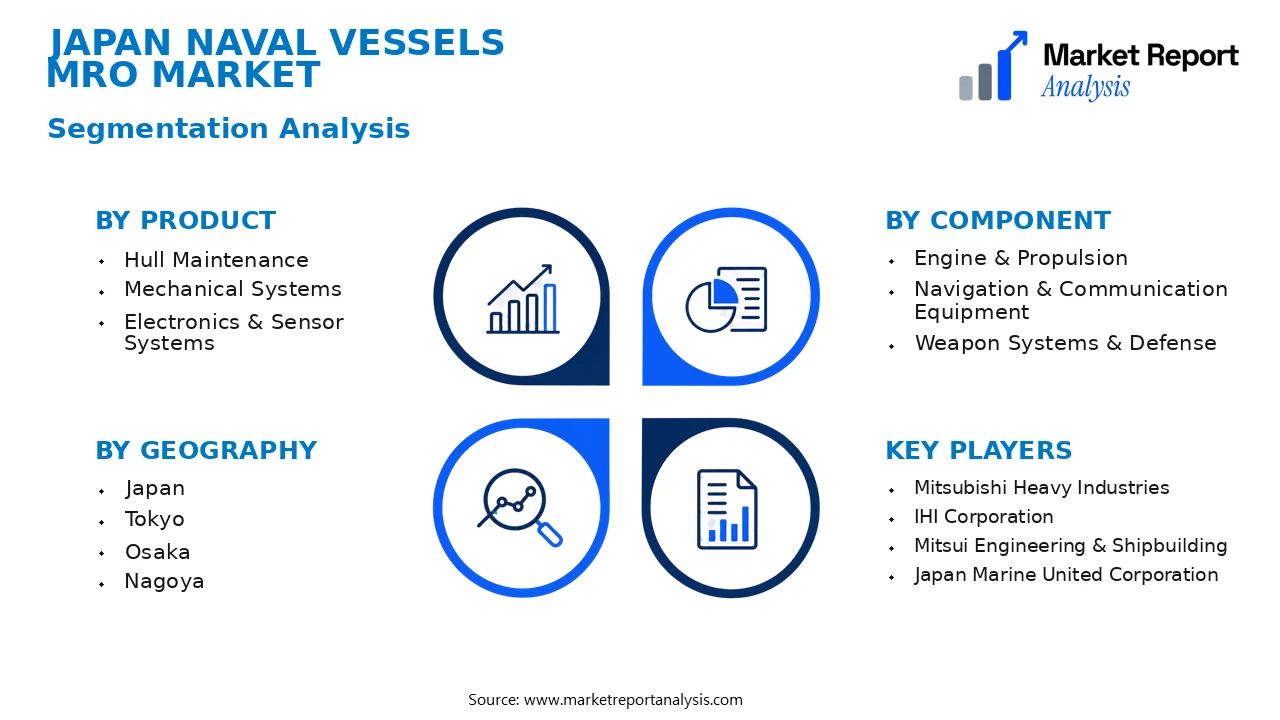
- Product
- Hull Maintenance: This subsegment focuses on repair and upkeep of vessel hulls, essential for maintaining vessel integrity and operational longevity. Demand is driven by vessel age, operational tempo, and maintenance schedules, particularly in aging fleets.
- Mechanical Systems: Encompasses repairs of propulsion, power generation, and auxiliary mechanical systems, critical for ensuring vessel mobility and operational readiness. Growing technological complexity and vessel standardization influence this market's growth.
- Electronics & Sensor Systems: Pertains to maintenance of navigation, communication, and weapon sensor systems. As fleet modernization accelerates, the need for advanced electronic MRO solutions is expanding rapidly.
- Component
- Engine & Propulsion: This component includes maintenance of main engines, turbines, and propulsion systems, which are vital for vessel movement. Increased procurement of high-speed vessels fuels demand for specialized engine repairs.
- Navigation & Communication Equipment: Focuses on servicing radar, sonar, GPS, and satellite communication devices integral to vessel operation and safety, with upgrades and modernizations driving demand.
- Weapon Systems & Defense: Encompasses maintenance of missile launchers, gun systems, and electronic warfare modules, critical for navy combat readiness amid regional security concerns.
- Technology
- Traditional MRO: Conventional repair techniques involving manual inspections, standard replacement parts, and basic overhaul practices dominate this segment, supporting existing fleet maintenance routines.
- Advanced Maintenance: Incorporates digital diagnostics, predictive analytics, and automation to enhance repair precision and reduce downtime, aligned with Japan’s technological advancements in military systems.
- Geography
- Japan: The core market, driven by the country's extensive naval fleet and ongoing modernization programs, requiring comprehensive MRO services to sustain fleet readiness and technological edge.
- Tokyo: As the political and economic hub, Tokyo hosts key naval maintenance facilities, research centers, and strategic military installations that support regional naval operations and modernization efforts.
- Osaka: Known for its industrial base and port infrastructure, Osaka is critical for logistics and specialized repair services, particularly for large vessels and submarine components.
- Nagoya: An important hub for manufacturing and harbor activities, Nagoya's strategic location enhances naval logistical operations and parts supply chains, boosting regional MRO demand.
- Yokohama: With a major port and active shipbuilding sector, Yokohama supports active fleet maintenance and upgrades, fostering a robust MRO service ecosystem for naval vessels.
- Kyoto: Although primarily recognized for its cultural heritage, Kyoto is emerging as a center for electronics and sensor system development relevant to naval maritime technology.
- Kobe: An integral naval logistics and industrial hub, Kobe’s port facilities and manufacturing plants are pivotal to regional MRO supply chains for naval vessels.
- Fukuoka: As a strategic southern port, Fukuoka serves as a maintenance and repair node for regional naval units, with growing investments in infrastructure for naval MRO activities.
Competitive Intelligence
The Japan Naval Vessels MRO Market is characterized by its moderate competition and high market concentration, with a few key players dominating the landscape. Major defense contractors and specialized MRO service providers pursue aggressive business strategies, including strategic partnerships, technology collaborations, and targeted acquisitions to strengthen their market positions. Product innovation plays a vital role, with firms investing heavily in R&D to develop advanced repair solutions, corrosion-resistant coatings, and smart maintenance systems that enhance vessel longevity and operational readiness.
Partnerships between defense agencies and private companies facilitate technology transfer and joint development initiatives, fostering a competitive edge. Companies are also expanding operations across major Japanese cities like Tokyo, Yokohama, and Sasebo, aiming to leverage localized infrastructure and government support. Acquisitions of smaller niche firms allow for market consolidation and broaden service portfolios.
Investments in R&D are pivotal for differentiation, particularly in integrating digital tools such as predictive maintenance and automation. Overall, competitive activity hinges on innovation, strategic alliances, and regional expansion to meet Japan's evolving naval MRO requirements.
Leading Company Profiles
The Japan Naval Vessels MRO market is supported by a competitive landscape comprising established defense and technology conglomerates. These companies leverage advanced engineering capabilities, extensive military maintenance experience, and strategic partnerships to secure their positions and innovate in naval MRO services.
- Mitsubishi Heavy Industries
- IHI Corporation
- Mitsui Engineering & Shipbuilding
- Japan Marine United Corporation
- Furukawa Electric Co., Ltd.
- ORIX Corporation
- Sumitomo Heavy Industries
- Toshiba Infrastructure Systems & Solutions Corporation
- Yokohama Dockyard & Equipment
- Tsuneishi Shipbuilding Co., Ltd.
Mitsubishi Heavy Industries
Mitsubishi Heavy Industries is a leader in naval vessel design, maintenance, and modernization, emphasizing innovative propulsion systems, weaponry integration, and comprehensive lifecycle support for Japan’s maritime defense forces.
IHI Corporation
IHI specializes in propulsion and power systems, delivering advanced maintenance services for combat ships and submarines, with significant investments in digital diagnostics and energy-efficient retrofit solutions for navy vessels.
Mitsui Engineering & Shipbuilding
This company focuses on hull maintenance, structural repairs, and systems upgrades, leveraging cutting-edge fabrication techniques and extensive post-deployment support to ensure operational readiness of Japan’s naval fleet.
Japan Marine United Corporation
JMU offers comprehensive MRO services, including vessel overhauls, modernization, and tailor-made upgrades, supported by its strong engineering workforce and strategic alliances with military technology providers.
Furukawa Electric Co., Ltd.
Furukawa supplies electrical cables, communication systems, and integrated power management solutions, enhancing the reliability and sustainability of naval vessels through advanced electrical infrastructure support.
ORIX Corporation
ORIX provides financial and leasing services for naval MRO infrastructure, facilitating joint ventures and investments in maintenance facilities, and supporting sustained modernization projects of Japan’s naval fleet.
Sumitomo Heavy Industries
Sumitomo develops and maintains propulsion and auxiliary machinery, focusing on reliability enhancements, digital condition monitoring, and eco-friendly upgrades in existing naval vessels.
Toshiba Infrastructure Systems & Solutions Corporation
Toshiba delivers integrated power and control systems, emphasizing digitalization, smart maintenance platforms, and energy conservation technologies in naval vessel repairs and upgrades.
Yokohama Dockyard & Equipment
Yokohama Dockyard specializes in hull repairs, outfitting, and comprehensive vessel overhauls, with a focus on fast turnaround and high-quality service for Japan’s military ships.
Tsuneishi Shipbuilding Co., Ltd.
Tsuneishi offers partner-led maintenance solutions, including vessel refurbishment, component repairs, and modernization, leveraging advanced shipbuilding techniques and onboard system integrations for naval vessels.
Strategic Business Developments
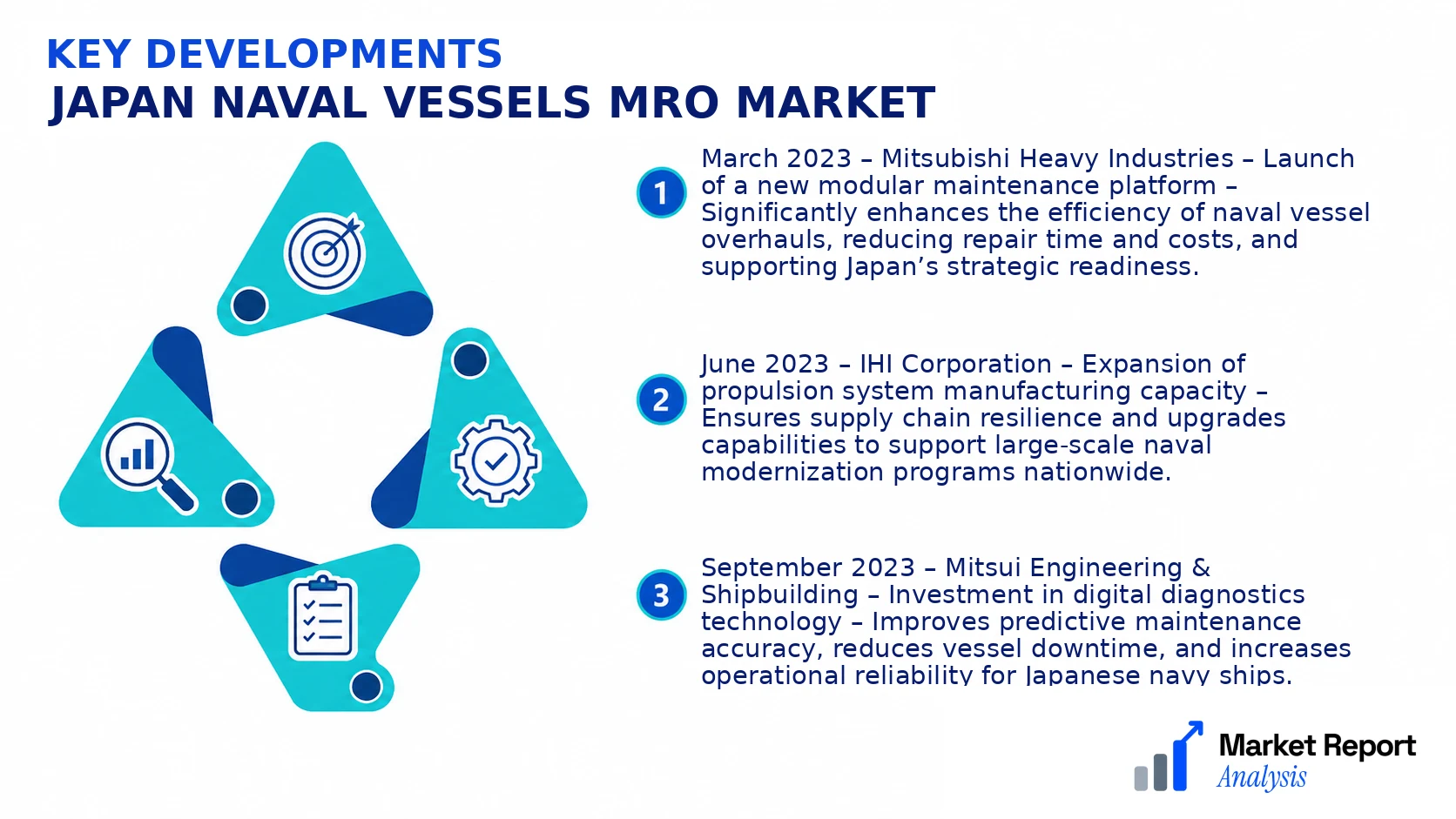
- March 2023 – Mitsubishi Heavy Industries – Launch of a new modular maintenance platform – Significantly enhances the efficiency of naval vessel overhauls, reducing repair time and costs, and supporting Japan’s strategic readiness.
- June 2023 – IHI Corporation – Expansion of propulsion system manufacturing capacity – Ensures supply chain resilience and upgrades capabilities to support large-scale naval modernization programs nationwide.
- September 2023 – Mitsui Engineering & Shipbuilding – Investment in digital diagnostics technology – Improves predictive maintenance accuracy, reduces vessel downtime, and increases operational reliability for Japanese navy ships.
- December 2023 – Japan Marine United Corporation – Formation of a joint venture with a private defense contractor – Strengthens service offerings, enhances technological expertise, and supports comprehensive maintenance solutions for fleet modernization.
- February 2024 – Furukawa Electric Co., Ltd. – Deployment of energy-efficient electrical systems – Enhances sustainability of naval vessels, reducing power consumption and CO2 emissions, aligning with Japan’s green defense initiatives.
Frequently Asked Questions
What is the Japan Naval Vessels MRO Market?
The Japan Naval Vessels Maintenance, Repair, and Overhaul (MRO) Market encompasses the industry's services dedicated to maintaining, repairing, and upgrading naval vessels for the Japanese maritime defense sector, ensuring operational readiness and extending vessel lifespan.
What is the current market size of Japan Naval Vessels MRO Market?
In 2026, the Japan Naval Vessels MRO Market is estimated to be valued at approximately USD 4.5 Billion, reflecting ongoing defense modernization efforts and a focus on sustaining naval capabilities amidst regional security dynamics.
What factors are driving the Japan Naval Vessels MRO Market?
Market growth is driven by increased procurement of new naval vessels, technological upgrades, and the need for regular maintenance to ensure fleet operability. Additionally, defense budget allocations and strategic defense initiatives significantly propel market expansion.
Which region dominates the Japan Naval Vessels MRO Market?
The primary market dominates within Japan itself, specifically concentrated around key naval bases and shipyards located in regions like Yokosuka and Sasebo, which are pivotal for domestic naval operations and MRO activities.
Which segment is expected to grow the fastest?
The repair and modernization segment is forecasted to grow fastest, driven by the need to upgrade aging vessels and incorporate latest technologies, ensuring fleet longevity and enhanced operational efficiency.
Who are the leading companies operating in the Japan Naval Vessels MRO Market?
Leading industry players include Japan Marine United Corporation, Mitsubishi Heavy Industries, and Kawasaki Heavy Industries, which are key contractors providing comprehensive MRO services tailored for the Japanese naval fleet, supported by government defense agencies.
Analyst Perspective
The Japan Naval Vessels MRO Market exhibits a mature yet steadily evolving landscape, poised for sustained growth driven by regional strategic imperatives and technological advancements. Long-term, Japan’s focus on enhancing fleet readiness and modernizing aging vessels will underpin consistent demand. Commercial opportunities lie in cutting-edge repair technologies, sustainable MRO practices, and digital maintenance solutions, which will boost efficiency and lifecycle optimization. Technology evolution, particularly in automation, AI-driven diagnostics, and eco-friendly materials, will reshape maintenance paradigms, offering significant competitive advantages to early adopters. Investment priorities are increasingly centered on specialized naval infrastructure, resilient supply chains, and integrative maintenance platforms to mitigate operational risks. Competitive intensity remains high, with established defense contractors and emerging players vying for contracts, emphasizing innovation and cost-effectiveness. Regionally, urban centers such as Yokohama and Nagasaki hold strategic importance due to their naval bases and access to global maritime trade routes, representing substantial growth hubs for MRO activities and supplier partnerships.
