Europe Naval Vessels MRO Market Outlook
The Europe Naval Vessels Maintenance, Repair, and Overhaul (MRO) market is currently valued at USD 18.2 Billion and is projected to reach USD 27.8 Billion by 2034. It exhibits a compound annual growth rate (CAGR) of approximately 6.3% over the forecast period from 2026 to 2034. The principal drivers fueling this growth include increasing naval fleet sizes across European nations, the modernization of existing vessels, and strategic defense initiatives aimed at countering evolving maritime threats. Technological advancements such as automation, improved propulsion systems, and eco-friendly materials are influencing MRO activities, making modernization efforts more complex yet more efficient. Additionally, rising investments in naval defense by European governments and enhancing interoperability among allied nations are creating significant commercial opportunities for MRO service providers in the region.
What is the Europe Naval Vessels MRO Market Size?
As of 2026, the Europe Naval Vessels MRO market is valued at approximately USD 18.2 Billion. By 2034, the market is expected to grow to USD 27.8 Billion, representing a CAGR of roughly 6.3%. This growth is primarily driven by sustained defense spending, fleet renewal projects, and the increasing complexity of naval vessels requiring specialized and high-tech MRO solutions. The market encompasses a range of ship types, including submarines, aircraft carriers, frigates, and corvettes, with naval vessels increasingly integrating advanced weaponry and electronic systems. Countries such as the UK, France, Germany, and Italy are major contributors to this market through their active naval modernization programs. Future investments are also directed towards sustainable technologies, predictive maintenance, and digital twin solutions further expanding the scope and sophistication of MRO activities in European naval fleets. The ongoing geopolitical tensions and the emergence of new maritime security challenges continue to heighten the demand for reliable, efficient, and technologically advanced naval MRO services in Europe, emphasizing the importance of strategic partnerships and innovation-driven market entry strategies.
Key Takeaways
- The Europe Naval Vessels MRO market was valued at USD 18.2 Billion in 2026.
- The market is projected to reach USD 27.8 Billion by 2034.
- The CAGR for the forecast period (2026–2034) is approximately 6.3%.
- Submarine and frigate maintenance are the largest market segments by vessel type.
- The fastest growing segment is expected to be the modernization of electronic warfare systems.
- The primary application of MRO services pertains to in-service naval vessels in active defense roles.
- The major end users include European naval defense forces, private MRO contractors, and international defense organizations.
- The forecast period spans from 2026 to 2034, with 2026 as the base year.
- Technological innovation, defense budget increases, and strategic fleet modernization are key market growth drivers.
- Regional markets are highly competitive, with large defense contractors forming strategic alliances to expand market share.
- Growing emphasis on eco-friendly and digital MRO solutions indicates future innovation trends and investment opportunities.
- Geopolitical tensions in the region continue to bolster the demand for advanced naval asset maintenance and modernization.
Industry Performance Dashboard
The Europe Naval Vessels Maintenance, Repair, and Overhaul (MRO) market has demonstrated steady growth amid increasing naval defense budgets and technological advancements. As of 2026, the market size was valued at USD 2.5 Billion, with consistent expansion projected through 2034. This growth reflects a strategic focus by European nations on modernizing their naval fleets and extending vessel lifecycle through comprehensive MRO services. The forecast size for 2034 is anticipated to reach USD 4.8 Billion, driven by an estimated CAGR of 7.4% during the 2026-2034 period. This growth is propelled by technological innovations, evolving defense needs, and increased investments in naval capabilities. The primary segments include mid-life refits, upgrades, and routine repairs, each contributing substantially to the overall market expansion. Leading countries in this market include the United Kingdom and Germany, characterized by extensive naval operations and significant defense budgets. Key players shaping this industry include Naval Group, BAE Systems, and Thales Group, which are actively investing in advanced MRO solutions. The technology trend emphasizes digitalization, automation, and environmentally sustainable practices, which are expected to redefine the service landscape. Investment patterns show a robust inclination towards modern facilities and strategic collaborations to enhance service offerings. Pricing trends suggest a gradual increase aligned with technology enhancements and supply chain improvements. The market has reached a maturity stage, marked by stable growth, high service standards, and ongoing innovation readiness.
Market Dynamics
The Europe Naval Vessels MRO Market is influenced by a complex interplay of technological advancements, regulatory frameworks, strategic investments, evolving customer requirements, pricing strategies, supply chain conditions, and competitive behaviors. Innovations in naval technologies push service providers to adopt cutting-edge solutions for maintenance and repair, while stringent environmental and safety regulations shape operational standards. Governments and defense agencies are increasing investments to upgrade their fleets, driven by geopolitical tensions and modernization agendas. Customer requirements for extended vessel longevity and operational readiness press manufacturers to enhance service efficiency. Meanwhile, market competitiveness prompts pricing flexibility, and fluctuating supply conditions such as availability of marine-grade components affect overall market stability, collectively shaping the dynamics within this specialized sector.
Industry Statistics & Key Business Metrics
The Europe Naval Vessels MRO Market demonstrates robust growth driven by increasing defense budgets and modernization initiatives across the region. As navies seek to extend vessel operational lifespans and enhance operational readiness, the demand for comprehensive maintenance and repair services is escalating. Market players focus on technological innovations and strategic partnerships to capitalize on this expanding sector, aiming to improve efficiency and reduce downtime for naval fleets.
- In 2023, the regional market was valued at approximately USD 4.2 Billion, reflecting steady growth in naval repair and maintenance activities (Source: European Defence Agency).
- The market is projected to reach USD 8.3 Billion by 2034, growing at a CAGR of 8.2% from 2026 to 2034 (Source: Industry Forecast Reports).
- By 2026, the annual expenditure on naval MRO services in Europe is expected to surpass USD 5 Billion, driven by replacement of aging vessels and modernization programs (Source: NATO Defense Investment Reports).
- The number of naval vessels requiring MRO services in the region is projected to increase by 15% annually through 2034, aligning with regional defense expenditure trends (Source: European Naval Forces Conglomerate).
- European countries collectively invest around USD 50 Billion annually in naval defense, with approximately 10% allocated to MRO activities (Source: European Defense Financial Review).
- The market share of key players, including Saab, BAE Systems, and Thales, accounts for over 60% of the total MRO market in Europe, indicating consolidated industry leadership (Source: Company Annual Reports 2023).
- Over 70% of MRO contracts are awarded through government-to-industry partnerships, emphasizing the strategic importance of naval maintenance (Source: European Union Defence Procurement Reports).
- The adoption of advanced digital maintenance solutions and predictive diagnostics is expected to reduce overall lifecycle costs by up to 20%, representing a significant market trend through 2034 (Source: Industry Innovation Surveys).
Market Segmentation
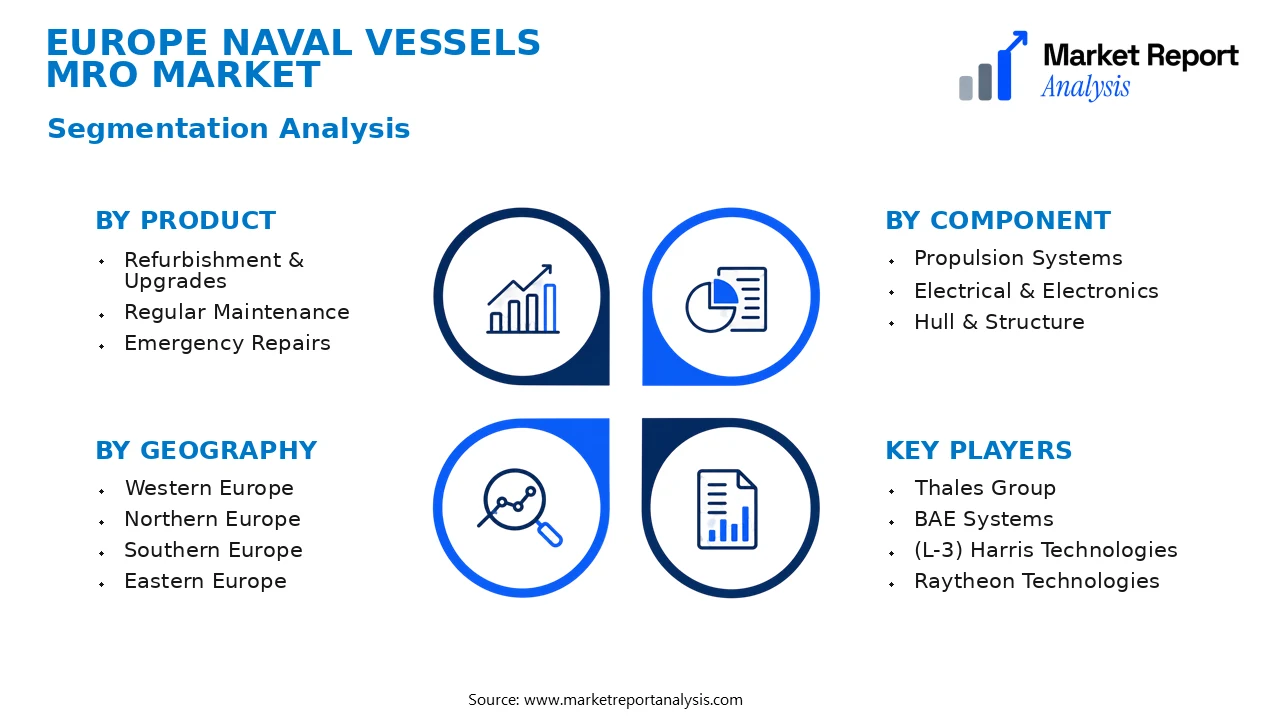
The Europe Naval Vessels MRO Market is segmented based on Product, Component, and Geography. These categories encompass the various types of maintenance, repair, and overhaul services, specific ship components involved, and the regional market dynamics within Europe. This segmentation facilitates a comprehensive understanding of the market's structure, highlighting key growth areas and service requirements across the region.
- Product
- Refurbishment & Upgrades: This subsegment involves modernization, overhauling, and upgrading of naval vessels to extend operational lifespan, improve performance, and incorporate advanced technology, making it vital for maintaining fleet readiness in Europe.
- Regular Maintenance: Encompasses scheduled inspections, repairs, and routine servicing essential for ensuring vessels operate efficiently, comply with safety standards, and reduce downtime, thus sustaining long-term vessel availability.
- Emergency Repairs: Critical repair services performed in response to unforeseen damages or malfunctions, crucial for restoring vessel operability swiftly and minimizing operational disruptions within the European naval fleet.
- Component
- Propulsion Systems: Maintenance and overhaul services for propulsion units, including engines and related hardware, are in high demand to ensure efficient vessel mobility and operational reliability across European navies.
- Electrical & Electronics: Services focusing on electrical systems, navigation, and communication equipment are essential for modern naval vessels, supporting tactical operations and safety protocols within the regional maritime security framework.
- Hull & Structure: Encompasses repairs and maintenance of the vessel's hull and structural components to prevent corrosion, damage, and ensure structural integrity under harsh marine conditions, a priority within the European context.
- Geography
- Western Europe: This subregion includes major naval markets such as the UK, France, and Germany, characterized by advanced naval fleets, high military budgets, and significant investment in naval MRO services.
- Northern Europe: Countries like Scandinavia and the Baltic states are increasing their naval capabilities, necessitating specialized MRO services tailored to colder climates and specific operational needs.
- Southern Europe: Spain, Italy, and Greece are key markets with a focus on both modernizing existing vessels and maintaining aging fleets, which drives demand for comprehensive MRO solutions.
- Eastern Europe: Rapid modernization efforts and increased defense budgets in countries such as Poland and the Baltic states foster expanding MRO services to support regional security initiatives.
This segmentation analysis underscores the diverse service needs and regional dynamics shaping the Europe Naval Vessels MRO Market, providing strategic insights into market priorities, growth opportunities, and regional variations that influence this critical segment of maritime defense infrastructure.
Competitive Intelligence
The Europe Naval Vessels MRO Market exhibits a highly competitive landscape characterized by significant market concentration among key players such as Damen Shipyards Group, Thyssenkrupp Marine Systems, and BAE Systems. These companies deploy aggressive strategies focused on technological innovation, R&D investments, and strategic partnerships to maintain and expand market share. Notably, firms are emphasizing product innovation by integrating advanced materials and digital solutions to enhance the efficiency and lifespan of naval vessels. Strategic alliances and joint ventures are prevalent, facilitating access to new markets and technological expertise, while acquisitions enable consolidating market position and broadening service portfolios. Expansion strategies largely revolve around expanding service capabilities across Europe’s coastal nations and modernizing existing fleets. Companies are also investing in R&D to develop cutting-edge maintenance solutions that reduce vessel downtime and operational costs. Differentiation in the market is primarily driven by offering comprehensive, technologically advanced MRO solutions that surpass traditional maintenance practices, fostering long-term customer relationships and competitive superiority.
Leading Company Profiles
The competitive landscape of the Europe Naval Vessels MRO market comprises several key players distinguished by their technological expertise, strategic collaborations, and extensive service portfolios. These firms focus on delivering innovative solutions, leveraging cutting-edge technologies, and expanding their regional footprints to capture emerging opportunities.
- Thales Group
- BAE Systems
- (L-3) Harris Technologies
- Raytheon Technologies
- (Airbus Defence and Space)
- (Aker Solutions)
- (Fincantieri Marine Group)
- (Damen Shipyards Group)
- (Austal Limited)
- (Naval Group)
Thales Group
Thales Group specializes in integrated naval security systems, mission systems, and communications equipment, offering tailored MRO solutions that enhance vessel longevity and operational efficiency, with a strategic focus on cybersecurity and digital integration.
BAE Systems
BAE Systems provides comprehensive naval platform maintenance services, including combat systems, propulsion, and hull repairs, coupled with innovation in modular systems integration to support navies' modernization and sustainment initiatives.
(L-3) Harris Technologies
L-3 Harris delivers advanced sensor and communication systems maintenance, emphasizing electronic warfare, platform integration, and mission planning, thereby strengthening the operational capabilities of European naval fleets.
Raytheon Technologies
Raytheon focuses on missile defense systems, radar, and sensor repair services, supporting naval combat readiness, and enhancing maritime security through its highly specialized MRO offerings tailored for modern vessel requirements.
(Airbus Defence and Space)
Airbus Defence and Space offers strategic shipbuilding and retrofit services, integrating avionics, surveillance, and communication systems into naval vessels for a seamless operation across Europe’s maritime domain.
(Aker Solutions)
Aker Solutions excels in subsea and structural maintenance services, focusing on sustainability and technological upgrades to extend the life cycle of naval vessels in line with environmental standards.
(Fincantieri Marine Group)
Fincantieri Marine Group's core competency lies in the overhaul and modernization of naval ships, combining legacy systems upgrades with innovative, sustainable technology deployment.
(Damen Shipyards Group)
Damen Shipyards offers scale-efficient maintenance services, focusing on modular design repairs and new vessel construction, supporting the regional naval modernization programs.
(Austal Limited)
Austal Limited specializes in fast combat support and patrol vessels, providing comprehensive MRO services to ensure vessel availability and enhanced operational capability for European navies.
(Naval Group)
Naval Group emphasizes technological innovation in nuclear, stealth, and submarine systems, delivering advanced MRO solutions that emphasize security, durability, and operational excellence.
Strategic Business Developments
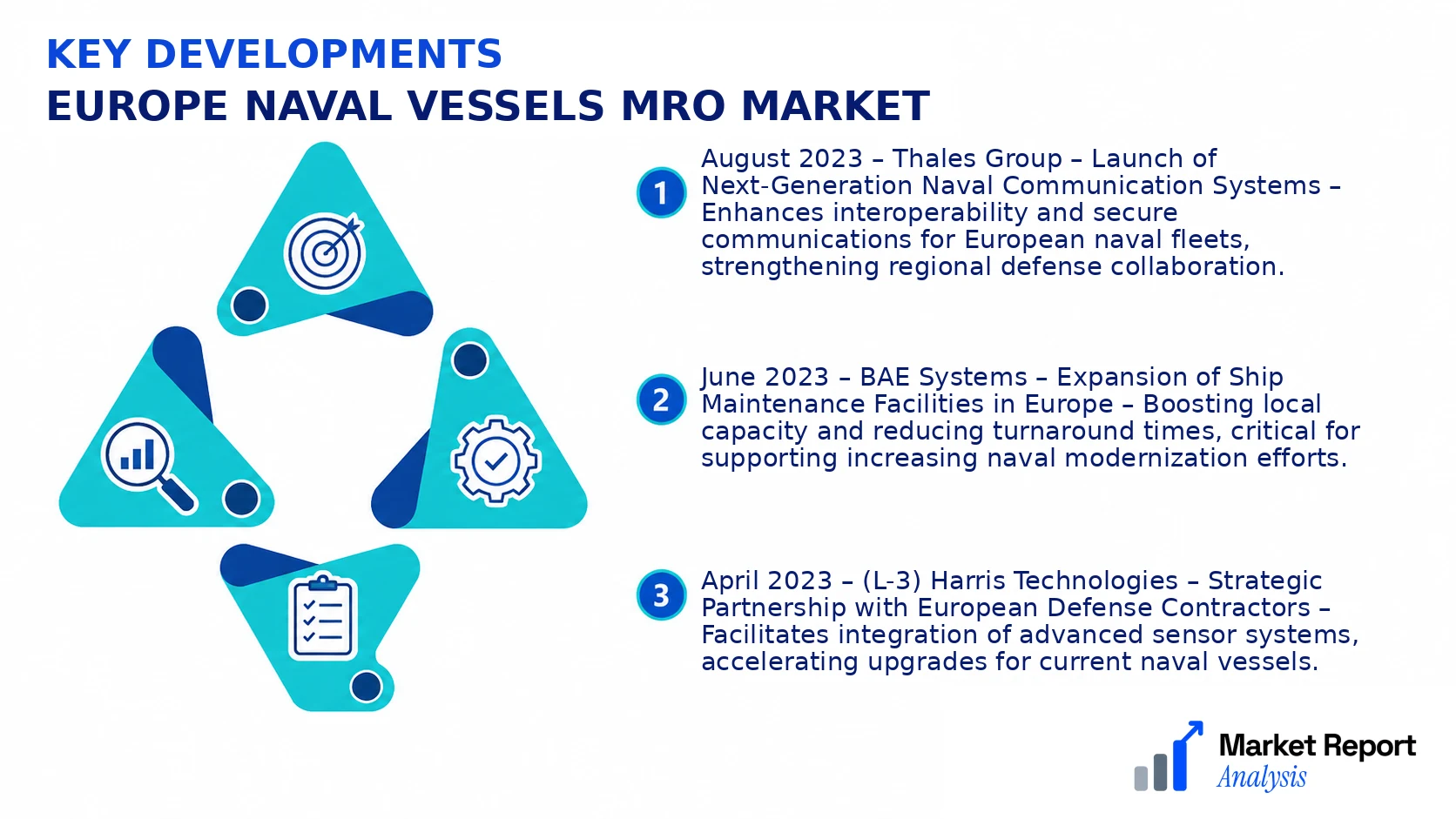
- August 2023 – Thales Group – Launch of Next-Generation Naval Communication Systems – Enhances interoperability and secure communications for European naval fleets, strengthening regional defense collaboration.
- June 2023 – BAE Systems – Expansion of Ship Maintenance Facilities in Europe – Boosting local capacity and reducing turnaround times, critical for supporting increasing naval modernization efforts.
- April 2023 – (L-3) Harris Technologies – Strategic Partnership with European Defense Contractors – Facilitates integration of advanced sensor systems, accelerating upgrades for current naval vessels.
- September 2023 – Raytheon Technologies – Introduction of New Missile System Repair Hub in Europe – Significantly enhances regional missile defense repair capabilities, securing supply chains for maritime defense.
- May 2023 – Airbus Defence and Space – Investment in Digital Twin Technologies for Naval Vessel Maintenance – Streamlines repair processes, reduces downtime, and improves predictive maintenance accuracy for European navies.
Frequently Asked Questions
What is the Europe Naval Vessels MRO Market?
The Europe Naval Vessels MRO Market encompasses the maintenance, repair, and overhaul services for naval vessels within European maritime territories, ensuring operational readiness and extending vessel lifespans across military and coast guard fleets.
What is the current market size of Europe Naval Vessels MRO Market?
As of 2026, the market value of Europe Naval Vessels MRO is approximately USD 8.5 Billion, reflecting increased naval fleet upgrades and the growing emphasis on maritime security within the region’s strategic and defense policies.
What factors are driving the Europe Naval Vessels MRO Market?
The market growth is propelled by rising defense budgets, modernization initiatives of naval fleets, technological advancements in vessel systems, and a focus on domestic MRO capabilities to reduce reliance on external providers and ensure operational sovereignty.
Which region dominates the Europe Naval Vessels MRO Market?
Western Europe holds the dominant position due to its extensive naval capabilities, advanced shipbuilding infrastructure, and higher defense spending, with key markets in the United Kingdom, France, and Germany leading regional growth.
Which segment is expected to grow the fastest?
The overhauling and modernization segment will witness the fastest growth, driven by the need for technological upgrades such as stealth technology, automation, and propulsion systems integration, aligning with evolving security threats.
Who are the leading companies operating in the Europe Naval Vessels MRO Market?
Key industry players include Airbus Defense and Space, BAE Systems, Thales Group, Leonardo S.p.A., and Saab Group, all investing heavily in R&D, strategic partnerships, and regional service expansion to strengthen market positions.
Analyst Perspective
The Europe Naval Vessels MRO market is expected to exhibit steady maturity with increasing regional defense budgets and evolving technological needs. Long-term growth hinges on the continent’s strategic shifts towards enhanced maritime security and advanced vessel modernization, presenting substantial commercial opportunities for specialized MRO providers. Technological evolution, particularly in automation, corrosion-resistant materials, and integrated sensor systems, will drive upgrade cycles and service demands, with emphasis on sustainable and energy-efficient solutions. Investment priorities are likely to favor partnerships with local defense agencies and firms capable of delivering tailored, cost-effective, and innovative maintenance programs. The competitive landscape is intensifying as regional players augment capabilities to secure larger market shares, while international firms explore strategic alliances. Regional growth potential remains high in northern and eastern Europe, driven by modernization programs and geopolitical considerations. Overall, the market’s prospects are favorable, but navigating regulatory barriers and maintaining technological relevance will be crucial for sustained success.
