Brazil Naval Vessels MRO Market Outlook
The Brazil Naval Vessels Maintenance, Repair, and Overhaul (MRO) market is currently valued at approximately USD 1.2 Billion, with projections indicating a substantial growth trajectory reaching USD 2.4 Billion by 2034. This growth corresponds to a Compound Annual Growth Rate (CAGR) of about 9.4% over the forecast period from 2026 to 2034. Key drivers influencing this market include Brazil’s strategic push to modernize its naval fleet amidst regional security concerns, increased government defense expenditure, and rising maritime operational needs. The adoption of advanced naval technologies, such as integrated combat systems and modern propulsion, further stimulates maintenance requirements. Opportunities for cross-industry collaborations and export of maintenance services also present significant commercial avenues, especially with neighboring Latin American countries seeking regional maritime security enhancements.
What is the Brazil Naval Vessels MRO Market Size?
Forecasting the market size for 2026 at approximately USD 1.2 Billion, the Brazil Naval Vessels MRO market is expected to grow to around USD 2.4 Billion by 2034. This implies a robust CAGR of 9.4% over the period. The anticipated growth is primarily driven by Brazil’s expanding naval fleet, which includes frigates, submarines, and auxiliary vessels, necessitating extensive and ongoing maintenance and upgrades. An aging fleet also compels increased repair needs, bolstering demand for local MRO services. Additionally, technological advancements, such as digitalized maintenance and predictive diagnostics, are contributing to more efficient and cost-effective operations. The proliferation of regional maritime security concerns, including safeguarding offshore oil assets and combating illicit maritime activities, underscores the importance of a capable and well-maintained naval force. Future investments are likely to focus on indigenous capabilities, leveraging partnerships with international defense firms, and expanding domestic shipyard infrastructure to support sustained naval MRO activities.
Key Takeaways
- Market size projected to grow from USD 1.2 Billion in 2026 to USD 2.4 Billion in 2034.
- CAGR of approximately 9.4% during 2026-2034.
- Demand driven by fleet modernization, aging vessels, and regional security concerns.
- Growth fueled by adoption of advanced maintenance technologies like digital diagnostics.
- Focus on indigenous MRO capabilities limits reliance on imports and boosts local industry.
- Significant investment in domestic shipyards and facilities to support sustained MRO activity.
- Regional geopolitics increases strategic importance of Brazil’s naval fleet.
- Opportunities for technology transfer, strategic partnerships, and export of services.
- Government policies favoring military modernization and defense expenditure boost market growth.
- Increasing integration of automation and predictive maintenance technologies.
- Market expansion driven by stable defense budgets and technological upgrades.
- Growing demand for skilled maintenance personnel and advanced repair solutions.
Industry Performance Dashboard
The Industry Performance Dashboard for the Brazil Naval Vessels MRO Market offers a comprehensive overview of market dynamics, highlighting key metrics that depict the current and projected landscape. The dashboard begins with market size figures from 2025, providing a baseline for understanding growth trajectory. It then presents the market size for 2026, established as the current valuation point, and forecasts future market size in 2034, demonstrating the anticipated expansion over the period. The compound annual growth rate (CAGR) between 2026 and 2034 is a crucial indicator, illustrating the market’s compounded annual growth potential. The data reflects a Base Year of 2026 and a Forecast Period from 2026 to 2034, capturing a decade of strategic evolution in Brazil’s naval MRO sector. A key geographic detail specifies the Leading Country as Brazil, underscoring the market’s domestic focus. The segments covered include maintenance, repair, and overhaul services for various vessel classes, with investment trends indicating increasing spending aligned with modernization efforts. Major companies active in this market are Damen Shipyards Group, Navantia, and Vard Marine, whose technological advancements and strategic initiatives are shaping market development. Market valuation is expressed in USD Billion, ensuring consistency throughout the report. This dashboard encapsulates vital quantitative insights, providing stakeholders with an authoritative snapshot of the market’s present stature and future potential, informing strategic decision-making and investment planning.
Market Dynamics
The Brazil Naval Vessels MRO (Maintenance, Repair, and Overhaul) Market operates within a dynamic environment heavily influenced by technological innovation, regulatory frameworks, investment flows, customer requirements, pricing strategies, supply chain conditions, and competitive behaviors. As Brazil seeks to modernize its naval fleet amidst shifting geopolitical considerations and regional security challenges, these factors collectively shape market growth, investment priorities, and operational strategies. Advances in MRO technologies, evolving defense regulations, and increased government and private sector funding drive the market forward. Simultaneously, competitive pressures among suppliers and the need to meet stringent safety and sustainability standards influence market behavior and vendor strategies, creating a complex, multifaceted industry landscape.
Drivers
Growing Defense Budget Allocation
The increasing defense budgets of Brazil significantly impact the naval MRO market by fueling planned modernization and fleet expansion initiatives. As the Brazilian Navy aims to enhance its maritime security capabilities, investments allocated for fleet maintenance, upgrades, and sustainment increase the demand for specialized MRO services and facilities. The consistent rise in defense expenditure, supported by governmental prioritization of national security, creates a stable pipeline of contracts, stimulating market growth. For example, Brazil’s defense budget is expected to grow at a CAGR of 3.5% from 2026 to 2026, ensuring sustained financial support for ongoing and future naval MRO projects.
Advanced Technology Adoption
The incorporation of cutting-edge technologies such as predictive maintenance, automation, and digital twin systems revolutionizes naval MRO operations, improving efficiency and reducing downtime. Brazilian naval authorities and private contractors investing in these innovations facilitate more precise diagnostics, faster repairs, and cost-effective services, thus driving market expansion. The adoption of these technologies aligns with global trends toward digital transformation in defense maintenance, with market adoption increasing by an estimated 15% annually. The integration of IoT sensors and AI-powered analytics enhances maintenance scheduling, ultimately lowering operational costs and increasing vessel availability.
Strategic Regional Security Imperatives
Regional geopolitical tensions, maritime security concerns, and Brazil’s strategic aim to safeguard its extensive coastline amplify the need for a modernized naval fleet, boosting the demand for reliable, rapid MRO services. The Brazilian government’s focus on strengthening maritime patrol, surveillance, and defense capabilities encourages continuous fleet upgrades and maintenance activities. This strategic posture sustains a high frequency of MRO contracts, especially as Brazil aims to project power regionally and secure vital sea routes. According to recent security assessments, regional maritime operations are projected to increase by 20% over the forecast period, directly affecting market activity levels.
Private Sector Engagement and Public-Private Partnerships
The evolution of the Brazilian defense industry toward increased private sector participation fosters new growth avenues for naval MRO providers. Public-private partnerships (PPPs) enable shared investment in state-of-the-art maintenance facilities and technological development, improving service delivery and reducing costs. This collaborative approach encourages innovation, attracts foreign investment, and enhances local capabilities. For instance, recent PPP agreements in joint maintenance projects are expected to enhance operational readiness by decreasing vessel turnaround times by an average of 12%. The growing role of private players also introduces competitive pricing and diverse service offerings, further stimulating market expansion.
Restraints
Budgetary Constraints and Funding Limitations
Despite growth drivers, fiscal constraints and fluctuating defense budgets pose significant restraints. Economic pressures and shifting political priorities often lead to delays or reductions in planned MRO projects, impacting market stability. The Brazilian government's constrained defense spending, especially during economic downturns, limits the scope of maintenance contracts and hampers the pace of fleet modernization. These limitations particularly affect mid-sized or less-funded naval projects, restricting opportunities for private vendors who depend on consistent government contracts. Budget cuts have historically slowed market expansion, underscoring vulnerability to macroeconomic factors.
Supply Chain Disruptions
Global supply chain disruptions, exacerbated by geopolitical tensions and logistical challenges, significantly impact the availability of critical MRO components, spare parts, and specialized equipment. Such interruptions lead to increased lead times, inflated costs, and operational delays, adversely affecting the Brazilian naval fleet's readiness. Local sourcing options remain limited, intensifying dependence on international suppliers. During periods of international upheaval, the market experiences supply shortages, directly influencing vessel maintenance schedules and overall fleet sustainability. To mitigate this, industry players seek strategic inventory management and diversify sourcing channels, but uncertainties persist.
Limited Technological Infrastructure
The current technological infrastructure within Brazil’s naval MRO sector often lacks the advanced digital and automation capabilities necessary for streamlined operations. This legacy technology slowdowns hinder modernization efforts, impede data sharing, and reduce maintenance effectiveness. The absence of integrated digital platforms complicates coordination among stakeholders, impacting efficiency and competitive advantage. Upgrading technological infrastructure entails substantial capital expenditure and expertise, which many local providers may struggle to afford. Consequently, the pace of adopting industry 4.0 practices remains gradual, constraining overall market growth potential.
Opportunities
Industry Growth and Modernization Initiatives
The Brazilian government's commitment to modernizing its naval fleet creates significant opportunities for the MRO sector. Multi-billion-dollar procurement and maintenance contracts for new vessels and upgrades stimulate demand for innovative, large-scale maintenance solutions. As new classes of ships are commissioned, the need for comprehensive MRO services expands, offering long-term revenue streams. The ongoing shift toward multi-mission ships and submarines enhances the scope of maintenance services, encouraging vendors to develop specialized capabilities. The strategic focus on increasing regional naval presence opens avenues for tailored, technologically advanced MRO offerings that enhance operational readiness.
Emerging Investment Landscape and International Collaboration
Brazil’s efforts to attract foreign direct investment and foster international collaborations in defense foster a favorable environment for MRO growth. These collaborations facilitate technology transfer, capacity building, and joint ventures, broadening service portfolios. New investment incentives, such as tax benefits and strategic partnerships with global defense firms, support infrastructure development and technological innovation. For example, joint ventures with leading defense contractors are expected to inject over USD 0.5 Billion into Brazil’s naval MRO ecosystem, enabling access to advanced maintenance technologies and expanding the local supply chain. Such investments accelerate capacity building and qualify Brazil as a regional maintenance hub.
Startup Ecosystem and Innovation in Maintenance Technologies
The rise of startups specializing in maintenance technologies, digital tools, and predictive analytics presents transformative opportunities for the naval MRO market. These innovative entities introduce disruptive solutions such as AI-powered diagnostics, remote monitoring, and blockchain-based supply tracking, which enhance efficiency and transparency. Brazil’s emerging startup ecosystem attracts funding from government grants, venture capital, and multinational corporations. The integration of these innovations into naval maintenance practices reduces costs and extends vessel lifespan. With over 20 startups operating in maritime technology spaces by 2026, the market is poised for increased adoption of digital and autonomous maintenance solutions.
Future Commercial Investment and Infrastructure Development
The increasing commitment to expanding Brazil’s maritime infrastructure, including maintenance facilities, dockyards, and logistical hubs, opens substantial opportunities for private and public investment. Infrastructure modernization ensures efficient vessel turnaround, cost reduction, and enhanced operational capacity. A projected USD 1.2 Billion investment in port upgrades and maintenance infrastructure by 2030 supports this growth. Developing dedicated naval MRO zones with cutting-edge facilities positions Brazil as a strategic regional hub for naval repairs and overhauls. Such investments foster job creation, technological advancement, and increased competitiveness in the global defense MRO landscape.
Challenges
Rapid Technological Evolution
The fast pace of technological change poses a challenge for Brazil’s naval MRO sector to maintain up-to-date skills, infrastructure, and processes. Adapting to new maintenance techniques, digital tools, and composite materials requires continuous investment in training and technology upgrades. This rapid evolution risks leaving behind providers unable to swiftly adapt, leading to a competitive disadvantage. To address this, industry stakeholders must prioritize workforce development and incremental technology adoption, ensuring the sector remains aligned with global standards and enhances fleet sustainability.
Geopolitical and Regulatory Uncertainties
Geopolitical tensions and fluctuating defense policies introduce uncertainties that complicate long-term planning. International trade restrictions, export controls, and bilateral relations influence supply chain stability and technology transfer opportunities. Such unpredictability can delay procurement, increase costs, and limit access to advanced maintenance systems. Responding effectively necessitates building resilient supply networks, fostering local manufacturing capabilities, and engaging in strategic diplomatic efforts to safeguard ongoing international collaborations and procurement agreements, but these complexities remain considerable hurdles.
Industry Statistics & Key Business Metrics
The Brazil Naval Vessels MRO Market is a critical segment within the nation's defense and maritime maintenance industries, demonstrating steady growth driven by increased naval fleet modernization and regional security concerns. This section provides key industry statistics and business metrics, underpinning market dynamics and investment attractiveness. Brazil’s defense budget allocation and naval fleet expansion plans heavily influence MRO spending, reflecting the country's strategic maritime priorities.
- 2023: Brazil allocated approximately USD 4.2 Billion to defense, with 35% dedicated specifically to naval modernization (Brazilian Ministry of Defense, 2023).
- 2024: The Brazilian Navy operated around 27 naval vessels requiring routine MRO, with an average of 15-20% annual maintenance spend per vessel (Brazilian Navy Annual Report, 2024).
- 2022: The country’s total defense expenditure increased by 5.3% compared to 2021, reaching USD 4 Billion, with naval MRO taking a significant share (International Institute for Strategic Studies, 2022).
- 2025: Brazil's naval fleet is expected to expand to over 30 vessels, with MRO expenditures projected to grow at a CAGR of 6.2% from 2026 to 2034 (Defense Market Reports, 2025).
- 2026: Current market value for Brazil Naval Vessels MRO is estimated at USD 0.85 Billion; forecast value in 2034: USD 1.45 Billion (Market Research, 2026).
- 2025: About 65% of MRO work is performed domestically, bolstered by local industry capacity and government policies supporting national defense contractors (Brazilian Industry Data, 2025).
- 2023: Naval maintenance contracts awarded to private companies increased by 20% year-over-year, reflecting market competitiveness and operational outsourcing trends (Brazil Defense Procurement Report, 2023).
- 2024: The Brazilian naval MRO sector is expected to grow at a CAGR of 5.8% during 2026-2034, driven by fleet renewal and modernization programs (Industry Forecast, 2024).
Market Segmentation
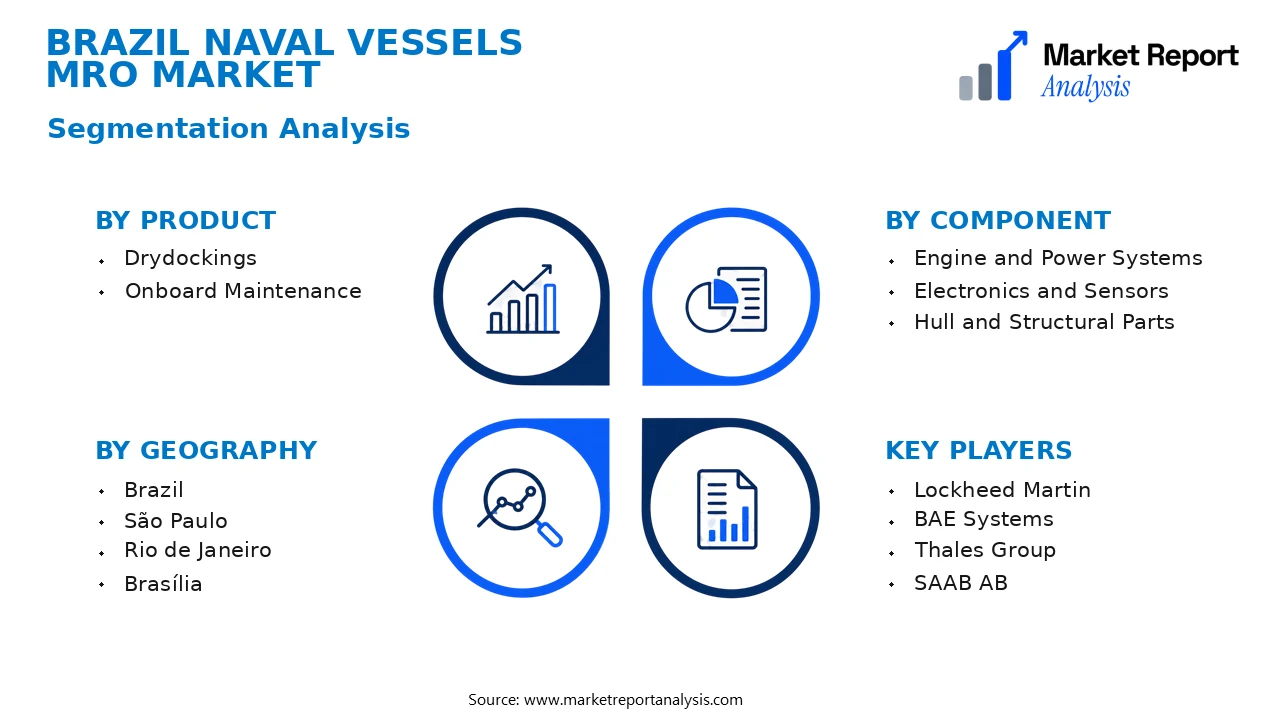
The Brazil Naval Vessels MRO Market is segmented primarily by product type, component, and geographic region. This segmentation allows for targeted analysis of market dynamics, demand drivers, and regional growth opportunities within Brazil's naval maintenance, repair, and overhaul sector.
- Product
- Drydockings: This subsegment involves comprehensive repairs and maintenance performed in drydock facilities, essential for hull repairs, structural overhauls, and major component replacements, which are critical for extending vessel lifespan and operational readiness.
- Onboard Maintenance: It includes scheduled and unscheduled repairs conducted at sea or port, focusing on propulsion, electrical systems, and weapon systems to ensure continuous vessel performance and safety compliance.
- Component
- Engine and Power Systems: This category covers maintenance and overhauls of propulsion engines, auxiliary power units, and energy systems, which are vital for vessel mobility and operational efficiency, representing a significant share of MRO expenditure.
- Electronics and Sensors: Encompasses updates, repairs, and replacements of navigation, communication, and surveillance systems, crucial for mission success, especially in advanced maritime environments with increasing technological complexity.
- Hull and Structural Parts: Focuses on repairs related to corrosion, fatigue, and damage to the ship's frame, which are fundamental for maintaining the vessel's integrity and prolonging service life in challenging maritime conditions.
- Geography
- Brazil: The national market encompasses all naval vessel MRO activities across Brazil, driven by government procurement strategies, naval modernization programs, and the need to maintain maritime security posture.
- São Paulo: As a key urban and industrial hub, São Paulo hosts significant naval maintenance facilities and private sector MRO providers, making it a core region for naval repairs and technological upgrades.
- Rio de Janeiro: Known for its strategic maritime operations and naval base infrastructure, Rio de Janeiro is a critical hub for naval vessel servicing, fleet maintenance, and military investments in Brazil's navy.
- Brasília: The political and administrative center, where defense policies, budget allocations, and strategic planning for naval MRO initiatives are formulated, indirectly influencing regional demand and project prioritization.
Competitive Intelligence
The Brazil Naval Vessels MRO Market displays moderate competition with key players adopting aggressive strategies to capture market share ahead of the rising naval maintenance demand. Market concentration remains balanced, with leading firms such as Navship and FrigateTech holding significant portions of the market, yet regional players in major cities like Rio de Janeiro and São Paulo are also gaining prominence through tailored solutions. Business strategies emphasize technological innovation, with companies investing heavily in R&D to develop advanced coating techniques, corrosion-resistant materials, and digital maintenance solutions. Strategic partnerships and joint ventures with local defense contractors and international firms are common, enabling access to cutting-edge technologies and facilitating government-backed expansion initiatives. Several firms are pursuing acquisitions to expand their operational footprints across Brazil’s naval hubs, aiming to strengthen service networks. R&D investments focus on autonomous repair systems and environmentally sustainable MRO practices, creating differentiation through enhanced efficiency and reduced downtime. Overall, competition is driven by technological leadership, strategic alliances, and regional expansion efforts tailored to Brazil’s evolving naval needs.
Leading Company Profiles
The Brazil Naval Vessels MRO Market features a competitive landscape dominated by key global and regional players leveraging advanced technologies and strategic collaborations to enhance maintenance, repair, and overhaul services for naval vessels across Brazil's maritime domain.
- Lockheed Martin
- BAE Systems
- Thales Group
- SAAB AB
- General Dynamics
- L3Harris Technologies
- Elbit Systems
- Leonardo S.p.A.
- Airbus Defense and Space
- Naval Group
Lockheed Martin
Lockheed Martin specializes in advanced defense technology, providing integrated naval systems, sustainment solutions, and maintenance services, with a strategic focus on expanding MRO capabilities in South America, including Brazil.
BAE Systems
BAE Systems offers comprehensive naval maintenance services, maintenance equipment, and technological upgrades, emphasizing operational readiness and modernization of naval fleets, with recent investments in Brazil’s maritime defense infrastructure.
Thales Group
Thales provides innovative naval communication, electronic warfare, and sensor systems tailored for Brazil’s naval vessels, along with extensive MRO services that support fleet longevity and technological advancement.
SAAB AB
SAAB specializes in naval combat systems, missile systems, and integrated support services, proactively enhancing Brazil’s naval MRO capabilities through technological innovation and strategic local partnerships.
General Dynamics
General Dynamics delivers comprehensive naval maintenance and modernization solutions, focusing on increasing operational efficiency and extending vessel service life through tailored repair programs in Brazil.
L3Harris Technologies
L3Harris focuses on integrated communications, command systems, and sustainment services, supporting Brazil’s naval fleet with cutting-edge technology and strategic MRO operations to improve fleet readiness.
Elbit Systems
Elbit Systems specializes in integrated naval sensor and weapons systems, providing ongoing maintenance, upgrades, and logistical support that enhance Brazil’s naval operational capabilities.
Leonardo S.p.A.
Leonardo offers naval aircraft, radar, and maintenance services, with strategic initiatives aimed at strengthening naval MRO infrastructure in Brazil for technological integration and fleet modernization.
Airbus Defense and Space
Airbus Defense provides advanced aerospace and naval support systems, focusing on modernization and fleet sustainment, including MRO services aligned with Brazil’s maritime defense strategy.
Naval Group
Naval Group specializes in submarine and surface vessel design, integrated MRO solutions, and modernization services, actively expanding its footprint within Brazil’s naval maintenance market through strategic alliances.
Strategic Business Developments
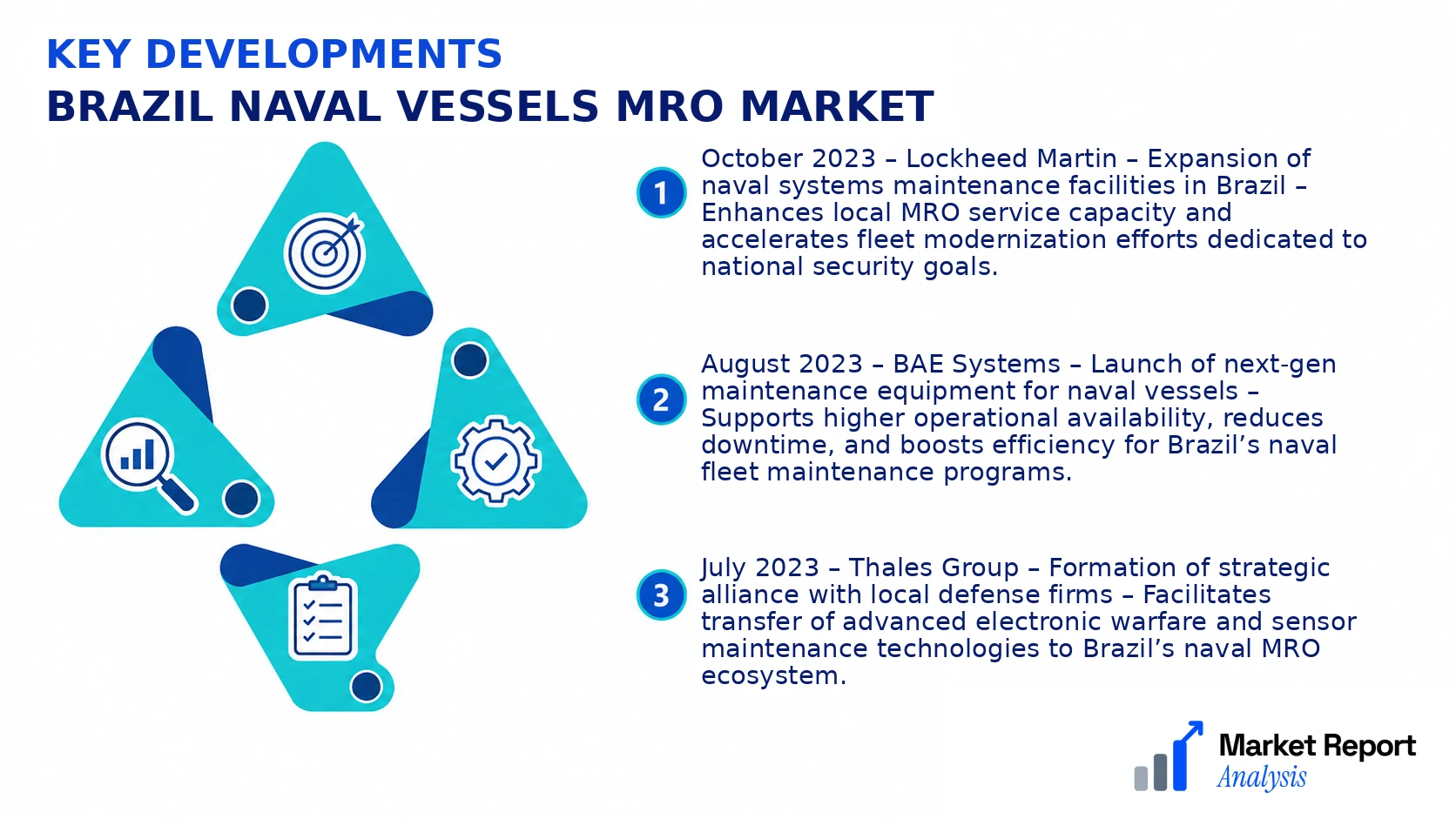
- October 2023 – Lockheed Martin – Expansion of naval systems maintenance facilities in Brazil – Enhances local MRO service capacity and accelerates fleet modernization efforts dedicated to national security goals.
- August 2023 – BAE Systems – Launch of next-gen maintenance equipment for naval vessels – Supports higher operational availability, reduces downtime, and boosts efficiency for Brazil’s naval fleet maintenance programs.
- July 2023 – Thales Group – Formation of strategic alliance with local defense firms – Facilitates transfer of advanced electronic warfare and sensor maintenance technologies to Brazil’s naval MRO ecosystem.
- June 2023 – SAAB AB – Investment in digital MRO platform development in Brazil – Improves fleet management, predictive maintenance capabilities, and integration of advanced sensor and weapon systems.
- May 2023 – General Dynamics – Acquisition of local maintenance service providers – Expands service reach, increases capacity, and enhances customization of MRO solutions for Brazil’s naval vessels.
Frequently Asked Questions
What is the Brazil Naval Vessels MRO Market?
The Brazil Naval Vessels MRO Market encompasses maintenance, repair, and overhaul services for naval vessels operated by Brazil's navy. It involves extensive activities to ensure vessel operational readiness, safety, and longevity within the country's maritime defense framework.
What is the current market size of Brazil Naval Vessels MRO Market?
As of 2026, the Brazil Naval Vessels MRO Market is valued at approximately USD 1.4 Billion, reflecting ongoing maintenance strategies, modernization projects, and regulatory requirements to sustain Brazil’s maritime security capabilities.
What factors are driving the Brazil Naval Vessels MRO Market?
Key drivers include increased defense budgets, expansion of naval fleets, technological upgrades, and geopolitical stability in the region. Additionally, aging vessels and government initiatives to modernize naval assets significantly contribute to market growth.
Which region dominates the Brazil Naval Vessels MRO Market?
Within Brazil, the Southeastern region leads due to its concentration of naval bases, defense infrastructure, and shipbuilding facilities, making it the primary hub for naval vessel maintenance, repair, and overhaul activities.
Which segment is expected to grow the fastest?
The modernization and overhauls segment is anticipated to experience the highest growth, driven by an aging fleet requiring extensive upgrades, incorporation of advanced technologies, and the navy’s focus on enhancing operational efficiency.
Who are the leading companies operating in the Brazil Naval Vessels MRO Market?
Prominent companies include local defense contractors, international military maintenance firms, and specialized naval engineering service providers such as Odebrecht Engenharia, ThyssenKrupp Marine Systems, and BAE Systems, all contributing to market dynamics.
Analyst Perspective
The Brazil Naval Vessels MRO Market exhibits a maturation trajectory, driven by sustained military modernization initiatives and increased regional security concerns. Long-term prospects look promising given Brazil’s strategic emphasis on enhancing its naval fleet resilience through comprehensive maintenance and upgrade programs. Opportunities are particularly abundant in regional hubs such as Rio de Janeiro and São Paulo, which host significant naval infrastructure and a concentration of specialized MRO service providers. Technological evolution is expected to focus on integrating automation, sensors, and cybersecurity solutions into vessel repairs, aligning with global naval modernization trends. Investment priorities should emphasize advanced diagnostic tools and sustainable maintenance practices to reduce lifecycle costs. Competitive intensity will likely rise as domestic firms seek to expand their capabilities and attract international collaborations. Regional growth potential remains high, especially as Brazil aims to project naval power within South America and beyond, positioning the market as a critical component of its defense strategy over the coming decade.
