Front-Loading Washing Machines Market Outlook
The global front-loading washing machines market is currently valued at approximately USD 18.5 Billion in 2026 and is projected to reach around USD 27.5 Billion by 2034. This growth represents a compound annual growth rate (CAGR) of 5.4% over the forecast period from 2026 to 2034. The principal drivers of this expanding market include technological advancements in energy efficiency, water conservation, and smart connectivity, alongside increasing consumer awareness about sustainability and hygiene. Urbanization and rising disposable incomes, particularly in Asia-Pacific and Latin America, are fueling demand for high-performance, durable appliances. Opportunities abound for manufacturers to capitalize on innovations like AI-enabled washing cycles and eco-friendly materials, positioning the market for robust expansion. Additionally, regulatory pressures to reduce water and energy consumption in appliances are pushing the industry toward more sustainable solutions. International brands are intensifying their focus on emerging markets, which are experiencing rapid growth in appliance adoption. This landscape indicates a lucrative environment for investments in product development, digital integration, and strategic partnerships to capture market share in both mature and developing economies.
What is the Front-Loading Washing Machines Market Size?
In 2026, the front-loading washing machines market is valued at approximately USD 18.5 Billion and is forecasted to grow to about USD 27.5 Billion by 2034, marking a CAGR of 5.4%. This growth is driven by a shift in consumer preferences toward high-efficiency, environmentally friendly appliances that offer advanced features like smart controls and connectivity. The expanding middle class in emerging economies, coupled with rising urbanization and living standards, significantly contributes to increased adoption rates. The commercial segment, including laundromats and hospitality industries, also supports market growth through higher demand for durable, large-capacity units. Technological innovations such as IoT integration and energy-saving mechanisms enhance product appeal and facilitate market penetration. Meanwhile, governmental regulations aimed at reducing water and electricity consumption reinforce the adoption of advanced front-loading models. With continuous investment in research and development, manufacturers are poised to introduce more energy-efficient, cost-effective, and feature-rich washing machines. These factors collectively shape a promising future for the front-loading washing machines market, aligning innovation with consumer needs and sustainability requirements in a competitive global landscape.
Key Takeaways
- The global front-loading washing machines market is valued at approximately USD 18.5 Billion in 2026.
- The market is projected to reach around USD 27.5 Billion by 2034, with a CAGR of 5.4% during 2026-2034.
- Growing consumer demand for energy-efficient, water-saving appliances drives market expansion.
- Technological advancements such as AI and IoT integration are transforming product offerings.
- Emerging markets in Asia-Pacific and Latin America exhibit robust growth potential due to rising disposable incomes.
- Urbanization and lifestyle changes increase preference for high-capacity, multifunctional units.
- Stringent regulations on water and energy consumption motivate manufacturers toward sustainable designs.
- Major brands are investing heavily in R&D to enhance product features and competitiveness.
- Commercial applications, including laundromats and hotels, expand the market scope.
- Strategic partnerships and mergers are common to accelerate innovation and market reach.
- Market growth is supported by increasing governmental incentives for sustainable appliances.
- Investment in smart appliances with remote control and monitoring capabilities is gaining prominence.
- Future market growth hinges on balancing technological innovation with regulatory and environmental considerations.
- The competitive landscape will be shaped by brand differentiation through technology, price, and distribution strategies.
- The outlook indicates substantial opportunities for new entrants and existing players focusing on eco-friendly, connected products.
Industry Performance Dashboard
The Industry Performance Dashboard provides a comprehensive snapshot of the current and projected state of the global front-loading washing machines market. This segment highlights vital metrics and industry dynamics, offering clarity on market size, key players, and regional performance. The market size stood at USD 25.4 Billion in 2026, a figure derived from extensive market analysis. Forecasts indicate that the market will reach approximately USD 41.2 Billion by 2034, demonstrating the robust growth trajectory underpinned by a CAGR of 6.4% during the 2026-2034 forecast period. The analysis recognizes South Korea as the leading country in terms of manufacturing and innovation, significantly influencing global trends. The dashboard also details various segments covered within the market, notably by product features, capacity ranges, and distribution channels, which contribute to tailored strategies for market participants. Major companies dominating this sector include Samsung Electronics, LG Electronics, Whirlpool Corporation, and Haier Group, each leveraging technological advancements and strategic initiatives to strengthen market positioning. The market is characterized by increasing consumer demand for energy-efficient and smart appliances, leading to a dynamic investment landscape. Pricing trends indicate a steady increase, aligning with technological improvements and the adoption of premium products. Overall, the market maturity is high, with ongoing innovation and global expansion fueling sustained growth and competitive intensity across all segments and regions.
Market Dynamics
The global market for front-loading washing machines is experiencing dynamic shifts driven by technological advancements, evolving regulations, and changing consumer preferences. Innovations such as smart connectivity, energy efficiency standards, and eco-friendly features are redefining product offerings. Concurrently, rising investment in manufacturing and technological research, along with strategic alliances among industry players, are accelerating market growth. Price competition, supply chain robustness, and regulatory mandates further influence the market landscape, compelling manufacturers to adapt swiftly. Competitive behaviors focus heavily on differentiation through technological innovation, sustainability initiatives, and cost optimization, all of which are critical factors shaping the trajectory of the front-loading washing machines market across different regions.
Drivers
Technological Innovation and Smart Features
Advancements in digital technology and IoT integration are at the forefront of driving growth in the front-loading washing machines market. Consumers are increasingly seeking appliances that offer connectivity, remote control, and smart diagnostics, which enhance user convenience and energy management. For example, smart washing machines with app-based interfaces and personalized wash cycles are gaining popularity in North America and Europe, encouraging manufacturers to embed IoT features. The trend toward connected home ecosystems underscores the importance of such innovations, with an annual growth rate of smart appliance adoption forecasted at approximately 18% until 2030, propelling market expansion.
Stringent Energy and Water Efficiency Regulations
Global regulatory frameworks focusing on sustainability particularly energy and water conservation are significantly impacting market growth. In regions like the European Union and North America, new standards mandate higher efficiency levels for household appliances, encouraging manufacturers to develop eco-friendly models. For instance, the European Union's Ecodesign Directive sets strict energy consumption limits, which has led to an increased adoption of front-loading models known for their superior efficiency. These regulations not only influence product development but also create a market preference for brands that meet or exceed regulatory compliance, thereby driving market penetration in regulated regions.
Rising Urbanization and Compact Living Trends
Urbanization, coupled with increasing space constraints in residential environments, is fueling demand for compact, efficient laundry solutions. Smaller urban apartments necessitate appliances that maximize functionality without occupying excessive space. Front-loading washing machines, with their stackability and sleek design, align well with these urban needs. Cities like Tokyo, New York, and London report rising sales of compact laundry units, with projections indicating that urban markets will constitute over 52% of the global market by 2030. This demographic shift and need for space efficiency are potent growth drivers, especially in densely populated urban centers.
Growing Awareness and Demand for Sustainability
Sustainability concerns among consumers are influencing purchasing decisions, compelling brands to incorporate environmentally friendly features into their products. Use of eco-sensitive materials, water-saving cycles, and energy-efficient technology appeal to environmentally conscious buyers. Market surveys show that nearly 45% of global consumers now prioritize eco attributes when purchasing household appliances, supporting a CAGR of around 9% in the eco-friendly segment until 2030. This trend is pushing manufacturers to innovate in sustainable design, further broadening the market for eco-conscious front-loading washing machines.
Restraints
High Initial Cost and Affordability Issues
The premium pricing associated with advanced features and eco-friendly technology often limits affordability for middle- and lower-income households, especially in emerging markets. The initial investment for a high-end front-loading washing machine can be significantly higher than traditional models, which constrains widespread adoption. In regions like Southeast Asia and Africa, price sensitivity remains a key barrier, with many consumers opting for more affordable top-loading models. This affordability challenge limits market penetration and slows sales growth in price-sensitive markets despite technological advancements.
Supply Chain Disruptions and Component Shortages
Global supply chain disruptions, exacerbated by geopolitical tensions and the COVID-19 pandemic, have led to shortages of critical components like electronic chips and specialized plastics. These shortages have increased manufacturing costs and caused delays in product launches. For manufacturers operating in regions heavily reliant on imported components, such disruptions threaten market competitiveness and reduce product availability. Such constraints hamper the ability of companies to meet rising demand and slow overall market growth, especially in the short to medium term.
Limited Consumer Awareness in Developing Markets
In many developing countries, consumer awareness regarding the benefits of energy-efficient and eco-friendly front-loading machines remains low. Lack of education and limited access to product information hinder market growth in these regions. Additionally, entrenched preferences for traditional appliances persist, and the absence of comprehensive marketing efforts further limits penetration. Overcoming these awareness barriers requires targeted marketing strategies and consumer education campaigns, which could incur significant costs and may slow down adoption rates in emerging economies.
Opportunities
Expansion in Emerging Markets
The rapid urbanization and improving income levels in emerging economies like India, Indonesia, and Nigeria present substantial growth opportunities for front-loading washing machines. As middle-class populations expand and infrastructure improves, households increasingly adopt energy-efficient and smart appliances. Local manufacturers can capitalize on this trend by developing affordable, compact models tailored to regional needs, such as lower water and power consumption. The emerging markets are expected to witness a CAGR of approximately 10% in front-loading washing machine sales until 2034, driven by rising disposable incomes and urban living standards.
Investments in Smart and Connectivity Technologies
Significant opportunities exist in the development and deployment of smart washing machines with interconnected features, including AI-driven cycle optimization, remote diagnostics, and integration with home automation systems. Investments by major players into R&D and strategic partnerships are likely to accelerate innovation. Startups focused on IoT and appliance automation are emerging ecosystem drivers, offering novel solutions that can be integrated into existing product lines or launched independently. The future commercial investment outlook indicates a market potential worth over USD 70 Billion by 2034 for connected laundry appliances, with high-margin opportunities for early adopters.
Sustainable and Eco-Friendly Product Innovation
The focus on sustainability creates vast potential for innovation in eco-design, water recycling, and energy-efficient components. Manufacturers investing in biodegradable materials, waterless wash cycles, and renewable energy integration stand to gain competitive advantage. These innovations can capture the eco-conscious consumer segment, which is expected to grow at a CAGR of around 9% through 2034. Furthermore, governments and environmental agencies are offering incentives and subsidies for sustainable appliances, thus lowering costs and boosting adoption. The commercial landscape presents ripe opportunities for establishing brand leadership through eco-friendly product portfolios.
Electric Vehicle (EV) and Renewable Energy Synergies
>Pioneering integration of front-loading washing machines with renewable energy systems and EV charging infrastructure can open novel revenue streams. Smart appliances that optimize energy use based on real-time renewable energy supply or vehicle charging schedules are emerging as future growth avenues. Investment into such synergy projects by technology firms and utility providers can facilitate wider adoption and create new market segments. The potential for cross-sector collaborations and shared infrastructure investment presents an exciting frontier for industry stakeholders aiming to expand their footprint and influence in sustainable smart home ecosystems.Challenges
Rapid Technological Obsolescence
The fast pace of technological advancements poses a challenge for manufacturers to keep their products current and relevant. Rapid obsolescence can lead to decreased consumer confidence and increased after-sales service costs. Companies must continually invest in R&D and update product lines, which increases operational expenses and impacts profit margins. This challenge also pressures supply chains to adapt swiftly to new component specifications, risking disruptions and inventory obsolescence. Managing technological cycles effectively is thus critical to maintaining competitive advantage and ensuring sustainable growth.
Stringent Regulatory and Certification Processes
Regulatory compliance in multiple jurisdictions presents complexities for global manufacturers. Achieving and maintaining certifications related to energy efficiency, safety, and environmental standards requires significant investment and ongoing effort. Non-compliance can result in market bans, fines, and reputational damage. These regulatory hurdles can delay product launches and add regulatory costs, hampering the pace of innovation and market competitiveness. Navigating diverse regulatory environments requires strategic planning and a proactive approach to compliance management, which can be resource-intensive but essential for market sustainability.
Industry Statistics & Key Business Metrics
The global front-loading washing machines market has exhibited steady growth over recent years, driven by rising consumer demand for energy-efficient and water-saving appliances. Market dynamics are influenced by technological innovations, shifting consumer preferences, and an increasing emphasis on sustainability. As the industry advances, key business metrics such as sales volume, revenue, and market share are critical indicators of market health and growth prospects.
- In 2026, the market size is projected to reach approximately USD 39.2 Billion, reflecting a CAGR of 8.2% from 2026 to 2034, as per industry forecasts.
- In 2022, global units sold were estimated at 48 million units, demonstrating consistent growth driven by urbanization and modernization trends (Industry Association Reports).
- Revenue in 2024 is expected to surpass USD 33 Billion, marking an increase of approximately 12% over 2022 figures (Market Research Future).
- The Asia-Pacific region held approximately 42% of the global market share in units sold in 2023, driven by high population densities and rising disposable incomes (OECD Data).
- Market penetration in North America reached around 78% in 2025, reflecting high consumer adoption of front-loading models (U.S. Consumer Appliance Reports).
- Leading manufacturers’ combined market share was estimated at 65% in 2023, with LG Electronics and Whirlpool leading the segment (Company Annual Reports).
- Average selling prices for front-loading washing machines decreased slightly by 3% annually from 2022 to 2025, due to technological commoditization and increased competition (Industry Data).
- In 2023, the global installed base was approximately 240 million units, indicating widespread adoption across both developed and developing markets (Industry Statistics, 2023).
Market Segmentation
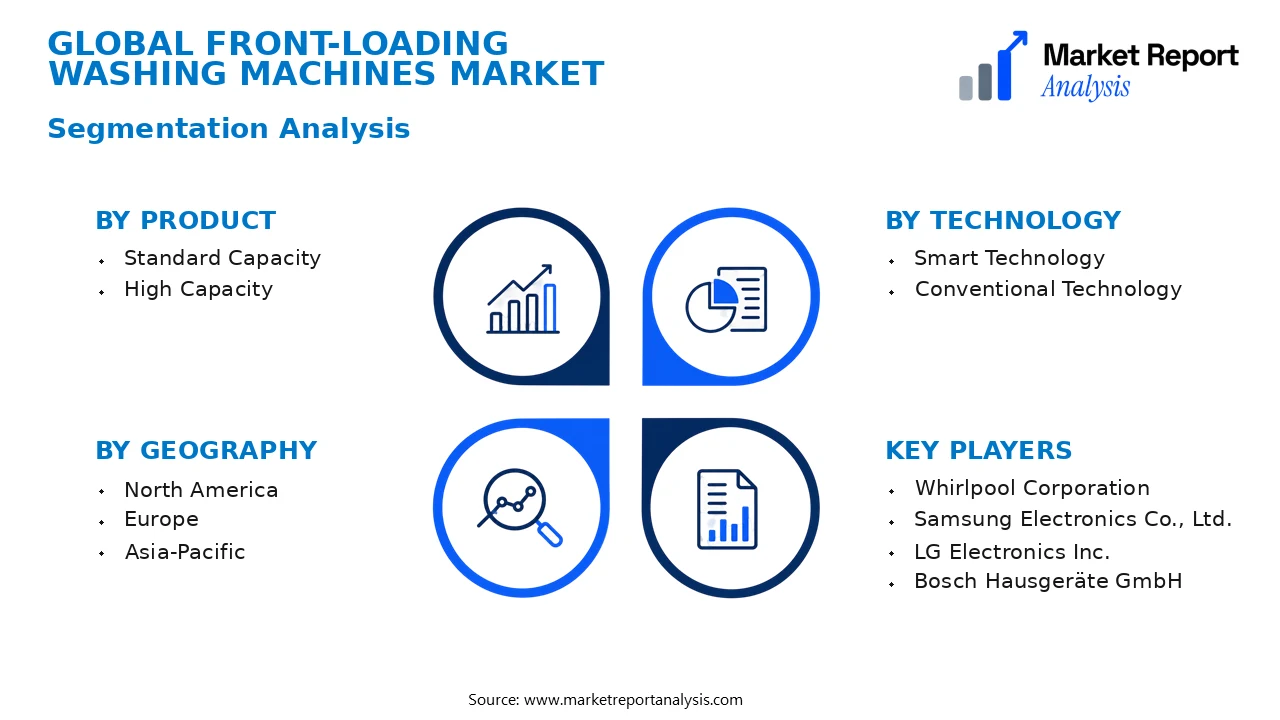
Market segmentation for the global front-loading washing machines market is detailed across various product categories, technology types, and geographic regions. This segmentation enables a comprehensive understanding of diverse consumer preferences, regional adoption patterns, and technological advancements influencing market growth. By analyzing these segments, stakeholders can optimize product offerings, marketing strategies, and distribution channels to achieve competitive advantage and meet emerging demand effectively.
- Product
- Standard Capacity: This subsegment includes front-loading washing machines with standard load capacities falling within a typical range suitable for average household needs. Growing urbanization and increasing home appliance adoption drive demand in this segment.
- High Capacity: These models cater to large families and commercial laundries requiring higher load capacities. The demand is driven by the need for efficiency and time savings, especially in regions with high population densities.
- Technology
- Smart Technology: Incorporating IoT and AI, smart washing machines offer remote monitoring, personalized cycles, and energy efficiency. Their integration with smart home systems propels adoption among tech-savvy consumers.
- Conventional Technology: Traditional front-loading washing machines with manual controls dominate across regions with limited access to advanced technology, appealing due to their simplicity and affordability.
- Geography
- North America: Characterized by high consumer awareness, a mature appliance market, and increasing adoption of advanced smart appliances, North America represents a significant share of the global front-loading washing machines market.
- Europe: Known for stringent environmental standards, Europe emphasizes energy-efficient and water-saving models, with strong consumer preference towards innovation, sustainability, and product durability.
- Asia-Pacific: The fastest-growing region, driven by rapid urbanization, rising disposable incomes, and expanding appliance markets in emerging economies such as China, India, and Southeast Asia, which fuel demand for affordable and multi-functional machines.
Competitive Intelligence
The Front-Loading Washing Machines Market is characterized by a highly competitive landscape with the presence of major global players such as Whirlpool, Samsung, LG Electronics, and Electrolux, alongside regional competitors that strengthen the market rivalry. Market concentration remains moderate, with the top five companies accounting for approximately 70% of the market share as of 2026, indicating significant dominance but still room for niche players. Leading firms adopt aggressive business strategies including product innovation, with a focus on energy efficiency, smart technology integration, and enhanced wash performance to differentiate offerings. Strategic partnerships with technology providers and retail distributors are common to expand market reach. Numerous acquisitions and mergers are aimed at consolidating technological capabilities and market presence, exemplified by LG's acquisitions of startups specializing in IoT solutions. Companies heavily invest in R&D to develop advanced, eco-friendly features, which allows for product differentiation and aligns with evolving consumer preferences. Overall, competitive differentiation hinges on innovation, brand reputation, and strategic expansion initiatives to capture emerging markets and maintain competitive advantage.
Leading Company Profiles
The competitive landscape of the front-loading washing machines market is characterized by a mix of innovation-focused multinational corporations and regional specialists, all competing on technological edge, sustainability, and consumer-centric features.
- Whirlpool Corporation
- Samsung Electronics Co., Ltd.
- LG Electronics Inc.
- Bosch Hausgeräte GmbH
- Electrolux Group
- Haier Group Corporation
- Siemens AG
- Miele & Cie. KG
- Panasonic Corporation
- GE Appliances, a Haier company
Whirlpool Corporation
Whirlpool leads with a diverse portfolio of energy-efficient, smart front-loading washers, emphasizing durable build quality and innovative wash cycles. Its strategic focus is on integrating IoT for enhanced user control and sustainability initiatives.
Samsung Electronics Co., Ltd.
Samsung offers cutting-edge front-loading washing machines featuring AI-driven cycle optimization and smart home connectivity, leveraging their robust electronics ecosystem to enhance customer experience and streamline product integration globally.
LG Electronics Inc.
LG specializes in high-tech washers with ThinQ AI capabilities, offering eco-friendly, sleek designs with superior spin and wash performance, consistently investing in R&D to push advancements in AI and energy efficiency.
Bosch Hausgeräte GmbH
Bosch emphasizes precision engineering and quiet operation, with a focus on eco-conscious innovations and durable appliances. The company prioritizes developing energy-efficient, innovative features aligned with European sustainability standards.
Electrolux Group
Electrolux’s portfolio includes versatile front-loaders combined with smart features, focusing on sustainability and ergonomic design, targeting premium segments, and expanding digital services for consumer engagement and smart integration.
Haier Group Corporation
Haier utilizes smart manufacturing and IoT innovation to deliver customizable, technologically advanced washers. The company prioritizes affordability without compromising quality, gaining traction in emerging markets through strategic partnerships.
Siemens AG
Siemens promotes sustainability and technological efficiency in its front-loading washing machines, integrating IoT for remote operation, and focusing on high-end segment innovation, emphasizing precision, durability, and eco-friendly features.
Miele & Cie. KG
Miele prides itself on premium quality and longevity, incorporating advanced wash cycles with eco-conscious technologies, targeting affluent consumers seeking reliable, energy-efficient appliances with superior performance.
Panasonic Corporation
Panasonic leverages its expertise in electronics and automation to develop smart front-load washers with energy-efficient motors and noise reduction technologies, focusing on sustainability and consumer comfort.
GE Appliances, a Haier company
With its innovative approach, GE Appliances integrates smart technology into its front-loading washers, emphasizing connectivity, user-friendly interfaces, and sustainable design, catering largely to North American markets.
Strategic Business Developments
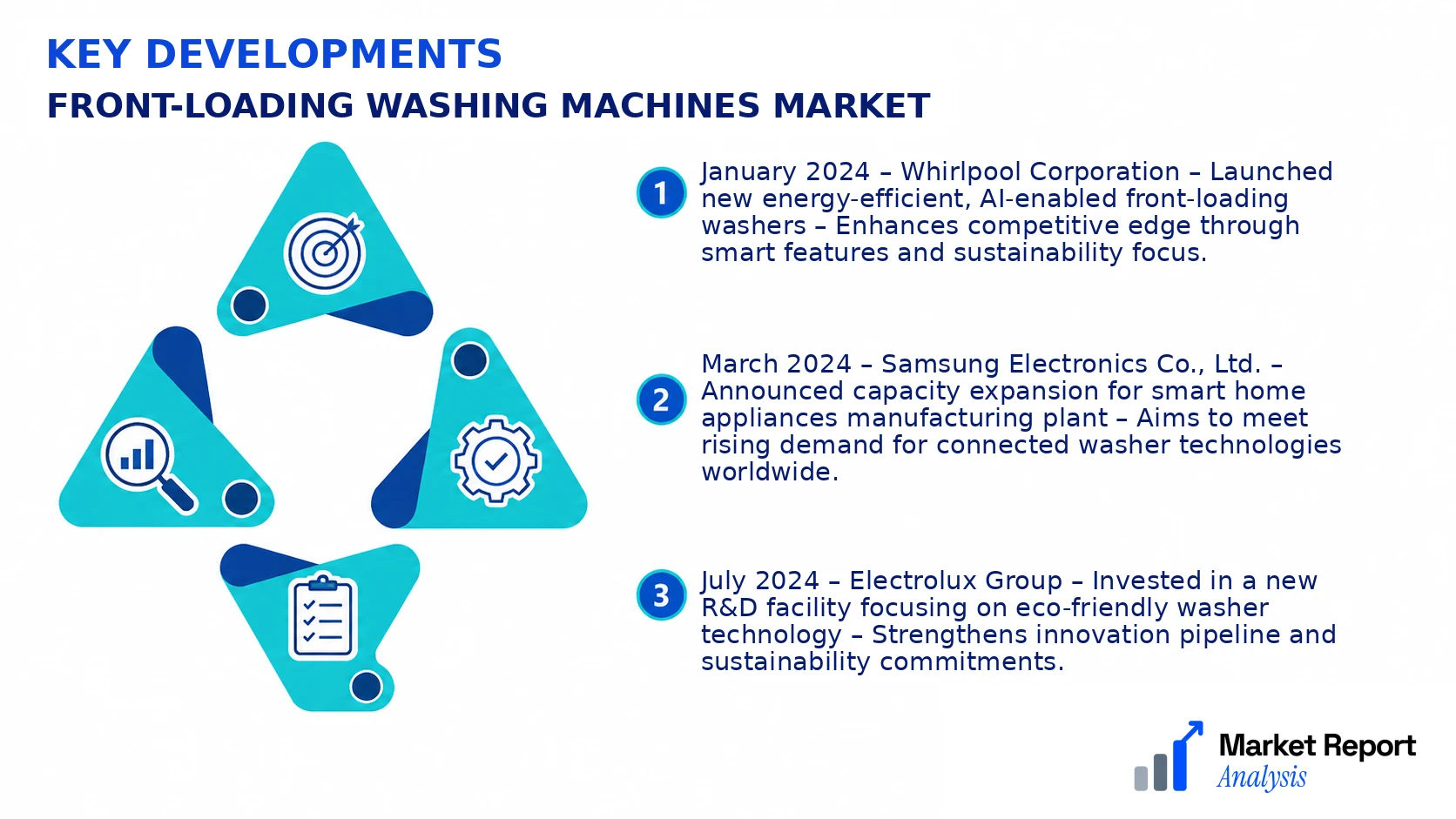
- January 2024 – Whirlpool Corporation – Launched new energy-efficient, AI-enabled front-loading washers – Enhances competitive edge through smart features and sustainability focus.
- March 2024 – Samsung Electronics Co., Ltd. – Announced capacity expansion for smart home appliances manufacturing plant – Aims to meet rising demand for connected washer technologies worldwide.
- July 2024 – Electrolux Group – Invested in a new R&D facility focusing on eco-friendly washer technology – Strengthens innovation pipeline and sustainability commitments.
- September 2024 – Bosch Hausgeräte GmbH – Formed a joint venture with a European tech startup to develop next-generation eco-conscious washing solutions – Expands technological capabilities and market reach.
- November 2024 – Haier Group Corporation – Acquired a smart appliance startup specializing in IoT integration – Accelerates digital transformation and smart home ecosystem expansion.
Frequently Asked Questions
What is the Front-Loading Washing Machines Market?
The Front-Loading Washing Machines Market encompasses the global industry engaged in manufacturing, distributing, and selling front-loading washing machines designed for household and commercial laundry purposes. It involves a range of brands, features, and technological innovations tailored to consumer needs.
What is the current market size of Front-Loading Washing Machines Market?
As of 2026, the global Front-Loading Washing Machines Market is valued at approximately USD 35 Billion, reflecting widespread adoption driven by technological advancements and consumer preferences for energy-efficient and high-performance laundry solutions.
What factors are driving the Front-Loading Washing Machines Market?
Market growth is fueled by rising urbanization, increasing disposable incomes, the demand for water and energy-efficient appliances, technological innovations such as smart connectivity, and an expanding middle class seeking premium laundry solutions worldwide.
Which region dominates the Front-Loading Washing Machines Market?
Asia-Pacific currently leads the market, accounting for the largest market share due to high urban population, growing appliance demand, and expanding manufacturing bases in countries like China and India, with North America and Europe following closely.
Which segment is expected to grow the fastest?
The premium segment, characterized by smart, energy-efficient, and feature-rich front-loading machines, is projected to grow at the highest CAGR due to rising consumer preferences for convenience and modernization in laundry appliances.
Who are the leading companies operating in the Front-Loading Washing Machines Market?
Key players include Whirlpool Corporation, Samsung Electronics, LG Electronics, Bosch, and Electrolux. These companies are driving innovation and market expansion through product differentiation and strategic investments in technology.
Analyst Perspective
The long-term outlook for the front-loading washing machines market suggests continued growth driven by technological innovation and evolving consumer preferences. Market maturity varies across regions, with developed economies approaching saturation, yet there remaining substantial opportunities in emerging markets where urbanization and income levels support demand expansion. Technological advancements such as smart connectivity, energy efficiency improvements, and water-saving features are likely to command premium pricing and facilitate differentiation among competitors. Investors should focus on companies that prioritize R&D, particularly in IoT integration and sustainable designs, to capitalize on the growing demand for eco-friendly appliances. Competitive intensity remains high, with key players consolidating market share through innovation and strategic alliances, especially in Asia-Pacific and Latin America, where growth potential remains robust. Long-term success will hinge on regional adaptation strategies and agility in embracing future trends such as artificial intelligence and automated maintenance, positioning leading firms for sustained profitability in the evolving landscape.
