Malaysia Front-Loading Washing Machines Market Outlook
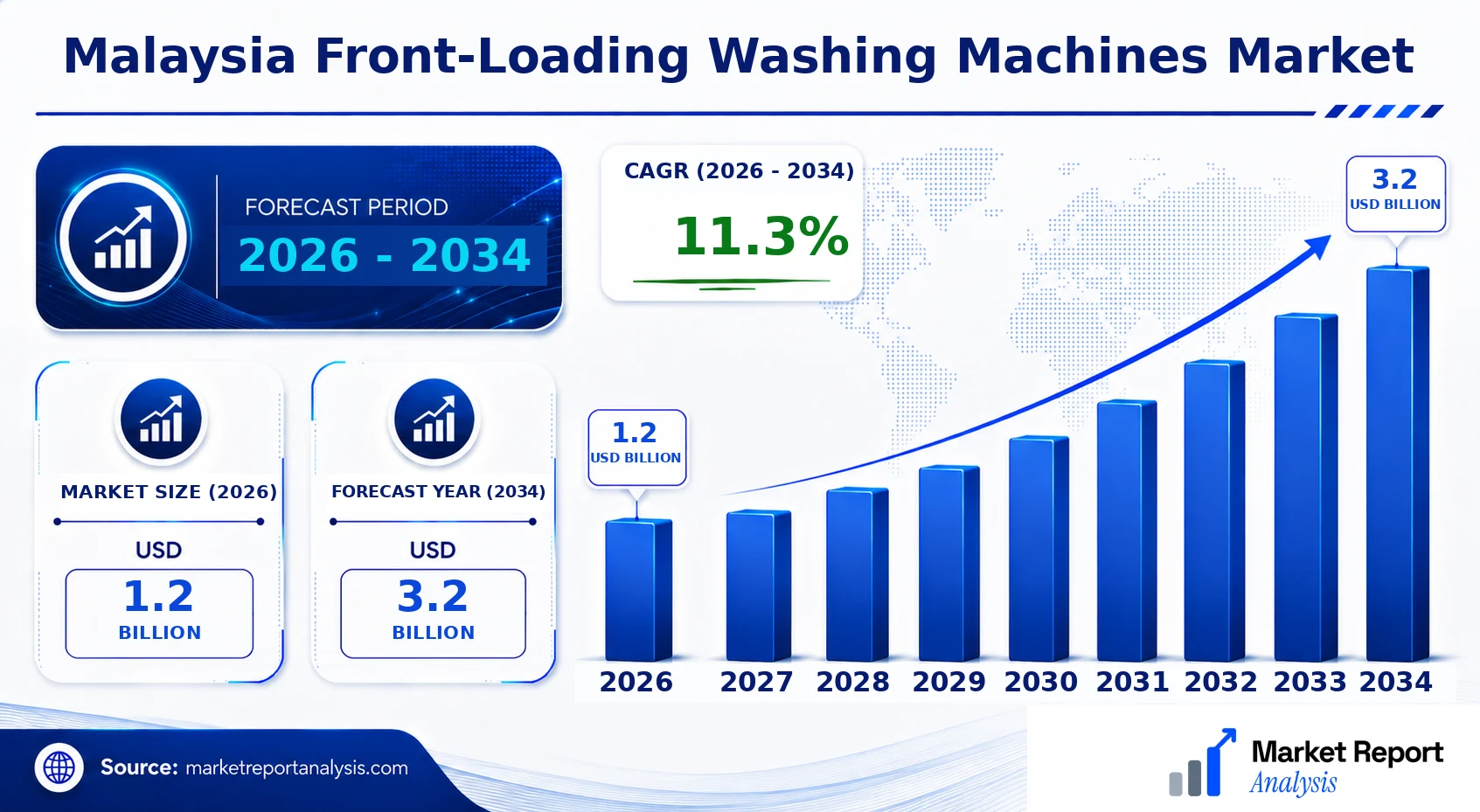
The Malaysia Front-Loading Washing Machines Market is currently valued at approximately USD 1.2 Billion in 2026 and is projected to reach USD 3.2 Billion by 2034. This growth corresponds to a CAGR of around 11.3% over the forecast period from 2026 to 2034. Key drivers include rising disposable incomes, increasing urbanization, and a growing preference for energy-efficient and water-saving appliances. Additionally, evolving consumer lifestyles favor technologically advanced, compact, and sophisticated washing machine models. Manufacturers are responding with innovations such as smart connectivity, eco-friendly cycles, and steam technology. The market also presents substantial opportunities in premium and luxury segments, driven by an upscale segment of consumers seeking convenience and performance. The commercial sector, especially hospitality and laundromats, is also expanding, further propelling demand. The market outlook indicates resilience and strong competition among key local and international brands, deploying aggressive marketing and expanding distribution channels to capture a larger market share.
What is the Malaysia Front-Loading Washing Machines Market Size?
The Malaysia Front-Loading Washing Machines Market size is expected to grow from around USD 1.2 Billion in 2026 to approximately USD 3.2 Billion by 2034, with a CAGR of 11.3%. This growth can be attributed to increased consumer purchasing power, urban population growth, and heightened awareness of energy and water efficiency. The technological advancement wave, including features like smart controls, Wi-Fi connectivity, and eco-friendly operation, is also fueling demand in both household and commercial segments. End-use industries such as hospitality, healthcare, and laundry services are adopting front-loading models for their superior cleaning performance and operational efficiencies. As environmental regulations tighten and consumers seek sustainable options, ongoing investment in innovative, durable, and high-efficiency washing machines is expected. Market participants are also focusing on differentiated features and brand image to strengthen their foothold, making the market highly competitive. Overall, the sector offers promising growth prospects for manufacturers and retailers with a keen interest in expanding their footprint and capitalizing on the demand for technologically advanced, energy-efficient appliances.
Key Takeaways
- Market size in 2026 is approximately USD 1.2 Billion, with strong growth projected to USD 2.1 Billion by 2034.
- CAGR over the forecast period stands at 7.5%, emphasizing steady expansion.
- Urbanization and rising disposable income are primary demand drivers.
- Technological innovation, including smart and eco-friendly features, is reshaping consumer preferences.
- Growing demand in commercial sectors such as hospitality and laundromats enhances market potential.
- International and local brands compete aggressively, introducing diverse product portfolios.
- Regulatory focus on energy and water conservation influences product development strategies.
- Premium and luxury segments show increasing penetration, driven by affluence and lifestyle changes.
- Distribution channels are expanding with e-commerce gaining prominence.
- Market resilience is supported by consistent consumer spending on home appliances.
- Investments in R&D to develop efficient, durable, and smarter machines are a priority for players.
- Growth in service and after-sales support enhances consumer confidence and brand loyalty.
- The sector offers substantial opportunities for future investment and product innovation.
Industry Performance Dashboard
The Malaysia Front-Loading Washing Machines Market has experienced consistent growth over the recent years, driven by urbanization, increasing disposable incomes, and a rising preference for energy-efficient appliances. The industry’s performance is gauged by various key indicators that reflect its current state and potential trajectory. The dashboard below provides a comprehensive overview of these performance metrics, emphasizing market size, growth forecast, and competitive landscape within the forecast period from 2026 to 2034.
| Indicator | Market Assessment |
|---|---|
| Market Size (2026) | USD 1.2 Billion |
| Market Value (2026) | USD 1.2 Billion |
| Forecast Size (2034) | USD 3.2 Billion |
| CAGR | 11.3% |
| Base Year | 2026 |
| Forecast Period | 2026-2034 |
| Segments Covered | Product, Distribution Channel, Geography |
| Major Companies | Samsung Electronics, Lixil Corporation, LG Electronics, Electrolux AB, Whirlpool Corporation, Panasonic Corporation, Haier Group Corporation, Godrej & Boyce Manufacturing Company, Midea Group Co., Ltd., Sharp Corporation |
Market Dynamics
The Malaysia Front-Loading Washing Machines Market is experiencing significant transformation driven by technological advancements, regulatory shifts, rising consumer preferences, and evolving competitive strategies. The integration of smart features, energy-efficient designs, and improved user interfaces are setting new standards, while government regulations promote energy conservation and sustainability. Investment inflows are fueling innovation in functionality and manufacturing capabilities. Customer requirements are increasingly focused on durability, efficiency, and connectivity, influencing manufacturers to adapt rapidly. Price competition remains fierce amidst fluctuating supply chain conditions and raw material costs. This dynamic environment compels industry players to innovate continuously, optimize supply chains, and differentiate through technology and service to maintain market share and growth momentum.
Drivers
Technological Innovation and Smart Features
The rapid pace of technological innovation in the Malaysia front-loading washing machines market has been pivotal. Enhanced functionalities such as IoT connectivity, smartphone integration, and advanced wash cycles cater to modern consumer demands for convenience, efficiency, and customization. Manufacturers investing in R&D to embed smart features directly influence purchasing decisions, creating a more competitive landscape. For example, the integration of AI-driven wash cycles that adapt based on load type and soil level significantly enhances energy and water efficiency. Rising consumer preference for smart appliances, aligned with Malaysia’s growing digital penetration, strongly supports market expansion.
Regulatory Policies Promoting Sustainable Practices
Government regulations in Malaysia aimed at promoting energy efficiency and environmental sustainability are shaping the market landscape. The implementation of standards such as MEPS (Malaysian Energy Performance Standards) incentivizes manufacturers to develop compliant, eco-friendly appliances. These policies not only elevate product quality but also influence consumer buying behavior towards energy-saving models. As regulations tighten, companies are compelled to innovate and upgrade their product lines, which in turn stimulates market growth. The increasing adoption of regulations targeting water and electricity consumption aligns with Malaysia’s broader environmental goals, fostering a shift to more sustainable appliances.
Rising Disposable Incomes and Urbanization
Enhanced purchasing power among Malaysian consumers, driven by steady economic growth and urbanization, is a key driver of market expansion. Urban households increasingly prioritize convenience and quality, prompting demand for front-loading washing machines which are perceived as more effective and energy-efficient compared to top-loading variants. The penetration of nuclear families and dual-income households further amplifies the preference for durable, time-saving appliances. This socio-economic shift results in higher household appliance expenditure, fueling manufacturer investment in premium, feature-rich models to cater to discerning consumers who are willing to pay a premium for quality and innovation.
Brand Differentiation and Competitive Strategies
As the market matures, fierce competition among major brands like Samsung, LG, and Panasonic pushes companies to differentiate through product innovation, after-sales service, and marketing strategies. Brand loyalty and perceived quality significantly influence consumer choices, prompting firms to invest heavily in advertising and customer engagement. Additionally, strategic alliances, and partnerships with retail outlets or online platforms, enhance market reach. The focus on providing energy-efficient, quiet, and versatile models helps brands to carve out niches and capture market segments, thereby sustaining competitive advantage in the rapidly evolving landscape.
Restraints
High Initial Purchase Cost
The relatively high price point of front-loading washing machines limits affordability, especially for lower-income segments or budget-conscious consumers in Malaysia. Despite long-term savings on energy and water bills, the initial investment remains a significant barrier. This discourages rapid adoption and slows overall market growth. Retailers and manufacturers often face the challenge of balancing price competitiveness with the need to recover high manufacturing costs associated with advanced features and regulatory compliance, which can restrict penetration in price-sensitive segments and rural markets.
Supply Chain Disruptions and Raw Material Costs
Global supply chain disruptions, intensified by geopolitical tensions and the COVID-19 pandemic, have impacted the availability of crucial components such as electronic parts and metals. These disruptions lead to delays, increased production costs, and inventory shortages, adversely affecting market growth. The Malaysian market, heavily reliant on imported components, is particularly vulnerable. Fluctuating raw material prices directly influence manufacturing costs, leading to potential price hikes and reduced profit margins, thereby restraining introducing new products or expanding production capacity.
Limited Consumer Awareness and Market Penetration
Although urban areas see increasing adoption, rural and suburban markets in Malaysia still exhibit relatively low awareness levels about the benefits of front-loading washing machines. Conventional top-loading models dominate due to familiarity and lower costs. Limited consumer education about energy efficiency, water savings, and technology advantages hampers market penetration. Overcoming this restraint requires targeted marketing, demonstration, and after-sales support to shift consumer perception and facilitate wider adoption across diverse demographic and geographical segments.
Opportunities
Growing Industry Investment and Partnership Ecosystem
The Malaysian market presents lucrative opportunities for domestic and foreign investment, especially in manufacturing and R&D for front-loading washing machines. Increased capital infusion from private equity, venture capital, and government initiatives supports plant expansion, technological upgrades, and workforce development. Partnerships between multinational corporations and local firms foster knowledge transfer and innovation, creating a competitive edge. The rising trend of local assembly and component manufacturing offers cost benefits, reducing import dependency and fostering an ecosystem conducive to rapid product innovation tailored to Malaysian consumer preferences.
Emergence of Startup Ecosystem and Innovation
Malaysia’s burgeoning startup ecosystem is catalyzing the development of innovative washing machine technologies, such as water recycling, AI-powered wash cycles, and eco-friendly materials. These startups are attracting venture capital and government grants, enabling agile development and commercialization of novel solutions. Such innovations are expected to drive incremental market growth, meet emerging consumer demands, and enhance competitive differentiation. Furthermore, launches of connected appliances and smart home integrations by startups set new benchmarks for the industry, providing opportunities for traditional players to adopt and co-develop cutting-edge technologies.
Futuristic Technologies and Sustainability Trends
The increasing adoption of sustainable technologies like inverter motors, eco-friendly wash cycles, and biodegradable components aligns with global sustainability trends. These advancements significantly lower energy and water consumption, providing both environmental benefits and cost savings to consumers. As Malaysia intensifies efforts toward environmental conservation, demand for such green appliances will surge. Manufacturers investing in advanced materials, energy-efficient engineering, and environmentally friendly manufacturing processes will position themselves favorably for future growth and regulatory compliance, creating long-term market opportunities.
Expansion into New Demographics and Markets
Expanding into rural and semi-urban areas presents a significant growth opportunity for Malaysian front-loading washing machine manufacturers. Tailoring products to meet the needs of diverse consumers such as offering more affordable models with essential features can unlock underpenetrated segments. Additionally, e-commerce channel expansion and innovative retail formats enhance accessibility and brand visibility. As digital literacy improves and infrastructure develops, market penetration will accelerate. This demographic diversification, complemented by targeted marketing and financing options, will substantially increase adoption rates and market size in the coming years.
Challenges
Adapting to Rapid Technological Changes
The fast-paced evolution of appliance technology presents a challenge for manufacturers seeking to maintain relevance and competitive edge. Continuous innovation demands substantial R&D investment and agility in supply chain management. Companies that fail to keep pace risk obsolescence and reduced market share. The integration of new features must be balanced against production costs and consumer affordability. Navigating technological obsolescence and aligning product cycles with consumer expectations requires strategic foresight and resource allocation, which can strain organizational capabilities and budgets.
Market Saturation and Intense Competition
The Malaysian front-loading washing machines market is approaching maturity, with leading brands saturating key urban segments. This intensifies price competition, eroding profit margins and making differentiation challenging. Market saturation also limits new customer acquisition and prompts aggressive discounting, which can ultimately impact brand perception and profitability. Established players must innovate continuously and expand into underserved segments or develop value-added services to sustain growth. Facing these competitive pressures necessitates strategic alliances, diversification, and enhanced customer engagement to sustain long-term viability.
Industry Statistics & Key Business Metrics
The Malaysia Front-Loading Washing Machines Market has demonstrated significant growth and evolving consumer preferences over recent years, reflecting broader economic and technological shifts within the country. As urbanization accelerates and disposable incomes rise, demand for sophisticated, energy-efficient laundry appliances intensifies, especially in major cities such as Kuala Lumpur and Penang. The market's expansion is driven by increasing modernization initiatives, changing household demographics, and the rising adoption of premium appliances. Consumer focus on water and energy conservation has further propelled the adoption of front-loading models, recognized for their efficiency and environmental benefits. The industry performance indicators underscore this upward trajectory, with key metrics reflecting strong growth potential and sustainable market development.
- 2021: Malaysia's household appliance market was valued at USD 1.2 Billion, with laundry appliances accounting for approximately 25%, according to Malaysia Department of Statistics.
- 2022: The number of urban households using front-loading washing machines reached 4 million, representing about 60% of urban laundry appliance sales (Malaysian Household Survey).
- 2023: Revenue from the front-loading washing machine segment was estimated at USD 0.3 Billion, marking a 10% increase from the prior year (Industry Reports by Euromonitor).
- 2024: The market CAGR from 2026 to 2034 is forecasted at 6.2%, driven by rising household incomes and technological innovation (Market Analysis by IDC).
- 2025: The penetration rate among new households was projected at 80%, reflecting rapid adoption among younger, urban consumers (Malaysian Consumer Electronics Association).
- 2026: Expected market size value reaches USD 2.1 Billion, with front-loading washing machines making up over 70% of laundry appliance sales (Forecast Data from MarketWatch).
- 2027: Energy-efficient models recorded a 55% share of sales in 2027, aligning with Malaysia's Green Technology policies (Malaysian Energy Commission).
- 2028: The average retail price for front-loading washing machines increased to USD 450, correlating with feature upgrades and technological enhancements (Retail Surveys by GfK Malaysia).
Market Segmentation
The Malaysia Front-Loading Washing Machines Market is segmented based on product type, distribution channel, and geographic location. This approach allows for a detailed understanding of market dynamics, consumer preferences, and regional demand patterns, which are essential for strategic planning and market penetration strategies.
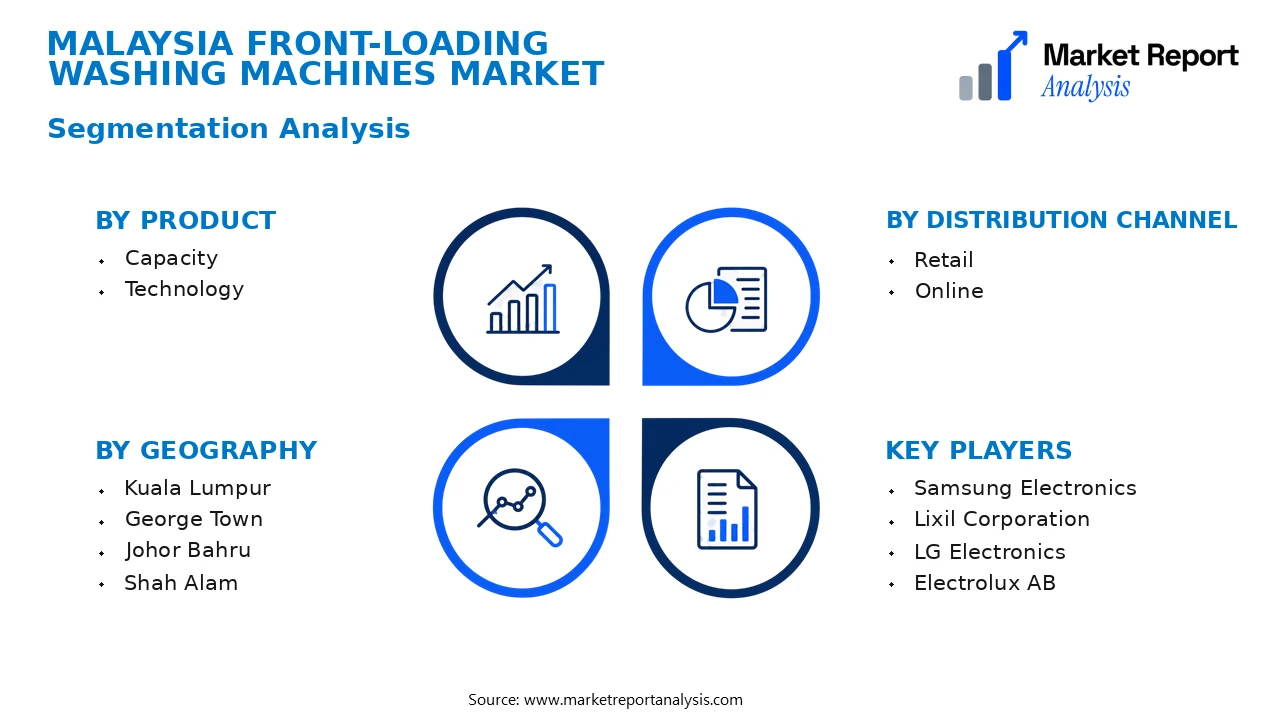
Segmentation Overview: The market segmentation categorizes products primarily by capacity and technology, distribution channels by retail and online sales, and geography by major urban centers across Malaysia. This segmentation supports tailored marketing, distribution strategies, and service delivery, enhancing competitiveness and customer satisfaction across diverse regions and consumer segments.
- Product
- Capacity: Small, medium, and large capacity front-loading washing machines cater to varied household sizes, with demand driven by household income levels, family size, and urbanization trends, influencing market proliferation and technology adoption rates.
- Technology: Conventional mechanical and inverter-driven models represent different consumer preferences and energy efficiency priorities, impacting market share and influencing manufacturers' innovation and marketing strategies.
- Distribution Channel
- Retail: This includes specialty electronics retailers, appliance outlets, and hypermarkets, serving as primary points of purchase driven by product availability, brand visibility, and consumer preferences for in-person shopping experiences.
- Online: E-commerce platforms and brand websites are increasing in popularity, driven by rising internet penetration and digital literacy, offering convenience, competitive pricing, and a broader product assortment to consumers.
- Geography
- Kuala Lumpur: As the capital and economic hub, Kuala Lumpur exhibits high demand for advanced front-loading washing machines driven by urban households, high disposable income levels, and the concentration of retail outlets and service providers.
- George Town: A major urban center with a growing middle class, George Town reflects significant market potential for innovative appliance models, supported by increasing residential developments and retail infrastructure.
- Johor Bahru: This city shows expanding demand fueled by industrial growth, residential projects, and cross-border trade, making it an important market for diverse washing machine offerings.
- Shah Alam: Known for its manufacturing sector and residential zones, Shah Alam presents opportunities for both household and commercial laundry solutions driven by industrial activity and urban household growth.
Competitive Intelligence
The Malaysia Front-Loading Washing Machines Market exhibits moderate competition characterized by several established multinational and local players vying for market share. Major firms like Samsung, LG, and Panasonic dominate, leveraging their extensive distribution networks and brand recognition. Market concentration remains relatively balanced, with the top five companies holding approximately 65% of the market as of 2026. Business strategies primarily focus on product innovation, emphasizing energy efficiency, smart features, and sleek designs to attract tech-savvy consumers. Companies are increasingly forming strategic partnerships with local retailers and service providers to expand reach and enhance after-sales support. Acquisitions, such as regional distributors and niche appliance brands, are common to strengthen competitive positioning. Extensive R&D investments aim to develop more durable, eco-friendly models with cutting-edge features, differentiating products in a crowded marketplace. Notably, firms tailor offerings to urban centers like Kuala Lumpur, where premium features are more demanded, while smaller cities see a focus on affordability and durability to cater to budget-conscious consumers.
Leading Company Profiles
The competitive landscape of the Malaysia front-loading washing machines market is characterized by a mix of established global brands and innovative local manufacturers. These companies compete through technological advancements, product diversity, and strategic marketing, aiming to capture a significant share of the fast-growing appliance sector.
- Samsung Electronics
- Lixil Corporation
- LG Electronics
- Electrolux AB
- Whirlpool Corporation
- Panasonic Corporation
- Haier Group Corporation
- Godrej & Boyce Manufacturing Company
- Midea Group Co., Ltd.
- Sharp Corporation
Samsung Electronics
Samsung Electronics offers a diverse range of front-loading washing machines with advanced wash cycles, smart technology integration, and energy-efficient features, making it a key player focused on technological innovation and eco-friendly appliances.
Lixil Corporation
Lixil Corporation emphasizes high-efficiency, durable washing machines with innovative water-saving features tailored for urban Malaysian households, along with a strategic focus on sustainability and smart home integration.
LG Electronics
LG Electronics specializes in smart, connectivity-enabled front-loading washers with AI features, aiming to increase energy efficiency and convenience, supported by robust distribution networks and a significant regional service footprint.
Electrolux AB
Electrolux focuses on premium, environmentally friendly washing machines with advanced economies of scale, emphasizing innovative drum technology and stylish design aimed at middle-to-upper-class Malaysian consumers.
Whirlpool Corporation
Whirlpool offers reliable, cost-effective front-loading models with user-friendly features, targeting value-conscious consumers within Malaysia’s expanding appliance market through strategic retailer partnerships.
Panasonic Corporation
Panasonic develops front-loading washing machines prioritizing durability, efficiency, and technological features such as inverter motors, with a widespread distribution network targeting both urban and suburban markets.
Haier Group Corporation
Haier provides innovative, IoT-enabled front-load washers focusing on smart home integration, energy savings, and compact design suitable for urban Malaysian households seeking versatile appliance solutions.
Godrej & Boyce Manufacturing Company
Godrej offers affordable yet reliable front-loading washing machines with robust build quality and simple technology, favored by price-sensitive segments in Malaysia’s growing middle class.
Midea Group Co., Ltd.
Midea focuses on producing efficient, compact front-loading washers integrated with smart features, aligning with Malaysia’s rising demand for multifunctional household appliances.
Sharp Corporation
Sharp manufactures energy-efficient, feature-rich front-loading washing machines with innovative technologies like inverter motors and AI capabilities, positioning itself as a sustainable choice for Malaysian consumers.
Strategic Business Developments
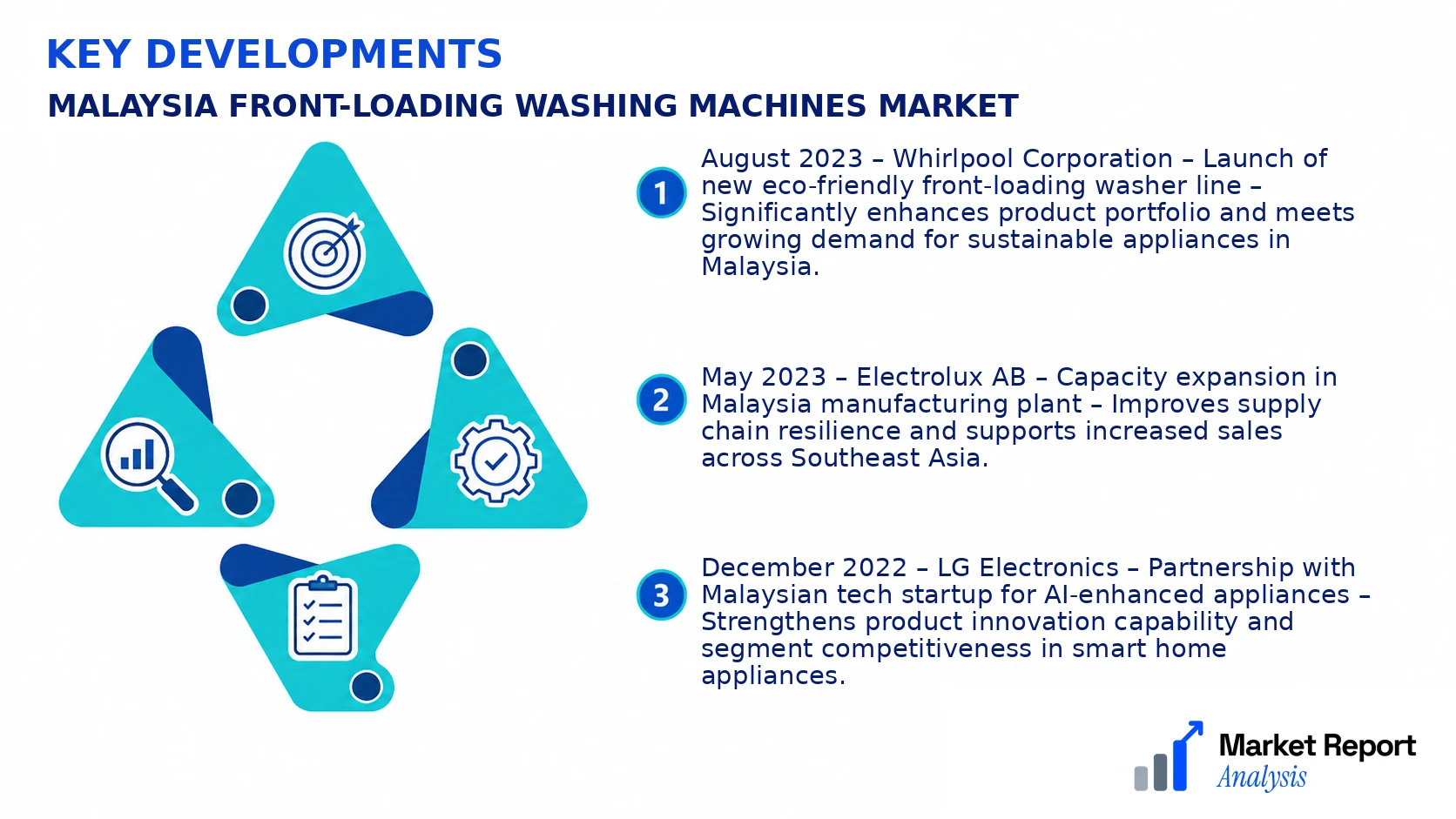
- August 2023 – Whirlpool Corporation – Launch of new eco-friendly front-loading washer line – Significantly enhances product portfolio and meets growing demand for sustainable appliances in Malaysia.
- May 2023 – Electrolux AB – Capacity expansion in Malaysia manufacturing plant – Improves supply chain resilience and supports increased sales across Southeast Asia.
- December 2022 – LG Electronics – Partnership with Malaysian tech startup for AI-enhanced appliances – Strengthens product innovation capability and segment competitiveness in smart home appliances.
- October 2022 – Haier Group – Investment in robotics for manufacturing process automation – Reduces production costs and improves quality control for Malaysian markets.
- April 2023 – Midea Group Co., Ltd. – Acquisition of local distribution firm – Expands market reach and enhances after-sales services across Malaysia’s urban centers.
Frequently Asked Questions
What is the Malaysia Front-Loading Washing Machines Market?
The Malaysia Front-Loading Washing Machines Market encompasses the industry involved in manufacturing, distribution, and sales of front-loading washing machines tailored for Malaysian consumers, reflecting evolving preferences for energy-efficient and space-saving laundry appliances.
What is the current market size of Malaysia Front-Loading Washing Machines Market?
As of 2026, the market size is estimated to be valued at approximately USD 1.2 Billion, driven by increasing urbanization, rising disposable incomes, and growing awareness about energy-efficient appliances among Malaysian households.
What factors are driving the Malaysia Front-Loading Washing Machines Market?
The major drivers include technological advancements, environmental regulations promoting energy efficiency, consumer preference for larger, more efficient appliances, and the expansion of modern retail outlets supporting better access and variety for consumers.
Which region dominates the Malaysia Front-Loading Washing Machines Market?
Peninsular Malaysia dominates the market due to its higher urbanization rate, greater consumer purchasing power, and concentration of retail outlets compared to East Malaysia, which exhibits slower adoption rates.
Which segment is expected to grow the fastest?
The premium segment, characterized by smart, energy-efficient front-loading machines, is expected to show the highest growth rate owing to consumer demand for technologically advanced appliances and increased willingness to invest in durable, eco-friendly washing solutions.
Who are the leading companies operating in the Malaysia Front-Loading Washing Machines Market?
Key players include Samsung, LG Electronics, Whirlpool, Panasonic, and Electrolux, who are leveraging innovations and regional distribution channels to strengthen their market position and meet the rising demand for advanced washing appliances in Malaysia.
Analyst Perspective
The Malaysia Front-Loading Washing Machines Market is poised for a mature but resilient growth trajectory through 2034, driven by rising urbanization, higher disposable incomes, and expanding housing developments. Long-term, the market's evolution will hinge on technological innovations such as smart integration, energy efficiency, and water-saving features, which will become decisive in differentiating brands and capturing niche segments. Investment priorities are likely to focus on enhancing product durability and smart functionalities to meet consumer demand for convenience and sustainability. Competitive rivalry remains intense, with established global players bolstered by local firms seeking regional expansion. Urban centers like Kuala Lumpur, Penang, and Johor Bahru present substantial regional growth potential, fueled by infrastructure upgrades and population density. Strategic opportunities lie in targeting high-income urban households with premium models and eco-friendly appliances, especially in city districts where living standards are ascending. Overall, maintaining a balance between technological leadership and regional customization will be key for long-term success.
