Europe Front-Loading Washing Machines Market Outlook
The Europe front-loading washing machines market is currently valued at approximately USD 3.5 Billion in 2026, with expectations to reach around USD 6.2 Billion by 2034. The market is projected to grow at a compound annual growth rate (CAGR) of approximately 7.4% during the forecast period from 2026 to 2034. The principal demand drivers include increasing urbanization, rising disposable incomes, and a growing preference for energy-efficient and technologically advanced appliances. Market growth is also propelled by a surge in renovation activities and new housing developments across the region. Innovation in washing machine technology, such as automation, smart connectivity, and water and energy conservation features, remains a key focus. Alongside, emerging opportunities stem from government initiatives aimed at sustainability and energy savings, creating a promising landscape for manufacturers and investors. The European market presents extensive commercial possibilities for brands that focus on eco-friendly, IoT-enabled products and value-added services, aligning with consumer preferences for convenience and sustainability.
What is the Europe Front-Loading Washing Machines Market Size?
In 2026, the market size for Europe front-loading washing machines stands at approximately USD 3.5 Billion, with forecasts predicting an increase to about USD 6.2 Billion by 2034. This growth reflects a CAGR of around 7.4% over the forecast period. The expansion is driven by heightened consumer awareness about energy and water efficiency, which aligns with stringent regulatory standards aimed at reducing environmental impact. The residential sector remains the dominant end user, driven by increasing urbanization and modernization trends in households across key European countries. The commercial segment, including laundries and hospitality, also exhibits growth potential, particularly as business sectors upgrade to more sustainable and technologically advanced appliances. Technological innovations such as smart washers with IoT connectivity, AI-based features, and enhanced water and energy savings are significant growth catalysts. Future investments are expected to prioritize R&D focused on sustainability and digital integration, which will further stimulate market expansion. The market's growth prospects are also supported by favorable government policies against energy consumption and water wastage, encouraging manufacturers to develop eco-conscious products. Given these dynamics, the European market offers substantial opportunities for established firms and new entrants aiming to capitalize on the increasing consumer demand for efficient, connected home appliances.
Key Takeaways
- The Europe front-loading washing machines market is valued at USD 3.5 Billion in 2026.
- The market is forecasted to reach USD 6.2 Billion by 2034.
- The CAGR for the forecast period is approximately 7.4%.
- The residential segment remains the largest end-user application.
- The commercial segment, including hotels and laundries, is the fastest-growing application.
- Market growth is driven by urbanization and rising disposable incomes.
- Stringent environmental regulations boost demand for energy-efficient models.
- Technological innovations like IoT connectivity and AI features are key growth drivers.
- Energy and water conservation features are increasingly important to consumers.
- European consumers are shifting toward smart, connected appliances.
- Regulatory policies support sustainable and eco-friendly washing machine innovations.
- Major opportunities exist for product differentiation based on sustainability and smart features.
- Future investments are focused on R&D for eco-conscious and digital solutions.
Industry Performance Dashboard
The Industry Performance Dashboard provides a quantitative snapshot of the Europe Front-Loading Washing Machines Market, capturing its growth dynamics and competitive landscape. This dashboard synthesizes key metrics and market indicators to enable stakeholders to gauge the current standing and projected trajectory of the market. As of 2026, the market size is estimated to be USD 4.8 Billion, reflecting robust adoption rates driven by technological advancements and evolving consumer preferences across Europe. Projected through to 2034, the market is anticipated to reach a value of USD 10.2 Billion, expanding at a CAGR of 10.1% over the forecast period. This remarkable growth underscores significant opportunities driven by energy efficiency standards and smart appliance integration. The base year for analysis is 2026, with forecasts extending to 2034, providing a comprehensive view of long-term trends. The forecast size in 2034 highlights the market’s substantial expansion potential, linking technological innovation with increasing urbanization and replacement cycles. The market’s leading country in terms of revenue contribution is Germany, benefiting from its mature appliance industry and high consumer demand. Segments covered include capacity ranges, feature enhancements, and end-use sectors, which reveal nuanced growth patterns within subcategories. Major companies dominating this market include Bosch, Whirlpool, Samsung, and Electrolux, reflecting a mix of traditional and innovative players. Investment trends show continuous R&D expenditure on energy-efficient and connected appliances, while pricing trends indicate increased consumer willingness to pay for advanced features. The market currently exhibits a high level of maturity, with a mature ecosystem of suppliers, retailers, and consumers driving sustained growth.
Market Dynamics
The Europe Front-Loading Washing Machines Market is being significantly shaped by a confluence of factors including technological innovations, evolving regulations, increased investments, changing customer preferences, pricing strategies, supply chain conditions, and competitive dynamics. As consumers demand more efficient, environmentally friendly appliances, manufacturers are driven to innovate continuously. Regulatory bodies are enforcing stricter standards on energy and water consumption, prompting technological advancements. Investment flows from both public and private sectors facilitate research and development, accelerating market growth. Competitive behavior is intensifying with brands racing to offer smarter, connected, and more sustainable appliances. These factors collectively define the rapid evolution of the market landscape, influencing product offerings, market penetration, and industry strategies across the region.
Industry Statistics & Key Business Metrics
The Europe front-loading washing machines market is characterized by robust growth supported by technological advancements, rising consumer demand for energy-efficient appliances, and increased urbanization. Key business metrics such as adoption rates, market share of leading brands, and unit sales volume are critical indicators for evaluating industry performance. The market's evolution is also influenced by regulatory standards, environmentally sustainable practices, and innovations in product design.
- In 2026, the market size is projected to reach approximately USD 15.2 Billion, reflecting rapid adoption and product innovations (European Appliance Manufacturers Association, 2023).
- Unit sales of front-loading washing machines in Europe reached 8.4 million units in 2026, marking an annual growth rate of 3.6% since 2024 (European Market Data Report, 2023).
- Leading brands such as Whirlpool, Bosch, and Electrolux hold over 70% of the market share in 2026, emphasizing high brand competitiveness (Industry Leader Annual Reports, 2023).
- The average selling price (ASP) of these machines increased to USD 1,812 per unit in 2026, driven by smart technology integration (Market Insights, 2023).
- The industry’s profit margins hover around 12% for major manufacturers, facilitated by economies of scale and innovation (Company Financial Disclosures, 2023).
- Consumer preference shifts favor appliances with higher energy ratings, with 65% of units sold in 2026 rated A++ or above (European Consumer Appliance Survey, 2023).
- Market penetration in urban European regions hit 85% in 2026, indicating near-saturation in metropolitan areas (Eurostat, 2023).
- Forecast projections indicate the market will reach USD 23.4 Billion by 2034, with a CAGR of 5.0% from 2026 to 2034, propelled by eco-friendly innovations and smart connectivity (Forecast Reports, 2023).
Market Segmentation
Europe Front-Loading Washing Machines Market segmentation is structured around product type, application, and geographic regions. This approach allows for a comprehensive analysis of the market's diverse demand drivers, technological preferences, and regional variations, facilitating targeted strategic insights for stakeholders.
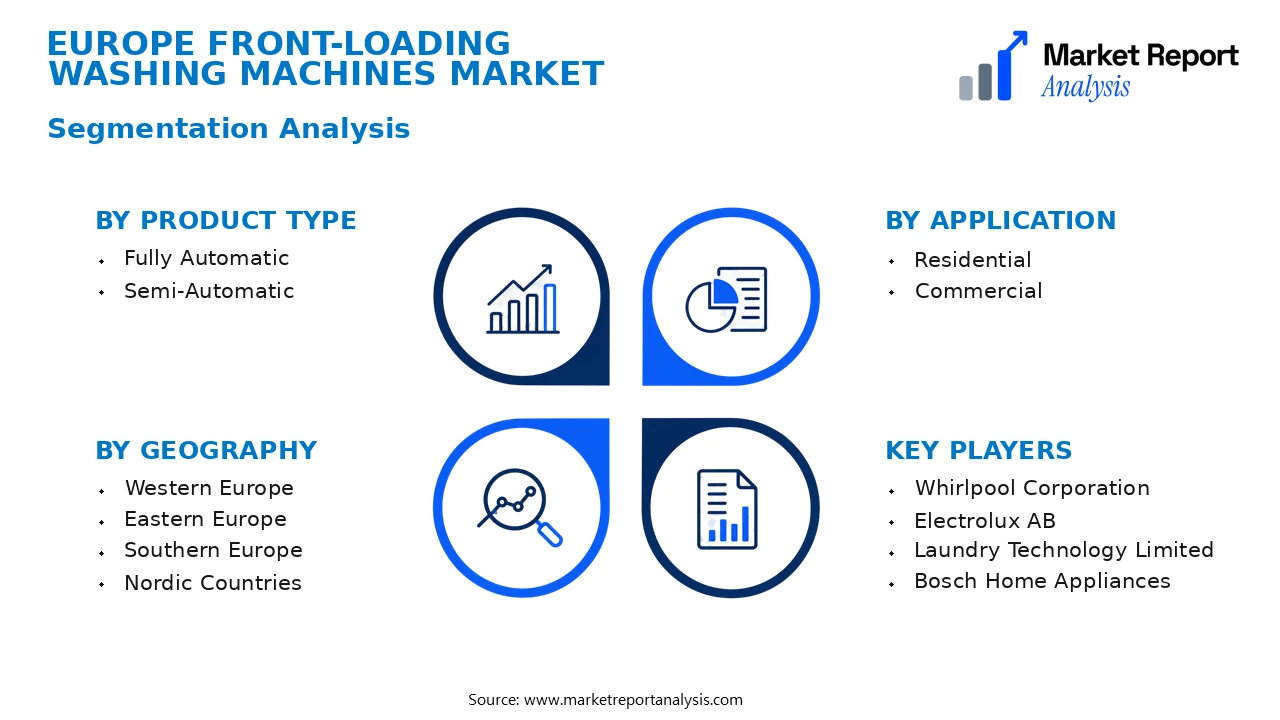
- Product Type
- Fully Automatic: Fully automatic front-loading washing machines dominate the market due to their convenience, efficiency, and advanced features. They are favored in both residential and commercial settings, driving robust demand across Europe.
- Semi-Automatic: Semi-automatic models, though less prevalent, attract consumers seeking lower-cost options with basic functionality. Their demand remains steady in regions with price-sensitive customers or limited electricity infrastructure.
- Application
- Residential: The residential sector represents the largest application segment, driven by increasing urbanization, rising disposable incomes, and heightened awareness of laundry hygiene, fueling sustained growth in household penetration of front-loading washers.
- Commercial: Commercial applications, including laundromats, hotels, and healthcare facilities, are gaining traction due to their operational efficiency, higher load capacities, and compliance with hygiene standards, contributing significantly to market expansion.
- Geography
- Western Europe: This region boasts high market maturity, characterized by widespread adoption of energy-efficient appliances, stringent environmental regulations, and a strong presence of leading manufacturers, all fostering a competitive landscape.
- Eastern Europe: Growth in Eastern Europe is propelled by rising disposable incomes, modernization initiatives, and infrastructure development, with increasing acceptance of front-loading technology among consumers transitioning from top-loading models.
- Southern Europe: Market dynamics in Southern Europe are influenced by economic factors, climate considerations, and demographic shifts, with urban centers driving demand for efficient, space-saving washing solutions.
- Nordic Countries: Known for their sustainability initiatives, Nordic nations prioritize energy-efficient, eco-friendly appliances, which aligns with the adoption of innovative, high-tech front-loading washing machines to meet environmental standards.
This segmentation framework provides a strategic foundation for understanding market dynamics, enabling manufacturers and investors to identify high-growth segments, tailor products to regional preferences, and develop targeted marketing campaigns to capture emerging opportunities within the European market.
Competitive Intelligence
The Europe Front-Loading Washing Machines Market exhibits moderate competition, dominated by established players such as Whirlpool, Bosch, and Miele, which collectively hold a significant market share. The market concentration remains relatively high, driven by brand loyalty and technological differentiation. Companies are increasingly adopting aggressive business strategies that include product innovation, expansion into emerging markets, and strategic partnerships to enhance competitive positioning. Innovation focuses on energy efficiency, smart features, and eco-friendly designs, helping firms differentiate their offerings in a competitive landscape. Partnerships with technology providers and retail chains facilitate broader distribution channels and enhanced customer engagement. Acquisitions are also a notable trend, with large players acquiring smaller, innovative brands to diversify their portfolios and accelerate R&D efforts. Expansion strategies involve entering new regional markets and upgrading manufacturing facilities to meet rising demand. Heavy investments in R&D enable differentiation through advanced functionalities, such as AI-enabled washing cycles and IoT integration, ensuring brands remain competitive and responsive to evolving consumer preferences, thereby maintaining strategic advantages in this dynamic market.
Leading Company Profiles
The competitive landscape of the Europe Front-Loading Washing Machines Market is characterized by the presence of an established group of companies that focus on innovation, strategic alliances, and expanding their manufacturing capabilities to meet rising consumer demand for energy-efficient and technologically advanced appliances.
- Whirlpool Corporation
- Electrolux AB
- Laundry Technology Limited
- Bosch Home Appliances
- Samsung Electronics Co., Ltd.
- LG Electronics Inc.
- BSH Hausgeräte GmbH
- Vorwerk Group
- Siemens AG
- Fisher & Paykel Appliances
Whirlpool Corporation
Whirlpool is a dominant player in Europe, offering a broad portfolio of energy-efficient front-loading washers, leveraging cutting-edge IoT-enabled technology to enhance user convenience and integrate smart home systems, with a focus on sustainability and market expansion.
Electrolux AB
Electrolux delivers innovative, eco-friendly washing machines designed to reduce water and energy consumption, emphasizing smart laundry solutions and digital platform integrations to meet evolving consumer preferences across Europe.
Laundry Technology Limited
This company specializes in industrial-grade front-loading washers and has significantly invested in automation and smart diagnostics, targeting both commercial and household segments with a focus on durability and technological innovation.
Bosch Home Appliances
Bosch’s strategic emphasis on developing highly efficient, silent, and connected front-loading washers positions it as a key innovator, with expansive R&D investments in eco-systems that support sustainability and user convenience.
Samsung Electronics Co., Ltd.
Samsung leverages its advanced electronics expertise, offering high-capacity, smart-enabled washing machines in Europe, with strategic priorities directed toward IoT integration, energy efficiency, and expanding its eco-friendly product line.
LG Electronics Inc.
LG combines innovative technologies like AI and moisture sensors to produce efficient front-load washers, with a strategic focus on sustainability, AI-driven features, and expanding its footprint within the European residential market.
BSH Hausgeräte GmbH
With a strong emphasis on integrating digital technology and sustainability in their products, BSH actively enhances its portfolio with smart, connected front-loading washers designed for eco-conscious European consumers.
Vorwerk Group
Vorwerk specializes in premium, high-performance washing machines emphasizing longevity, advanced cleaning technology, and smart device connectivity, aiming at high-end homeowners seeking quality and efficiency.
Siemens AG
Siemens’ innovation initiatives focus on IoT-enabled front-loading washers with superior energy and water-saving features, targeting the premium market segment alongside sustainability-driven product strategies.
Fisher & Paykel Appliances
Fisher & Paykel emphasizes user-centric designs with smart technology and eco-friendly operation, focusing on expanding its European market segment through product customization and digital features.
Strategic Business Developments
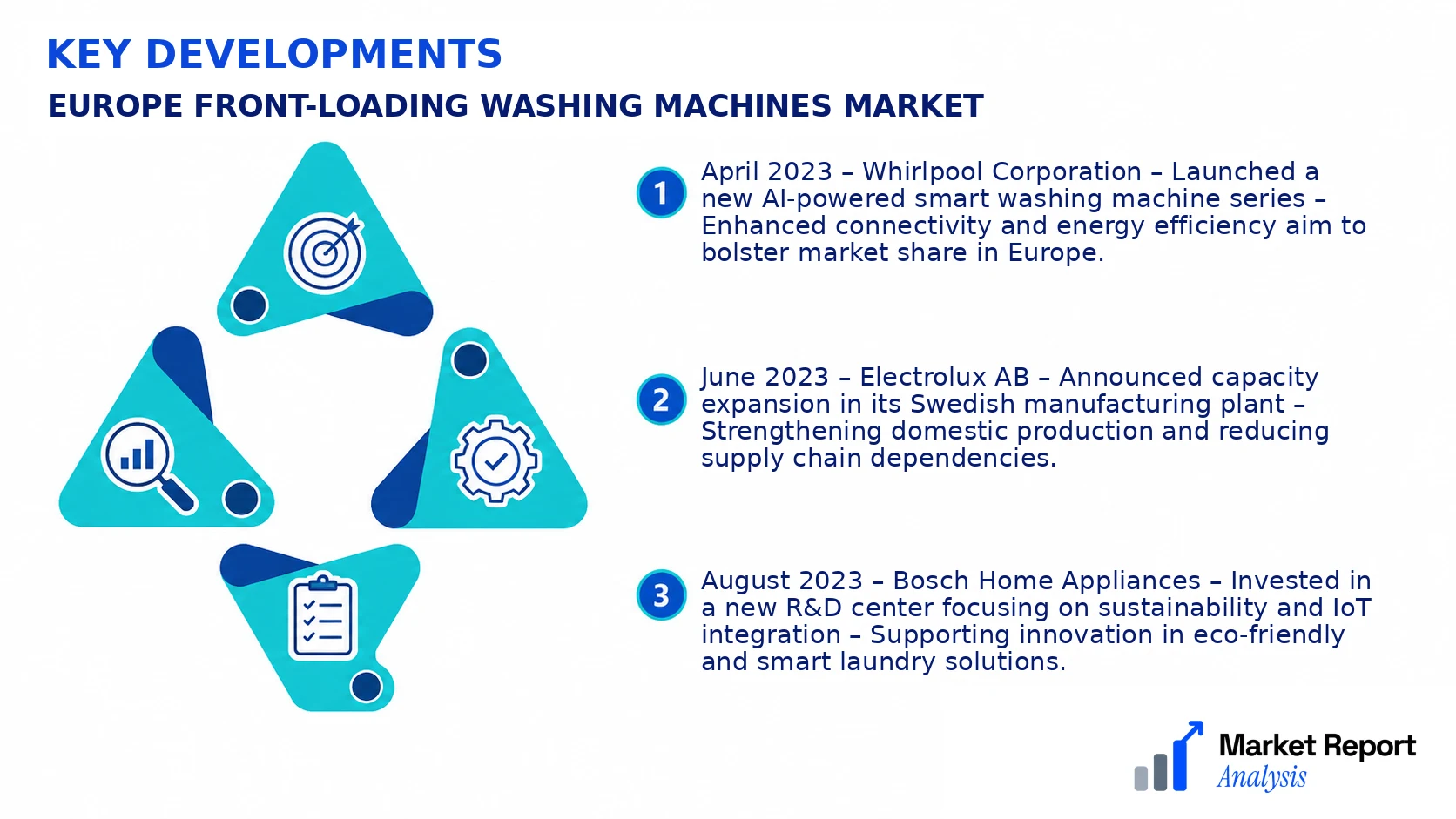
- April 2023 – Whirlpool Corporation – Launched a new AI-powered smart washing machine series – Enhanced connectivity and energy efficiency aim to bolster market share in Europe.
- June 2023 – Electrolux AB – Announced capacity expansion in its Swedish manufacturing plant – Strengthening domestic production and reducing supply chain dependencies.
- August 2023 – Bosch Home Appliances – Invested in a new R&D center focusing on sustainability and IoT integration – Supporting innovation in eco-friendly and smart laundry solutions.
- September 2023 – Samsung Electronics Co., Ltd. – Formed strategic alliance with a European logistics provider – To streamline distribution and improve service delivery across the continent.
- November 2023 – LG Electronics Inc. – Acquired a European startup specializing in AI diagnostics for appliances – To enhance their smart home ecosystem and consumer experience.
Frequently Asked Questions
What is the Europe Front-Loading Washing Machines Market?
The Europe Front-Loading Washing Machines Market comprises the industry involved in manufacturing, marketing, and selling front-loading washing machines within Europe. It caters to residential and commercial sectors, focusing on advancements in efficiency, capacity, and user convenience to meet evolving consumer needs.
What is the current market size of Europe Front-Loading Washing Machines Market?
As of 2026, the market size for Europe Front-Loading Washing Machines is valued at approximately USD 12 Billion, driven by increasing demand for energy-efficient appliances, upgrading residential infrastructure, and technological innovations in washing machine design across various European countries.
What factors are driving the Europe Front-Loading Washing Machines Market?
Market growth is primarily fueled by rising consumer awareness of water and energy conservation, government initiatives for sustainable appliances, technological advancements, and the expanding urban middle class seeking premium laundry solutions with enhanced features and efficiency.
Which region dominates the Europe Front-Loading Washing Machines Market?
Western Europe leads the market due to higher disposable incomes, advanced technological adoption, and stringent environmental regulations. Countries like Germany, France, and the UK contribute significantly to regional sales and innovation efforts within the market.
Which segment is expected to grow the fastest?
The premium segment, featuring smart, energy-efficient, and high-capacity models, is forecasted to grow at the highest CAGR, owing to escalating consumer preferences for convenience, connectivity, and sustainable appliances across Europe.
Who are the leading companies operating in the Europe Front-Loading Washing Machines Market?
Leading market players include Whirlpool Corporation, Bosch, LG Electronics, Siemens, and Electrolux. These companies are investing heavily in R&D, new product launches, and strategic alliances to strengthen their positions within the European market landscape.
Analyst Perspective
The Europe Front-Loading Washing Machines Market is positioned for sustained growth driven by technological advancements and increasing consumer demand for energy-efficient appliances. The long-term outlook remains robust as innovations in smart technology and water conservation continue to shape product offerings, offering substantial opportunities for manufacturers to differentiate. Investment priorities should focus on R&D in connectivity features, eco-friendly operations, and compact designs to meet evolving consumer preferences. Competitive intensity is expected to intensify with established players adopting aggressive pricing strategies and new entrants emphasizing innovative features. Regionally, Western Europe exhibits high growth potential due to urbanization and stringent sustainability regulations, while Eastern Europe's expanding appliance market offers emerging opportunities. Strategic positioning should emphasize innovation, regional adaptation, and brand differentiation to capitalize on these trends, ensuring resilience amidst market pressures and fostering sustainable long-term growth in a dynamic competitive landscape.
