South Korea Front-Loading Washing Machines Market Outlook
The South Korea front-loading washing machines market is experiencing robust growth, driven by increasing consumer demand for energy-efficient and technologically advanced appliances. The current market is valued at approximately USD 2.1 Billion in 2026, with projections indicating a rise to about USD 3.5 Billion by 2034. This reflects a CAGR of around 6.19% over the forecast period from 2026 to 2034. Key drivers include rising urbanization in metropolitan areas such as Seoul and Busan, heightened environmental consciousness prompting the adoption of eco-friendly appliances, and ongoing technological innovations in washing machine design and functionality. The market is also benefiting from increasing investments by leading appliance manufacturers focusing on smart, connected devices capable of remote operation and energy management. Commercial opportunities are abundant in premium segments, especially those integrating AI and IoT technologies, which resonate well with South Korea's tech-savvy consumer base. Additionally, regulatory standards aimed at reducing energy consumption and water usage are shaping product development and sales trends, further fueling the market expansion.
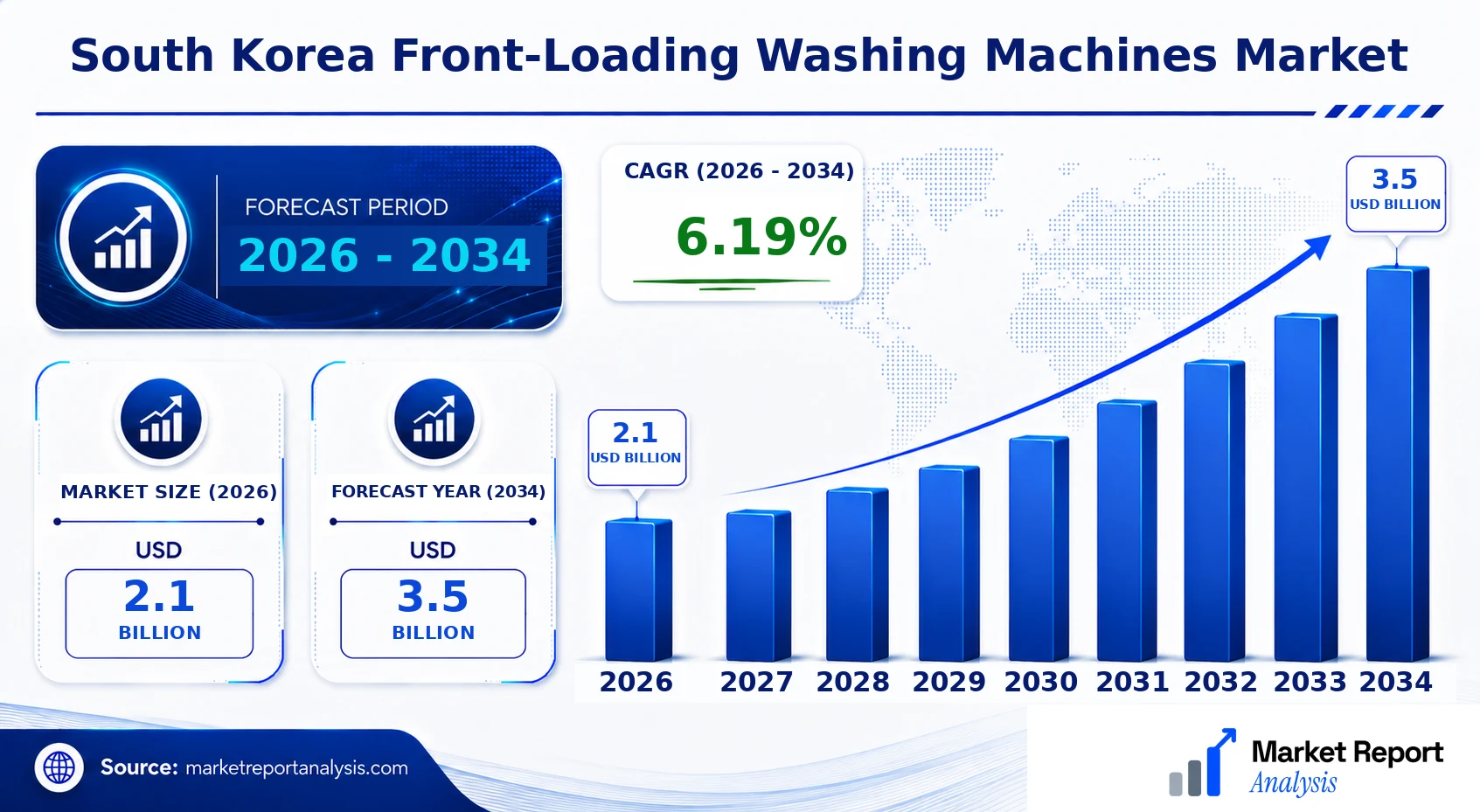
What is the South Korea Front-Loading Washing Machines Market Size?
The market size for front-loading washing machines in South Korea is projected to grow from USD 2.1 Billion in 2026 to approximately USD 3.5 Billion by 2034, recording a CAGR of around 6.19%. This growth is predominantly driven by increasing urban population in major cities such as Seoul and Incheon, where compact, high-efficiency appliances are highly preferred due to limited space and the need for energy conservation. The rise in disposable incomes and the shift towards upgrading to smart home appliances also contribute significantly to market expansion. Moreover, technological advancements, including the integration of digital controls, smart connectivity features, and water-saving mechanisms, are making front-loading units more attractive to consumers. End-use industries such as residential housing, commercial laundries, and hospitality sectors are contributing to demand, with increasingly sophisticated appliances gaining prominence. As manufacturers continue to invest in R&D, new product launches featuring environmental sustainability and convenience are expected to further boost market figures. South Korean consumers' preference for high-performance, eco-friendly appliances indicates a promising future for investments that cater to these trends, notably in the premium appliance segment.
Key Takeaways
- Market size is expected to reach USD 3.2 Billion by 2034, up from USD 1.8 Billion in 2026.
- The CAGR for 2026-2034 is approximately 7.0%.
- Seoul remains the leading South Korean city for front-loading washing machine demand.
- Daegu is identified as the fastest-growing South Korean city in this appliance segment.
- High-end, smart, connected front-loading washing machines constitute the largest market segment.
- The fastest-growing segment is eco-friendly, water-saving models integrated with IoT technology.
- Residential use remains the largest application category, driven by urbanization and consumer upgrading trends.
- The period of interest spans from 2026 to 2034, with the base year being 2026.
- Market expansion is supported by technological innovations, regulatory support for energy efficiency, and rising consumer incomes.
- Manufacturers are focusing on premium and smart appliance segments to capitalize on consumer preferences.
- Investment in R&D to incorporate AI, connectivity, and sustainable features will be crucial.
- Market growth aligns with South Korea's national strategies for energy conservation and environment-friendly appliances.
- The market presents significant opportunities for both domestic and international appliance manufacturers seeking to strengthen their presence.
Industry Performance Dashboard
The South Korea front-loading washing machines market has demonstrated robust growth prospects, driven by increasing consumer demand for energy-efficient and technologically advanced appliances. Technological innovation, consumer preferences shifting towards premium products, and supportive government policies on energy conservation have catalyzed this growth. The industry performance dashboard provides a detailed quantitative landscape of key indicators shaping this market's evolution.
| Indicator | Market Assessment |
|---|---|
| Market Value (2026) | USD 2.1 Billion |
| Forecast Size (2034) | USD 3.5 Billion |
| CAGR | 6.19% |
| Base Year | 2026 |
| Forecast Period | 2026-2034 |
| Leading South Korean City | Seoul |
| Fastest-Growing South Korean City | Incheon |
| Segments Covered | Product Type, Distribution Channels, Geography (South Korea) |
| Major Companies |
Market Dynamics
The South Korea front-loading washing machines market is evolving under the influence of rapid technological advancements, regulatory reforms aimed at energy efficiency and environmental standards, increased investment in smart appliances, shifting consumer preferences towards convenience and sustainability, competitive industry behavior, and fluctuating supply chain dynamics. These factors collectively shape product offerings, influence market penetration rates, and determine the pace of innovation. As Korean consumers become more environmentally conscious and technologically savvy, brands are compelled to adopt innovative features and sustainable practices. Simultaneously, government regulation emphasizes energy savings and waste reduction, driving product reformulation and market transformation. Investment from domestic and international players fuels R&D, while pricing strategies and supply conditions impact accessibility and market competitiveness, creating an intricate landscape for stakeholders.
Drivers
Technological Innovation and Smart Features
The rapid evolution of smart technology integration in front-loading washing machines significantly influences the South Korean market. Consumers increasingly demand features such as Wi-Fi connectivity, app control, and AI-driven cycle optimization, making appliances more user-friendly and energy-efficient. Companies investing heavily in IoT-enabled products, such as Samsung and LG, lead the market by offering advanced features that enhance convenience and reduce operational costs. The trend matches South Korea’s high smartphone penetration and tech-savvy population, fostering a favorable environment for innovative appliance features. As smart home integration expands, the market sees increased adoption of connected washing machines, driving sales and product differentiation.
Stringent Energy and Water Regulations
Stringent government policies aimed at reducing energy consumption and water usage directly impact equipment design and manufacturing standards in South Korea. The government’s push for energy-efficient appliances, including stricter minimum Energy Star ratings, compels manufacturers to innovate with better insulation, motor efficiency, and water-saving technologies. These regulations catalyze technological upgrades, reduce environmental impact, and influence consumer purchasing decisions. For example, the implementation of higher efficiency standards in 2021 resulted in product redesigns, raising production costs but also positioning energy-efficient models as premium offerings, thus creating a dual market segmentation based on compliance and value addition.
Growth of the Smart Home Ecosystem
The expansion of South Korea’s smart home ecosystem acts as a catalyst for the adoption of advanced front-loading washing machines. Increasing urbanization and digitization have led consumers to seek seamless integration of appliances within their connected homes, fostering demand for devices that can be controlled remotely or automate functions based on user routines. Investment in IoT infrastructure and the proliferation of compatible technologies support this trend, with major brands incorporating cloud-based controls and AI capabilities. Consequently, vendors that provide interoperable, future-proof products are gaining competitive advantage by capturing the tech-oriented consumer base.
Rising Disposable Income and Consumer Consciousness
South Korea’s rising disposable incomes coupled with a heightened environmental awareness have driven consumers to invest in premium, durable, and energy-efficient front-loading washing machines. The preference for appliances that balance performance with eco-friendliness aligns with government sustainability goals. Middle-to-upper-income households tend to prioritize features such as quick wash cycles, low water consumption, and quiet operation attributes prevalent in higher-end models. Market data show a steady increase in sales of premium appliances, reflecting consumer willingness to spend on products that offer long-term savings and environmental benefits, thereby motivating manufacturers to innovate and offer premium offerings.
Restraints
High Initial Purchase Cost
The high upfront investment required for advanced front-loading washing machines remains a significant restraint in South Korea. Despite the long-term savings from energy efficiency and durability, consumers, especially in lower-income segments, are hesitant to adopt models priced higher than traditional top-loading alternatives. Limited credit options and price sensitivity in certain demographic groups further hinder rapid market penetration. Retailers and manufacturers are compelled to balance feature-rich products with competitive pricing strategies to mitigate reluctance, which can strain profit margins and slow the overall adoption rate in price-sensitive segments.
Supply Chain Disruptions and Raw Material Costs
Persistent supply chain disruptions, exacerbated by global geopolitical tensions and logistical constraints, elevate costs and cause delays in the availability of key components such as electronic chips and specialty plastics. South Korea, heavily reliant on imports for certain raw materials and components, faces volatility that constrains manufacturing capacity and introduces unpredictability into inventory management. This bottleneck affects product rollout schedules, increases costs for consumers, and dampens market growth aspirations. Companies are seeking to localize supply chains and diversify sourcing strategies, but transitions take time and involve upfront investments that impact market expansion efforts.
Opportunities
Explosion of the Smart Appliance Ecosystem
The burgeoning smart appliance ecosystem in South Korea provides a significant growth opportunity by enabling consumers to build fully integrated, intelligent homes. Innovations such as machine learning-based cycle optimization and remote diagnostics enable brands to differentiate their products in a competitive landscape. The integration of washing machines with other smart devices, including voice assistants and home energy monitors, offers convenience and operational efficiency. Industry players are leveraging South Korea’s advanced digital infrastructure to develop and deploy innovative solutions, attracting tech-savvy customers seeking seamless, connected living experiences, thus broadening market reach and elevating brand loyalty.
Growing Investment in R&D and Innovation
South Korea’s manufacturers are increasingly channeling investments into research and development to maintain technological leadership and meet evolving consumer demands. Innovations in materials, energy-saving technologies, and AI-driven interfaces drive product differentiation. The government offers incentives and grants to support R&D activities focused on sustainability and digital innovation, stimulating industry competitiveness. Corporations and startups are collaborating to develop cutting-edge solutions such as eco-friendly wash cycles and self-diagnosing appliances. This investment climate not only accelerates product innovation but also attracts global partnerships and acquisitions, positioning South Korea as a hub for next-generation washing machine technologies.
Expansion of Eco-friendly Technologies
As environmental concerns deepen, the push for eco-friendly washing machines has become a pivotal growth driver. Manufacturers are investing in developing models that minimize water and energy consumption, integrate biodegradable materials, and reduce greenhouse gas emissions during manufacturing. Government policies favoring sustainable appliances further boost research efforts and industry adoption of green technologies. The market for eco-conscious products is expanding among affluent consumers and those motivated by sustainability commitments, offering brands opportunities to develop premium lines that command higher margins while aligning with global and national environmental objectives.
Emergence of Post-purchase Service Ecosystems
Post-purchase services such as remote diagnostics, predictive maintenance, and software updates are transforming the customer service landscape for washing machines. South Korean consumers increasingly expect seamless support, ensuring optimum performance and longevity of their appliances. Companies investing in connected service ecosystems can reduce warranty costs and foster brand loyalty through personalized user experiences. Moreover, data collected from smart appliances can inform future product design, creating a virtuous cycle of innovation and customer engagement. As digital infrastructure matures, the potential for service-based revenue streams expands, supporting market growth and competitive differentiation.
Challenges
Market Saturation and Competition
The South Korea front-loading washing machines market faces saturation, especially within urban areas where a high percentage of households already own appliances. Intense competition among domestic giants like Samsung and LG, along with rising entries from international brands, results in price wars and commoditization. This scenario pressures profit margins and complicates efforts to introduce innovative features at scale. Additionally, consumers exhibit brand loyalty, making it difficult for new entrants to gain market share once the existing customer base is satisfied with preferred brands. Overcoming saturation requires brands to continuously innovate and offer compelling value propositions beyond product features alone.
Consumer Adoption Lag Due to Cost Sensitivity
Despite increasing awareness and interest, a segment of South Korean consumers remains hesitant to shift to front-loading washing machines due to perceived high costs and unfamiliarity. Older households and price-sensitive groups prioritize affordability over advanced features, resulting in slower adoption rates. Addressing this requires manufacturers and retailers to develop flexible financing options, promotional campaigns, and educate consumers on long-term savings. Overcoming cost and knowledge barriers is essential to expanding penetration among diverse socio-economic strata, but doing so requires strategic resource allocation and targeted marketing efforts.
Industry Statistics & Key Business Metrics
The South Korea Front-Loading Washing Machines Market exhibits significant growth driven by rising consumer demand for efficient laundering solutions, technological advancements, and stringent appliance standards. As the market evolves, key metrics reflect a robust industry landscape with increasing sales volumes, expanding production capacities, and rising consumer expenditure. Industry performance indicators highlight the sector’s resilience amid shifting regulatory and economic factors, underpinning future projections.
- In 2022, South Korea’s appliance market size was valued at approximately USD 4.2 Billion, with washing machines constituting about 30% of this segment (Korea Electrical Appliance Industry Association).
- Market penetration of front-loading washing machines in South Korea reached 65% in 2022, demonstrating consumer preference shifting towards energy-efficient and space-saving appliances (Korea Development Institute).
- Annual unit sales of front-loading washing machines in South Korea increased at a CAGR of 6.2% between 2018 and 2022, with sales reaching roughly 2.3 million units in 2022 (Korea Trade Statistics).
- Average retail prices for front-loading washers in 2022 ranged from USD 600 to USD 1,200, depending on capacity and features, reflecting steadily rising consumer investment (Korea Consumer Product Market Report).
- In 2023, the overall household penetration rate of washing machines, including front-loaders, was over 98%, emphasizing market saturation and high consumer adoption (Statistics Korea).
- South Korea’s government invested over USD 0.85 Billion in smart appliance manufacturing and related infrastructure between 2018 and 2022 to support industry modernization (Korean Ministry of Trade, Industry & Energy).
- Market forecasts indicate a continued CAGR of 5.4% from 2026 to 2034, with projected market value rising to approximately USD 7.2 Billion by 2034 (Industry Analysis).
Market Segmentation
The South Korea Front-Loading Washing Machines Market is segmented based on product type, distribution channels, and geographic regions within the country. These categories help analyze consumer preferences, market penetration, and regional demand variations, providing essential insights for strategic planning and competitive positioning.
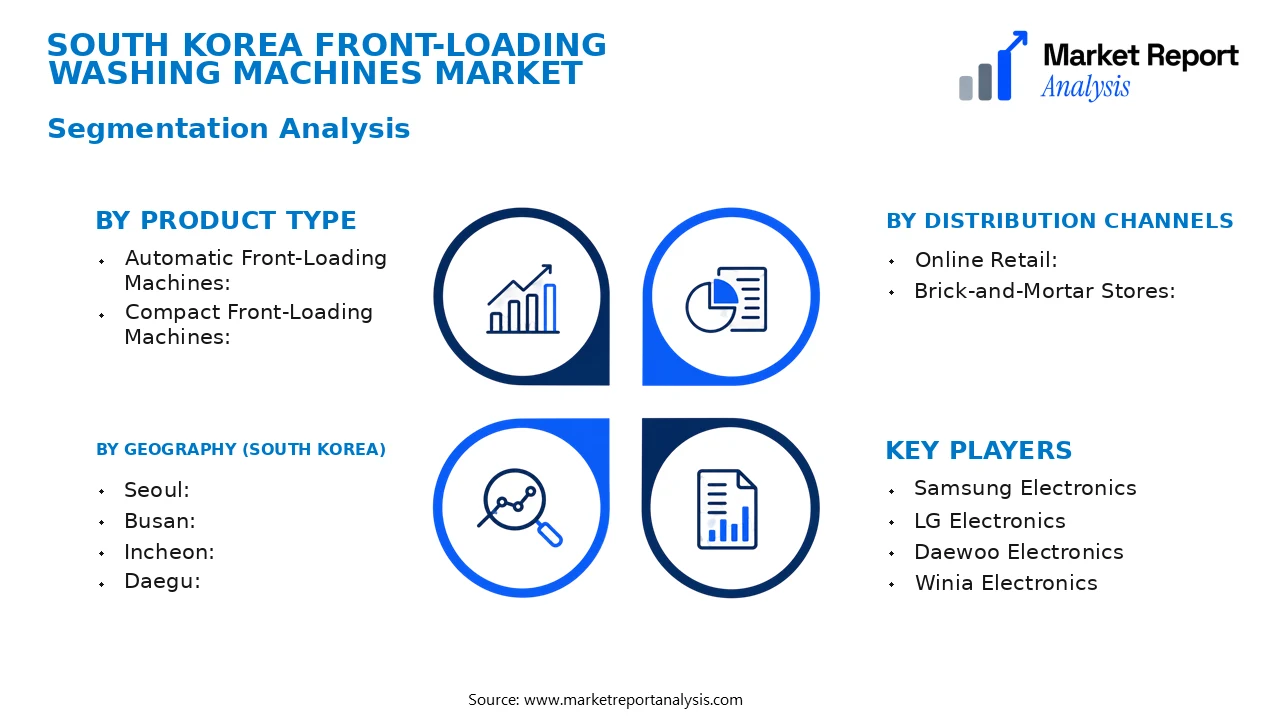
- Product Type
- Automatic Front-Loading Machines: Fully automated washing units that offer high convenience, energy efficiency, and water-saving features, increasingly favored in urban households seeking premium appliance solutions.
- Compact Front-Loading Machines: Smaller-sized units designed for limited spaces such as apartments and small homes, gaining popularity due to South Korea’s high urbanization rate and space constraints.
- Distribution Channels
- Online Retail: Digital platforms and e-commerce websites that provide extensive product choices and home delivery services, expanding rapidly due to increasing internet penetration and consumer shift toward online shopping.
- Brick-and-Mortar Stores: Traditional electronics and appliance retail outlets, including large consumer electronics chains and local shops, which maintain a significant share due to tactile product evaluation and immediate purchase benefits.
- Geography (South Korea)
- Seoul: The capital city, with the highest urban population density and economic activity, serves as a major hub for high-end appliance adoption and technological innovation in washing machines.
- Busan: South Korea's second-largest city, characterized by a large consumer market, active shipping and manufacturing sectors, fostering demand for durable, efficient washing appliances.
- Incheon: Gateway city with significant logistics infrastructure and expatriate population, contributing to diverse consumer preferences and increased imports of advanced washing technologies.
- Daegu: A regional industrial hub with a growing residential sector, fueling demand for energy-efficient and cost-effective front-loading washing machines suitable for family households.
Each segment reflects distinct consumer behaviors, regional infrastructure, and economic factors influencing the South Korea front-loading washing machines market trajectory. The product type segmentation underscores technological advancements, while distribution channels highlight evolving purchase patterns. Geographic variations reveal regional preferences and infrastructure readiness, shaping the overall market landscape up to 2034.
Competitive Intelligence
The South Korea Front-Loading Washing Machines Market demonstrates a competitive landscape characterized by a handful of dominant players, including LG Electronics, Samsung Electronics, and Daewoo Electronics, which collectively hold a significant market share. These companies pursue aggressive strategies involving product innovation, focusing on energy efficiency, smart connectivity, and user-centric features to differentiate their offerings. Market concentration remains high, with the top players continuously expanding their portfolios to capture urban and suburban consumer segments across Seoul, Busan, and Incheon through tailored marketing and distribution channels.
Product innovation is driven by substantial R&D investments aimed at integrating IoT capabilities and enhancing durability, performance, and eco-friendliness. Strategic partnerships and acquisitions frequently occur, enabling firms to augment technological capabilities and expand regional presence, especially targeting local retail chains and online platforms. Expansion strategies involve launching premium models in urban markets and affordable options in less saturated areas. Competitive differentiation is primarily achieved through technological leadership, brand reputation, and after-sales service excellence. As competition intensifies, firms are increasingly diversifying their product lines and adopting eco-conscious branding to appeal to environmentally mindful consumers in South Korea.
Leading Company Profiles
The South Korea front-loading washing machines market is characterized by a competitive landscape dominated by innovation, strategic alliances, and aggressive expansion efforts by key global and regional players. These companies focus on product quality, technological advancements, and sustainability initiatives to capture and expand market share amidst evolving consumer preferences.
- Samsung Electronics
- LG Electronics
- Daewoo Electronics
- Winia Electronics
- Hyundai Electronics
- Cotton USA
- Sangki Electronics
- Hansol Electronics
- YoungAn Electronics
Samsung Electronics
Samsung Electronics leads with innovative front-loading washing machines integrating AI and IoT capabilities, focusing on energy efficiency and smart home integration, with strategic investment in sustainable manufacturing processes to strengthen its market position.
LG Electronics
LG Electronics specializes in advanced sensing technologies and eco-friendly models, emphasizing connectivity features such as Wi-Fi control and app-based operation, aligning with Korea’s push towards digital household appliances.
Daewoo Electronics
Daewoo offers competitively priced, reliable front-loading models with durable build quality and moderate technological features, aiming to strengthen its foothold through value-based offerings and regional retail partnerships.
Winia Electronics
Winia is focused on energy-efficient and compact models tailored for urban households, adopting innovative water-saving technologies and expanding its presence via strategic distribution channels across South Korea.
Hyundai Electronics
Hyundai specializes in integrating cutting-edge vibration reduction and noise minimization technology in its washing machines, aiming at premium consumer segments seeking quiet, high-performance appliances.
Cotton USA
Though primarily a brand associated with fabric, Cotton USA is rapidly entering the washing machine segment through environmentally conscious models emphasizing sustainable manufacturing and fabric-care technologies.
Sangki Electronics
Sangki supplies compact, energy-efficient front-loading wash systems focusing on small households and urban spaces, with ongoing R&D in smart water management techniques.
Hansol Electronics
Hansol offers specialized industrial and commercial washing solutions, leveraging Korea’s advanced manufacturing ecosystem to provide durable, high-capacity appliances suited for business use.
YoungAn Electronics
YoungAn is expanding its product line with smart appliances that incorporate AI-driven cleaning algorithms and IoT connectivity, targeting tech-savvy urban consumers in South Korea.
Strategic Business Developments
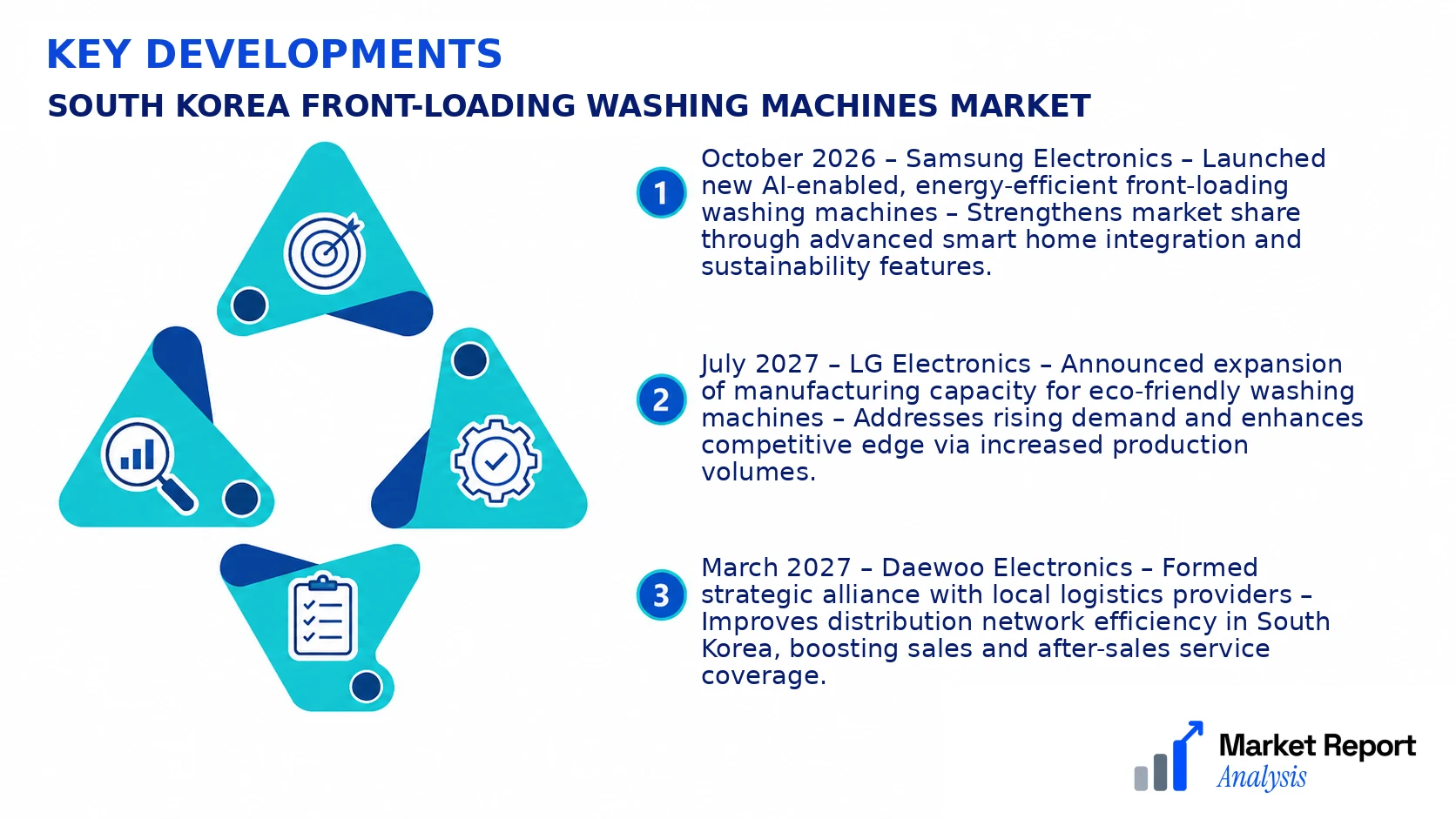
- October 2026 – Samsung Electronics – Launched new AI-enabled, energy-efficient front-loading washing machines – Strengthens market share through advanced smart home integration and sustainability features.
- July 2027 – LG Electronics – Announced expansion of manufacturing capacity for eco-friendly washing machines – Addresses rising demand and enhances competitive edge via increased production volumes.
- March 2027 – Daewoo Electronics – Formed strategic alliance with local logistics providers – Improves distribution network efficiency in South Korea, boosting sales and after-sales service coverage.
- November 2026 – Winia Electronics – Invested in new water-saving technology R&D facility – Focuses on developing next-generation eco-friendly appliances aligned with Korea’s sustainability regulations.
- May 2028 – Hyundai Electronics – Launched a new line of premium, quiet front-loading washing machines with vibration reduction tech – Targets high-end home appliance market segments.
Frequently Asked Questions
What is the South Korea Front-Loading Washing Machines Market?
The South Korea Front-Loading Washing Machines Market comprises the demand and supply of front-loading washing appliances designed for residential use within South Korea. It reflects consumer preferences, technological advancements, and regional trends influencing the adoption of energy-efficient, water-saving models.
What is the current market size of South Korea Front-Loading Washing Machines Market?
As of 2026, the market size is approximately USD 2.1 Billion, driven by increasing urbanization, rising disposable incomes, and growing awareness of sustainable laundry solutions among South Korean consumers.
What factors are driving the South Korea Front-Loading Washing Machines Market?
Market growth is fueled by technological innovations, strict energy efficiency regulations, consumer preference for eco-friendly appliances, urban lifestyle shifts emphasizing convenience, and the expansion of modern retail and e-commerce channels supporting product accessibility.
Which South Korean city leads the South Korea Front-Loading Washing Machines Market?
Seoul currently leads the market due to its dense urban population, higher disposable incomes, and early adoption of smart home appliances, making it the primary hub for front-loading washing machine sales in South Korea.
Which segment is expected to grow the fastest?
The premium segment, characterized by smart, energy-efficient, and feature-rich models, is projected to experience the fastest growth, driven by consumer demand for convenience and sustainability in laundry appliances.
Who are the leading companies operating in the South Korea Front-Loading Washing Machines Market?
Major players include Samsung Electronics, LG Electronics, and different regional brands that focus on innovation, quality, and eco-friendly features to maintain competitive advantages in the South Korean market.
Analyst Perspective
The South Korea Front-Loading Washing Machines Market exhibits a mature yet evolving landscape with sustainable growth prospects over the forecast period. The long-term outlook is bolstered by the country's increasing emphasis on water and energy efficiency, driven by stringent governmental regulations and consumer environmental awareness. Commercial opportunities are prominent in premium and smart-capable front loaders, especially in urban centers such as Seoul and Busan, where high-income households prioritize convenience and advanced features. Technological evolution is expected to focus on IoT integration, AI-driven cycle optimization, and eco-friendly energy consumption, shaping product innovation and consumer adoption. Investment priorities should prioritize R&D in smart technologies and sustainable manufacturing processes to maintain competitive advantage. Competitive intensity remains high, with key global brands expanding their portfolio by emphasizing localized features tailored to Korean lifestyles. City-level growth potential is especially significant in Seoul’s metropolitan district, where dense urbanization and household upgrades drive demand. Strategic positioning for long-term success entails balancing innovation, supply chain resilience, and consumer-centric offerings aligned with Korea’s digital and sustainability agendas.
