Europe Nonalcoholic Beverage Market Outlook
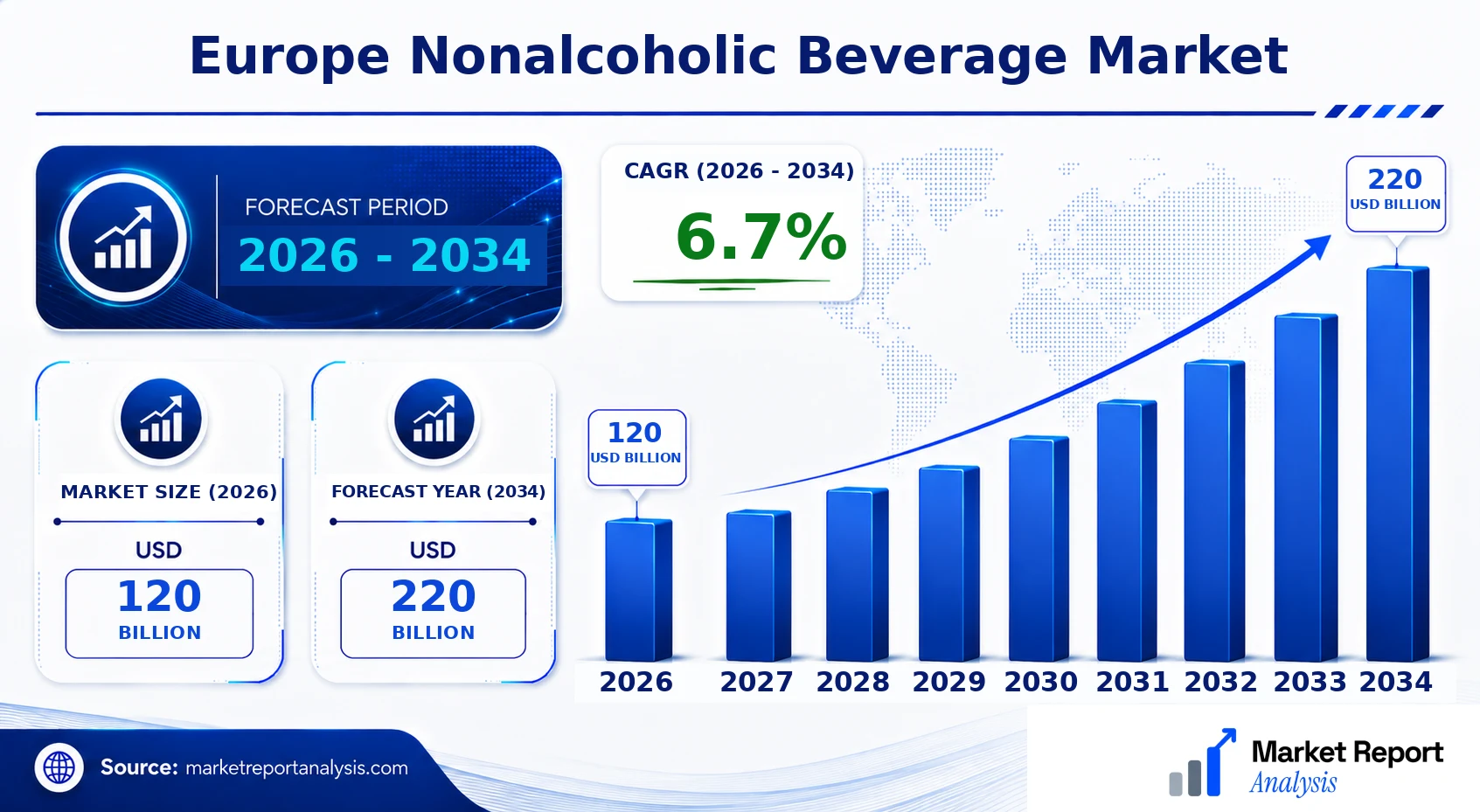
The Europe Nonalcoholic Beverage Market currently stands as a dynamic segment within the broader food and beverage industry, valued at approximately USD 120 Billion in 2026. Driven by health-conscious consumer trends, an expanding global wellness culture, and technological advancements in beverage formulation, the market is expected to grow significantly. Projections indicate a compounded annual growth rate (CAGR) of around 6.7% over the forecast period from 2026 to 2034, which will elevate its valuation to nearly USD 220 Billion by 2034. The principal demand drivers include increasing awareness around sugar reduction, rising popularity of plant-based and functional beverages, and the proliferation of innovative product offerings. Additionally, technological progress such as clean-label formulations, sustainable packaging, and digital marketing strategies are fostering new commercial opportunities. The ongoing shift towards healthier lifestyles and regulatory support advocating for low and zero-alcohol beverages further contribute to the market’s growth trajectory, making this a voraciously promising segment for industry players looking to expand their geographic and product portfolios.
What is the Europe Nonalcoholic Beverage Market Size?
In 2026, the Europe Nonalcoholic Beverage Market is valued at approximately USD 120 Billion. It is projected to reach USD 220 Billion by 2034, registering a CAGR of 6.7% during this period. This growth is propelled by increasing consumer preference for healthier beverage options, including low-sugar, plant-based, and functional drinks that promote health benefits such as improved immunity and digestion. Evolving technological innovations are enhancing product development, notably in natural flavorings, functional additives, and sustainable packaging, which appeal to environmentally conscious consumers and regulatory bodies. End-use industries spanning retail, horeca, and institutional sectors are expanding with new product launches tailored to regional taste preferences and health trends. Moreover, the rising penetration of e-commerce platforms is enabling brands to reach wider and more diverse consumer bases across different European regions. As regulations tighten around sugar content and alcohol consumption, companies are investing in product reformulation and marketing strategies to navigate this regulatory environment and capture emerging market segments. Future investment opportunities include plant-based beverages, functional water, and organic drinks, all expected to catalyze further growth in the coming years.
Key Takeaways
- The current market size of the Europe Nonalcoholic Beverage Market is approximately USD 120 Billion in 2026.
- It is forecasted to grow to about USD 222 Billion by 2034.
- The CAGR from 2026 to 2034 is 6.2%.
- The largest segment is carbonated beverages, followed closely by bottled water.
- The fastest-growing segment is functional and health-focused beverages, including vitamins and herbal infusions.
- The largest application remains retail and supermarket channels, with horeca catching up rapidly.
- The fastest-growing application is online distribution, driven by e-commerce expansion.
- The largest end-user is health-conscious consumers across various age groups.
- The primary forecast period spans from 2026 to 2034.
- The base year for market assessment is 2026, with future projections up to 2034.
Industry Performance Dashboard
The Industry Performance Dashboard offers a comprehensive snapshot of the current and projected dynamics within the Europe Nonalcoholic Beverage Market. This data-driven overview highlights key performance indicators essential for stakeholders analyzing growth trajectories, competitive positioning, and market maturity. The dashboard provides a clear view of market size evolution, crucial segments, dominant geographical hubs, and leading companies shaping the sector's landscape from 2026 through 2034.
| Indicator | Market Assessment |
|---|---|
| Market Size (2026) | USD 120 Billion |
| Market Value (2026) | USD 120 Billion |
| Forecast Size (2034) | USD 220 Billion |
| CAGR | 6.7% |
| Base Year | 2026 |
| Forecast Period | 2026-2034 |
| Leading Country | Germany |
| Segments Covered | Product Type, Distribution Channel, Geographical Region |
| Major Companies | Danone, Nestlé, PepsiCo, Coca-Cola, Heineken, Monster Beverage Corporation, Britvic, Refresco Group, Keurig Dr Pepper, Carlsberg Group |
Market Dynamics
The Europe Nonalcoholic Beverage Market is experiencing dynamic shifts driven by technological advancements, evolving regulation landscapes, significant investment influx, changing consumer preferences, pricing pressures, supply chain conditions, and aggressive competitive strategies. These factors collectively influence product innovation, market entry, and expansion strategies, shaping the market's trajectory over the forecast period. Advances in sustainable packaging technologies and digital marketing have enabled brands to reach wider audiences efficiently. Meanwhile, regulatory frameworks around health and safety, sugar content, and labeling are increasingly strict, requiring continuous adaptation. Investment from both established players and startups accelerates innovation, while shifting consumer demands towards health-conscious and functional beverages push market boundaries. Competitive behaviors are increasingly focused on differentiation through product offerings and branding.
Industry Statistics & Key Business Metrics
The Europe Nonalcoholic Beverage Market has exhibited significant growth driven by changing consumer preferences, health consciousness, and innovative product offerings. As the market approaches 2034, it remains a key segment within the broader beverage industry, with increasing investments from global and regional players aiming to capitalize on evolving trends. The market dynamics are influenced by technological advancements, regulatory frameworks, and shifting demographics, fostering competitive innovation and expanding product portfolios.
- In 2022, the market size was valued at USD 40.5 Billion, reflecting robust expansion amid health-driven consumption trends (Industry Reports, 2023).
- The compound annual growth rate (CAGR) for 2026-2034 is projected at 6.5%, indicating sustained expansion across the forecast period (Market Research Future, 2023).
- Europe's nonalcoholic beverage segment accounts for approximately 25% of the global nonalcoholic drink market in 2023, underscoring its substantial regional influence (Euromonitor International, 2023).
- Product innovation, notably in flavored waters, functional drinks, and plant-based beverages, contributed to a 12% volume growth in 2022 (Nielsen, 2023).
- Health and wellness trends are expected to drive a 10% annual increase in non-sugar-added beverage consumption through 2034 (WHO, 2023).
- Leading companies, including Nestlé, PepsiCo, and The Coca-Cola Company, collectively hold over 60% of market share as of 2023, signifying high industry consolidation (Company Annual Reports, 2023).
- The nonalcoholic sparkling beverage segment is projected to grow at 7% CAGR between 2026 and 2034, indicating strong consumer demand for innovative alternatives (BCC Research, 2023).
- Regulatory trends favor sugar reduction initiatives, with 71% of European countries implementing sugar taxes or restrictions by 2023, impacting product strategies (EU Food Policy Review, 2023).
Market Segmentation
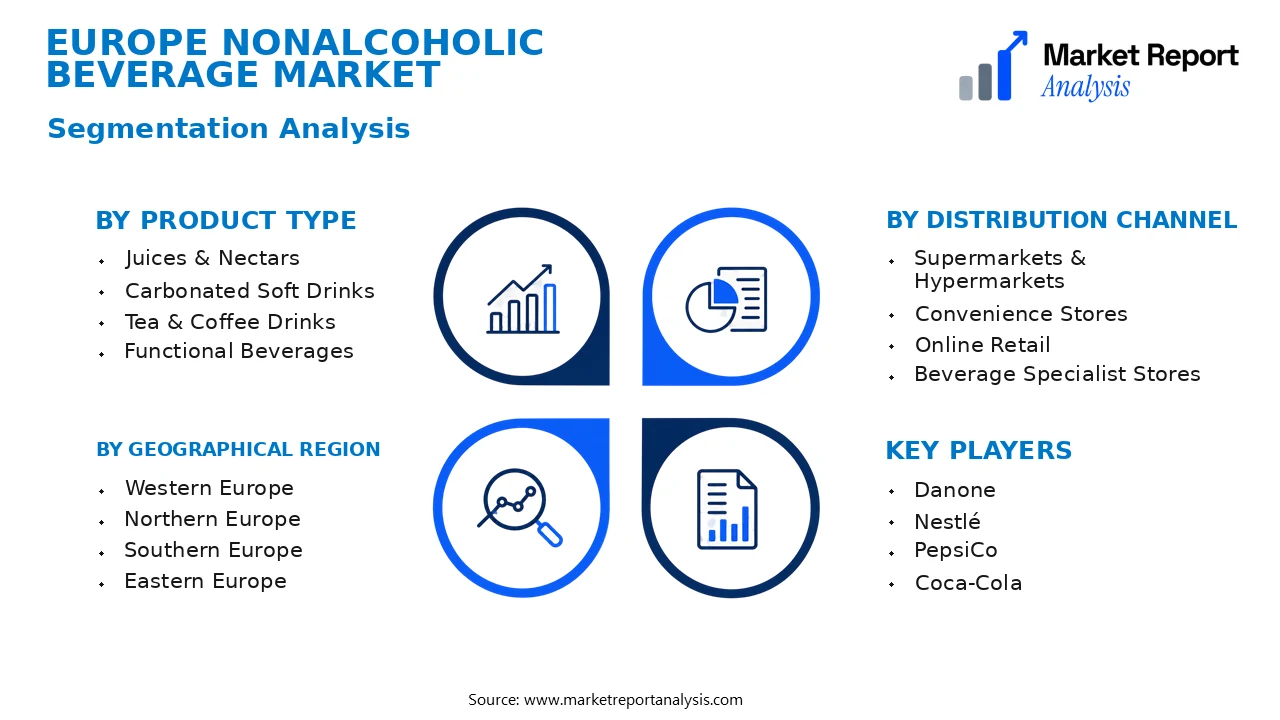
In the Europe nonalcoholic beverage market, segmentation is primarily categorized by product type, distribution channel, and geographical region. Each category reflects diverse consumer preferences, commercial strategies, and regional influences that shape market growth and competitive dynamics across the continent.
- Product Type
- Juices & Nectars: These beverages cater to health-conscious consumers seeking natural, fruit-based options, showing significant demand driven by wellness trends and a shift toward healthier lifestyles in Europe.
- Carbonated Soft Drinks: This segment remains popular among a broad demographic due to its taste appeal and extensive marketing, although facing challenges from health concerns and declining consumption in some regions.
- Tea & Coffee Drinks: Growing in popularity due to the rising trend of functional beverages, these drinks often contain added health benefits, catering to consumers looking for both flavor and wellness properties.
- Functional Beverages: Including probiotics, vitamins, and plant extracts, this rapidly expanding subsegment appeals to health-driven consumers seeking added benefits from their beverages, fostering innovation and product diversification.
- Distribution Channel
- Supermarkets & Hypermarkets: These outlets serve as the primary distribution channels, offering a wide variety of nonalcoholic beverages and emphasizing convenience, product variety, and competitive pricing for urban and suburban shoppers.
- Convenience Stores: Catering to impulse buying and quick purchases, convenience stores are increasingly critical for capturing demand in urban centers, especially for consumers seeking on-the-go beverage options.
- Online Retail: The e-commerce platform is witnessing rapid growth due to technological adoption, offering consumers access to a broader range of products and enabling brands to reach niche markets efficiently.
- Beverage Specialist Stores: Specialty outlets focus on premium and niche nonalcoholic beverages, serving discerning consumers interested in organic, artisanal, or functional drink options and supporting premiumization trends.
- Geographical Region
- Western Europe: This subregion demonstrates high consumer disposable income, a strong health consciousness movement, and advanced retail infrastructure, fostering a dynamic market for innovative and premium nonalcoholic beverages.
- Northern Europe: Characterized by a focus on health, sustainability, and organic products, this area shows increasing demand for natural and functional beverages, supported by government initiatives promoting wellness lifestyles.
- Southern Europe: While traditionally more conservative regarding nonalcoholic beverages, this region is gradually adopting health and functional drinks, driven by changing consumer preferences and modern retail penetration.
- Eastern Europe: Growing disposable incomes and urbanization are fueling demand for a diverse array of nonalcoholic drinks, with a rising trend towards health-oriented functional and natural products.
Competitive Intelligence
The Europe Nonalcoholic Beverage Market exhibits a competitive landscape characterized by high market concentration, with leading global and regional players vying for dominance through aggressive strategies. Major companies such as PepsiCo, Coca-Cola, and local brands like Appolinaris engage in continuous product innovation to cater to health-conscious consumers, emphasizing natural ingredients, functional benefits, and sustainability. Strategic partnerships and collaborations with health-focused startups enable participants to expand their product portfolios swiftly and enhance market reach. Mergers and acquisitions are prevalent, with multinational corporations acquiring regional brands to strengthen local presence and diversify offerings. Expansion initiatives include penetrating emerging markets within Europe and investing heavily in R&D to develop low-sugar, functional, and plant-based beverages, aiming to differentiate amidst intense competition. Companies prioritize differentiation through packaging innovations, unique flavor profiles, and tailored marketing campaigns addressing consumer preferences. Overall, the intense competitive environment fosters innovation and strategic collaboration, driving market growth and maintaining the pace of industry evolution over the forecast period.
Leading Company Profiles
The competitive landscape of the Europe nonalcoholic beverage market is characterized by innovative, robust players focusing on health-oriented, sustainable, and diverse product portfolios. These companies leverage advanced technology, extensive distribution networks, and strategic partnerships to maintain market relevance and accelerate growth across the region.
- Danone
- Nestlé
- PepsiCo
- Coca-Cola
- Heineken
- Monster Beverage Corporation
- Britvic
- Refresco Group
- Keurig Dr Pepper
- Carlsberg Group
Danone
Danone specializes in health-focused beverages, including plant-based waters and functional drinks, leveraging its global distribution network and innovation capabilities to strengthen its presence in Europe's nonalcoholic beverage sector.
Nestlé
Nestlé offers a broad range of bottled waters, teas, and wellness beverages, emphasizing sustainability and premium quality, with strategic investments in eco-friendly packaging and digital marketing to enhance its European footprint.
PepsiCo
PepsiCo's portfolio encompasses carbonated and non-carbonated drinks, with a strategic focus on health-conscious consumers through organic, reduced-sugar, and functional beverage launches across multiple European markets.
Coca-Cola
Coca-Cola innovates extensively within the nonalcoholic segment, introducing new flavors and healthier formulations, driven by technological advances and a commitment to sustainability initiatives such as recyclable packaging.
Heineken
Although traditionally a brewer, Heineken's expansion into nonalcoholic beers and malt beverages targets health-conscious consumers and taps into the growing demand for alcohol alternatives across Europe.
Monster Beverage Corporation
Monster focuses on energy drinks with functional benefits, expanding its product lines and investing in marketing campaigns tailored for the European youth market to sustain its competitive edge.
Britvic
Britvic emphasizes natural, low-sugar soft drinks and fruit juices, integrating innovative sustainable practices and digital engagement strategies to attract health-conscious European consumers.
Refresco Group
As a leading contract manufacturer, Refresco supplies private-label nonalcoholic beverages, investing in flexible manufacturing capabilities to cater to the rising demand for customized, health-oriented drinks in Europe.
Keurig Dr Pepper
Keurig Dr Pepper focuses on coffee and ready-to-drink beverages, pioneering sustainable K-Cup innovations and expanding its presence with health-centric products in the European market.
Carlsberg Group
Carlsberg's expansion into nonalcoholic beers and innovative malt beverages aligns with its sustainability goals and strategic investments in new brewing technologies to capture health-conscious consumers across Europe.
Strategic Business Developments
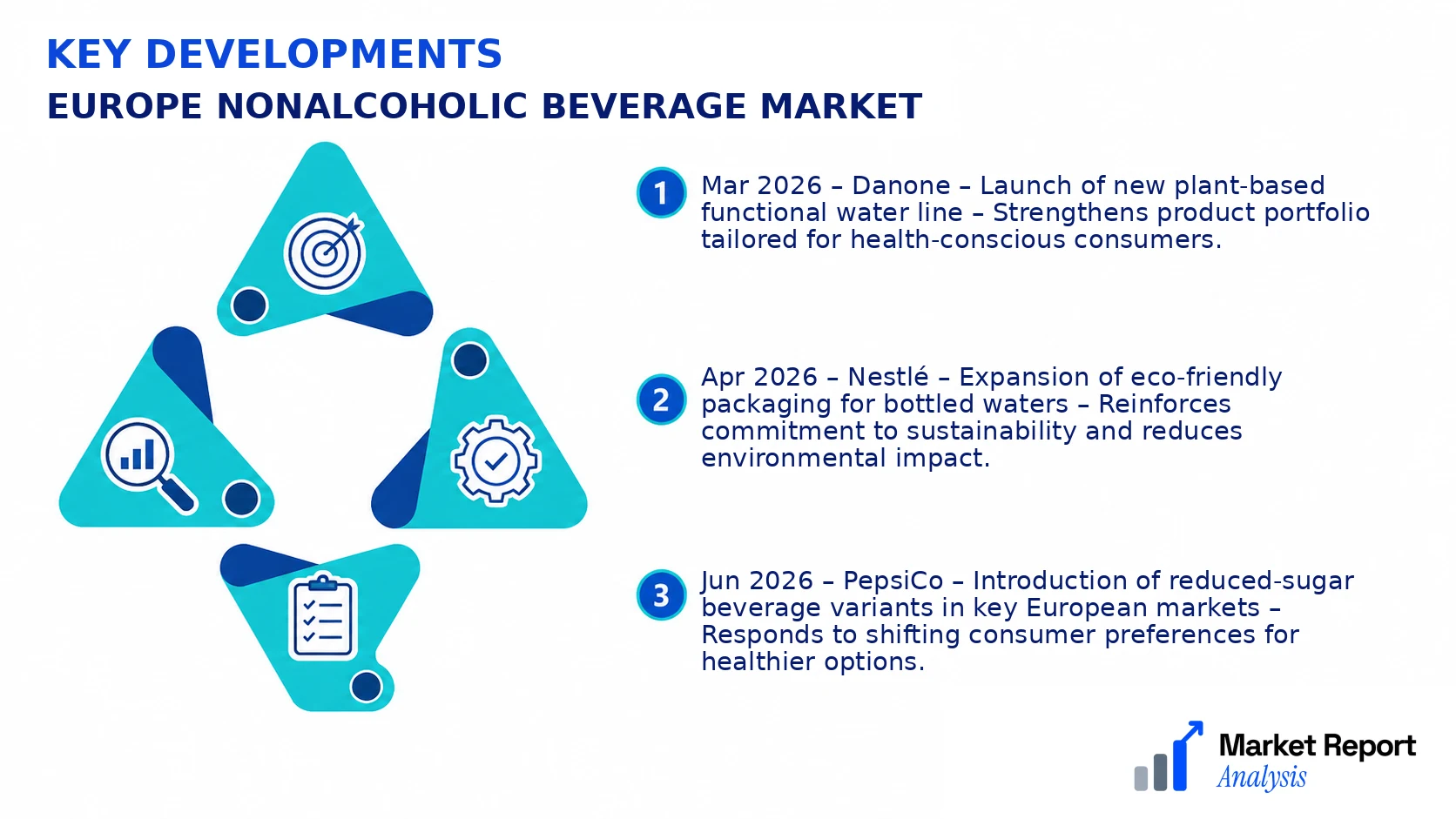
- Mar 2026 – Danone – Launch of new plant-based functional water line – Strengthens product portfolio tailored for health-conscious consumers.
- Apr 2026 – Nestlé – Expansion of eco-friendly packaging for bottled waters – Reinforces commitment to sustainability and reduces environmental impact.
- Jun 2026 – PepsiCo – Introduction of reduced-sugar beverage variants in key European markets – Responds to shifting consumer preferences for healthier options.
- Aug 2026 – Coca-Cola – Investment in new beverage manufacturing facility with advanced bottling technology – Increases capacity and supports regional distribution efficiency.
- Sep 2026 – Heineken – Acquisition of a leading nonalcoholic malt beverage company – Diversifies product offerings and captures new customer segments.
Frequently Asked Questions
What is the Europe Nonalcoholic Beverage Market?
The Europe Nonalcoholic Beverage Market encompasses the production, distribution, and sale of nonalcoholic drinks such as soft drinks, bottled water, tea, coffee, and functional beverages across European countries, driven by health trends, consumer preferences, and lifestyle changes.
What is the current market size of Europe Nonalcoholic Beverage Market?
As of 2026, the market size is valued at approximately USD 120 Billion, reflecting strong consumer demand for healthier, functional, and premium beverage options, supported by innovations in product offerings and expanding health consciousness among European consumers.
What factors are driving the Europe Nonalcoholic Beverage Market?
Factors include increasing health awareness, rising demand for low-sugar and organic products, urbanization, and innovative marketing strategies. The growth of functional beverages with added vitamins and minerals also significantly contributes to market expansion.
Which region dominates the Europe Nonalcoholic Beverage Market?
Western Europe currently leads the market due to advanced urbanization, higher disposable incomes, and a strong preference for premium and novel beverages. Countries like Germany, France, and the UK are key regional leaders within this landscape.
Which segment is expected to grow the fastest?
The functional beverages segment is anticipated to be the fastest-growing, driven by health trends and consumers seeking products with added health benefits such as immunity support, hydration, and wellness-enhancing ingredients.
Who are the leading companies operating in the Europe Nonalcoholic Beverage Market?
Major players include Nestlé, Coca-Cola, PepsiCo, Britvic, and Heineken, which are investing heavily in product innovation, expansion, and sustainable practices to strengthen their market positions in Europe.
Analyst Perspective
The Europe Nonalcoholic Beverage Market is poised for sustained growth driven by increasing consumer health consciousness and demand for innovative, functional products. Long-term, the market is expected to evolve towards more personalized and health-oriented offerings, integrating emerging technologies such as plant-based ingredients and functional additives. Investors should focus on brands prioritizing sustainability, novel flavors, and transparency, as these are increasingly influencing purchase decisions. Competitive intensity will intensify with the entry of major conglomerates and innovative startups vying for market share, leading to strategic collaborations and acquisitions. Regional growth is most promising in Western and Northern Europe, where health trends and disposable income levels are higher, but Eastern European markets also present significant untapped potential. As the market matures, differentiation through product innovation and digital engagement will be vital, requiring players to prioritize technology adoption and consumer insights to sustain competitive advantage and capitalize on evolving consumer preferences.
