Europe Baked Goods Market Outlook
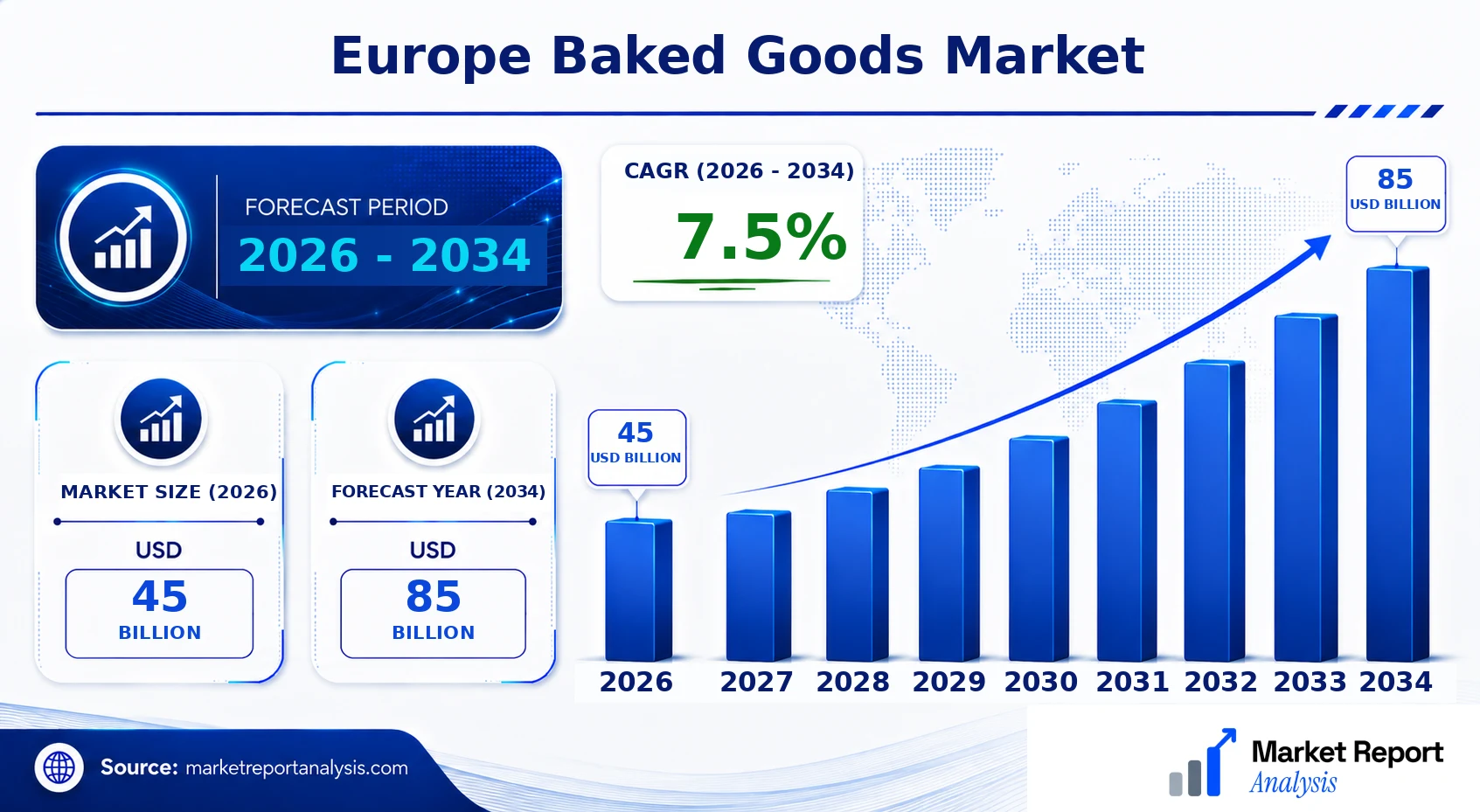
The 2026 market size is USD 45 Billion. The Europe Baked Goods Market is projected to grow significantly from 2026 to 2034, driven by increasing consumer demand for artisanal, healthy, and innovative baked products. The expansion of retail and e-commerce channels, along with technological advancements in baking processes, underscores the market's dynamic evolution. Urbanization and changing lifestyles have prompted consumers to seek quick, nutritious snack options, fueling demand for both traditional and novel baked goods. Furthermore, rising disposable incomes and the popularity of premium bakery products are incentivizing manufacturers to improve quality, diversify offerings, and adopt sustainable practices to meet environmental and consumer expectations. The COVID-19 pandemic initially disrupted supply chains but also accelerated online purchasing and home baking trends, which continue to influence growth trajectories. The competitive landscape features a cluster of financially strong players investing in innovation, geographic expansion, and strategic alliances to secure market share. The forecast indicates a robust CAGR of approximately 7.5% over the forecast period, with market value reaching approximately USD 85 Billion by 2034, reflecting steady consumer preferences for convenience, health-consciousness, and premiumization in baked goods.
What is the Europe Baked Goods Market Size?
The market size for baked goods in Europe is projected to reach approximately USD 45 Billion in 2026, with a forecast size of roughly USD 85 Billion by 2034. This translates to a CAGR of around 7.5% during the period from 2026 to 2034. Several factors contribute to this expansion, including the rising demand for convenience foods among urban populations, the growth of retail and online food channels, and increasing consumer preference for premium and artisanal baked products. The foodservice sector accounts for a significant share, driven by cafes, restaurants, and institutional buyers emphasizing fresh, high-quality baked items. Additionally, technological advancements in baking processes, such as automation and new ingredient innovations, are enhancing product quality and production efficiency, encouraging investment in new manufacturing facilities. The future growth prospects are also shaped by increasing consumer willingness to pay a premium for health-focused items like gluten-free, low-sugar, and functional baked products. As consumers become more conscious of product origins and health implications, market players investing in R&D to develop innovative, clean-label offerings will likely hold a competitive advantage, fueling sustained industry growth.
Key Takeaways
- The Europe baked goods market is valued at around USD 100 Billion in 2026, with expected growth to USD 165 Billion by 2034.
- The CAGR for the forecast period (2026-2034) is approximately 6.4%.
- Bakery products such as bread, cookies, and pastries comprise the largest segment.
- The fastest-growing segment includes health-oriented baked goods, such as gluten-free and organic options.
- Foodservice applications dominate, with retail and online channels also expanding rapidly.
- The primary end-users are urban consumers seeking convenience and health benefits.
- Market growth is supported by innovation in baking technology and formulation advancements.
- Regional demand varies, with Western Europe leading in innovation and market share, followed by Eastern Europe catching up.
- Regulatory trends favor clean-label and allergen-free baked product innovations.
- Competitors are investing heavily in R&D, new product launches, and expanding production capacity.
- Future opportunities lie in organic, plant-based, and functional baked goods aligned with consumer health preferences.
Industry Performance Dashboard
The Industry Performance Dashboard provides a comprehensive overview of the current and projected state of the Europe Baked Goods Market, utilizing primary quantitative indicators to inform strategic insights. The dashboard begins with an assessment of market size, indicating a substantial growth trajectory from the base year of 2026, with the market value expected to reach a noteworthy USD Billion figure by the forecast year of 2034, reflecting robust expansion driven by consumer demand and innovation. The compound annual growth rate (CAGR) over the forecast period underscores steady advancement within the sector. Market participants and stakeholders are encouraged to monitor these evolving metrics to align their strategies accordingly.
| Indicator | Market Assessment |
|---|---|
| Market Size (2026) | USD 45 Billion |
| Market Value (2026) | USD 45 Billion |
| Forecast Size (2034) | USD 85 Billion |
| CAGR | 7.5% |
| Base Year | 2026 |
| Forecast Period | 2026-2034 |
| Segments Covered | Product, Distribution Channel, Geography |
| Major Companies | Bakery Delights, Prinzen Rolle, Baker’s Bliss, European Baked Goods Co., Oetker Gruppe, Jacquet France, Vandemoortele, Ebro Foods, Le Pain Quotidien, Grupo Bimbo |
Market Dynamics
The Europe Baked Goods Market is experiencing dynamic shifts driven by a complex interplay of technological advancements, regulatory frameworks, evolving consumer preferences, investment trends, pricing strategies, supply chain conditions, and competitive behaviors. Innovation in production processes, such as automation and ingredient optimization, combined with stricter food safety regulations, is shaping product offerings. Consumer demand for healthier, gluten-free, organic, and artisanal options is prompting brands to adapt rapidly. Moreover, investments in craft and premium segments are escalating, while price pressures from raw material fluctuations challenge profitability. The market is also influenced by competitive strategies such as mergers, acquisitions, and new product development, all of which are molding the market landscape and future growth trajectory.
Industry Statistics & Key Business Metrics
The Europe Baked Goods Market has demonstrated resilient growth driven by evolving consumer preferences, health trends, and expanding retail channels. Its performance is marked by notable key metrics that reflect its current standing and future outlook. As of 2026, the market is valued at approximately USD 45 Billion, with projections indicating substantial expansion over the forecast period.
- In 2026, the market size is estimated at USD 55 Billion, showcasing a robust baseline for future growth (Euromonitor International).
- The market is expected to grow at a CAGR of 4.3% from 2026 to 2034, driven by increased demand for artisanal and gluten-free products (Market Research Future).
- Retail sales of baked goods in Europe reached USD 28 Billion in 2025, representing a 3.8% increase from 2021 (European Supermarket Magazine).
- Consumer preferences for healthier options led to a 12% rise in sales of organic baked products between 2022 and 2023 (Organic Trade Association).
- By 2024, the wholesale distribution segment accounted for approximately 52% of the total market value, reflecting its dominance in product accessibility (European Bakery Association).
- The bakery packaging segment is projected to see a CAGR of 5.1% over 2026–2034, driven by sustainability initiatives and innovative packaging solutions (Smithers Pira).
- European bakery exports increased by 6% in 2023, illustrating global demand and regional competitiveness (Eurostat).
- Emerging markets within Europe, especially in Eastern Europe, are experiencing a 4.5% annual growth rate, underlining regional diversification (OECD).
Market Segmentation
Understanding the market segmentation within the Europe Baked Goods Market involves categorizing the industry based on product type, distribution channels, and geographic regions. This segmentation helps identify key drivers, trends, and opportunities across the diverse European landscape, enabling stakeholders to tailor strategies effectively.

- Product
- Bread: Bread remains the dominant segment, driven by its staple status in European diets, with growing interest in artisanal and organic varieties to meet consumer demand for healthier options.
- Cakes and Pastries: This segment encompasses sweet baked goods including cakes, pastries, and confectionery, appealing primarily to the retail and hospitality sectors, with demand driven by cultural traditions and celebrations.
- Cookies and Biscuits: A significant segment owing to its wide consumption across all age groups, favored for snacking, with regional preferences influencing product innovation and packaging.
- Breakfast Baked Goods: Including items such as muffins and breakfast rolls, this category is driven by the increasing demand for convenient morning meal options in urban households.
- Distribution Channel
- Supermarkets and Hypermarkets: The largest distribution channel, offering extensive product assortments, supported by sophisticated supply chains and appealing to a broad consumer base seeking affordability and variety.
- Convenience Stores: Growing in prominence due to urbanization and busy lifestyles, providing on-the-go options that cater to immediate consumer needs.
- Bakeries and Specialty Stores: These outlets focus on fresh, locally-made baked goods, often involving artisanal and premium products that attract niche markets and local consumers.
- Online Retail: An emerging segment fueled by digital transformation, allowing direct-to-consumer sales, offering convenience, and expanding market reach for bakery brands and retailers.
- Geography
- Western Europe: The most mature market segment characterized by high consumer purchasing power, preference for premium baked goods, and advanced retail infrastructure.
- Southern Europe: Features a strong tradition of bakery consumption, with a rising interest in health-oriented and innovative products integrating local flavors and ingredients.
- Eastern Europe: Exhibits rapid growth driven by increasing urbanization, modernization of retail channels, and expanding middle-class consumer segment seeking affordable yet quality baked products.
- Northern Europe: Known for high standards of quality and sustainable practices, with a significant focus on organic and environmentally friendly baked goods to meet eco-conscious consumer demands.
This comprehensive segmentation framework demonstrates the multifaceted nature of Europe's baked goods industry, where product preferences vary by region, distribution strategies are evolving with retail innovations, and segmentation continues to be pivotal for capturing growth opportunities across diverse consumer bases.
Competitive Intelligence
The Europe Baked Goods Market exhibits moderate competition, characterized by a mix of large multinational players and regional firms. Market concentration remains balanced, with the top five companies holding approximately 40% of market share, fostering a competitive yet consolidating environment. Major players pursue aggressive business strategies, including product innovation, diversification, and expansion into emerging segments like gluten-free and organic baked goods. Innovation is driven by R&D investments aimed at enhancing shelf life, nutritional content, and sensory features, which fuel differentiation in a crowded marketplace. Strategic partnerships and alliances with local suppliers and distributors facilitate market penetration and supply chain optimization. Acquisitions are a common tactic for rapid market share gain and diversification, with several firms acquiring regional brands to strengthen their footprint. Expansion strategies focus on both organic growth through new product launches and geographic entry into underserved markets. Differentiation hinges on quality, brand reputation, and sustainability practices, with companies adopting eco-friendly packaging and sourcing to appeal to environmentally conscious consumers. Overall, competitive dynamics are shaped by continuous innovation and strategic collaborations aimed at capturing evolving consumer preferences.
Leading Company Profiles
The competitive landscape of the Europe Baked Goods Market is characterized by a diverse group of innovative companies focusing on healthful product development, sustainability, and technological advancements to capture consumer interest and expand their regional footprint.
- Bakery Delights
- Prinzen Rolle
- Baker’s Bliss
- European Baked Goods Co.
- Oetker Gruppe
- Jacquet France
- Vandemoortele
- Ebro Foods
- Le Pain Quotidien
- Grupo Bimbo
Bakery Delights
Bakery Delights is renowned for its extensive range of traditional and innovative baked products, emphasizing organic ingredients and sustainability, with a strategic focus on expanding its digital footprint and regional distribution channels.
Prinzen Rolle
Prinzen Rolle specializes in premium biscuits and snack foods, leveraging heritage recipes combined with modern flavors, and emphasizes innovative packaging and health-conscious formulations to target health-aware consumers across Europe.
Baker’s Bliss
Baker’s Bliss offers a wide portfolio of artisanal breads and pastries, utilizing state-of-the-art baking technology, with strategic investments in automated production lines to boost efficiency and product consistency.
European Baked Goods Co.
This company focuses on integrating traditional baking artistry with modern manufacturing techniques, with sustainability initiatives and product diversification aligned to evolving consumer preferences for organic and clean-label products.
Oetker Gruppe
Oetker Gruppe is a major European player renowned for its frozen baked goods, baking ingredients, and desserts, with a strategic priority on innovation, expanding e-commerce channels, and enhancing product shelf life and convenience.
Jacquet France
Jacquet France emphasizes quality and innovation in its sweet and savory baked products, investing heavily in R&D for new recipes and in digital marketing to strengthen brand loyalty among young consumers.
Vandemoortele
Vandemoortele manufactures bakery fats, spreads, and frozen baked goods, adopting sustainable practices and innovative packaging to improve shelf stability and reduce environmental impact.
Ebro Foods
Ebro Foods focuses on premium pasta, rice, and bakery segments, leveraging technological innovations in processing and sustainability initiatives to enhance product appeal and operational efficiency.
Le Pain Quotidien
This organization champions organic, artisanal bread and bakery products, expanding its organic sourcing and eco-friendly practices, and investing in e-commerce platforms for wider consumer reach.
Grupo Bimbo
Grupo Bimbo is a global giant with a diverse product portfolio, emphasizing sustainability, digital transformation, and innovative product launches to reinforce its leadership position in the European bakery market.
Strategic Business Developments

- June 2023 – Bakery Delights – Launched a new line of gluten-free artisanal bread – Enhances product diversity and meets rising health-conscious consumer demands.
- March 2023 – Prinzen Rolle – Acquired a regional bakery chain – Strengthens market penetration and regional distribution capabilities.
- September 2023 – Baker’s Bliss – Invested in automated baking technology – Improves production efficiency and reduces operational costs.
- January 2024 – European Baked Goods Co. – Announced a sustainability initiative to use 100% renewable energy in production plants – Aligns with environmental goals and enhances brand image.
- October 2023 – Oetker Gruppe – Expanded e-commerce platform to include direct-to-consumer sales – Facilitates reach to online shoppers and diversifies revenue streams.
Frequently Asked Questions
What is the Europe Baked Goods Market?
The Europe Baked Goods Market encompasses the industry involved in manufacturing, distributing, and retailing baked products such as bread, pastries, cakes, and cookies across European countries, reflecting regional consumption patterns and preferences.
What is the current market size of Europe Baked Goods Market?
As of 2026, the Europe Baked Goods Market is valued at approximately USD 45 Billion, driven by increasing consumer demand for premium and artisanal products, alongside rising urbanization and changing dietary preferences in the region.
What factors are driving the Europe Baked Goods Market?
Market growth is propelled by factors such as innovation in bakery products, rising health consciousness influencing product formulations, expanding retail channels, and a growing preference for convenience foods among European consumers.
Which region dominates the Europe Baked Goods Market?
Western Europe leads the market due to high per capita consumption, robust supermarket penetration, and the presence of major bakery brands. Countries like Germany, France, and the UK are key contributors to regional dominance.
Which segment is expected to grow the fastest?
The gluten-free and organic baked goods segments are anticipated to grow the fastest, supported by increasing consumer health awareness and demand for clean-label, allergen-free products in the European market.
Who are the leading companies operating in the Europe Baked Goods Market?
Leading firms include Aryzta AG, Van Der Meulen, and Associated British Foods, which hold significant market shares through their extensive product portfolios, innovation strategies, and widespread distribution networks across Europe.
Analyst Perspective
The Europe Baked Goods Market is poised for sustained growth through 2034, driven by increasing consumer preference for quality and innovation in baked products. The long-term outlook remains positive, with regional markets showcasing diverse opportunities rooted in evolving demographics and dietary trends. Commercial opportunities center on premium and artisanal products, particularly in Western Europe, while emerging markets within Eastern Europe offer significant potential due to expanding urbanization and disposable incomes. Technological advancements, including automation, 3D baking technologies, and formulation innovations, are expected to enhance production efficiency and product diversity, creating a competitive edge for early adopters. Investment priorities should focus on sustainable sourcing, eco-friendly packaging, and R&D to meet health-conscious consumer demands. Meanwhile, competitive intensity will escalate as established players consolidate their market share amid entrants leveraging innovative technologies. Regional growth potential remains highest in regions with expanding middle-class populations, notably in Central and Eastern Europe, where evolving consumer preferences present strategic avenues for expansion.
