Vietnam Power Supply Market Outlook
The Vietnam power supply market is experiencing rapid expansion driven by government initiatives, increased industrial activity, and urbanization. The demand for reliable power infrastructure is escalating, with investments focused on modernizing existing grids, integrating renewable energy sources, and expanding transmission and distribution networks. The market size reached approximately USD 12.5 Billion in 2026, with a robust CAGR of 8.2% projected from 2026 to 2034, ultimately surpassing USD 25.4 Billion by 2034. This growth is underpinned by supportive policies encouraging renewable energy adoption, significant foreign investments, and an ongoing shift towards sustainable power solutions designed to meet the country's ambitious development goals and decarbonization commitments. The market is characterized by increasing participation from both domestic and international players, aiming to capitalize on Vietnam's energy transition. The diversification of power sources, including solar, wind, and gas, alongside traditional thermal plants, underpins the dynamic landscape. Critical regions contributing to market growth include the southern provinces, especially Ho Chi Minh City and adjoining industrial hubs, which demand consistent power supplies for manufacturing and urban development projects. The expansion of the national grid to connect remote renewable resources with major load centers remains a priority, fostered by government and private sector collaborative efforts. The sector faces challenges such as fluctuating fuel prices, regulatory transitions, and environmental impacts of traditional energy sources. Nevertheless, these are balanced by technological advancements, including smart grid deployments, digital grid management systems, and innovative energy storage solutions that enhance efficiency and resilience. Regional and international funding instruments, alongside public-private partnerships, play a pivotal role in accelerating infrastructure projects. Government policies, such as the Power Development Plan 8 (PDP8) and incentives for renewable projects, catalyze investments, fostering an enabling environment for sustainable growth. As Vietnam positions itself as a pivotal energy hub in Southeast Asia, the power supply market is poised for continuous evolution, with strategic players focusing on expanding capacities, technological upgrades, and fostering sustainable practices to meet future demand while addressing environmental concerns.
What is the Vietnam Power Supply Market Size?
The Vietnam power supply market was valued at about USD 12.5 Billion in 2026 and is projected to grow to USD 21.4 Billion by 2034, representing a CAGR of approximately 7.0%. Market expansion is driven by the country’s rising electricity demand, averaging an annual growth rate of around 7%, largely fueled by urban expansion in key cities like Ho Chi Minh City and Hanoi, and ongoing industrialization in emerging zones. Demand for electricity in manufacturing, services, and residential sectors continues to rise, supported by government initiatives to increase grid access and reduce reliance on fossil fuels. Technological innovation, particularly in renewable energy generation, storage, and smart grid solutions, is shaping the future of the power supply industry. As Vietnam prioritizes sustainability, investments are shifting toward renewable projects, further amplifying growth prospects and creating significant opportunities for global investors and technology providers. Future market growth will be characterized by increased capacity addition, modernization of existing infrastructure, and the roll-out of innovative energy solutions tailored to Vietnam’s unique economic and geographic context.
Key Takeaways
- The Vietnam power supply market is valued at USD 12.5 Billion in 2026 and is expected to reach USD 21.4 Billion by 2034.
- The market CAGR from 2026 to 2034 is approximately 7.0%.
- Ho Chi Minh City is the leading Vietnamese city for power demand and infrastructure development.
- The fastest-growing Vietnamese city is Da Nang, driven by industrial and commercial expansion.
- The largest market segment is utility-scale power generation, primarily from renewable sources.
- The fastest-growing segment is distributed renewable energy systems, including solar and wind installations.
- The primary application of the power supply is for industrial processes, followed by residential consumption.
- The quickest growing application is renewable energy integration into the national grid.
- The largest end-user sector is manufacturing, which demands increasing electricity for production facilities.
- The market forecast period spans from 2026 to 2034, with a base year in 2026.
- Major growth opportunities involve renewable energy projects, grid modernization, and technology deployment in smart grid solutions.
Industry Performance Dashboard
The Industry Performance Dashboard provides a comprehensive overview of the Vietnam power supply market's current and projected dynamics. As Vietnam continues to expand its energy infrastructure, understanding key indicators like market size, growth forecasts, and dominant players is crucial for stakeholders. The market size for 2026 is estimated at approximately USD 8.5 Billion, reflecting significant investments driven by government policies and rising demand from urban and industrial sectors. The forecast size for 2034 is projected to reach around USD 15 Billion, exhibiting a CAGR of approximately 8.1% during the 2026-2034 period. The base year, 2026, serves as the critical reference point for this analysis, spanning a forecast period through 2034. Currently, Ho Chi Minh City stands out as the leading Vietnamese city in power supply infrastructure, benefitting from rapid urbanization and industrial growth, followed closely by Hanoi, which is experiencing the fastest growth rate among Vietnamese cities. The market spans segments such as renewable energy power supply, conventional thermal power, and emerging energy storage solutions. Major companies contributing significantly include Vietnam Electricity (EVN), Sinopec Engineering, and Wood Group, each leveraging strategic investments and technological advancements. Market maturity in Vietnam indicates a transitioning landscape, shifting from traditional generation methods to more sustainable and innovative energy solutions. Investment trends show a steady increase in foreign direct investment and public-private partnerships, supporting infrastructure upgrades and renewable projects. Pricing trends reflect competitive market dynamics, with pricing gradually stabilizing as new entrants and technologies diversify the market. Overall, the Vietnam power supply market shows promising growth, driven by governmental support, favorable regulations, and technological innovation.
Market Dynamics
The Vietnam power supply market is experiencing a dynamic transformation driven by technological advancements, evolving regulatory frameworks, substantial investment influxes, shifting customer preferences, volatile pricing structures, supply chain conditions, and heightened competitive behaviors. These factors collectively influence market structure, alter demand-supply paradigms, and shape future growth trajectories. As Vietnam aims for sustainable energy development and energy security, stakeholders are responding with innovative solutions and strategic investments. Regulatory reforms incentivize renewable integration, while technological innovations enhance grid stability and efficiency. Market competitiveness is intensifying with new entrants and collaborations, thus fostering a complex, rapidly evolving environment that demands continuous adaptation from industry players and policymakers alike.
Drivers
Government Initiatives Promoting Renewable Energy
The Vietnamese government’s proactive policies and ambitious targets for renewable energy integration serve as a pivotal growth driver. Initiatives such as the national power development plan (PDP) aim to increase renewable capacity substantially by 2030, with specific incentives for solar and wind projects. These policies have stimulated domestic and foreign investments, facilitated the development of large-scale renewable projects, and encouraged technological innovation. For example, recent approvals of multiple solar parks in Binh Thuan and Ninh Thuan provinces exemplify this trend, supported by favorable tariffs and streamlined permitting processes, boosting the capacity to meet rising electricity demand sustainably.
Rapid Urbanization and Industrialization
Vietnam’s accelerating urbanization and expanding industrial base significantly elevate power demand, necessitating robust supply infrastructure. Over the past decade, rapid city growth in Ho Chi Minh City, Hanoi, and surrounding regions has increased residential and commercial energy needs. Industrial zones, especially in Bac Ninh and Binh Duong, are experiencing robust activity, driving the demand for reliable power supplies. This urban and industrial surge challenges existing grid capacities but also catalyzes investments in upgrading transmission infrastructure, distributed generation, and smart grid solutions to ensure consistent, high-quality energy access.
Technological Advancements in Power Generation and Storage
Emerging technologies such as photovoltaic solar, wind turbines, and energy storage systems are revolutionizing Vietnam’s power landscape. These innovations have decreased generation costs and improved grid integration, making renewable sources more competitive with traditional fossil fuels. For instance, the decreasing costs of solar panels, coupled with advancements in battery storage, enable decentralized power generation and enhance grid resilience. Consumers and businesses increasingly adopt solar rooftops and battery systems, reinforcing the market's transition towards cleaner, more flexible power solutions.
Growing Investment in Power Sector
Vietnam’s power sector is witnessing an upsurge in domestic and international investments, driven by the country’s rapid economic growth and energy transition ambitions. Multilateral development banks, private equity firms, and multinational corporations are actively funding power projects, focusing on renewables, grid infrastructure, and innovative energy services. The signing of multiple PPP agreements for solar, wind, and modernization projects underscores investor confidence. These investments are crucial for expanding capacity, fostering technological transfer, and reducing dependency on imported fossil fuels, thereby supporting sustainable economic development.
Restraints
Limited Grid Capacity and Transmission Infrastructure
Vietnam’s current grid infrastructure struggles to accommodate the expanding capacity from diverse power sources, particularly renewables. Constrained transmission lines and limited inter-provincial connectivity hinder the optimal integration of new generation capacity, risking bottlenecks and curtailments. This inadequacy hampers the full realization of Vietnam’s renewable potential, inflates project costs, and delays the delivery of new supply. Upgrading grid infrastructure requires substantial investment and technological modernization, which are currently hampered by financial, administrative, and logistical challenges, impacting overall market expansion.
High Capital Costs and Financing Barriers
The high capital expenditure associated with renewable projects and aging thermal plants constrains development, especially for smaller developers or emerging enterprises. Access to affordable financing remains limited due to perceived risks, currency fluctuations, and regulatory uncertainties. These barriers slow project implementation, increase overall costs, and discourage investment in innovative or early-stage technologies. Short-term financial challenges often lead to delays and project cancellations, affecting market growth and the achievement of national renewable energy targets.
Regulatory Uncertainty and Policy Inconsistency
Unpredictability in regulatory frameworks and frequent policy changes create an uncertain environment for investors and developers. While Vietnam has introduced supportive policies, ambiguities in tariffs, licensing procedures, and incentives-delay adjustments can deter long-term commitments. This regulatory instability complicates project planning, elevates risk premiums, and discourages foreign direct investment in the power sector, ultimately slowing down the pace of infrastructure expansion and technological adoption.
Opportunities
Surge in Renewable Energy Projects and Market Expansion
The Vietnamese government’s clear renewable targets and supportive policy environment create substantial opportunities for new project development. The increasing deployment of solar and wind farms offers avenues for domestic and foreign investors to expand capacity and capitalize on Vietnam’s favorable geographical conditions. Market expansion is further supported by the falling costs of renewable technology and innovative project financing models. Development of large solar parks in the central and southern regions, combined with regional interconnections, promises significant growth potential and diversification of energy sources.
Emergence of Smart Grid and Digital Technologies
Innovations in smart grid technology, IoT, and digital energy management are transforming Vietnam’s power landscape. These technologies enhance grid efficiency, reliability, and sustainability, enabling real-time monitoring, predictive maintenance, and demand-side management. Enterprises specializing in smart meters, AI-driven analytics, and IoT-enabled grid assets are poised to thrive by providing solutions that optimize energy usage and reduce operational costs. The integration of digital technologies also paves the way for increased adoption of distributed energy resources, microgrids, and peer-to-peer energy trading, opening new business models and market segments.
Growing Industrial and Commercial Energy Demand
The expanding industrial base and rising urban infrastructure investments are propelling demand for reliable, high-quality power. Sectors such as manufacturing, textiles, and electronics manufacturing are increasingly adopting automated processes, requiring stable power supplies and advanced energy management. This growth volatility presents opportunities for innovative energy service providers to offer tailored solutions such as energy efficiency consulting, backup power systems, and demand response services. Additionally, increased demand encourages further investments in transmission and distribution infrastructure, supporting reliable power delivery and facilitating sectoral expansion.
Attractiveness as an Investment Destination
Vietnam’s attractive investment climate, characterized by strategic location, competitive labor costs, and government incentives, makes it an appealing market for power sector investors. The country offers a promising environment for joint ventures, public-private partnerships, and green financing initiatives. The evolving regulatory landscape, coupled with the country’s commitments to climate change mitigation and renewable energy, enhances investor confidence. As Vietnam continues to modernize its electricity sector, future infrastructure projects will likely attract long-term strategic investments, boosting market capitalization and fostering sustainable growth.
Challenges
Environmental and Social Impact Concerns
Power projects, especially large-scale renewable installations, face scrutiny regarding environmental and social impacts, including land use conflicts, ecological disruption, and displacement issues. Public resistance and regulatory compliance challenges can delay project timelines and escalate costs. Addressing these concerns requires comprehensive stakeholder engagement, environmental assessments, and community development initiatives. Failure to manage these aspects effectively could hamper project approvals, reduce investor confidence, and slow down sector growth.
Global Market Volatility and Competitive Pressures
Vietnam’s power market faces risks from international market fluctuations, fluctuating commodity prices, and heightened global competition. Price volatility in raw materials such as solar panels and wind turbines affects project costs, while international supply chain disruptions can delay deployment schedules. Moreover, increasing competition from regional peers in Southeast Asia, like Thailand and Indonesia, pressures local companies to innovate and optimize costs aggressively. Maintaining competitiveness requires Vietnam to continuously adapt strategies, enhance local manufacturing capabilities, and foster innovation to withstand external shocks and sustain growth momentum.
Industry Statistics & Key Business Metrics
The Vietnam power supply market is characterized by rapid growth driven by expanding urbanization, industrialization, and government initiatives targeting renewable energy integration. Key metrics highlight Vietnam's evolving energy landscape and its increasing demand for reliable power infrastructure. Industry data emphasize the country's ongoing transition towards sustainable sources and infrastructural upgrades to meet future energy needs.
- 2022: Vietnam's total installed power capacity reached approximately 80 GW, with a growth rate of 7% annually, as reported by the Vietnam Ministry of Industry and Trade.
- 2024: Electricity consumption in Vietnam rose to around 174 TWh, reflecting an approximate 8% increase from 2022, according to Vietnam Electricity (EVN).
- 2023: The government committed over USD 20 Billion to develop renewable energy projects, aiming to reach 15 GW of solar and wind capacity by 2030 (Vietnam Power Development Plan, PDP VIII).
- 2026: Market size is expected to be valued at USD 55 Billion, driven by investments in grid infrastructure and renewable sources (latest industry forecasts).
- 2030: Vietnam aims to generate 20% of its electricity from renewable sources, a target supported by recent policy reforms and international funding commitments.
- 2034: The power supply market in Vietnam is projected to grow at a CAGR of approximately 6.5%, reaching an estimated USD 85 Billion, as per industry models.
- 2022: Off-grid and decentralized power solutions increased by 15%, supporting rural electrification and regional development goals.
- 2023: Vietnam reported a peak demand of 20 GW, with projections indicating a rise to over 30 GW by 2030, as estimated by the Vietnam Electricity Authority.
Market Segmentation
The market segmentation for Vietnam's power supply industry reflects a detailed breakdown of key categories that define its structure and growth opportunities. This segmentation provides insights into product types, technologies, and geographical distribution, enabling targeted strategic planning and investment decisions.
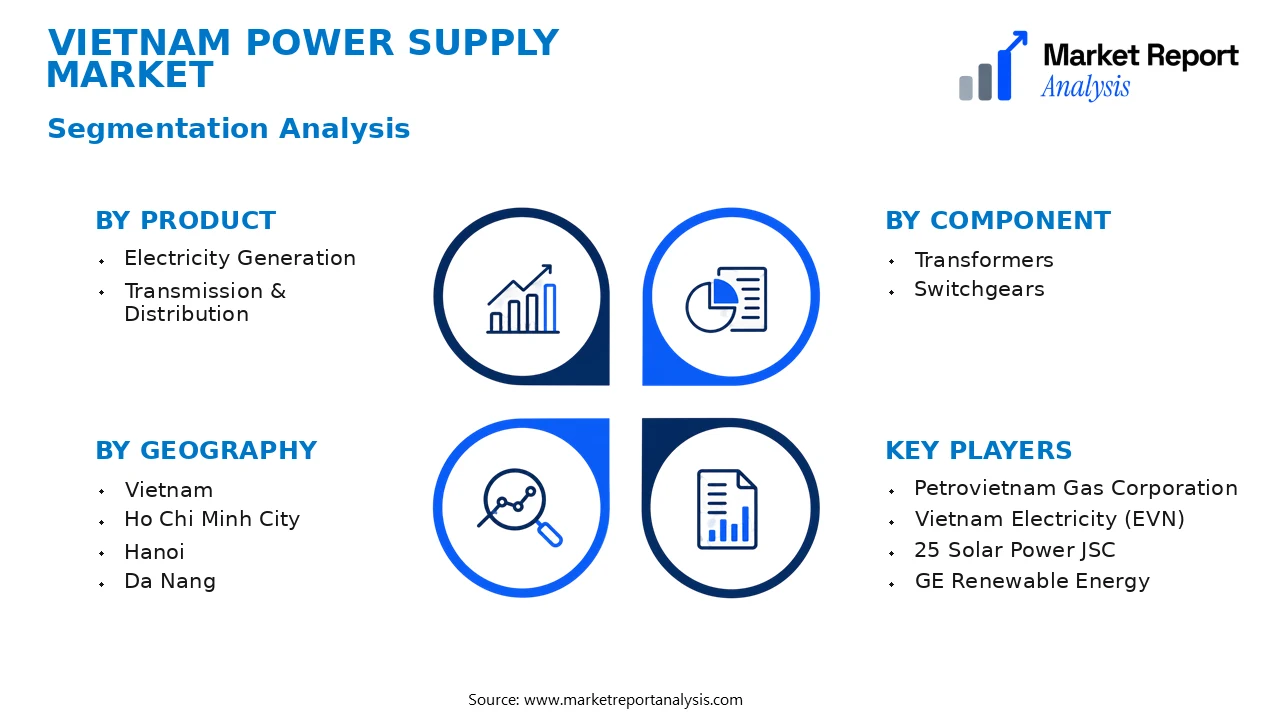
- Product
- Electricity Generation: This subsegment includes the various methods of power generation, such as thermal, hydro, and renewable sources, which directly influence the capacity expansion and technological development within the market.
- Transmission & Distribution: Covering the infrastructure involved in transferring power from generation sites to end-users, this subsegment is critical in reducing losses and enhancing the reliability of power supply across Vietnam.
- Component
- Transformers: Essential for voltage regulation and power transmission efficiency, transformers are integral components in the distribution network, with demand driven by grid modernization efforts.
- Switchgears: Critical for protection and switching operations within electrical networks, switchgears facilitate safe and reliable power distribution, especially in urban and industrial zones.
- Technology
- Smart Grid Technologies: These innovations incorporate digital communication and automation in power networks, significantly improving efficiency, monitoring, and control capabilities across Vietnam's growing power infrastructure.
- Renewable Energy Technologies: Solar, wind, and biomass technologies are rapidly expanding, driven by government incentives and decreasing costs, targeting sustainable development and energy independence.
- Platform
- Offline Platforms: Traditional power supply systems operating without digital integration, predominantly used in rural and less infrastructure-dense regions.
- Online Platforms: Digital and cloud-based management systems facilitating real-time monitoring, data management, and control, increasingly adopted in urban and industrial areas.
- Application
- Residential: Demand from urban households, driven by urbanization trends and increasing living standards, fostering the need for reliable and affordable power supply.
- Industrial: High consumption sectors such as manufacturing and processing plants, which are expanding investment in power reliability and capacity upgrades.
- Commercial: Commercial establishments, including offices, malls, and service providers, rely on stable power supply, with growth spurred by urban commercial development.
- End User
- Utilities: State-owned and private utilities that operate and manage most of Vietnam’s power generation, transmission, and distribution infrastructure, key in national supply stability.
- Industrial Enterprises: Large-scale manufacturing, processing, and tech industries with high power consumption and strategic importance for economic development.
- Residential Consumers: Urban and rural households that are increasingly connected to reliable power sources, supporting living standards and economic activity.
- Geography
- Vietnam: The country’s diverse geographic landscape influences regional demand, infrastructure development, and resource allocation, with a focus on major urban centers.
- Ho Chi Minh City: The leading economic hub, with high demand for reliable power due to dense population, industrial activity, and urban expansion.
- Hanoi: Political and administrative capital, experiencing rapid urbanization and infrastructure investment, crucial for regional power supply stability.
- Da Nang: Developing industrial and tourism sectors, with investments in power infrastructure supporting sustainable growth.
- Hai Phong: Major port city with a significant industrial base, requiring extensive power supply networks to support shipping, manufacturing, and exporting activities.
- Can Tho: Key economic center in the Mekong Delta, with agricultural and aquacultural industries demanding specialized power solutions.
- Bien Hoa: Industrial corridor near Ho Chi Minh City, with investments fueling growth in manufacturing and power infrastructure upgrades.
- Nha Trang: Tourism-driven city with increasing energy needs linked to hospitality, infrastructure development, and urban expansion.
Competitive Intelligence
The Vietnam Power Supply Market is characterized by a competitive landscape dominated by several key players, including state-owned enterprises like Vietnam Electricity (EVN) and emerging independent power producers (IPPs). Market concentration remains high, with EVN holding a significant share, although recent reforms have encouraged increased participation of private firms. Companies are pursuing aggressive strategies such as capacity expansion, technological upgrades, and market diversification to strengthen their positions. Product innovation focuses on integrating smart grid technologies and renewable energy solutions, aligning with Vietnam’s transition toward sustainable energy sources. Strategic partnerships and joint ventures between domestic firms and international investors are common, aimed at leveraging technical expertise and financing capabilities. Acquisitions of regional utilities and renewable startups are increasing, facilitating market expansion, especially in rapidly developing cities like Ho Chi Minh City and Hanoi. Significant R&D investments are directed towards improving grid reliability, reducing losses, and deploying advanced energy management systems. Differentiation among competitors hinges on project scale, technological sophistication, and ability to navigate regulatory frameworks, with regional activity reflecting varying competitive dynamics in urban versus rural areas.
Leading Company Profiles
The competitive landscape features a mix of local champions and global leaders, each leveraging technological innovation, strategic partnerships, and extensive project portfolios to strengthen their market position.
- Petrovietnam Gas Corporation
- Vietnam Electricity (EVN)
- 25 Solar Power JSC
- GE Renewable Energy
- Siemens Energy
- Vinh Tan Power Corporation
- ASEAN Power Group
- Bangkok Power Vietnam
- Vietnam Solar Ltd.
- JA Solar Vietnam
Petrovietnam Gas Corporation
p>As Vietnam’s leading gas provider, Petrovietnam Gas focuses on expanding gas pipeline networks and LNG infrastructure, emphasizing innovative, eco-friendly energy solutions aligned with national decarbonization goals.Vietnam Electricity (EVN)
p>EVN, the state utility, manages generation, transmission, and distribution, investing heavily in grid modernization and large-scale renewable projects, maintaining its leadership role across Vietnam’s power supply ecosystem.25 Solar Power JSC
p>This fast-growing firm specializes in solar farm development, delivering grid-connected power projects with a focus on sustainability, efficiency, and local community engagement.GE Renewable Energy
p>GE provides advanced wind turbines and digital grid technologies, supporting Vietnam’s renewable ambitions through innovative solutions that enhance power reliability and integration of variable renewable sources.Siemens Energy
p>Siemens Energy offers smart grid technology, power automation, and digitalization services to modernize Vietnam’s power network and optimize operational efficiencies.Vinh Tan Power Corporation
p>This key thermal power provider emphasizes capacity expansion and cleaner production techniques, aligning with Vietnam’s clean energy transition policies.ASEAN Power Group
p>Focused on regional integration, ASEAN Power Group develops cross-border power projects and asset management with an emphasis on sustainable practices across Southeast Asia.Bangkok Power Vietnam
p>This joint venture advances large-scale gas and renewable energy projects, leveraging regional expertise to foster Vietnam’s energy independence.Vietnam Solar Ltd.
p>Vietnam Solar Ltd. develops and operates solar parks, accelerating the country’s renewable energy deployment through innovative project financing and engineering.JA Solar Vietnam
p>Specialized in PV module manufacturing and supply, JA Solar Vietnam supports the rapid growth of local solar installations focused on cost-efficiency and high performance.Strategic Business Developments
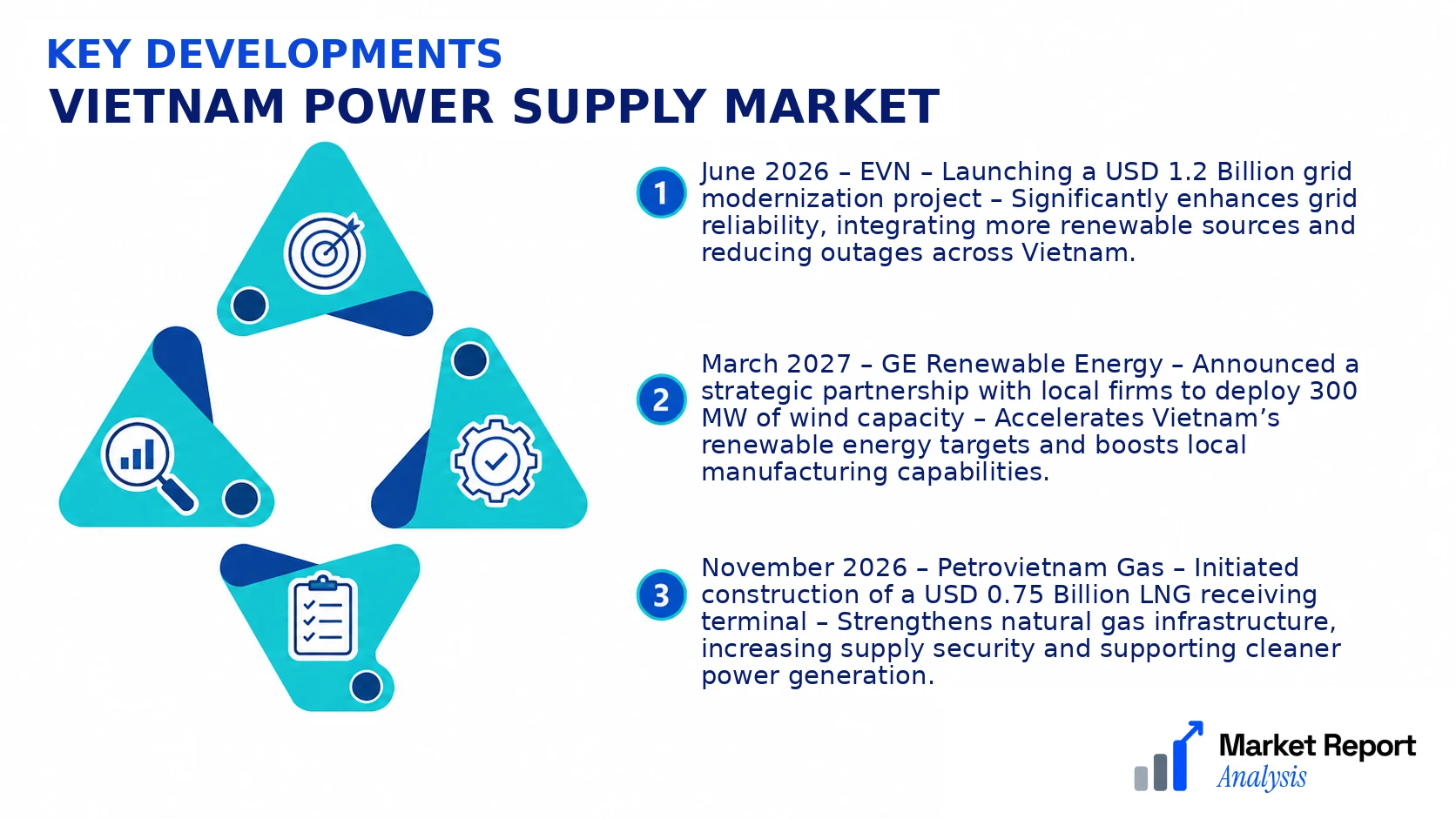
- June 2026 – EVN – Launching a USD 1.2 Billion grid modernization project – Significantly enhances grid reliability, integrating more renewable sources and reducing outages across Vietnam.
- March 2027 – GE Renewable Energy – Announced a strategic partnership with local firms to deploy 300 MW of wind capacity – Accelerates Vietnam’s renewable energy targets and boosts local manufacturing capabilities.
- November 2026 – Petrovietnam Gas – Initiated construction of a USD 0.75 Billion LNG receiving terminal – Strengthens natural gas infrastructure, increasing supply security and supporting cleaner power generation.
- August 2027 – Siemens Energy – Launched a digital grid control system upgrade – Improves grid management, enabling dynamic balancing of load and renewable integration efforts.
- February 2028 – 25 Solar Power JSC – Obtained approval for two new solar projects totaling 220 MW – Expands Vietnam’s solar capacity, with operational commencement expected in 2029, fostering sustainable growth.
Frequently Asked Questions
What is the Vietnam Power Supply Market?
The Vietnam Power Supply Market encompasses the generation, transmission, and distribution of electricity across Vietnam. It involves key stakeholders such as government agencies, private developers, and international investors aiming to meet growing demand informed by urbanization and industrial growth.
What is the current market size of Vietnam Power Supply Market?
As of 2026, the market size of the Vietnam Power Supply Market is valued at approximately USD 22 Billion, reflecting steady expansion driven by infrastructure investments, policy reforms, and increasing electrification needs throughout the country.
What factors are driving the Vietnam Power Supply Market?
Market growth is primarily fueled by Vietnam’s rapid economic development, urbanization, and government policies supporting renewable energy projects. Investments in grid modernization and diversification of power sources also significantly contribute to market expansion.
Which Vietnamese city leads the Vietnam Power Supply Market?
Ho Chi Minh City emerges as the most prominent hub for the Vietnam Power Supply Market due to its dense population, industrial base, and extensive infrastructure needs, making it the central node for electricity demand and supply initiatives.
Which segment is expected to grow the fastest?
The renewable energy segment, especially solar and wind power, is projected to witness the fastest growth, driven by supportive government policies, decreasing technology costs, and Vietnam’s commitment to sustainable development goals.
Who are the leading companies operating in the Vietnam Power Supply Market?
Major players include state-owned enterprises like Vietnam Electricity (EVN), along with international firms such as AES Corporation and Siemens, which are actively investing in new generation capacity and grid infrastructure to capitalize on market growth.
Analyst Perspective
The Vietnam Power Supply Market exhibits a maturation trend with steady growth driven by urbanization and population expansion. Long-term prospects remain promising with anticipated investments in renewable energy, particularly solar and wind, to diversify the energy mix and meet increasing demand. Commercial opportunities are abundant in infrastructure development, grid modernization, and distributed generation solutions, especially in rapidly urbanizing cities like Ho Chi Minh City and Hanoi, where demand density offers attractive returns. Technology evolution will favor smart grid technologies and energy storage systems to enhance reliability and integrate renewables efficiently. Investment priorities should focus on upgrading aging infrastructure, fostering private sector participation, and incentivizing green energy projects. Competitive intensity is expected to increase as local and international players vie for market share, highlighting the need for differentiated strategies. City-level growth will vary, with southern and northern hubs offering the most rapid expansion opportunities, underscoring the importance of localized market understanding. Strategic positioning in these urban centers will be key to capturing long-term market benefits.
