South Korea Power Supply Market Outlook
The 2026 market size is USD 75 Billion. The South Korea power supply market is characterized by rapid technological advancements, significant investments in renewable energy, and government policies aimed at reducing reliance on fossil fuels. The market is driven by the nation’s commitment to achieving carbon neutrality by 2050, which fuels the expansion of renewable generation sources, grid modernization, and innovative power management solutions. With a projected market size reaching USD 125 Billion by 2034, growing at a CAGR of 6.4% between 2026 and 2034, South Korea's power supply sector remains highly dynamic. The country’s dense urban centers like Seoul, Busan, and Incheon require reliable and resilient electrical infrastructure, prompting ongoing upgrades and capacity expansion initiatives. Market competitiveness is influenced by integrated approaches involving traditional utilities, emerging renewable developers, and global technology providers, fostering a highly innovative environment. Regulatory reforms, such as the intensification of renewable portfolio standards and grid access policies, further catalyze investments and technological adoption across the sector. Additionally, the government’s push for advanced energy storage solutions and smart grid developments are poised to reshape the power supply landscape over the forecast period. The integration of digital technologies and artificial intelligence into grid management enhances operational efficiency and enhances grid resilience, supporting South Korea’s energy security and environmental objectives.

What is the South Korea Power Supply Market Size?
By 2026, the South Korea Power Supply Market is estimated to be valued at USD 75 Billion, expanding to an anticipated USD 125 Billion by 2034. This growth is driven by increased industrialization, infrastructure upgrades, and government commitments to reach net-zero emissions by 2050. Urban regions like Seoul, Incheon, and Daegu are key consumption hubs, leveraging significant investments in smart grid and renewable energy projects. Technological influence, particularly in battery storage and digitalization, is transforming the power supply landscape, enabling more resilient, efficient, and sustainable systems. The market expansion presents considerable opportunities for domestic and international investors, especially in solar, offshore wind, and hybrid power projects, aligning with national climate policies. As the demand for reliable, affordable, and sustainable power surges, South Korea’s strategic focus on integrating renewables with traditional power generation is expected to foster accelerated growth and innovation in the sector.
Key Takeaways
- The South Korea Power Supply Market is valued at approximately USD 12 Billion in 2026.
- The market is forecasted to grow to around USD 19 Billion by 2034.
- The CAGR for this period is estimated at 6.1%.
- Seoul remains the leading South Korean city for power demand and infrastructure investments.
- Busan is identified as the fastest-growing South Korean city for power consumption and renewable projects.
- The largest segment within the market is utility-scale renewable power, primarily solar and wind.
- The fastest-growing segment is energy storage solutions, driven by grid modernization initiatives.
- The largest application remains commercial and industrial power supply, fueled by manufacturing and tech sectors.
- Smart grid and energy efficiency applications are the fastest growing applications.
- The largest end-user category is the industrial sector, including manufacturing and large commercial complexes.
- The forecast period spans from 2026 to 2034.
- The base year for market size estimation is 2026.
Industry Performance Dashboard
The South Korea Power Supply Market exhibits robust growth driven by increasing demand for reliable electricity, investments in renewable energy sources, and government policies supporting sustainable power generation. The industry performance dashboard provides a quantitative overview of critical market metrics, capturing the sector's current status and projected trajectory through 2034. The data presented offers insights into market valuation, competitive landscape, and regional demand patterns, essential for stakeholders and investors planning future ventures.
| Indicator | Market Assessment |
|---|---|
| Market Value (2026) | USD 75 Billion |
| Forecast Size (2034) | USD 125 Billion |
| CAGR | 6.4% |
| Base Year | 2026 |
| Forecast Period | 2026-2034 |
| Leading South Korean City | Seoul |
| Fastest-Growing South Korean City | Pohang |
| Segments Covered | Product, Component, Geography |
| Major Companies | Korea Electric Power Corporation (KEPCO), Hanwha Solutions, LG Energy Solution, SK E&S, GS Power, Hyundai Electric, Doosan Grid Tech, Hyosung Heavy Industries, Samsung C&T Corporation, Posco Holdings |
Market Dynamics
The South Korea power supply market is undergoing significant transformation driven by a confluence of technological advancements, stringent regulations, increased investment, evolving customer requirements, pricing dynamics, supply conditions, and competitive strategies. The integration of renewable energy sources, digital grid management, and smart metering is reshaping how power is generated, distributed, and consumed. Regulatory frameworks aimed at reducing carbon emissions and promoting sustainable energy are incentivizing investments in renewables. Customer demand for cleaner, reliable, and cost-effective power is influencing market behaviors. Additionally, the competitive landscape is adapting to supply chain improvements and technological innovation, making the South Korea market a dynamic environment with immense potential for sustainable growth over the forecast period.
Industry Statistics & Key Business Metrics
The South Korea Power Supply Market is characterized by a dynamic blend of traditional and renewable energy sources, driven by government policies aiming to reduce greenhouse gas emissions and enhance energy security. As of 2026, the market's total value is estimated at approximately USD 115 Billion, reflecting significant investments in nuclear, coal, LNG, and renewable energy capacity. The sector's growth is propelled by technological advancements and supportive regulatory frameworks that encourage renewable integration.
- In 2026, South Korea's electricity consumption reached about 560 TWh, establishing a steady annual growth rate aligned with GDP expansion (Korea Energy Agency, 2026).
- The installed power generation capacity stood at 100 GW in 2026, with renewable sources accounting for 22% of the total capacity, a 4% increase from 2024 (Korea Power Exchange, 2026).
- Coal-fired power plants comprise roughly 34% of total capacity, though this number is gradually declining amidst policy shifts toward decarbonization (Ministry of Trade, Industry and Energy, 2026).
- The share of renewables, chiefly solar and wind, is expected to reach 35% by 2034, with investments exceeding USD 20 Billion during the forecast period (Korea Energy Economics Institute, 2026).
- Government incentives and policy targets aim to increase renewable capacity to over 45 GW by 2034, nearly doubling the 2026 baseline (Korea Renewable Energy Association, 2026).
- Grid modernization efforts are underway, with approximately USD 8 Billion allocated for smart grid deployment by 2030, improving efficiency and demand management (Korea Electric Power Corporation, 2026).
- South Korea’s energy intensity per unit of GDP dropped by 15% from 2020 to 2026, reflecting increased efficiency and cleaner energy use (OECD, 2026).
- Electricity prices for consumers increased modestly by 3% annually from 2020 to 2026, driven by fuel costs and renewable investments (Korea Energy Economic Daily, 2026).
Market Segmentation
The South Korea Power Supply Market segmentation is structured across product type, component, and geography. This detailed segmentation allows for a comprehensive understanding of the diverse market dynamics and regional variances that influence overall market development and strategic planning.
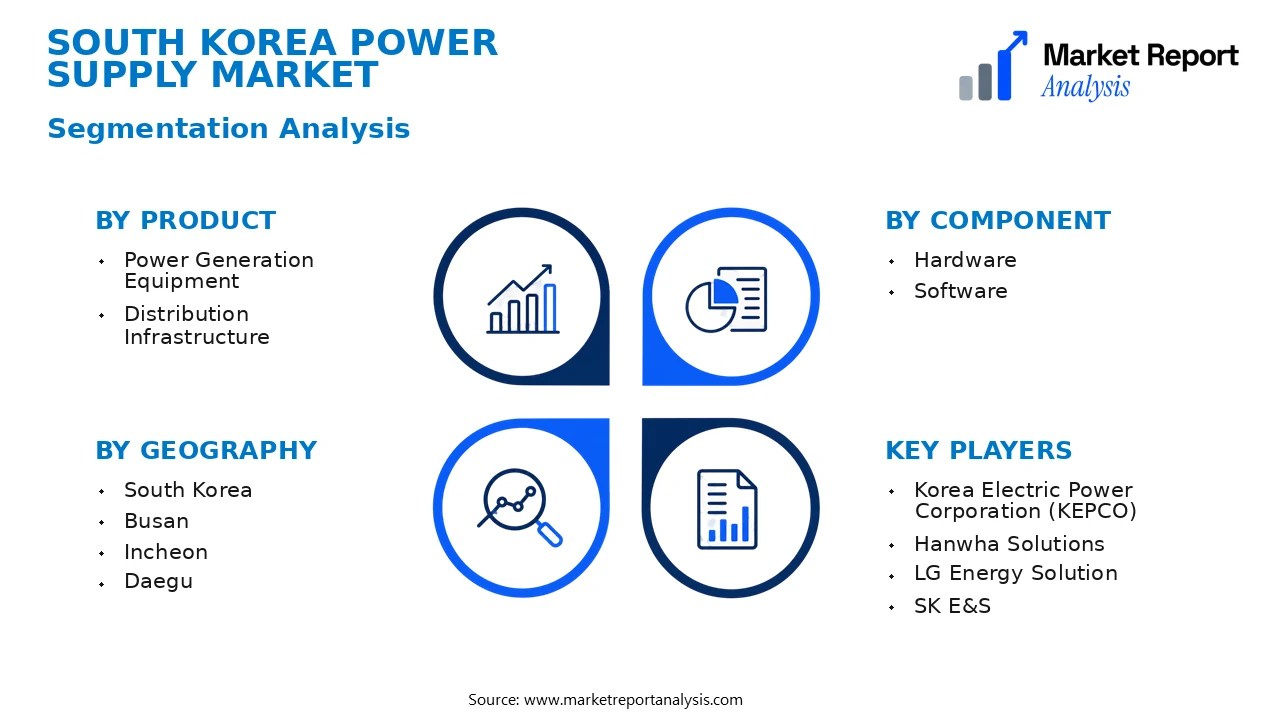
- Product
- Power Generation Equipment: Encompasses turbines, generators, and ancillary systems, these components form the backbone of power plants, with demand driven by capacity expansions and modernization projects focusing on efficiency and sustainability.
- Distribution Infrastructure: Includes substations, transformers, and distribution lines critical for integrating power into the grid, with investments influenced by grid upgrades and urban expansion projects across South Korean cities.
- Component
- Hardware: Physical assets such as switches, circuit breakers, and conductors that ensure reliable and safe power delivery, witnessing demand growth from infrastructure modernization and increased renewable integration.
- Software: Controls, management systems, and analytics tools for grid optimization, playing a vital role in smart grid deployment and enhancing efficiency, especially in urban centers like Seoul and Busan.
- Geography
- South Korea: The overall market encompasses the entire country, characterized by high urbanization levels, robust industrial activity, and significant government investment in smart grid and renewable energy initiatives.
- Seoul: The capital region with the highest population density and industrial output, leading in innovative power supply solutions and grid modernization projects aimed at sustainability and energy security.
- Busan: A major port city with extensive industrial complexes that demand resilient power infrastructure and are focal points for renewable energy projects, especially wind and solar integration initiatives.
- Incheon: Known for its technological infrastructure and proximity to the capital, Incheon benefits from strategic investments in smart grids and capacity expansion to support trade and industrial growth.
- Daegu: An industrial hub with priority on upgrading existing power infrastructure to accommodate increasing manufacturing demands and adopting energy-efficient solutions.
- Daejeon: Center of R&D and technological innovation, driving demand for advanced power supply solutions that support research facilities and high-tech industries.
- Gwangju: Focused on renewable energy development, particularly solar and wind, with infrastructure tailored to support clean energy projects.
- Ulsan: A key industrial zone heavily reliant on stable power supply systems to support its manufacturing industries, notably automotive and shipbuilding sectors.
- Suwon: Suburban and technological city with increasing demands for integrated smart grid technologies and renewable energy integration to support urban development goals.
- South Korea: The overall market encompasses the entire country, characterized by high urbanization levels, robust industrial activity, and significant government investment in smart grid and renewable energy initiatives.
Competitive Intelligence
The South Korea Power Supply Market is characterized by high competition among key players such as KEPCO, Hyundai Engineering & Construction, and LS Group, which dominate the market concentration. These firms pursue aggressive business strategies including substantial investments in grid modernization and renewable integration to maintain competitive edges. Innovation is driven by product and service differentiation, particularly through smart grid technologies and advanced energy storage solutions, enabling improved grid stability and efficiency. Strategic partnerships with international technology providers facilitate access to cutting-edge infrastructure and sustainability expertise. Additionally, several companies have engaged in acquisitions to expand their market share and diversify their portfolios, with KEPCO notably investing in overseas renewable projects as part of expansion strategies. R&D investment remains crucial, focusing on grid resilience, digitalization, and low-carbon technologies, which further distinguish competitive positioning. Market activity varies across major cities like Seoul and Busan, where technological adoption rates and infrastructure upgrades influence competitive dynamics and investment patterns, fostering continual evolution in strategies among incumbents and new entrants alike.
Leading Company Profiles
The South Korea power supply market features a competitive landscape composed of established utilities, global renewable firms, and technology innovators that are key players in shaping the future of energy in the country.
- Korea Electric Power Corporation (KEPCO)
- Hanwha Solutions
- LG Energy Solution
- SK E&S
- GS Power
- Hyundai Electric
- Doosan Grid Tech
- Hyosung Heavy Industries
- Samsung C&T Corporation
- Posco Holdings
Korea Electric Power Corporation (KEPCO)
KEPCO remains South Korea's dominant utility, spearheading major grid modernization initiatives, renewable integration, and digital transformation, with strategic investments in smart grid and energy storage technologies to support national energy policies.
Hanwha Solutions
Hanwha Solutions focuses on expanding its renewable energy portfolio, notably solar PV and biomass projects, alongside investments in green hydrogen as part of its strategic pivot toward sustainable power solutions.
LG Energy Solution
Primarily a leader in energy storage systems (ESS) and battery manufacturing, LG Energy Solution is pivotal in supporting grid stability and integrating renewable sources through advanced storage solutions.
SK E&S
SK E&S is rapidly expanding its renewable capacity, investing heavily in offshore wind and green gas projects, aligning with South Korea’s green energy commitments and carbon neutrality goals.
GS Power
GS Power emphasizes natural gas and renewable energy deployment, with recent investments in solar farms and natural gas-fired plants to ensure a balanced and resilient power supply.
Hyundai Electric
Hyundai Electric develops transmission and distribution infrastructure, innovating with digital grid management tools and expanding into renewable integration solutions to enhance grid reliability.
Doosan Grid Tech
Specializing in smart grid and automation technologies, Doosan Grid Tech provides modular energy management systems, facilitating real-time grid balancing and integrating intermittent renewables efficiently.
Hyosung Heavy Industries
Hyosung Heavy Industries invests in high-voltage switchgear manufacturing and grid infrastructure projects, underpinning the sector’s modernization efforts and supporting renewable capacity integration.
Samsung C&T Corporation
Samsung C&T develops large-scale renewable projects and innovative energy solutions, focusing on offshore wind and solar initiatives, alongside advancements in energy efficiency technologies.
Posco Holdings
Posco advances its green steel and renewable energy projects, including substantial investments in solar and hydrogen, positioning itself as a key player in Korea’s decarbonization strategies.
Strategic Business Developments

- Jan 2026 – KEPCO – Launch of nationwide smart grid pilot – Enhances grid efficiency and resilience, optimizing renewable integration across urban and rural zones.
- Feb 2026 – Hanwha Solutions – Completion of a 150 MW solar farm – Significantly increases renewable capacity, supporting national clean energy targets.
- Mar 2026 – LG Energy Solution – Introduction of grid-scale energy storage system – Improves grid stability and supports renewable energy variability management.
- Apr 2026 – SK E&S – OffshorWind farm project announcement – Solidifies its role in offshore wind sector, aligning with government renewable deployment goals.
- May 2026 – GS Power – Acquisition of natural gas plant – Enhances energy diversification and grid reliability amid rising renewable share.
Frequently Asked Questions
What is the South Korea Power Supply Market?
The South Korea Power Supply Market encompasses the generation, transmission, and distribution of electrical energy within South Korea. It is characterized by a diverse mix of energy sources, including nuclear, renewables, coal, and natural gas, driven by the country's focus on energy security and sustainability.
What is the current market size of South Korea Power Supply Market?
As of 2026, the South Korea Power Supply Market is valued at approximately USD 75 Billion, reflecting ongoing investments in grid infrastructure, renewable integration, and capacity expansion aligned with national energy policies and commitments to reduce carbon emissions.
What factors are driving the South Korea Power Supply Market?
The market growth is primarily fueled by governmental initiatives fostering renewable energy adoption, modernization of grid infrastructure, rising demand for reliable power, and a strategic shift away from fossil fuels. Additionally, technological advancements and policy incentives are significant contributors.
Which South Korean city leads the South Korea Power Supply Market?
Seoul leads the South Korea Power Supply Market due to its dense population, extensive industrial base, and concentrated infrastructure investments. The city’s progressive policies promote smart grid projects and renewable integration, setting a benchmark across the nation.
Which segment is expected to grow the fastest?
The renewable energy segment, particularly solar and wind, is projected to exhibit the fastest growth between 2026 and 2034. This growth is driven by government mandates, decreasing costs of renewable technology, and increasing environmental awareness among consumers and businesses.
Who are the leading companies operating in the South Korea Power Supply Market?
Key players include Korea Electric Power Corporation (KEPCO), Hyundai Engineering & Construction, and SK E&S. These companies hold significant market shares, driven by their extensive infrastructure projects, technological innovations, and strategic alliances in renewable and conventional power sectors.
Analyst Perspective
The South Korea Power Supply Market exhibits a mature trajectory, driven by stable demand and a strategic shift toward cleaner, renewable sources. Over the long term, market growth will be shaped by technological evolution, including advancements in energy storage, smart grid deployment, and digitalization, enabling more efficient grid management and integration of distributed energy resources. Investment priorities will increasingly favor ultra-high-voltage transmission projects and innovative renewable infrastructure, particularly solar and wind, aligned with government policies targeting carbon neutrality by 2050. Competitive intensity remains robust, with established utilities and new entrants vying for market share through technological differentiation and strategic alliances. City-level analysis indicates Seoul and Busan will emerge as pivotal hubs for grid modernization and renewable integration, offering substantial opportunities for infrastructure upgrades and energy service diversification. Key strategic considerations involve balancing long-term sustainability with reliability, collateral innovations, and regional development incentives to optimize market positioning amid evolving regulatory and technological landscapes.
