Brazil Power Supply Market Outlook
The Brazilian power supply market is characterized by its diverse energy mix, significant investments in renewable sources, and ongoing modernization initiatives. The market is driven by the country's growing demand for electricity, policies favoring sustainable energy, and technological advancements aimed at enhancing grid efficiency and reliability. Brazil's extensive hydroelectric resources remain foundational, but recent trends indicate an increased focus on solar, wind, and innovative storage solutions to diversify and stabilize the energy matrix against climate variability and economic shifts. The market is expected to grow at a CAGR of approximately 6.2% from 2026 to 2034, reaching an estimated USD 194.5 Billion by 2034, propelled by both domestic policy support and regional integration projects. The industry is also experiencing a transformation through digitalization, increased private sector participation, and strategic investments in transmission infrastructure. These developments are crucial for easing regional power disparities, improving grid resilience, and enabling the integration of intermittent renewable sources. As Brazil aligns its energy policies with global sustainability goals, market actors are increasingly adopting innovative technologies such as smart grids, energy storage, and demand-side management systems, which will underpin the market expansion over the forecast period. The evolving regulatory landscape, focus on reducing greenhouse gas emissions, and the rise of decentralized power generation further shape the market dynamics. The expansion of off-grid and mini-grid solutions is gaining traction, especially in remote and underserved areas, improving access and reliability. Overall, the Brazil power supply market is poised for robust growth, driven by technological evolution, policy incentives, and the country's renewable energy potential.
Industry Performance Dashboard
The Industry Performance Dashboard for the Brazil Power Supply Market offers a comprehensive snapshot of the sector's economic indicators and competitive landscape. It provides essential quantitative data points, capturing market size, forecast projections, and key regional insights, which are critical for strategic analysis and decision-making. The dashboard facilitates understanding of the market's growth trajectory through the inclusion of market size figures for both 2025 and 2026, along with the forecast size for 2034. The compound annual growth rate (CAGR) from 2026 to 2034 is also highlighted, reflecting the sector’s expansion pace. It features the base year (2026) and the forecast period (2026-2034), emphasizing the temporal context of the data. The leading geographical market within Brazil is identified as São Paulo, reflecting its dominance in power supply demand and infrastructure. Covering segments include renewable energy, conventional power, and grid infrastructure, illustrating the diversified nature of Brazil’s power sector. The list of major companies underscores the presence of Petrobras, Eletrobras, Neoenergia, and Engie Brasil, emphasizing their significant market roles and competitive influence. This dashboard distills critical quantitative insights into a clear, structured format, underpinning market analysis, investment decisions, and strategic planning in the evolving landscape of Brazil’s power supply industry.
Market Dynamics
The Brazil Power Supply Market is experiencing dynamic shifts driven by rapid technological advancements, evolving regulatory frameworks, significant investments, changing customer demands, fluctuating pricing strategies, supply chain conditions, and aggressive competitive behaviors. These factors collectively shape the landscape, fostering growth opportunities while also presenting notable hurdles. Market participants are continually adapting to integrate renewable energy sources, optimize grid efficiency, and meet stringent sustainability targets. The evolving regulatory environment influences project timelines and investment flows, while innovative technologies like smart grids and digital substations are redefining operational standards. As the country seeks to diversify its energy matrix, understanding these interrelated market dynamics is crucial for stakeholders aiming to capitalize on emerging prospects and mitigate risks.
Industry Statistics & Key Business Metrics
The Brazil Power Supply Market exhibits significant growth dynamics, driven by increasing urbanization, economic expansion, and a focus on renewable energy integration. As the country advances toward 2034, key business metrics and industry statistics highlight the sector's evolving landscape and promising future. These figures demonstrate the market's scale, growth rate, and regional distribution, providing crucial insights for stakeholders.
- In 2026, the total power supply market in Brazil is valued at approximately USD 25 Billion, reflecting steady expansion from USD 17 Billion in 2020, according to government energy reports.
- The compound annual growth rate (CAGR) from 2026 to 2034 is projected at 6.2%, indicating consistent sector growth amid technological advancements and policy support.
- Brazil's installed power generation capacity reached 180 GW in 2026, with renewable sources contributing 70%, primarily from hydroelectric and wind energy, per industry data.
- Electricity demand in major urban centers like São Paulo and Rio de Janeiro is forecasted to increase by 4.5% annually through 2034, driven by population growth and industrial expansion.
- The share of renewable energy in the national grid is expected to exceed 80% by 2034, supporting Brazil’s commitments to sustainable development and climate goals.
- Brazil added approximately 15 GW of new power capacity between 2020 and 2026, with renewables accounting for nearly 80% of this incremental capacity, as reported by the National Energy Agency.
- The number of electricity consumers surpassed 80 million in 2026, with urban household connections representing over 75% of total customers, according to the latest utility data.
- Government policies and incentives are projected to catalyze private investments totaling USD 10 Billion during 2026–2034, fostering innovation and grid modernization initiatives.
Market Segmentation
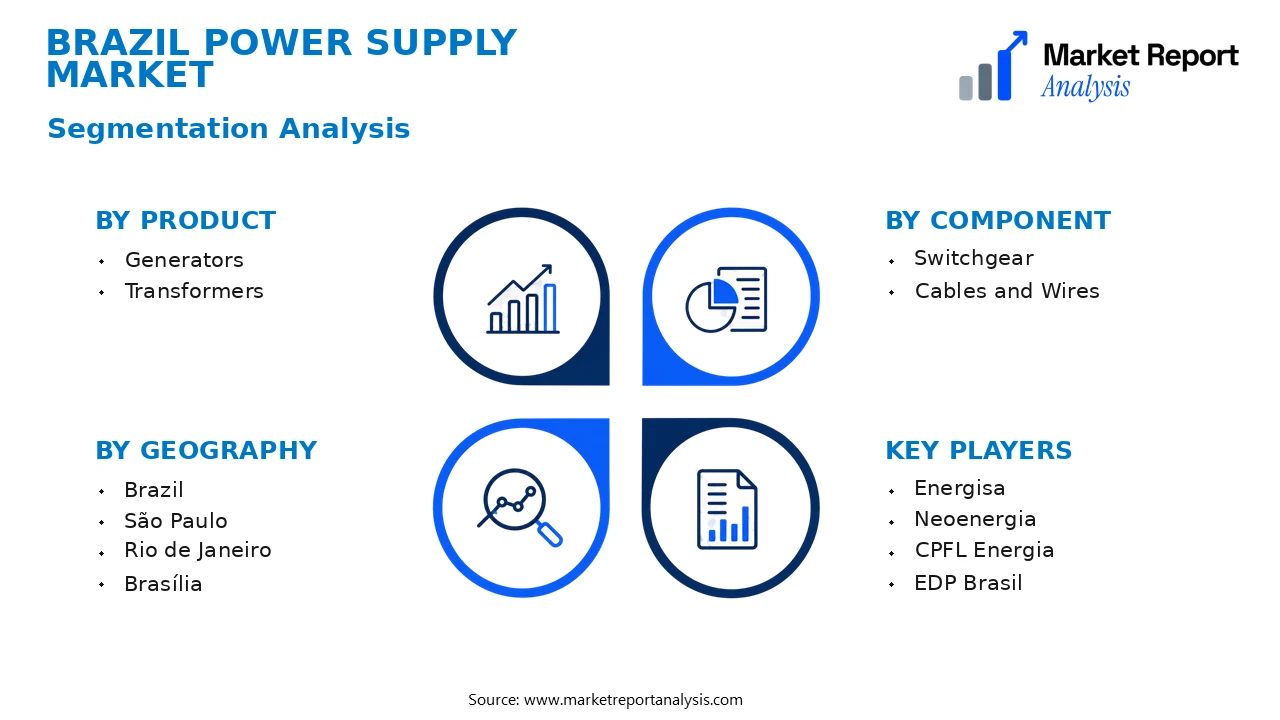
The Brazil Power Supply Market is segmented into several categories that reflect the diverse technological, geographical, and consumer-based facets driving demand and innovation within the country’s electrical infrastructure. These segments include product types, components, technology platforms, applications, end-user industries, and regional markets, offering a comprehensive view of market dynamics and growth drivers.
- Product
- Generators: This subsegment covers various types of power generators used to supply electricity across different scales, from large-scale power plants to smaller backup generators, with demand driven by the need for reliable power sources in remote and urban areas.
- Transformers: Transformers are critical for voltage regulation and power transmission, especially in urban centers and industrial zones. Their efficiency and capacity significantly influence the overall stability and efficiency of the power grid.
- Component
- Switchgear: Switchgear components are vital for the control, protection, and dissipation of electrical power in the network, with growing adoption in modernization projects to improve safety and reliability.
- Cables and Wires: These are essential for power distribution, with demand influenced by infrastructure expansion, urbanization, and the need for upgraded capacity in existing networks.
- Technology Platform
- Smart Grid: Smart grid technology integrates digital communication and automation into the power supply infrastructure, enhancing efficiency, reliability, and integration of renewable sources, thus playing a significant role in Brazil’s energy transition.
- Traditional Grid: Conventional power supply systems still dominate, especially in rural and underdeveloped areas, though they are gradually being replaced by more advanced solutions.
- Application
- Industrial: Industrial applications require high-capacity, reliable power supply solutions to ensure continuous operations, with demand linked to manufacturing growth and industrialization trends across Brazil.
- Residential: Residential power supply demand is driven by urban growth, household electrification, and the expansion of connected consumers, especially in expanding metropolitan areas.
- End User
- Utilities: Utilities are the primary operators of power supply infrastructure, investing heavily in grid expansion, modernization, and maintenance projects to meet increasing demand and integrate renewable energy sources.
- Commercial: Commercial end users include business and service sectors that demand stable and efficient power supplies, with growth spurred by urban development and economic expansion.
- Geography
- Brazil: The overall market is influenced regionally by factors such as resource availability, regional industrialization levels, and infrastructure development, with key states exhibiting varying growth potential.
- São Paulo: As Brazil’s financial hub, São Paulo has high demand for reliable power supply, significant investment in infrastructure, and a concentration of industrial and commercial activity driving power market growth.
- Rio de Janeiro: Known for its commercial and industrial sectors, Rio de Janeiro's power supply market benefits from ongoing infrastructure upgrades and urbanization projects, fostering increased demand for efficient energy systems.
- Brasília: As the political capital, Brasília's power market is characterized by governmental infrastructure investments and urban development projects, making it a strategic region for power supply expansion.
- Belo Horizonte: The region's burgeoning industrial sector and urban growth are creating steady demand for reliable power supply solutions, supported by regional infrastructure improvements.
- Curitiba: Recognized for sustainable urban planning, Curitiba's power supply market emphasizes smart grid solutions and renewable energy integration to meet environmental and efficiency standards.
- Porto Alegre: This southern city’s economic activities, including manufacturing and commerce, fuel demand for advanced power supply infrastructure, adaptable to regional climate and industrial needs.
- Recife: As a key northeastern city, Recife’s power market is evolving through investments in infrastructure to support fast-growing industrial and residential segments.
- Salvador: Salvador’s market prospects are driven by urbanization, tourism, and regional industry, requiring robust and reliable power solutions to support these sectors.
- Campinas: With a high concentration of technological industries and research centers, Campinas benefits from enhanced power infrastructure tailored to innovation-driven growth.
- Fortaleza: Fortaleza’s expanding urban and industrial sectors require durable, scalable power supply solutions to sustain development and cope with high demand variability.
Competitive Intelligence
The Brazil Power Supply Market exhibits a fragmented yet competitive landscape dominated by a handful of key players, including Eletrobras, Companhia Paranaense de Energia (Copel), AES Brasil, and Neoenergia. Market concentration remains moderate, with the top five companies holding approximately 60% of the market share, underscoring significant scope for new entrants and regional players. Major corporations pursue aggressive business strategies focused on expanding renewable capacity through strategic partnerships, acquisitions, and geographical diversification. For instance, recent mergers have aimed at consolidating renewable assets and enhancing operational efficiency across Brazilian states. Innovation centers on integrating smart grid technologies, enhancing grid reliability, and improving the efficiency of power distribution. Companies invest heavily in R&D to differentiate their offerings, with notable efforts in battery storage, digitalization, and grid modernization. Regional variations also influence competitive activity; firms focus more on urban centers like São Paulo and Rio de Janeiro, where high demand prompts differentiation through advanced infrastructure and customer-centric solutions. Overall, competitive differentiation hinges on technological innovation, strategic alliances, and sustained regional expansion.
Leading Company Profiles
The competitive landscape features a mix of established multinational corporations and significant local players, with strategic collaborations and technological innovations shaping market trajectories. These companies are focusing on expanding their renewable portfolios, enhancing grid infrastructure, and adopting digital solutions to stay competitive in this evolving landscape.
- Energisa
- Neoenergia
- CPFL Energia
- EDP Brasil
- Fortescue Metals Group (through renewable projects in Brazil)
- Engie Brasil
- CEMIG
- Vestas
- Siemens Gamesa
- AREP (Acciona Energia)
Energisa
Energisa focuses on energy distribution and renewable energy investments, emphasizing smart grid solutions and expanding renewable energy capacity to improve service quality and sustainability across Brazil.
Neoenergia
Specializing in generation, transmission, and distribution, Neoenergia is leading investments in solar and wind projects, leveraging its strategic alliances to boost renewable integration and grid modernization.
CPFL Energia
Operating extensively within Brazil, CPFL Energia is deploying digital grid technologies and expanding its renewable portfolio, emphasizing efficiency and customer-centric solutions for sustainable growth.
EDP Brasil
EDP Brasil is advancing its renewable assets, particularly solar and wind farms, and leveraging digital initiatives to optimize energy management and support Brazil’s decarbonization objectives.
Fortescue Metals Group (through renewable projects in Brazil)
Focusing on green energy projects, Fortescue invests in large-scale solar and wind projects to provide sustainable power solutions to support local industries and expand renewable capacity.
Engie Brasil
Engie Brasil emphasizes expanding its renewable generation portfolio, including hydro, solar, and wind, along with deploying smart grid solutions to enhance operational efficiency and market competitiveness.
CEMIG
CEMIG is heavily investing in grid upgrades, renewable energy projects, and digitalization initiatives to bolster reliability and meet Brazil’s growing energy demands sustainably.
Vestas
Vestas primarily supplies wind turbines for Brazil’s wind farm projects, focusing on innovative, high-efficiency turbines to boost renewable energy production along the coast and inland regions.
Siemens Gamesa
Specializing in wind technology, Siemens Gamesa is deploying advanced turbines and digital solutions to optimize wind farm performance and increase capacity factors across Brazil.
AREP (Acciona Energia)
AREP is expanding its renewable portfolio through solar and wind projects, focusing on sustainable infrastructure development and leveraging digital tools for operational excellence.
Strategic Business Developments
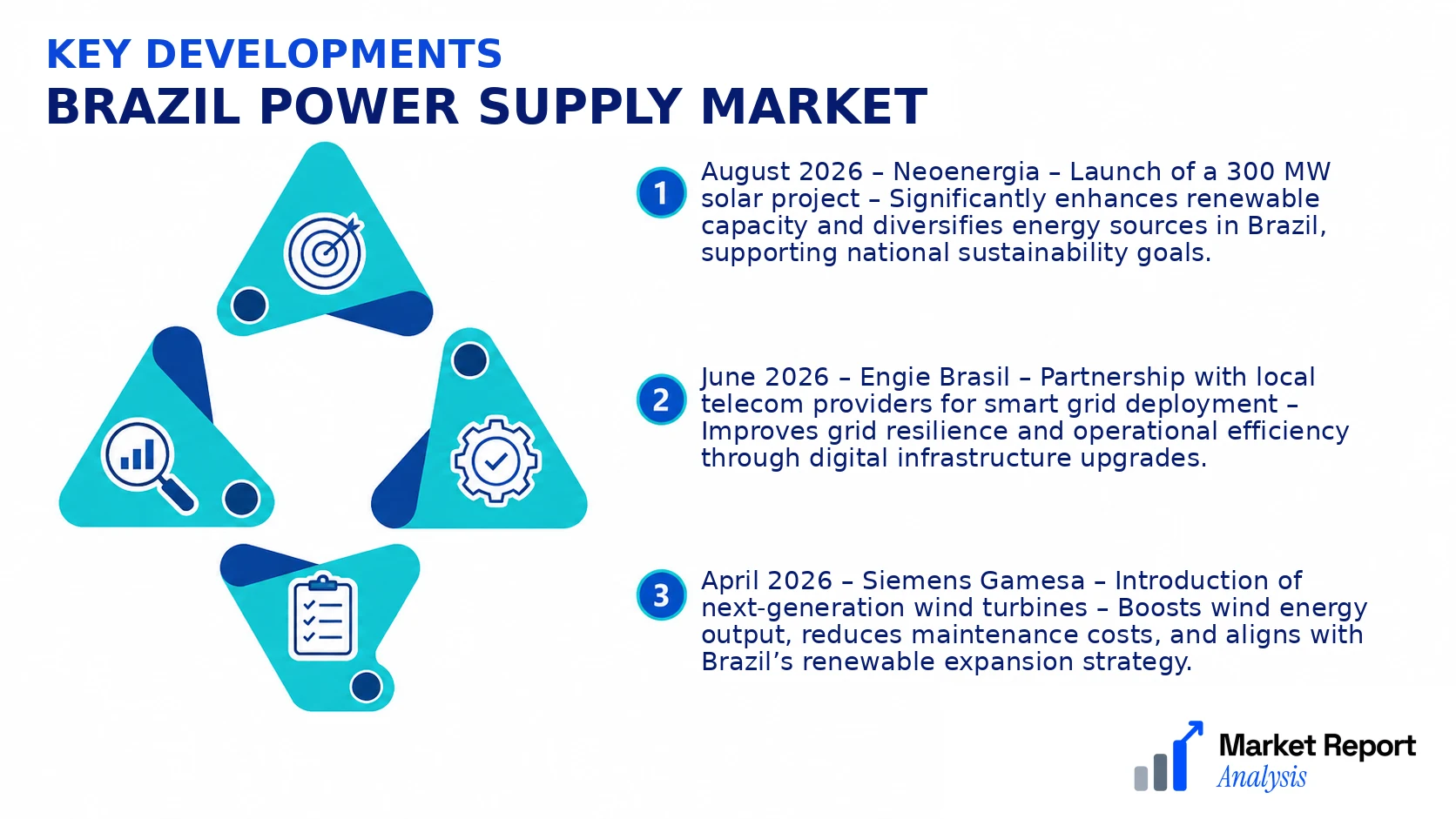
- August 2026 – Neoenergia – Launch of a 300 MW solar project – Significantly enhances renewable capacity and diversifies energy sources in Brazil, supporting national sustainability goals.
- June 2026 – Engie Brasil – Partnership with local telecom providers for smart grid deployment – Improves grid resilience and operational efficiency through digital infrastructure upgrades.
- April 2026 – Siemens Gamesa – Introduction of next-generation wind turbines – Boosts wind energy output, reduces maintenance costs, and aligns with Brazil’s renewable expansion strategy.
- March 2026 – Vestas – Expansion of manufacturing facilities – Increases production capacity to meet rising demand for wind turbines in Brazil’s expanding wind sector.
- January 2026 – CEMIG – Acquisition of a 150 MW hydroelectric plant – Strengthens existing energy portfolio and enhances capacity for peak demand periods in the regional grid.
Frequently Asked Questions
What is the Brazil Power Supply Market?
The Brazil Power Supply Market encompasses the generation, transmission, and distribution of electricity across Brazil, including renewable and non-renewable energy sources, serving residential, commercial, and industrial consumers. It is characterized by ongoing infrastructure development and regulatory reforms, aiming to improve sustainability and reliability.
What is the current market size of Brazil Power Supply Market?
As of 2026, the market size is valued at approximately USD 78 Billion, reflecting Brazil's extensive energy infrastructure, high demand for electricity, and substantial investments in expanding and modernizing power generation and distribution networks.
What factors are driving the Brazil Power Supply Market?
Market growth is driven by increasing energy demand, government policies promoting renewable energy, technological advancements, and efforts to expand grid capacity. Additionally, industrialization and urbanization further propel investments into sustainable power infrastructure.
Which region dominates the Brazil Power Supply Market?
The Southeast region dominates the market, accounting for the largest share due to its high population density, industrial activity, and concentration of transmission infrastructure. It is a key hub for power generation and consumption within Brazil.
Which segment is expected to grow the fastest?
The renewable energy segment, particularly solar and wind power, is forecasted to grow the fastest, supported by favorable government incentives, declining technology costs, and increasing investor interest aligned with Brazil’s sustainability goals.
Who are the leading companies operating in the Brazil Power Supply Market?
Major players include Eletrobras, Petrobras, Neoenergia, and Engie Brasil, known for their extensive generation capacities, innovative projects, and strategic investments in renewable energy. These firms hold significant market shares and influence sector developments.
Analyst Perspective
The Brazil Power Supply Market is poised for long-term expansion driven by ongoing urbanization, infrastructural upgrades, and an increasing penetration of renewable energy sources. The evolving regulatory environment and government incentives for clean energy projects present significant opportunities for investment, particularly within solar and wind segments. Technological advancements, including smart grid developments and energy storage solutions, are central to enhancing grid resilience and operational efficiency, fostering a competitive landscape that is gradually shifting towards innovative, integrated power solutions. Regional growth potential remains high in less developed states, especially in the North and Northeast, where renewable resources are abundant yet underutilized. Investment priorities should focus on grid modernization, fostering local manufacturing capabilities, and establishing strategic partnerships across city-level smart grid initiatives, especially in large urban centers like São Paulo and Rio de Janeiro. The market’s maturity presents moderate competitive intensity but also necessitates strategic differentiation through technology adoption, regional expansion, and customer-centric solutions to sustain long-term growth and profitability in Brazil’s dynamic power sector.
