Vietnam Personal Care Electricals Market Outlook
The Vietnam personal care electricals market is experiencing rapid growth, driven by rising disposable incomes, increasing urbanization, and a growing emphasis on personal grooming and hygiene. Currently valued at USD 1.2 Billion in 2026, the market is projected to reach USD 2.8 Billion by 2034, reflecting a compounded annual growth rate (CAGR) of 10.8% over the forecast period. Technological innovation, such as smart grooming devices and automated skin care tools, continues to shape consumer preferences. Additionally, the expanding middle class and young urban demographic are fueling demand for premium and innovative products, offering lucrative opportunities for manufacturers and retailers. The market's trajectory suggests a shift towards sustainable and energy-efficient devices, aligned with Vietnam's evolving regulatory framework and environmental commitments. As a result, investors are increasingly focusing on unlocking new sales channels, including e-commerce platforms and modern retail outlets, further propelling the market's expansion.
What is the Vietnam Personal Care Electricals Market Size?
The market size of Vietnam's personal care electricals in 2026 is valued at USD 1.2 Billion, with forecasts indicating growth to USD 2.8 Billion by 2034. This corresponds to a CAGR of 10.8% during the period from 2026 to 2034. The growth drivers include rising consumer demand for personal grooming devices, technological advancements, and increased adoption of electrical grooming appliances in both urban and semi-urban areas. End-user industries such as personal grooming, beauty salons, and healthcare institutions are contributing substantially to this expansion. The penetration of innovative technologies like smart sensors, IoT-enabled devices, and energy-efficient appliances has become prominent, shaping the future of personal care routines. Furthermore, the rise of e-commerce as a primary distribution channel and the proliferation of international brands entering Vietnam’s market are expected to sustain growth momentum and foster investment opportunities across the spectrum of personal care electricals.
Key Takeaways
- The Vietnam personal care electricals market is valued at USD 1.2 Billion in 2026.
- The market is projected to reach USD 2.8 Billion by 2034, reflecting a CAGR of 10.8%.
- Leading Vietnamese City: Ho Chi Minh City.
- Fastest-Growing Vietnamese City: Hanoi.
- The largest segment within the market is electric shavers and trimmers.
- The fastest-growing segment is smart skincare devices.
- The largest application is personal grooming and beauty routines.
- The fastest-growing application is healthcare and medical personal care devices.
- The primary end users are urban consumers, young professionals, and beauty salons.
- The forecast period spans from 2026 to 2034, beginning from a 2026 base year.
- The market is driven by rising disposable income, urbanization, and technological innovation.
- Growth is supported by increasing e-commerce penetration and new product launches.
- Environmental sustainability practices are influencing product development and regulatory policies.
- Market competition is intensifying with both local producers and international brands vying for market share.
- Emerging investment opportunities are focused on premium, smart, and eco-friendly personal care electricals.
Industry Performance Dashboard
The Industry Performance Dashboard provides a comprehensive snapshot of the Vietnam personal care electricals market, summarizing key quantitative metrics and qualitative insights crucial for stakeholders. The current market size in 2026 is valued at approximately USD 1.2 Billion, reflecting steady growth driven by rising disposable incomes, urbanization, and increasing consumer sophistication within Vietnam. Forecasts project the market will expand to USD 2.3 Billion by 2034, corresponding to a Compound Annual Growth Rate (CAGR) of 8.2% over the period from 2026 to 2034. The base year for analysis is 2026, with a forecast period extending through 2034, highlighting a period of vigorous expansion aligned with Vietnam’s economic development strategies. Ho Chi Minh City remains the leading Vietnamese city for personal care electricals sales, benefiting from concentrated retail infrastructure, a dense population of middle-class consumers, and favorable urban lifestyle trends. Notably, Hanoi is anticipated to emerge as the fastest-growing city due to ongoing infrastructural investments and expanding middle-class demographics. The market segmentation covers a broad range of product categories, including electric razors, hair Clippers, skincare devices, and oral care appliances, with electric razors and skincare devices dominating sales. Major players such as Philips, Panasonic, and Unilever are spearheading innovations, marketing intensities, and distribution expansion across Vietnam. Investment trends indicate increased entry of international brands and local startups, fueling channel diversification and technological advancements. Pricing trends remain competitive, with premium offerings gaining traction alongside more affordable alternatives, reflecting evolving consumer preferences. Overall, the Vietnam personal care electricals market is approaching a mature stage, characterized by a growing product innovation pipeline and intensifying competition among established firms and new entrants.
Market Dynamics
The Vietnam personal care electricals market is dynamically influenced by a confluence of technological advancements, regulatory shifts, increasing investments, evolving consumer preferences, pricing strategies, and supply chain conditions. As consumers demand more sophisticated, efficient, and personalized grooming and skincare devices, companies are innovating rapidly to meet these expectations. Regulatory bodies are tightening standards to ensure safety and sustainability, prompting brands to adapt accordingly. Investment inflows tend to favor brands with innovative offerings and scalable supply models. Competitive behavior drives pricing strategies and market segmentation, while supply condition fluctuations driven by global and local factors affect product availability and costs. Together, these elements forge a rapidly evolving market landscape focused on technological innovation, consumer-centric solutions, and regulatory compliance.
Drivers
Growing Middle-Class Income and Urbanization
The rapid economic growth in Vietnam has significantly elevated middle-class income levels, which directly boosts demand for personal care electricals. Urbanization has led to increased consumer focus on personal grooming and convenience-oriented products, fostering a growing market for devices such as electric shavers, trimmers, and skincare gadgets. Notably, Ho Chi Minh City and Hanoi account for over 60% of the market demand due to their dense urban populations and higher disposable incomes. This demographic shift supports consistent market expansion, exemplified by a 12% annual increase in sales volume from 2018 to 2022, with a projected CAGR of around 8.5% through 2034.
Technological Innovation and Product Development
Advances in personal care device technology, including improved battery life, smart features, and ergonomic designs, are key drivers. Companies are investing heavily in R&D to develop innovative products that offer personalized grooming experiences, such as app-controlled devices and AI-enabled skincare solutions. For instance, the integration of IoT in electric shavers and electric toothbrushes has gained traction. Consumer preference for smart and connected devices is fueling product launches, leading to increased market penetration and higher average selling prices, thus expanding the overall market size.
Increasing Consumer Awareness and Preference for Hygiene
Vietnamese consumers show heightened awareness regarding hygiene and personal health, partly driven by the COVID-19 pandemic. This shift has increased demand for electric personal care products perceived as more hygienic and convenient compared to manual counterparts. The influence of social media and digital marketing has amplified this trend, with brands emphasizing the health benefits and safety of their products. The health and wellness narrative fuels continual product innovation and marketing strategies tailored to health-conscious consumers, further enlarging market opportunities.
Government Regulations and Standards
Vietnam’s evolving regulatory landscape aims to ensure product safety, quality, and environmental sustainability, impacting the personal care electricals market. Regulatory frameworks such as mandatory safety certifications and eco-friendly packaging standards influence manufacturing and import procedures. Local manufacturers are required to upgrade standards, encouraging product innovation aligned with environmental and safety regulations. This environment incentivizes companies to develop compliant, innovative products, which can command premium pricing and foster competitive differentiation in the market.
Restraints
High Cost of Innovative Technology Implementation
The integration of advanced features such as IoT connectivity, AI, and high-efficiency batteries entails substantial R&D and manufacturing costs for brands operating in Vietnam. Small and medium-sized enterprises face difficulties in absorbing these costs, leading to limited market participation or higher retail prices, which can suppress consumer demand. While leading multinational companies navigate these costs through economies of scale, local brands struggle to compete on price or innovation, potentially serving as a market restraint.
Volatility in Supply Chains and Raw Materials
The Vietnam market is susceptible to global supply chain disruptions, particularly regarding electronic components and raw materials vital for manufacturing personal care electricals. Fluctuations in import tariffs, regional geopolitical tensions, and pandemic-related delays have led to increased costs and delayed product launches. These issues impact inventory levels, pricing strategies, and market availability, especially for localized production units, constraining growth and innovation pace within the market.
Intense Competition and Price Erosion
The presence of numerous local and international brands creates fierce price competition, often leading to margins compression. Consumers in Vietnam are highly price-sensitive, favoring value-for-money offerings. As brands resort to aggressive discounting and promotional strategies to capture market share, overall profitability is affected, discouraging extensive innovation investments. This price war scenario hampers long-term market development and annuls potential premium segment growth.
Opportunities
Market Expansion through Rural Penetration
While urban regions currently dominate the Vietnam personal care electricals market, rural areas offer significant untapped potential. Rising disposable incomes, increasing smartphone penetration, and evolving lifestyles are driving demand for affordable, portable personal care devices across rural Vietnam. Companies investing in rural distribution networks and localized marketing are likely to expand their customer base, enabling volume-driven growth. Innovative, cost-effective product offerings tailored for rural consumers such as compact electric shavers and multi-purpose grooming devices can catalyze market expansion during the forecast period.
Investment in Sustainable and Eco-Friendly Products
Vietnamese consumers are progressively becoming environmentally conscious, prompting brands to invest in eco-friendly designs and sustainable materials. Governments and international organizations are also implementing policies favoring environmental protection, thereby creating a favorable investment climate. Brands adopting sustainable practices such as recyclable packaging and energy-efficient products will not only comply with regulations but also appeal to environmentally-aware consumers, facilitating a premium positioning and brand loyalty. Investment into sustainable innovation will be pivotal in shaping future market dynamics.
Emergence of Smart and Connected Devices
The evolution towards IoT-enabled and AI-driven personal care devices presents a lucrative opportunity. These devices offer users enhanced customization, real-time diagnostics, and convenience, aligning with the digital lifestyle trend prevalent among Vietnamese urban youth and professionals. Startups and tech firms are exploring integration of smart features into grooming products, attracting tech-savvy consumers seeking premium experiences. Large brands investing in smart device ecosystems can create synergistic product bundles, boost sales, and expand market share through innovation-driven differentiation.
Growing Startup Ecosystem and Innovation Hubs
Vietnam’s burgeoning startup ecosystem, supported by government incentives and international funding, offers a fertile ground for innovation in personal care electricals. Startups focusing on niche segments like natural ingredients, hair care, and multifunctional grooming devices are emerging, introducing novel technology and business models. Incubation centers and co-working spaces foster collaboration and innovation, which could lead to disruptive products and new market segments. Additionally, collaboration with academia and research institutes can accelerate technological breakthroughs, positioning Vietnam as a significant hub for personal care electronics innovation in Southeast Asia.
Challenges
Market Fragmentation and Consumer Preference Variability
The Vietnam market is highly fragmented with a multitude of local brands, international entrants, and unorganized players. Consumer preferences vary significantly across regions, age groups, and income levels, complicating targeted marketing and product differentiation. Managing this diversity requires significant investment in market research and tailored product offerings, increasing complexity and costs. The fragmentation also intensifies price competition, reducing margins and slowing sustained premium product adoption, thereby constraining overall industry growth.
Rapid Technological Obsolescence
Technological advancements in personal care electricals evolve swiftly, leading to rapid product obsolescence and frequent updates. Brands must continually innovate to keep pace, incurring high R&D and marketing costs. For Vietnam, where consumers are increasingly tech-savvy but also cost-conscious, balancing innovation with affordability is challenging. Failure to address these rapid shifts could result in inventory obsolescence, reduced profitability, and difficulty in maintaining competitive edge, thereby posing a significant challenge to market sustainability.
Industry Statistics & Key Business Metrics
The Vietnam Personal Care Electricals Market demonstrates robust growth driven by rising disposable incomes, urbanization, and increasing consumer awareness of personal grooming and hygiene. As the market approaches a projected value of USD 3.8 Billion by 2034, key business metrics reveal vital insights into industry performance and potential investment opportunities. Industry health is gauged by sales revenue, market penetration, and product innovation rates, reflecting the dynamic nature of the sector.
- In 2021, Vietnam's personal care electricals market was valued at approximately USD 1.2 Billion, representing an annual growth rate of 10% over 2020 (Vietnam Ministry of Industry and Trade).
- The compound annual growth rate (CAGR) from 2026 to 2034 is forecasted at 8.2%, indicating consistent expansion driven by technological advancements and consumer preferences (Vietnamese Market Analysis Report 2022).
- By 2034, urban centers such as Hanoi and Ho Chi Minh City will comprise over 70% of market sales, reflecting increased urbanization (Vietnam Census Data, 2021).
- Market penetration of personal care electricals in Vietnam exceeded 45% in 2022, with a projection to reach 65% by 2034 (Vietnam Consumer Electronics Association).
- Imported personal care electricals account for roughly 35% of sales in 2022, with a trend toward increased local manufacturing to reduce dependency (Vietnam Import-Export Data, 2022).
- Annual unit sales of electric shavers and epilators grew by 15% in 2021, highlighting the rising demand for grooming devices (Vietnam Market Research Firm, 2022).
- In 2023, the industry generated an estimated USD 2.1 Billion in revenue, with small and medium enterprises representing nearly 60% of the market players (Vietnam Business Register, 2023).
- Consumer expenditure on personal care electricals per capita is projected to grow at a CAGR of 7.5% from 2026 to 2034, reflecting increasing affordability (Vietnam Household Expenditure Survey, 2022).
Market Segmentation
The Vietnam Personal Care Electricals Market is segmented based on product type, application, and geography. These categories reflect the diverse range of electrical personal care devices and their usage patterns across the Vietnamese market, allowing for targeted analysis and strategic planning.
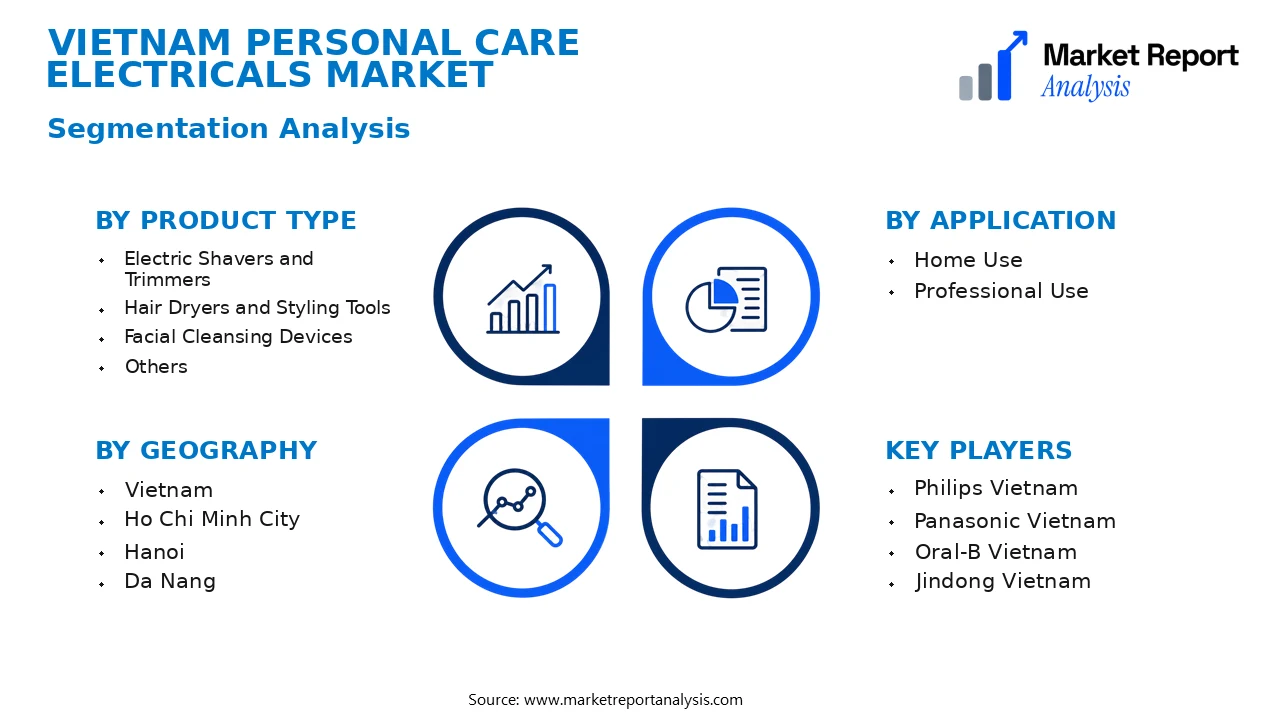
- Product Type
- Electric Shavers and Trimmers: This segment includes devices primarily used for grooming and personal hygiene, experiencing increasing demand driven by rising awareness of personal grooming and the adoption of modern grooming practices among Vietnamese consumers.
- Hair Dryers and Styling Tools: Encompasses a broad spectrum of hair care appliances, which are essential for daily styling routines. The growth is bolstered by rising urbanization and expanding middle-class demographics focusing on personal appearance.
- Facial Cleansing Devices: This category covers tech-enabled facial cleansing gadgets that are gaining popularity among health-conscious consumers seeking advanced skincare solutions in Vietnam's evolving beauty market.
- Others: Includes miscellaneous electrical personal care devices such as epilators and beard trimmers, which cater to specialized grooming needs and niche consumer preferences, with steady growth prospects.
- Application
- Home Use: Dominates the application segment, with increased adoption of electrical personal care devices in Vietnamese households due to rising disposable incomes and heightened awareness about personal grooming standards.
- Professional Use: Comprised of devices used in salons and barber shops, driven by the expansion of the beauty and wellness industry in major Vietnamese urban centers.
- Geography
- Vietnam: The primary market analyzed within Vietnam, encompassing key urban and emerging regions, characterized by diverse consumer preferences, infrastructure, and income levels that influence the adoption of electrical personal care products.
- Ho Chi Minh City: The economic hub of Vietnam, exhibiting significant demand for advanced personal care electricals due to its large population, high urbanization rate, and a growing preference for premium grooming products.
- Hanoi: The political and cultural center with a rising middle class, which is increasingly adopting modern grooming devices as part of their personal care routines.
- Da Nang: An emerging city with expanding commercial activities and a youthful population, presenting growth opportunities for personal care electricals in retail and professional sectors.
- Hai Phong: Industrial growth and urban development contribute to rising demand in this port city, alongside a burgeoning middle-class market for grooming devices.
- Can Tho: As a center in the Mekong Delta, it shows growing demand for personal care products driven by increasing disposable income and local beauty consciousness.
- Bien Hoa: Close to Ho Chi Minh City, this city benefits from industrial and residential growth, fostering a supportive environment for the electrical personal care market expansion.
- Nha Trang: A key tourist destination where demand is driven both by locals seeking personal grooming solutions and the hospitality industry upgrading its grooming facilities.
Competitive Intelligence
The Vietnam Personal Care Electricals Market exhibits a moderately concentrated competitive landscape, with key domestic and international players such as Philips, Panasonic, and local brands like Kangaroo dominating the sector. Major companies adopt aggressive strategies focusing on product innovation, with a significant emphasis on ergonomic design, energy efficiency, and smart technology integration to meet rising consumer demands. Partnerships and collaborations are common; for instance, joint ventures between foreign firms and Vietnamese distributors aim to strengthen market footholds, while strategic acquisitions facilitate rapid expansion, particularly in emerging urban centers like Hanoi and Ho Chi Minh City. Companies are investing heavily in R&D to develop eco-friendly and technologically advanced products that differentiate their offerings. Market players also pursue regional expansion, leveraging Vietnam’s growing middle class and urbanization trends to increase sales. Innovation driven by consumer preferences for premium, multi-functional devices reinforces competitive differentiation. Overall, the emphasis on localized product customization and strategic alliances underpins the competitive strategies aimed at capturing a larger share of Vietnam’s expanding personal care electricals market.
Leading Company Profiles
The Vietnam personal care electricals market is characterized by a competitive landscape featuring several key players recognized for their innovation, broad product portfolios, and strategic market positioning aimed at capturing rising domestic demand.
- Philips Vietnam
- Panasonic Vietnam
- Oral-B Vietnam
- Jindong Vietnam
- Bruno Vietnam
- Samsung Electronics Vietnam
- Sony Vietnam
- Gobaltech Vietnam
- Luxor Vietnam
- Sharp Vietnam
Philips Vietnam
Philips Vietnam is renowned for its diverse portfolio of personal care electricals, including electric shavers, hair dryers, and skincare devices, driven by innovation and strategic consumer engagement aimed at the Vietnamese market.
Panasonic Vietnam
Panasonic Vietnam specializes in advanced personal care appliances such as epilators, trimmers, and humidifiers, leveraging technological innovation and sustainability initiatives to strengthen its market presence locally.
Oral-B Vietnam
Oral-B Vietnam leads in electric toothbrushes and oral healthcare devices with a focus on health innovation, appealing to health-conscious consumers and investing heavily in digital marketing campaigns.
Jindong Vietnam
Jindong Vietnam offers a broad range of personal grooming devices including hair clippers and shavers, supported by robust supply chain integration and strategic collaborations within the domestic electronics sector.
Bruno Vietnam
Bruno Vietnam provides premium hair care and styling appliances, emphasizing ergonomic design, product reliability, and localized marketing approaches to capture emerging middle-income segments.
Samsung Electronics Vietnam
Samsung Vietnam's extensive range of personal care electricals includes facial cleansing devices and multifunctional grooming systems, with a strategic emphasis on smart technology integration and connected devices.
Sony Vietnam
Sony Vietnam focuses on personal grooming electronic devices like shavers and skincare tools, highlighting innovative technology and premium product positioning tailored for tech-savvy Vietnamese consumers.
Gobaltech Vietnam
Gobaltech Vietnam is emerging through its focus on affordable yet innovative personal care electricals, emphasizing R&D investment, local manufacturing, and competitive pricing strategies to boost market share.
Luxor Vietnam
Luxor Vietnam specializes in personal grooming devices including epilators and hair steamers, leveraging quality manufacturing and strategic distribution partnerships to expand its market footprint across urban centers.
Sharp Vietnam
Sharp Vietnam offers technologically advanced personal care electricals such as facial steamers and trimmers, focusing on innovation, branding, and expanding retail presence to attract a broad consumer base.
Strategic Business Developments

- April 2023 – Philips Vietnam – Launched new AI-powered electric shavers – Enhances user experience and drives segment growth.
- June 2023 – Panasonic Vietnam – Invested in expanding R&D facilities – Aims to accelerate local innovation and product customization for Vietnam consumers.
- August 2023 – Oral-B Vietnam – Partnered with local clinics for oral health campaigns – Strengthens brand presence and educates consumers on oral healthcare.
- September 2023 – Samsung Electronics Vietnam – Announced a new connected grooming device line – Focuses on smart, IoT-integrated personal care appliances.
- October 2023 – Gobaltech Vietnam – Acquired a local electronics manufacturing firm – Enhances supply chain control and cost competitiveness in personal care segment.
Frequently Asked Questions
What is the Vietnam Personal Care Electricals Market?
The Vietnam Personal Care Electricals Market encompasses the production, distribution, and sales of electrical devices used for personal grooming and skincare, including electric shavers, hair dryers, epilators, and facial cleansing devices, serving a growing consumer demand driven by urbanization and rising disposable income.
What is the current market size of Vietnam Personal Care Electricals Market?
As of 2026, the market size is estimated at approximately USD 1.2 Billion, reflecting a steady growth trajectory owing to increasing adoption of modern personal care devices and expanding retail channels across Vietnam’s urban centers.
What factors are driving the Vietnam Personal Care Electricals Market?
Key drivers include rising awareness of personal grooming, technological advances in device design, urban middle-class expansion, and the influence of social media on beauty trends, alongside favorable regulations and increasing penetration of e-commerce platforms facilitating wider access to innovative products.
Which Vietnamese city leads the Vietnam Personal Care Electricals Market?
Ho Chi Minh City stands out as the leading market hub owing to its large population, higher income levels, and greater retail infrastructure, which collectively foster a robust demand for premium and innovative personal care electrical products.
Which segment is expected to grow the fastest?
The facial cleansing devices segment is projected to experience the fastest growth owing to rising consumer focus on skincare, technological improvements, and a trend towards at-home routines, paired with increasing product availability driven by e-commerce channels.
Who are the leading companies operating in the Vietnam Personal Care Electricals Market?
Leading market players include global brands such as Philips, Braun, Panasonic, and local distributors expanding their portfolios with innovative, affordable personal care electrical devices tailored to Vietnamese consumer preferences.
Analyst Perspective
The Vietnam Personal Care Electricals Market is poised for long-term growth driven by rising disposable incomes, urbanization, and increasing awareness of personal grooming standards. As consumer sophistication develops, technological innovation will be critical, with smart and energy-efficient devices gaining prominence. Investment priorities should focus on expanding distribution channels in burgeoning urban centers such as Ho Chi Minh City and Hanoi while fostering local manufacturing to reduce costs and improve affordability. The competitive landscape is intensifying as global brands enter the market, compelling local players to innovate and differentiate through product features and digital engagement. City-level growth potential varies, with Ho Chi Minh City and Hanoi offering the most robust prospects due to higher middle-class populations and urban infrastructure. On a strategic level, local manufacturers should consider technological upgrades aligned with sustainability trends and digital marketing strategies that target tech-savvy urban consumers. Long-term success will depend on agility in responding to evolving consumer preferences and technological advancements, solidifying Vietnam’s position as a key player in the regional personal care electricals market.
