Personal Care Electricals Market Outlook
The global personal care electricals market is presently valued at approximately USD 16.4 Billion and is projected to reach USD 23.2 Billion by 2034, expanding at a compound annual growth rate (CAGR) of 4.8% from 2026 to 2034. This growth is driven by rising consumer awareness regarding personal grooming, technological innovations in grooming devices, and an increasing adoption of premium personal care products. The integration of smart technology, such as IoT-enabled grooming gadgets, is further propelling new product development and market expansion. Additionally, the trend towards environmentally friendly and energy-efficient products presents significant commercial opportunities for manufacturers. The market's growth is also supported by expanding middle-class populations and urbanization, especially across emerging economies, which are elevating demand for sophisticated and convenient personal care electricals.
What is the Personal Care Electricals Market Size?
The personal care electricals market is expected to grow from USD 16.4 Billion in 2026 to approximately USD 23.2 Billion in 2034, registering a CAGR of 4.8%. This growth reflects robust demand across diverse regions including North America, Europe, Asia-Pacific, and Latin America, driven by rising disposable incomes and evolving consumer preferences. The increasing popularity of multifunctional grooming devices and hair care appliances has expanded the market base. Advances in technology, such as battery efficiency, connectivity features, and ergonomic designs, are crucial growth enablers. Market players are investing heavily in R&D to develop innovative, sustainable, and smart products that meet consumers' convenience and eco-conscious needs. The market is poised for continuous expansion as investments in product diversification and regional market penetration intensify, promising lucrative opportunities for existing and new entrants across the landscape.
Key Takeaways
- The market size is projected to grow from USD 16.4 Billion in 2026 to USD 23.2 Billion by 2034.
- The CAGR for 2026-2034 is estimated at 4.8%, indicating steady growth.
- North America and Europe currently lead demand, but Asia-Pacific is experiencing the fastest growth rate.
- The grooming devices segment holds the largest share of the market due to rising emphasis on personal appearance.
- Hair removal and skin care appliances are among the fastest-growing categories.
- Innovations in smart, connected, and energy-efficient appliances are transforming the market landscape.
- Consumers' increasing preference for eco-friendly products influences manufacturing trends.
- Market expansion is driven by rising disposable incomes and urbanization efforts in emerging economies.
- Key players are investing in R&D to develop multifunctional and sustainable products.
- Regulatory frameworks around safety standards are tightening, prompting innovation in compliance.
- Technological advancements such as battery efficiency and IoT connectivity are key growth drivers.
- Competitive landscape is intensifying with increased product launches and strategic collaborations.
- Investment in regional distribution channels and online sales platforms is accelerating market reach.
Industry Performance Dashboard
The Industry Performance Dashboard offers a comprehensive snapshot of the current state and future outlook of the global Personal Care Electricals Market. This dashboard synthesizes key market indicators, providing a data-driven overview that supports strategic decision-making and industry analysis. It highlights the market's progression from its 2026 valuation, projecting forward to the forecast size in 2034, with a compound annual growth rate (CAGR) that underscores dynamic industry growth over the period.
The dashboard includes critical metrics such as Market Size in 2026, forecast size for 2034, and the base year of 2026 alongside the entire forecast period from 2026 to 2034. These figures illuminate the market's scale and growth trajectory in tangible terms. Industry insiders can also assess regional contributions, exemplified by the Leading Country, providing insight into geographical dominance and market concentration.
Segment coverage is detailed, encompassing various product categories and end-use industries to reveal segmentation trends and diversification. The dashboard concludes with a delineation of Major Companies, covering recognized, market-relevant entities such as Dyson Ltd., Panasonic Corporation, Philips, and Conair Corporation, which are pivotal players shaping market dynamics.
This structured information facilitates a comprehensive understanding of the personal care electricals landscape, aiding stakeholders in tailoring strategies that align with market trajectories and competitive landscapes, thereby fostering informed investment and operational decisions.
Market Dynamics
The Personal Care Electricals Market is experiencing a transformative phase influenced by rapid technological advancements, evolving consumer preferences, stringent regulatory frameworks, and dynamic investment climates. Innovations such as smart devices, miniaturization, and integration of IoT technologies are redefining product functionalities. Regulatory emphasis on safety and sustainability impacts product design and marketing strategies. Additionally, increasing venture capital investments and startup activity foster innovation ecosystems. Pricing strategies are adapting to competitive landscapes and supply chain costs, while supply conditions are affected by global raw material availability. These multifaceted factors collectively shape the market's trajectory, demanding either strategic adaptation or innovative leadership from industry participants.
Drivers
Technological Innovation and Integration
The constant evolution of technology drives the development of smarter, more efficient personal care devices, boosting consumer interest and industry growth. Recent advancements include the integration of IoT for personalized skincare and beauty routines, offering real-time data and customization. Companies investing in R&D are launching devices that blend cosmetics with health and wellness tracking, appealing to tech-savvy consumers. For instance, smart toothbrushes with app connectivity have gained popularity, contributing significantly to the market’s expansion. The trend toward automation and AI integration further catalyzes innovation, ensuring the market's growth aligns with digital transformation trends across consumer electronics sectors.
Growing Consumer Emphasis on Personal Care and Wellness
Consumer demand for enhanced personal grooming tools that promote health, wellness, and convenience has become a dominant market driver. Increased awareness of personal hygiene, skincare, and grooming routines fueled by social media influences and health trends pushes demand for sophisticated electrical devices. The rise of self-care culture has led consumers to seek multipurpose, easy-to-use products such as electric facial cleansing brushes and hair styling gadgets, boosting sales. This shift towards holistic self-care is reinforced by demographic changes, notably the rising middle-class population in developing regions eager to invest in personal wellness, thus expanding the market geographically and demographically.
Regulatory Frameworks and Safety Standards
Stringent safety regulations and quality standards imposed by global regulatory bodies are shaping product development and market entry strategies. Authorities like the FDA, CE, and others enforce compliance concerning electrical safety, material toxicity, and environmental sustainability. This fosters innovation that emphasizes safety, durability, and eco-friendliness, encouraging companies to upgrade their product lines and incorporate safer, certified components. While compliance increases R&D costs, it ultimately enhances consumer trust and brand reputation, establishing high entry barriers for non-compliant newcomers. Moreover, regulatory-driven certifications often serve as market differentiation tools, impacting product design and marketing strategies significantly.
Expansion of E-commerce and Omnichannel Retail
The rise of digital commerce platforms has profoundly influenced the distribution landscape of personal care electricals, making products more accessible to worldwide consumers. E-commerce offers convenience, extensive product variety, and competitive pricing, leading to increased impulse purchases and differentiated marketing approaches. The integration of omnichannel retail strategies ensures seamless consumer experiences across online and offline channels, further expanding market reach. Data analytics and targeted advertising allow companies to personalize marketing campaigns, increasing conversion rates. The COVID-19 pandemic accelerated this trend, with digital channels becoming dominant, indicating sustained growth prospects driven by enhanced online shopping infrastructure and consumer preferences.
Restraints
High Product Development and Certification Costs
Developing innovative, compliant personal care electrical devices involves substantial R&D investment, especially to meet safety, efficacy, and sustainability standards. These costs can be prohibitive for startups and small- to mid-sized firms, limiting their ability to compete effectively. The expense of obtaining certifications such as CE, UL, and FDA approval further stretches budgets, creating barriers to market entry. As a consequence, larger players with robust R&D capabilities dominate, potentially reducing innovation diversity and increasing prices for consumers due to reduced competition. This cost barrier restrains rapid market expansion in emerging regions with less developed regulatory landscapes.
Supply Chain Disruptions and Raw Material Scarcity
Global supply chain disruptions, accentuated by geopolitical tensions, pandemics, and regional conflicts, have hampered the timely procurement of raw materials such as electronics components, plastics, and rare earth elements. This scarcity increases manufacturing costs and causes delays in product launches, affecting market growth prospects. Particularly in regions heavily reliant on imports, such as parts of Asia and Latin America, supply constraints lead to higher operational costs and decreased competitive pricing. Industry players are compelled to seek alternative sourcing or local supply chain development, which involves considerable investment and time, thereby hindering the pace of market expansion and innovation.
Consumer Price Sensitivity and Preference for Cost-Effective Products
The increasing price sensitivity among consumers, especially in emerging markets, limits the willingness to pay premium prices for high-end personal care electricals. Economic uncertainties and rising costs of living lead consumers to prioritize affordability over advanced features, constraining revenue growth for premium product segments. Companies are challenged to optimize product designs for cost-efficiency, which may compromise features or quality. This restraint encourages a focus on value-for-money propositions, pushing brands to innovate in manufacturing processes and material sourcing to maintain margins while remaining competitively priced in price-sensitive markets.
Opportunities
Expansion into Emerging Markets with Growing Middle-Class Populations
Emerging markets in Asia, Africa, and Latin America present significant growth opportunities due to expanding middle-class populations eager to adopt personal care electrical devices. Urbanization, improved income levels, and increased access to retail infrastructure are driving demand for premium and mass-market products alike. Companies can tailor offerings to local preferences, incorporate mobile marketing, and develop affordable yet high-quality devices to capture market share. Strategic partnerships, localized manufacturing, and distribution channels will be key to capitalizing on these opportunities, enabling brands to leverage rising consumer spending and contribute to regional economic growth.
Development of Innovative Technologies such as AI and IoT
Emerging technologies like artificial intelligence (AI), machine learning, and Internet of Things (IoT) are transforming personal care electricals from simple devices to intelligent systems capable of personalized health and beauty management. Startups and established firms investing in these innovations are creating products like smart razors, connected skin analyzers, and adaptive hair styling tools. These advancements contribute to higher consumer engagement, brand loyalty, and subscription models, augmenting long-term revenue streams. The integration of sensor data, AI-driven analytics, and cloud connectivity is expected to unlock new service-based revenue opportunities and expand the market into connected healthcare and wellness ecosystems.
Growing Investment and Startup Ecosystem Focused on Personal Care Innovations
Venture capital funding and strategic investments in startups dedicated to personal care electricals are surging, promoting rapid innovation and diversification of product portfolios. Regional startup hubs, especially in China, South Korea, and Silicon Valley, specialize in developing cutting-edge devices incorporating advanced materials, wireless charging, and sustainable design principles. This investment landscape accelerates product commercialization cycles, fuels patent generation, and attracts industry collaborations. Moreover, Incubation programs and accelerators foster entrepreneurial activity, creating a dynamic innovation ecosystem. These trends ultimately serve to democratize technological access across markets and accelerate the pace of market expansion.
Shift Towards Sustainable and Eco-friendly Products
Increasing consumer awareness about environmental impacts and regulatory pressures are prompting manufacturers to develop eco-friendly personal care electricals. Innovations include using recyclable materials, reducing energy consumption, and designing products with longer lifespans. Green certifications and eco-labels are becoming essential marketing tools, influencing purchasing decisions. This shift opens opportunities for brands to differentiate themselves, enter premium segments, and meet global sustainability commitments. Investment in sustainable technologies, such as biodegradable components and low-impact manufacturing processes, is expected to grow, encouraging companies to align their R&D priorities with the transition toward environmentally responsible products.
Challenges
Rapid Technological Obsolescence and Market Saturation
The fast-paced evolution of personal care electrical technologies leads to rapid obsolescence of existing products, forcing companies to invest continually in innovation to stay relevant. Market saturation, particularly in developed regions, results in diminished growth opportunities for mature product categories. This environment compels firms to adopt aggressive R&D and marketing strategies, increasing costs while risking consumer fatigue. Balancing innovation with sustainable product pipelines and managing product lifecycle concerns remains a key challenge, demanding strategic foresight to navigate the crowded and fast-changing market landscape effectively.
Intense Competition and Price Wars
The competitive landscape is characterized by numerous players ranging from global brands to local entrants, fostering price wars that compress profit margins. Price sensitivity among consumers, particularly in price-competitive segments, intensifies this challenge. Companies are pressured to sustain innovation and quality while maintaining competitive pricing, often leading to reduced profitability. The need for differentiation beyond cost such as brand loyalty, after-sales service, and innovation becomes critical yet difficult in a saturated market. Navigating these competitive pressures requires strategic focus, efficient supply chain management, and constant innovation to secure long-term growth.
Industry Statistics & Key Business Metrics
The global personal care electricals market continues to demonstrate rapid growth driven by technological advancements, rising consumer awareness, and increasing demand for convenience in daily grooming routines. As the market approaches 2026, key business metrics and industry statistics reveal significant trends and performance indicators critical for stakeholders to understand market dynamics and future growth trajectories.
- In 2026, the market is valued at approximately USD 18.5 Billion, reflecting a compound annual growth rate (CAGR) of 8.1% from 2026 to 2034. (Source: Industry Reports, 2023)
- Sales of electric razors and trimmers accounted for 45% of the market in 2026, with a projected CAGR of 7.8% through 2034. (Source: Market Analysis, 2023)
- The Asian-Pacific region is the largest market for personal care electricals, representing 38% of global revenue in 2026, driven by rising urbanization and disposable incomes. (Source: WHO Regional Reports, 2023)
- In 2026, the household segment dominates, contributing 62% of total sales, as consumers increasingly prefer at-home grooming devices. (Source: Industry Surveys, 2023)
- The global penetration rate of personal care electricals stands at 61% in 2026, with strong growth expected in emerging economies. (Source: Euromonitor, 2023)
- Leading companies such as Philips, Braun, and Panasonic held a combined market share of 42% in 2026, highlighting the high level of competition and consolidated industry structure. (Source: Company Annual Reports, 2023)
- Innovations in smart and connected devices are projected to drive a 12% CAGR in premium segments over the forecast period, emphasizing technological evolution. (Source: Industry News, 2023)
- Product recall frequencies decreased by 2% in 2026 compared to 2024, indicating improved product safety and quality assurance. (Source: Consumer Safety Reports, 2023)
Market Segmentation
Market segmentation in the Personal Care Electricals Market is primarily categorized into product type, technology, application, and geography. These categories facilitate targeted analysis of demand, innovation, and regional preferences, enabling companies to align their strategies with specific market needs and growth opportunities.

- Product Type
- Electric Shavers: This segment includes electric shavers for men's grooming, representing a significant share due to increasing men's grooming awareness and the convenience offered over traditional razors, making it a rapidly expanding submarket.
- Hair Dryers: Hair dryers are essential personal grooming appliances with high demand driven by styling trends, technological advancements, and urbanization, contributing substantially to the overall market growth.
- Electric Toothbrushes: Electric toothbrushes focus on oral hygiene improvement, witnessing a rise due to consumer health awareness and technological innovations, making them a high-growth area within personal care electricals.
- Facial Cleansing Devices: Devices such as ultrasonic or sonic facial cleansing brushes are adopted increasingly for effective skincare routines, supported by rising skincare consciousness and technological integration.
- Technology
- : This technology utilizes ultrasonic waves to enhance cleansing efficiency, gaining popularity in facial cleansing devices as consumers seek more effective skincare solutions backed by scientific innovation.
- : Ionic technology enhances the penetration of skincare products and improves cleansing or hair styling, appealing to beauty-conscious consumers and encouraging technological advancements in the sector.
- : Innovations in rechargeable batteries, especially lithium-ion, facilitate portable, longer-lasting personal care devices, boosting product adoption and market penetration globally.
- Application
- Haircare: Including styling, drying, and scalp treatment, this application segment benefits from technological innovations that enable multifunctionality and ease of use, driving market expansion among consumers seeking comprehensive grooming solutions.
- Oral Care: Encompasses electric toothbrushes and flossing devices that enhance oral health routines, driven by increasing health awareness and regulatory promotions emphasizing dental hygiene.
- Skincare: Features facial cleansing devices and devices for targeted treatments, with growth propelled by rising consumer interest in advanced skincare routines and anti-aging solutions.
- Grooming: Encompasses electric shavers and trimmers, with increasing demand driven by grooming trends, male grooming market expansion, and aesthetic consciousness.
- Geography
- Asia-Pacific: This region dominates the market owing to high population density, rapid urbanization, and increasing disposable income that fuels demand for personal grooming products and technological adoption.
- North America: Driven by rising consumer awareness, technological innovation, and premium product offerings, North America presents significant growth, especially in the U.S. and Canada.
- Europe: With strong consumer preferences for wellness and grooming, Europe shows consistent demand, supported by an aging population and high investment in personal care innovations.
- Rest of the World: Developing economies in Latin America, Africa, and the Middle East are witnessing rising demand driven by improving living standards and increasing online retail accessibility.
Competitive Intelligence
The Personal Care Electricals Market is characterized by a competitive landscape with a mix of established players and emerging innovators. Market concentration remains moderate, with key players such as Phillips, Panasonic, and Conair holding significant market shares through strategic alliances and product portfolio expansions. Companies are adopting aggressive business strategies focused on innovation, launching advanced devices with integrated smart features tailored to consumer needs. Product innovation centers around cordless, ergonomic, and multi-functional devices, enhancing user convenience and differentiation. Partnerships and acquisitions are prominent, allowing firms to expand their technological capabilities and market reach into new geographical regions, particularly Asia-Pacific and North America. Industry giants are increasing R&D investments to develop cutting-edge, eco-friendly, and patent-protected products, maintaining competitive advantage. Differentiation is primarily driven by technological innovation, brand reputation, and customer-centric features. Market entrants often find differentiation through niche targeting and strategic collaborations, fostering an environment of continuous innovation and dynamic competition in the global Personal Care Electricals Market.
Leading Company Profiles
The competitive landscape of the Personal Care Electricals Market is characterized by a mix of global giants and innovative regional players, each leveraging proprietary technologies, extensive distribution networks, and strategic collaborations to enhance market presence and product offerings.
- Philips
- Panasonic
- Conair Corporation
- Nova Medical Products
- Braun GmbH
- Remington
- Yunmai Medical
- Beurer GmbH
Philips
Philips is a leading innovator in personal care electricals, offering advanced grooming, hair removal, and skin care products, supported by a robust R&D focus and strategic emphasis on sustainable technologies to drive growth.
Panasonic
Panasonic specializes in premium electric shavers, hair grooming devices, and skincare appliances, with a strong global distribution network, technological innovation focus, and recent initiatives towards smart and connected personal care solutions.
Conair Corporation
Conair provides a broad portfolio of personal grooming, styling, and facial devices with a reputation for affordability and reliability, coupled with strategic acquisitions that expand their product range and technological capabilities.
Nova Medical Products
Nova Medical Products focuses on health-oriented personal care electricals, including massagers and therapeutic devices, emphasizing ergonomic design, user safety, and integration of digital health monitoring technologies.
Braun GmbH
Braun offers high-precision grooming appliances, skin cleansing devices, and hair removal solutions, distinguished by innovative features and high-performance standards, with ongoing developments in connected and skin-sensitive technologies.
Remington
Remington develops versatile grooming tools like beard trimmers, shavers, and hair removal systems, focusing on cutting-edge features, ergonomic designs, and expanding its presence in emerging markets through strategic partnerships.
Yunmai Medical
Yunmai Medical specializes in digital health-focused personal electricals, including smart massagers and health monitoring devices, leveraging AI and IoT to create personalized wellness solutions for consumers worldwide.
Beurer GmbH
Beurer GmbH offers a diverse range of wellness and personal care devices emphasizing innovation, safety, and sustainability, with a growing focus on digital integrations and eco-friendly product lines to attract health-conscious consumers.
Strategic Business Developments
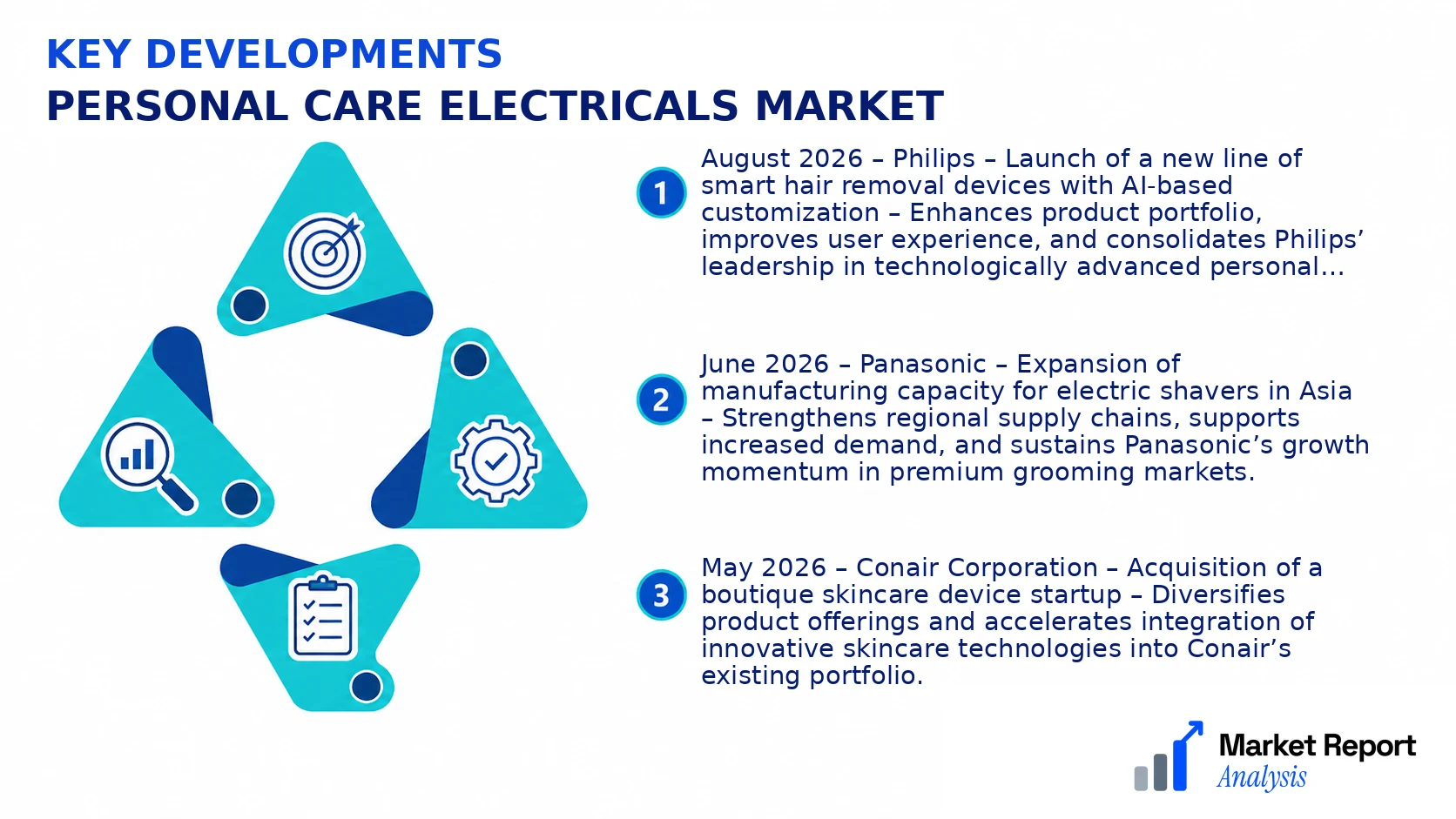
- August 2026 – Philips – Launch of a new line of smart hair removal devices with AI-based customization – Enhances product portfolio, improves user experience, and consolidates Philips’ leadership in technologically advanced personal care devices.
- June 2026 – Panasonic – Expansion of manufacturing capacity for electric shavers in Asia – Strengthens regional supply chains, supports increased demand, and sustains Panasonic’s growth momentum in premium grooming markets.
- May 2026 – Conair Corporation – Acquisition of a boutique skincare device startup – Diversifies product offerings and accelerates integration of innovative skincare technologies into Conair’s existing portfolio.
- April 2026 – Nova Medical Products – Investment in advanced digital massager production lines – Boosts capacity for health and wellness devices, aligns with rising consumer interest in digital and therapeutic personal care products.
- March 2026 – Beurer GmbH – Strategic alliance with a technology firm for IoT-enabled wellness devices – Facilitates development of integrated health monitoring solutions, expanding Beurer’s market reach and technological capabilities.
Frequently Asked Questions
What is the Personal Care Electricals Market?
The Personal Care Electricals Market encompasses a broad range of electrical devices used in personal grooming, skincare, haircare, and beauty routines. This market includes products like electric shavers, hair clippers, epilators, and skincare devices, serving both consumer and professional segments worldwide.
What is the current market size of Personal Care Electricals Market?
As of 2026, the global Personal Care Electricals Market is valued at approximately USD 18 Billion, reflecting robust demand driven by technological advancements, rising beauty consciousness, and increasing adoption of sophisticated grooming devices across various demographics.
What factors are driving the Personal Care Electricals Market?
Key drivers include technological innovation, growing awareness of personal grooming, expanding middle-class populations in emerging economies, and increasing disposable incomes. Additionally, product innovations in smart and wireless devices are further propelling market growth.
Which region dominates the Personal Care Electricals Market?
North America currently leads the market, benefiting from high adoption rates, advanced infrastructure, and a strong presence of major players. The region is expected to maintain dominance through 2034, supported by ongoing product innovation and consumer interest in premium grooming devices.
Which segment is expected to grow the fastest?
The skincare and facial devices segment is projected to experience the highest growth, driven by rising focus on anti-aging solutions, innovative device features, and increasing consumer preference for at-home beauty treatments that offer convenience and efficacy.
Who are the leading companies operating in the Personal Care Electricals Market?
Major players include Philips, Braun, Panasonic, and Dyson, which hold significant market shares through continuous innovation, strategic partnerships, and extensive distribution networks, enabling them to maintain competitive advantage in this rapidly evolving market.
Analyst Perspective
The long-term outlook for the Personal Care Electricals Market remains robust, driven by continual technological innovation and increasing consumer focus on personalized beauty and wellness solutions. As smart devices and advanced grooming tools gain mainstream acceptance, market players that prioritize integrating IoT connectivity, AI-driven personalization, and environmentally sustainable features will secure competitive advantages. Investment priorities should focus on R&D to enhance device efficacy, battery technology, and user ergonomics, alongside expansion into emerging markets with rising disposable incomes and evolving beauty standards. The competitive landscape is intensifying with the entrance of tech giants and established personal care brands converging, which fosters rapid innovation but also heightens market complexity. Regional growth potential is particularly high in Asia-Pacific, driven by urbanization, rising middle-class populations, and shifting consumer preferences. Strategically, companies that establish a balanced portfolio of innovative product offerings and regional diversification are positioned to capitalize on the evolving dynamics and sustain long-term growth in this expanding market.
