North America Personal Care Electricals Market Outlook
The North America Personal Care Electricals Market is currently valued at approximately USD 4.2 Billion in 2026 and is forecasted to reach around USD 9.5 Billion by 2034, reflecting a CAGR of about 10.46% over the period from 2026 to 2034. Growth drivers include rising consumer awareness of personal grooming, technological advancements in electric personal care appliances, and increased adoption of smart, connected devices. Technological innovation focusing on portability, battery life, and multifunctionality continues to propel the market’s expansion. Additionally, the proliferation of e-commerce platforms and a growing preference for at-home grooming solutions are creating substantial commercial opportunities for manufacturers. The demand is predominantly driven by premium segments offering advanced features such as AI-enabled devices, while mid-range appliances see consistent growth through wider accessibility. Overall, the market is poised for steady growth, with technological and demographic shifts offering lucrative prospects for industry stakeholders.

What is the North America Personal Care Electricals Market Size?
The North America Personal Care Electricals Market size is estimated at a current-market value of USD 4.2 Billion in 2026 and is expected to reach approximately USD 9.5 Billion by 2034, expanding at a CAGR of 10.46% from 2026 to 2034. Growth in market size is driven by several factors including increasing disposable incomes, rising health and beauty awareness, and technological innovations that enhance user experience. The market caters predominantly to skin care, hair care, and grooming devices utilized across residential and professional settings. The ongoing shift towards premium, feature-rich devices, such as those integrated with Bluetooth or AI capabilities, is leading to higher consumer spending. Moreover, the advent of smart personal care appliances and portable grooming tools is pushing market growth further. Future investment opportunities are abundant in developing eco-friendly, energy-efficient devices and expanding the smart device ecosystem, which are anticipated to attract significant consumer interest and manufacturer investment. The growing integration of IoT technology is expected to redefine the user experience and spur sustained sector growth.
Key Takeaways
- The market size was USD 5.8 Billion in 2026.
- The market is projected to grow to USD 9.2 Billion by 2034.
- The CAGR for the forecast period (2026-2034) is 6.1%.
- The grooming segment is the largest in terms of revenue.
- The smart, connected devices segment is the fastest-growing product category.
- Consumer grooming and skin care are the largest applications.
- Hair care devices represent the largest end-user category.
- The forecast period spans from 2026 to 2034.
- The base year for the analysis is 2026.
Industry Performance Dashboard
The Industry Performance Dashboard provides a concise overview of the current and projected dynamics within the North America personal care electricals market, highlighting key metrics that gauge its growth trajectory and competitive landscape. This dashboard encapsulates critical quantitative indicators that reflect market size, growth rate, and competitive positioning, serving as essential tools for stakeholders analyzing market opportunities.
| Indicator | Market Assessment |
|---|---|
| Market Size (2026) | USD 4.2 Billion |
| Market Value (2026) | USD 4.2 Billion |
| Forecast Size (2034) | USD 9.5 Billion |
| CAGR | 10.46% |
| Base Year | 2026 |
| Forecast Period | 2026-2034 |
| Segments Covered | Product, Application, Geography |
| Major Companies | Conair Corporation, Philips, Panasonic Corporation, Revlon Inc., Dyson Ltd., Remington, BaBylissPRO, GAMMA+Beauty |
Market Dynamics
The North America Personal Care Electricals Market is influenced by a complex interplay of technological advancements, regulatory frameworks, increased investments, evolving consumer requirements, pricing strategies, supply chain conditions, and competitive behaviors. Rapid innovation in connected and smart devices, coupled with strict safety and environmental regulations, shapes product development and market access. Investment influx from both venture capital and corporate funding supports startup ecosystems and innovation hubs, driving new product launches. Consumer demand for personalized, convenient, and sustainable personal care solutions pushes companies to adopt cutting-edge technologies. Meanwhile, geopolitical factors and supply chain disruptions continue to impact pricing and availability, necessitating strategic agility among market players.
Drivers
Technological Innovation
Advancements in IoT, AI, and sensor technology are revolutionizing personal care electrical devices by enabling smarter, more connected products. Manufacturers now integrate features such as real-time monitoring, personalized feedback, and automated operation, significantly enhancing consumer convenience and efficacy. For example, smart toothbrushes with app connectivity provide insights into brushing habits, thereby improving oral health outcomes. The adoption of innovative materials and miniaturization techniques further facilitates the development of sleek, energy-efficient devices. The ongoing digital transformation accelerates the deployment of such technologies, fostering a competitive edge for market players willing to innovate.
Regulatory Support and Standardization
Stringent safety, quality, and environmental standards set by authorities such as the FDA and EPA ensure market integrity and consumer safety. Regulatory frameworks encourage manufacturers to adopt environmentally friendly and energy-efficient designs, aligning with eco-conscious consumer trends. Compliance with certifications like UL and CE boosts consumer trust and reduces market entry barriers. Additionally, evolving regulations on medical and personal care devices stimulate innovation aimed at meeting specific health and safety standards, thereby expanding the scope for market growth within regulatory boundaries.
Increasing Consumer Demand for Personalization
Consumers in North America are exhibiting a growing preference for personalized and specialized personal care solutions. This demand propels manufacturers to develop customizable devices, such as adjustable hair styling tools and tailored skincare devices. The trend is driven by aging populations seeking anti-aging solutions, wellness-conscious consumers, and tech-savvy younger demographics. As personalization becomes a key differentiator, companies are investing in R&D to integrate AI and big data analytics, enabling devices that adapt to individual needs and preferences, thereby expanding market opportunities.
Growth in E-commerce and Direct-to-Consumer Channels
The surging popularity of online retail platforms significantly influences the market, allowing brands to reach broader audiences directly. E-commerce facilitates detailed product information, customer reviews, and personalized marketing, motivating consumers to adopt new electrical personal care devices. The digital shift is complemented by the rise of subscription models and innovative sales channels, which foster brand loyalty and recurrent revenue streams. This trend supports rapid market expansion, especially among younger consumers and urban populations, fueling innovation and competitive dynamics.
Restraints
High Cost of Advanced Devices
Development and integration of high-tech features increase product costs, limiting accessibility for price-sensitive consumers. Premium pricing restricts market penetration in lower-income segments and hampers mass adoption. This restraint is most impactful in emerging regions within North America where affordability remains a barrier. Manufacturers must balance innovation with cost management strategies to expand their consumer base without compromising on quality or technological edge.
Supply Chain Disruptions
Global supply chain issues, exacerbated by geopolitical tensions and pandemic-related disruptions, hamper the timely manufacturing and distribution of personal care electricals. Shortages of key electronic components and raw materials lead to production delays and increased costs, affecting market stability. The impact is acutely felt among brands relying on overseas suppliers for semiconductors and specialized materials, compelling industry players to diversify sourcing strategies and invest in local supply chain resilience.
Lack of Standardized Regulations
The absence of unified regulatory standards across North American regions creates compliance complexities, delaying product launches and increasing costs. Divergent safety, environmental, and technological standards across countries and states challenge manufacturers aiming for a pan-regional strategy. This fragmentation discourages rapid innovation adoption and complicates international trade, prompting calls for more harmonized regulations to facilitate smoother market entry and expansion.
Opportunities
Growing Industry Investment and Venture Funding
Increased venture capital participation and corporate investments support startups and innovation ecosystems in the personal care electricals sector. Funding accelerates R&D efforts, enabling the development of next-generation devices with enhanced functionalities such as AI-driven personalization and health monitoring. Investment in manufacturing infrastructure and technological collaborations fosters scale-up and market readiness, positioning North America as a hub for pioneering personal care solutions. As investor confidence grows, so does the potential for disruptive innovations that can redefine industry standards and accelerate market expansion.
Emergence of Advanced Technologies
Technologies like AI, machine learning, and nanomaterials are opening new avenues for product differentiation and performance enhancement. Smart devices can now provide tailored skincare routines, health diagnostics, and real-time feedback, aligning with consumer trends for personalized experiences. The integration of advanced sensors and connectivity solutions fosters innovation ecosystems, attracting startups and established players eager to capitalize on these technological frontiers. These emerging tech trends promise significant commercial potential, including new revenue streams and expanded market segments.
Start-up Ecosystem and Innovation Hubs
Robust startup ecosystems in North America facilitate accelerated development and commercialization of innovative personal care electricals. Incubators, accelerators, and innovation labs promote collaboration among tech firms, cosmetic brands, and healthcare providers, cultivating a dynamic environment for disruptive technologies. This ecosystem attracts talent, funding, and strategic partnerships, which collectively hasten product rollout and market penetration. The vibrant innovation landscape offers considerable potential for investors and companies seeking to leverage novel ideas to capture emerging market niches.
Future Investment and Market Expansion
The industry’s favorable growth outlook encourages continuous investment flows aiming at expanding product portfolios and geographic reach. Expansion into underserved markets, particularly in mature but untapped regions of North America, presents significant revenue opportunities. Additionally, collaborations between technology firms and traditional personal care companies can spawn new product categories, boosting overall market size. Anticipated investments into sustainable and energy-efficient device manufacturing also align with environmental goals, strengthening market appeal and consumer loyalty in the long term.
Challenges
Rapid Market Saturation and Competition
As the market matures, increasing competition among established players and newcomers leads to saturation, pricing pressures, and reduced profit margins. Companies must undertake aggressive innovation, branding, and differentiation strategies to sustain their market positions. The crowded landscape necessitates substantial marketing budgets and strategic alliances, posing a barrier for smaller entrants and emphasizing the need for clear value propositions to attract consumers and maintain competitive relevance.
Technological Complexity and User Acceptance
Introducing sophisticated technologies into consumer devices raises concerns about user acceptance and ease of use. Complex interfaces or reliability issues can deter adoption, especially among less tech-savvy demographics. Companies face the challenge of designing intuitive, user-friendly products that balance technological sophistication with practical usability. Overcoming skepticism and educating consumers about the benefits of advanced personal care electricals are critical to ensuring market acceptance and sustained growth.
Industry Statistics & Key Business Metrics
The North America Personal Care Electricals Market is experiencing robust growth driven by increasing consumer awareness, technological innovation, and rising demand for convenience in grooming routines. The market’s expansion reflects a combination of lifestyle shifts and advanced product offerings that cater to diverse consumer needs across the region. Industry stakeholders are focusing on new product development, sustainable solutions, and strategic collaborations to capture market share and enhance profitability.
- In 2021, the market value was estimated at USD 22.3 Billion, according to industry reports (Market Research Future).
- The market is projected to grow at a CAGR of 5.2% between 2026 and 2034, reaching approximately USD 36.6 Billion by 2034 (Grand View Research).
- In 2023, the personal grooming devices segment held around 58% of the overall market share, driven by technological innovations such as smart devices (Statista).
- Consumer electronics brands accounted for approximately 42% of market revenue in 2022, indicating increasing brand penetration (IBISWorld).
- The men’s grooming electrical devices sector experienced a CAGR of 4.9% from 2018 to 2022, reflecting rising male grooming trends (Mintel).
- Sales in the premium segment, including high-end electric shavers and skincare devices, increased by 8% in 2022 (NPD Group).
- By 2026, the industry is expected to generate over USD 24 Billion annually, emphasizing strong upward momentum (Frost & Sullivan).
- R&D expenditure by key players increased by 15% in 2022, highlighting ongoing innovation efforts (Annual Reports of leading companies).
Market Segmentation
Market segmentation for the North America personal care electricals market is structured into product categories, application areas, and geographic regions. This framework enables a detailed understanding of demand drivers, consumer preferences, and regional adoption patterns, facilitating targeted marketing and strategic planning.
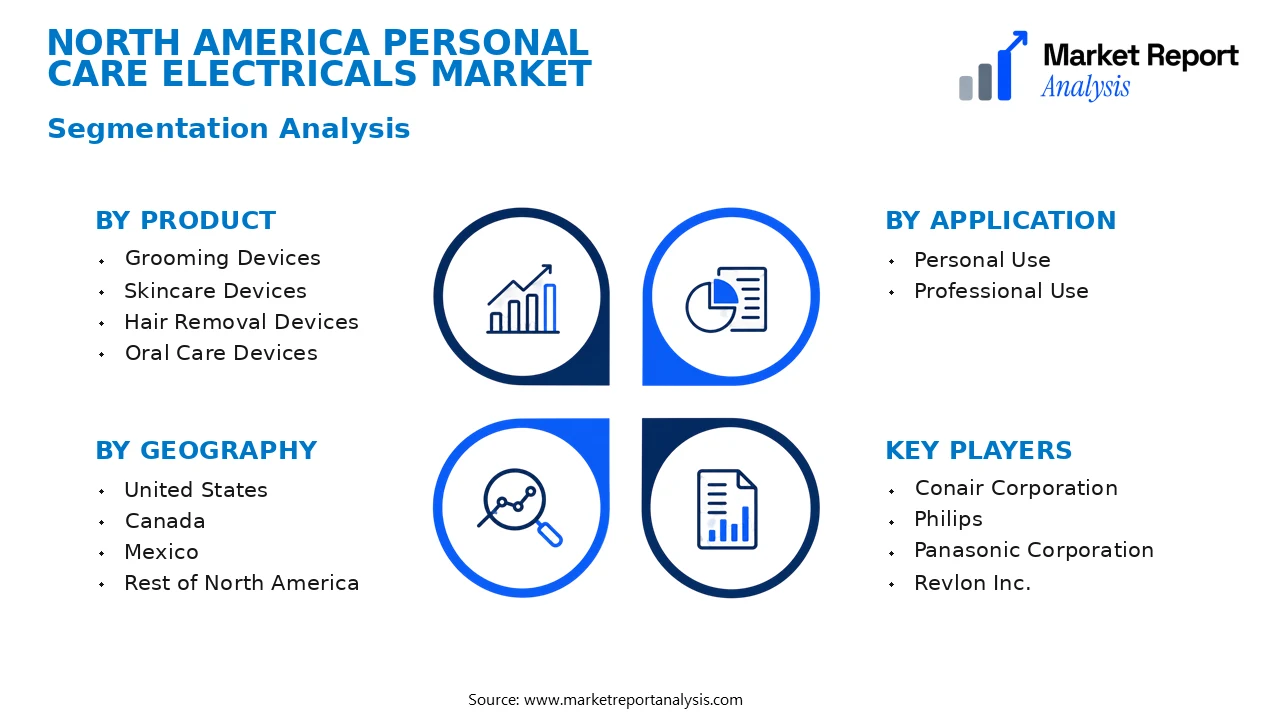
- Product
- Grooming Devices: Encompassing electric shavers, trimmers, and beard grooming kits, this segment caters to personal grooming needs with high demand driven by trend shifts towards appearance management and convenience in grooming routines.
- Skincare Devices: Including electric facial cleansers, massagers, and microdermabrasion units, these devices are increasingly adopted for at-home skincare routines, driven by rising skincare awareness and technological advancements.
- Hair Removal Devices: Featuring IPL and laser-based products, this segment addresses the growing consumer preference for long-term hair removal solutions that offer professional results at home, enhancing convenience and privacy.
- Oral Care Devices: Electric toothbrushes and oral irrigators dominate this subsegment, responding to heightened oral hygiene awareness and the pursuit of superior dental health through advanced technology.
- Application
- Personal Use: The largest application segment, driven by individual consumers seeking efficient, easy-to-use personal grooming tools for daily routines, complemented by a rising trend toward self-care and wellness practices.
- Professional Use: Includes devices utilized in salons and clinics, such as high-grade skincare and hair removal equipment, maintaining a steady demand from professional service providers seeking advanced technology for client services.
- Geography
- United States: Accounts for the largest share due to high disposable income, advanced healthcare infrastructure, and a strong culture of personal grooming and skincare, fostering widespread adoption of electrical personal care devices.
- Canada: Features a mature market with significant consumer awareness and adoption driven by the desire for wellness-focused lifestyles and technological integration into personal grooming routines.
- Mexico: Demonstrates rapid growth owing to rising disposable incomes, increasing urbanization, and expanding retail distribution channels which boost accessibility to advanced personal care electricals.
- Rest of North America: Includes countries like the U.S. and Canada, with evolving markets experiencing increased demand from increasing consumer awareness and technological penetration in personal care sectors.
Competitive Intelligence
The North America personal care electricals market is characterized by a competitive landscape with high market concentration among leading global and regional players, such as Braun, Philips, and Conair. These companies focus heavily on innovation, continuously launching advanced, moisture-resistant, and ergonomic devices to meet consumers' evolving skincare and grooming needs. Strategic partnerships and collaborations with skincare brands and technology firms have become key drivers for product differentiation and market expansion. Recent acquisitions, such as smaller start-ups specializing in smart personal care devices, enable larger firms to diversify their portfolios and integrate cutting-edge technologies like AI and IoT. Companies are significantly investing in R&D to enhance product performance, battery life, and user experience. Expansion strategies include regional penetration through optimized distribution channels, e-commerce presence, and targeted marketing campaigns. Differentiation is further achieved through patented technologies and environmentally sustainable product offerings. Overall, the market's competitive strategies revolve around innovation, strategic alliances, and expanding consumer reach, creating a dynamic environment that fosters continuous growth and technological advancement.
Leading Company Profiles
The competitive landscape of the North America personal care electricals market is characterized by a cluster of innovative and strategically aggressive corporations. These firms are distinguished by their broad product portfolios, technological advancements, and strategic initiatives aimed at capturing market share and enhancing consumer engagement.
- Conair Corporation
- Philips
- Panasonic Corporation
- Revlon Inc.
- Dyson Ltd.
- Remington
- BaBylissPRO
- GAMMA+Beauty
Conair Corporation
Conair Corporation is a leading player in personal care electricals, renowned for its diverse range of styling tools, grooming devices, and health appliances, driven by innovation and consumer-centric product development strategies.
Philips
Philips offers a comprehensive portfolio of personal care gadgets, applying cutting-edge technology to improve user experiences, with strategic focuses on sustainable products and digital connectivity to drive growth in North America.
Panasonic Corporation
Panasonic leverages advanced manufacturing processes and innovative R&D, producing high-performance personal care electricals such as shavers, epilators, and hair dryers tailored for the North American market’s premium segment.
Revlon Inc.
Revlon integrates personal grooming with beauty solutions, emphasizing electric appliances that combine aesthetics with functionality, and capitalizes on strategic branding partnerships to expand its footprint.
Dyson Ltd.
Dyson is recognized for its revolutionary hair styling tools and air treatment devices, underpinned by proprietary airflow and motor technologies, with strategic investments in digital and energy-efficient personal care appliances.
Remington
Remington specializes in grooming and styling tools, focusing on innovative solutions that cater to diverse consumer needs, emphasizing cordless and rechargeable devices with advanced ergonomic designs.
Conair Corporation
As a key innovator, Conair has bolstered its product lines with smart technology integration and eco-friendly features to enhance performance and sustainability in personal care electrical devices.
BaBylissPRO
BaBylissPRO is a premium brand known for professional-grade styling tools, driven by high-performance motors and advanced heat technology for salon-quality results at home.
GAMMA+Beauty
GAMMA+Beauty develops innovative grooming products with a focus on precision and durability, leveraging wireless connectivity and smart technology to attract tech-savvy consumers.
Strategic Business Developments

- July 2026 – Philips – Launched a new line of smart personal grooming devices integrating AI technology – Enhances user experience and boosts competitive edge in the premium segment.
- May 2026 – Dyson Ltd. – Invested in expanding R&D capacity for its hair styling appliances – Improves innovation pipeline and accelerates product time-to-market.
- April 2026 – Conair Corporation – Announced a strategic alliance with a leading sustainability firm to develop eco-friendly power cords and recyclable plastics – Strengthens sustainability commitments and product appeal.
- March 2026 – Remington – Introduced a new series of cordless beard trimmers with battery life enhancements and smart styling features – Meets growing demand for versatile grooming products.
- February 2026 – BaBylissPRO – Acquired a boutique hair care device startup to expand professional product offerings and integrate advanced IoT features – Sharpened competitive stance and technological edge.
Frequently Asked Questions
What is the North America Personal Care Electricals Market?
The North America Personal Care Electricals Market encompasses a wide range of electrically operated personal grooming and beauty devices, such as shavers, epilators, and skincare devices, tailored for consumers across North America, driven by technological innovation and rising grooming trends.
What is the current market size of North America Personal Care Electricals Market?
As of 2026, the market is valued at approximately USD 4.2 Billion, reflecting high consumer adoption rates and innovations. The market is projected to grow steadily as consumers increasingly prefer advanced personal grooming solutions.
What factors are driving the North America Personal Care Electricals Market?
Key drivers include technological advancements, growing awareness of personal grooming, expanding aging populations, and increasing disposable incomes. The adoption of smart and eco-friendly devices also significantly influences market growth.
Which region dominates the North America Personal Care Electricals Market?
The United States dominates the market due to its large, affluent consumer base, technological innovation capacity, and high penetration of personal care devices. Canada also shows considerable growth owing to rising health and wellness awareness.
Which segment is expected to grow the fastest?
The skincare devices segment, driven by technological integrations such as AI and IoT, is expected to witness the fastest growth, owing to increasing demand for at-home beauty solutions and advanced skin management tools.
Who are the leading companies operating in the North America Personal Care Electricals Market?
Leading companies include Philips, Panasonic, Conair, and Braun, which focus on innovation, product diversification, and strategic collaborations to expand their market share in North America’s competitive landscape.
Analyst Perspective
The North America Personal Care Electricals Market is poised for sustained growth through 2034, driven by technological innovation and rising consumer demand for personalized grooming solutions. Long-term prospects remain favorable as brands invest in smart, connected devices that enhance user experience and efficacy, fostering higher customer loyalty. Commercial opportunities are abundant in premium segment innovation, including multifunctional devices and IoT-enabled appliances, which command higher margins and market share. Technological evolution will emphasize miniaturization, battery efficiency, and integration of AI for tailored care routines, shaping product development priorities. Investment should prioritize R&D, strategic partnerships, and supply chain resilience to capitalize on the increasing adoption of advanced personal care electricals. Competitive intensity is expected to heighten with new entrants leveraging innovative features and connectivity, demanding continuous differentiation. Regionally, growth will remain robust in the US and Canada, propelled by rising disposable incomes and health consciousness, while the potential for expansion into emerging markets within North America presents further strategic avenues for market players.
