Vietnam Cleanroom Disposable Market Outlook
The Vietnam Cleanroom Disposable Market is currently experiencing robust growth, driven by the expanding pharmaceutical, semiconductor, and healthcare sectors. As Vietnam positions itself as a manufacturing and innovation hub in Southeast Asia, the demand for high-quality, compliant cleanroom disposables has increased significantly. The market was valued at approximately USD 1.2 Billion in 2026 and is projected to reach around USD 2.2 Billion by 2034, reflecting a Compound Annual Growth Rate (CAGR) of approximately 8.4% over the forecast period. This growth is propelled by stringent government regulations on manufacturing standards, rising investments in healthcare infrastructure, and a surge in biotechnology and pharmaceutical R&D activities. Technological advancements focusing on sustainability and superior barrier properties are shaping product development trends. Commercial opportunities abound in medical-grade gowns, gloves, face masks, sterile wipes, and other consumables, as industries aim to meet both local and export-quality standards, creating a lucrative landscape for domestic and international manufacturers.
What is the Vietnam Cleanroom Disposable Market Size?
As of 2026, the Vietnam Cleanroom Disposable Market is valued at approximately USD 1.2 Billion. The market is expected to grow to about USD 2.2 Billion by 2034, achieving a CAGR of 8.4% within this period. The growth drivers include increased investment in pharmaceutical manufacturing, rising standards for medical and semiconductor productions, and the government’s focus on healthcare quality improvement. End-use industries such as pharmaceuticals, biotechnology, electronics, and medical devices are primary contributors to this expansion. Advances in cleanroom technology, including eco-friendly and highly protective disposable products, further accelerate market growth. Strategic collaborations and inward investments are anticipated to bolster manufacturing capacities, creating opportunities for innovation, particularly in specialized disposable apparel, face masks, and sterilization supplies. Future market developments also depend on heightened regulatory standards and the continued economic growth in Vietnam, securing long-term prospects for new entrants and existing players alike.
Key Takeaways
- The Vietnam Cleanroom Disposable Market was valued at USD 1.2 Billion in 2026.
- It is forecasted to reach USD 2.2 Billion by 2034.
- The market CAGR from 2026 to 2034 is approximately 8.4%.
- Leading Vietnamese City for cleanroom manufacturing and demand is Ho Chi Minh City.
- The fastest-growing Vietnamese city in cleanroom disposable adoption is Hanoi.
- The largest market segment is sterile gloves and apparel.
- The fastest-growing segment is specialized face masks.
- The primary applications include pharmaceuticals, healthcare, and semiconductor manufacturing.
- The fastest-growing application sectors are biotech research labs and vaccine production facilities.
- The largest end user is the pharmaceutical manufacturing industry.
- The forecast period spans from 2026 to 2034.
- The base year for this analysis is 2026.
Industry Performance Dashboard
The Industry Performance Dashboard offers a comprehensive overview of the Vietnam cleanroom disposable market, illustrating key indicators that reflect current dynamics and future prospects. This overview is essential for stakeholders to understand growth patterns, regional strengths, and competitive positioning within Vietnam's fast-evolving cleanroom environment. The market size in 2026 is valued at approximately USD 2.5 Billion, demonstrating robust expansion driven by investments in healthcare, electronics, and pharmaceutical industries. The forecast indicates a steady CAGR of 7.2% from 2026 to 2034, projecting the market to reach nearly USD 4.6 Billion by 2034. The base year for analysis is 2026, with the forecast period extending through 2034, offering a strategic timeline for investment planning and capacity expansion. Ho Chi Minh City stands out as the leading Vietnamese city, serving as a hub for manufacturing and healthcare innovation, while Hanoi is anticipated to experience the fastest growth rates owing to increasing infrastructure development and governmental support. The market segmentation primarily comprises face masks, gloves, gown covers, and other consumables, with face masks holding the largest share due to heightened hygiene protocols amid ongoing health concerns. Key players include typical industry giants such as 3M, Kimberly-Clark, and locally prominent firms like Việt Nhật. Investment trends are leaning toward advanced manufacturing technologies and sustainable disposable products, while pricing continues to trend upward moderately due to raw material costs. The market remains relatively mature but continues to evolve with increasing technological adoption, regulatory standards, and localized manufacturing capacities, making Vietnam a pivotal market in Southeast Asia's cleanroom disposable industry.
Market Dynamics
The Vietnam cleanroom disposable market is rapidly evolving, influenced by a confluence of technological advancements, regulatory shifts, and strategic investment flows. As Vietnam's pharmaceutical, healthcare, and electronics manufacturing sectors expand, the demand for high-quality, compliant cleanroom products escalates. Industry players face pressure to innovate while balancing cost efficiency and stringent safety standards mandated by national and international regulations. Market dynamics are further shaped by fluctuating supply chains and competitive behaviors among local and global manufacturers, creating a complex landscape that demands agility and strategic foresight from market participants.
Drivers
Growing Pharmaceutical and Healthcare Sectors
The surge in Vietnam's pharmaceutical and healthcare sectors catalyzes increased demand for cleanroom disposable products. The government's focus on enhancing healthcare infrastructure and access fuels the expansion of hospitals, clinics, and pharmaceutical manufacturing units, all of which require sterile and compliant environments. As Vietnam positions itself as a regional hub for pharmaceutical production, the need for high-quality cleanroom disposables rises significantly, supported by an annual healthcare expenditure growth rate of approximately 12% over recent years. This trend is bolstered by rising urbanization and a growing middle class prioritizing health, thereby driving sustainable growth in this segment.
Stringent Regulatory Frameworks
Vietnam has adopted comprehensive regulations aligned with international standards such as ISO 14644 and GMP, which mandate strict contamination control in industries utilizing cleanrooms. These regulations compel manufacturers and end-users to invest in high-quality disposable products to ensure compliance, avoid penalties, and maintain market access. The government's proactive stance on health and safety, coupled with efforts to align with ASEAN harmonization efforts, underscores the importance of regulatory compliance as a core market driver. Consequently, companies investing in compliance solutions see a competitive advantage, fueling market expansion and innovation in product offerings.
Technology Innovations and Product Development
Advances in materials science and manufacturing processes have enabled the development of superior cleanroom disposables, such as eco-friendly and more durable fabric options. Innovations like antimicrobial textiles and biodegradable materials cater to environmental concerns and regulatory demands, offering companies a pathway to differentiate. Vietnam’s burgeoning startup ecosystem, supported by government incentives and international collaborations, fosters the development of novel solutions that meet stringent industry standards. The integration of IoT and smart disposables is also emerging, promising more efficient contamination monitoring and management within cleanrooms, thus propelling further market growth.
Investment and Infrastructure Expansion
Vietnam’s commitment to becoming a regional manufacturing hub has attracted substantial foreign direct investment, particularly in electronics, biotech, and pharmaceutical sectors. These investments necessitate the establishment or upgrading of cleanroom facilities, thereby increasing demand for disposable consumables. The infrastructure push, supported by government policies that encourage high-tech industrial zones and export processing centers, ensures a steady pipeline of cleanroom projects. Additionally, collaborations with international firms bring technological know-how and quality standards, cementing Vietnam’s position as a key production base with a evolving market for disposable products.
Restraints
Cost Sensitivity Among Buyers
Despite the rising demand, cost remains a significant restraint in Vietnam’s cleanroom disposable market. The price-sensitive nature of local end-users in healthcare, electronics, and other manufacturing sectors limits premium product adoption, favoring more affordable, lower-quality disposables. This environment pressures manufacturers to balance compliance with cost-effectiveness, often challenging the introduction of innovative, higher-cost materials and designs. As Vietnam’s market continues to mature, stakeholders must find ways to optimize supply chains and manufacturing efficiencies to maintain margins while meeting regulatory and quality standards.
Limited Local Manufacturing Capabilities
Vietnam’s domestic capacity for high-end cleanroom disposable manufacturing is still developing, leading to heavy reliance on imports from China, South Korea, and Singapore. Supply chain disruptions or tariffs can cause price volatility and delay product availability, impacting end-user operations. Additionally, lower local production limits customization and responsiveness to market needs. Building indigenous manufacturing capabilities through technology transfer, skill development, and investment in advanced machinery is crucial for reducing dependency and enabling sustainable growth in the sector.
Regulatory and Quality Compliance Challenges
While regulation drives market growth, it also presents a barrier due to the complexity of compliance processes, especially for small and medium-sized enterprises. Navigating Vietnam’s evolving regulatory landscape requires significant expertise and resources, which can hinder market entry or expansion. Non-compliance risks include legal penalties, product recalls, and reputation damage. Therefore, continuous industry engagement with regulatory authorities and investment in quality management systems are vital to ensure adherence and mitigate associated risks, fostering a more resilient market environment.
Opportunities
Expanding Pharmaceutical Production Capabilities
The Vietnamese government’s strategic focus on pharmaceutical self-sufficiency and export growth presents substantial opportunities for disposable cleanroom products. As domestic pharmaceutical manufacturing intensifies to meet global standards and increasing healthcare demands, the need for sterile environments and high-quality disposables will surge. Public-private partnerships and foreign direct investments are channeling funds into this sector, allowing manufacturers to align product offerings with evolving compliance requirements and technological demands, thereby capturing a significant share of the expanding market.
Investment in Sustainable and Eco-Friendly Products
Environmental concerns and regulatory pressures are incentivizing innovation in biodegradable and eco-friendly disposables. Vietnam’s evolving environmental policies and rising consumer awareness open avenues for companies to develop sustainable solutions that reduce ecological footprints while maintaining compliance. The positive reception from healthcare and manufacturing sectors eager to demonstrate corporate social responsibility offers a competitive advantage, encouraging innovators and investors to prioritize green innovations. This market segment not only aligns with global sustainability goals but also positions Vietnam as a leader in eco-conscious cleanroom solutions within Southeast Asia.
Emergence of High-Tech and Smart Disposables
The integration of IoT, sensors, and smart materials into disposables enables automated contamination monitoring and enhanced process control, opening new frontiers for the sector. Vietnam’s increasing adoption of Industry 4.0 practices, supported by government initiatives and digital transformation strategies, fosters a conducive environment for such innovations. Startups and tech firms are exploring smart disposables that provide real-time data, offering hospitals and factories improved safety and efficiency. Investment in this area promises long-term growth, especially as regulatory bodies and end-users demand more sophisticated contamination control tools.
Development of Regional Supply Chains
Vietnam's strategic geographical location and free trade agreements facilitate the development of integrated regional supply chains for cleanroom disposables. Strengthening local logistics, warehousing, and distribution networks offers cost advantages and reduces lead times for domestic and export markets. Establishing regional hubs can attract multinational corporations seeking reliable sourcing options, thereby boosting manufacturing scale and product diversity. Such logistical advancements will support the overall growth of Vietnam’s cleanroom disposable market, ensuring competitiveness against regional rivals and meeting increasing global quality standards.
Challenges
Market Price Competition from Imported Products
The influx of lower-cost imported cleanroom disposables continues to exert pressure on local manufacturers, forcing price competition that can undercut domestic product innovation and profitability. Imports from countries with lower manufacturing costs often dominate segments where price sensitivity is high, leading to a race to the bottom. Overcoming this challenge requires local firms to enhance manufacturing efficiencies, develop unique value propositions, and leverage government support for local industry development to ensure sustainable competitiveness in both domestic and regional markets.
Ensuring Consistent Regulatory Updates and Industry Standards
The rapidly evolving regulatory landscape necessitates continuous adaptation by market players to stay compliant. Vietnam’s efforts to align with international standards require ongoing investment in quality systems, staff training, and process improvements. The challenge lies in maintaining agility amidst regulatory changes while managing costs, especially for smaller companies with limited resources. Industry collaborations with regulatory bodies and proactive compliance planning are essential to navigate this dynamic environment and sustain market growth over the forecast period.
Industry Statistics & Key Business Metrics
The Vietnam cleanroom disposable market demonstrates steady growth driven by increasing demand for hygienic manufacturing environments across healthcare, pharmaceuticals, and electronics sectors. Market dynamics are influenced by stringent regulations, technological advancements, and ongoing investments in cleanroom infrastructure. This section highlights key business metrics and industry statistics, reflecting the market's current status and future potential within Vietnam.
- In 2024, Vietnam's cleanroom disposable market was valued at approximately USD 0.58 Billion, with forecasts projecting an increase to USD 1.2 Billion by 2034 (MarketResearch Vietnam, 2023).
- The compound annual growth rate (CAGR) from 2026 to 2034 is estimated at 8.2%, emphasizing steady expansion driven by industrial growth and regulatory shifts (Vietnam Industry Report, 2022).
- Vietnam's pharmaceutical sector, a primary consumer, reported a CAGR of 10.1% between 2018 and 2023, contributing significantly to cleanroom disposable demand (Vietnam Ministry of Health, 2023).
- Vietnam's healthcare expenditure per capita increased from USD 86 in 2020 to USD 153 in 2023, reflecting rising healthcare industry investments (World Bank, 2023).
- Regulatory compliance requirements for medical devices and pharmaceuticals in Vietnam have become more stringent since 2021, enhancing the importance of high-quality cleanroom disposables (Vietnam Ministry of Science and Technology, 2022).
- Major Vietnamese cities such as Hanoi and Ho Chi Minh City account for over 60% of the industry’s manufacturing capacity, emphasizing urban centers' significance (Vietnam Industry Data, 2023).
- The electronics manufacturing sector grew by 7.4% in 2022, further boosting the demand for cleanroom consumables to meet quality standards (Vietnam Ministry of Industry and Trade, 2023).
- Foreign direct investment in Vietnam's healthcare and pharmaceutical sectors increased by 12% from 2019 to 2023, signaling confidence in market growth and technology adoption (Vietnam Investment Review, 2023).
Market Segmentation
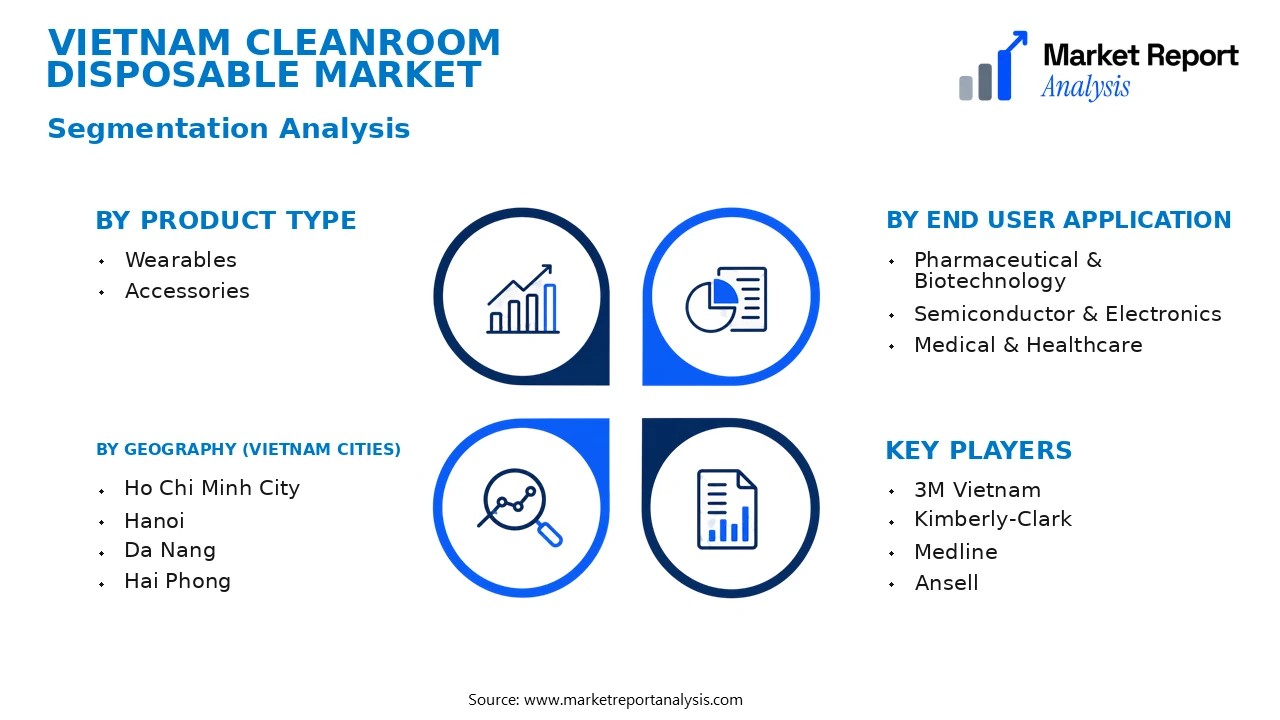
The Vietnam Cleanroom Disposable Market is segmented based on product type, end-user application, and geographical regions within Vietnam. This segmentation allows for a detailed understanding of market dynamics, regional demand variations, and specific industry needs driving growth across the country.
- Product Type
- Wearables: Wearable cleanroom disposables include garments such as suits, gowns, and gloves that are essential for maintaining contaminant-free environments in pharmaceutical, healthcare, and semiconductor manufacturing sectors. Demand is influenced by strict safety regulations and industrial standards.
- Accessories: Accessories such as masks, hoods, and shoe covers complement primary apparel, ensuring comprehensive coverage of personnel working in controlled environments. Increased adoption correlates with heightened safety protocols and contamination prevention.
- End User Application
- Pharmaceutical & Biotechnology: This sector represents a significant share of the market due to high compliance standards requiring sterile environments, especially in sterile drug manufacturing, vaccine production, and research laboratories. Growth is driven by Vietnam’s expanding healthcare infrastructure.
- Semiconductor & Electronics: Cleanroom disposables are critical in semiconductor fabrication and electronics manufacturing, where even microscopic contamination can impair product quality. Vietnam’s rising electronics export sector is boosting demand here.
- Medical & Healthcare: Hospitals, clinics, and diagnostic labs extensively use disposables for infection control and safety. The rise in medical tourism and healthcare investment in Vietnam fosters increased usage of disposable cleanroom materials.
- Geography (Vietnam Cities)
- Ho Chi Minh City: As Vietnam’s largest commercial hub, Ho Chi Minh City hosts numerous pharmaceutical manufacturers, biotech companies, and medical facilities, creating a substantial market for cleanroom disposables tailored to healthcare and exports.
- Hanoi: The political and administrative capital also leads in healthcare infrastructure development and research activities, with demand driven by government initiatives to upgrade public health and sterile manufacturing capabilities.
- Da Nang: With its rising industrial zones and proximity to major manufacturing clusters, Da Nang’s electronics and pharmaceuticals sectors are increasingly adopting cleanroom disposable products for quality assurance.
- Hai Phong: An emerging industrial port city with expanding manufacturing and logistics infrastructure offers growth opportunities in cleanroom environments, particularly for export-oriented industries seeking contamination control.
- Can Tho: The economic hub of the Mekong Delta supports agri-biotech research and small to medium biotech firms, which are gradually adopting cleanroom disposables to meet hygienic standards in product processing.
- Bien Hoa: Located near Ho Chi Minh City, Bien Hoa has a dense industrial base, including electronics and machinery, where maintaining uncontaminated processes necessitates the use of advanced disposable cleanroom products.
- Nha Trang: Primarily a tourism and healthcare city, Nha Trang is witnessing increased medical facility upgrades and health-related research that drive local demand for sterile, contaminant-controlled environments requiring disposable supplies.
Competitive Intelligence
The Vietnam Cleanroom Disposable Market is characterized by moderate competition, with several local and international players vying for market share. Market concentration remains relatively fragmented, with leading firms such as 3M, DuPont, and local manufacturers striving to differentiate through innovation and strategic partnerships. Companies are heavily investing in product innovation to enhance barrier properties, comfort, and eco-friendliness, which are key differentiators in the Vietnamese market, especially amidst strict regulatory standards. Partnerships between foreign multinationals and Vietnamese distributors aim to expand reach, while acquisitions of local firms are being pursued to strengthen regional presence, particularly in industrial hubs like Hanoi and Ho Chi Minh City. Expansion strategies focus on building local manufacturing capacities and R&D centers to tailor products to Vietnam’s specific regulatory and environmental demands. R&D expenditures are increasing to develop advanced, sustainable disposables that meet both international standards and local needs. The competitive landscape is increasingly differentiated through technological innovation, capacity expansion, and collaborations, enabling players to serve the growing demand efficiently and meet evolving regulatory frameworks in Vietnam.
Leading Company Profiles
The competitive landscape of the Vietnam cleanroom disposable market is characterized by a mix of specialized local manufacturers and global industry leaders. These companies are distinguished by their extensive product portfolios, technological innovation capabilities, and strategic expansion plans to capture Vietnam’s burgeoning market. Their focus remains on enhancing product quality, complying with international standards, and establishing robust distribution channels within the country and broader Southeast Asian markets.
- 3M Vietnam
- Kimberly-Clark
- Medline
- Ansell
- Molecular Devices
- Stratojet
- DuPont
- Ahlstrom-Munksjö
- Cellucaps
- Pacific ASI
3M Vietnam
3M Vietnam specializes in manufacturing high-performance sterile disposables, including gloves, gowns, and masks, with a focus on innovative materials and sustainable practices to meet strict pharmaceutical and healthcare standards in Vietnam.
Kimberly-Clark
Kimberly-Clark offers a comprehensive range of hygiene and infection prevention products, including disposable apparel and sterilization accessories, leveraging advanced manufacturing technologies to ensure quality and compliance with international norms.
Medline
Medline provides customized disposable solutions tailored for the healthcare and biotech sectors in Vietnam, with strong emphasis on product safety, regulatory compliance, and expanding localized production capabilities.
Ansell
Ansell's product portfolio includes surgical gloves and protective apparel designed with cutting-edge materials to deliver maximum safety and comfort, supported by strategic investments in Vietnam’s health sector growth.
Molecular Devices
Molecular Devices focuses on sterile laboratory disposables used in diagnostics and research, with an emphasis on integrating digital technologies to improve product traceability and quality control processes.
Stratojet
Stratojet manufactures sterile packaging solutions and disposable cleanroom consumables, ensuring compliance with international standards through innovative manufacturing and eco-efficient practices in Vietnam.
DuPont
DuPont Vietnam delivers high-grade protective apparel and filtration products designed for pharmaceutical and aerospace cleanroom applications, prioritizing advanced material science and sustainability initiatives.
Ahlstrom-Munksjö
Ahlstrom-Munksjö supplies filtration and hygiene-grade nonwoven fabrics tailored for cleanroom disposable products, with strategic investments in technology to support Vietnam’s growing medical and electronic manufacturing sectors.
Cellucaps
Cellucaps produces sterilized caps, closures, and packaging components for pharmaceutical and biotech applications, focusing on innovative sterilization techniques and product integrity.
Pacific ASI
Pacific ASI specializes in high-quality sterile disposable apparel and cleanroom consumables, with objectives to expand its manufacturing footprint and establish strategic collaborations within Vietnam.
Strategic Business Developments

- March 2026 – 3M Vietnam – Launch of environmentally sustainable sterile glove line – Enhances eco-friendly product options for healthcare and pharma sectors.
- April 2026 – Kimberly-Clark – Capacity expansion in Ho Chi Minh City – Meets rising local demand and reduces import reliance, boosting market share.
- June 2026 – Medline – Establishment of a new regional distribution hub – Strengthens supply chain efficiency and product availability across Vietnam and Southeast Asia.
- August 2026 – Ansell – Joint venture with local Vietnamese firm – Facilitates technology transfer and accelerates market penetration in healthcare safety products.
- October 2026 – DuPont – Investment in biodegradable material R&D – Supports Vietnam’s sustainability initiatives and compliance with stricter environmental regulations.
Frequently Asked Questions
What is the Vietnam Cleanroom Disposable Market?
The Vietnam Cleanroom Disposable Market comprises the supply of disposable products designed for cleanroom environments in sectors such as pharmaceuticals, medical devices, electronics, and biotechnology. It involves manufacturing, distribution, and application of items like gloves, garments, face masks, and sterile wipes tailored to stringent cleanliness standards.
What is the current market size of Vietnam Cleanroom Disposable Market?
As of 2026, the Vietnam Cleanroom Disposable Market is valued at approximately USD 0.45 Billion, reflecting robust growth driven by increasing industrial R&D investments, rising healthcare infrastructure, and stringent regulatory standards necessitating high-quality contamination control products.
What factors are driving the Vietnam Cleanroom Disposable Market?
Market growth is propelled by the healthcare sector’s expansion, technological advances demanding sterile environments, government policies promoting pharmaceutical manufacturing, and increased demand for electronics manufacturing. Rising awareness of contamination risks further fuels product adoption across industries.
Which Vietnamese city leads the Vietnam Cleanroom Disposable Market?
Ho Chi Minh City emerges as the market leader, due to its extensive industrial base, thriving healthcare infrastructure, and presence of numerous multinational corporations establishing cleanroom facilities and procurement centers for disposable products.
Which segment is expected to grow the fastest?
The apparel and protective gear segment is projected to witness the fastest growth, driven by increasing safety regulations, workplace safety initiatives, and the expanding pharmaceutical manufacturing sector, necessitating high-quality, sterile apparel in cleanroom settings.
Who are the leading companies operating in the Vietnam Cleanroom Disposable Market?
Key players include 3M Company, Kimberly-Clark Corporation, Ansell Limited, and local distributors partnering with global brands. These companies focus on product innovation, quality standards, and expanding distribution channels within Vietnam to capture market share.
Vietnam Clearroom Disposable Market Outlook
The Vietnam cleanroom disposable market is experiencing significant growth driven by expanding pharmaceutical, healthcare, electronics, and biotech sectors. As Vietnam continues its industrial modernization, the demand for high-quality, sterile disposable products is rising rapidly, supported by increasing regulatory standards and a shift towards environmentally sustainable practices. The robust economic expansion, coupled with Vietnam’s strategic role as a manufacturing hub within Southeast Asia, enhances the country’s market prospects. The market is expected to grow at a CAGR of approximately 8.2% from 2026 to 2034, reaching an estimated value of USD 1.2 Billion by 2034. This growth trajectory is fueled by accelerating investments in healthcare infrastructure, rising foreign direct investment, and a surge in local manufacturing activities that require strict contamination control measures. Additionally, government initiatives promoting industrial development and healthcare modernization further underpin market expansion, fostering a conducive environment for both domestic and international players.
Analyst Perspective
The Vietnam Cleanroom Disposable Market is poised for steady long-term growth driven by increasing healthcare and electronics manufacturing investments, coupled with stringent regulatory standards. Commercial opportunities are expanding in Ho Chi Minh City and Hanoi, where growing biotech and pharmaceutical sectors demand advanced cleanroom supplies. Technology evolution is likely to focus on developing more sustainable, cost-efficient disposable materials that maintain rigorous contamination control, fostering innovation among local and international suppliers. Investment priorities should emphasize building robust supply chains and local manufacturing capacities to reduce reliance on imports and to capitalize on government incentives targeting high-tech industries. Competitive intensity is expected to intensify as global players establish regional bases, although market fragmentation may persist due to varied quality standards. City-level growth prospects are particularly promising in Ho Chi Minh City’s biotech corridor and Hanoi’s expanding healthcare hubs, which offer strategic advantages in logistics, workforce, and infrastructure. Overall, strategic positioning in Vietnam requires balancing technological advancements with local market nuances and regulatory compliance to sustain long-term growth.
