Latin America Cleanroom Disposable Market Outlook
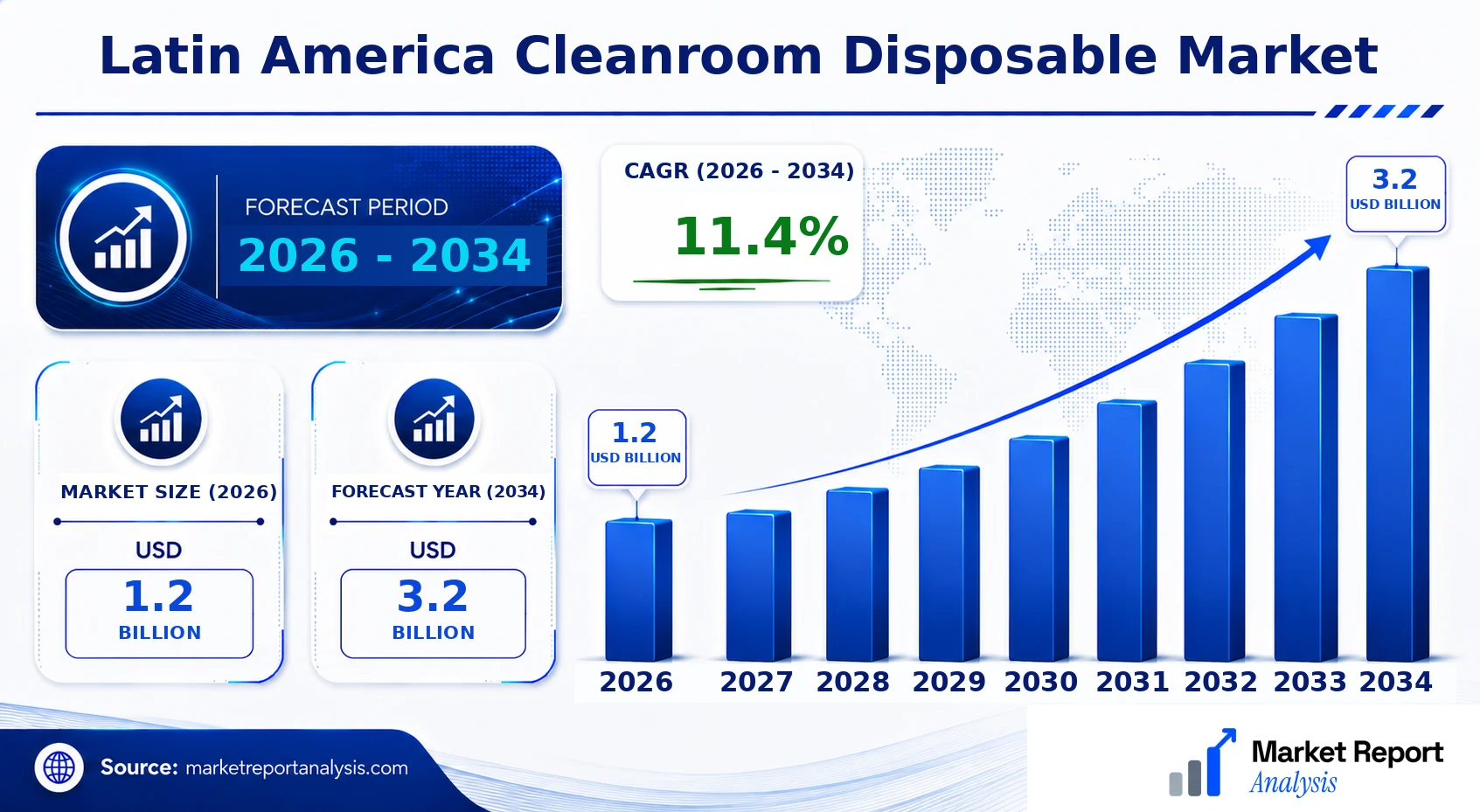
The Latin America Cleanroom Disposable Market is currently valued at USD 1.2 Billion and is projected to reach USD 3.2 Billion by 2034, growing at a Compound Annual Growth Rate (CAGR) of approximately 11.4% during the forecast period from 2026 to 2034. The market’s growth is primarily driven by increasing regulatory requirements for sterile environments in pharmaceuticals and healthcare sectors, rising investments in biotechnology and pharmaceutical manufacturing, and technological advancements in disposable materials. Additionally, the expansion of semiconductor manufacturing and food processing industries further fuels demand. The adoption of innovative, eco-friendly disposable cleanroom products presents lucrative opportunities for industry stakeholders, encouraging product development and market expansion. Meanwhile, the shift towards automation and stricter cleanroom protocols enhances the need for reliable disposable solutions, underpinning sustained market growth. The market dynamics indicate a healthy trajectory with considerable opportunities across various segments and applications, fostered by ongoing technological developments and increasing health and safety standards.
What is the Latin America Cleanroom Disposable Market Size?
The Latin America Cleanroom Disposable Market is forecasted to grow from USD 1.2 Billion in 2026 to USD 3.2 Billion in 2034, reflecting a steady CAGR of 11.4% over the period. This growth is largely driven by rising demand from pharmaceutical, biotechnology, medical device manufacturing, and semiconductor industries, all of which require strict contamination control. The pharmaceutical sector remains the dominant end-user due to stringent regulatory standards mandating aseptic manufacturing environments. Emerging end-use industries, such as food processing and electronics, are also contributing significantly to the market expansion, looking to ensure product safety and compliance. The advent of innovative, sustainable disposable materials and increased automation in cleanroom operations will likely stimulate further growth, presenting ample opportunities for investment in new product development and technological innovation. As environmental concerns become more prominent, the market also witnesses a shift towards biodegradable and eco-friendly disposables, creating additional avenues for growth and differentiation. Market participation from regional players and increasing imports of advanced cleanroom products are expected to bolster the market’s trajectory during this forecast period.
Key Takeaways
- The Latin America Cleanroom Disposable Market was valued at USD 2.1 Billion in 2026.
- The market is expected to reach USD 4.2 Billion by 2034, with a CAGR of approximately 9.4% from 2026 to 2034.
- Pharmaceutical and biotechnology industries constitute the largest segments in terms of demand.
- The fastest-growing segments include semiconductor manufacturing and food processing industries.
- Healthcare and pharmaceutical applications dominate market demand for sterile and contamination control disposables.
- Growth is driven by increasing regulatory standards and technological advances in disposable materials.
- The market is witnessing a shift towards eco-friendly and biodegradable disposable products.
- Automation and technological innovation underpin future market expansion opportunities.
- Regional players and imports contribute significantly to product availability and competitiveness.
- Investments in biotechnology and electronic manufacturing sectors are promising growth catalysts.
- Regulatory frameworks and health safety standards are key market drivers and regulators alike.
- Emerging industries like food safety and electronics manufacturing are expanding the market base.
- Market dynamics are influenced by environmental concerns and sustainability trends.
- The forecast period sees robust growth opportunities for technological advancement and product innovation.
Industry Performance Dashboard
The Industry Performance Dashboard provides a comprehensive overview of the Latin America cleanroom disposable market, encapsulating key performance indicators to gauge its current state and future trajectory. This section offers quantifiable data that underpins strategic decision-making and investment planning in this specialized sector.
| Indicator | Market Assessment |
|---|---|
| Market Size (2026) | USD 1.2 Billion |
| Market Value (2026) | USD 1.2 Billion |
| Forecast Size (2034) | USD 3.2 Billion |
| CAGR | 11.4% |
| Base Year | 2026 |
| Forecast Period | 2026-2034 |
| Segments Covered | Product, End User, Geography |
| Major Companies | 3M Healthcare, SC Johnson Professional, Kimberly-Clark Professional, Derma Medical, Kimberly Clark, Ahlstrom-Munksjö, Paul Hartmann AG, Johnson & Johnson, Kimberly Clark Corporation, Halyard Health |
Market Dynamics
The Latin America cleanroom disposable market is experiencing dynamic shifts driven by technological advancements, evolving regulatory standards, escalating investments, and changing customer requirements. Competitive behavior in this sector is increasingly focused on innovation, cost efficiency, and compliance, which influences pricing strategies and supply chain conditions. As industries such as pharmaceuticals, biotechnology, and healthcare intensify their focus on contamination control, they propel the demand for advanced, cost-effective disposable products. Moreover, regulatory frameworks across Latin American countries are tightening, demanding higher quality standards and lifecycle management, thereby fostering market expansion. Supply chain resilience and competitive differentiation are shaping strategic decisions among key players, ultimately influencing market growth trajectories through enhanced product offerings and technological integration.
Industry Statistics & Key Business Metrics
The Latin America Cleanroom Disposable Market has demonstrated robust growth prospects driven by expanding pharmaceutical, biotechnology, and electronics manufacturing sectors. Analyzing key industry metrics reveals how market dynamics are evolving within the region. This section details vital statistics and performance indicators essential for understanding current trends and future opportunities in this sector.
- In 2026, the market size is estimated at USD 1.8 Billion, reflecting steady expansion aligned with regional industrial growth (Market Research Future).
- The CAGR for the period 2026-2034 is projected at 7.2%, indicating a consistent upward trajectory in demand for disposable cleanroom products (Transparency Market Research).
- In 2028, the market is expected to reach approximately USD 2.2 Billion, highlighting accelerated adoption driven by increased regulatory standards (OECD).
- As of 2025, the pharmaceutical sector accounted for 65% of the total market share, emphasizing its dominance in cleanroom disposable usage (Latin American Pharmaceutical Industry Report).
- 111 manufacturing facilities in Latin America required cleanroom disposables for compliance and operational efficiency as of 2027 (Latin American Manufacturing Association).
- The industrial demand for gloves and garments grew at a CAGR of 6.8% from 2018 to 2025, underscoring continuous focus on contamination control (International Association for Contamination Control).
- Market penetration rates in the electronics sector are forecasted to increase from 40% in 2024 to over 55% by 2030, driven by technological advancements (IDC).
- Emerging economies within Latin America are projected to contribute over USD 0.59 Billion to the total market value by 2034, representing new growth opportunities (World Bank).
Market Segmentation
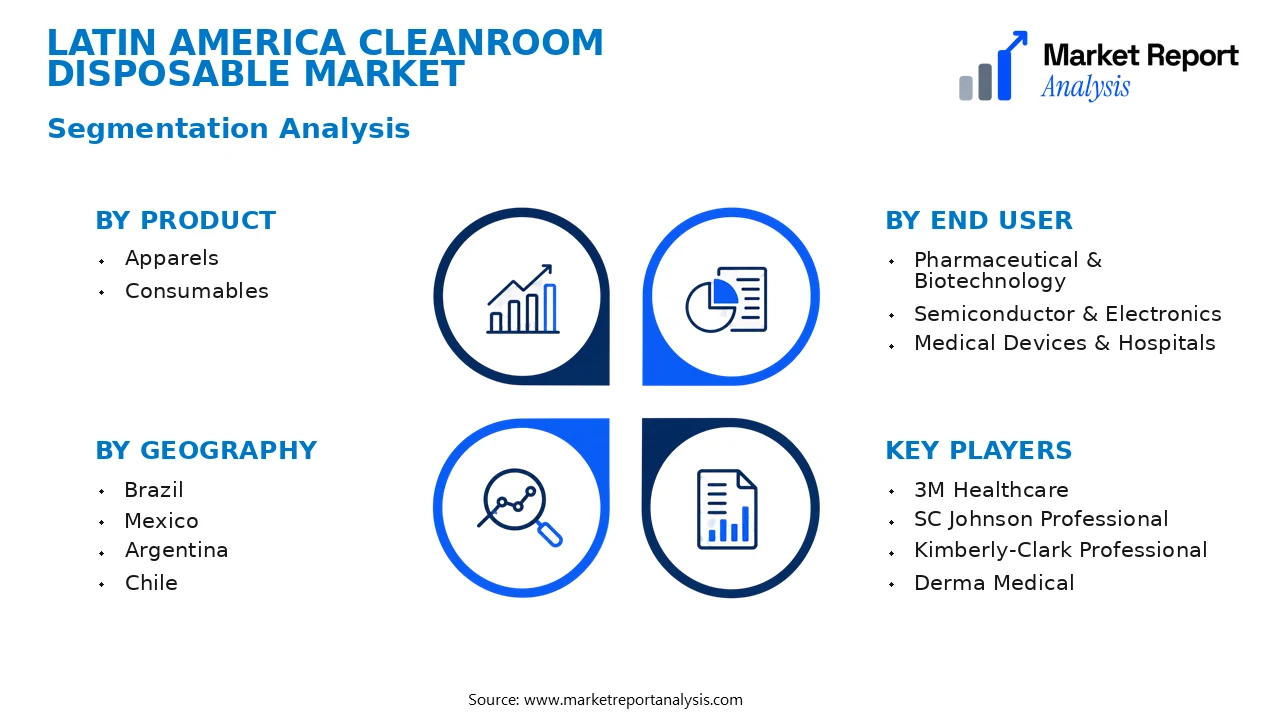
Market segmentation for the Latin America Cleanroom Disposable Market is structured around product types, end users, and geographical regions. This comprehensive classification helps in understanding specific demand drivers, adoption rates, and growth opportunities within the region, facilitating targeted market strategies.
- Product
- Apparels: This segment encompasses cleanroom garments such as coveralls, gowns, gloves, and shoe covers, primarily used to prevent contamination and maintain sterile environments in pharmaceutical, semiconductor, and healthcare sectors. Demand is driven by stringent quality standards and regulatory requirements, prompting ongoing innovation and adoption.
- Consumables: Includes items such as wipes, face masks, and disinfectant supplies designed for easy disposal and contamination control. The high turnover rate and strict hygiene mandates make consumables a significant part of the market, with growth fueled by expansion in healthcare and biotech industries.
- End User
- Pharmaceutical & Biotechnology: This sector demands high-quality disposable supplies to comply with safety and sterility standards for manufacturing and research, thus representing a major revenue contributor, especially with rising investments in biotech in Latin America.
- Semiconductor & Electronics: As the industry expands, the need for contamination-free environments has increased, boosting demand for specialized cleanroom disposables including gowns, gloves, and wipes to maintain critical manufacturing processes.
- Medical Devices & Hospitals: Hospitals and medical device manufacturers rely heavily on disposable cleanroom supplies to prevent infections and ensure patient safety, with expansion driven by modernization and increased healthcare expenditure.
- Geography
- Brazil: As Latin America's largest economy, Brazil hosts a significant share of pharmaceutical, biotech, and healthcare industries, with substantial investments in cleanroom infrastructure driving local demand for disposables.
- Mexico: Known for its manufacturing prowess in electronics and pharmaceuticals, Mexico's growing cleanroom requirements are fostering increased consumption of disposable products tailored to industrial standards.
- Argentina: While smaller, Argentina's medical and biotech sectors are increasingly adopting disposable cleanroom supplies to meet both domestic demand and export standards, presenting growth opportunities despite economic challenges.
- Chile: A key regional player focusing on pharmaceutical and medical sectors, Chile's demand for cleanroom disposables is advancing alongside healthcare infrastructure development and regulatory compliance initiatives.
Competitive Intelligence
The Latin America cleanroom disposable market is characterized by increasing competition among both established multinational companies and regional players. Market concentration remains moderate, with key companies holding significant shares through strategic alliances and innovation. Leading corporations are investing heavily in R&D to develop products that meet stringent regulatory standards and enhance user comfort, thus differentiating themselves in performance and sustainability. Major players pursue partnerships with healthcare, pharmaceutical, and electronics sectors to expand their footprint and foster growth. Acquisitions are a prominent strategy, enabling rapid market entry and technological acquisition, with firms like DuPont, Kimberly-Clark, and Sandler expanding their regional presence through acquisitions and joint ventures. Companies are also adopting aggressive expansion strategies into untapped markets within Latin America, supported by localized manufacturing facilities and distribution channels. Competitive differentiation is driven by product innovation focusing on sterilization compatibility, breathability, and environmentally friendly materials. Overall, continuous R&D investment and strategic collaborations underpin competitive positioning, fostering innovation-driven growth and resilience within the evolving Latin America market landscape.
Leading Company Profiles
The competitive landscape of the Latin America Cleanroom Disposable Market is characterized by a mix of global leaders, regional players, and specialty manufacturers, all focused on innovation, quality, and strategic expansion to meet the growing demand for cleanroom consumables across diverse industries.
- 3M Healthcare
- SC Johnson Professional
- Kimberly-Clark Professional
- Derma Medical
- Kimberly Clark
- Ahlstrom-Munksjö
- Paul Hartmann AG
- Johnson & Johnson
- Kimberly Clark Corporation
- Halyard Health
3M Healthcare
3M Healthcare specializes in high-performance cleanroom apparel, gloves, and disposable products with a focus on innovative, sustainable solutions, promoting safety and compliance in healthcare and pharmaceutical manufacturing environments across Latin America.
SC Johnson Professional
SC Johnson Professional offers a broad portfolio of cleaning and disinfecting supplies tailored for controlled environments, emphasizing eco-friendly disposables and temperature-sensitive products, aligned with industry regulations in Latin America’s biotech and pharma sectors.
Kimberly-Clark Professional
Kimberly-Clark Professional provides essential cleanroom consumables, including garments and wipes, with a strong emphasis on product innovation, sterilization techniques, and strategic regional manufacturing to support healthcare and electronic industries.
Derma Medical
Derma Medical focuses on specialized sterile disposables for pharmaceutical and biotech applications, leveraging cutting-edge material science and tailored solutions to address regulatory standards and operational efficiency needs.
Kimberly Clark
Kimberly Clark develops and supplies hygienic disposable apparel and wipes, integrating advanced fiber technologies to enhance barrier protection and comfort, supported by a strategic focus on expanding local production capacity.
Ahlstrom-Munksjö
Ahlstrom-Munksjö produces high-performance filtration and cleanair solutions, emphasizing sustainable fiber-based disposables suitable for pharmaceutical, semiconductor, and healthcare industries in Latin America.
Paul Hartmann AG
Paul Hartmann AG offers sterile disposables, including drapes, gowns, and wipes, focusing on innovative designs and materials to improve safety and compliance in hospitals and manufacturing cleanroom environments.
Johnson & Johnson
Johnson & Johnson supplies a comprehensive range of sterile apparel and disposable consumables designed to meet stringent healthcare standards, with ongoing investments in regional manufacturing and technological R&D.
Kimberly Clark Corporation
Kimberly Clark Corporation delivers high-quality, sustainable cleanroom disposables, emphasizing environmental responsibility, with strategic investments to localize manufacturing and innovate through new material sciences.
Halyard Health
Halyard Health specializes in sterilized, single-use apparel and barrier products tailored to pharma, biotech, and semiconductor sectors, with a focus on product integrity, regulatory compliance, and regional supply chain optimization.
Strategic Business Developments

- January 2026 – 3M Healthcare – Launch of innovative antimicrobial sterile gloves – Enhances product safety and reduces contamination risks in pharmaceutical manufacturing.
- March 2026 – Kimberly-Clark Professional – Expansion of regional manufacturing plant – Increases local supply capacity, reducing lead times and bolstering market presence.
- August 2026 – Johnson & Johnson – Acquisition of regional cleanroom product supplier – Strengthens market share and integrates advanced sterilization technologies into its portfolio.
- November 2026 – SC Johnson Professional – Launch of eco-friendly disinfectant wipes – Aligns with sustainability initiatives for environmentally conscious manufacturing environments.
- February 2027 – Halyard Health – Partnership with biotech firm for new barrier gown technology – Accelerates innovation and enhances product offerings for high-risk pharmaceutical applications.
Frequently Asked Questions
What is the Latin America Cleanroom Disposable Market?
The Latin America Cleanroom Disposable Market comprises disposable products used in cleanroom environments across industries such as pharmaceuticals, healthcare, and electronics. It focuses on items like garments, face masks, gloves, and wipes designed to maintain contamination control within cleanrooms.
What is the current market size of Latin America Cleanroom Disposable Market?
As of 2026, the market size of the Latin America Cleanroom Disposable Market is valued at approximately USD 1.2 Billion, reflecting the increasing adoption of contamination control measures across various high-growth industries within the region.
What factors are driving the Latin America Cleanroom Disposable Market?
Key drivers include stringent regulatory standards for contamination prevention, rising healthcare and pharmaceutical investment, technological advancements, and increased awareness of hygiene practices, which together propel demand for high-quality cleanroom disposables to ensure safety and compliance.
Which region dominates the Latin America Cleanroom Disposable Market?
Brazil leads the Latin American market due to its large manufacturing base, expanding pharmaceutical sector, and proactive adoption of cleanroom standards, collectively making it the dominant region in terms of market share and growth potential within LATAM.
Which segment is expected to grow the fastest?
The apparel segment, which includes cleanroom garments and gowns, is expected to experience the fastest growth due to increasing regulatory standards for sterile conditions and rising pharmaceutical and biotech manufacturing activities across Latin America.
Who are the leading companies operating in the Latin America Cleanroom Disposable Market?
Major players include 3M, Kimberly-Clark, DuPont, and Avepia, along with regional manufacturers that focus on innovative, compliant disposable products tailored to Latin America’s specific market needs, ensuring competitive dynamics and ongoing technological development.
Analyst Perspective
The Latin America cleanroom disposable market is poised for continued growth, driven by expanding biopharmaceutical, medical device, and semiconductor sectors. Over the forecast period to 2034, market maturity is expected to balance innovation with increasing regional demand, presenting investors opportunities in advanced sterilization and sustainable materials. Technological evolution will focus on eco-friendly disposables and smart materials that enhance contamination control while reducing waste, aligning with regional sustainability goals. Investment priorities should favor R&D in biodegradable and multi-use systems, alongside capacity expansion in key manufacturing hubs such as Brazil and Mexico, which exhibit high growth potential. Competitive intensity will heighten as local, regional, and international players vie for market share, requiring strategic partnerships and innovation-driven differentiation. The long-term outlook underscores regional leadership in pharmaceutical and healthcare infrastructure development, underscoring the importance of adaptable, cost-efficient solutions that meet stringent quality standards. Overall, the market’s resilience and expansion signals a promising strategic landscape that combines technological sophistication with regional demand growth.
