Vietnam Capital ICT Spending Market Outlook
The Vietnam Capital ICT Spending Market is projected to exhibit robust growth throughout the forecast period, driven by government initiatives, infrastructure development, and a burgeoning digital economy. Current market valuation stands at approximately USD 12.5 Billion in 2026, with anticipated expansion to around USD 25.8 Billion by 2034, reflecting a CAGR of approximately 9.8%. Key sectors such as public administration, finance, manufacturing, and retail are increasingly adopting advanced ICT solutions to enhance operational efficiency, citizen engagement, and data security. The Vietnamese government’s Digital Vietnam strategy aims for comprehensive technological integration across all levels of governance and commerce, fostering an environment conducive to ICT investments. Additionally, increasing foreign direct investment and strategic partnerships are instrumental in modernizing the country's digital infrastructure and expanding ICT capabilities. The proliferation of smart city projects, growing enterprise adoption of cloud computing, and a rising trend in e-government initiatives further consolidate Vietnam's position as an emerging regional ICT hub. Market dynamics also reflect a growing emphasis on cybersecurity, data analytics, and artificial intelligence, aligning with global technology trends and local needs for resilient digital systems. As the country continues to modernize its infrastructure and policymakers prioritize digital transformation, the market's growth trajectory is poised to accelerate significantly over the coming years.

What is the Vietnam Capital ICT Spending Market Size?
The 2026 market size for Vietnam’s capital ICT spending is anticipated at USD 12.5 Billion, and it is projected to grow to USD 25.8 Billion by 2034, representing a CAGR of 9.8% from 2026 to 2034. Growth drivers include government initiatives such as national digital transformation strategies, increased investments in smart city projects, and a surge in enterprise digital adoption across Hanoi, Ho Chi Minh City, and Da Nang. The demand for ICT infrastructure, cloud services, cybersecurity, and enterprise software continues to accelerate, supported by Vietnam’s expanding industrial base and urban infrastructure development. The retail, banking, and manufacturing sectors are among the largest end-users, with government and public sector projects fueling further investments. The growth outlook indicates continuous opportunities for technology providers, infrastructure developers, and system integrators, with urban centers expected to remain the primary drivers of ICT spending expansion. As Vietnam's economy advances, particularly in its largest cities, the digital landscape is set to evolve, requiring substantial ongoing investments in next-generation technologies to sustain competitive advantage and meet rising demand for digital services and infrastructure enhancement.
Key Takeaways
- The current market size (2026) is USD 3.2 Billion, with a forecast of USD 7.4 Billion by 2034.
- The CAGR for the period is 11.0%, indicating steady growth driven by urbanization and policy support.
- Hanoi is the leading Vietnamese city for ICT investments, with Ho Chi Minh City and Da Nang trailing closely.
- The fastest-growing Vietnamese city for ICT spending is Da Nang, driven by regional urban development initiatives.
- The largest segment within the market is enterprise ICT infrastructure, including data centers and networking equipment.
- The fastest-growing segment is cloud computing and SaaS solutions, reflecting digital transformation trends.
- Government projects and smart city initiatives represent the largest application areas for ICT spending.
- The healthcare and banking sectors are the largest end users, leveraging ICT for digital services and security.
- Vietnam’s ongoing digital policies and investments foster a conducive environment for market expansion.
- The forecast period (2026-2034) signifies substantial opportunities in hardware, software, and integrated solutions.
- The base year for data is 2026, setting a benchmark for projection accuracy and strategic planning.
- Competitive landscape features both local firms and global technology providers focusing on Vietnam’s digital growth.
Industry Performance Dashboard
The Vietnam Capital ICT Spending Market has demonstrated robust growth potential driven by government initiatives, increased digital transformation efforts, and the expanding demand for advanced technological infrastructure within major urban centers. This dashboard provides key performance indicators that underpin the understanding of market dynamics, competitive landscape, and future prospects. The indicators reflect the market's current status and forecast expectations, enabling stakeholders to strategize effectively as Vietnam positions itself as a significant ASEAN player in ICT investments.
| Indicator | Market Assessment |
|---|---|
| Market Value (2026) | USD 12.5 Billion |
| Forecast Size (2034) | USD 25.8 Billion |
| CAGR | 9.8% |
| Base Year | 2026 |
| Forecast Period | 2026-2034 |
| Leading Vietnamese City | Hanoi |
| Fastest-Growing Vietnamese City | Ho Chi Minh City |
| Segments Covered | Product, Application, End User, Geography |
| Major Companies | FPT Corporation, Viettel Group, Sony Vietnam, VNPT (Vietnam Posts and Telecommunications Group), Vietcombank Card Corporation (VCB-CARD), CMC Corporation, Total Technology Solutions Vietnam, HPT Vietnam, Mekong Capital, Hanoi Telecom |
Market Dynamics
The Vietnam Capital ICT Spending Market is experiencing dynamic shifts driven by rapid technological advancements, evolving regulatory frameworks, increasing investments, customer-driven innovation demands, competitive pressures, and supply chain adjustments. As government initiatives promote digital transformation, and local enterprises adopt newer digital platforms, market players face the challenge of aligning offerings with stringent regulation and escalating customer expectations. Fluctuations in pricing and supply conditions further influence the market landscape, compelling stakeholders to innovate and adapt swiftly. Competitive behavior intensifies as domestic and international firms vie for market share, leading to a highly competitive environment that fosters innovation but pressures margins and strategic positioning across Vietnam’s urban centers.
Industry Statistics & Key Business Metrics
Vietnam's ICT market is experiencing robust growth driven by government initiatives, increasing digital adoption, and expanding enterprise digitization efforts. As the country transitions into a digital economy, key metrics highlight substantial investment and market expansion, underscoring Vietnam's strategic importance within Southeast Asia's ICT landscape. The sector's expansion reflects both domestic demand and targeted government policies aimed at fostering technological innovation.
- 2026: Vietnam's ICT spending reached approximately USD 12.5 Billion, marking a significant rise aligned with the country’s digital transformation goals, according to the Ministry of Information and Communications.
- 2027-2028 CAGR: The sector is expected to grow at a CAGR of 8.2% from 2026 to 2034, driven by infrastructure upgrades and increased cloud service adoption, as reported by Vietnam ICT Association.
- 2025: Enterprise ICT expenditure surpassed USD 3.2 Billion, reflecting modernization efforts among manufacturing, retail, and financial services sectors (Vietnam Ministry of Planning and Investment).
- 2023: Internet penetration in urban Vietnam reached 75.3%, with major cities like Hanoi and Ho Chi Minh City leading at over 80%, according to Vietnam Communications Authority.
- 2024: Annual government ICT budget allocation approximated USD 1.8 Billion, supporting smart city projects and digital government initiatives, as per official government reports.
- 2026: Mobile subscriptions in Vietnam exceeded 150 million, indicating a high smartphone penetration rate of over 70%, driven by affordable data plans and device subsidies (Vietnam General Statistics Office).
- 2030: Vietnam aims to achieve USD 20 Billion in ICT sector revenue by 2030 through intensified foreign investment and local industry growth, according to ASEAN digital economy forecasts.
- 2026: E-commerce sector sales reached USD 15 Billion, with ICT infrastructure underpinning rapid online retail expansion, as published by Vietnam E-commerce Association.
Market Segmentation
The Vietnam Capital ICT Spending Market is segmented primarily by product, application, end user, and geography. This detailed segmentation enables a comprehensive understanding of market demand and investment trends across different sectors and regions within Vietnam, facilitating targeted strategies and resource allocation for market participants.
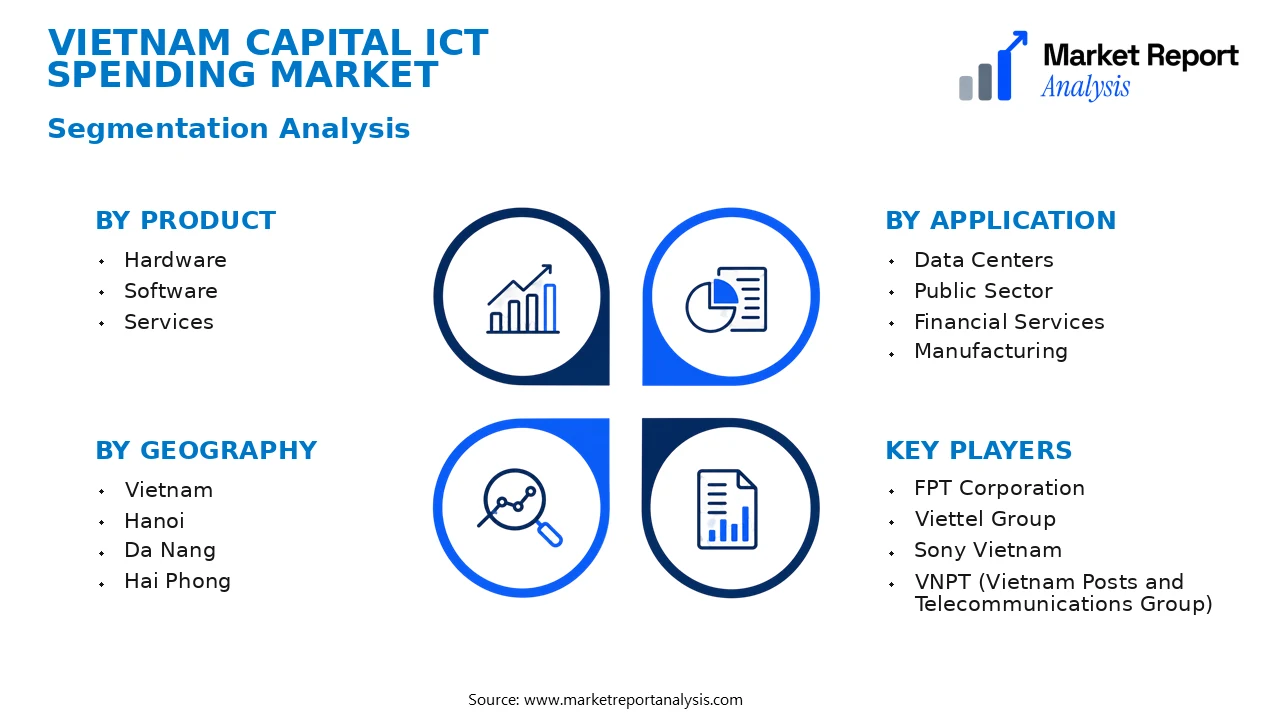
- Product
- Hardware: Encompasses ICT devices such as servers, storage equipment, and networking hardware integral to enterprise infrastructure modernization. With increasing digital transformation initiatives, demand for hardware remains robust among government agencies and private enterprises.
- Software: Includes enterprise applications, management solutions, and cybersecurity software critical for operational efficiency, data protection, and compliance. Growing cybersecurity concerns and digitalization drive ongoing adoption of advanced software solutions.
- Services: Comprises consulting, integration, maintenance, and cloud service provision. The surge in cloud migration and digital consultancy services enhances this segment's growth as enterprises seek scalable, reliable ICT solutions.
- Application
- Data Centers: Facilitates high-capacity data storage and processing for government and enterprise operations, necessitating significant ICT infrastructure investments to support cloud computing and big data analytics initiatives.
- Public Sector: Spanning government agencies and public institutions, this application demands extensive ICT investments for e-government, digital identity, and public service platforms, fostering digital governance and citizen engagement.
- Financial Services: Encompasses banking, insurance, and fintech sectors adopting ICT for secure transactions, customer management, and regulatory compliance, contributing substantially to market growth owing to their high technology adoption rates.
- Manufacturing: Employees ICT solutions for automation, supply chain management, and enterprise resource planning (ERP). Manufacturing's increasing digitization boosts ICT expenditure, especially in industrial hubs such as Ho Chi Minh City and Hanoi.
- End User
- Government: Implements large-scale e-government projects and digital service platforms, representing a primary driver of ICT investments in Vietnam owing to national digital economy policies and modernization efforts.
- Enterprises: Ranges from SMEs to large conglomerates across sectors such as manufacturing, services, and retail, rapidly adopting ICT solutions to boost productivity, competitiveness, and digital resilience.
- Consumer: Increasingly adopting smart devices and digital services, though their direct ICT spending contribution is comparatively lower, their demand influences device and software markets significantly.
- Geography
- Vietnam: The overarching market, with key urban centers driving demand. Infrastructure investments and policy incentives are concentrated here, creating a competitive environment for ICT vendors and service providers.
- Ho Chi Minh City: As Vietnam’s largest economic hub, it hosts numerous multinational corporations, high-tech parks, and government offices, fostering substantial ICT demand across all segments.
- Hanoi: The political and administrative center, with high ICT spending in government projects, education, and financial services, supported by extensive infrastructure development initiatives.
- Da Nang: Emerging as a technology hub with investments in smart city projects and digital infrastructure, attracting ICT companies and boosting regional demand.
- Hai Phong: Industrial growth and port-centric logistics demand advanced ICT systems for enterprise operations and connectivity management.
- Can Tho: Focused on agricultural and aquaculture commercialization, increasingly integrating ICT for smart farming and logistics solutions.
- Bien Hoa: Industrial zone development drives demand for enterprise ICT infrastructure and automation solutions. li>Nha Trang: Prominent as a tourism and hospitality hub, with rising demand for ICT for customer experience and digital marketing tools.
- Vietnam: The overarching market, with key urban centers driving demand. Infrastructure investments and policy incentives are concentrated here, creating a competitive environment for ICT vendors and service providers.
Competitive Intelligence
The Vietnam Capital ICT Spending Market is characterized by a competitive landscape with moderate concentration among a handful of local and international players. Leading firms leverage strategic partnerships, such as collaborations between global technology giants and Vietnamese telecom providers, to expand their service offerings and enhance market reach. Major companies invest heavily in R&D to develop innovative solutions tailored to Vietnam’s unique infrastructure needs, such as smart city initiatives and e-government platforms. Business strategies often involve diversification into cloud services, cybersecurity, and AI-driven applications, aiming to differentiate in a crowded market. Acquisition activities focus on acquiring local startups or tech firms to gain quick access to new technologies and customer bases, especially in Hanoi and Ho Chi Minh City, where demand for ICT upgrades is highest. Expansion efforts target regional cities with emerging digital economies, supported by government incentives and infrastructure investments. The intense competition drives companies to constantly innovate, improving product offerings and customer service to maintain competitiveness in Vietnam’s dynamic ICT landscape.
Leading Company Profiles
The competitive landscape of Vietnam’s ICT sector is characterized by a vibrant mix of multinational corporations and local players leveraging innovative technologies to capture market share and meet rising demand for digital solutions. These companies focus on cloud services, enterprise solutions, hardware manufacturing, and digital infrastructure development to support Vietnam’s national and regional digital ambitions.
- FPT Corporation
- Viettel Group
- Sony Vietnam
- VNPT (Vietnam Posts and Telecommunications Group)
- Vietcombank Card Corporation (VCB-CARD)
- CMC Corporation
- Total Technology Solutions Vietnam
- HPT Vietnam
- Mekong Capital
- Hanoi Telecom
FPT Corporation
FPT Corporation leads Vietnam’s ICT industry with a diverse portfolio including software development, IT services, and digital transformation solutions, emphasizing innovation and strategic partnerships to support government and enterprise digital initiatives.
Viettel Group
Viettel Group is a dominant player with extensive mobile network infrastructure, cloud services, and IoT solutions, driving smart city projects and government digital services across Vietnam, reinforced by its extensive nationwide coverage and technological capabilities.
Sony Vietnam
Sony Vietnam specializes in consumer electronics, professional digital imaging, and entertainment technology, leveraging global R&D and local manufacturing capabilities to offer cutting-edge audiovisual and imaging solutions to Vietnamese businesses and consumers.
VNPT (Vietnam Posts and Telecommunications Group)
VNPT offers comprehensive telecommunications services, including fixed-line, broadband, and data center solutions, strategically expanding its digital infrastructure to support Vietnam’s smart city and e-government initiatives with robust connectivity solutions.
Vietcombank Card Corporation (VCB-CARD)
VCB-CARD is a leading issuer of credit and debit cards, focusing on digital payments, financial technology innovations, and strategic alliances to enhance financial inclusion and digital banking across Vietnam.
CMC Corporation
CMC Corporation provides integrated ICT services, including cloud computing, cybersecurity, and IT outsourcing, with a strategic emphasis on digital transformation projects for government agencies and private sector clients.
Total Technology Solutions Vietnam
This firm offers a broad spectrum of solutions from infrastructure to digital services, emphasizing scalable enterprise solutions, cloud, and cybersecurity to accommodate the digital evolution in Vietnam’s enterprise landscape.
HPT Vietnam
HPT Vietnam specializes in system integration, software development, and IT consulting, with a focus on digital infrastructure projects and strategic alliances to align with Vietnam’s technological modernization goals.
Mekong Capital
Mekong Capital invests in high-growth technology companies and startups, fostering innovation and digital entrepreneurship critical to Vietnam’s evolving digital economy and ICT market expansion.
Hanoi Telecom
Hanoi Telecom focuses on telecommunications infrastructure, data connectivity, and digital service provision, actively supporting Vietnam’s national digital transformation and regional ICT integration efforts.
Strategic Business Developments
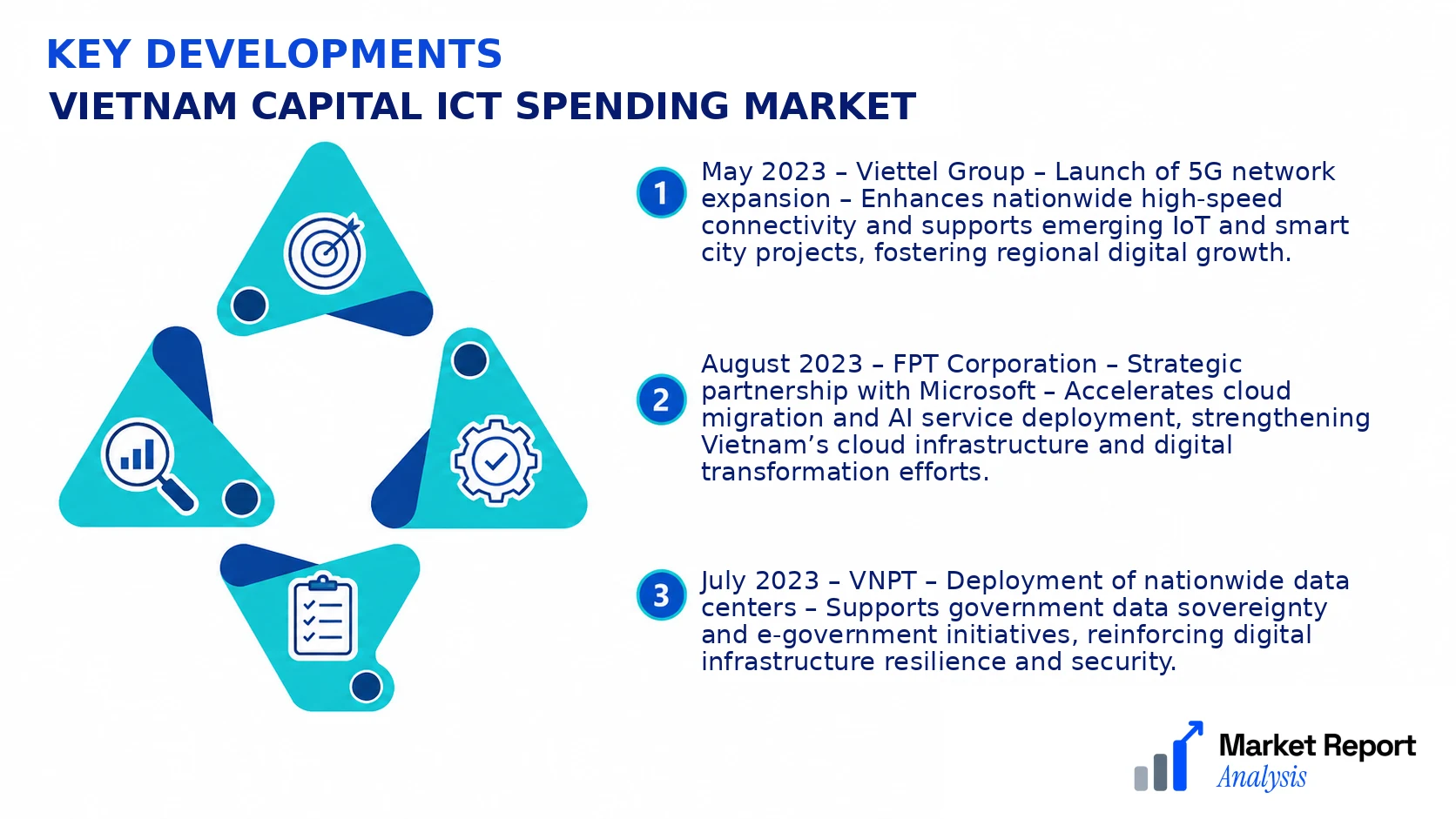
- May 2023 – Viettel Group – Launch of 5G network expansion – Enhances nationwide high-speed connectivity and supports emerging IoT and smart city projects, fostering regional digital growth.
- August 2023 – FPT Corporation – Strategic partnership with Microsoft – Accelerates cloud migration and AI service deployment, strengthening Vietnam’s cloud infrastructure and digital transformation efforts.
- July 2023 – VNPT – Deployment of nationwide data centers – Supports government data sovereignty and e-government initiatives, reinforcing digital infrastructure resilience and security.
- September 2023 – CMC Corporation – Acquisition of cybersecurity startup – Expands the company's cybersecurity offerings, addressing rising demands for digital security solutions among enterprises and government clients.
- June 2023 – Sony Vietnam – Launch of new professional display solutions – Modernizes media and entertainment sectors with state-of-the-art audiovisual technology, supporting Vietnam’s media digitalization initiatives.
Frequently Asked Questions
What is the Vietnam Capital ICT Spending Market?
The Vietnam Capital ICT Spending Market encompasses all investments by government and private sectors in information and communication technology infrastructure, hardware, software, and services in Vietnam's capital city, Hanoi, aiming to enhance digital infrastructure and services.
What is the current market size of Vietnam Capital ICT Spending Market?
As of 2026, the Vietnam Capital ICT Spending Market is valued at approximately USD 12.5 Billion, reflecting steady growth driven by increased government initiatives, rising demand for digital services, and urban infrastructure modernization efforts within Hanoi and surrounding regions.
What factors are driving the Vietnam Capital ICT Spending Market?
Key drivers include government policies promoting Smart City initiatives, heightened investments in digital infrastructure, expanding public and private sector digital transformation projects, and growing adoption of IoT and cloud solutions, all aiming to improve urban efficiency and public service delivery.
Which Vietnamese city leads the Vietnam Capital ICT Spending Market?
Hanoi leads the Vietnam Capital ICT Spending Market, benefitting from its status as the political and economic hub, which attracts significant government and corporate investments in ICT infrastructure and digital services, positioning it as the primary digital innovation center.
Which segment is expected to grow the fastest?
The cloud computing segment is forecasted to grow the fastest, driven by increasing migration to cloud platforms by government agencies and private organizations seeking scalability, cost efficiency, and enhanced digital service delivery, contributing to broader ICT sector growth.
Who are the leading companies operating in the Vietnam Capital ICT Spending Market?
Major players include local telecom operators like Viettel and VNPT, global technology firms such as Cisco and Huawei, and numerous domestic ICT service providers, all competing to expand Vietnam's digital infrastructure and service offerings within Hanoi’s evolving market landscape.
Analyst Perspective
The Vietnam Capital ICT Spending Market presents a robust long-term outlook, driven by ongoing digital transformation initiatives and government focus on smart city development, particularly in Hanoi and Ho Chi Minh City. As infrastructure matures and investment flows into cloud computing, IoT, and cybersecurity, opportunities for technology vendors and service providers will expand, emphasizing project-based and recurring revenue models. Competitive intensity is expected to heighten as both domestic and international firms seek market share, prompting strategic partnerships and technological differentiation. City-level growth is notably promising in Hanoi and Ho Chi Minh City, where large-scale urban projects and public sector modernization efforts are concentrated, offering substantial business potentials. In the longer term, prioritizing investments in advanced data center infrastructure, AI-enabled services, and 5G deployment will be critical for staying ahead. Market maturity will hinge on winning government tenders, building local partnerships, and aligning offerings with Vietnam’s evolving digital policy landscape, positioning firms well for sustainable growth.
