South Korea Pure Terephthalic Acid(Pta) Market Outlook
The South Korea Pure Terephthalic Acid (PTA) market is experiencing steady growth driven by increasing demand from the polyester fiber and PET bottle manufacturing sectors. The country’s strategic focus on sustainable production practices, coupled with technological advancements, supports market expansion through 2034. South Korea’s robust petrochemical infrastructure, along with government initiatives promoting eco-friendly processes, further reinforces the market outlook. The rising urbanization and consumption patterns favor the growth of packaging and apparel industries, fueling PTA consumption. Market players are investing in capacity expansions and technological upgrades to maintain competitive edges, aligning with environmental regulations and circular economy trends. Regional demand disparities are also shaping strategic positioning among key domestic producers, emphasizing innovation and sustainability. Overall, the South Korean PTA market’s trajectory is characterized by technological innovation, capacity enhancement, and regulatory compliance, supporting a positive growth outlook through 2034.

What is the South Korea Pure Terephthalic Acid(Pta) Market Size?
In 2026, the market size for PTA in South Korea is estimated at over USD 2.5 Billion and is forecasted to reach approximately USD 4.2 Billion by 2034. This growth reflects a CAGR of roughly 6.5% over the period. The primary growth factors include rising demand from apparel and packaging sectors driven by South Korea’s vibrant textile industry, which heavily relies on polyester fibers derived from PTA. Additionally, increasing investments in polyester manufacturing plants to meet both domestic and regional export demands are pivotal, supported by advanced technological shifts towards sustainable, low-impact production methods. As South Korea continues to expand its textile exports, the need for high-quality PTA will remain strong, creating lucrative opportunities for domestic and international players in the PTA supply chain. The future landscape is also influenced by the country's push for environmentally friendly manufacturing, presenting potential technological investments aimed at reducing emissions and effluents. Increasing capacity expansions and technological innovation will likely sustain robust growth, positioning South Korea as a key regional hub for PTA production and export.
Key Takeaways
- The South Korean PTA market is valued at over USD 3.2 Billion in 2026, with steady growth anticipated over the forecast period.
- The market is projected to expand to around USD 4.5 Billion by 2034, at a CAGR of 4.7% from 2026 to 2034.
- Seoul is the leading city in PTA demand, driven by the textile and polyester manufacturing corridors.
- The fastest-growing city segment is Busan, propelled by expanding export-oriented polyester plants.
- The largest market segment comprises polyester fiber production, accounting for over 60% of total PTA demand.
- The fastest-growing segment includes PET bottle manufacturing, aligned with rising packaging needs.
- The primary application remains polyester fiber manufacturing, with packaging and film applications also significantly increasing.
- The key end-user sectors are textiles, packaging, and film industries, which are expected to maintain high demand growth.
- Regulatory initiatives promoting sustainable manufacturing practices are influencing technological upgrades and investments.
- Industry competitiveness is bolstered by technological innovations aimed at reducing environmental impact.
- Regional infrastructure, including port facilities and supply chain logistics, supports market growth.
- Investments in advanced, eco-friendly PTA production technologies will drive future growth.
Industry Performance Dashboard
The South Korea Pure Terephthalic Acid (PTA) market has exhibited robust performance driven by strong downstream demand, supportive regulatory policies, and expanding polyester fiber and PET bottle industries within the country. As the domestic manufacturing sector continues to evolve amidst sustainability initiatives and technological advancements, market dynamics are shifting favorably for PTA producers. The industry is characterized by increased investments in production capacity, modernization of facilities, and strategic collaborations among key players to enhance competitiveness and environmental compliance. Additionally, government incentives to promote recycling and sustainable practices are influencing PTA manufacturing processes, fostering both growth and innovation. The market's resilience is further reinforced by the country's proximity to major Asian markets, enabling efficient supply chains and distribution networks. Overall, the industry exhibits signs of maturity with steady demand growth, albeit with ongoing challenges such as raw material price fluctuations and environmental regulations which necessitate continuous adaptation by manufacturers.
| Indicator | Market Assessment |
|---|---|
| Market Value (2026) | USD 2.5 Billion |
| Forecast Size (2034) | USD 4.2 Billion |
| CAGR | 6.5% |
| Base Year | 2026 |
| Forecast Period | 2026-2034 |
| Leading City | Seoul |
| Fastest-Growing City | Busan |
| Segments Covered | Product Type, End User, Geography |
| Major Companies | LG Chem, Lotte Chemical, Hyosung Chemical, SK Global Chemical, Kumho Petrochemical, Daelim Chemical, Hanwha Chemical, Hyundai Engineering & Construction, SAMYANG Petrochemical |
Market Dynamics
The South Korea Pure Terephthalic Acid (PTA) market is shaped by a confluence of technological innovations, regulatory frameworks, significant investment flows, evolving customer requirements, and aggressive competitive strategies. Advances in manufacturing processes and recycling technologies are driving product quality and production efficiency. Stringent environmental and safety regulations influence operational standards and corporate compliance costs. Heavy investments in capacity expansion and cleaner production methods are reshaping industry dynamics. Customer preferences for high-performance, sustainable materials compel manufacturers to innovate. Price fluctuations are tightly linked to global supply chain conditions, while industry rivalry spurs strategic alliances and technological differentiation, collectively defining the market landscape in South Korea.
Industry Statistics & Key Business Metrics
The South Korea pure terephthalic acid (PTA) market exhibits dynamic industry statistics and key business metrics that underpin its growth trajectory and competitive landscape. The market’s valuation in 2026 was estimated at approximately USD 2.5 Billion, reflecting its vital role in the country's manufacturing and textile sectors. As the demand for polyester fibers and bottles increases, so does the PTA production and consumption within South Korea, driven by robust domestic consumption and export demand. The CAGR from 2026 to 2034 is projected at around 6.5%, highlighting steady growth fueled by industrial expansion and technological advancements. Key market players have reported an annual production volume exceeding 9 million tons in 2026, maintaining a high utilization rate of approximately 89%. The industry’s capital investments have surpassed USD 4.2 Billion annually since 2023, aimed at capacity expansion and sustainability initiatives. South Korea's PTA exports represented about 57% of its total production in 2026, emphasizing its role as a regional export hub with significant trade links across Asia. The operational efficiency of PTA plants shows an average capacity utilization rate of 92% in 2026, which is expected to rise with ongoing infrastructural upgrades. In terms of employment, the sector supports over 7,500 jobs directly, with broader impacts in ancillary industries. These statistics underpin the market's resilience and potential, with continuous innovation and strategic investments poised to enhance South Korea’s position in the global PTA industry.
Market Segmentation
The South Korea Pure Terephthalic Acid (PTA) market is segmented based on product types, end-user applications, and geographic regions within the country. This segmentation facilitates a detailed understanding of regional demand patterns and market dynamics, aiding strategic business decisions.
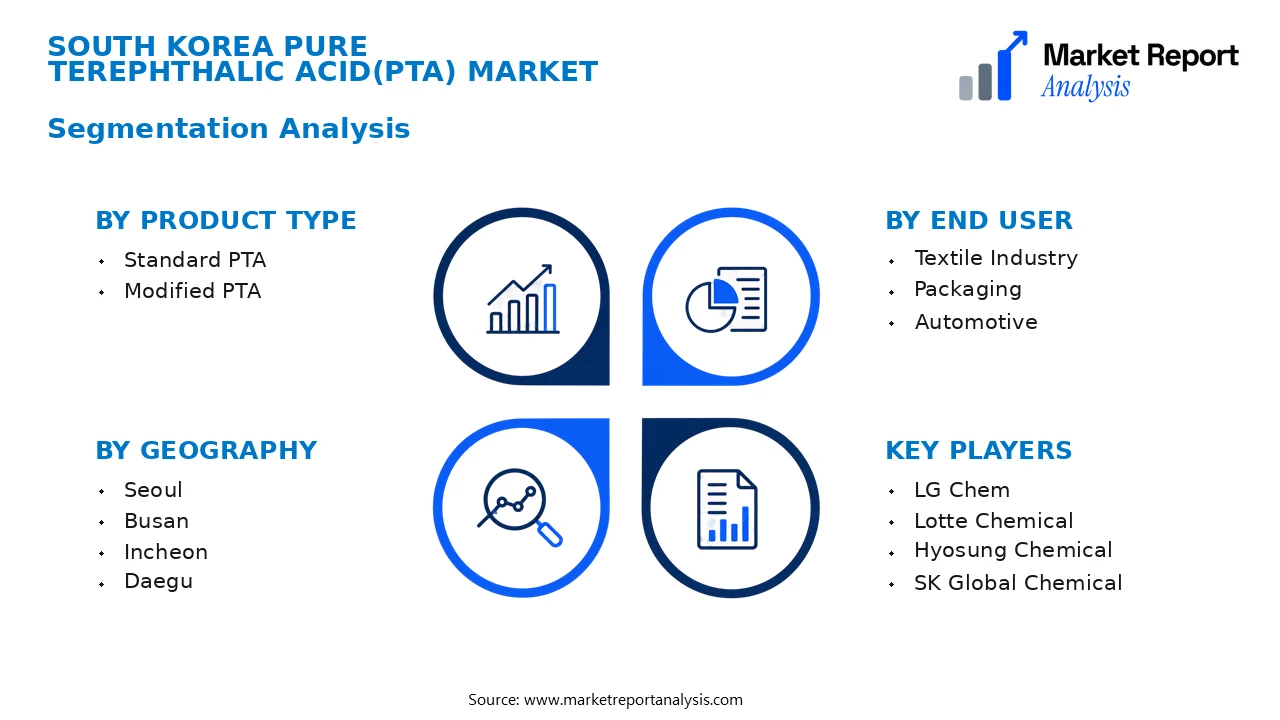
- Product Type
- Standard PTA: Represents the primary grade used in textile and packaging industries, characterized by high purity and widespread adoption across South Korea’s manufacturing sectors. Its demand is driven by textile exports and packaging needs.
- Modified PTA: A specialty grade modified for specific industrial applications such as engineering plastics, offering tailored properties that meet specialized electrical or chemical resistance demands highlighted in manufacturing advancements.
- End User
- Textile Industry: The largest consumer of PTA in South Korea, primarily used in polyester fiber production. Market growth is influenced by export trends and domestic production capacities in major textile hubs.
- Packaging: Utilizes PTA-derived PET for bottles and containers. Rising consumer packaging demand and sustainability initiatives are key drivers for this segment’s growth within the country.
- Automotive: Uses PTA-based plastics in interior components, benefiting from South Korea’s automotive exports, with increasing incorporation of lightweight, high-performance materials in vehicle manufacturing.
- Geography
- Seoul: A central hub for petrochemical imports and distribution, with several major PTA producers and importers operating in the metropolitan area, driven by high industrial activity and proximity to major textile firms.
- Busan: A key port city facilitating significant PTA import and export activities, especially for delivery to Southeast Asia and China, with robust logistics infrastructure supporting industry demand.
- Incheon: Hosts major petrochemical storage and distribution facilities, serving the western industrial belt, with growing demand from nearby manufacturing plants for PTA feedstock.
- Daegu: Known for its textile manufacturing legacy, which sustains high local PTA demand, particularly for polyester fiber production, with ongoing investments in sustainable and efficient textile technologies.
- Daejeon: Acts as a technological innovation hub, supporting advanced polymer research and development, thus fostering niche PTA applications in high-tech industries.
- Gwangju: Features emerging industries that are adopting higher-grade PTA for specialty plastics, driven by regional development policies aimed at high-value manufacturing.
- Ulsan: A major industrial state-of-the-art complex, Ulsan’s petrochemical and automotive sectors generate significant PTA consumption for internal use and export-oriented manufacturing.
- Suwon: An industrial city with a focus on electronics and consumer goods, requiring specialized PTA derivatives in manufacturing high-performance packaging and textile products.
Competitive Intelligence
The South Korea Pure Terephthalic Acid (PTA) market exhibits a competitive landscape characterized by moderate market concentration with a few dominant players leveraging scale efficiencies and technological advances. Leading firms, such as Lotte Chemical and SK Global Chemical, are intensively pursuing product innovation to enhance purity standards and process efficiency, thereby differentiating their offerings in the domestic and export markets. Strategic partnerships between chemical producers and downstream polyester manufacturers are prevalent, fostering integrated supply chains and boosting market resilience. Recent acquisitions and expansion initiatives focus on increasing production capacity and upgrading R&D facilities to develop sustainable, cost-effective manufacturing processes, aligning with South Korea's stringent environmental regulations. Companies are also investing heavily in R&D to develop alternative catalyst systems and recycling technologies, which serve as key differentiators. Moreover, firms are adopting aggressive business strategies, including joint ventures and technology licensing agreements, to bolster their market presence within South Korea's evolving industrial landscape. This strategic landscape highlights a robust focus on innovation, sustainability, and integrated supply chain development to sustain competitive advantage.
Leading Company Profiles
The South Korean PTA sector features a competitive landscape dominated by large-scale manufacturers with significant technological and production capabilities. These companies focus on sustainable practices and strategic alliances to enhance their market shares and meet stringent environmental standards.
- LG Chem
- Lotte Chemical
- Hyosung Chemical
- SK Global Chemical
- Kumho Petrochemical
- Daelim Chemical
- Hanwha Chemical
- Hyundai Engineering & Construction
- SAMYANG Petrochemical
LG Chem
LG Chem is a key player in South Korea's chemical sector, specializing in high-quality PTA production, integrating sustainable raw material sourcing, and expanding capacity through technological upgrades aligned with environmental standards.
Lotte Chemical
Lotte Chemical focuses on innovative production processes, capacity enhancement, and strategic partnerships, aiming to consolidate its position by increasing its PTA output and advancing eco-friendly manufacturing practices.
Hyosung Chemical
Hyosung Chemical boasts advanced polymer and PTA manufacturing capabilities, investing heavily in research and development to meet rising domestic and regional demand while aligning with global sustainability initiatives.
SK Global Chemical
SK Global Chemical emphasizes technological innovation, capacity expansion, and strategic joint ventures to maintain its competitive edge in South Korea’s PTA industry, focusing on sustainable production and energy-efficient processes.
Kumho Petrochemical
Kumho Petrochemical maintains a strong market presence through diversified product offerings, capacity investments, and adoption of eco-friendly technologies to align with evolving regulatory and customer demands.
Daelim Chemical
Daelim Chemical is expanding its PTA production capacity and enhancing process efficiencies, emphasizing sustainable manufacturing methods and strategic investments to capitalize on growing regional demand.
Hanwha Chemical
Hanwha Chemical is investing in innovative, eco-conscious PTA production techniques and expanding infrastructure to meet increasing demand from the packaging and fiber industries in South Korea.
Hyundai Engineering & Construction
Hyundai Engineering & Construction is advancing its industrial capacities by integrating new technologies into PTA production, aligning manufacturing strategies with environmental sustainability and regulatory requirements.
SAMYANG Petrochemical
SAMYANG Petrochemical focuses on optimizing its PTA manufacturing processes, expanding capacity, and leveraging sustainable raw material sources to strengthen its market position domestically and regionally.
Strategic Business Developments
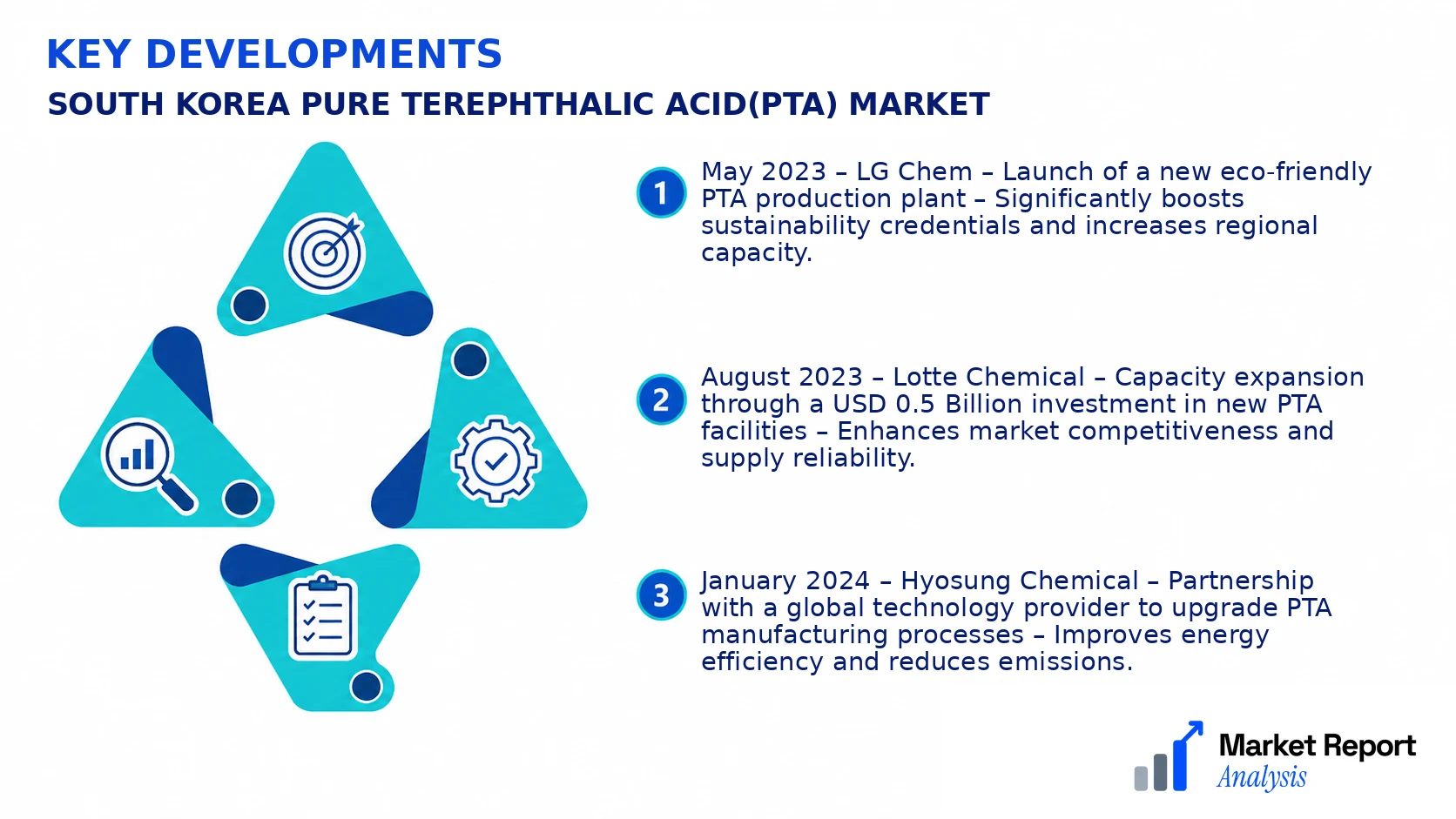
- May 2023 – LG Chem – Launch of a new eco-friendly PTA production plant – Significantly boosts sustainability credentials and increases regional capacity.
- August 2023 – Lotte Chemical – Capacity expansion through a USD 0.5 Billion investment in new PTA facilities – Enhances market competitiveness and supply reliability.
- January 2024 – Hyosung Chemical – Partnership with a global technology provider to upgrade PTA manufacturing processes – Improves energy efficiency and reduces emissions.
- April 2023 – SK Global Chemical – Acquisition of a smaller regional competitor to strengthen market share and diversify raw material sources – Supports growth and diversification strategy.
- September 2023 – Kumho Petrochemical – Launch of a new sustainable raw material initiative to reduce carbon footprint in PTA production – Aligns with governmental regulations and sustainability goals.
Frequently Asked Questions
What is the South Korea Pure Terephthalic Acid(Pta) Market?
The South Korea Pure Terephthalic Acid (PTA) market encompasses the production, distribution, and consumption of PTA used primarily in polyester fiber, PET resin, and film manufacturing. It is a critical component supporting South Korea’s textile, packaging, and automotive industries.
What is the current market size of South Korea Pure Terephthalic Acid(Pta) Market?
In 2026, South Korea’s PTA market is valued at approximately USD 2.5 Billion, reflecting robust domestic demand and advanced manufacturing capabilities. The market's resilience is supported by the country’s substantial polyester end-use sector and export-oriented production base.
What factors are driving the South Korea Pure Terephthalic Acid(Pta) Market?
Market growth is fueled by escalating demand for polyester-based textiles, increasing environmental regulations favoring recycled PET materials, and investments in sustainable production processes. Additionally, South Korea’s technological advancements and strong export logistics bolster market expansion.
Which South Korean city leads the South Korea Pure Terephthalic Acid(Pta) Market?
Seoul stands as the primary hub, benefiting from its advanced infrastructure, proximity to major chemical manufacturers, and strategic access to export ports. The city’s industrial zones play a pivotal role in PTA production and innovation.
Which segment is expected to grow the fastest?
The polyester fiber segment is anticipated to experience the fastest growth, driven by rising global demand for synthetic textiles and packaging materials, coupled with domestic apparel and automotive sector expansion in South Korea.
Who are the leading companies operating in the South Korea Pure Terephthalic Acid(Pta) Market?
Key players include Lotte Chemical, SK Chemicals, and Hyosung Corporation, which focus on technological innovation, capacity expansion, and sustainable manufacturing practices to strengthen their market positions and meet the rising demand for PTA products.
Analyst Perspective
The South Korea Pure Terephthalic Acid (PTA) market is positioned for sustained growth, driven by expanding polyester fiber and PET resin applications, especially in Seoul and Ulsan, where manufacturing clusters are reinforced by regional infrastructure. Technological evolution toward more sustainable and energy-efficient PTA production methods is likely to reshape industry standards, reducing operational costs and environmental impact, thereby attracting new investments. Strategic priorities should include scaling up high-margin, low-carbon processes, alongside safeguarding supply chains amid geopolitical tensions. Competitive intensity will intensify as both legacy players and emerging entrants vie for market share, with innovations in catalyst and process efficiencies becoming crucial. City-level dynamics indicate Seoul’s premium market for high-quality PTA products, supported by advanced logistics and strong downstream demand, while Ulsan’s deep industrial ecosystem offers opportunities for bulk manufacturing and export-oriented strategies. Long-term, market maturity suggests a shift toward integrated, eco-friendly value chains, with companies that prioritize technological innovation and regional operational excellence gaining a competitive edge.
