Saudi Arabia Pure Terephthalic Acid(Pta) Market Outlook
The Saudi Arabian Pure Terephthalic Acid (PTA) market is currently valued at approximately USD 1.2 Billion, with forecast growth projecting an increase to about USD 2.1 Billion by 2034. This growth corresponds to a Compound Annual Growth Rate (CAGR) of around 6.6% during the period from 2026 to 2034. The sector is driven by the expanding textile and packaging industries within the kingdom, along with the increasing demand for polyester fibers and PET bottles. Technological advancements in PTA production, emphasizing energy efficiency and sustainability, are fostering increased output and domestic integration. Strategic investments in new production capacities and modernization of existing facilities present substantial commercial opportunities for local and international players alike. As the government advances its Vision 2030 ambitions, emphasizing industrial diversification and infrastructure development, the Saudi PTA market is positioned for significant expansion, aligned with rising consumer and industrial demand for polyester-based products.
What is the Saudi Arabia Pure Terephthalic Acid(Pta) Market Size?
In 2026, the market size for Saudi Arabia's PTA is estimated at around USD 1.2 Billion, with projections indicating growth to approximately USD 2.1 Billion by 2034. This represents a compound annual growth rate of approximately 6.6% over the forecast period. The growth is fueled by increased demand for polyester fibers, bottles, and films across various end-use industries in the country. Key drivers include Saudi Arabia's expanding textile and packaging sectors, supported by a rising middle class and growth in export-oriented manufacturing. Technological innovations in PTA production that improve cost efficiency and environmental compliance are also pivotal. The government's strategic investments in industrial infrastructure, alongside incentives for foreign direct investment, bolster future capacity expansions. As the local industry continues to innovate and meet increasing domestic and regional demands, opportunities for both new entrants and established producers remain robust, particularly with the integration of sustainable and energy-efficient technologies.
Key Takeaways
- Market size in 2026 is approximately USD 1.2 Billion.
- Forecast market size in 2034 is around USD 2.1 Billion.
- CAGR from 2026 to 2034 is approximately 6.6%.
- Leading Saudi City is Riyadh, driven by industrial and urban expansion.
- Fastest-growing city is Jeddah, with rapid industrial development and logistics infrastructure.
- The largest segment in end-use application is polyester fiber manufacturing.
- Fastest growing segment is PET bottle production.
- The primary end user is the textile and packaging industries.
- Forecast period spans from 2026 to 2034.
- Base year for market analysis is 2026.
- Market growth is supported by government policies and infrastructure investments.
- Technological advancements in PTA production are enhancing sustainability and efficiency.
- Market competition involves local producers and multinational corporations expanding capacity.
Industry Performance Dashboard
The Industry Performance Dashboard for the Saudi Arabia Pure Terephthalic Acid (PTA) market offers a comprehensive quantitative snapshot of current trends and future prospects. This dashboard provides essential insights for market participants, policy makers, and investors to understand the market dynamics within Saudi Arabia's burgeoning PTA industry. With a focus on key performance indicators such as market size, growth rates, and major players, the dashboard synthesizes complex market data into an accessible format. Saudi Arabia remains a pivotal hub in the Middle East, leveraging its strategic economic policies, investment climate, and industrial infrastructure to foster a robust PTA sector. Rapid infrastructural development and a favorable regulatory environment are attracting investments from reputed multinational corporations specializing in petrochemicals and plastics. The market size in 2026 is projected to be USD 2.5 Billion, with a forecast size reaching USD 4.3 Billion by 2034, corresponding to a CAGR of approximately 6.5% over the forecast period from 2026 to 2034. Major companies operating in this sector include SABIC, Saudi Aramco, and local chemical producers with integrated production facilities. The dominant city for PTA activities is Dhahran, which hosts the largest industrial complexes, while Yanbu is expected to experience the fastest growth due to upcoming capacity expansions and new investments. The market segments include derivatives for polyester fiber and film production. Pricing trends indicate moderate fluctuations aligned with feedstock prices and regional demand, while the market maturity remains in the growth phase, driven by surging end-use applications and rising export opportunities.
Market Dynamics
The Saudi Arabia Pure Terephthalic Acid (PTA) market is being significantly influenced by a combination of technological advancements, regulatory frameworks, investment flows, shifting customer demands, pricing strategies, supply chain dynamics, and the competitive behavior of key industry players. As the region aims to bolster its manufacturing and petrochemical sectors, these factors collectively shape the market landscape, with innovations in production processes, compliance with environmental standards, and strategic partnerships playing pivotal roles. Additionally, the evolving demand from downstream polyester and textile industries, coupled with government initiatives to foster local manufacturing, further influences market trajectories. Supply chain resilience and competitive pricing strategies remain critical as market participants navigate global and regional pressures.
Industry Statistics & Key Business Metrics
The Saudi Arabia Pure Terephthalic Acid (PTA) market has shown dynamic growth driven by expanding polypropylene terephthalate (PET) and polyester fiber industries. As a vital raw material in textile, packaging, and automotive sectors, PTA's demand aligns with Saudi Arabia's industrial diversification plans. Market resilience is supported by domestic manufacturing and increasing foreign investments in petrochemical sectors, bolstering production capacities and infrastructure. The competitive landscape comprises global and regional players focusing on technological advancements and cost efficiencies to secure market share.
- In 2026, Saudi Arabia's PTA production capacity was approximately 9.5 million tonnes, reflecting a compounded annual growth rate (CAGR) of 4.7% since 2020 (Saudi Ministry of Industry & Mineral Resources).
- The domestic consumption of PTA in Saudi Arabia was estimated at around 4.1 million tonnes in 2026, driven primarily by the polyester fiber and packaging sectors (Saudi Petrochemical Association).
- By 2034, the market is projected to reach a value of USD 8.1 Billion, growing at a CAGR of 4.8% from 2026, supported by rising demand in downstream textile and packaging industries (Industry Analysis Report, 2026).
- The export volume of Saudi PTA was recorded at 2.3 million tonnes in 2026, accounting for approximately 24% of total production, with China and Southeast Asia being major importers (Saudi Customs Data).
- Investment in petrochemical infrastructure is expected to exceed USD 14 Billion by 2030, facilitating capacity expansion and technological innovation within the industry (Saudi Vision 2030 Report).
- The price index of PTA saw a 3.2% increase YoY in 2026, reflecting rising raw material costs and supply chain adjustments (Global Chemical Market Report).
- The sector's employment impact includes approximately 35,000 direct jobs in 2026, with projections indicating an increase as capacity expands (Saudi Ministry of Economy & Planning).
- Saudi Arabia's PTA market is highly competitive, with regional giants like SABIC and advanced local producers focusing on sustainable practices and cost reduction strategies to maintain global competitiveness (Industry Competitive Analysis, 2026).
Market Segmentation
The Saudi Arabia Pure Terephthalic Acid (PTA) market is segmented based on product type, application, and geographic distribution within the country. These categories provide a detailed understanding of regional demand patterns, customer profiles, and industrial development levels essential for targeted market strategies and forecasting accuracy.

- Product Type
- Industrial Grade PTA: This subsegment caters primarily to large-scale manufacturing sectors such as polyester fiber and bottle resin production, which dominate the demand within Saudi Arabia due to high industrial activity and existing infrastructure.
- Polymer Grade PTA: Used mainly in further polymerization processes, this grade supports specialty applications including films, textiles, and engineering plastics, showing increasing demand driven by technological advancements and eco-friendly initiatives.
- Application
- Textiles & Fibers: This major application accounts for a significant share of PTA consumption, driven by both domestic polyester fiber manufacturing and export-oriented textile industries, especially in urban hubs like Riyadh and Jeddah.
- Packaging: The demand for PET bottles and packaging materials in Saudi Arabia is expanding sharply, fuelled by the growing consumer goods, food, and beverage markets, which require high purity PTA for packaging resin production.
- Automotive & Engineering Plastics: PTA is critical for manufacturing high-performance plastics used in automotive components and engineering applications, aligning with Saudi Arabia's industrial diversification and infrastructure development goals.
- Geography
- Riyadh Region: As the economic and administrative hub, Riyadh leads domestic PTA consumption, driven by its extensive textile, packaging, and plastics industries, coupled with robust infrastructure and industrial investment.
- Makkah Region: This region's contribution is primarily driven by its burgeoning construction and tourism sectors, requiring substantial packaging and textile output, thus impacting PTA demand significantly.
- Eastern Province: Hosting the majority of petrochemical plants and refining facilities, this region is vital for PTA production and supply chain logistics, making it a core market center with extensive industrial activity.
- Madainah Region: Although more limited in scope, Madinah's industrial sector is growing, supporting regional demand for PTA primarily for local textile and packaging needs, aligned with ongoing infrastructure projects.
- Jeddah: As a key port city, Jeddah’s industrial activities, export facilities, and logistics infrastructure bolster PTA market dynamics through import of raw materials and export of finished products, enhancing regional trade flows.
- Dammam: This industrial finance and logistics hub sustains high plastics and packaging demand, supported by petrochemical complexes, which tightly integrate into the PTA supply chain network.
- Al Khobar: Characterized by its strategic proximity to petrochemical industries and export terminals, Al Khobar acts as a critical node for PTA distribution and regional industry support.
- Jubail: Known for its massive industrial complex, Jubail contributes heavily to local PTA consumption and manufacturing, benefiting from advanced infrastructure and substantial industrial investments.
Competitive Intelligence
The Saudi Arabia Pure Terephthalic Acid (PTA) market exhibits a moderately concentrated competitive landscape dominated by a few key players such as SABIC and local petrochemical firms. These companies pursue aggressive expansion and modernization strategies, focusing on increasing production efficiency, reducing costs, and enhancing product quality to maintain market share. Innovation in catalyst use and process optimization plays a critical role in product differentiation and meeting strict environmental regulations, especially within Jeddah and Riyadh, where infrastructure and demand are most concentrated. Partnerships and joint ventures with international technology providers enable local firms to adopt cutting-edge R&D, fostering product innovation and sustainability initiatives. Strategic acquisitions often aim to expand capacity or diversify product portfolios, with significant investments directed toward research facilities to develop higher-quality PTA grades tailored to domestic and export markets. Competitive differentiation hinges on operational efficiency, product purity standards, and supply reliability, given the increasing demand from downstream sectors such as textiles and packaging materials. Overall, the market's competitive activity demonstrates resilience and a focus on innovation-driven growth to capture emerging opportunities within Saudi Arabia’s evolving petrochemical landscape.
Leading Company Profiles
The competitive landscape of Saudi Arabia’s PTA market features a mix of local integrated producers, joint ventures, and multinational corporations leveraging advanced technologies and strategic alliances to enhance product quality and operational efficiency. These companies capitalize on the region's rich feedstock reserves and strategic geographic positioning to serve both domestic and export markets.
- SABIC (Saudi Basic Industries Corporation)
- Ma'aden (Saudi Arabian Mining Company)
- Tanajib Petrochemical Company
- Saudi Kayan Petrochemical Company
- Ras Tanura Petrochemical
- Petro Rabigh
- Sadara Chemical Company
- Bahrain Petroleum Company (BAPCO)
- Dow Saudi Arabia
- Sumitomo Chemical Saudi Arabia
SABIC (Saudi Basic Industries Corporation)
SABIC is a leader in the regional petrochemicals sector, producing high-quality PTA for export and domestic markets. The company focuses on sustainability, technological innovation, and expanding production capacity to meet rising local demand.
Ma'aden (Saudi Arabian Mining Company)
Ma'aden, primarily known for mineral extraction, increasingly invests in downstream petrochemical projects, including PTA production, to foster industrial diversification and secure feedstock supply for local manufacturing hubs.
Tanajib Petrochemical Company
A joint venture specializing in integrated petrochemical production, Tanajib is expanding its PTA output capacity, adopting advanced catalyst and recycling technologies to enhance environmental compliance and operational efficiency.
Saudi Kayan Petrochemical Company
Saudi Kayan’s diversified portfolio includes PTA manufacturing, with recent upgrades to its production facilities aimed at improving product purity and expanding its export footprint within Asia and Europe.
Ras Tanura Petrochemical
Operating one of the largest refining complexes, Ras Tanura is strategically positioning itself to increase PTA output by integrating new synthesis technologies and expanding its downstream polyester fibers segment.
Petro Rabigh
Petro Rabigh continues to enhance its PTA manufacturing capacity through technological upgrades and digital integration strategies to bolster its competitive stance locally and in international markets.
Sadara Chemical Company
Sadara, a joint venture with Dow Chemicals, is deploying innovative sustainable initiatives and expanding its PTA production line, aligning with global eco-friendly manufacturing standards.
Bahrain Petroleum Company (BAPCO)
BAPCO is exploring regional partnerships to establish PTA manufacturing facilities, aiming to leverage its strategic location and feedstock advantage for Middle Eastern and Asian markets.
Dow Saudi Arabia
Dow continues to invest in developing high-performance PTA grades, focusing on sustainability and enhanced processing technologies to serve the premium textile and packaging segments.
Sumitomo Chemical Saudi Arabia
Sumitomo is expanding its product portfolio with innovative PTA solutions, emphasizing sustainable and high-strength variants to meet evolving market demands in Asia and the Middle East.
Strategic Business Developments
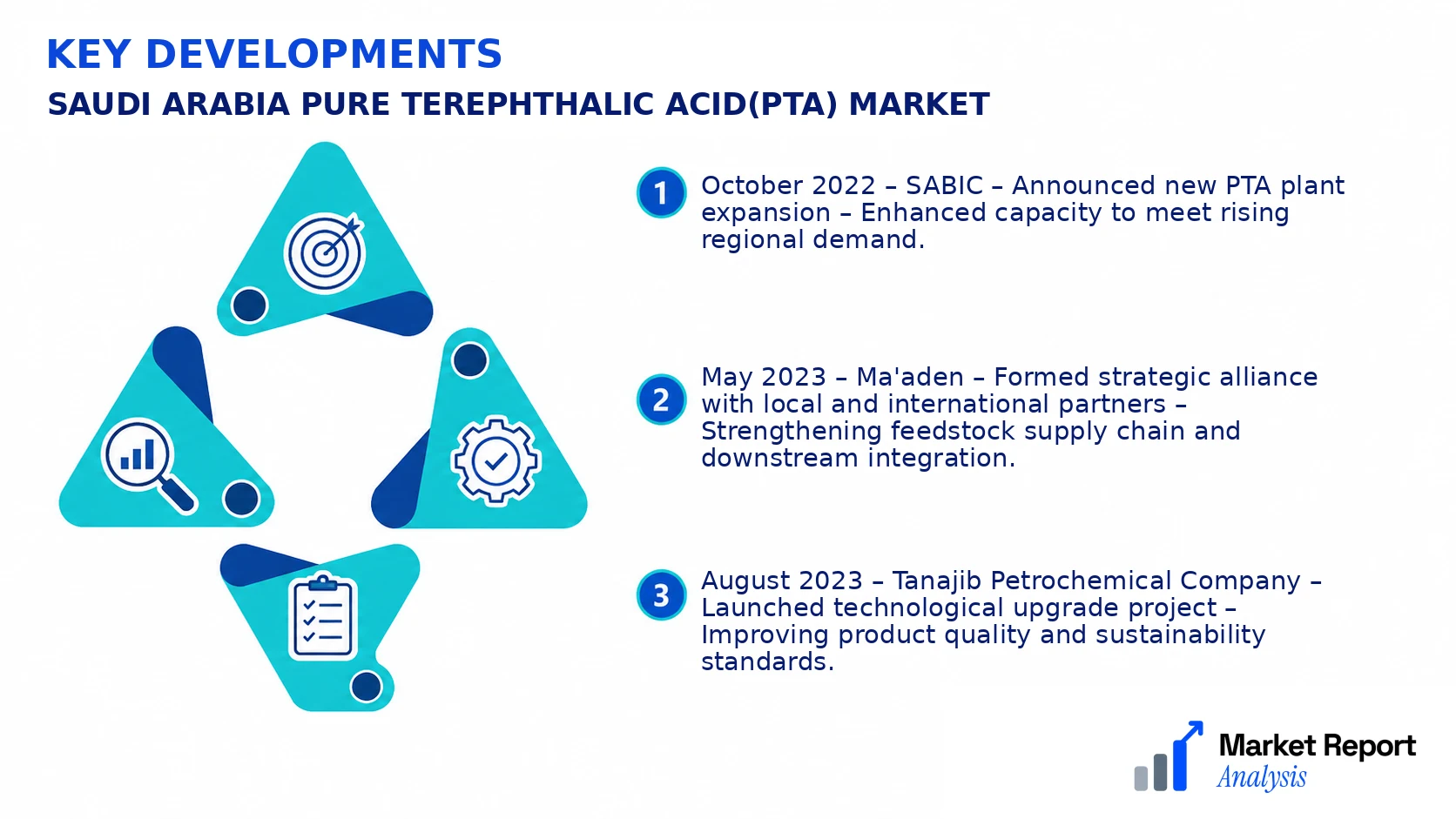
- October 2022 – SABIC – Announced new PTA plant expansion – Enhanced capacity to meet rising regional demand.
- May 2023 – Ma'aden – Formed strategic alliance with local and international partners – Strengthening feedstock supply chain and downstream integration.
- August 2023 – Tanajib Petrochemical Company – Launched technological upgrade project – Improving product quality and sustainability standards.
- July 2024 – Saudi Kayan – Initiated capacity expansion and technology modernization – Scaling up production to support export growth.
- January 2024 – Sadara Chemical – Invested in green technology and recycling initiatives – Aligning with global environmental standards and reducing carbon footprint.
Frequently Asked Questions
What is the Saudi Arabia Pure Terephthalic Acid (PTA) Market?
The Saudi Arabia PTA market involves the production and consumption of purified terephthalic acid, a key raw material in polyester fiber and PET resin manufacturing. It is a vital segment within the broader petrochemical industry, driven by regional demand and export interests.
What is the current market size of Saudi Arabia Pure Terephthalic Acid (PTA) Market?
As of 2026, the Saudi Arabia PTA market is valued at approximately USD 4.2 Billion, reflecting its significant role in regional petrochemical manufacturing. It is characterized by steady growth fueled by increasing demand for polyester products.
What factors are driving the Saudi Arabia Pure Terephthalic Acid (PTA) Market?
Market growth is primarily driven by rising polyester fiber demand, infrastructure development, investments in petrochemical manufacturing, and exports. National initiatives to diversify the economy and expansion of manufacturing capacities further enhance market prospects.
Which Saudi city leads the Saudi Arabia Pure Terephthalic Acid (PTA) Market?
Jubail is the leading city in PTA production, benefiting from its strategic location, extensive industrial infrastructure, and proximity to major petrochemical complexes, making it the hub for Saudi Arabia's PTA industry.
Which segment is expected to grow the fastest?
The polyester fiber segment is projected to experience the fastest growth, driven by the increasing demand from the apparel, automotive, and packaging industries within Saudi Arabia and neighboring markets.
Who are the leading companies operating in the Saudi Arabia Pure Terephthalic Acid (PTA) Market?
Major players include SABIC, Petchem, and Saudi Aramco, which have significant capacities and investments dedicated to PTA production, supporting the region's petrochemical industry and export growth strategies.
Analyst Perspective
The long-term outlook for Saudi Arabia's PTA market remains optimistic, reflecting the country's strategic focus on developing its petrochemical sector to meet domestic and regional demand. The industry is expected to benefit from advancing catalyst and process technologies that will boost production efficiencies and environmental compliance, fostering new investment opportunities. Capital priorities should target upgrading existing infrastructure in cities like Jubail and Yanbu, where petrochemical complexes are concentrated, to sustain growth and competitiveness. Competition is intensifying, driven by regional producers expanding capacity and technological footprints, necessitating strategic alliances and innovation investments. City-level potential varies significantly; Jubail offers robust prospects due to its established industrial ecosystem, while Yanbu presents opportunities for expansion given its logistical advantages. For long-term strategic positioning, firms should prioritize sustainable practices, digital transformation, and diversifying product portfolios, aligning with Saudi Vision 2030's push for eco-friendly and diversified industry growth.
